INTRODUCTION
Many animal species have evolved sophisticated morphological, physiological and behavioural adaptations to avoid succumbing to predation (Edmunds, 1974; Bertram, 1978; Elgar, 1989; Kavaliers and Choleris, 2001; Curio, 1993; Caro et al. 2004; Scott, 2005). These adaptations either reduce the probability of an attack (e.g. mimicry, crypsis and aposematic coloration), or lessen its chance of success (e.g. chemical defences, morphological weapons) (Magurran, 1999; Morin, 2003). The selective landscape in which parasites of animals evolve in response to predation pressures displays noticeable particularities. While virtually all free-living organisms (except mature top consumers) have predators, very few parasite species are directly concerned by predation, at least once inside their host (Combes, 2001). Rather, they inherit the predators of their host (Thomas et al. 2002a). This particular ecological context has in return favoured the emergence of original adaptive responses.
Hairworms, Dufour (Nematomorpha: Gordiida), typically develop in terrestrial arthropods, growing from a microscopic larva to a large worm that occupies most of the host cavity (Schmidt-Rhaesa, 1997, 2001). Once they reach this stage, hairworms emerge from their hosts and because adult males and females are free-living in aquatic environments, mature hairworms alter the behaviour of the insect host making them seek out and jump into water (Thomas et al. 2002b, 2003). That is, hairworms induce the suicide of their hosts. Once the host is in the water the adult worms then actively emerge, this takes from several seconds to several minutes (Thomas et al. 2002b). Once emerged the individuals begin searching for sexual partners (Thomas et al. 2002b). This emergence step is a critical period for the parasite with regard to predation risks, a time during which the writhing parasitized insect at the water surface is both attractive and highly vulnerable to a predator like a fish or a frog. Nevertheless, hairworms display a remarkable ability to escape from the digestive tract of predators following the predation of their host; they emerge alive from the mouth, gills or nose of the predators of their cricket hosts (Ponton et al. 2006).
The aim of this paper was to explore the physiological mechanisms underlying this anti-predator response of hairworms. For this, we studied the proteomics response of worms able to escape from the gills or from the mouth of a fish predator. The study of the proteome with two key technologies of proteomics, two-dimensional gel electrophoresis (2-DE) and mass spectrometry (MALDI-TOF), can provide a rapid and comprehensive view of the expression of entire genomes (Biron et al. 2005a). By permitting the study of the parasite proteome in action during the escaping behaviour, proteomics therefore offers, a priori, an excellent tool to understand the physiological basis of this anti-predator response. In a second step, to investigate whether the energy spent by the hairworm when exiting the predator is traded against reproductive effort, we studied the offspring number produced by pairs made with individuals having, or not, performed this behaviour.
MATERIALS AND METHODS
Data collection
We used as a model one of the most common insect-hairworm systems of Southern France, that is the cricket Nemobius sylvestris, Bosc (Orthoptera: Gryllidae), parasitized by the hairworm, Paragordius tricuspidatus. Nemobius sylvestris infected by P. tricuspidatus were captured at night in July 2004 as described by Ponton et al. (2006). Infected crickets were captured just before they jumped into water. To avoid the possible confounding effects on the proteomics expression of multiple infections and/or parasite-sex specific factors, only male hairworms singly infecting a male insect host were used for 2-DE.
The predator used for predation experiments was the fish Micropterus salmoïdes, a common predator species in the river and lakes from southern France, easy to maintain at the laboratory. Previous tests revealed that about 25% of worms are able to exit this predator (Ponton et al. 2006). Four M. salmoïdes (body length 15–25 cm) were caught with a lure from the wild 2 weeks before the experiment. They were maintained in the Station Méditerranéenne de l'Environnement Littoral (Sète) in a large tank containing 6 m3 of constantly aerated freshwater and fed with uninfected N. sylvestris.
Experimental protocol
Predation experiments were performed as described by Ponton et al. (2006). In all cases hairworms that were able to escape from the predator did so within 10 min following the ingestion of the infected cricket. These worms were immediately retrieved after their exit from the fish. The first category comprised worms able to escape the digestive tract of fish by the mouth or the gill (Ingested – Escaped, I-E). A second category was worms having emerged normally from their insect host (Not Ingested – Non-Stressed, NI-NS). For this, infected crickets were placed in a tank of fresh water until the emergence of the worm. These NI-NS were maintained in freshwater and allowed to swim for 5 min before being preserved. Considering that being the victim of predation constitutes a stressful event for worms, we might expect the expression of several protein spots typically linked to general stress responses in the proteome of predated worms. In an attempt to control for this effect, we placed worms that had just emerged in another kind of stressful environment, a draining habitat since in natural conditions this represents a hostile and potentially lethal environment (Non Ingested – Stressed, NI-S). To simulate the draining of the habitat, hairworms were laid into a thin water layer on a table for 5 min. Finally, the fourth category comprised worms that did not succeed in exiting the fish predator. These worms (Ingested – Non-Escaped, I-NE) were retrieved by gastric tubing 20 min after the ingestion of the parasitized cricket. For each category, hairworms were immediately frozen in liquid nitrogen during the retrieval process and then conserved at −80 °C.
Two-dimensional gel electrophoresis (2-DE)
For the 4 categories, 5 hairworms were cut into fine equal pieces on an ice bath and under sterile conditions. Following Biron et al. (2005b), each sample was rinsed 4 times in a Tris-HCl (10 mM, pH 7·4) solution. Then water soluble and especially constitutive proteins were extracted in a homogenizing solution (urea 15M, Tris-HCl 10 mM, pH 7·4, 5% (v/v) β-mercaptoethanol, ampholytes 2%, pH 3–10) as described by Biron et al. (2005b). Protein concentration was estimated (Bradford, 1976) then standardized at 2 μg/μl (Biron et al. 2005b). The protein samples were stored at −80 °C prior to electrophoresis separation on 2-DE. The two dimensional gels were done following the protocol of Biron et al. (2005a). At least 4 IPG strips (ImmobilineTM, DryStrip gels; Bio-Rad, USA) of pH 3–10 were run per treatment. Gels were stained using tetrathionate-silver nitrate (Oakley et al. 1980; Rabilloud et al. 1994).
Computer analyses
At least 3 well-replicated 2-DE gels were preserved and used for computer analyses of the various hairworm categories described above. Replicated gels for the same treatment were compared using ImageMasterTM 2D Platinum Software Version 5.0 (Amersham Biosciences, UK; GENEBIO, Switzerland), common protein spots observed at least on 2 replica gels were retained. The best gel obtained for each category was then used to build a 2-D master gel showing the differential expression of the hairworm proteome between the 4 categories. Spots differentially expressed between the 4 categories should reflect more the variability inter-category than the variability intra-category (Tastet et al. 1999; Francis et al. 2006). The isoelectric-point (pI) and molecular weight (Mw) scales of 2-DE gels were determined using a protein standard kit from Bio-Rad (USA). Crowded protein spot areas and areas containing high molecular weight protein spots were not well defined and thus discarded from the analysis.
Protein identification by MALDI-TOF mass spectrometry
Once initial analyses suggested protein spots of interest, new gels were run and silver stained following the method described by Schevchenko et al. (1996) in order to excise candidate protein spots. Identification of proteins, peptide digestion and MALDI-TOF analysis were done following the protocol of Biron et al. (2005c). Protein identification was obtained by conducting a database search of the peptide mass generated from MALDI analysis. Identification of proteins was performed using ALDENTE (http://www.expasy.org/tools/aldente) and PROTEIN PROSPECTOR MS-FIT (http://prospector.ucsf.edu) software. Monoisotopic peak lists were imported into ALDENTE and PROTEIN PROSPECTOR MS-FIT software with the following search parameters: OTHER METAZOA in the species field, pI±2·0, Mw±30%, one missing cleavage, tryptic digestion, carbamidomethylation as a cysteine modification and oxidation of methionine (Wilkins and Williams, 1997; Barrett et al. 2005). Based on cross-species concepts for the protein identification, we did a parsimony search by taking into consideration closest Nematomorpha taxa (Wilkins and Williams, 1997; Lester and Hubbard, 2002; Barrett et al. 2005; Gasteiger et al. 2005). Actually, given the poor number of protein sequences in Nematomorpha, we consider valid results given proteins belonging to Nematoda taxa as it is considered as the Nematomorpha closest phylogenetic group (Hanelt et al. 2005). Search tolerance was set at 100 ppm with a MH+ charge state. Proteins that were retained had: the highest score, the higher significant ‘P-value’ (P<0·05, i.e. the probability that observed match is a random event), a minimum of missed cleavages, a minimum of Δppm between the molecular mass of the experimental peptides and the corresponding theoretical peptides, a theoretical pI/Mw close to the experimental pI/Mw (Wilkins and Williams, 1997; Lester and Hubbard, 2002; Barrett et al. 2005; Gasteiger et al. 2005). Matching peptides with missed cleavages were considered as relevant only when there were 2 consecutive basic residues or when arginine and lysine residues were followed by a proline or acidic residues inside the peptide amino acid sequence (Bécamel et al. 2002; Gasteiger et al. 2005).
Hairworm crossing
In order to investigate the reproductive potential of hairworms following predation, we estimated the offspring number produced by pairs made with individuals having accomplished the escape behaviour (I-E) and hairworms that were not predated (NI-NS). Again only hairworms, singly infecting a male insect host, were considered. By randomly choosing male and female hairworms, 4 kinds of pairs were made: [male ]NI-NS×[female]NI-NS (n=11), [male ]NI-NS×[female]I-E (n=15), [male ]I-E×[female]NI-NS (n=22), and [male ]I-E×[female]I-E (n=15). Length measurements revealed that there was no significant size difference between individuals from the different kind of pairs (mean±S.E.: [male ]NI-NS: 11·12±0·34 (n=11)×[female]NI-NS: 11·60±0·36 (n=11), [male ]NI-NS: 10·30±0·29 (n=15)×[female]I-E: 11·75±0·31 (n=15), [male ]I-E: 10·98±0·25 (n=21)×[female]NI-NS: 11·55±0·26 (n=22), and [male ]I-E: 10·73±0·29 (n=15)×[female]I-E: 11·58±0·31 (n=15); males: Kruskal-Wallis H3=5·31, P=0·15; females: Kruskal-Wallis H3=0·47, P=0·93). Pairs were maintained individually in small cups (diameter, 2 cm; height, 5 cm) filled with constantly oxygenated freshwater and under 22±1 °C and a LD 12[ratio ]12 cycle. Males were removed after mating (4 days after pair formation). Females were kept in the cups and these were examined daily to determine the delay required for a complete larval hatching. We added ethanol 70% in all cups 52 days after mating to kill the worms and larvae, since by then the large majority of the larvae had successfully hatched. Larval counting was done under a microscope (Leica DM LB) with a Thoma chamber. For each reproductive pair, larval concentration was determined in 30 ml of ethanol 70%. Prior testing ensured that 12 sample cups were sufficient to obtain a reliable estimation of the larval quantity. Concentration was determined by randomly choosing tubes from the different categories.
RESULTS
Analysis of 2D gels
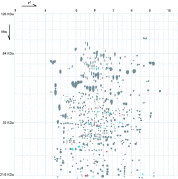
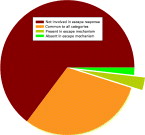
Our results demonstrated a differential expression of specific proteins in the proteome of worms able to escape. Fig. 1 shows the differential expression of the hairworm proteome in the different categories. A total of 553 protein spots was detected, 358 of them (i.e. 64·74%, see Figs 1 and 2) being common between the 4 categories. We considered that a protein spot was likely to be linked to the predator escape behaviour when it was either present or absent specifically in the Ingested-Escaped category. Applying this criterion, 4·88% of the total of protein spots (i.e. 17 present and 10 absent) were considered as linked to the escaping behaviour (see Figs 1 and 2).

Fig. 1. Two-dimensional synthetic gel of Paragordius tricuspidatus showing proteome response to the ‘escape behaviour’ (worms Ingested – Escaped).Common and non-specific protein spots,Proteins specifically induced on the proteome of Ingested-Escaped worms,Proteins specifically suppressed on the proteome of Ingested-Escaped worms.

Fig. 2. Percentages of protein spots from the synthetic gel classified in 3 categories: (i) common proteins (ii) proteins not involved in escape mechanisms (iii) proteins involved in escape mechanisms (detected during the phenomenon (present), not detected during the phenomenon (absent)).
Identification of candidate proteins
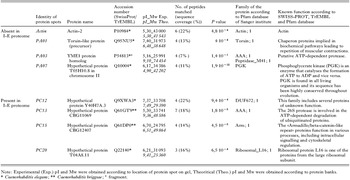
PMF analyses were performed on the 27 protein spots probably linked to the escaping behaviour. Good PMF were obtained for the 27 candidate protein spots (see Electronic Supplementary Material S1). Since actin is highly conserved (Sheterline et al. 1996) it is thus a nice positive control to evaluate the MALDI-TOF protocol used in our experiment. Searches in SwissProt and TrEMBL protein databases confirmed that the control protein spot belongs to the Actin family (Table 1 and Electronic Supplementary Material S1). For the candidate protein spots, we identified 7 with PMF (see Table 1). Three protein spots, specifically absent from the proteome of Ingested-Escaped hairworm category, were identified as (i) a torsin-like protein precursor, (ii) an ATP-dependent protease and (iii) an enzyme belonging to the phosphoglycerate kinase (see Table 1). In addition, 3 proteins specifically present in the Ingested-Escaped category were identified as (i) a protease involved in the ATP-dependent degradation of ubiquitinated proteins, (ii) a protein intervening in intracellular signalling and cytoskeletal regulation and (iii) a protein constitutive of the large ribosomal subunit (see Table 1). A final induced protein was identified as belonging to the DUF672;1 family but its function is unknown.

Reproductive output
There was no significant difference between the mean number of larvae produced by the different kinds of pairs (mean number of larvae±S.E.: [male ]NI-NS×[female]NI-NS (n=11), 41590·9±17595; [male ]NI-NS×[female]I-E (n=15), 35916·7±15068; [male ]I-E×[female]NI-NS (n=22), 61215·2±12442 and [male ]I-E×[female]I-E (n=15), 49661·1±15068; Kruskal-Wallis ANOVA, χ2=1·70, D.F.=3, P=0·64). Given the high P-value and moderately large sample sizes, we conclude that no difference in fecundity exists between the categories. Because the data were non-normally distributed and we used non-parametric tests then a Power analysis was inappropriate (David Nash, personal communication).
DISCUSSION
Gordian worms have evolved a novel and simple solution to predation of their host: they crawl out from the digestive tract of the predator. Achieving this remarkable feat relies upon both their fusiform morphology and evolved adaptations to the harsh environment of the digestive tract. Not only can these worms survive a predation event but they apparently reproduce afterwards without any reduction of reproductive potential.
Our data has shown that this behaviour coincides with particular physiological mechanisms detectable with proteomics tools. We identified 27 proteins whose expression was specifically altered in the proteome of worms able to exit the predator. Identification of candidate proteins indicates a modification of the muscular activity since some of the identified torsin-like proteins are involved in repetitive muscle contractions and twisted postures (Breakefield et al. 2001). Additionally, proteins probably involved in intracellular signalling and cytoskeletal regulation were observed. A modified ATP synthesis also appears to occur and may facilitate escape. Using our approach we did not detect biological signatures of toxic component synthesis that might serve to elicit a vomit response by the predator. This could argue that worms use a simpler anti-predator strategy that involves active self-propelled exit from the hostile environment of the vertebrate gut.
Although this study only focused on physiological aspects detectable with proteomics tools, it seems likely that the efficiency of the escaping behaviour results from the synergistic action between the intense muscular activity and the filiform morphology of hairworms coupled with the rigidity of their cuticle (Protasoni et al. 2003; Schmidt-Rhaesa, 2003). The filiform morphology probably enhances mobility under conditions such as those within the vertebrate gut. The rigidity, and unique arrangement of the cuticle, probably also protect hairworms from mechanical and chemical attacks during escape. Further studies would be necessary to determine the stimuli that induce the escape behaviour in worms once inside the predator. Acidic pH levels, digestive enzymes and/or mechanical constraints could be included in the factors which signal to the worm the urgency of displaying such an anti-predator response.
Life-history theory predicts that anti-predator behaviour should have a cost that is traded off against other components of fitness (Stearns, 1992; West-Eberhard, 2003). The general problem of searching for such trade-offs involving anti-predation behaviour has recently be raised and centred on the potential compensation by prey following predator avoidance (Lind and Cresswell, 2005). Clearly, no study has demonstrated an ability to escape the gut following ingestion so determining, a priori, what possible costs are involved is difficult. For this reason no study has measured the fecundity of an organism after it survived ingestion by a predator. Remarkably, we found no significant difference between the mean numbers of larvae produced by the different kinds of pairs. At least in our experimental approach, predation did not have a negative effect on reproductive output. Of course this absence of evidence is not evidence for absence taking into account our sample size but seems to indicate that worms do not suffer a negative effect on their reproductive output when they escape from a predator. Further research is necessary to clarify the cost of the escaping behaviour for worms, since we did not measure the performances of the different kinds of worms in the other steps of the reproductive process. For instance, it could be possible that worms having experienced a predation event subsequently have a reduced survival and/or swimming activity making them less able to find a sexual partner. In addition, further studies would be necessary to determine the frequency of this anti-predator response in natural populations in relationship with the local frequency/ identity of predators.
In conclusion, it is safe to say that the unique behaviour of hairworms following a predation event upon their host predator is an impressive phenomenon. An intense muscular activity seems to be the main physiological process underlying this anti-predator response.
We thank Nathalie Galéotti and Emmanuelle Demey-Thomas from the proteomics platform of Montpellier Génopôle® for their help concerning the mass spectrometry analysis. We thank Mr F. Bonhomme (Station Méditerranéenne de l'Environnement Littoral, Sète), Mr J. L. Lafaurie and the thermal station of Avènes-Les-Bains for their cooperation during the field study. We thank David Nash for statistical advice. This work was supported by la région Languedoc-Roussillon and by an ACI ‘jeunes chercheurs’ grant to F. Thomas. The experiments comply with the current laws of the country in which they were performed.