Introduction
Circa 2009–2011, social media platforms like Twitter and Facebook were celebrated as “liberation technology”Footnote 2 that would facilitate mass mobilization against authoritarian regimes of the Middle East and North Africa (MENA). After the 2009 Iranian election protests and subsequently the so-called Arab Spring earned the moniker “Twitter revolutions,” numerous studies have sought to articulate how exactly social media facilitated the coordination of contentious political action across MENA, even in the face of brutal repression.Footnote 3 After this initial wave of euphoria, however, examination of the cumulative impact of day-to-day social media usage has highlighted the potential for online communities to develop homophilic “echo chambers,” accelerating ideological or sectarian polarization in societies.Footnote 4 Social media, it was realized, has a darker side. Thus far, however, even these identified vices of social media in the MENA region have at least enjoyed the redeeming quality of being “organic” or in some sense “self-inflicted.”
Unfortunately, mounting evidence now suggests that authoritarian governments are exploiting social media to further social control. From their initially censorial, defensive, and reactive posture during the “Arab Spring,” regimes in the Middle East and North Africa – particularly the wealthy Gulf monarchies – have now gone on the offensive, exploiting Twitter and other forms of social media as vectors for political propaganda by which to manufacture the perception of support for themselves and their policies while dividing and discouraging their opposition.Footnote 5
The events of the intra-GCC crisis and major social changes in Saudi Arabia present ideal grounds to explore online communication and manipulation in the region. Internet and social-media penetration for the Gulf countries are among the highest in the world, while the widespread use of externally based social-media platforms forces governments to rely on less direct methods of influencing online narratives. By examining the strategies employed by identifiable state elites and institutions within one Gulf country – Saudi Arabia – and providing evidence of these strategies’ ability to warp online discourse to regimes’ advantage, this essay encourages greater consideration of the ways in which new media technologies empower not only activists and opposition movements, but also authoritarian rulers themselves. Political leaders also retain significant agency in choosing which online strategies to deploy. As Geoff Martin notes in this Special Focus, state actors in Kuwait – likely incentivized by their country's democratic institutions – concentrate their online efforts on soliciting citizens’ complaints in order to gain an accurate read on public opinion and address grievances. In examining Twitter discourse linked to Saudi Arabia, however, we find considerable suggestive evidence that dedicated institutions within ruling regimes can generate or drown out specific online narratives – particularly through the mass deployment of automated, inauthentic accounts (“bots”), and the outsized influence of certain authentic, pro-regime “influencer” accounts.
Liberating What?
Social media platforms like Twitter, Facebook, and their peers and predecessors have facilitated new means of communication and organization over the past decade and a half. Users can post thoughts, article links, creative content, and event information to other personal accounts or online groups, potentially building new communities or developing common knowledge even in the face of governments opposed to independent civil society and the free flow of information. While much work has examined the potential (and potential limitations) of these new technologies in challenging durable authoritarianism, fewer studies have considered the advantages that may accrue to authoritarian regimes by keeping tabs on these shifting perceptions, or even actively molding online narratives.
While Gulf monarchies such as the UAE have the capacity to block Internet access to various online sites and services, they have not chosen to block access to platforms such as Twitter. They have instead sought to contain the disruptive potential of social media and repurpose it to their own ends, whether by mobilizing supporters in the face of demonstrations or by shaping official narratives in ways that “can more easily avoid the appearance of artifice.”Footnote 6 Research on China has produced some of the most detailed profiles of online censorship strategies, with Margaret Roberts documenting the Chinese government's deployment of the full “three F's” of censorship - striking fear into individual users through threats of offline sanctions, slowing the spread of critical information by generating higher friction in users’ efforts to access certain sites or posts, and flooding online platforms with distracting information or preferred narratives.Footnote 7 When social media serves as a yardstick for the prevailing views of “society” or other reference groups, these interventions can have the effect of encouraging citizens to believe that official statements or narratives enjoy widespread popular support due to the volume of perceived online engagement.Footnote 8
For many countries, however, the underlying architecture of digital platforms lies outside state control (as is the case with Twitter and most popular platforms outside of China); rulers are limited in their ability to regulate online interactions by denying access to specific narratives. Banning platforms outright, as Turkey has done periodically with Facebook and WhatsApp and Iran has done with Twitter and Facebook, eliminates the potential for social media posts to serve as an “advance warning system” for rulers to learn of and address grievances in piecemeal fashion to present the image – if not the reality – of government responsiveness.Footnote 9 While shutting down or blocking online platforms sends an undeniable signal of censorship that can generate protests of its own accord (the so-called “Streisand” effect), globalized cyber-intelligence firms such as NSO Group Technologies proffer a range of tools for governments to refashion online spaces to their own ends rather than silencing them outright.Footnote 10 Such technologies offer a viable “third way” for regimes to mitigate the liberating potential of the Internet generally, and social media specifically. Where access cannot feasibly be denied, nor controlled, it can be contested.Footnote 11
Twitter is an important platform for analysis of “networked authoritarianism” on both practical and theoretical grounds. The micro-blogging site is a major source of news and interaction that allows for the expression of a wide range of viewpoints and perspectives; only belatedly did the site begin to remove accounts affiliated with the extremist group Islamic State of Iraq and al-Sham (ISIS). Users post everything from commentary on the events of the day and links to relevant articles to cat photos, cutting across borders; the site has become a popular subject for political science research focusing on mobilization, opinion formation, and public opinion for subjects or populations that are hard to gauge with traditional polling methods.
In contrast to views of Twitter data as the equivalent of high-frequency polling of individual perspectives,Footnote 12 we follow commentators such as Kalev Leetaru in noting that Twitter conversations in general are often dominated by a limited number of elite “influencers,” and hypothesize that Twitter discourse is susceptible to the selective amplification of key topics under authoritarianism.Footnote 13 Here, state-led action (by some combination of real users and automated accounts) promotes a particular hashtag as a “trending topic” for the country in question or retweets posts by other accounts to make them seem more influential than they actually are. For example, Jones finds evidence that bots retweeted favorable remarks about Saudi Arabia by President Donald Trump during his visit to the Kingdom in May 2017.Footnote 14
Selective amplification affords most authoritarian governments the ability to influence, yet not fully control, narratives in the online public sphere. In this mixed strategy, tweeting by actual accounts – elite or otherwise – intermingles with bot efforts, making efforts at censorship and propaganda less readily apparent to users. Furthermore, while automated accounts may be useful in suppressing certain forms of speech through low-level harassment, without engagement by “real” users it is hard to see how particular narratives become entrenched in society.Footnote 15 This hinders efforts to foment “common knowledge” under autocracy “about who is in charge, and what their social goals are” – tweets by a thousand isolated bots are lost in the void rather than forming the basis for these shared expectations.Footnote 16
Rather than viewing social media as a boon to the powerful or the powerless alone, we argue that social media opens an arena of competition between rulers and potential opposition – otherwise, either no ruler would permit them or no user would ever offer a critical comment. Those in power benefit from new opportunities for surveillance and communication, albeit at a particular risk of citizens engaging in “subversive activities.”Footnote 17 It need not be a fair arena – regime success in promoting strategic narratives or subverting collective action is probable, even if opposition success in forcing government action is occasionally possible.
Social Media Campaigns and the GCC
The oil-rich monarchies of the Arabian Peninsula – members of the Gulf Cooperation Council, or GCC – provide an ideal venue to explore authoritarian rulers’ efforts to govern decentralized public spaces such as Twitter. These countries provide a paradigmatic example of what “networked authoritarianism” looks like beyond China,Footnote 18 governing some of the most highly networked populations in the world. Nearly half of survey respondents in Qatar, Saudi Arabia and the United Arab Emirates reported using Twitter accounts in 2017, with few respondents of any age category reporting no social-media use whatsoever.Footnote 19 Smart phones are ubiquitous across the Arab Gulf states, as are Snapchat accounts, Instagram handles, and official Twitter profiles for ministries and ministers alike.
There is also significant variation in popular narratives of how authorities have dealt with online speech. Qatari authorities, for example, have repeatedly backed away from fee hikes or cancelled Western-style concerts in the face of criticism on Twitter.Footnote 20 As a result, more upbeat narratives focus on the new opportunities afforded Gulf citizens to express dissent online; “Twitter for us is like a parliament,” one cheerful interviewee explained to the New York Times in 2012.Footnote 21 At the same time, other narratives have highlighted the potential for GCC rulers to hire or develop sophisticated tools for controlling social media usage. Stories of cyber-intrigue have emerged from the United Arab Emirates and other Gulf countries, ranging from expatriate employees jailed for social-media rants to the use of sophisticated, Western-developed spyware to track and target potential activists.Footnote 22 Crossing unspoken red-lines – typically deemed insulting to religion or to the monarchies’ ruling families – has often resulted in offline efforts at prosecution when Gulf citizens post online under their real identities, even in slightly more liberal Kuwait.Footnote 23
Evidence has also emerged of Gulf efforts that suggests systematic policing and shaping of online spheres. In pioneering work, Marc Owen Jones has documented how online bots have been programmed to accomplish a range of political tasks in Bahrain and elsewhere across the Arab Gulf. For example, in one incident around June 21, 2016, Jones documents how a Twitter conversation among Bahraini activists and opposition sympathizers was suddenly inundated with sectarian hate speech in a coordinated flooding attack by numerous bot accounts.Footnote 24 Wealthy Gulf governments can afford to purchase access to high-level surveillance and communications technologies, hiring Western technicians and cybersecurity firms to track the activities of political dissidents and manipulate social media posts in their own favor.Footnote 25
Saud al-Qahtani – Minister of Hacking
Saud al-Qahtani, formerly advisor to the Royal Court of Saudi Arabia and minister-rank General Supervisor of the Center for Studies and Media Affairs, was one of the most pronounced official Saudi voices on Twitter from the outset of the Gulf Crisis – and the figure most associated with social media manipulation. His rise to prominence was associated with the growing power and influence of Crown Prince Muhammad bin Salman, as Qahtani frequently joined MBS’ entourage in trips abroad over the past several years. A glowing account of MBS by Qahtani himself (he had worked at the Royal Court from 2004) places their first meeting in early 2015, shortly before King Salman appointed Qahtani to his minister-level rank within the Saudi Royal Court.Footnote 26
Unusually for a leader in the security sector of an authoritarian regime, Qahtani built and maintained a prominent public profile while working behind the scenes to shape online traffic. While Qahtani's Twitter profile included the disclaimer that @saudq1978 was a “personal account that does not represent official views,” he openly suggested that his online statements did reflect official policy. “I am an employee faithfully carrying out the orders of my lord the King and His Highness the Crown Prince,” he replied to one critic on Twitter, while at other times he tweeted out what appeared to be behind-the-scenes information on Saudi government spending.Footnote 27 A 2018 New York Times investigation established his role as the “strategist behind the operation” to “harass critics [of the Saudi government] on Twitter.”Footnote 28
Qahtani drove Twitter traffic directly by rallying online followers as any social media influencer might – “an aggressive field commander in cyberspace,” as a critical look at his activities described him.Footnote 29 Early in the Gulf Crisis, for example, he created a hashtag aimed at building a “black list” of Saudi citizens or other individuals in the Gulf who might sympathize with Qatar during the crisis, attracting researcher attention for the first time.Footnote 30 His aggressive stance during the early months of the crisis earned glowing reviews from Saudi columnists. “Saud's tweets defeated the lies of al-Jazeera and its journalists, to the point that any tweet from their broadcasters gets replied to with ‘Saud is coming for you!’.”Footnote 31
Evidence also suggests, however, that Qahtani and his employees developed or at least sought the capacity to shape online conversations. Email exchanges from 2012 to 2015 between him and the staff of Milan-based cyber-security and surveillance firm Hacking Team surfaced in leaked emails from the company, providing scattered references to efforts by Qahtani to secure the company's services on behalf of the Kingdom and his office within the Royal Court.Footnote 32 Prior to the Gulf crisis, Saudi journalist Turki al-Roqi accused Qahtani of building up an “army” of hackers and “hacking tools” for years to harass critical media outlets within the Kingdom.Footnote 33 Later, in August, another anonymous Twitter account with the name Tarikh wa Dhikriyat (History and Memories) tweeted out a series of screenshots purporting to show a user associated with Saud al-Qahtani's screenname and email address (saudq1978) requesting account-access and -creation tools on the website Hack Forums.Footnote 34 Subsequent analysis has conclusively linked contact information found in these leaks to Qahtani's social-media accounts.Footnote 35 Qahtani and his office certainly had access to sophisticated tools of social media analysis – he periodically disseminated reports on Twitter traffic in the region from the center he leads within the Royal Court, usually to substantiate claims of Qatari social-media manipulation.Footnote 36
While evidence supports the idea that Qahtani played a significant role in shaping online narratives, he was likely only the most public face of larger state efforts to monitor and censor social media. While Qahtani himself was dismissed from his position on October 22, 2019, amid fallout from the killing of Saudi columnist Jamal Khashoggi, suspicions of state-led manipulation have continued. Offline efforts at directing prominent individuals’ online commentary, as suggested by al-Roqi and other accounts of Saudi Arabia's media environment, might be hard to detect short of a strict party line being suddenly imposed on these individuals without warning.Footnote 37 Yet available information on Qahtani's activities supports, at a minimum, a high likelihood of social media manipulation on behalf of the Saudi government. Given this, we explore contentious social media conversations involving official Saudi narratives for evidence of interventions by digital elites or automated accounts.
The GCC Crisis
The Gulf Cooperation Council (GCC) crisis is an ongoing effort by Saudi Arabia, the United Arab Emirates, and Bahrain to oppose aspects of Qatari foreign policy, most notably its regional support for various Islamist movements (especially in the wake of the Arab Spring). Beginning in June 2017, these countries have closed their airspace to flights bound for Qatar while shuttering the country's sole land border (with Saudi Arabia).
The Gulf Crisis has seen no shortage of accusations that state agencies are intervening in online conversations to promote desired narratives and harass representatives of the other side. Saudi and Emirati commentators in both social and traditional media, for example, have repeatedly accused the Qatari government of a protracted anti-Saudi and anti-UAE media campaign, one waged (among other fronts) via social media accounts and hacking efforts.Footnote 38 The catch-all term for Qatar's electronic foot-soldiers in these accounts is khilaya ‘Azmi (“Azmi cells”), a reference to the purported role of Azmi Bishara – Palestinian intellectual, Qatar resident, and director of the Doha-based Arab Center for Research and Policy Studies – in directing the Qatari media campaigns. At the same time, Saudi officials and ordinary users have frequently tweeted out photos or statements mocking or demeaning Qatar and its rulers, often referencing Qatar's small size as a country or hyping anti-Qatar conspiracy.Footnote 39
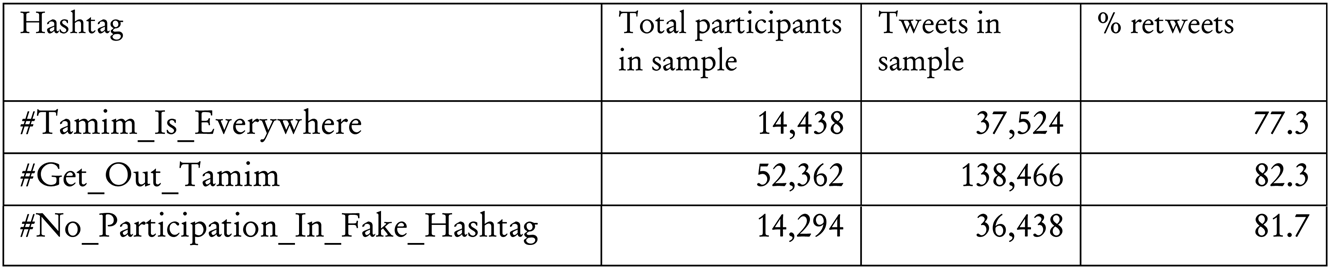
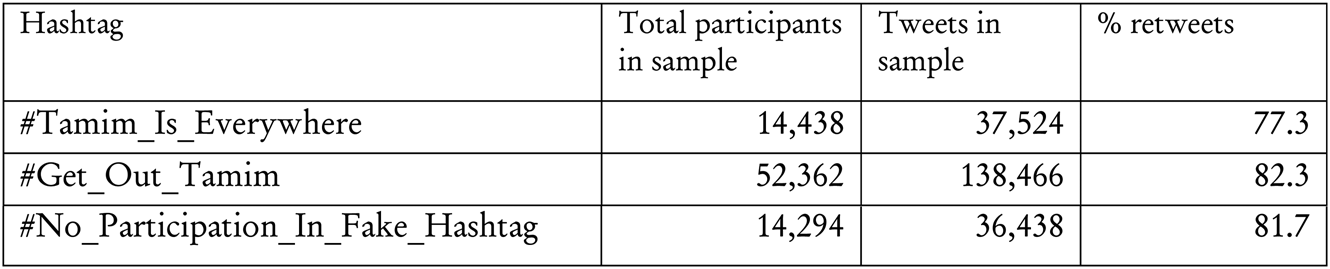
To test for the presence of social-media manipulation, we collected around 200,000 tweets related to a series of Twitter hashtag campaigns in August 2017 (Table in Figure 6 in the appendix). Among these tweets, we focus on a key set of “influencers” – those accounts that garnered the most retweets per hashtag campaign. These tweets included hashtag campaigns publicly championed by figures from Qatar and Saudi Arabia with participation from other Gulf-based influencers as well, with retweets making up 77–83 percent of overall tweets in each case. We further determined whether these accounts claimed a link to Saudi Arabia, Qatar, or other countries (e.g., “Qatar-linked”) through their self-reported location and national allegiance.Footnote 40
In judging whether any of these campaigns show signs of manipulation, we rely on two metrics. The first is the skew of a user's tweets – in other words, the degree to which retweets of a given user skewed toward the initial minutes and hours after they posted a given tweet. High skew of retweet patterns could indicate coordinated efforts to “signal-boost” particular tweets in order to raise their visibility both to other users and to Twitter's algorithms that identify popular tweets and “trending” topics.Footnote 41 Second, we identify a number of suspicious accounts by searching for statistically anomalous clustering of account metadata, including whether the account was deleted or suspended in the six months following initial data collection.Footnote 42
Data and Discussion
A spate of online activity from August 2017 provides circumstantial evidence of state intervention directly involving Saud al-Qahtani. In the afternoon of August 21, the hashtag Irhal Ya Tamim (“Get Out, Tamim!”) began to circulate among some Gulf-based Twitter accounts, with various Emirati and Saudi-aligned outlets suggesting this was an organic reaction to alleged efforts by the Qatari government to prevent Hajj pilgrims from travelling to Mecca.Footnote 43 Soon after, however, a competing hashtag – Tamim fi Kul Makan (“[Emir] Tamim is Everywhere”) - arose to counter this narrative, with mostly Qatar-linked users tweeting their support for the Emir and seeking to deny that there was significant political dissent within the country. A relatively small number of users accounted for most Twitter traffic related to the hashtags, as more than three-quarters of tweets including each hashtag were retweets of original posts (Appendix, Figure 6).
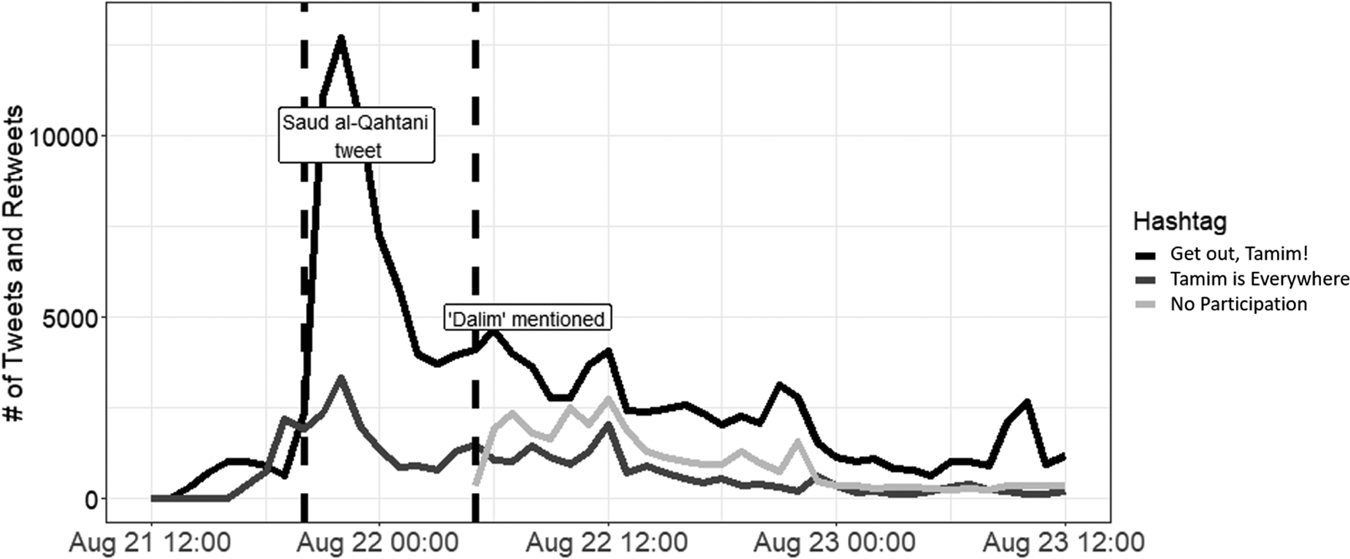
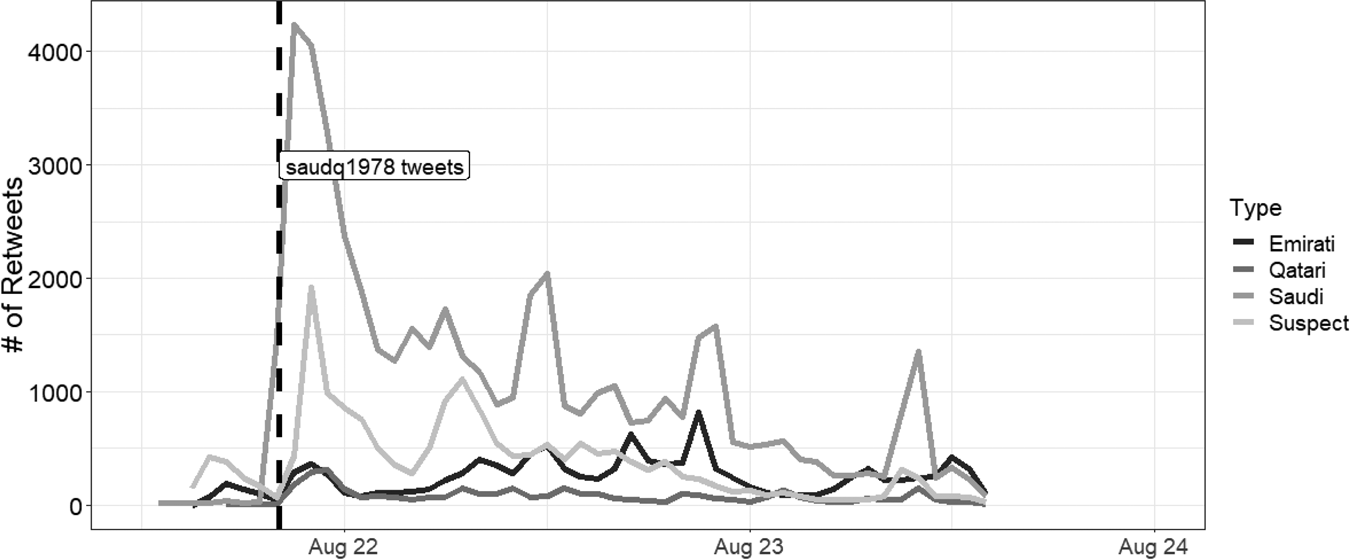
Qahtani made a single yet seemingly influential intervention into this conversation at around 11:00pm Riyadh time [see Figure 1]. In a single Twitter thread, he claimed that “Get Out, Tamim!” was a “trending topic” inside Qatar – indicating widespread activity on the hashtag within the country – citing a screenshot of Twitter's own list of “trending topics” in Qatar to make this claim.Footnote 44
Tweets and retweets related to the “Get Out, Tamim!” “Tamim is Everywhere,” and “I won't participate” hashtag campaigns, with key interventions marked.

This intervention was followed by a dramatic spike in activity on the hashtag, from fewer than 1000 tweets on the hashtag in the hour before his tweet to over 10,000 in the hour after. In addition (as shown in Figure 4 in the appendix), much of the activity after Qahtani's intervention was driven by Saudi influencer accounts and the retweets they gathered – the few self-professed Qatari accounts influencing the hashtag (many claiming to live abroad) likewise only appear after this intervention. This burst of activity is highly suspicious, providing evidence in favor of coordinated action (automated or otherwise) to drive activity around this hashtag. As Figure 1 demonstrates, “Tamim is Everywhere” had eclipsed “Get Out, Tamim!” at the time of Qahtani's intervention – especially among Qatar-linked accounts – suggesting the screenshot he included was outdated or otherwise doctored.
While Qahtani was no doubt able to drive traffic organically as a social media “influencer” with hundreds of thousands of followers, a comparison with the “leader” of yet another hashtag campaign suggests a degree of offline coordination to manipulate social media discourse. La Musharikah Fih Hashtaq Mashbuha (“No Participation in a Suspicious Hashtag”) was begun by Muhammad al-Kuwari, a technology commentator and media columnist who pointed out Qahtani's intervention and sought to re-establish control over Qatar's perceived “digital space.”Footnote 45 His call to get the alternative hashtag trending on Qatari Twitter generated a significant amount of traffic (see Figure 1), though not quite enough to eclipse “Get Out, Tamim!”
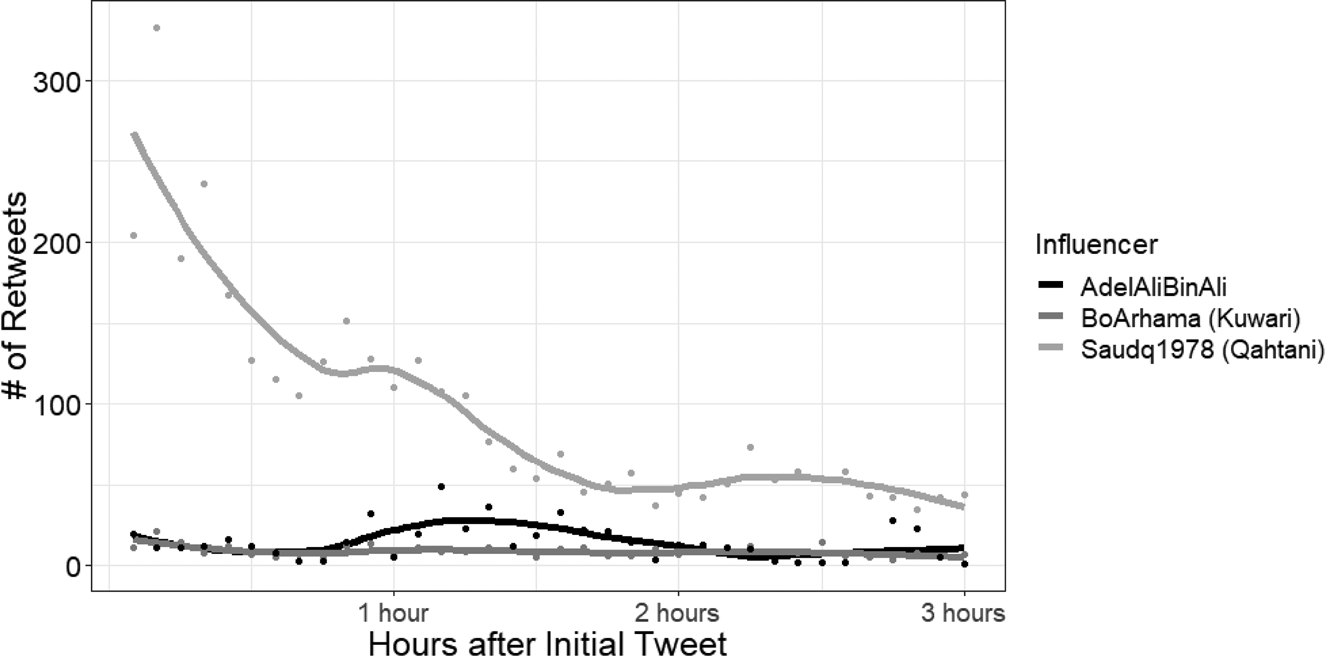
While Kuwari commands fewer Twitter followers than Qahtani, measuring the skew of retweets and the portion of retweets provided by suspicious accounts provides a comparable measure for both accounts. Given how rapidly online narratives can develop, we focus on the first few hours of engagement for initial tweets from Kuwari, Qahtani, and Adel Ali Bin Ali (a Qatari businessman among the most active in the #Tamim_is_Everywhere hashtag) in Figure 2. Engagement with Kuwari's tweet was fairly static in the initial hours (skew of 0.11, or approximately normal). Qahtani's tweet received an enormous amount of minute-by-minute engagement that quickly declined in its first few hours (skew of 0.75). Interestingly, Bin Ali's retweet amounts actually rose over time before subsiding again. Despite a relatively low skew (0.25), 41% of his retweets came from suspicious accounts (versus 11% and 13% for Kuwari and Qahtani, respectively) – perhaps an isolated purchase of fake retweets.Footnote 46
Hashtags from Saud al-Qahtani, Ahmed al-Kuwari, and Adel Ali bin Ali, 5-minute retweet totals from initial tweet.

Further analysis of retweeting trends across the three hashtags provides more systematic evidence of greater manipulation on the Qahtani-backed hashtag. We defined ‘influencer’ accounts as all those receiving a very high number of retweets relative to others (98th percentile or higher). Among these, we conducted a manual check of key influencers’ profiles and tweets to identify advertising bots (accounts programmed to promote unrelated products) as well as “infiltrator” accounts (those attempting to hijack the hashtag and promote an alternative narrative). @Dol7K, for example, is an Emirati account that mocked “No participation in suspicious hashtags” by appending other hashtags critical of Qatar and retweeting accounts that did the same. We had already identified bot accounts within the overall sample of users, leaving us to focus on “genuine” accounts that appear to be operated by human individuals who agree with the content of the hashtag.Footnote 47
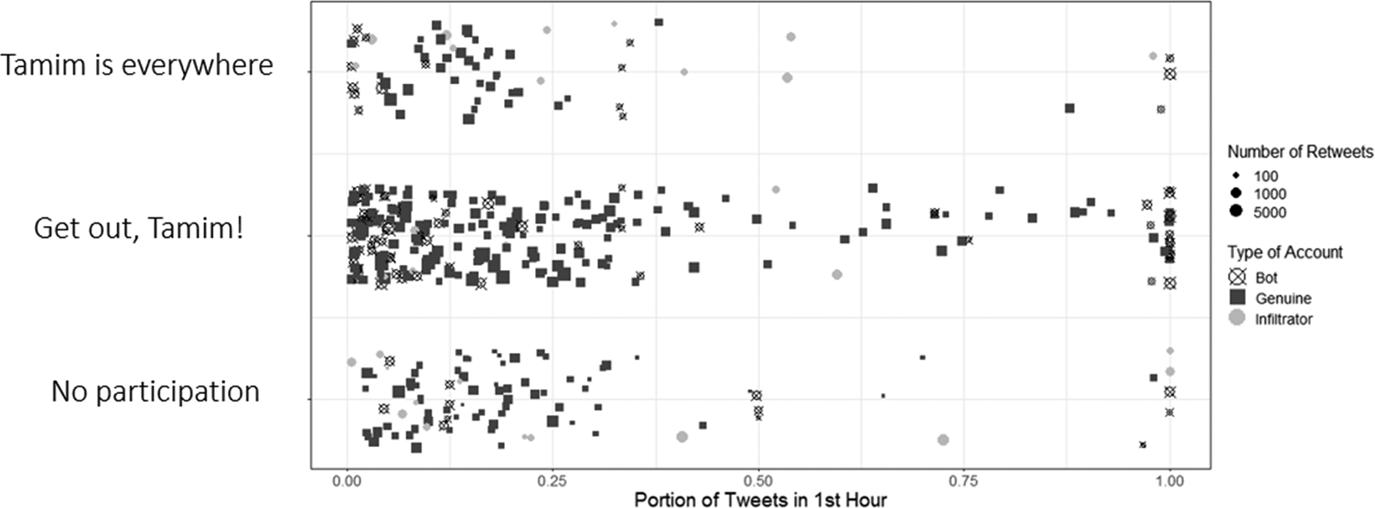
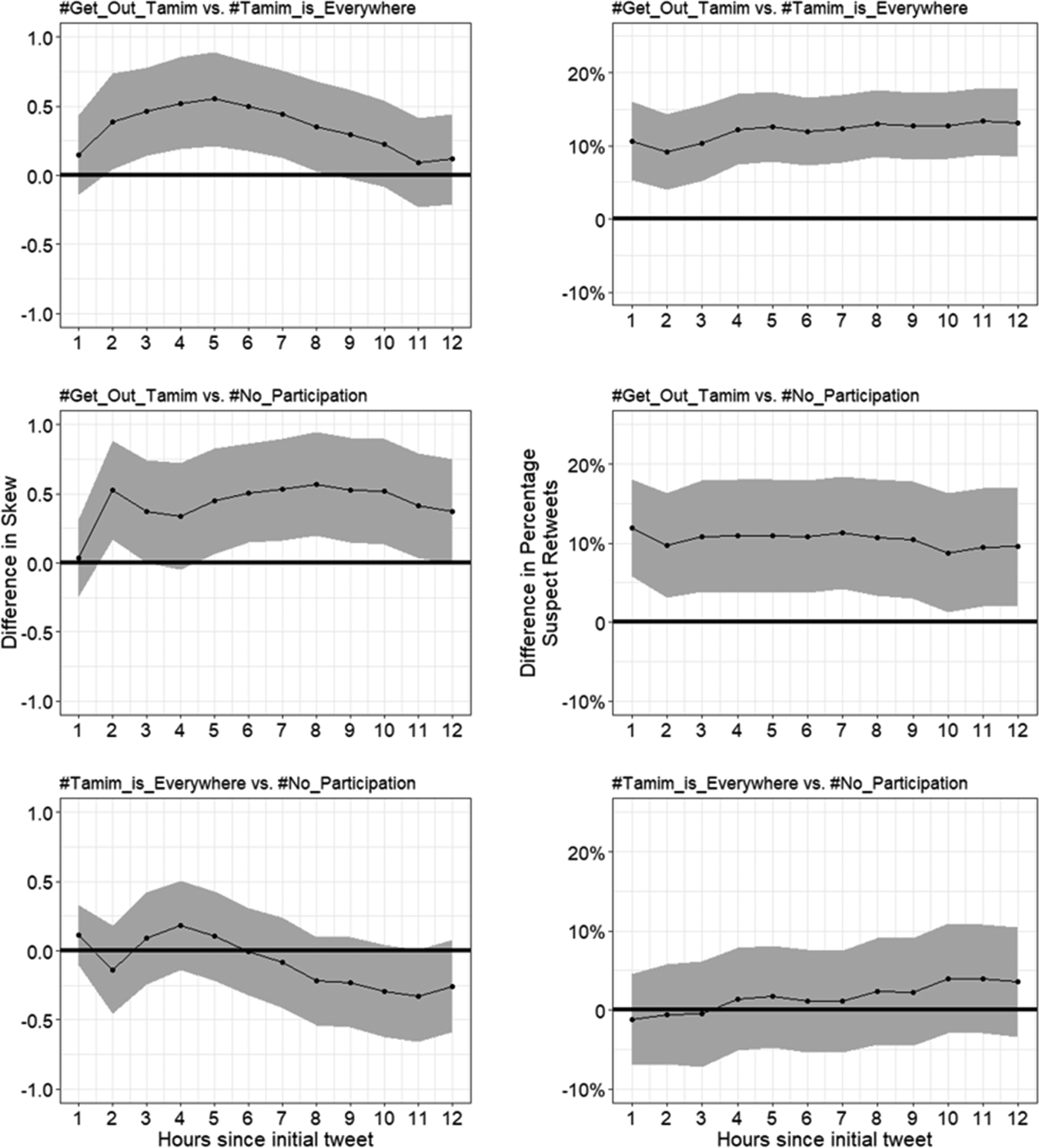
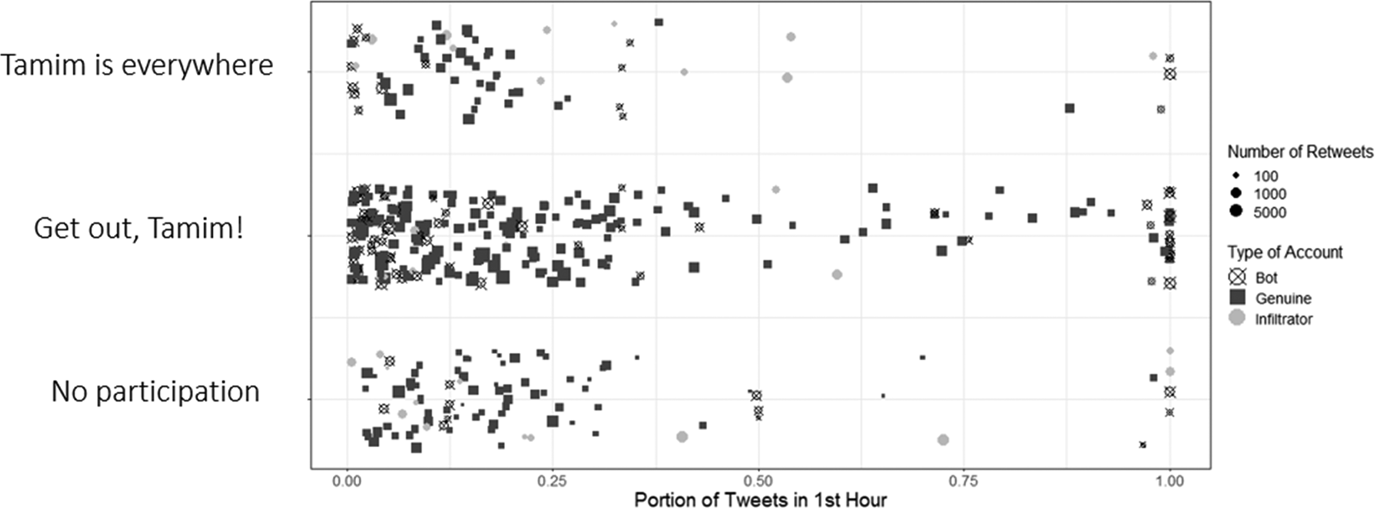
Key genuine influencers involved in promoting “Get Out, Tamim!” exhibited greater skew on average than the other two hashtags. Difference-in-means tests show a tendency toward more skewed retweet patterns on this hashtag, as well as a higher prevalence of suspicious accounts, regardless of the timeframe we examine. This gives us reason to suspect higher levels of coordination behind this hashtag relative to the other two campaigns (Figure 5 in the appendix). A comparison of the “No Participation” and “Tamim is Everywhere” campaigns found inconsistent and insignificant results. This is reflected in the higher portion of retweets occurring in the first hour of “Get Out, Tamim!” participants’ Twitter activity [Figure 3].
Portion of retweets accruing to influencer accounts in the first hour after initial tweet.
At a minimum, the data presented here falsifies the assumption that Twitter conversations automatically reflect the “unfiltered” opinion of citizens in the Arab Gulf (or elsewhere). Even in the case of “No Participation,” al-Kuwari's offline “capital” as a media figure helped him to generate online narratives. More dramatically, Saud al-Qahtani's intervention into the “Get Out, Tamim!” campaign appears to have heralded a coordinated effort to boost the hashtag.
One explanation could simply be that Saudi Arabia has a higher percentage of social media users willing to pay for followers and retweets. Yet while some individuals in our sample almost certainly make use of these services, there is little reason to believe that independent Saudi users make use of these services at systematically higher rates than their Qatari counterparts.
Notably, even the “Get Out, Tamim!” hashtag was sustained by large numbers of seemingly genuine accounts after initial promotion by Saud al-Qahtani. The combination of higher skew and bot presence among this campaign provides suggestive evidence of a state intervention strategy centered around boosting the visibility of particular hashtags or influencers at the outset of a campaign. Rather than manufacturing online narratives out of whole cloth, these interventions stoke online interest (and anger) regarding particular topics, drawing in “real” users eager to participate in a particular campaign out of a sense of nationalism or boredom.Footnote 48
Conclusion
Despite the initial promise of social media platforms as the basis for diffuse, even democratic discussion of an unending range of issues, developments over the past decade suggest that even platforms made possible by “liberation technology” risk falling victim to Michel's iron law of oligarchy. Entities with significant offline resources and organizational power – especially authoritarian states – have both capacity and incentive to try to shape online discussions in their favor, biasing online free expression toward mindless repetition and careful self-censorship.
To review, we find evidence that strongly politically salient Twitter conversations in the region are centrally dominated, which renders them vulnerable to organized intervention by state authorities. We provide further evidence that hashtag campaigns are subject to state-led manipulation on occasion. We further provide evidence that states engaged in manipulation are likely to pursue a mixed strategy that engages “genuine” users in building popular engagement around a shared narrative, rather than simply flooding the social media commons with fake accounts tweeting in isolation.
While we focus on the influence of one particular Gulf official – Saudi Advisor to the Royal Court Saud al-Qahtani – further evidence is needed to understand the comparative capability and willingness of Gulf governments to warp social-media environments, either to influence public opinion toward citizens’ own governments or toward potential rivals. Given ongoing incentives to instrumentalize social-media discourse in this fashion, the next few years may witness a small-scale tragedy of the digital commons as otherwise engaging and insightful users depart the increasingly uncertain digital reality of platforms such as Twitter for smaller circles (such as WhatsApp groups) where the range of views present may be smaller but the provenance of those speaking more certain.
As other articles in this special edition note, this tragedy is not inevitable. Users under even the most authoritarian conditions have demonstrated an ability to evade censure through ambiguous messaging that flies below the radar, while regimes have significant agency in choosing whether to cultivate social media spaces as a crude stand-in for high-frequency polling. Ensuring against a bleak social-media future under authoritarianism, however, requires a clear understanding of the digital “arenas” rulers and citizens face, the tools of manipulation and clarification at their disposals, and the strategies they pursue to deploy or counter particular narratives.
Appendix
Internal composition of influencers (tweets and retweets) for “Get Out, Tamim!” hashtag.

Difference in skewness and bot activity among retweets for different campaigns. 90% confidence intervals shown using difference-in-means t-tests.
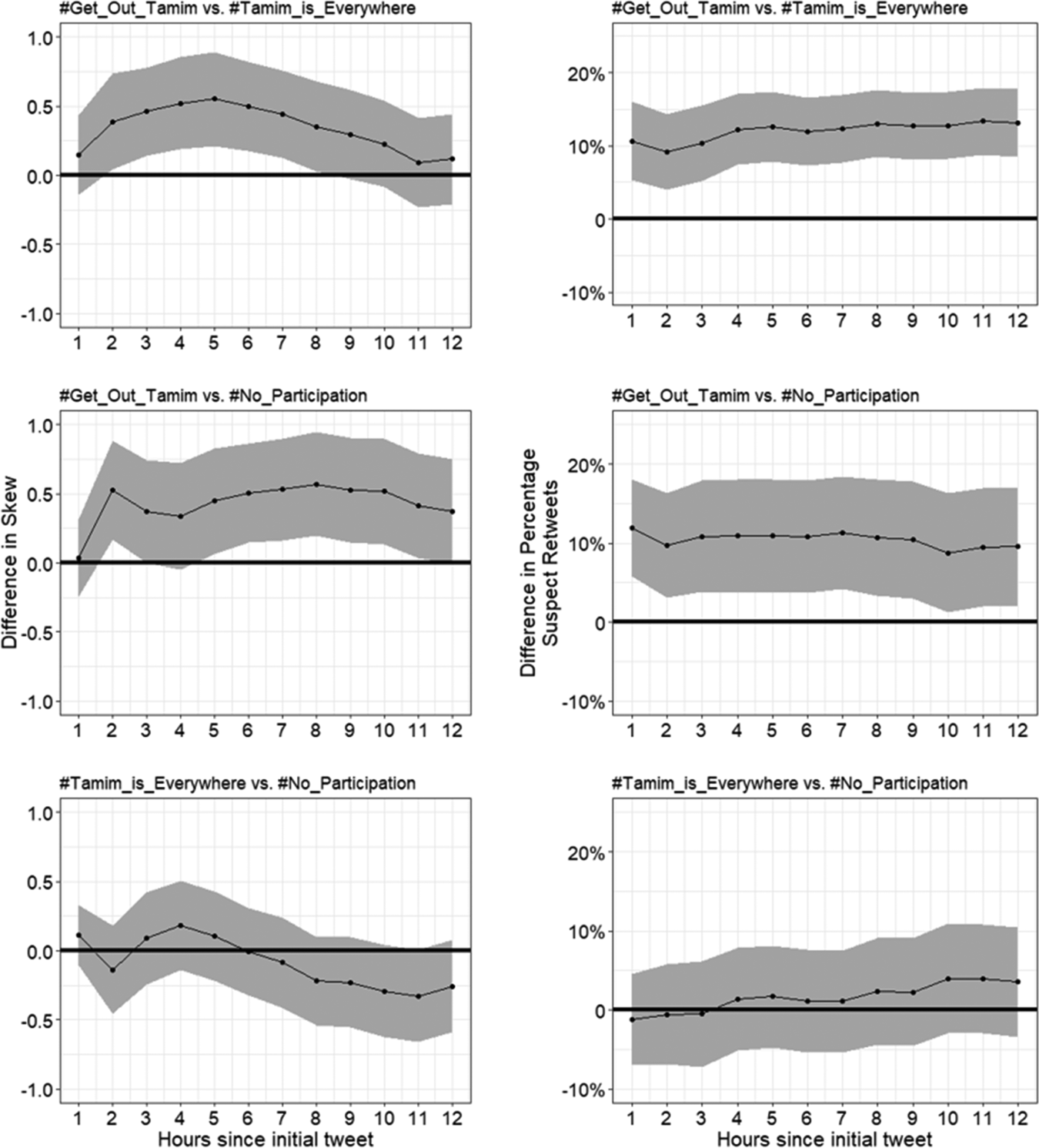
Table indicating descriptive statistics of the three hashtag campaigns.