INTRODUCTION
The human–environmental relationship in the Arctic is one of the key issues in modern studies of the anthropogenic impact on nature in this vulnerable part of the Earth. Not only the current situation but also patterns of this process in the past should be taken into account, in order to both protect archaeological sites in the Arctic (e.g., Hollesen et al. Reference Hollesen, Matthiesen and Elberling2017) and to produce a reliable forecast of a possible negative influence of society on Arctic ecosystems in the future. The importance of studying the correspondence between natural and cultural changes was repeatedly highlighted (e.g., Renfrew Reference Renfrew1990).
There is a growing body of literature on human–environment interaction in the Arctic (Pitul’ko and Pavlova Reference Pitul’ko and Pavlova2016, Reference Pitulko, Pavlova, Goldstein and DellaSala2020a, Reference Pitulko, Pavlova, Goldstein and DellaSala2020b; Besprozvanny et al. Reference Besprozvanny, Kosintsev, Pogodin, Kotlyakov, Velichko and Vasil’ev2017; Kuzmin Reference Kuzmin, Kotlyakov, Velichko and Vasil’ev2017; Volokitin and Gribchenko Reference Volokitin, Gribchenko, Kotlyakov, Velichko and Vasil’ev2017; Slobodin et al. Reference Slobodin, Anderson, Glushkova, Lozhkin, Kotlyakov, Velichko and Vasil’ev2017; Anderson et al. Reference Anderson, Brown, Junge and Duelks2019a; Desjardins et al. Reference Desjardins, Jordan, Friesen and Timmermans2020; Pavlova and Pitulko Reference Pavlova and Pitulko2020). This is supplemented by research of early modern human DNA in the Arctic (Raghavan et al. Reference Raghavan, DeGiorgio, Albrechtsen, Moltke, Skoglund, Korneliussen, Grønnow, Appelt, Gulløv and Friesen2014; Flegontov et al. Reference Flegontov, Altınışık, Changmai, Rohland, Mallick, Adamski, Bolnick, Broomandkhoshbacht, Candilio and Culleton2019; Sikora et al. Reference Sikora, Pitulko, Sousa, Allentoft, Vinner, Rasmussen, Margaryan, de Barros Damgaard, de la Fuente and Renaud2019; Ning et al. Reference Ning, Fernandes, Changmai, Flegontova, Yuncu, Maier, Altınışık, Kassian, Krause and Lalueza-Fox2020; Kılınç et al. Reference Kılınç, Kashuba, Koptekin, Bergfeldt, Dönertaş, Rodriguez-Varela, Shergin, Ivanov, Kichigin, Pestereva, Volkov, Mandryka, Kharinskii, Tishkin, Ineshin, Kovychev, Stepanov, Dalén, Günther, Kırdök, Jakobsson, Somel, Krzewińska, Storå and Götherström2021). Although still scanty, these data provide important insights about the history of human populations that cannot be studied by other sciences like archaeology. The relationship between people and environment in hostile northern latitudes of Eurasia is important for a better understanding of human adaptations in the past.
This paper examines the main patterns of human–environmental interactions across northern Asia during the Holocene (the last 10,000 14C years, or last 11,500 calendar years). The goal is to summarize current knowledge and identify key areas for future research. It is based on previously published data (Kuzmin Reference Kuzmin2010; Pitul’ko and Pavlova Reference Pitul’ko and Pavlova2016), with the addition of new information accumulated in the last ten years.
MATERIAL AND METHODS
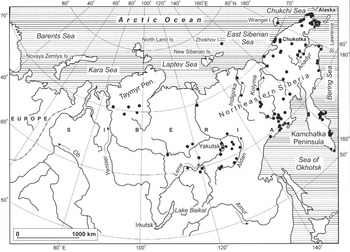
The most representative region for the purpose of this study is the Siberian Arctic where 150 archaeological sites and site clusters are known (Figure 1), with 435 radiocarbon (14C) age determinations (Table S1). The arctic part of European Russia is still relatively poorly studied in this respect, and only a handful of 14C dates exist for the prehistoric cultural complexes (e.g., Shumkin Reference Shumkin1986); this is why it is currently impossible to conduct a numerical analysis of 14C dates for this region. According to Williams (2012), several hundred 14C values are necessary to perform an analysis of their frequencies for a relatively large territory.
Location of 14C-dated sites in Siberian Arctic and neighboring regions used in this study (after Pitul’ko and Pavlova Reference Pitul’ko and Pavlova2016; modified).

Since the 1980s, the temporal distribution of 14C dates is used as a proxy to understand the dynamics of ancient populations (Rick Reference Rick1987; see review: Brown Reference Brown2015). Currently, this approach is widely employed in different parts of the world (e.g., Bocquet-Appel et al. Reference Bocquet-Appel, Naji, Linden and Kozlowski2012; Chaput and Gajewski Reference Chaput and Gajewski2016; Crema et al. Reference Crema, Bevan and Shennan2017; Seong and Kim Reference Seong and Kim2022), including Siberia (Kuzmin and Keates Reference Kuzmin and Keates2005, Reference Kuzmin and Keates2013) and its Arctic territories (Kuzmin Reference Kuzmin2010; Pitul’ko and Pavlova Reference Pitul’ko and Pavlova2016:126–136). The data on human population changes are often coupled with information on environmental fluctuations (e.g., Williams et al. Reference Williams, Ulm, Turney, Rohde and White2015, Reference Williams, Ulm, Sapienza, Lewis and Turney2018).
The main sources for this study are summary publications (Kuzmin Reference Kuzmin2010; Pitul’ko and Pavlova Reference Pitul’ko and Pavlova2016), supplemented by new data (Khassanov and Savinetsky Reference Khassanov, Savinetsky, Dumond and Bland2006; Alekseyev and Dyakonov Reference Alexeyev and Dyakonov2009; Lebedintsev and Kuzmin Reference Lebedintsev, Kuzmin and Lebedintsev2010; Csonka Reference Csonka2014; Gusev Reference Gusev and Fedorova2014; Kuzmin and Dikova Reference Kuzmin and Dikova2014; Pitulko and Pavlova Reference Pitulko and Pavlova2015; Bravina et al. Reference Bravina, D’iakonov, Bagashev, Razhev, Poshekhonova, Stetsenko, Alekseeva, Kuz’min and Hodgins2016; Pendea et al. Reference Pendea, Ponomareva, Bourgeois, Zubrow, Portnyagin, Ponkratova, Harmsen and Korosec2017; Kuzmin et al. Reference Kuzmin, Kosintsev, Stepanov, Boeskorov and Cruz2017). The area under consideration includes (from west to east): Taymyr Peninsula; the middle and lower reaches of the Lena River basin (including Aldan River basin); Northeastern Siberia; and Kamchatka Peninsula (Figure 1). All these parts of Siberia belong to Arctic and Sub-Arctic climatic zones (Suslov Reference Suslov1961; Shahgedanova Reference Shahgedanova2002), with such typical features as a harsh continental climate; thick permafrost; and tundra, forest tundra, and northern taiga (conifer forest) vegetation.
After critical evaluation of the existing dataset, the most reliable sites and 14C values were selected (see Table S1). In order to do this, several checks were carried out. Outliers (i.e., values which are in discord with other 14C dates and the stratigraphy) were deleted from the calculations. Most commonly, the outliers can be detected when 14C values are distributed in stratigraphic order according to cultural layers. The ages from the strata lying above are sometimes older than the ones from below, or vice versa, and this is evidence of outliers. Post-depositional disturbances of original stratigraphy could be the cause for some of them. At some sites such as Ulakhan-Segelennyakh and Sumnagin 1 (see original data in Alexeyev and Dyakonov Reference Alexeyev and Dyakonov2009), there are several reversals (i.e., outliers) in the 14C sequences, and they were deleted from our records. The 14C values with very large standard deviations (sigma, Greek letter “σ”), usually more than ± 250 14C years, were excluded due to their extremely wide calendar interval which makes them essentially useless for analysis.
The 14C dates run on marine-based organisms (marine mammals; dogs at maritime sites; and humans with a significant part of the diet from marine food) are also excluded, especially from records for the Zhokhov and Ekven sites (see Khassanov and Savinetsky Reference Khassanov, Savinetsky, Dumond and Bland2006; Pitulko and Pavlova Reference Pitulko and Pavlova2015). It is now clear that the reservoir age for marine-based substances in the Arctic (Sea of Okhotsk, Bering Sea, and seas of the Arctic Ocean) is quite high, with the R value up to 750–1100 years (see Dumond and Griffin Reference Dumond and Griffin2002; Khassanov and Savinetsky Reference Khassanov, Savinetsky, Dumond and Bland2006; Kuzmin et al. Reference Kuzmin, Burr, Gorbunov, Rakov and Razjigaeva2007; Yoneda et al. Reference Yoneda, Uno, Shibata, Suzuki, Kumamoto, Yoshida, Sasaki, Suzuki and Kawahata2007; Khasanov et al. Reference Khasanov, Nakamura, Okuno, Gorlova, Krylovich, West, Hatfield and Savinetsky2015, Reference Khasanov, Fitzhugh, Nakamura, Okuno, Hatfield, Krylovich, Vasyukov, West, Zendler and Savinetsky2022; Reuther et al. Reference Reuther, Shirar, Mason, Anderson, Coltrain, Freeburg, Bowers, Alix, Darwent and Norman2021). It is therefore impossible to use 14C values run on marine samples (or bones of humans who consumed significant amounts of aquatic food) to establish their true age.
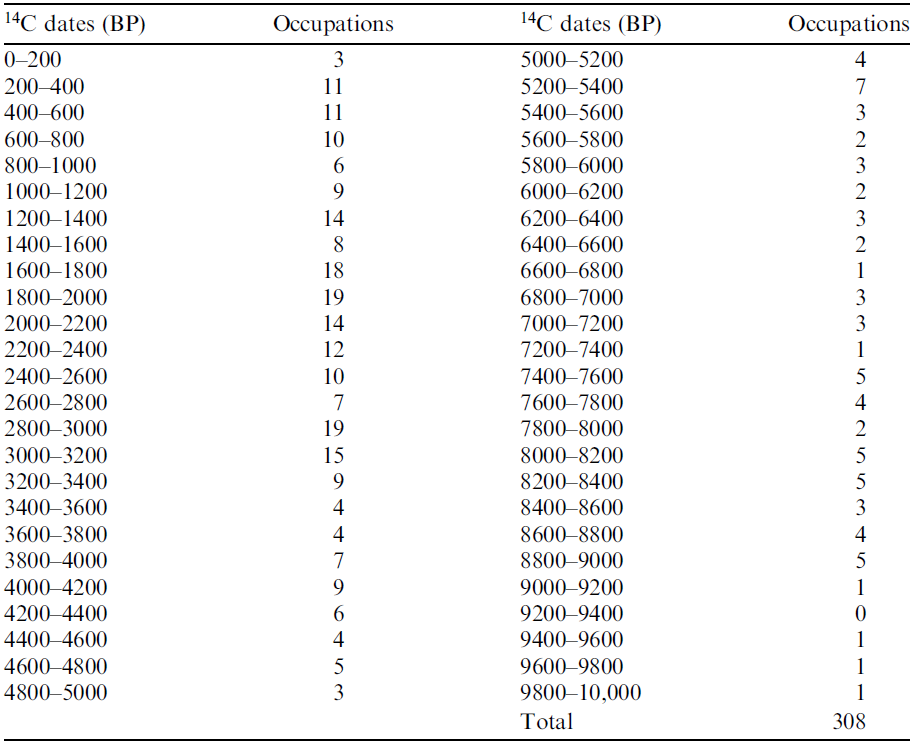
Frequencies of “occupation episodes” (sensu Kuzmin and Keates Reference Kuzmin and Keates2005, Reference Kuzmin and Keates2013; Fiedel and Kuzmin Reference Fiedel and Kuzmin2007) were counted for the dataset (Table 1). Anderson et al. (Reference Anderson, Brown, Junge and Duelks2019a) followed this method in order to normalize 14C records from each site. This approach is different from the simple distribution of 14C values for a certain region, regardless of how many 14C dates are obtained from the same cultural layer or site (e.g., Fitzhugh et al. Reference Fitzhugh, Gjesfjeld, Brown, Hudson and Shaw2016). When we have a large amount of 14C values from a particular site, the frequency is biased because it shows more intensive occupation compared to another site for which we have either one or a few 14C dates (see more details in Kuzmin and Keates Reference Kuzmin and Keates2005:775–777). Without normalization, the sites with a large number of 14C values will distort the actual picture. An example of this is the Zhokhov site. There are currently 61 14C values run on wood, charcoal, plant remains, and bones of terrestrial animals (reindeer and elk/moose) (Pitulko and Pavlova Reference Pitulko and Pavlova2015; see Table S1); however, they indicate only six occupation episodes of 7200–7400, 7400–7600, 7600–7800, 7800–8000, 8000–8200, and 8200–8400 BP. If one takes the numerous Zhokhov 14C records at face value, it will severely distort the distribution based on normalized frequencies.
The Holocene human occupation frequencies in Siberian Arctic and neighboring regions (at 200 14C years intervals; original data are in Table S1).

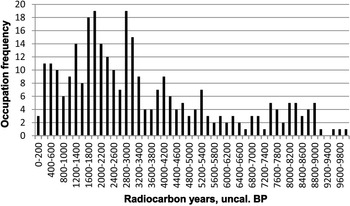
The average 1σ value for 435 14C dates is 82.6 14C years (Table S1). Rounding it to 100 14C years, this results in a ±1σ interval equal to 200 14C years. The distribution of occupation episodes throughout the Holocene, divided by 200 14C year increments, is shown in Table 1 and Figure 2. Obviously, the overall picture is a function of the availability of material for analysis. Unfortunately, for some regions there is still a lack of significant amount of 14C dates. Nevertheless, the relatively large amount of information (ca. 440 14C values) unavailable before makes this study useful for understanding general patterns.
Human occupation frequencies for Siberian Arctic and neighboring regions in the Holocene (see Table 1).

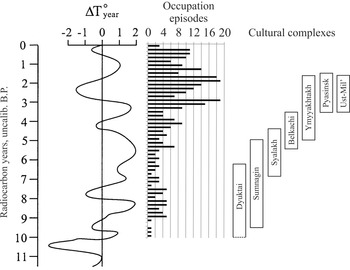
For the correlation of archaeological 14C records and Holocene environmental changes in the Arctic the summary paleoclimatic curve for the Taymyr Peninsula was used (Figure 3; see Andreev and Klimanov Reference Andreev and Klimanov2000). Other paleoenvironmental proxies for the Siberian Arctic were also taken into account (see details in Kuzmin Reference Kuzmin2010; Pitul’ko and Pavlova Reference Pitul’ko and Pavlova2016, Reference Pitulko, Pavlova, Goldstein and DellaSala2020a, Reference Pitulko, Pavlova, Goldstein and DellaSala2020b).
Relationship between climatic fluctuations, human occupations, and cultural changes in Siberian Arctic and neighboring regions in the Holocene (after Kuzmin Reference Kuzmin2010; Pitul’ko and Pavlova Reference Pitul’ko and Pavlova2016; modified).

RESULTS AND DISCUSSION
Using the frequency of “occupation episodes” approach, a distribution of 14C dates through the Holocene for the Siberian Arctic and neighboring regions was generated (Figure 2). It has several maxima, most notably at 5200–5400, 4000–4200, 2800–3000, 1800–2000, 1600–1800, and 1200–1400 BP. Smaller increases can be observed at 8800–9000, 8200–8400, 8000–8200, and 7400–7600 BP. There are also clear minima at 7800–8000, 7200–7400, 6600–6800, 4800–5000, 3600–3800, 3400–3600, 2600–2800, 1400–1600, and 800–1000 BP. The 14C dates younger than ca. 400 BP are excluded because of sampling bias; historical records show that we have much more sites after ca. 400 BP (roughly equal to a calendar interval of AD 1450–1610) due to the increased pace of the Russian colonization of Siberia since the late AD 1500s (e.g., Wood Reference Wood2011).
The overall trend in the Holocene for the Siberian Arctic is the slow increase of frequencies at 10,000–7400 BP; this is followed by a decrease at 7400–5400 BP, and a gradual increase from 5400 BP to 3400 BP. After that, there is a fast rise at 3400–3000 BP, following by a sharp drop at 2800–2600 BP, and a rise again at 2600–1600 BP, with a gradual decrease afterward (Figure 2). This is in general accord with a previous study by Kuzmin (Reference Kuzmin2010). Small differences are most probably due to the larger dataset—ca. 300 14C dates and 237 episodes in Kuzmin (Reference Kuzmin2010), and ca. 440 14C values and 308 occupations in the current study.
Using this study’s dataset (see Table S1), one can try to connect fluctuations in occupation frequency with climatic and cultural changes. It is clear that the density of human occupation in the Arctic was related to climatic conditions and their short-term fluctuations. Krupnik (Reference Krupnik1993) showed that even small changes in ice cover conditions could have a devastating effect for the Eskimo tribes, and cause hunger, depopulation, and a shrinking of habitat. Nevertheless, in terms of the relationship between intensity of occupation and climatic fluctuations, in the case of the Siberian Arctic there is no straightforward correlation (Figure 3). For example, the increases of occupations during the warm period in the Early Holocene (ca. 8500–8000 BP) and the Middle Holocene (ca. 5500–5000 BP) are notable; however, the most pronounced rises in occupation frequency at 2800–3000 BP and 1600–2000 BP coincide with a cooling trend. The same is true with decreases in occupations: a relatively small number is detected in the warm Middle Holocene (or Climatic Optimum), ca. 7300–4500 BP.
The sampling bias caused by different factors, such as the sea level rise in the terminal Pleistocene and Early Holocene and submergence of early sites, and “invisibility” of sites belonging to nomadic populations, should be taken into account. Similar issues are reviewed by Brown (Reference Brown2015). When the Arctic Ocean’s level was rising until the Holocene Climatic Optimum, ca. 5000–6000 BP (e.g., Lozhkin Reference Lozhkin and Simakov2002; Gavrilov et al. Reference Gavrilov, Romanovskii and Hubberten2006), enormous swathes of today’s shelf were inundated, and some sites were destroyed and buried in marine deposits. Unfortunately, it is impossible to estimate how many of them existed prior to ca. 5000–6000 BP. As for the possible “invisibility” of sites, this is less probable when we have a large number of archaeological features (mainly long-term settlements and temporal camps) distributed on a large territory (Figure 1). In this case, the degree of “invisibility” should be more-or-less equal for the entire region under analysis, and this will not affect significantly the number of sites and 14C dates.
An important observation can be made when we compare climatic oscillations and changes of cultural complexes (Figure 3). As stated previously, Pitul’ko and Pavlova (Reference Pitul’ko and Pavlova2016:133–134) found that there is a definite connection between natural and cultural phenomena in the Siberian Arctic, but their relationships are not of linear type (see also Powers and Jordan Reference Powers and Jordan1990). In general, replacements of cultural complexes coincide with the beginning of warm periods, and new cultural features arose during the cold periods and continued to exist in the following warm phase; these cycles were repeated several times throughout the Holocene (see Pitul’ko and Pavlova Reference Pitul’ko and Pavlova2016). New data suggest that the Dyuktai Culture of the Upper Paleolithic terminates not at the Pleistocene/Holocene border, ca. 10,000 BP, as it was suggested previously (see Mochanov Reference Mochanov2009), but continued to exist until the Middle Holocene, ca. 6200 BP, and in the late stages it overlaps with the Mesolithic Sumnagin Culture (Pitul’ko and Pavlova Reference Pitul’ko and Pavlova2016; Ineshin and Tetenkin Reference Ineshin and Tetenkin2017) (Figure 3). The same pattern of coexistence is typical for cultural complexes of the Neolithic and Bronze Age in the Siberian Arctic. For example, it is quite possible that three major Neolithic cultural complexes—Syalakh, Belkachi, and Ymyyakhtakh—coexisted or at least overlapped chronologically (Pitul’ko and Pavlova Reference Pitul’ko and Pavlova2016:131–132) (see Figure 3). The possible coexistence of the Late Neolithic Ymyyakhtakh complex and two Bronze Age complexes, Pyasinsk and Us-Mil’, was also suggested (Pitul’ko and Pavlova Reference Pitul’ko and Pavlova2016:123, their Fig. 51), although the number of 14C dates for the latter complexes are small (Pitul’ko and Pavlova Reference Pitul’ko and Pavlova2016:127).
The impact of reindeer domestication and change of settlement patterns in the Siberian Arctic can be provisionally accessed. Losey et al. (Reference Losey, Nomokonova, Arzyutov, Gusev, Plekhanov, Fedorova and Anderson2021:220) have shown that the earliest manifestation of reindeer pastoralism known from the Yamal Peninsula of the West Siberian Arctic, dates to ca. 2200 BP (or ca. 260 cal BC). It is not clear how the emergence of reindeer domestication is related to climatic changes (Losey et al. Reference Losey, Nomokonova, Arzyutov, Gusev, Plekhanov, Fedorova and Anderson2021:220–221); however, the same is true concerning the issue of settlement patterns that could have been affected by the new economy based on reindeer pastoralism (see also Anderson et al. Reference Anderson, Harrault, Milek, Forbes, Kuoppamaa and Plekhanov2019b).
The phenomenon of human presence in the High Arctic in the Mesolithic, ca. 8400–7800 BP, at the Zhokhov Island located at 76°N (Pitulko Reference Pitulko2001, Reference Pitulko2013), is a remarkable example of adaptation to a cold environment, even though the local climate at that time was warmer than now (Makeyev et al. Reference Makeyev, Ponomareva, Chernova, Pitulko and Solovyeva2003). The inhabitants of the Zhokhov site developed a highly efficient model of subsistence based on hunting reindeer and polar bear (Pitulko et al. Reference Pitulko, Ivanova, Kasparov and Pavlova2015), and exploitation of scarce plant resources including collecting driftwood. These people were also a part of vast exchange network of valuable raw material—obsidian (Pitulko et al. Reference Pitulko, Kuzmin, Glascock, Pavlova and Grebennikov2019). In terms of the Zhokhov site’s chronology, more than 90 14C dates were obtained on different materials from the culture-bearing stratum: driftwood; charcoal and charred wood; plant remains; bones, hair, and excrements of animals; and human bones (Pitulko and Pavlova Reference Pitulko and Pavlova2015); 61 values run on terrestrial materials were selected (Table S1). Judging from the view of occupation episodes approach, the site existed mainly at ca. 8400–7800 BP, with a less intensive presence at ca. 7800–7400 BP. The most active habitation occurred at ca. 8200–7800 BP, with the main peak at ca. 8000–7800 BP.
The issue of maritime adaptation in the Siberian Arctic deserves a brief discussion. The earliest use of riverine resources, including anadromous fish (dog salmon), is known from the Kamchatka Peninsula at the Ushki 5 site (Layer 7), dated to ca. 10,800–11,100 BP and associated with the late Upper Paleolithic (e.g., Kuzmin Reference Kuzmin2009, Reference Kuzmin2021). This, however, cannot be accepted as evidence of a fully-fledged maritime adaptation. Some Mesolithic sites, dated to ca. 8400–8000 BP and located near today’s seashore—such as Zhokhov and Naivan (the latter is situated in eastern Chukotka; see Gusev Reference Gusev, Dumond and Bland2002; Kuzmin Reference Kuzmin2010:108)—have very little evidence for the procurement of marine mammals and other organisms. In this case, it is not possible to conclude that these sites represent the initial adaptation to a coastal type of environment (see also Kuzmin Reference Kuzmin2009).
The rise of maritime adaptation in coastal Siberian Arctic at ca. 3000 BP coincides with a cooling trend (Kuzmin Reference Kuzmin2010: 113; Pitul’ko and Pavlova Reference Pitul’ko and Pavlova2016:133; see Figure 3). One of the earliest manifestations of this new type of human subsistence is the Chertov Ovrag (“Devil’s Ravine”) site on Wrangel Island, dated to ca. 3400–2900 BP (Gerasimov et al. Reference Gerasimov, Giria, Pitul’ko, Tikhonov, Dumond and Bland2006). Once again, it is possible that some early sites with evidence of maritime adaptation are now below sea level, but they currently cannot be discovered because of the absence of underwater archaeological studies in the Russian Arctic that would be extremely complicated and costly. Another important feature is the migration of Eskimo people to the easternmost coast of the Siberian Arctic at ca. 1200–900 BP corresponding to the Medieval Warm Period (which can also be called “Little Climatic Optimum”; see Pitul’ko and Pavlova Reference Pitul’ko and Pavlova2016).
The appearance at ca. 3200–3000 BP of maritime resource exploitation also occurred in the neighboring Alaska region (e.g., Ackerman Reference Ackerman1988, Reference Ackerman1998; Dumond Reference Dumond1998; Yesner Reference Yesner1998; see also Britton et al. Reference Britton, Knecht, Nehlich, Hillerdal, Davis and Richards2013; Tremayne and Brown Reference Tremayne and Brown2017). On the Pacific coast of Alaska, the Ocean Bay tradition contains the evidence of early exploitation of marine resources (e.g., Clark Reference Clark, Peregrine and Ember2001). This complex, however, never extended to the Siberian and North American Arctic. This is why the conservative estimate for the beginning of fully-fledged maritime adaptation in Arctic Ocean coast of Alaska—3200–3000 BP—is more suitable for the purpose of this study. The latest analysis of the frequency of 14C dates from Alaska (Anderson et al. Reference Anderson, Brown, Junge and Duelks2019a) shows that marine resource procurement, which began at ca. 4100–3900 BP (see Tremayne Reference Tremayne2015; Buonasera et al. Reference Buonasera, Tremayne, Darwent, Eerkens and Mason2015), was preceded by population growth; a similar pattern can be observed in the Siberian Arctic for pre-3200 BP times (Figure 2). The use of marine resources in Alaska significantly intensified after ca. 4000 BP (e.g., Tremayne Reference Tremayne2018; Admiraal and Knecht Reference Admiraal, Knecht, Jordan and Gibbs2019; Admiraal et al. Reference Admiraal, Lucquin, von Tersch, Craig and Jordan2020).
CONCLUSIONS
Based on this updated dataset of human occupation of the Siberian Arctic and Sub-Arctic regions in the Holocene, analysis of the temporal distribution of 14C dates combined into occupation episodes was carried out. It was found that the general trend was a slow increase of population size in the Early Holocene, ca. 10,000–7400 BP; a drop in the Middle Holocene, ca. 7400–5400 BP; and a gradual increase from ca. 5400 BP to modern times. It is likely that the most intensive occupation since ca. 3400 BP is related to the emergence of maritime adaptation in the Siberian Arctic. Correlation with the Holocene climatic fluctuations shows that the intensity of human presence is not directly related to a simplistic scheme “when it is warmer, people go to the north, and when it is colder, they retreat to the south.” The relationship between humans and nature in the Holocene of the Siberian Arctic was complex, with ebbs and flows of human habitation not directly connected with environmental changes. It is clear that more work is needed to understand the main patterns of human−environment interaction in the Holocene Siberian Arctic and Sub-Arctic.
ACKNOWLEDGMENTS
I am grateful to the International Arctic Science Committee for providing travel assistance to attend the Arctic Science Summit Week (ASSW), 31 March–7 April 2017, in Prague (Czech Republic), where an earlier version of this paper was presented at the Symposium “Long-Term Perspectives on Arctic Change: Implications for Archaeology, Palaeoenvironments and Cultural Heritage.” Valuable comments by Dr. Vladimir V. Pitulko helped to clarify several issues related to this paper. I am also thankful to two anonymous reviewers for useful remarks and suggestions, and to Dr. Susan G. Keates for polishing the grammar. This study was supported by the State Assignment of the Sobolev Institute of Geology and Mineralogy, Siberian Branch of the Russian Academy of Sciences, with funding provided by the Ministry of Science and Higher Education of the Russian Federation.
SUPPLEMENTARY MATERIAL
To view supplementary material for this article (Table S1: Radiocarbon dates for archaeological sites in the Siberian Arctic and neighboring regions), please visit https://doi.org/10.1017/RDC.2023.9.