Looking out from her country house over the cloth-making districts of south Somerset, Mary Clarke watched the troubles mounting in the wake of the Glorious Revolution. From the moment of William and Mary's coronation in April 1689, England was at war with the new regime's enemies in Scotland, Ireland, and France. The following year, Clarke recorded that ‘want of trade’ was great, that money was ‘never scarcer’, and pondered ‘how the taxes will be raised tiss hard to know’.Footnote 1 The weather soon turned, bringing unseasonable temperatures and ruined harvests. At nearby Exeter, the price of wheat doubled. Around the same time, the supply of money and credit essential to the south-west's woollen industry contracted – first gradually, then in a sudden collapse in late 1695. The poor of the region slipped into beggary. Old Goody Thorne came to Clarke in tears after labouring to spin thirty ounces of wool, only to be paid with an old shilling worth merely a third of its face value because of the severely debased coinage.Footnote 2 ‘The poor’, wrote Clarke in November 1696, ‘have noe bread nor noe worke noe fire nor noe cloths’.Footnote 3
The hard times of William III's reign left almost no family untouched. Shortages of food, fuel, money, and employment afflicted the whole kingdom throughout the 1690s, a decade in which ordinary people faced a barrage of economic blows worse than anything they had experienced since the turmoil of the Civil Wars and Interregnum. By several measures, the period was as bad as the notorious crisis years that punctuated the reigns of the Tudors and early Stuarts. Yet, these hardships have rarely received more than a passing mention in histories of the Glorious Revolution.Footnote 4 Instead, scholars of the later seventeenth century tend to present their period as one of a growing ‘commercial empire’, an expansive ‘financial revolution’, and rising living standards for labouring people.Footnote 5 Such terms are accurate when applied to the later Stuart period as a whole, but that is exactly why the 1690s stand out. Three decades of growing prosperity came to a shuddering halt. Examining the nature and effects of the disasters that unfolded not only brings attention to an understudied moment in English history. It also shows the limits of the overarching narrative of long-term economic development. This sort of multi-pronged, cyclical calamity – when military conflict, monetary instability, and rapid inflation caused widespread misery among ordinary people, elements which will be explored below in turn – had more in common with the much better-known ‘crisis’ years of the 1590s, 1640s, and 1790s.Footnote 6 A closer look at the 1690s shows that the narrative traditionally offered by social and economic historians of a crisis-prone Tudor and early Stuart period followed by a prosperous and stable later Stuart period is overdrawn.
Most people experienced such problems not as an abstract national misfortune but rather as a mounting series of local and personal calamities. Using evidence from a range of local and national archives, this article makes the case that the economic turmoil is best appreciated by studying its impact on individuals and communities. Merchants, shopkeepers, and artisans learned of vital shipments lost or cancelled, only to receive bills for poll taxes and poor rates that rose more steeply every year. They became desperate as debts grew larger and bailiffs prowled at the door.Footnote 7 Labouring men and women who worked in manufacturing found their wages unpaid at the end of the week, often a precursor to unemployment. Their families, and the rest of the poorer sort, struggled through bitterly cold winters as the price of fuel and food rose higher. Households used to wheaten bread switched to rougher grains, while the worst off were left with horseflesh, peas, beans, or turnips.Footnote 8 If such options ran out, the poor turned to their neighbours for pity or took to the road in search of charity or work.
The direct suffering caused by the sharp reversal of economic fortunes should not be neglected in histories of the Revolution. If William's landing at Torbay on 5 November is worth including in England's national memory, then Goody Thorne's tears for her clipped shilling ought to be remembered too. Indeed, the sudden reversal of fortunes was often directly linked to the new regime and provoked much political debate.Footnote 9 When we view the 1690s from the perspective of a sailor's widow in Stepney or a weaving family in Tiverton, we can understand why the decade provoked such contention. Furthermore, histories of later Stuart economic development cannot highlight the rise of London and Bristol as global ports or the growth of industry in places like Manchester, Leeds, and Newcastle without also accounting for the precariousness of these apparent sources of prosperity. The events of the 1690s demonstrate that historical narratives of long-term economic expansion risk eliding the hard times that shaped the lives of ordinary people.
I
On 17 May 1689, the English crown declared war on Louis XIV's France. The eight-year conflict that ensued was a catastrophe for overseas and coastal trade. Almost immediately, the war sparked widespread privateering and commerce-raiding that resulted in thousands of British vessels being captured or wrecked. Only four months after hostilities began, an official ‘Account of ships lately taken by the French privateers’ listed fifty-five merchant vessels including The Avarilla from Virginia, carrying 800 hogsheads of tobacco, and the unfortunately named Happy Conclusion from Jamaica, captured with 600 hogsheads of sugar. According to this account, in these first few months the crown had already lost £73,050 in customs revenue and the merchants £218,500 in merchandise.Footnote 10 The threat to internal trade arrived almost as rapidly, due to England's reliance on coastal shipping for much of its domestic commerce. The coasts had become so dangerous that bulky goods such as cheese from Liverpool and Chester had to be sent to London by land.Footnote 11 As a result of such disruptions, the first year of the war was described by contemporaries as a ‘hard time of bad trading’.Footnote 12 Yet these initial losses did not signal merely a short-term dip in trade; they foreshadowed seven more years of continuously depressed and disordered maritime commerce, with wide-ranging effects throughout English society. Ordinary people would be paying for the costs of war, through taxation and shocks of business and employment, long after the cannons fell silent.
Although the English government soon set up a convoy system to counteract French attacks on commercial vessels, the results were mixed. When news reached England of the under-protected Turkey fleet of English and Dutch merchant ships sailing directly into the main French fleet in the Bay of Lagos and suffering heavy losses, it ‘put a great Stop to Trade’, bringing misery not only for the traders involved but also for London's silk-weaving community.Footnote 13 By early 1694, the Turkey merchants had ‘shut up their shops and warehouses’ and the price of silk had risen so dramatically that ‘multitudes’ of silk-throwers and silk-weavers in London were ‘greatly distressed…for want of work’.Footnote 14 Two years later, the weavers still recalled ‘when the Turkey-Fleet was Damnified by the French’ as a time when they had ‘neither Work nor Money to buy Bread’.Footnote 15 Such infamous disasters left scars that were slow to fade, even as English defensive policies became more successful.Footnote 16
Moreover, perhaps more damaging were the persistent small-scale attacks nearer to home. Observers positioned along the English coastline provided a stream of bad news. In 1693, at Harwich in Essex, a resident reported that privateers ‘swarm [ex]tremely upon this Coast [so] that not a Ship can Stir’ and ‘one of them forced a ship on shore laden with wheate oyle & skins & went on board her & took out 80 sacks & then set her on fire’.Footnote 17 Even local coastal traders and fishermen faced the constant threat of a violent capture. Only the Treaty of Ryswick, signed in September 1697, finally brought an end to the plague of privateers.
Some did benefit from the war. Men with official posts in the expanding fiscal-military bureaucracy earned a tidy profit, as did the well-connected private contractors who supplied the troops with food and uniforms.Footnote 18 Those with capital to invest in government debt often did well.Footnote 19 The war also opened opportunities for humbler individuals, such as the gunsmiths of Birmingham and the shipwrights in the busy royal dockyards.Footnote 20 Almost 100,000 Englishmen earned a living as soldiers or sailors.Footnote 21 Some communities benefited from the suddenly increased demand for smuggled goods and from the occasional windfalls that came when English privateers captured enemy ships.Footnote 22 More broadly, manufacturers of goods that normally competed with continental imports profited when shipments from France were banned and other sources were squeezed by the dangers of shipping.Footnote 23
Yet, for most people, the war's economic damage was more obvious than these indirect gains. In fact, merely counting up the millions lost to privateers severely underestimates the material costs. For every English ship captured by the French, many more simply did not sail at all. Fear of attack made small-scale merchants such as Samuel Jeake of Rye give up the maritime trade for a safer occupation, though he soon learned that this ‘could but barely maintain my family’.Footnote 24 The ships that still sailed faced higher costs from losing members of their crews to the navy and having to wait for convoys. They were also adversely affected by the frequent embargos that the crown laid on all commercial shipping.Footnote 25 As well as causing expensive delays, these embargos forced traders to send out vessels at unseasonable times of the year, meaning more were lost or wrecked in storms.Footnote 26 Overall, it was seaborne trade as a whole that suffered, a point easily missed by focusing on the relatively small number of long-distance merchant ships lost to the French.
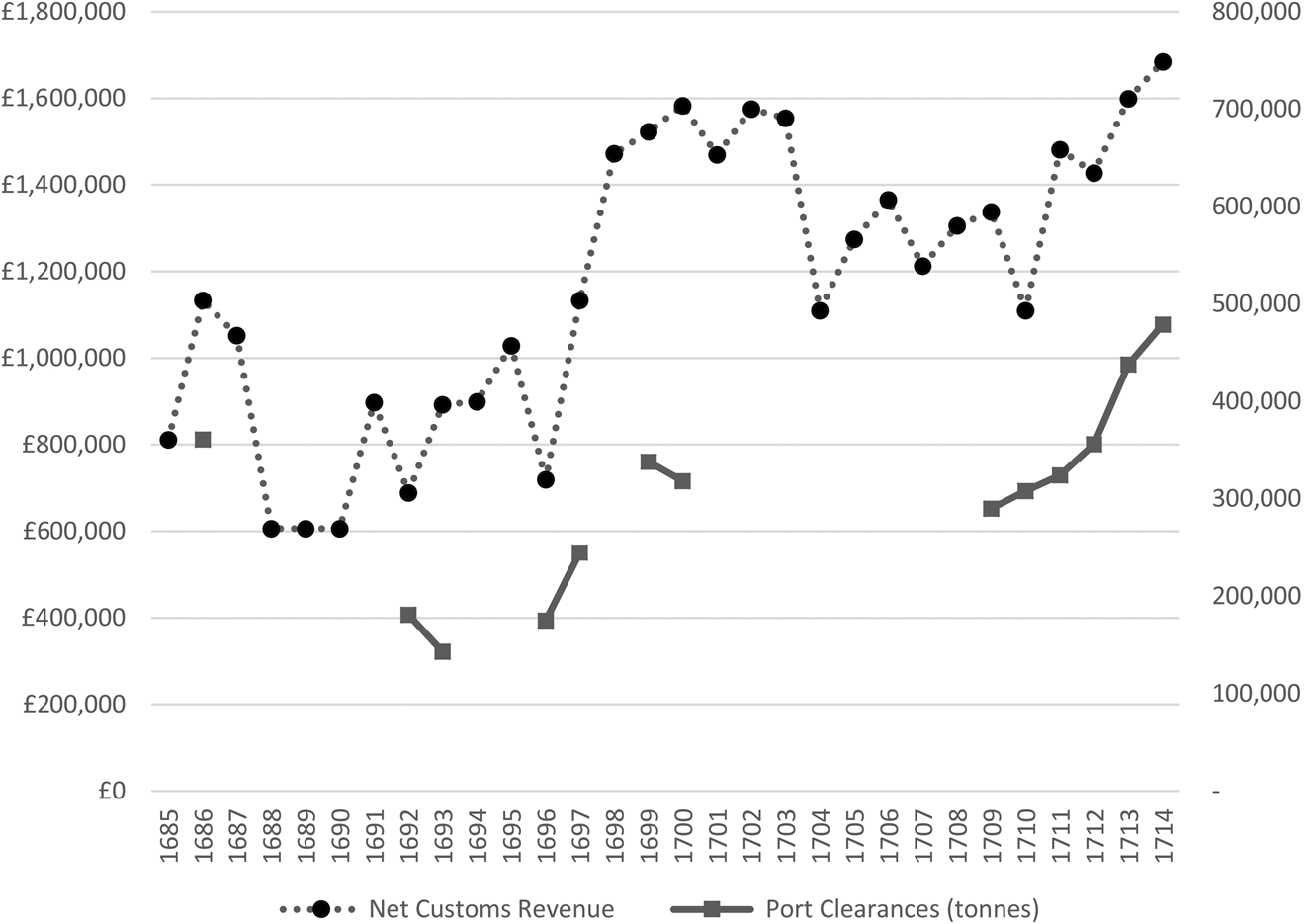
The ‘decay of trade’ during the Nine Years War can be measured directly against pre-war figures. The various numbers that can be pieced together from local and national taxation records are hardly indisputable, but suggest a steep decline in commercial shipping. The starkest figures are from the port books of the exchequer, which record the number and tonnage of ships cleared for departure (Figure 1). Though records do not survive for all years, English shipping clearances fell from 331,000 tonnes in 1686 to less than 200,000 tonnes per annum in 1692–3, 1693–4, and 1696–7.Footnote 27 National customs revenue also dropped, albeit less dramatically. James II received about £1 million a year from this source, whereas William III was able to collect annually only £600,000 in the first three years of his reign.Footnote 28 By these proxies, we can suggest that English imports and exports may have fallen by something like half in some of the years following the Revolution.
National customs revenue and shipping tonnage, 1685–1714.

Coastal shipping – at this time, vital for domestic trade – also suffered a measurable decline. The south coast, unsurprisingly, was hardest hit. Annual coastwise trade for Kent and Sussex ports during the war was more than 20 per cent lower than its long-term pre-war average.Footnote 29 The contraction of east coast trade was probably less significant, though still unmistakable. At King's Lynn, the town's dues collected from shipping declined by almost one third between 1688 and 1690.Footnote 30 Annual coastal shipments from Newcastle, which supplied London and much of England with fuel, fell from about 544,000 tonnes under James II to merely 430,000 tonnes during the war.Footnote 31
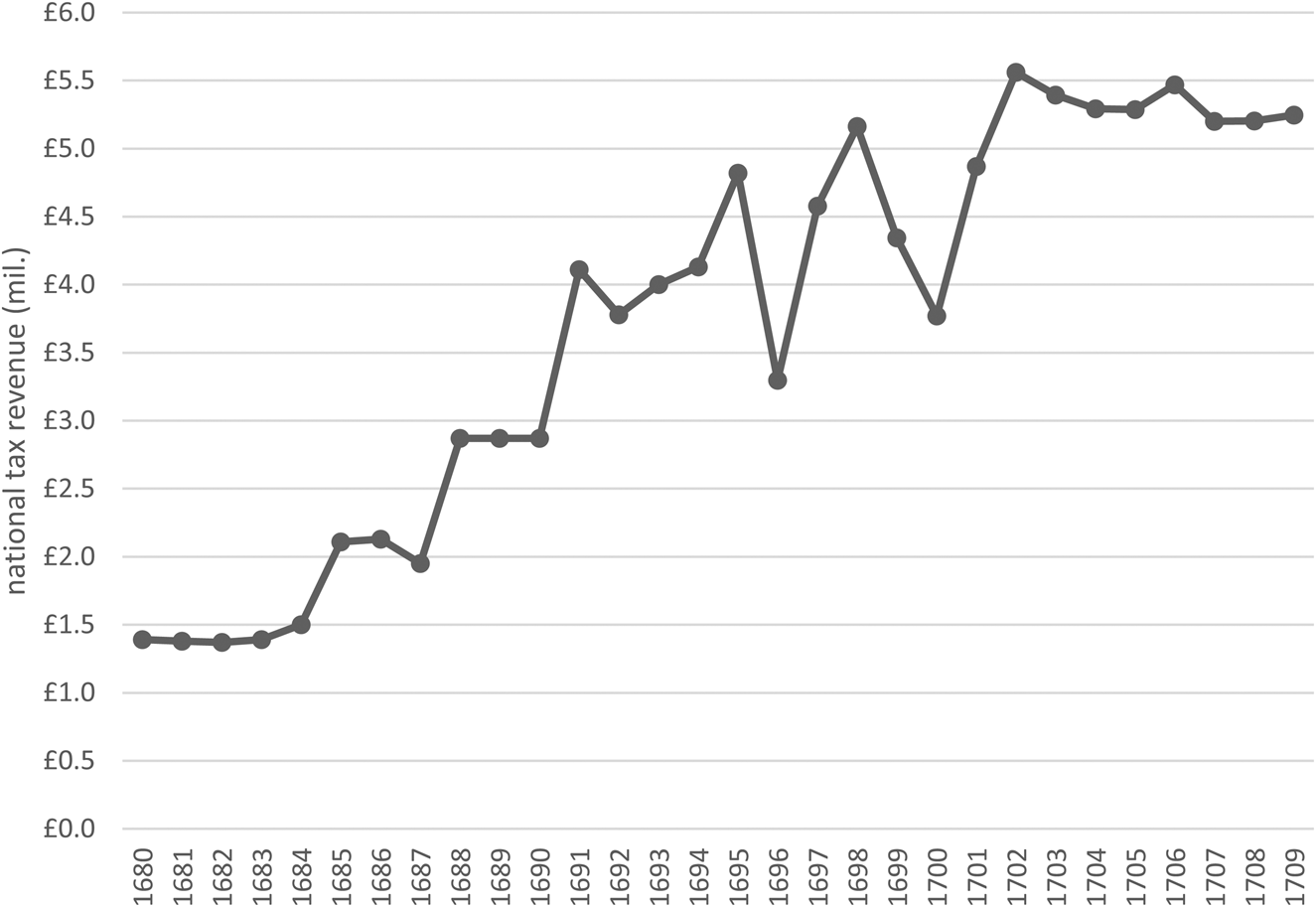
To pay for the conflict, the state raised taxes on the English population. The high levels of taxation in the long eighteenth century are well-known, but the sharpness of the spike after 1688 remains remarkable.Footnote 32 Whereas James II's government only collected around £2.0 million in tax revenue per year, this rose to nearly £3.0 million soon after the Revolution and peaked at more than £5.0 million in 1698–9 (Figure 2).Footnote 33 It would have had to be still higher if not for additional funds provided by the Bank of England through the creation of the National Debt. Although the new government repealed the unpopular hearth tax, it soon introduced a land tax, expanded the excise on beer, and passed new duties on salt, seaborne coal, glass, tobacco pipes, leather, hackney coaches, hawkers, and windows. New taxes were even imposed on births, burials, and marriages.Footnote 34 Inevitably, ordinary people quickly felt the impact. By 1701, a Wiltshire clothier who at first enthusiastically supported William III's early campaigns against Jacobite resistance noted with apparent bitterness that he had since paid close to £80 in taxes ‘through the occasion of the Revolution’.Footnote 35 Of course, much of this revenue was spent on shipbuilding, seamen's wages, and other domestic reinvestment, but huge sums were sent overseas to provision the army in Flanders and hire foreign mercenaries, draining millions from the English economy.Footnote 36
Total national tax revenue.

The end of the war in September 1697 did not bring immediate relief. While customs revenue from foreign trade revived, the number of English ships clearing the ports in 1700–1 was still lower than before the Revolution. Demobilization costs and interest owed on wartime loans meant that taxes remained high between the signing of the Treaty of Ryswick and the outbreak of the War of Spanish Succession in 1702. Peace brought new problems too. With parliament fearful of a large standing army, tens of thousands of seamen and soldiers – most still owed much of their wages – were immediately discharged from service in 1698–9.Footnote 37 The surge of unpaid, unemployed veterans threatened the prospects of other workers and may have pushed down wages in many localities. Struggling to find lawful work, many of the newly disbanded understandably turned to begging or crime.Footnote 38
The war's adverse effects were widespread. With merchants across the country suffering, the thousands of men, women, and children whose labour supplied them with goods for export fared no better, as depressed demand caused misery in England's textile districts. The plight of the London silk-weavers after the damage to the Turkey fleet was hardly an isolated example. In the south-west, Thomas Power reported that ‘thousands stand Idle for want of supply’ of raw wool in November 1695, because ‘wee have not had 30 baggs of wooll into this porte for Eight month past for want of convoy, whereas usually had two or three vessells every weeke’.Footnote 39 Hardship also hit the cloth towns in eastern counties like Essex. In Colchester, where woollen production dropped markedly, weaver James Carter lamented in November 1693 that ‘he hath ben out of Constant work ever since last Shrovetide’ and pleaded with the town's magistrates to help him to find ‘worke in his Trade’.Footnote 40
For the families of rank-and-file soldiers and sailors, any hope of economic security was illusory: wages were paid belatedly and often in discounted debentures, provisions repeatedly ran short, and military careers ended in death, maiming, or the sudden immiseration of demobilization.Footnote 41 Areas with high concentrations of sailors and shipbuilding, such as London's eastern suburbs, suffered deprivation. In November 1693, the churchwardens and overseers of Stepney reported that many local ‘Seafaring men’ had been killed or captured during the conflict, leaving their widows and orphans in ‘great poverty and want’, pushed ‘to such lamentable extremitie as to beg graines for their food’.Footnote 42 Nearby in Ratcliffe, local officers witnessed ‘great increase of the poor, occasioned by the present war’.Footnote 43
The inhabitants of Stepney and Ratcliffe were not alone. The 1690s witnessed the fastest rise in the cost of poor relief out of any decade in the late seventeenth and early eighteenth centuries.Footnote 44 Just as the number of needy parishioners was increasing, so too was the population of ‘poor travellers’ who moved from place to place in search of relief. Though an increase was noted earlier in the decade, the demobilization that began in autumn 1697 led to even higher numbers on the roads, including many described as seamen or soldiers.Footnote 45 In Yorkshire, the charitably minded minister Oliver Heywood noted in early 1698 that ‘tis a matter of admiration to think what multitudes of poor people come weekly and dayly to our door, from Halifax and elsewhere’.Footnote 46
The human and financial cost of England joining the battle against Louis XIV was severe. The economic problems were doubtless made worse by the fact that the English people were relatively unfamiliar with major military mobilization, having just enjoyed fourteen years of peace after the three brief Anglo-Dutch Wars. Contemporaries would have had to look back to the 1640s to find a precedent for the scale and duration of wartime disruption that erupted after the Glorious Revolution.
II
Alongside depressed trade and increased taxes, the war with France also provoked a major monetary and financial crisis. The quantity and quality of English coinage had long been poor, but it worsened dramatically in the early 1690s.Footnote 47 The immediate cause was the spread of illicit ‘clipping’ – the technique of shaving the edge of shillings and other silver coins, then melting down the trimmings into bullion while passing on the clipped coin at its full face value.Footnote 48 Paying and provisioning the British and foreign troops fighting on the continent required vast amounts of silver, a want the clippers were only too happy to supply.Footnote 49 The prevalence of clipped coins also encouraged people to hoard those that were unclipped, accelerating the process whereby circulating money came to be composed almost entirely of ‘small’ or ‘bad’ coins. Despite the threat of death by hanging for anyone caught defacing the coinage, the clipping industry became increasingly sophisticated as the demand for bullion grew. But clipping was just one aspect of a collapse in the circulation of currency that, despite the government's efforts, severely blighted industry and everyday commerce for several years.
Monetary problems soon rippled across the country. As we heard earlier, Mary Clarke in Somerset could already see by late 1690 that a lack of ‘ready money’ was impeding business.Footnote 50 According to the grand jury of the West Riding of Yorkshire, ‘Chlippinge and abusing of money is grown to that hight that you see half of it almost Spoyled which is the distruction of trade & all affaires where an honest man should get a livelyhood.’Footnote 51 Such difficulties only proliferated as the war progressed. In 1693, William Stout discovered the extent of the problem when he took a trip from Lancaster to London to buy stock for his shop. The shopkeeper reported ‘great confusion in trade, people being cautious in setting a price of their goods without known in what money they should be payed’.Footnote 52 By 1695, the situation was no longer sustainable, with much of the circulating silver clipped to about half its original weight. Anyone handling such coins could feel how little was left of the precious metal that supposedly underpinned the value of every shilling and half-crown. As a result, many simply lost faith in the currency.
When parliament reconvened in November 1695, the king urged legislators to take swift action on this ‘Matter of so general Concern, and of so great Importance’.Footnote 53 On 14 December, after much heated debate, the House of Commons agreed to an address asking the king to reform the coinage.Footnote 54 Five days later, the crown issued a royal proclamation setting a series of deadlines after which various current coins would no longer ‘pass’ as lawful payment.Footnote 55 The events sent panic through the English economy, with retailers rejecting coins long before the official deadlines. In mid-December, even before William's proclamation, the shopkeepers of Great Yarmouth were ‘frightened into being beyond measure curious about the Lesser Coines’, causing ‘a great Vexation to the Populace, especially to such of them as have but a just sufficiency for a day or two's Expence’.Footnote 56 The new year brought little relief. There were accounts in several counties in early 1696 of ‘Great confusion & distraction’ due to the scarcity of ‘passable’ coins.Footnote 57 The grimmest report came from Thomas Power in Devon. On 7 January, he wrote to London that the royal proclamation had caused such disruption that ‘the poor in many places are ready to starve’ and ‘several have been murdered in some Markitt Towns about it’.Footnote 58 Over subsequent months, counterfeiting boomed and bills of exchange became less reliable.Footnote 59
On 4 May 1696, all of England's old, clipped silver money ceased to be legal currency for private transactions. The Mint in London had been producing great quantities of new ‘milled’ coins with ridged edges designed to make clipping impossible, but much of it disappeared soon after it had been issued. As long as the ‘small’ clipped money was current, people avoided using the ‘broad’ milled money for everyday exchange. Instead, the new coins were melted down into bullion or sent overseas where clipped silver was not accepted. So, when the May deadline arrived, there was simply not enough good money available to grease the wheels of commerce. Vast sums of clipped coins suddenly became unusable, but there was nothing to replace them. The result was a liquidity crisis, the most severe and abrupt monetary breakdown since the debasements of Henry VIII and Edward VI.Footnote 60
The most prominent institutional victim was the Bank of England, founded only two years before. Within days, it was overwhelmed by depositors seeking to withdraw funds in milled coinage. Although the governor temporarily mollified frustrated depositors, the Bank's directors knew the situation was deteriorating fast.Footnote 61 A week later, they warned their members that the whole kingdom was appallingly undersupplied with new money – the Mint had not yet coined even £400,000. The Bank's directors could no longer issue cash to their depositors, and all they could offer instead were exchequer tally sticks.Footnote 62 Predictably, people began to lose faith in the Bank's bills and notes, especially when the treasury failed to supply as much milled money as promised.Footnote 63 Such fears were contagious and before long other forms of paper currency were being refused or heavily discounted.
The shockwaves spread through the kingdom over the course of the summer. In London, the troubles of the Bank's depositors were minor compared to those of less wealthy inhabitants. On 5 May, one observer lamented:
the Strange Confusion there is throughout the towne about money, in so much that at our great Clare markett there were but 3 joynts of meat, & at theis time all money is refused unless it be new or verry broad of which theres but little Stirring.Footnote 64
The shortage of useable coinage continued to afflict the capital, though the worst was over by August.Footnote 65 For the rest of the country, the pain continued much longer. In Lincolnshire, within a week of the May deadline, the crisis had ‘putt all things to a stand, and makes the markates very small that was larg ones a little while since’.Footnote 66 It hit the labouring poor particularly hard as they rarely had an opportunity to dispose of clipped coinage at face value through taxes or loans to the government. Instead, they tried to use it for their bare necessities, but the traders who normally supplied them with food and other essentials took the old coin at a crippling discount if at all. Worse still, the disruption to commerce also led some employers to dismiss their workers, leaving industrial districts in a wretched state. Labourers suffered in the mining districts of Derbyshire and around Newcastle, and in the cloth manufacturing towns of East Anglia, the West Riding of Yorkshire, and the south-west.Footnote 67 Conditions in Manchester were particularly harrowing. In June, the town was ‘in so great distresse for want of current money, that without some speedy supply, all traffick will cease’. The local tradesmen could no longer ‘employ the many families that depend upon them for work’, estimated at 40,000 souls, and soon many more would be forced to join in the ‘miseries of those that know not how to buy bread at present’.Footnote 68 Other groups suffered as well. Families who ran alehouses and inns had reportedly ‘given over brewing and selling of ale, because that they can get no good money for the ale that they shall sell’.Footnote 69 Anyone who relied on cash, as buyers or sellers, faced a long, brutal summer of hungry days and anxious nights.
On returning in October, parliament's proposed solution was to restrict still further the circulation of ‘old’ money. A new bill ordered that ‘all the hammered Silver Money of this Kingdom do go in Payments by Weight only’ – that is to say, even unclipped old money would henceforth be heavily discounted.Footnote 70 Instead of reviving trade, this seems to have stomped the life out of any prospect of a rapid recovery, drawing out the disruption even longer. Letters and petitions from dozens of English towns reported deepening misery for labouring people. In November, the ironmasters of Birmingham were ‘forced to turn off most of their Workmen, for want of Money to pay them’, and button-makers of Macclesfield were ‘ready to starve for want of Employment and Food’.Footnote 71 That winter, in places as far afield as London, Dover, Cornwall, Lancashire, and Lincolnshire, ‘the small Currency of Money’ left ‘the poorer Sort reduced to the utmost Extremity’.Footnote 72
By the end of 1696, the delicate web of long-distance finance that had tied the country's most important manufacturing districts to the metropolitan markets was frayed from months of strain. Bank of England bills, which London merchants used to pay their provincial suppliers and had become essential due to the lack of ready money, rapidly fell into discredit as the public began to lose faith in the nation's financial institutions. Soon, people would only accept the bills at a significant discount.Footnote 73 As the new year dawned and parliamentary inaction continued, the great cloth traders of the West Country ran out of both credit and patience, determining to send ‘no more Cloth to London till such time they could be Payd in Money and not in Bancke notes’.Footnote 74 Manufacturers in eastern cloth towns such as Colchester and Sudbury also faced ‘extreme Poverty, for want of Money to carry on their Trades, which is occasioned by the Non-payment of Bank-Bills’.Footnote 75 Those who received paper money were now facing loses of almost a quarter when they tried to convert it into cash and many decided that they had no choice but to turn out their workers.Footnote 76 That spring, as the government's Malt Tax Lottery scheme failed in London due to weakness of public credit and continued want of useable currency, labouring families in the south-west were experiencing first-hand the effects of a broken financial system.Footnote 77 Wiltshire clothier George Wanley described a ‘Great Scarcity of money and Great scarcity of worke’.Footnote 78 Some parts of the country did not escape the after-effects of coinage crisis until the spring or summer of 1697.
The currency problems of the 1690s were neither brief nor isolated. What started as a disruptive economic malady in the early part of the decade transformed into a series of acute emergencies punctuating the years 1695, 1696, and 1697. Hardship was particularly severe in manufacturing and industrial districts, but it was not confined to such regions. The problems were impossible for anyone to ignore: the silver coins in their purses became ever smaller as clipping accelerated; shopkeepers and tradesmen became increasingly distrustful of the old money with each new proclamation and statute; when clipped coins were refused, new coin was scarce and paper money was discredited. Specie had long been inadequate and petty credit was widespread, but the monetary instability of this crisis period left much of the labouring population without steady employment and, at crucial moments, unable to buy their daily bread.
III
To make matters worse, the price of everyday essentials started rising in 1689 and remained high for the rest of the decade, as poor weather combined with the effects of warfare, commercial disruption, and monetary instability. For the labouring poor, the surging costs of grain and coal were where the economic crisis was most painfully felt. Ordinary people experienced the crisis first and foremost in the shrinking value of their wages, the chill of their homes over winter, and the pangs of their empty stomachs. Not every community suffered to the same degree and parts of the country avoided the worst, but in most regions the pain was awful and acute.
War was the primary cause for the rising price of coal. In some cases, this took the form of direct attacks by privateers on the coastal trade, but the threat of capture also disrupted the fuel supply in other ways: some ships turned back mid-journey to avoid prowling privateers; others were prevented from sailing by the embargos laid on shipping and by the press masters’ endless hunt for able seamen.Footnote 79 In London, impressment of seamen serving the Newcastle coal trade may have been at its worst during the preparations for a naval ‘decent’ on France in 1692. Along with seamen, whole fleets of coal ships were ‘prest’ for naval duty, with ‘200 light colliers’ seized in May, ‘all the other collier vessells’ in the Thames in June, and finally ‘the biggest of the collier ships’ in July.Footnote 80 In addition, the war had an indirect impact through monetary instability and fiscal demands. From 1694, new duties were laid on every chaldron of seaborne coal.Footnote 81
As a result of dwindling supply, prices leapt. By this time, coal was the chief fuel for urban households and, in London, its price jumped from 20s per chaldron under James II to 32s in 1689 and remained stubbornly high until peace came in 1697.Footnote 82 Equivalent increases were recorded in the southern towns of Winchester and Sandwich.Footnote 83 The urban poor were most affected, hardly able to afford paying 50 per cent extra for their fuel. As early as December 1690, a petition to the House of Commons declared that the poor of London were ‘in danger of perishing for want of Firing’.Footnote 84 In early 1696, during the parliamentary debates on coal duties, there were similar reports from London and Norwich of impoverished parishioners at risk of freezing. In the West Midlands, crowds attacked fences, hedges, and woodlands in a desperate search for fuel.Footnote 85
More dangerous still was the dearth of grain that England faced through much of the 1690s. As with coal, the Nine Years War was a factor, with the coastal corn trade disrupted by privateering and impressment. Chichester in Sussex sent an average of more than 1,000 quarters of meal to other English ports each year throughout 1686–8; the total plunged to less than 100 quarters in 1692–4 and remained low until 1698.Footnote 86 With coastal transport more expensive and unreliable, grain costs rose in many markets and merchants struggled to supply localities with low stocks. In addition, a new group of buyers appeared in many ports at this time, competing with domestic consumers and further pushing up prices: English and Dutch factors buying up ‘great quantities’ of grain to feed Confederate forces in their campaigns against France.Footnote 87
A disastrous run of weather was a more direct cause. The diary of the antiquary Anthony Wood at Oxford makes for grim reading. Over the spring and summer of 1692, he wrote:
Latter end of April, cold, wet; the springe exceeding backward; all fruit spoiled, very deare…
June 20, Munday, rain'd all day. Rain'd every day for a week after – a great flood, all grass spoyl'd – not such weather in the memory of man…
Aug. 5, Friday, a frost in the morn and much wet the same day and the day following…Very unseasonable weather, and like to spoyle the harvest of corne, as the harvest of hay was before…
September was a cold and unseasonable month in England, as all the months of this yeare hitherto hath been. An unseasonable yeare. Nothing but unseasonable times…Footnote 88
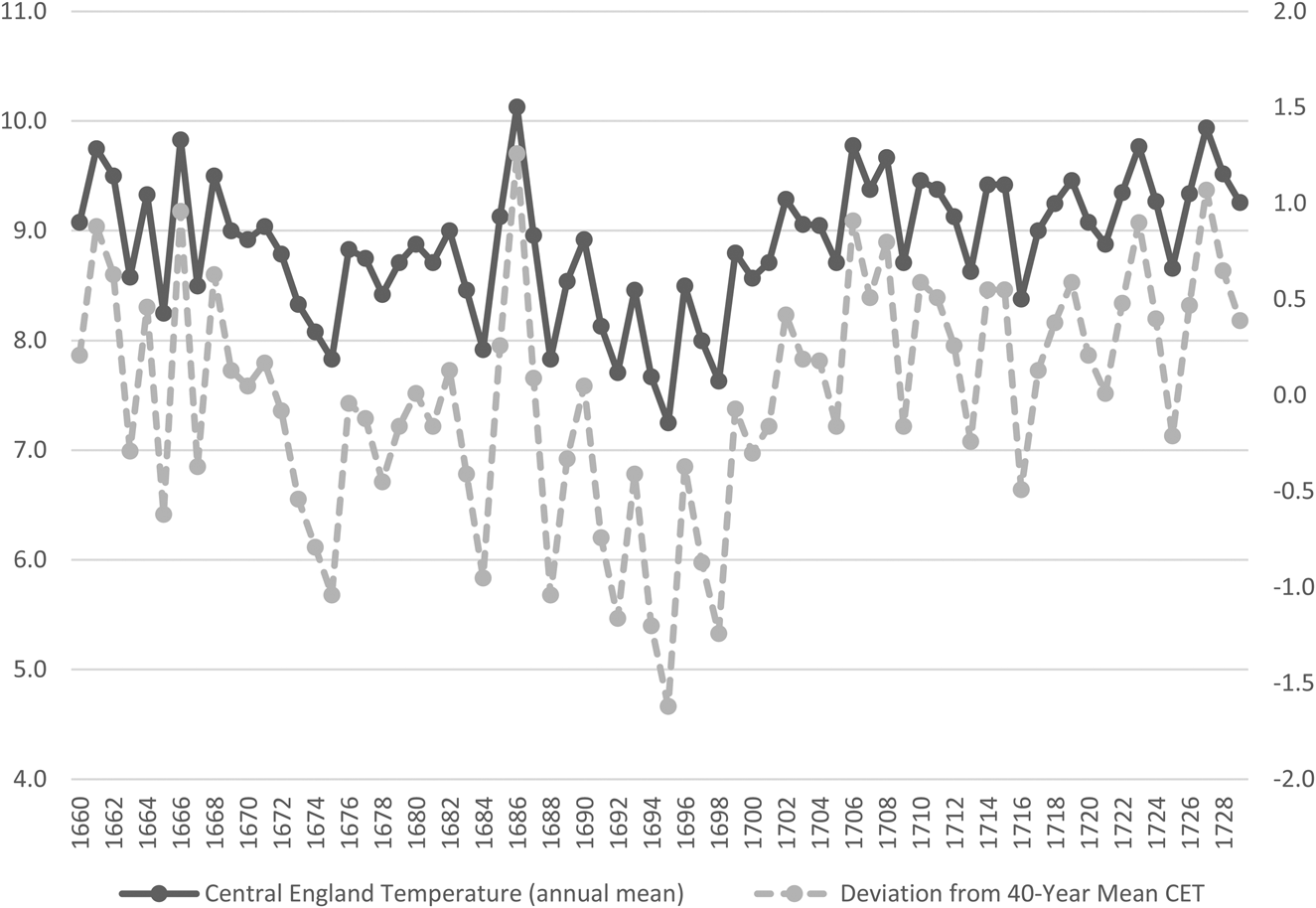
Wood and his contemporaries recorded a litany of meteorological misfortune over the years that followed. The summers of 1693, 1694, 1695, and 1696 were ruined by ‘great Raines’, ‘very wet weather’, ‘unseasonableness’, and ‘continual rains and mists, to the great damage of the harvest’.Footnote 89 The winter of 1694–5 brought such an extraordinarily long frost that ‘the Severity of the Weather’ caused ‘great hardship’, while the next winter was ‘soe severe that all trades are att a full stop’ in Somerset and ‘so exceeding fierce’ that crops were ‘much rotted’ in Surrey.Footnote 90 Then, in December 1697, the fen-dwellers of Yorkshire, Lincolnshire, and Cambridgeshire witnessed ‘the vastest flood that ever they saw or heard’, which broke bridges and banks across many miles of countryside.Footnote 91 The most remarkable weather events of the whole decade must be the May snow storms of 1697 and 1698. At the very moment when green shoots were emerging from the ground, the heavens sent ‘a colde winterly season in the midest of the Spring’.Footnote 92 Storms left snow drifts along with ‘a hard frost and ice thicker than a crown’ in places as far afield as London, Nottinghamshire, and Yorkshire.Footnote 93 The decade seemed to be a long, dark, wintery nightmare – and it measurably was. At the nadir of Europe's ‘Little Ice Age’, this ten-year span was the coldest of any between 1500 and the present day and included four of the six chilliest individual years.Footnote 94 In England, nearly every year of William III's reign was unusually cold (Figure 3).Footnote 95 Those who bewailed ‘very little summer’ and miserable harvest weather in the middle years of the decade were right to think that something was amiss – these summer months were amongst the coolest ever recorded in England.Footnote 96 Late frosts killed young grains and wet summers rotted crops in fields.
Annual temperatures, 1660–1729.

When combined with the disruptive impact of the Nine Years War, failed harvests brought food shortages and high prices. Wheat, the staple breadcorn, was cheap and plentiful on the eve of the Revolution. Afterwards, grain prices began rising and did not stop until they reached levels unseen for decades. Six or seven ‘lean years’ were especially bad: across the kingdom, a quarter of wheat cost roughly double its 1688–9 rate in 1692–3, 1693–4, 1695–6, 1696–7, 1697–8, and 1698–9.Footnote 97 At Norwich, prices in the summer of 1694 and winter of 1697–8 were at least two and a half times those enjoyed in the final months of James's reign.Footnote 98 Other key foodstuffs such as barley, oats, hops, butter, and cheese all reached exceptionally high prices. Although these increases were not as consistent as they were with wheat, one still finds complaints like that from Oxford in March 1694 where ‘All things [were] exceeding deare.’Footnote 99 True plenty only reappeared in England with the harvest of 1701, when the relatively low prices of the 1680s finally returned.
Assessing the countrywide level of dearth understates the human impact. Each region had its own distinct pattern of inflation and averaging them together rounds off the worst of the jagged price peaks. At London, Norwich, Coventry, Eton, Winchester, and Portsmouth, the price of wheat peaked in 1693–4 and returned to these heights again in 1698–9.Footnote 100 In these places, everyone remarked frequently on ‘the dearnesse of provision’ and ‘Scarcity of bread’.Footnote 101 Meanwhile, in Cornwall, Devon, and Somerset, the most ‘Pinching’ grain prices reigned in the second half of the decade, when observers remarked on the ‘very excessive rate’, and barley bread, more popular in this region than elsewhere, also rose in price.Footnote 102 Oatmeal- and rye-eating northerners and Scots were less affected by the scarcity of wheat, but still suffered in the final years of the decade when it was said that ‘corn of all sorts is exceeding dear’.Footnote 103 Despite its highly commercialized agriculture, England was still far from a single, unified market and the internal trade in foodstuffs failed to eliminate regional shortages.
The effects of inflated food prices were predictable. A late seventeenth-century labouring family was typically forced to devote about 80 to 90 per cent of its budget to food and fuel, so when these costs spiked the result was hunger.Footnote 104 Several groups of petitioners from London claimed that the ‘great Scarcity and Dearness of Corn and Bread’ meant that ‘poor Workmen are not able, with their Wages, to find their Families with Bread; so that many have been forced to beg, others to leave their Country’.Footnote 105 Most vulnerable were the poorest of the poor, such as destitute prisoners and paupers, whose survival depended on a fixed allowance from their superiors. At Colchester, a disabled woolcomber named Stephen White was granted 18d per week to maintain himself and his young family, but in 1694 had to sell all his goods and still ‘by reason of the dearnesse of provision cannot Subsist with that allowance’.Footnote 106 Many others who usually managed to get by with a meagre parish pension discovered that they could not make ends meet in the worst years of this decade.Footnote 107
The most extreme outcome was the possibility of starvation. Several contemporaries reported instances of poor people starving in the decade's worst years. According to Tiverton tradesman Richard Newman, hundreds if not thousands nearly died unable to afford food during this ‘Starving Time’.Footnote 108 However, while these anecdotes suggest that the economic turmoil of the decade had fatal consequences for some of the country's most vulnerable, there is no evidence of famine. The national mortality rate did not rise substantially in any year of William's reign, despite the heightened levels of widespread hardship. In Wrigley and Schofield's sample of 404 parishes, less than 2 per cent showed any ‘crisis mortality’ during these years, one of the lowest figures for the whole early modern period.Footnote 109 Although starvation was a real threat to some vulnerable individuals during the 1690s, it was mercifully rare when compared to the Tudor period or to other countries at this time. Other scholars have suggested good reasons for this contrast, including better regional market integration, the resilience of the poor relief system, and increased production of cheaper grains.Footnote 110 Yet the lack of mass mortality should not blind us to the years of widespread hunger that interrupted a period that is more usually considered one of growth and prosperity.
The dearths of the 1690s had some unpleasantly distinctive features. The most stark was the contrast with the previous decade. Even wealthy observers remarked on the contrast, noting that provisions repeatedly reached double or triple ‘the price in ordinary times’.Footnote 111 Also striking are the number of years of elevated prices. England experienced more ‘deficient harvests’ during this decade than any comparable stretch over the early modern period.Footnote 112 Finally, the impact varied significantly across the country. In some parts of the kingdom, the dearth years were brief enough to be bearable, whereas other areas faced truly dire conditions. Still, it is impossible to find a region that made it through unscathed. No matter where they lived, anyone who had to spend most of their income on bread, coal, and other essentials felt the pinch of dearth in the aftermath of the Revolution.
IV
The effects of the economic crisis of the 1690s were worsened by their compound nature. Disrupted trade, rising taxes, financial turmoil, and higher prices were not necessarily threatening when they arrived separately, but became disastrous when they all struck together. In 1693 and 1694, French privateering left trade near its lowest ebb in many years, taxes were higher than ever, and miserable weather ruined harvests.Footnote 113 In early 1697, Oliver Heywood described how ‘Money is scant, trading bad, people are breaking weekly, assessments heavy, [and] poverty comes like an armed man.’Footnote 114 In 1698–9, grain prices jumped and trading was ‘dead’ just as rapid demobilization flooded the roads with penniless men.Footnote 115 Any of these years on their own would be unpleasant enough, but were all the more damaging for the fact that so many ‘ill years’ hit England in such a short period.
In the hard times that followed the Glorious Revolution, middling men and women suffered severe shocks to their trade and business, while labouring people and the poor faced tighter restrictions on their living conditions. Focusing on these specific and local experiences of crisis can reshape our understanding of the wider history of England's economic development in the late seventeenth and early eighteenth centuries. From our present-day vantage point, it is easy to spot the positive long-term trends. With trade expanding and increasingly efficient, consumer goods became more widely available than ever before and the English economy was connected to markets in Europe, Asia, and America.Footnote 116 In finance, credit and investment were booming, leading to the foundation of the first English banks.Footnote 117 The cost of living fell, as population growth slowed and rising agricultural productivity ended sustained inflation. For most of the period between the Restoration and the Hanoverian Accession, real wages and disposable income were rising.Footnote 118 Yet most people who lived through this period lacked the luxury of such disinterested analysis. The 1690s witnessed a crisis with extreme repercussions, within a wider period in which the economic environment has typically been seen as benign.
In one sense, then, this decade of economic turmoil demonstrates the continued precarity of everyday life at the end of the seventeenth century. In retrospect, it may appear obvious that by this time England had escaped the threat of mass famine and was gradually becoming Europe's pre-eminent commercial, financial, and industrial hub. But for most people, the only certainty was the ever-present risk of immiseration.Footnote 119 Scholars studying early modern attitudes to labour, consumption, credit, and charity can learn as much from these moments of crisis – and especially from labouring people's experience of them – as from the long-term trends in real wages or probate inventories.
The disjuncture between the three decades of expansion that preceded the Revolution and the miserable years that followed were what made the crisis such a powerful shock. Indeed, many of the welcome developments since the mid-seventeenth century meant that the problems faced by William's subjects were different from those faced by their Elizabethan and early Stuart predecessors. Years of growth in coastal and overseas shipping meant that the interruption of maritime trade during the Nine Years War affected more people than ever before. English commerce had become reliant on a financial network that had spread so successfully that when both hard cash and paper credit collapsed in 1696, the effects were felt far from London's Royal Exchange. Meanwhile, although a widening group of people benefited from the robust commercial and industrial sectors in the late seventeenth century, without access to land and crops of their own they were more sensitive than previously to the effects of rising prices.Footnote 120 This is not to say that the hard times of the 1690s were worse than the outright famines of earlier decades. The economic growth of the preceding decades made the country more materially resilient when this new crisis arrived – but it also made its effects more diverse, unexpected, and conspicuous.
Acknowledgements
I am very grateful to Charlie Taverner for helping me turn a spawling draft text into something more appropriate for publication as an article, and I also would like to thank Mark Hailwood, Dave Hitchcock, and Steve Hindle for commenting on that initial overlong draft many years ago. Much of the archival research used here was undertaken while I was an Early Career Fellow at Cambridge in 2010–12, funded by the Leverhulme Trust and Isaac Newton Trust, so I am grateful to those bodies for supporting me at that time.