

INTRODUCTION
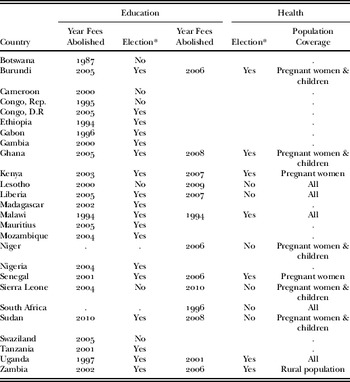
How do capacity-constrained states succeed in abolishing user charges for basic services? Why have more African states re-introduced free primary education than free basic healthcare? Although many states provided free basic services in the initial years after independence, fiscal crises in the 1970s and 1980s led to the introduction of user charges. However, in recent years, 23 African states have re-introduced free universal primary education (UNESCO 2008), while five have completely abolished fees in primary healthcare, and a further seven have removed fees for certain sections of their populations (Yates Reference Yates2009). These policy changes are detailed in Table 1.
Health and education policy changes in 26 African states

* Year before, of or after an election.
Sources: Right to Education Project 2008; UNESCO 2008; Yates Reference Yates2009.
Such successful pro-poor reform is not what we generally expect of African states, often characterised as being dominated by elites who have little interest in welfare-maximising policy changes, and too weak to undertake such substantial reforms. Given that this is the case, or perhaps because of it, there has been very little academic research on the question of why African states want to introduce basic universal services and how they have been able to do so. Although much has been written on the technical design of reform and the impact on human development outcomes, we have a limited understanding of the political processes behind these changes. The paper seeks to address this gap in the literature by looking at welfare reforms in two focused case studies: an inter-sector comparison of education and health policy in Tanzania over time and a ‘least likely’ case of healthcare reform in Lesotho.
The main argument presented here is that the key to overcoming capacity constraints has been the formation of alliances with actors outside the state. Two kinds of alliances are investigated: those with donors, who provide the money needed to introduce reforms, and those with existing non-state service providers, such as religious organisations, whose infrastructure can be used to bridge capacity deficits. These alliances help to explain not only how some countries have been able to remove fees, but also why there has been a more extensive introduction of universal primary education compared with healthcare. Alliance opportunities have been greater in education, where donor policy preferences have converged around the principle of universal primary education (UPE).
The paper seeks to make a contribution to the overarching debate on the nature of the influence of external actors in the political economy of African countries. This debate has generally been characterised by two broad positions – one arguing that external actors, particularly donors and the International Financial Institutions (IFIs) have played a pivotal role, imposing structural adjustment and conditionalities on African states in ways that are central to explaining their difficulties (see for example Bourguignon et al. Reference Bourguignon, de Melo and Suwa1991; Adepoju Reference Adepoju1993; Mosley & Weeks Reference Mosley and Weeks1993; Lall Reference Lall1995); and another that posits that external actors have been relatively impotent in the face of prevailing political institutions and unable to change the behaviour of political elites (van de Walle Reference Van de Walle2001). The first position can be charged with attributing too little agency to African states and too much to donors, and the other with the opposite criticism. By contrast, the argument here is that African states can be alliance-makers, not merely recipients, and that donors can be enablers, not simply omnipotent actors imposing their will. By seeing these reforms as alliances, it becomes possible to explore the ways in which both actors exert agency, and to perceive more clearly where their interests diverge and overlap.
The paper proceeds as follows: the first section looks at existing explanations for welfare reform. The second section presents the theoretical argument about the importance of alliances with external actors in helping states overcome capacity constraints. It also charts the ways in which alliance opportunities vary both across states and across social sectors. The third section presents the empirical analysis, using the two in-depth qualitative case studies. The first case study uses an inter-sector comparison of health and education policy in Tanzania over time to illustrate the ways in which capacity considerations have impinged on policy decisions, and how opportunities for alliances with donors have varied across sectors. The second case study presents a ‘least likely’ case of healthcare reform in Lesotho that shows how alliances with non-state providers enabled the government to remove fees for primary healthcare, in spite of many challenges, including the AIDS epidemic. Finally, the paper concludes with some thoughts on the implications of the findings for how we understand African states, and on how donors can assist in the state building process.
EXISTING EXPLANATIONS OF WELFARE REFORM
There is a dearth of literature on emerging welfare regimes in the least-developed countries, in general, and African states, in particular. Although quite a lot has been written about welfare policy reform in middle-income countries in Latin America and East Asia (for example Mesa-Lago Reference Mesa-Lago1997; Brooks Reference Brooks2009), most discussions of social policy in the least developed countries have focused on the issue of spending.Footnote 1 These studies have been mostly concerned with the impact of globalisation on social spending, and whether or not economic openness and integration have depressed or stimulated social spending in the developing world (Kaufman & Segura-Ubiergo Reference Kaufman and Segura-Ubiergo2001; Rudra & Haggard Reference Rudra and Haggard2005).
However, a number of important studies have looked at recent welfare reform in Africa and argued that democratisation has played a key role (Stasavage Reference Stasavage2005a, Reference Stasavage2005b; Carbone Reference Carbone2011). Stasavage argues that, in light of democratisation, the introduction of universal primary education has become a powerful tool in mobilising poor, rural voters (Stasavage Reference Stasavage2005a, Reference Stasavage2005b). He points out that as the median voter in almost all African states is poor and living in a rural area, policies that appeal to this constituency will deliver high political returns. Carbone argues that political competition has played a crucial role in bringing about recent health policy reforms in Ghana (Carbone Reference Carbone2011). In each of these studies, democracy – through the mechanism of electoral competition – has played a critical role in triggering universal reforms in both the health and education sectors.
It is certainly the case that the announcement of welfare reforms has often coincided with elections. As can be seen in Table 1, the re-introduction of free primary education was announced the year before or after an election in 18 of the 24 countries who have introduced UPE. Of those who have made primary healthcare either completely or partially free, the decision was announced the year before or after an election in seven of the 13 countries. Even in countries with limited amounts of political competition, such as Uganda and Tanzania, there would seem to be high political returns for introducing universalism in both sectors.
However, it is also the case that, of the countries in Table 1, only two are deemed by Freedom House to be ‘free’ (South Africa and Ghana). Most are ‘partly free’ and some are classified as ‘not free’ (Cameroon, Swaziland, Republic of Congo). This may be because autocracies can also have incentives to improve public welfare (Olson Reference Olson1993; Wintrobe Reference Wintrobe, Boix and Stokes2007). It may also be because of ‘neighbourhood’ effects: policy changes in neighbouring countries may generate pressure on governments, regardless of regime type. It is striking that there are clusters of similar reforms in neighbouring countries with quite different party systems and levels of political competition – for example, Uganda (one party presidential system), Kenya (multi-party presidential system) and Tanzania (dominant party presidential system) have all introduced free primary education. Although the political returns to these policy changes would seem to have increased in light of the continent-wide moves towards democratic opening, democracy may not be the only important variable in precipitating reform.
Historical institutionalist accounts of the evolution of universal service provision in the now developed countries provide an alternative lens for understanding these processes. While the institutions of the regime are important, emphasis is also placed on the institutions of the state itself: the bureaucracy, judicial system, military and revenue-raising institutions that provide the government with the capacity, and power, to execute their will. While regime type can tell us much about the incentive structures which politicians operate within, the material and institutional capacity of state structures determine what is feasible and how those incentives can be acted upon. As Theda Skocpol has argued in relation to social policy making in the USA in the late nineteenth/early twentieth century, ‘if a state possesses no existing (or readily adaptable) capacities for implementing given lines of policies, politicians are not likely to pursue them’ (Skocpol Reference Skocpol1992: 42). It was the stronger states in Europe, such as Germany and Austria, who led the way in terms of early welfare provision (Flora & Alber Reference Flora, Alber, Flora and Heidenheimer1981). While having a strong state did not guarantee that the state would take on these tasks, it did mean that they constituted viable options available to politicians.
Drawing a distinction between what governments may want to do, and what the state can do centres attention on the critical ways in which sequencing can determine welfare state outcomes. As the work of Skocpol and others suggests, where the establishment of a competent Weberian bureaucracy preceded mass democratisation, welfare effort was more extensive (in the sense of population coverage) and, in time, more intensive also (Kamens Reference Kamens1986; Skocpol Reference Skocpol1992). In the USA, where democratisation happened first, welfare provision became part of the system of political clientelism, making its benefits partisan and creating greater resistance to its extension. Yet, the introduction of early welfare reforms was also itself, in many cases, a pre-emptive move on the part of elites, anticipating, and trying to assuage demands for, participatory rights (Flora & Alber Reference Flora, Alber, Flora and Heidenheimer1981). This literature emphasises how the interplay between issues of capacity and of democracy impact on the forms of welfare regime which emerge.
Viewed through this theoretical lens, most African countries are democratising in the context of weak state capacity. However, the recent introduction of free education and health services by many African countries, would seem to contradict the theoretical predictions the historical institutional literature provides; many countries have re-introduced universal welfare despite having democratised before building up strong state capacity. Although they are capacity-constrained states in poor, predominantly agriculturally based economies, they have introduced major reforms with significant, long-term implications. The historical institutionalist analysis may be right in emphasising the importance of supply side capacity factors in determining the state's ability to undertake welfare reform, but African states with severely limited capacity have still introduced reforms. Can the mismatch between theory and observed outcomes be explained, or is the extension of this theoretical lens to Africa incorrect?
The literature on welfare reform in the now advanced countries is almost exclusively focused on internal actors and institutions. If states needed or wanted to make changes to welfare policy, they had to look within their own existing resources. There were few external sources of support available to them. One of the most significant differences between this scenario and that faced by most African states, is the large role played by external actors in their political economy (Clapham Reference Clapham1996). The historical weaknesses of African states have resulted in high levels of involvement from international aid agencies, missionaries, and NGOs and this, ironically, has presented these states today with opportunities to circumvent their capacity constraints, opportunities that were not available to the developed countries in the past. The next section presents an account of how African states have used alliances with actors outside the state to boost their capacity to the point where they could remove user charges for basic services. In doing so, it draws on the theoretical emphasis of historical institutionalism on the importance of state capacity, but extends the understanding of capacity by taking into account the relationship between the state and external actors.
USING ALLIANCES TO INCREASE STATE CAPACITY
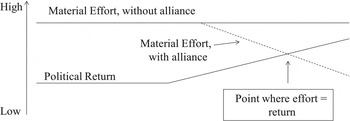
When considering the possibility of welfare reform, politicians can choose to uphold the status quo and continue charging, or they can abolish fees and realise a high political return, made possible by a rapid expansion of capacity that then becomes sustained over time. The decision, then, can be thought of in terms of an equation; on one side there is a political return that would result from reform, such as increased votes; on the other, there is the material effort, in terms of additional investment and enhanced capacity, required to make the change.
A policy change will only happen at the point where the material effort required to make that change is equal to the political return to be realised from a change. Even if the potential return is high, as the studies discussed above argue it to be in light of democratisation, if the material effort required exceeds it, the government is unable to contemplate policy change. It requires a lowering of the effort required, to create a point at which return equals effort.
The abolition of user fees is a policy reform that appeals to politicians as it generates a particularly high political return. Voters have been noted to reward politicians seen to be delivering public goods (Lindberg & Morrison Reference Lindberg and Morrison2008), but in the context of poor state capacity and low information, they can have difficulty directly attributing the actions of politicians to concrete outcomes in service delivery (Stasavage & Harding 2011). The abolition of fees is particularly attractive to politicians as it is a policy action that has an immediate and visible effect that can be directly attributed to the politicians who announced it. This is less true of other policy commitments, such as, for example, a promise to improve school quality – which is difficult to carry out and harder to attribute.
Although the political return may be high, removing fees for health and education services also requires a high degree of material effort, as it has been observed to produce an upsurge in the numbers accessing services. The abolition of fees in primary schools in Malawi in 1994, led to an immediate increase in enrolment of 51%, while two years later, in Uganda, enrolment soared by 70% when UPE was introduced (Kattan & Burnett Reference Kattan and Burnett2004: 8). It is this, more than the lost revenue, which makes the abolition of user fees a daunting prospect for the state. It means that the state has to either invest intensively in building new schools, health centres, training etc., or find new ways to bring the existing infrastructure of non-state providers within the public provision sector. Either way, it demands that the state expands quite dramatically, in a short space of time, requiring considerable effort to plug the infrastructure deficits that removing fees both creates and exacerbates.
While the removal of fees in both sectors requires an expansion of capacity, the requirements for healthcare are even greater in health.Footnote 2 The physical infrastructure required to deliver even the most basic levels of healthcare is considerably greater than in education. While schools can deliver a basic service with minimal equipment (desks, textbooks and blackboards), health centres and hospitals require sterilisers, fridges, operating theatres, diagnostic laboratories, X-ray machines, vehicles to transport patients etc. The main input for health, drugs, are also more valuable and so prone to ‘leakage’ (McPake et al. Reference McPake, Asiimwe, Mwesigye, Ofumbi, Ortenblad, Streefland and Turinde1999). This means that the capacity constraints are even higher in healthcare than education, meaning that an alliance is even more necessary for the state, if they are to overcome their capacity constraints.Footnote 3
Without the resources within to bridge capacity deficits, African states have had to use alliances with actors external to the state to make change possible. To return to the equation of return versus effort discussed above, without an alliance the effort required to make a change exceeds the return by too great an amount for it to be feasible. But with an alliance, which lowers the material effort required, a point can be reached where return is equal to effort, as illustrated in Figure 1.
The Political Return and Material Effort for policy change, with and without an alliance.

In looking for ways to bridge the material gaps produced by the abolition of fees, states have to seek out alliance partners within the existing web of non-state actors within service provision. In most developing countries a complex ‘aid chain’ of these actors is involved in the delivery of many basic services (Wallace et al. Reference Wallace, Bornstein and Chapman2006). At the top of the chain are the donors, who provide funding both directly to governments, through general budgetary support or sector basket funds, which is used directly to fund public providers, but they also provide funding to non-state service providers, such as religious organisations or NGOs, who run private facilities. Conceived in this way, there are two main alliance partners available to states: donors and non-state providers.
The different roles that these actors play in the chain have important implications for the kinds of alliances that can emerge: if states form an alliance with donors, they can use donor funding to expand existing public provision to meet rising demands created by fee abolition; if states form an alliance with non-state providers, they co-opt the latter's provision infrastructure and use it to plug the gap between demand and supply created by the removal of fees, replacing donors as their main funder. Both of these kinds of alliances lower the material effort required and enable the state to consider making a policy change.
Challenges and opportunities for alliance formation
If the formation of alliances is critical to the state's ability to introduce universal services, what then are the determinants of its ability to form these alliances? Alliances involve two parties, and the ability of the state to negotiate with donors or non-state service providers critically depends on the character and preferences of these potential allies. Although donors and non-state providers are key players in all countries, who they are and how they operate can vary. Individual donors have different policy preferences, modes of operation and accountability requirements. African states, though for the most part aid dependent, have different donors to deal with: while multilaterals may dominate in countries like Lesotho, bilateral donors – often in the form of former colonial powers – are important in others, like Cameroon (where both French and British aid agencies play a significant role). Policy preferences between both multilateral and bilateral agencies can vary significantly. Although donor coordination has improved since the Paris Declaration, donor policy preferences in the social sectors still vary considerably (discussed at length below). Equally, non-state providers in different countries vary in their character and degree of coordination. For a non-state provider to be a viable partner for the state in effectively rolling out universal services, it needs to have a countrywide presence, but also a high degree of central coordination: the state needs to have someone to negotiate with.
These patterns of variation mean that each state faces a different web of credible partners with whom it can potentially form alliances. For a state to form an alliance with donors there must be both a convergence in policy preferences among donors and between donors and government. For a state to form an alliance with non-state providers there must be a high degree of coordination among non-state providers, and operational incentives for the non-state provider to enter the alliance. The existence, or absence, of these conditions can help to explain why some countries have been able to abolish fees, while others have not.
To show that this is the case, the paper exploits the differences between the health and education sectors noted in the introduction. Within the same country, with the same donors, there have in many cases been differences in the ability of the state to find alliances to provide universal services in education as compared with healthcare. While the constellation of donors existing in each country varies, donor preferences are more or less constant across countries, with the same agencies following the same policies in different settings. If these preferences vary across sectors this constitutes a systematic source of variation that shows how it is only when the preferences within donors and between donors and governments converge, such as in education, that alliances are formed. Where donor convergence has not happened, such as in health, governments must seek alliances with non-state providers, the key variable here being their degree of organisational coordination. The key variation, then, explaining the differences between sectors is the degree of convergence in donor policy preferences and the degree of non-state coordination.
The policy preferences of donors: convergence in education, fragmentation in health
Charting the evolution of stated donor policy preferences in the social sectors over the last two to three decades, a divergence between health and education becomes clear: while donors have converged behind the principle of universal primary education for all, they have become more fragmented in the area of health, into specific foci on particular aspects of health.
The policy preferences of donors on the issue of cost sharing in primary education converged over the course of the 1990s behind the elimination of fees. The ‘Education for All’ movement was launched at a conference in Jomtien in 1990. The declaration resulting from the conference emphasised the need for ensuring universal access but stopped short of explicitly calling for education to be free, emphasising instead the need to ‘mobilise existing and new financial resources, public, private and voluntary’ (UNESCO 1990: Article 9:1). The Dakar Conference in 2000, which followed up, and assessed progress on, the Jomtien Declaration, went further, specifying that education for all could only be achieved when ‘all children have access to complete, free and compulsory education’ (UNESCO 2000: Article 7(ii)). One hundred and sixty-four countries signed up to the Dakar Framework for Action, which reflected and further reinforced an unprecedented level of consensus, not only on the importance of universal primary education as an objective, but also specifically on free education as the best way to achieve it.
This kind of convergence behind free provision has been largely absent in the area of health. The Alma Ata Declaration of 1978 introduced the equivalent concept of ‘Health for All’ and set an ambitious goal of aiming to ensure ‘the attainment by all peoples of the world, by the year 2000, of a level of health that will permit them to lead a socially and economically productive life’ (World Health Organization (WHO) 1978: Article V). The Declaration did however acknowledge that this would have to be done ‘at a cost that the community and country can afford to maintain at every stage of their development’ (Article VI). The support for some kind of user charges became more explicit in the Bamako Initiative of 1987, which advocated the use of user fees, in combination with other sources of funding (Knippenberg et al. Reference Knippenberg, Nafo, Osseni, Camara, El Abassi and Soucat2003). Throughout the 1980s, the World Bank, in particular, advocated charging users of ‘publically provided health services’ as part of a general objective of ‘shifting some of the burdens of financing from the public sector to the beneficiaries (households)’ (Akin et al. Reference Akin, Birdsall and De Ferranti1987: 25). Although the Bank declared in 2004 that it had ‘no blanket policy on user fees’ (World Bank 2004), there has been no equivalent of the Dakar Declaration, linking the objective of universal access with the policy instrument of free provision.
The Millennium Development Goals (MDGs) of 2000 both reflected, and further reinforced, the differing levels of consensus among donors between the two sectors. Two goals refer specifically to education: the second goal, which commits to ensuring that ‘children everywhere will be able to complete a full course of primary schooling’ and the third goal that targets the ‘elimination of gender disparity in primary and secondary schooling’ (United Nations 2000: Article 19). This commitment to universal primary education does not have an equivalent in health.Footnote 4 Unlike the Alma Ata Declaration which envisaged primary healthcare in a holistic way, the MDGs focus on a number of specific aspects of health: child and maternal health, and combating AIDS, malaria and other diseases. While donors have moved towards convergence around free universal primary education, they have fragmented into specific foci in healthcare, and an emphatic commitment to free provision has yet to emerge.
This section has made three core arguments. Firstly, that the decision about whether or not to abolish fees is underpinned by a rational calculation about the likely political return from any change, and material effort required to make that change. In most African states, although the return to bold policy actions, such as introducing universalism, has been increasing, the material effort required to make changes has remained insurmountable. Secondly, alliances with donors and non-state providers give states ways of lowering the effort required and thus contemplating change. But, thirdly, the ability to do so depends on the character, degree of coordination and preferences of potential partners, which varies across countries and across sectors. The empirical section below leverages this variation to explain both inter-sector differences within one country, and intra-sector differences between countries.
TWO CASE STUDIES OF UNIVERSAL SERVICE REFORM
The following section presents two qualitative case studies to illustrate the arguments made in the theoretical section above. In the first, an inter-sector comparison between health and education policy in Tanzania over time, is used to show how varying alliance opportunities existed for the state, due to policy preference differences among donors, and leading to different policy outcomes in health and education. In the second, Lesotho constitutes a ‘least likely’ case for the abolition of fees in healthcare, demonstrating how states can form alliances with non-state service providers, but only when these providers are coordinated. Both are based on fieldwork conducted in 2009, involving semi-structured, key stakeholder interviews with donors, civil society and government officials. Where possible the interviewees are named, though a number requested anonymity on the grounds that the information was diplomatically or politically sensitive. The interviews were triangulated with policy documents and detailed process tracing was used to establish the causal chain of events.
Primary health and education services in Tanzania
Upon independence in 1961, the Tanzanian state committed itself to the provision of free and easily accessible basic health and education services. Four decades later, the state now provides free services only in primary education, while user fees have been introduced in basic healthcare. How can we account for the attrition of the state from its role in service provision in certain sectors but not others? As argued below, the changes in the state's policy position reflect, on the one hand, the shifts in the political incentive structures brought about by democratisation and, critically, changes in the capacity of the state to provide basic services. In the face of severe state incapacity, the Tanzanian state has used alliances with donors to provide free universal education, but has not been able to do the same in healthcare.
The ambitions of and constraints on the state
Dating from the commitment to socialism outlined in the Arusha Declaration of 1967, the Tanzanian state ideologically adhered to the principle of providing free basic services in health and education. As Nyerere made explicit in his ‘Policy of Education for Self Reliance’, education was seen as a critical tool in creating an egalitarian, socialist society, and in fostering development. The Musoma Resolution of 1974 underscored universal primary education as a key objective and the Education Act of 1978 made it compulsory for all children to study for seven years (United Republic of Tanzania 1995: ii). Health, equally, was seen as a right, and a prerequisite, for individual and collective development.
In a poor country with a dispersed, predominantly rural population, the key policy action needed to turn these objectives into reality was making services free and easily accessible. The government committed to making basic education and healthcare free for all, and large amounts of money were invested in the infrastructure of the health and education systems. Equitable provision of social services was a key part of ujaama, and the villagisation process, moving dispersed population into newly constructed settlements, enabled more effective service delivery (Kaiser Reference Kaiser1996). The number of health facilities had increased from 897, at independence, to 2,746 in 1991 (World Bank 1999: 117). Strict criteria as to where facilities were to be located aimed to ensure that this investment improved access broadly across the population (Benson Reference Benson2001: 1905). By 1978, 90% of the population lived within a 10 km walk of a health facility, up from 76% of the population in 1972 (Thomas Reference Thomas1983).
The state also aspired to become the only provider of social services. Denominational schools were nationalised, making the government almost solely responsible for education provision (Oketch & Rolleston Reference Oketch and Rolleston2007: 146). Although non-profit facilities run by churches and charities were allowed to exist and charge fees, for-profit hospitals were banned in 1977. By 1980, primary enrolment rates had risen to 96%, from 39% in 1970 (World Bank 2011), and the government could legitimately claim that it was providing near universal education. The 1970s saw the newly independent state commit to, and take on, the task of delivering free basic education and health services to the Tanzanian population.
The cost of this level of provision was substantial and, as Tanzania's economic situation deteriorated during the 1980s, the state's ability to maintain social services came under strain. In 1980, government spending on education was 5% of GDP but tax revenue at the same time was only 11% (World Bank 2011). The borrowing needed to sustain spending, in the face of low economic growth and revenue collection, led Tanzania further and further into debt. Similarly in health, the high rates of increase in spending year on year in the 1970s – on average 25% – could not be sustained into the 1980s, when they dropped to 11%, at a time when inflation was running at an average of 35% (World Bank 2011).
As the 1980s went on, the government was increasingly unable to maintain spending. The oil crises and commodity price shocks of the 1970s, in addition to the war with Uganda in 1978–9, had left the country with huge debts. Nyerere introduced two ‘self-imposed’ austerity programmes – The National Economic Survival Programme and their own Structural Adjustment Programme – to try to avoid going to the IMF for loans. Within this context the burden of the costs of education and health began to shift from government to parents, with informal payments becoming increasingly common (Galabawa Reference Galabawa2001). One estimate has suggested that before the 1980s, parents were bearing 33% of the cost of education and the government 67%, but that over the next 10 years parents’ share increased to 57% (Galabawa Reference Galabawa2001: 25). The government, now led by Nyerere's successor, Ali Hassan Mwinyi, who embraced liberalisation to a greater extent, finally entered into an IMF Structural Adjustment Programme in 1986.
The increasing cost, and deteriorating quality of public services, contributed to worsening education and health outcomes. Primary school enrolment rates in 1990 had dropped to 69%. From 1987, life expectancy went into decline and the maternal mortality rate from 1987 to 1996 was 529 out of every 100,000 live births (Demographic and Health Survey (DHS) 1996: 137). One of the contributing factors to this high level was the declining number of women delivering at health facilities: due to high costs and diminishing standards, by 1991/2, only 53% of women were delivering at facilities (DHS 1991: 84). Over the course of the 1980s it became apparent that the government's fiscal capacity was insufficient to sustain its ideological goals and policy commitments.
In light of the limits of state capacity which the 1980s had exposed, the government was forced to reconsider its position on free social services. By 1995, as enrolment rates continued to decline, the government finally announced that ‘given its limited domestic resource base, the government now advocates the introduction of cost recovery and cost sharing mechanisms where applicable’ (United Republic of Tanzania 1995: xi), and fees for primary education were formally introduced. In 1991, the government lifted the ban on for-profit healthcare, allowing private provision to emerge and in 1995 proposals for reform of the health sector were launched in an effort to redefine the government's role from being the near sole provider of healthcare to becoming a facilitator (Burki Reference Burki2001). The emphasis on equity and access, which had dominated healthcare discussion in the 1970s, was increasingly superseded by greater focus on issues of quality and management systems. Among the main reforms was the introduction of user fees.Footnote 5
While the government later admitted that ‘the principle and practice of cost sharing was accepted with mixed feelings’ (United Republic of Tanzania 2001: 41), the constraints of state capacity left little alternative. By 1995, the education sector required investment beyond what the government could provide. The number of schools had declined from 10,960 to 10,891, a relatively small decrease that might not have been significant if population growth had been less pronounced. With a fertility rate of 5·8 from 1993–1996 (DHS 1996: xvii), the population was rapidly growing and by 2000 the number of school-age children (age 7–13) had increased by over a million from 5·3 million in 1990 to 6·8 million (United Republic of Tanzania 1999). Population pressures also put a severe strain on health services. Increasing demand and limited supply, within the context of severe fiscal constraint, left the government with little choice but to put more of the burden of education on parents, and of healthcare on patients. Even a state as committed to the principles of free basic services as Tanzania, had to forgo its ideological ambitions in light of its material and capacity constraints.
Democratisation and changing political incentives
The shift towards fees coincided with the first multiparty election in Tanzania in 1995. Since the early 1990s, under pressure from donors and with direction from Nyerere, who acknowledged the inevitability of political opening in light of the end of the Cold War, the state had been moving towards multiparty democracy (Kensall Reference Kensall2002). Although Nyerere's party, Chama cha Mapinduzi (CCM), retained 80% of the seats in the parliament and their presidential candidate, Benjamin Mkapa, won with just under two-thirds of the vote, the dynamic of politics changed significantly after 1995. Under Nyerere, political power and advancement had depended to a greater extent on loyalty to the president and ideological commitment, rather than the ability to control and distribute resources. Patronage was present but limited, as the highly centralised party structures kept a lid on unofficial channels of redistribution (Hyden Reference Hyden1983: 43). Decisions about the location of schools and health centres were taken according to strict, needs-based criteria (Benson Reference Benson2001: 1905), which meant they were not used as a political resource for patrimonial purposes. The political return for providing health and education services accrued centrally, to the CCM, rather than locally to individual politicians.
The advent of multiparty elections changed this dynamic, though the trend was already beginning with Nyerere's retirement in 1985. Even though there was limited political competition, politicians had to be seen to be bringing benefits to their constituencies. The political payout for policies with mass appeal to poor rural voters increased (Stasavage Reference Stasavage2005a).
These changes in political return structures happened in the context of crises in the social sectors. The re-introduction of fees had done little to ameliorate the problems within both health and education. Enrolment rates remained on average 67% (World Bank 2011) of an ever-increasing number of children. By 2000, the government estimated that there existed only 57% of the classrooms required to meet this demand (United Republic of Tanzania 2000: 4). In health, life expectancy continued to decline, and the 1999 DHS showed a slight increase in the number of maternal deaths (DHS 1999). Two NGO reports, one by a Tanzanian NGO, Maarifa ui Ufunguo, focused on education and one by Save the Children focused on health, released in 2000 and 2004 respectively, highlighted that fees in both sectors were acting as a barrier to entry for the poorest (Maarifa ui Ufunguo 2001; Save the Children 2004). These reports generated considerable publicity, putting pressure on the government to reconsider its position.
At the start of the new century, there was a clear crisis in both sectors and growing pressure from civil society and the electorate for the abolition of fees. Yet there has been a difference in policy outcomes. In March 2001, fulfilling an election promise, President Mkapa announced the re-introduction of free primary education (Globe & Mail 2001). But in healthcare, the government has remained committed to cost-sharing. The same government, at the same moment in time, faced with same set of resources and an equal ideological commitment to both sectors, decided to abolish fees in education but not in healthcare. Why was this the case?
Differing alliance opportunities
2000 witnessed the second multiparty election held in Tanzania. Although electoral competition was not very high, with Tanzania still being effectively a one-party state, there was some pressure on the party to be seen to be pro-poor.Footnote 6 Mkapa had begun his presidency with strong reformist credentials, bringing new faces into politics, and setting up a number of anti-corruption agencies (Kensall Reference Kensall2002). Yet, his first term had delivered few serious achievements. In the words of one civil society observer, the promise to remove school fees ‘was definitely a vote winner’ (Dyer 2009 int.). The context of the election meant that the policy change would yield a particularly high political return for the government.
However, the removal of fees would not have been feasible without the help of donors. The introduction of universal primary education was made possible by a $150 million loan from the World Bank, which came in the form of debt relief for the social sectors. The donors, especially the Bank's new country director who had recently arrived from Uganda, were very keen that the debt relief be used for removing primary school fees (Civil Society Representative 2009 int.; Donor Representative 2009c int.). From their point of view, the Millennium Development Goals (MDGs) had given renewed emphasis to the social sectors and universal primary education received particular attention through the second MDG and the Dakar Declaration on Education for All. After the success of the policy in increasing enrolment rates in Uganda and Malawi (Kattan & Burnett Reference Kattan and Burnett2004), it was a policy change that was seen to yield results.
The loan was used to plug the capacity gap that removing fees created. The year after fees were abolished, enrolment rates increased from 58% to 74%, and by 2006 had reached 98% (World Bank 2011). To meet this surge in demand the state needed to build schools, train teachers and supply books. According to the government, 3,751 new primary schools have been built to try to attain the target of having one primary school in each village, 45,796 new teachers have been recruited, and the increased supply of textbooks has led the book-to-student ratio to improve from 1 : 20 in 2000, to 1 : 3 in 2007 (Simwanza Sitta Reference Simwanza Sitta2007).
The immediate and striking results of the policy change had a strong, positive impact on public opinion. A perceptions survey of social services conducted in 2003 by a leading research institute in Dar es Salaam, found that 52% of respondents reported improvement in basic education across a number of indicators (Research on Poverty Alleviation 2003: 29). Ninety per cent of respondents felt that the reason more people were sending their children to school was because of the abolition of school fees (Research on Poverty Alleviation 2003: 28). In 2004, when asked in the Afrobarometer opinion poll surveys whether or not they were satisfied with the government's handling of addressing educational needs, 84% of respondents agreed that they were fairly or very satisfied. The policy change made an immediate impact, and gained high recognition from the electorate.
By contrast to the improved perception of education services, the view of healthcare was poor. The same survey quoted above, found that only 31% reported an improvement in basic healthcare (Research on Poverty Alleviation 2003: 36); 78% felt that the affordability of healthcare had deteriorated (Research on Poverty Alleviation 2003: 33). Why did the government not abolish fees for primary healthcare, when the introduction of universal primary education had been such a success?Footnote 7
The removal of fees for primary education had been made possible by a loan from the World Bank. No such loan was offered to the Tanzanian government to remove fees in primary healthcare. The donors who constituted the Donor Partners Group on Health, held differing views on the issue of user charges. Only two members, the UK's Department for International Development (DfID) and UNICEF, were open advocates for the removal of fees. The World Bank, which had become a major supporter of removing fees in education, had a far less emphatic position on healthcare. Most of the other members also held ambiguous stances. A representative from one of the large bilateral donors reported asking Head Office for an official position on the issue, but did not receive one (Donor Representative 2009b int.). Unlike in education where most countries had signed a public commitment to universal education, a minority of donors had a clear position to support the removal of fees in healthcare.
The support for the removal of fees in health was further damaged when one of the policy change's few advocates, DfID, lost a considerable degree of influence with the government. In 2002, as part of a broader policy shift, DfID switched from providing funding for particular sector basket funds,Footnote 8 to General Budgetary Support. This meant that money was no longer earmarked specifically for health, but went into the overall government budget. As a result, in the words of one donor observer, ‘DfID stopped being a major player in health’ (Donor Representative 2009a int.). This was particularly significant as, the same year, the government held a major conference on the issue of cost sharing. The donors did not push the issue of removing fees, or offer bridging financing.Footnote 9 The National Health Strategy which was published the following year, declared that ‘the function and coverage of the various cost-sharing initiatives will be greatly strengthened and enhanced to contribute to the resource envelope of the sector, whilst at the same time protecting the poorer members of society’ (United Republic of Tanzania 2003: 52). Without an alliance with donors, removing fees was not a feasible option.Footnote 10
The Tanzanian case shows both the limits that state capacity creates and sheds light on the conditions under which, and the reasons why, those constraints can be overcome. At independence, the Tanzanian state committed itself to providing free education and healthcare. Impressive advances were made in enrolment and healthcare in its first two decades. From 1985 onwards, after Nyerere's retirement, in the context of economic crisis and eroding state capacity, maintaining free services became untenable. In the same year that multiparty elections were introduced, the government was forced to introduce fees in both sectors. Even a state as demonstrably ideologically committed to free social services as Tanzania, had to adjust its ideals in light of its capacity constraints, and though the introduction of elections raised the political returns further, it was not a sufficient condition for sustaining universal services.
Without a way to overcome capacity constraints, the government could not contemplate a policy change. In the early 2000s, however, this situation changed, as donors, galvanised by the Millennium Development Goals, offered a loan for introduction of free universal primary education. This enabled the government to contemplate a policy change that otherwise would have been difficult for the state to undertake. In the context of multiparty elections, new schools, free education and higher enrolment constituted a considerable political win for the CCM, achieved with a relatively modest loan from the World Bank. A similar loan was not forthcoming to support universal primary healthcare. Most donors had no clear position on the issue, and those that did had reduced influence in the area of health. Without financial support from donors a move to abolish fees was not a viable possibility for the state to entertain, and cost-sharing has persisted.
The introduction of universal primary healthcare in Lesotho
If donors’ policy preferences in health have not clearly converged around universal services and health is a significantly more difficult task for the state, then how has any African state been able to make primary healthcare free? Lesotho is one African country where fees for primary healthcare have been abolished and in many ways it was a ‘least likely’ case for this policy change to happen: its low population density and mountainous terrain mean that offering health services covering the whole population is difficult. The challenge is compounded by the country's AIDS crisis: an estimated 23% of the adult population is HIV positive (World Bank 2011). Improving healthcare, which is a difficult task in the best of circumstances, is even more challenging in a poor, low-capacity state dealing with a serious and ongoing epidemic. The effort required to abolish fees was very high in Lesotho: how then can we account for the fact that they did so?
Alliances with non-state service providers
In 2007 the largest party in Lesotho, the Lesotho Congress for Democracy (LDC), made an election promise to abolish fees, which they followed through on in 2009. They were able to do so because they reached an agreement with the Christian Health Association of Lesotho (CHAL), an umbrella body representing the religious organisations that run health facilities in Lesotho. As a direct legacy of missionary activities, CHAL members run 40% of all facilities in Lesotho, many of them in the remote rural areas where government services are absent. The alliance that the government formed with CHAL, whereby the government agreed to pay the wages of staff at CHAL facilities if they provided services for free, increased the capacity of the government in the health sector, as the state instantly almost doubled the amount of facilities providing public services. This lowered the level of constraint needed to abolish fees, which combined with the high political return for the policy change, made it both feasible and desirable for the government.
An escalating health crisis throughout the 2000s formed the context for the government's decision to abolish fees. While some improvements in health outcomes had been made in the 1990s, Demographic and Health Survey results from 2001 and 2004 revealed reversals in the positive trends (DHS 2004). Life expectancy, which had increased in the 1990s to 59 years, had dropped to 54, according to the 2001 DHS. Infant deaths had dropped to a level of 75 per 1000 live births in the 1990s, but climbed again to 91, in the 2004 DHS.
The major context within which these reversals took place was the AIDS epidemic, which put a strain on existing resources and brought an influx of donor money. The crisis put additional demands on the already capacity-constrained health sector: in 2002 there were approximately 535 AIDS patients for every physician, and the cost of providing anti-retroviral drugs was several times the average per capita health spending (WHO 2004: 1). The severity of the crisis brought an influx of donor funding: in 2001/2 Lesotho received external funding for AIDS of US$5.3 million, half of the overall health budget and 90% of all expenditure on AIDS (Martin Reference Martin2003: 16).
This influx of donor money brought opportunities for the government to ally with donors, but only in the provision of targeted programmes specifically related to AIDS rather than broader forms of universal care. In the first five years of the 2000s, a range of donor-funded programmes were launched ranging from education campaigns to workplace initiatives to a major drive to increase testing (UNAIDS 2008). However, the aggregate impact of these piecemeal campaigns was perceived to be low: by 2007 only 17·2% of the population had been tested (WHO 2008) and the prevalence rate had not declined.
The focus on AIDS and the influx of money from donors directed towards it had the effect of crowding out the state's opportunities for alliances with donors for broader sector-wide reforms. As has been noted elsewhere, the large levels of spending on AIDS reduced spending on more general areas, such as health sector strengthening (Shiffman et al. Reference Shiffman, Berlan and Hafner2009). By 2007, 64% of the government's health budget was being spent on AIDS (Amico et al. Reference Amico, Aran and Avila2010). Even within AIDS funding, spending was fragmented across policy areas and government departments. In 2005/6 only 29% of funding for AIDs was directed towards care and treatment, while most the rest went on broader social programmes such as prevention (15%) and social protection (12%), particularly the care of orphans and vulnerable children (23%) (UNAIDS 2008).
The worsening AIDS crisis, the failure of piecemeal programmes and the lack of alliance opportunities with donors for sector-wide reform, increasingly turned the government towards seeking alternative alliance partners, and particularly towards CHAL. A CHAL facility, Maluti Hospital, was the first in the country to provide ARV treatment, at a quite considerable cost to the patients – $120 per person per year in 2004 (WHO 2005). When, in 2004, the government launched a programme attempting to provide universal ARV treatment to all who required it, they had to work through the CHAL clinics that were already providing services. As one of the main providers of health services in Lesotho, the government could not progress significant reform efforts in this, or any other area, without working in partnership with CHAL.
The political context of the mid 2000s meant that addressing the crisis in the health sector could yield a high political return. In late 2006, the defection of 18 members of the ruling party, the LCD, precipitated a snap election the following year. In that election, the new party founded by those who had defected, the All Basotho Congress, won 17, mainly urban seats and, in alliance with the Lesotho Worker's Party, became an active and credible opposition to the LDC. In this context of increased political competition, the fact that healthcare was an issue of great concern to voters made the political return to reform high. As the Minister of Health, who ultimately removed fees, saw it, poor voters could afford the costs of transport or fees, but not both (Ramatlapeng 2009 int.).
However, this would not have been a feasible option if the supply-side obstacles had not been removed first. These obstacles were institutional rather than financial. As the 2002 report had shown, fees were only responsible for raising small amounts of revenue at health facilities (c. 6%). A greater challenge than replacing the lost revenue was dealing with the additional demands that removing fees would generate. Evidence from other countries had shown that the removal of fees leads to an initial surge in numbers attending health facilities (Deininger & Mpuga Reference Deininger and Mpuga2004; Nabyonga et al. Reference Nabyonga, Desmet, Karamagi, Kadama, Omaswa and Walker2005). The government could not contemplate removing fees before signing an agreement with CHAL, as doing so would have exacerbated the existing imbalances in usage between facilities. The government alone did not have the institutional capacity, physical infrastructure or human resources to deal with the implications of removing user fees.
In order to be able to abolish fees, the government had to reach an agreement with CHAL to address a systemic imbalance that had been noted in health service provision. As the government put it in their 2004 Poverty Reduction Strategy there was a ‘huge imbalance between over-crowded Government health centres with highly-subsidised fees and CHAL health centres where fuller fees are paid’ (Kingdom of Lesotho 2004, xvii). According to a report commissioned by the Ministry of Health and Social Welfare in 2002, government-run facilities, which were about 60% of all health facilities, charged uniform fees that were low and had not been revised in over a decade (Ramatlapeng 2009 int.). These fees contributed, on average, 6% of the running costs of these public facilities. At CHAL facilities on the other hand, user fees were higher and varied considerably across facilities. They constituted a higher proportion of revenue to facilities, at between 22 and 43%. Perceptions of the quality of care between CHAL and public facilities were also markedly different. According to a patient satisfaction survey conducted for the government's Health Sector Review in 2007, average patient satisfaction in government hospitals was 45%, while it was on average 90% in CHAL hospitals (Kingdom of Lesotho 2007a: 24). This reflected and entrenched the perception that Lesotho had a two-tier health system, where government facilities were cheaper, over-used, and providing a lower standard of care, while CHAL facilities were more expensive, higher quality and underutilised.
As the government and CHAL entered into negotiations to formulate a MoU, each was primarily concerned with a different aspect of this imbalance. The government wanted to see service delivery equalised across public and CHAL facilities, in terms of use and quality (Ramatlapeng 2009 int.). The key to doing this, as recommended by the 2002 report, was to equalise the cost of care, as lower charges in government facilities were leading to over-use and deteriorating standards in public hospitals.
From CHAL's point of view the primary concern was to address the imbalance in salary levels between staff in public and CHAL facilities (CHAL representative 2009 int.). Although the fees at government facilities were lower, the salaries of staff were higher, leading to high rates of attrition from CHAL facilities. This reflected the underlying funding challenges that CHAL faced: they had traditionally been funded from a combination of sources in addition to the revenue from fees and local donations – bilateral donors, such as Irish Aid, multilateral agencies such as UNICEF, WFP or the WHO, international NGOs such as Médecins sans Frontièrs and the Global Fund. However, most of this funding was targeted towards rolling out particular programmes, rather than covering fixed recurrent costs such as salaries. This had two implications: firstly it made it harder for CHAL facilities to offer free services, as they depended on fees to cover many of their recurrent fixed costs not generally covered by donor funding. Secondly, as the discrepancy between salaries in public facilities and CHAL facilities was one of the main concerns facing CHAL, the government's offer to pay for salaries and even out discrepancies was one of the major factors making an alliance with the government attractive. From CHAL's perspective, dependence on donor funding had implications for their operations which made an alliance with government, which substantially substituted government for donor funding, particularly attractive.
In the protracted negotiations that ensued, the government was primarily concerned with standardising charges, and CHAL with standardising salaries and the MoU that was finally signed in 2007 reflected this bargain: CHAL agreed to bring its fees in line with government facilities, while the government committed to covering 80% of the costs of CHAL facilities, including covering all salaries (Kingdom of Lesotho 2007b). Although CHAL facilities remained technically autonomous, they each had to be accredited by the government, have a government representative on the board and were dependent on government for 80% of their revenue (Kingdom of Lesotho 2007b). While still a non-state body, as one CHAL official noted, such is the degree to which CHAL is now perceived to be part of the state, they have missed out on funding from some international donors as they are often no longer seen to be a ‘purely’ civil society organisation (CHAL representative, 2009 int.). By alliance, the government had in effect doubled the amount of facilities providing standardised healthcare to the public, thereby lowering the effort required to make the change.
The Lesothan state has been noted in the past to be adept at using external actors to increase state reach (Ferguson Reference Ferguson1990). The case of health reform provides a further example. Without the existence of a coordinated body of non-state providers with whom the government could negotiate, and ultimately ally, making this change would have been very difficult. The case of Lesotho demonstrates how external alliances can make service provision easier for the state, and so enable them to provide universal services where otherwise it would not have been feasible.
CONCLUSION
This paper has sought to understand the political processes behind important recent developments in welfare policy in Africa. It has argued that while democratisation has created pressure for better public welfare provision, supply side capacity constraints must be overcome for reform to become a possibility. By using alliances with donors and non-state providers to enable them to overcome these constraints, a number of African states have been able to introduce universal provision. These alliance opportunities have not been uniform across states, as they face differences in potential donor partners and their preferences, as well as different configurations of non-state providers. By exploiting these alliance opportunities, where they exist, states have succeeded in introducing universal services.
Alliance opportunities vary not only across states, but also across sectors. While donors have united behind universal primary education, they have not reached a similar level of consensus on health financing. Without alliances, universal healthcare constitutes a prohibitively difficult challenge. The differing patterns of reform between the sectors can be explained by the greater need for alliances in that sector, coupled with fewer opportunities to form them.Footnote 11
The argument made here has important policy implications, particularly for the relationship between African states and donors. These successful reforms show that, where African governments are willing, but constraints remain high, donors can play a crucial role, by lowering the constraint threshold. In other words, donors can have an impact not by telling states what they should do, but by enabling them to undertake what they want to do.