INTRODUCTION
‘It is remarkable that the investigation of the uses of figural representation in Greek sacred architecture is not one of the main areas of the present-day scholarship.’
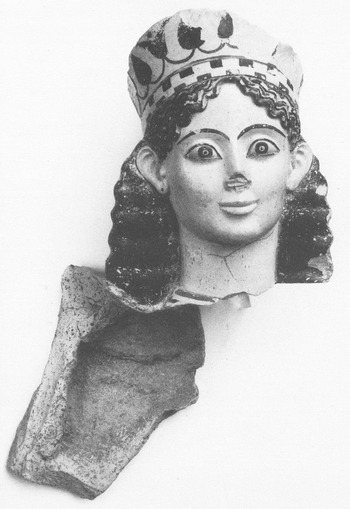
(Marconi Reference Marconi2007, p. 1).Jean Marcadé once complained that archaeologists had neglected acroteria (Marcadé Reference Marcadé1993, 3).Footnote 1 The reasons for this disregard can be understood. Labelled with an ambiguous status between architecture and sculpture, they interest few specialists of either discipline. Moreover, they are more often than not reduced to small scraps, making their restoration and consequent study difficult. Claude Rolley chose to place on the cover of his La sculpture grecque the attractive head of a terracotta sphinx in the Louvre, an acroterion from Thebes (Fig. 1), but in his chapters dedicated to architectural sculpture acroteria are generally ignored. In the field of architecture, in volume 2 of the dictionary of R. Martin and R. Ginouvès, three very short paragraphs, unillustrated, are devoted to them (Martin and Ginouvès Reference Martin and Ginouvès1992, 131–2). M.-Chr. Hellmann's fine handbook is an exception, with her lengthy discussion of the decoration of temples, their polychromy and roofing (Hellmann Reference Hellmann2002, 194–228, 229–62, 264–326). Neither of these works, however, questions the meaning of the figured motifs. True, the task might seem difficult, if not pointless. These figures do indeed appear both abundant and disparate. G. Gruben felt that they gave free rein to unrestrained fantasy (‘eine ungehemmte Phantasie’);Footnote 2 coming from such an erudite pen, the sentence may deter the search for rational explanation. So one may be tempted to give up any attempt towards interpretation, as implicitly suggest by W. Burkert: ‘It is difficult to say anything in general about the iconography in temple ornamentation, be it friezes, pediments, or acroteria' (Burkert Reference Burkert and Fox1988, 34). Marcadé's wish has however been granted by P. Danner, who has dedicated three volumes to the subject (Danner Reference Danner1989; Reference Danner1996; Reference Danner1997). Besides a full catalogue raisonné, he puts forward interpretations for every figure depicted, and I will return to these.Footnote 3 On the other hand we still have to await the full consideration that the rest of the temple decoration deserves; one can only join in C. Marconi's puzzlement, noted in the epigraph, since temple decoration would seem to be a candidate for providing direct evidence for the religious beliefs of the Greeks. With the exception of the pioneering works of M.-F. Billot, it is only recently that two publications have treated the question, those of N. Winter (Reference Winter2005) and S. Roland (Reference Roland2008). Despite the belated interest in the subject witnessed by these works, the various interpretations put forward in them remain nonetheless on the cautious side of logical possibility, for reasons to be developed below.
Sphinx acroterion in the Louvre (from Thebes?). After Danner Reference Danner1989, pl. 15, no. 138.

The origins of plastic decoration on the uppermost parts of Greek temples can be placed in Aetolia in the second half of the seventh century.Footnote 4 We have there a major innovation, destined for a splendid future.Footnote 5 At first it was confined to raking and lateral simas and to antefixes, but from the end of the seventh century such terracotta decoration appeared in the round at the angles of the roof (‘acroteria'). In the early period we see disc acroteria decorated with geometric ornament and stylised vegetal motifs from the late seventh century (Danner Reference Danner1989, 33), floral motifs with palmettes and volutes from the late seventh century as well (Danner Reference Danner1989, 36), gorgons from the second quarter of the sixth century (Danner Reference Danner1989, 42), and ‘Nike' figures from c.525 (Danner Reference Danner1989, 42). Here I propose to examine this figured decoration, approaching it through one of the most frequent types, especially in the Archaic period, the sphinx.
Among the figures it is indeed one of the most frequent and earliest. As an acroterion it probably appeared as early as the late seventh century, although it is not surely attested until the second quarter of the sixth (Danner Reference Danner1989, 46). Its floruit began around 560–550, and the phenomenon, a panhellenic one,Footnote 6 lasted till the end of the century. Moreover the sphinx is omnipresent, in a variety of forms, in Archaic Greek sanctuaries (Marconi Reference Marconi2007, 90). On the temple it is found in a variety of places, whether merely painted or in terracotta or stone. Therefore the motif is a good point of departure from which to approach the full range of figured decoration of Greek temples. Its chosen angle of attack once decided, the present study cannot, however, overlook the other representations accompanying the sphinx on temple roofs, for the clear reason that an iconographic motif cannot be explained without its being placed in archaeological and symbolic context; it is surely on this matter that the works cited above leave something to be desired.Footnote 7 True, the need to pass from the ‘analytical formalism' of nineteenth century German Ornamentik to an interpretative and ‘synthetic' formalism is clearly visible in all these studies,Footnote 8 but if one admits the semantic relationship between these different figures, that passage must be engendered through the analysis of iconographic groupings or ‘constellations of symbols' in which the individual motif appears.Footnote 9 I do not here intend to present a full catalogue of sphinxes on temples and their various associated figures, since the work has been done by authors of merit.Footnote 10 I hope it is enough to sketch the broad outlines and stress certain aspects.
I. SPHINXES ON THE ROOF
A. Lateral acroteria
An essential observation is to be made at once: although common as a lateral (corner or side) acroterion the sphinx is virtually absent as a central acroterion.Footnote 11 Apart from a vase representation from Taranto (Danner Reference Danner1997, pl. 37:4), the only exception is perhaps at Prinias, c.630 bc, where some would restore two heraldic sphinxes as a central acroterion; while the reconstruction is far from certain (Rolley Reference Rolley1994, fig. 107; Roland Reference Roland2008, 25 with fig. 8), this early building is in many respects exceptional in the history of Greek architecture, with the decoration concentrated at orthostate level, and thereby shown to be in a Near Eastern tradition (Marconi Reference Marconi2007, 6–7). However, at the corners, with body mostly in profile towards the outside and head turned ninety degrees to the spectator,Footnote 12 the sphinx accounts for the majority of acroteria both in mainland Greece (Winter Reference Winter2005, 37 and 50) and in the West Greek world.Footnote 13
While the state of preservation of acroteria is indeed often lamentable and fragments do not always permit certain identification of the relevant creature, many excavated wing fragments belong to sphinxes (Marconi Reference Marconi2007, 60 and 90). At Calydon on the Löwensimen-Dach (Winter Reference Winter2005, 128–30 [550–540 bc]; Roland Reference Roland2008, 101–6, figs. 85, 88–90, 94, 96 [580–570 bc]) and the Blassgelbes Dach, between 580 and 540 bc (Winter Reference Winter2005, 125–8 [550–540 bc]; Roland Reference Roland2008, 94–7, figs. 69–70 [580–570 bc]; Marconi Reference Marconi2007, 219), the corner acroteria are unmistakable; they are polychrome sphinxes, with female heads decorated with a diadem and floral motifs. Apollonion A at Syracuse (first half of the sixth century),Footnote 14 as well as temple B at Molino a Vento, Gela (mid-sixth century), also bear sphinxes as corner acroteria (Marconi Reference Marconi2007, 58–60; Ferrara Reference Ferrara2009, 464–7). Probably so too did the two successive temples at Thermos, of c.630 (Roland Reference Roland2008, 41, fig. 18)Footnote 15 and c.540 (Roland Reference Roland2008, 45, fig. 26; Winter Reference Winter2005, 130–2, figs. 54–6). From 560, sphinxes feature regularly as corner acroteria on the treasuries at Olympia (Marconi Reference Marconi2007, 17).Footnote 16 We find them at the temple of Apollo at Corinth around 550–540 (Winter Reference Winter2005, 26). At Megara Hyblaea a wing fragment was found which perhaps belonged to a sphinx from the second phase of temple A, c.510–500 (Marconi Reference Marconi2007, 56). Sphinx acroteria are also found at Larisa-on-Hermos, on Athena temple II, c.540–530 (Danner Reference Danner1989, 21 nos. 134–5; Marconi Reference Marconi2007, 21), and on Aegina at the Aphaia temple, c.500 (Danner Reference Danner1989, 21, no. 123). Our hybrids proliferate on temple roofs in Western Greece and Etruria: Agrigento (Danner Reference Danner1997, no. A38), Caulonia (Danner Reference Danner1997, no. A50), probably Cerveteri (Rizzo Reference Rizzo2009, 137–9 with fig. 1 [c.530], cf. also figs. 2–3 [Omobono]), Monte San Mauro (Danner Reference Danner1997, no. A63), Paestum (Danner Reference Danner1997, no. A70), Naxos (Danner Reference Danner1997, no. A66), Syracuse (Danner Reference Danner1997, nos. A73, A74, A75), Veio-Portonaccio (Michetti Reference Michetti2009, 98, fig. 5; Maras Reference Maras2009, 108, fig. 1; Carlucci Reference Carlucci2009, 124, figs. 22a–23 [reconstruction attempt]), and Vibio Valentia (Danner Reference Danner1997, no. A80), etc.Footnote 17
Given the state of preservation of most temples, it is no surprise to find it difficult to restore the appearance of their upper facades, and a fortiori their decoration. So it is often impossible to determine with what other figured representation the corner sphinx acroteria were associated. However, in some cases one can reconstruct the whole facade, acroteria included, even if sometimes conjecture is involved.
B. Sphinx acroteria in combinations
1) Sphinx and floral ridge acroterion
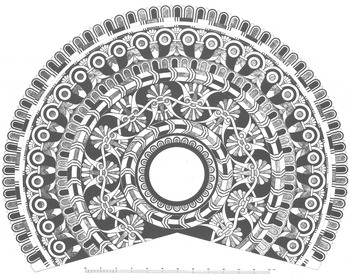
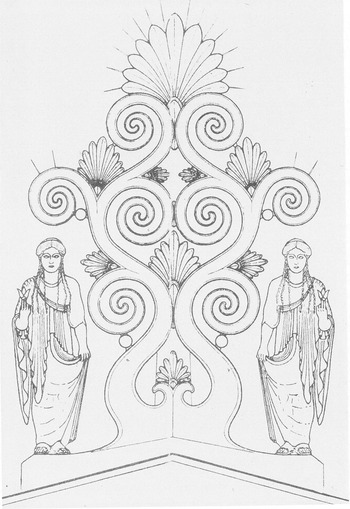
Among the oldest combinations of these motifs, we find in mainland Greece initially florals for all three acroteria, then a heraldic grouping of gorgon flanked by sphinxes, then immediately after lateral sphinxes and a floral central acroterion.Footnote 18 In West Greece central acroteria with volutes can be combined with various corner acroteria, often volutes as well (Danner Reference Danner1997, 137), but also sphinxes. In the Greek world overall it is the latter combination that seems to have been most popular throughout the sixth century (Danner Reference Danner1989, 61–2, 73–4; Reference Danner1997, 151; Billot Reference Billot1993, 51), in particular between 540 and 480, but then it seems to disappear in the early fifth century (Danner Reference Danner1989, 61; Billot Reference Billot1993, 53; Danner Reference Danner1997, 137).Footnote 19 Most often the vegetal motif is in stylised form (Danner Reference Danner1989, 10–6; Reference Danner1997, 14–24); in the late seventh and sixth century they are usually discs with floral motifs such as the lotus (Fig. 2).Footnote 20 From the sixth century discs are replaced by palmette and volute acroteria, either simple or superimposed (Fig. 3), and the disc acroterion almost disappears in the fifth century (Danner Reference Danner1989, 34–5). These ridge palmettes progress to increasingly naturalistic forms, to the point of incorporating an acanthus leaf in the fifth century.Footnote 21 It is on Aegina between 510 and 480 that M.-Fr. Billot suggests we should seek the origins of the ridge acroterion in the form of an anthemion with volutes and acanthus. It is then found at Sounion, c.440. It is worth noting that this composition in lyre form appears also on Attic funerary stelai.Footnote 22 The palmette acroterion or anthemion, one must remember, is an omnipresent, nigh on obsessive, motif found on various parts of the roofs of temples and other sanctuary buildings, in particular on antefixes and simas (for example, Roland Reference Roland2008, figs. 73–77; Winter Reference Winter2005, 24–5). Among innumerable examples one can cite those at Olympia on the treasuries of Byzantium, c.540–530, and Megara, c.510–500 (Winter Reference Winter2005, 59–60), and at Corinth on the Apollo temple, c.540–530. It is regularly combined with the lotus.
Central disc acroterion (Olympia). After Danner Reference Danner1989, pl. 2, no. 24.

Central acroterion with volutes (Delphi, Treasury of the Athenians). After Danner Reference Danner1989, pl. 5, no. 173.

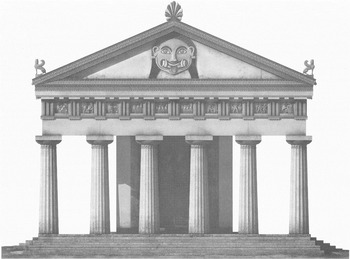
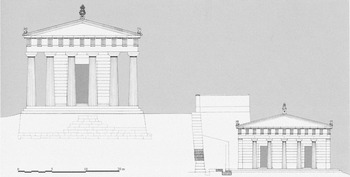
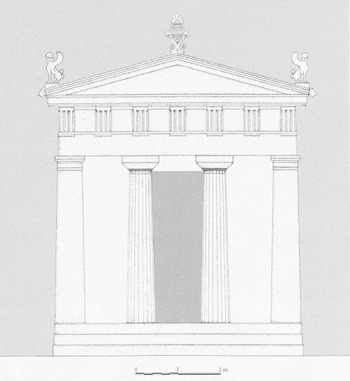
G. Gruben restores the combination of sphinxes as corner acroteria and floral central acroterion on Naxos, on the Demeter temple at Sangri (Gruben Reference Gruben1997, 263, fig. 1) and the fourth temple of Dionysos at Hyria, c.580–550 (Gruben Reference Gruben1997, 265, fig. 2b); it is also found on temple C at Selinus (first half of the sixth century) (Fig. 4),Footnote 23 the Athena temple at Assos (c.540–530)Footnote 24 and the temple of Apollo and the Thearion on Aegina, late sixth century (Lippolis, Livadiotti and Rocco Reference Lippolis, Livadiotti and Rocco2007, 309 fig. V 21; Belli Pasqua Reference Belli Pasqua2009, 142 fig. 8) (Fig. 5), as well as the second Aphaea temple, c.500 (Danner Reference Danner1989, 21 no. 123, 61; Lippolis, Livadiotti and Rocco Reference Lippolis, Livadiotti and Rocco2007, 309 fig. VI 24; Belli Pasqua Reference Belli Pasqua2009, 145 fig. 10), the temple of Apollo at Cyrene, c.500 (Danner Reference Danner1989, 86) and the Delion on Paros, c.490–480 (Danner Reference Danner1989, 22 no. 137; Billot Reference Billot1993, 43; Lippolis, Livadiotti and Rocco Reference Lippolis, Livadiotti and Rocco2007, 329 fig. VI 41; Belli Pasqua Reference Belli Pasqua2009, 144 fig. 9) (Fig. 6). There are also representations on vases which show temples bearing a similar combination, and which doubtless refer to actual buildings (Danner Reference Danner1989, 61–2; Reference Danner1997, 137, pl. 36:1 and 4 [nos. F25 and F32]).
Restoration of the façade of temple C at Selinus. After Marconi Reference Marconi2007, 123 fig. 64.

Restoration of the temple of Apollo III and of the Thearion (Aegina). After Lippolis, Livadiotti and Rocco Reference Lippolis, Livadiotti and Rocco2007, 309, fig. VI.21.

Restoration of the temple of Artemis at the Delion on Paros. After Lippolis, Livadiotti and Rocco Reference Lippolis, Livadiotti and Rocco2007, 329 fig. VI.41.

2) Sphinxes and rider
The group of horse and rider as a ridge acroterion is typical of West Greece (Marconi Reference Marconi2007, 45–8 and nn. 52, 59; Moustaka Reference Moustaka2009, 69–70). Perhaps created in Sicily, the motif appeared in the first half of the sixth century (Danner Reference Danner1996, 106) and remained in common use till the end of the fifth (Marconi Reference Marconi2007, 45). It is first attested on the temple of Olympian Zeus at Syracuse, c.580–570 (Marconi Reference Marconi2007, 45) and at Gela as a ridge acroterion perhaps around 580 (Marconi Reference Marconi2007, 46; Ferrara Reference Ferrara2009, 464–7). Subsequently it is found on temple A (of Artemis?) at Syracuse, c.570 (Marconi Reference Marconi2007, 52–4), at Kasmenai and Kamarina around 560–550 (Marconi Reference Marconi2007, 46 fig. 17; Lippolis, Livadiotti and Rocco Reference Lippolis, Livadiotti and Rocco2007, 259 fig. V 74) and at Akragas, Selinus and Himera towards the middle of the century (Marconi Reference Marconi2007, 46). It is frequently accompanied by two lateral sphinxes, as for example on different buildings at Molino a Vento, Gela (mid-sixth century?) (Marconi Reference Marconi2007, 46, 58–60).Footnote 25
South Italy also knew groups of a more baroque nature, combining in a single acroterion sphinx and rider. We see the hybrid literally carrying the rider on her back, or, more precisely, on her head and wings.Footnote 26 They are attested at Metaurus and Epizephyrian Locri, while the oldest is that from Paestum, c.520 (Marconi Reference Marconi2007, 46; Danner Reference Danner1997, 22 nos. A92–4, pl. 25:3–4, 124 for the dating). They appear at the corners while a floral motif commands the centre (Danner Reference Danner1997, 137).
3) Sphinxes and gorgon
From the end of the seventh century the gorgon becomes a dominant motif in Greek sanctuaries (Marconi Reference Marconi2007, 214–15). Its popularity increases in the second quarter of the sixth century, and by 550 it becomes the normal form of decoration in a variety of places on the upper part of buildings (Marconi Reference Marconi2007, 216–7; Winter Reference Winter2005, 110, 114, 123, 129, 137, 143 n. 30, 261–2, 279). It is found as an antefix on the temple of Hera on Corcyra, c.600 (Marconi Reference Marconi2007, 215; Winter Reference Winter2005, pl. 37), and the Oikos of the Naxians on Delos, c.600–590 (Marconi Reference Marconi2007, 215), in metopes, as at Thermos c.630–620 (Marconi, Reference Marconi2007, 215; Roland Reference Roland2008, fig. 42), or centrally in a pediment, as on Apollonion A at Syracuse, c.590–580 (Marconi Reference Marconi2007, 41–2, fig. 16) and temple A (of Artemis?) at Syracuse c.570 (Marconi Reference Marconi2007, 53–4 with fig. 22), on Corcyra, c.580, and on the second temple of Apollo on Aegina, c.570–560 (Marconi Reference Marconi2007, 216). Of particular interest here is its appearance as a central acroterion. The first assured example would be the temple of Apollo Lyseios at Thermos, c.580–570, whose central acroterion was a disc gorgoneion (Roland Reference Roland2008, 64 with fig. 48; Winter Reference Winter2005, 114); it is also found on the temple of Herakles on Thasos, c.560 (Daux Reference Daux1955, 368; Marconi Reference Marconi2007, 216). Calydon offers two probable, and seemingly contemporary, examples of the kneeling, running gorgon between two corner sphinxes, on the Blassgelbes Dach Footnote 27 and the Löwensimen-Dach, around 580–570;Footnote 28 the same format appears on the ‘H-temple' on the Acropolis at Athens, c.570–565 (Marconi Reference Marconi2007, 216), and perhaps also on the second roof of temple C at Thermos, around 540.Footnote 29
In the Archaic period sphinxes predominate among corner acroteria on Greek temples,Footnote 30 although other associations are known in which different types appear, like winged females (Danner Reference Danner1989, 61; Reference Danner1997, 116–9), abduction scenes,Footnote 31 horsemen (Danner Reference Danner1997, 137; Marconi Reference Marconi2007, 46, 59) and floral motifs (Winter Reference Winter2005, 35 [Corinthian system], 172 [Argive system], 206–7 [Attic system]).
C. Other sphinxes on temples
Sphinxes can also be found in many other places on sacred buildings. At Prinias, c.625, they appear as orthostates at the foot of the wall flanking the entrance of temple A (Hellmann Reference Hellmann2006, 67–8 with fig. 79; Marconi Reference Marconi2007, 5; Roland Reference Roland2008, fig. 8). They rapidly climb higher;Footnote 32 one of the most striking examples, though of disputed interpretation, is the early sixth century ‘Hera head' from Olympia, which, it has been argued, belongs to a sphinx from the pediment of the Hera temple.Footnote 33
Sphinxes can also be found in metopes, as perhaps on temple C at Thermos (end of seventh century) (Roland Reference Roland2008, 62, no. A7) and on Apollonion A at Calydon, around 580–570.Footnote 34 On the temple of Athena at Assos, besides the sphinxes on the architrave and as corner acroteria, they appear heraldically positioned on the metopes (Marconi Reference Marconi2007, 27, cf. 90 and n. 34); the same goes for the little metopes (or Y metopes) at Selinus, c.550 (Marconi Reference Marconi2007, 89–90 with fig. 36, 120 for the dating); and a metope from Granmichele is similarly decorated (Marconi Reference Marconi2007, 90 with n. 37). At Monte San Mauro, c.570–560, two heraldic sphinxes face across a palmette; the panel is crowned by a komast scene.Footnote 35 Megara Hyblaea is said to have provided another such piece.Footnote 36
Sphinxes are also common on antefixes where they appear as confronted pairs: in Arcadia at Kotylon c.625 and at Bassai c.625 and again c.575–550 (Cooper Reference Cooper1990, 84 and 87 [on the ‘Laconian roof']; Winter Reference Winter2005, 123 and 142, pl. 57 left), at Delphi, 600–550 (Cooper Reference Cooper1990, 87 with figs. 19–20; Winter Reference Winter2005, 123, 142; Marconi Reference Marconi2007, 16 with n. 80; Roland Reference Roland2008, 139), at Corinth on a roof of Laconian type (Winter Reference Winter2005, 142 and n. 27), and at Capua (Cooper Reference Cooper1990, 87). Though there is no motif between the pair the triple group is attested in at least an indirect manner, since in Arcadia, at Bassai and Kotylon, the two sphinxes are crowned by a stylised floral motif (Winter Reference Winter2005, 142 and pl. 57; Kelly Reference Kelly1995, 252–3, fig. 12, 272 and figs. 19–20). On some antefixes they flank a female head of so-called ‘Daedalic' type, because it wears the ‘layered wig' typical of seventh century Greek sculpture. Such isolated protomes on antefixes are found frequently in Corinthian domains and in Aetolia, from the first Apollo temple at Thermos (630–620) to the first and second roofs of the Hera temple at ‘Mon Repos’, Corcyra (c.610 and c.600 respectively),Footnote 37 and at Calydon on the Buntes Dach, c.600–590 (Winter Reference Winter2005, 120, pl. 43). It is in the following decades that they are flanked by sphinxes, as on Corcyra on the Corinthian roof at ‘Mon Repos’, c.580–570 (Roland Reference Roland2008, 116 and n. 291, 137–8, fig. 129; Winter Reference Winter2005, 122, pls. 44–5; cf. Billot Reference Billot1990, 115) (Fig. 7). Several authors would take this female head to be an abbreviated sphinx. Thus S. Roland (Reference Roland2008, 96) remarks, ‘the female protome, which stylistically resembled the head of the sphinx from the lateral acroteria, would indeed have offered a partial visual repetition of the larger statues standing on the corners'. Also one may note that on the Blassgelbes Dach of Calydon the Daedalic heads bear an astonishing resemblance to the sphinx of the acroterion of temple A.Footnote 38
Antefix from the temple at ‘Mon Repos' (Corfu). After Winter Reference Winter2005, pl. 45.

Thus presented, however, the reasoning cannot fail to surprise. Surely the image of sphinxes flanking a Daedalic head should rather run counter to the idea of the latter being a synecdoche of the former. N.A. Winter, nonetheless, sees no problem: the polos and the volutes ‘… might be thought of as attributes identifying the heads as sphinxes. Here the sphinx itself is actually represented in concrete form alongside the face' (Winter Reference Winter2005, 123). We will see later that another explanation is possible, even if it leads to a similar conclusion.Footnote 39
II. THE MEANING OF ACROTERIA
A. Current views
Questions have indeed been asked about the origin and significance of these figures called in to do decorative duty on Greek temples, and we will also address the issue in what follows. But before indulging in speculations on their meaning, one must first agree on whether they had one: for there is a strong temptation, in default of understanding them, to reduce them to a purely ‘decorative' role with no further significance. Some have yielded to it, such as G. Gruben, cited above.Footnote 40 Most, however, refuse that easy exit, even if the interpretation of the figures remains controversial.Footnote 41 P. Danner argues that the figures must have had a religious significance, though they cannot be linked to mythological sources (Danner Reference Danner1989, 74).Footnote 42
Their meaning cannot either, it would seem, be deduced from any original architectural function, since it is not clear that acroteria originate in the decoration of fundamental parts of the architecture of roofs, as P. Danner would have it.Footnote 43 On the one hand, the view that the orders and their individual details are to be explained through petrification does not stand up to analysis (Barletta Reference Barletta2001, 137–8). On the other hand, even if those parts of the buildings decorated with these figures originally had a practical function, such a function is not of itself adequate to explain the presence of the figures. One may yet hope to find their meaning elsewhere. Some hypotheses have already been proposed.
1) Psychoanalytical explanations
Let us first remove from the list any psychoanalytical interpretation, as has been suggested recently. Sphinxes and gorgons would represent the ‘bad mother', and Medusa the symbol of sexual desire between mother and child. These representations have been accorded a ritual role against mental distress or in the ‘exorcising of the demonic in art' (cited by Danner [1989, 74–5 n. 295–300]). At best one can agree that such an explanation is not incompatible with the others; at worst one must object that it is a symptom of the intellectual fashion of the time, devoid of any archaeological or historical basis.
2) The ‘effect of meaning': creating liminal space and sacred space
Without always defining the specific meaning of these figures, several authors agree with the notion that they instil, at least, an ‘effect of meaning'.Footnote 44 C. Marconi considers the sanctuary a bridge between the terrestrial world and the other, and that temple decoration should allow this liminal function to be instilled into the mind (Marconi Reference Marconi2007, 28). Also, according to W. Burkert, the monsters and beasts of prey would emit ‘the idea of liminality' (Burkert Reference Burkert and Fox1988, 34). This concept, borrowed from social anthropology, can be productive; but one would still have to establish, on the base of iconographic or textual evidence, the relationship between the figures and the message being delivered, that is the symbolic process which makes that relationship possible, or to enter as evidence parallel examples in other civilisations. Demonstration is still required.
3) An apotropaic function
These creatures, who scrutinised the visitor from the corners of the roof, have often been taken as ‘guardians',Footnote 45 a function also often assigned to their homologues on funerary stelai and in triple groups (Petit Reference Petit2011, passim, esp. 31, 34, 54 n. 345, 59 with n. 376, 106–7 with n. 1201, 174 with n. 1248, 212–8; see also Winter Reference Winter, Swaddling and Perkins2009b, 69). But what were they thought to guard? Against what? Some would see in them apotropaic figures whose function was to protect the temple.Footnote 46 (We shall see below that a similar explanation has been invoked to account for the presence of the horseman.) P. Danner and C. Marconi, however, doubt this interpretation; and one can indeed wonder with them in what respect the deity residing in the temple would need such protection.Footnote 47 One cannot but get the impression that the apotropaic interpretation is too general, a form of default solution in lieu of a more precise and convincing explanation.
However, Marconi, even though he was not inclined to accept it, proposed one which is closely linked to it. He suggests that these monsters could have been used to arouse respectful awe among the worshippers: for example, the central gorgons and the flanking sphinxes on the roof would have created a mysterium tremendum in the viewer.Footnote 48 Even here, though, a reasoned argument is lacking and several objections come to mind. For example, if it is true that the appearance of gorgons is none too pleasant, the sweet smile of female sphinxes, like that in the Louvre (Fig. 1)Footnote 49 or those from Calydon (Roland Reference Roland2008, figs. 70 and 90), do not seem designed to arouse such fear (cf. Schröder Reference Schröder and Winkler-Horaček2011, 148).
4) Death demons
Since sphinxes and other hybrids which decorate sanctuaries are also represented in funerary contexts, some have chosen to see in them death demons, who would have been tamed by the deity with whom they are associated. It is that deity's protection for which one should pray against the baleful forces symbolised by the monsters.Footnote 50 As T. Schröder (Reference Schröder and Winkler-Horaček2011, 163) has observed, however, the concept lacks precision.
5) Tamed nature
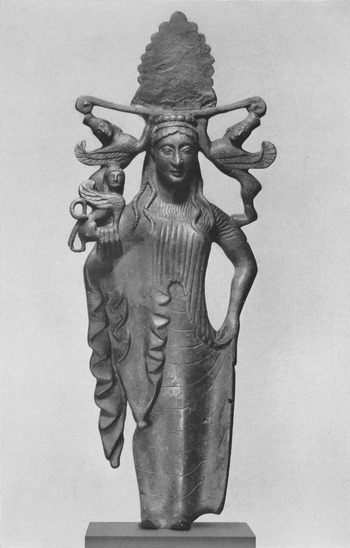
P. Danner believes that sphinxes, ‘Nikai' or female figures in heraldic groups, as well as floral acroteria, represent tamed nature (see also Winkler-Horaček Reference Winkler-Horaček and Hölscher2000, 23–8; Reference Winkler-Horaček and Winkler-Horaček2011). He would see an indication of this in the fact that they appear on temples dedicated to Artemis, Athena, Hera and Apollo, deities that are represented in Greek art as master or mistress of animals and monsters.Footnote 51 Firstly, if such a connection can be valid for Artemis, to extend it to Hera, Apollo and especially Athena requires a more fully argued demonstration. Moreover one cannot ipso facto characterise as ‘master or mistress of …' every figure or motif heraldically flanked by two facing motifs. It would be just as possible to see in the figured motifs which accompany deities attributes which determine their character or beings that serve them, rather than the symbol of the forces which they control. It is perhaps as ill-considered to qualify a deity as ‘mistress of monsters' as to designate as ‘mistress of branches' a Rankengöttin holding a branch in each hand (see, for instance, Petit Reference Petit2011, 190–1 with fig. 178), or even term the Athena Parthenos of Pheidias as ‘mistress of Nike' (except metaphorically), on the grounds that she carries a winged Nike on her right hand (Petit Reference Petit2011, 39). In this vein, why not interpret the floral of the triple groups, flanked by sphinxes, as a ‘master of sphinxes'? The goddess on a bronze mirror handle of c.500 from Taranto who carries two heraldic sphinxes on her shoulders and offers a third on her right hand (Fig. 8), does not appear to have subdued them by violent constraint (Demisch Reference Demisch1997, fig. 271; Delivorrias, Berger-Doer and Kossatz Reference Delivorrias, Berger-Doer and Kossatz1984, no. 81; Petit Reference Petit2011, 191 fig. 179). It is therefore wiser to see in the hybrids perched on the roofs ‘an attribute of the god of the sanctuary', as C. Marconi suggests (Marconi Reference Marconi2007, 89–90; cf. Danner Reference Danner1989, 74).
Bronze mirror handle (Taranto). After Petit Reference Petit2011, fig. 179.

6) Hypostases
Several authors who refused to discern any association with domination or taming have suggested that these figures represent entities that are not hostile and then tamed by the deity, but simply placed in their service. C. Marconi notes that from the first half of the sixth century the creatures seem to play a role previously played by the deities themselves (Marconi Reference Marconi2007, 215), which would confirm their dependent relationship. According to P. Danner, these Todesdämonen would in some way be subservient to the deity, being his or her ‘satellites' (Trabanten).Footnote 52 Though not using the word, these authors identify the figures as ‘hypostases' of the deity, in the sense given to the word by many writers:Footnote 53 it refers to a ‘divine being, most often semi-independent, who more or less fully incarnates a quality or an attribute of a deity of higher rank' (Ringgren cited in Winter Reference Winter1983, 508–9). The Taranto mirror handle cited above would illustrate this relationship between the hybrids and the deityFootnote 54 in the same way as the ‘Nike' on the Parthenos' right hand. The present author has supported this view in a recent book (Petit Reference Petit2011, 37–9, 45–6, 80–1, 192–4, 232–3). Such a concept would allow us to reconsider the ‘Daedalic' heads flanked by sphinxes on some Archaic antefixes (Fig. 7). The striking formal similarity between the central head and those of the flanking sphinxes was noted above, leading to the conclusion that the former was an abbreviation of the latter. However, the fact that one motif is surrounded by two others would argue against any simple identification of the two different entities represented. Rather, if we take the lateral figures as hypostases of the central being, a better explanation becomes available as to why they share the visual appearance of the goddess whom they serve: it would be a way of marking the close dependence, of showing how the ancillary being ‘shares the essence of a deity, who can thus be actively present in the world, without its essence being worn away in the action of this hypostasis'.Footnote 55 This hypothesis is not contradicted by the presence of such a head flanked by sphinxes on the temple of Artemis on Corcyra (Marconi Reference Marconi2007, 121–2, pls. 44–5). It constitutes to my mind a necessary point of departure; however, it explains only the nature, not the function of the hybrids on temple roofs. We must therefore take the analysis further forward, and try to determine the role assigned to them here.
B. The combinations and a suggestion
To achieve this we must return to the combinations of motifs in which the hybrid is inserted. First we have to show that the figures here in question, those that decorate Greek temples, have an interactive relationship, in other words that they possess a reciprocal symbolic relationship, one that is agglutinative, not ‘autistic'.Footnote 56 The matter is not self-evident, since according to E. Langlotz the horsemen were ‘völlig sinnlos und nur des Schmuckes halber …' (E. Langlotz, cited in Danner Reference Danner1996, 104); similarly P. Danner considers that the floral acroteria spring from a purely ornamental conception,Footnote 57 and were simply ‘durch eine parataktische Aneinanderreihung in einer festgelegten Folge verbunden';Footnote 58 the change from a paratactic composition to a functional combination would only have come about in the second half of the sixth century (Danner Reference Danner1989, 63). Thus the floral acroteria (volutes and palmettes) would have evolved from abstract to concrete (or to realism) and by being placed in a heraldic or triple schema would have acquired a kind of autonomen Bildcharakter. While the meaning of this formulation remains somewhat elusive, we can agree, along with the author, that one must analyse the motifs in their associations. When, however, it comes to ‘figures' (motifs other than floral: Danner Reference Danner1989, 74), P. Danner admits that from the outset they form part of deliberate combinations. According to him, central and corner acroteria are ‘durch ein einheitliches Kompositionsschema verbunden' (Danner Reference Danner1989, 61). He makes the point that corner acroteria are associated with ridge acroteria by their bodily orientation.Footnote 59 Nonetheless, he gives no reason why floral acroteria should be excluded from such group analysis. One should therefore give due attention to the hypothesis that these too enjoy a symbolic relationship with the sphinxes or female figures who surround them. Indeed the various floral motifs are not ‘figures' in the etymological sense, but they are representations which, even if from the beginning possessing stylised form, are in no way abstract, and therefore are ‘figurative' in the sense the adjective has in the phrase ‘figurative art'; they are clearly signifiers which make reference to an actual, precise significance, here a floral or vegetal object. Danner does in fact concede that the group of a floral ridge acroterion and the corner acroteria do indeed form a ‘heraldic' composition, similar to those that are of frequent occurrence in Greek art of the seventh and sixth centuries.Footnote 60 That remark is the starting point of my exegesis.
1) Sphinxes as acroteria and the floral motif
The triple group of sphinxes flanking the Tree, let us remind ourselves, is among the oldest and most common combinations of acroteria on Greek temples.Footnote 61 Moreover the group of two sphinxes surrounding a more or less stylised floral motif – or ‘triad' – appears frequently in Greek art already from the second millennium, after which there is a hiatus in the early Iron Age, and reappearance in eighth century vase paintings (see, for instance, Petit Reference Petit2011, figs. 88, 126 [Bronze Age], figs. 90–6, 117, 121, 125–9 [first millennium bc]). In the compact groups of vase-painting the placing of the figures cannot be paratactic since the three figures constitute a closely associated ensemble, to the extent that the sphinx often places a paw on one of the tendrils (Fig. 9).Footnote 62 Perched on the roof of a temple, the heraldic group, whose three components are now distanced from one another by the length of the slope of the pediment, certainly appears somewhat disjointed. But has it lost ipso facto all functional coherence? Referring to the precedence of heraldic groups on vases, P. Danner concludes nonetheless that there is an organic dissolution in the group formed by the acroteria, for two reasons: the distance between the elements and the fact that the sphinxes now turn their bodies to face out.Footnote 63 But, on the one hand, we will see below that we can draw no safe conclusions from their positioning; on the other hand, the earlier vase paintings mentioned above, the regular and systematic placement of the three figures and the contextual analysis offered below all add conviction to the argument regarding spacing. One feature in any case shows that the three figures so separated come from a compact triple group: sphinxes never appear as central acroteria, a fact that proves that the ordering of the figures on the roofs owes nothing to chance. This characteristic also seems to underline the importance of the figure which they flank and for whom they serve as guardians.
François Vase (detail) (Florence, Museo archeologico). After Petit Reference Petit2011, fig. 93.

Having pulled out the floral motif in his analysis, P. Danner rejects, rather too speedily as we shall see, the interpretation of K. Schefold, who sees in the floral symbol ‘[das] Bild des sich erneuenden Lebens'.Footnote 64 He also denies any solar or apotropaic significance in it. For him it is a question of natural forces over which the deity exercises power.Footnote 65
In the same way as the rosette,Footnote 66 the palmettes and the lotuses, which decorate Greek temples as well as vases and funerary stelai, become common and repetitive usque ad nauseam in Greek architecture, in Roman architecture, and right down into Neoclassical architecture and the decorative arts of the nineteenth century, to the point where nobody bothers to ask about their origin and significance. In particular we may point to the lotus, borrowed from the east, where it appears to have had a precise eschatological meaning,Footnote 67 and there is good reason to think that the palmette is equally significant.Footnote 68
As for the floral motif, whether it is placed on a disc acroterion (Fig. 2) or consists of a voluted palmette, plain or superimposed (Fig. 3), there is every reason to consider that its meaning and function depend on its placement in the triad it forms with the corner acroteria, the arrangement of which is by no means casual; since it only appears at the corners, the sphinx is never ‘flanked'. On the other hand the floral motif, when it appears in the triple group, is always flanked by guardians.Footnote 69 Since the respective position of the elements within the group is strictly controlled, one must reject the ornamental or decorative interpretations that have so often tempted commentators (see, for instance, Danner Reference Danner1989, 62 and 73; Reference Danner1997, 137). Therefore the interpretation of this group is connected to the one I have proposed for the triads known elsewhere in Greek art in tighter format. It is Old Testament texts that provide the interpretative key.Footnote 70
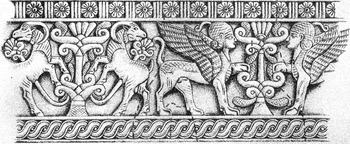
We have long known that the K e rûb h îm (‘cherubim') of the Bible are represented in the form of the hybrid called ‘sphinx' by the Greeks (Petit Reference Petit2011, 30–1). One often sees them in heraldic pairs flanking a floral motif that can take many forms, but most often is made up of a combination of ‘Phoenician' or ‘Greek' palmettes and volutes (Fig. 10).Footnote 71 This triple grouping corresponds iconographically to the celebrated passage in Genesis 3:24, where we read that the K e rûb h îm were set by YHWH at the gates of the Garden of Eden to protect (lišmor) the path to the Tree of Life and forbid the sinful couple access to it. The meaning of the motif is clear: it is a metaphor for (eternal) life, or immortality, symbolised by a floral motif (the ‘Tree of Life') which is guarded by the cherubim, hypostases of the deity.Footnote 72 We should pause over this passage; it is a fortunate unicum, fortunate in that here, and here alone, the iconographic metaphor is clearly explained. No other text, in Mesopotamia, the Levant, Cyprus or Greece, explicates in this way the nature metaphor (to harvest the fruits of the ‘Tree-of-knowledge-of-good-and-evil', and subsequently of the ‘Tree of Life’). How to explain this mutual disregard between texts and iconography? Here the artist had to resolve the problem of ‘l'infigurable dans la figure' (Arasse Reference Arasse1999, 12): how, when necessary, to represent immortality? Only an iconographical metaphor could cut this Gordian knot. What was needed was to find a motif that could symbolise life ever renewed: a motif from nature, a tree or plant, but stylised in a suitable manner to show that it was indeed a metaphor (Petit Reference Petit2011, 159–60). From the opposite viewpoint, why should authors employ the metaphor from nature to express a concept which has an adequate, precise formulation in all languages? The silence of our texts on the meaning of the symbol is equalled by their silence on its actual artistic manifestations. The heraldic group may be abundant in Levantine, Cypriot and Greek imagery but is only very rarely described. Again it is the Hebrew Bible that provides the only descriptions known (ekphraseis, if one prefers), where we have mention of two K e rûb h îm flanking the Timorîm in the decoration of the Temple at Jerusalem (1 Kings 6.29, 32, 35; Ezekiel 41.17–20, 25; cf. 2 Chronicles 3.5–7; see Petit Reference Petit2011, 29–33). This silence should cause no surprise if we consider the fact that descriptions of works of art are rare in ancient literature.Footnote 73
Nimrud Ivory (British Museum). After Petit Reference Petit2011, fig. 7.

Recent analyses allow us to suppose that the triad motif came to Greece via Cyprus and re-emerges with the same meaning in the eighth century Aegean iconography (Petit Reference Petit2011, passim, esp. 97–102, 121–3). Charles Picard had already drawn this conclusion in 1963 for the sphinx on Greek funerary stelai: ‘L'association du sphinx avec les palmettes de formes diverses indique clairement que son rôle de gardien de l'arbre de vie est toujours important et connu des Grecs' (Picard Reference Picard1963, 1431). Since the matter seems probable in the funerary domain and in vase-painting, can one propose the same hypothesis for the realm of religion? Here it would be in order to present some pieces which fill the gaps, on the one hand between tight and loose triple groupings and on the other between the funerary and sacral domains.
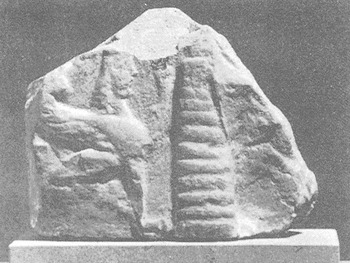
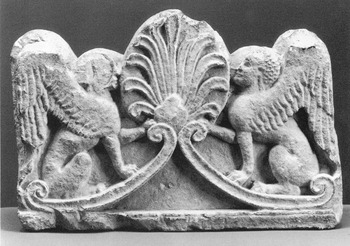
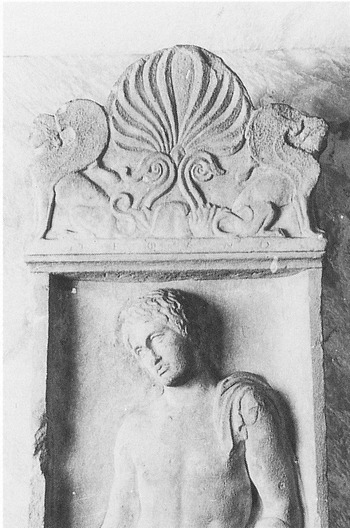
In the funerary sphere one can cite stelai crowned with ornament consisting of the same heraldic scheme. On Cyprus several funerary stelai of the Classical period have sphinxes either facing a large anthemion, with a paw on the volute of a vegetal motif, or with their backs turned away from the central anthemion but with one paw placed on a corner palmette (Fig. 11; Fig. 12). This type of decorative adornment is also found in Greece, with the sphinx's back turned to a central anthemion (Fig. 13). The position of these sphinxes allows us to discard the argument based on the position of the hybrids as corner acroteria in relation to the vegetal motif – that is, facing outwards from it – and which led to the denial of any functional connection with the central acroterion (Danner Reference Danner1989, 63). Besides, for ‘guardians' such a position is extremely logical.Footnote 74 In this respect the stele in the Metropolitan Museum (Fig. 12) demonstrates that the sphinxes who turn their back on the central anthemion at the same time take due regard of the corner palmettes on which they place a paw. Along with M.-Fr. Billot we should recall that the acanthus, frequently found on funerary stelai (Homolle Reference Homolle1916; Billot Reference Billot1993, figs. 14, 17, 19; Oakley Reference Oakley2004) and on some sarcophagi (like that from Akragas of the fourth century [Franchi del Orto Reference Franchi del Orto1988, 262 fig. 1 (= Danner Reference Danner1997, pl. 35 [F2]); cf. Billot Reference Billot1993, 55 with n. 123]), and which we see as a ridge acroterion on several temples from the mid-fifth century onwards, possesses an eschatological meaning (Billot Reference Billot1993, 47), as we can assume from the anecdote cited by Vitruvius (4. 1) regarding the invention of the Corinthian capital (cf. Petit Reference Petit2008, 349–50, with n. 122).
Cypriot funerary stele (Metropolitan Museum of Art 74.51.2856). After Petit Reference Petit2011, fig. 41.

Cypriot funerary stele (Metropolitan Museum of Art 74.51.2499). After Petit Reference Petit2011, fig. 42.

Attic funerary stele (from Tanagra. Athens, National Museum 2578). After Petit Reference Petit2011, fig. 96.

The same schema recurs on several sarcophagi, with two sphinxes as corner acroteria and a central floral one, often a Greek palmette. Since these sarcophagi imitate the facade of a building with pediments and the crowning figures are related to architectural acroteria, they serve to fill the logical gap between funerary and architectural sculpture. We find different variants of the combination in so-called ‘Greco-Persian' art. Among the parallels in funerary architecture one can stress the material from Xanthos.Footnote 75 From c.460, ‘Building H' on the acropolis has two sphinxes in the blind windows of the pediment. Because of the complete loss of the upper parts of the facade, it is impossible to tell if there was a ridge acroterion, or what form it may have taken (Metzger Reference Metzger1963, 67 and pl. XLVII; Demargne Reference Demargne1974, 53). On the Lion Sarcophagus of the last third of the fifth century two sphinxes decorate the ogival pediment, facing, but in separate panels (Demargne Reference Demargne1974, 49–53, pl. XXIV c–d, pl. 23). On the Merehi sarcophagus the sphinxes of the ogival pediment are surmounted by complex floral motifs on the extremity of the ridge beam (Demargne Reference Demargne1974, 94–5, pl. 53:3–4), which take a form similar to the decoration of mid-fourth century Greek funerary stelai (Demargne Reference Demargne1974, 95) and also notably to the ridge acroterion of the Parthenon (compare with Danner Reference Danner1989, 13–4, no. 77, pl. 7). M.-Fr. Billot (Reference Billot1993, 54) notes that on Lycian sarcophagi the central acroteria in the shape of Greek palmettes on double volutes are of the same form as, and develop similarly to, those on Greek temples. The same motif will probably have decorated the ridge beam of the Payava sarcophagus (Demargne Reference Demargne1974, 94), dated to the same period, c.370–350 (Demargne Reference Demargne1974, 86 and 96), standing above the sphinxes placed in the blind windows of the ogival pediment above the royal couple (Demargne Reference Demargne1974, 71, pl. 35–7). Although the association of sphinx and floral is indirect on these two works it is thus certainly attested.Footnote 76 We also see a similar combination on the ‘Lycian sarcophagus' from Sidon, c.390–380, where the sphinxes standing back-to-back occupy the whole pediment, with a palmette on the ridge above (Schmidt-Dounas Reference Schmidt-Dounas1985, pls. 15 and 24; Billot Reference Billot1993, 54; and, for instance, Rolley Reference Rolley1999, 237 fig. 235). B. Schmidt-Dounas (Reference Schmidt-Dounas1985, 75) notes that the majority of parallels cited for them consist of similar sphinxes flanking a floral element (palmette, ivy leaves or flowers).
A sarcophagus from Amathus on Cyprus (Fig. 14) presents an intermediate stage between some vase representations, in which the triad is presented in a compact and functional unity, and temple facades where the composition is pulled apart and loosened. On this work of c.480 the hybrids are not placed right at the corners, but at mid-slope, with the body turned to a central palmette and the head at right angles facing the viewer (see Matthäus Reference Matthäus2007, 220; Stylianou Reference Stylianou, Stylianou and Schollmeyer2007, 27–34, esp. 29, 33–4). The parallel with their homologues crowning Greek temples is striking.Footnote 77 Iconographical analysis of this exceptional work allows us to assign to them a role similar to that of the guardians of the biblical Tree of Life (Petit Reference Petit, Perrin and Petit2004; Reference Petit, Fourrier and Grivaud2006a; Reference Petit, Kreuz and Schweizer2006b), because the files of chariots on the two long sides symbolically make their way to the Trees of Life which stand on the legs and to the crowning palmette guarded by sphinxes. As H. Matthäus wrote, ‘by placing his corpse into a sarcophagus which imitates architectural features of a temple [the king] expresses his hopes for an afterlife in eternity and happiness and very probably some sort of apotheosis' (Matthäus Reference Matthäus2007, 220). As a corollary, we can assume that similar decoration on Greek temples reflects similar aspirations.
Sarcophagus from Amathus. Short side A (Metropolitan Museum of Art 74.51.2453). After Petit Reference Petit2011, fig. 38.

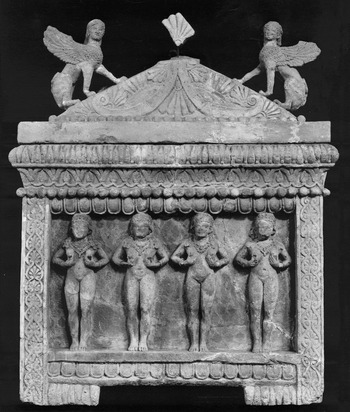
Returning briefly to Sidon, let us consider the decoration of the ‘Mourning Women' sarcophagus of c.350 (Fig. 15). It is almost totally conceived as a pseudo-peripteral building in the Ionic order (Fleischer Reference Fleischer1983), except for an attic (above the cornice), through which the two ‘temple' pediments are cut on the short sides. The pediments are decorated with a superb palmette as ridge acroterion, which alone rises above the attic, and two sphinxes as corner acroteria, set at forty-five degrees and seemingly rising from the body of the attic. For our purposes, the most interesting element is the frieze running along the long sides of the attic, which presents a cortege of chariots and horses; it has been interpreted as the funeral procession for the deceased to his final home (Fleischer Reference Fleischer1983, 44–54). However, in proceeding along the long sides of the attic the cortege is iconographically directed to the two pediments. The final destination of the cortege could not be better revealed: heroisation, symbolised by the palmette flanked by sphinxes. Compared with the previous example this work marks an additional stage in the revelation of the message, since the cortege is now placed in direct association with, and on the same level as, the triad to which all evidence suggests it is heading, as on the Amathus sarcophagus.Footnote 78 At the same time the architectural form of the work constitutes a substantial argument for assuming that corresponding decoration on temples should have the same significance.
‘Mourning Women' sarcophagus (from Sidon). After Fleischer Reference Fleischer1983, pl. 3.

Staying in the same funerary domain let us consider Attic stelai surmounted by a single sphinx (Petit Reference Petit2011, 125–6, 147–51, 154–6); they present the same scheme, but abbreviated: a single sphinx above a floral element now reduced to the main volutes, a grouping which we might now term ‘binary'; and according to my hypothesis this binary group would retain all the symbolic force of the triads (Petit Reference Petit2011, 147–56). Apropos of this M.-Fr. Billot stated that ridge acroteria consisting of lyre-palmettes took up the schema of the same motif found under the sphinxes on funerary stelai (Billot Reference Billot1993, 43). Thus the voluted floral motif of acroteria on several temples displays the same morphological details as the lyre-palmettes which support some funerary sphinxes (Billot Reference Billot1993, 42 with fig. 6, cf. figs. 1–3, 7–8 [Sounion, Aegina, Paros]) (Fig. 16). She adds that the acanthus of Corinthian capitals is identical to those of funerary stelai and ridge acroteria (Billot Reference Billot1993, 52–3).
Attic funerary stele. After Petit Reference Petit2011, fig. 109.

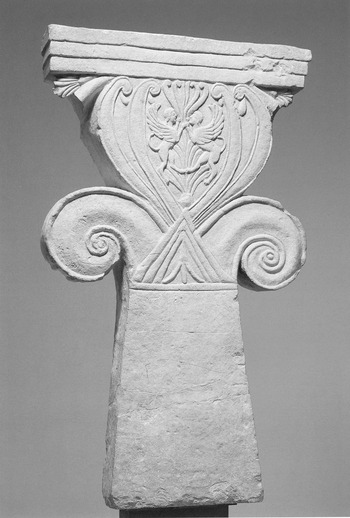
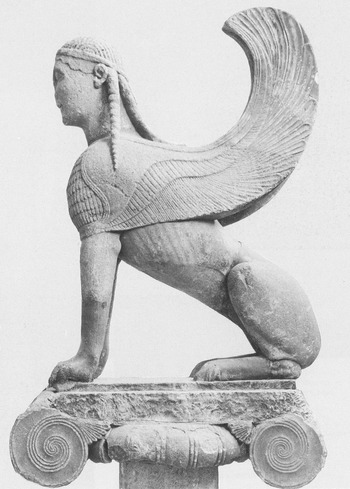
Let us turn now to the sacral domain. Cyprus knew a group of so-called ‘complex proto-Aeolic' votive stelai, which, above the usual volute capital (two volutes emerging from a central triangle), present efflorescences often in the form of a Phoenician palmette, the whole being capped by a three-stepped abacus (see, for example, Ohnefalsch-Richter Reference Ohnefalsch-Richter1893, pls. XXXVI:3, XCV:1, 2; Shiloh Reference Shiloh1979, 36–9, figs. 49–57). Two capitals in the Metropolitan Museum of Art display, among the efflorescences, two sphinxes facing across a vegetal motif (Karageorghis, Mertens and Rose Reference Karageorghis, Mertens and Rose2000, 216–7, no. 347) (Fig. 17). This Cypriot custom of votive stelai with double volutes is also found in Greece, since the first (Ionic) volute capitals found in the Aegean area appear on stelai crowned by a sphinx and dedicated in sanctuaries (Naxos, Delos, Aegina, Delphi; cf. Barletta Reference Barletta2001, 101) (Fig. 18). This induced B.A. Barletta to champion the notion of a votive origin of the Ionic column, an idea dismissed by others;Footnote 79 this is not of great importance from our point of view, as this kind of column is also associated with the sphinx in a sacred context. This last example allows us to consider that the sphinxes on columns with volutes dedicated in Greek sanctuaries, like the famous ‘Naxian sphinx' at Delphi, also combine the sphinx with a vegetal motif, here reduced to just the volutes, and from our present viewpoint also constitute a bridge between the funerary world and the sacral domain (Petit Reference Petit2011, 124–5, 147–54).
Cypriot votive stele (Metropolitan Museum of Art 74.51.2493). After Petit Reference Petit2011, fig. 43.

Sphinx of the Naxians. Delphi. After Petit Reference Petit2011, fig. 107.

P. Danner wisely remarked that the occurrence of the same motifs on funerary stelai, votive stelai and acroteria demonstrates the permeability of these contexts. He would see the notion of death as the link between the figures.Footnote 80 One can subscribe to this position, but also go further. Beyond the idea of death, it is that of survival after death which seems to be always behind the figure of the sphinx guarding the Tree. So there is no reason to allot a different symbolism to funerary sphinxes from those dedicated in sanctuaries; the latter category covers sphinxes on volute-columns but also those decorating temples, including the sphinxes in the form of corner acroteria guarding the central vegetal motif: they reflect the same heraldic schema, play the same role as guardians of the Tree and therefore must be imbued with the same eschatological significance.
We may note further that in the Levant we also find these sphinx-cherubim in a sacred context, since, as noted above, triple groups, no doubt in relief, attested by texts inside the temple at Jerusalem consisted of K e rûb h îm flanking Timorîm in the same heraldic schema (see Petit Reference Petit2011, 29–33).
2) Acroterial sphinxes and the rider
It remains to explain the replacement in West Greece of the vegetal motif as a central acroterion by the group of rider-on-horse, often associated with sphinxes as lateral acroteria (see above). Again this raises the question of the symbolic relationship between this group and the hybrids which flank it. Here the unusual acroteria from Paestum, Metaurus and Epizephyrian Locri, where a sphinx directly carries horse and rider, clearly prove a direct relationship between the sphinx and the rider on temple roofs, and show that sphinxes as lateral acroteria and riders as central ones cannot merely have a paratactic relationship, but interact symbolically, as C. Marconi believes (Marconi Reference Marconi2007, 46–8; cf. Danner Reference Danner1996, 105–6).
Attempts to identify these riders have led to various suggestions.Footnote 81 Some have thought them a status symbol, reflecting the ideology of aristocratic horse-rearers (Marconi Reference Marconi2007, 48; Torelli Reference Torelli2009, 4; Moustaka Reference Moustaka2009, 73). This hypothesis appears unlikely. Firstly, would such an act of hybris have been tolerated, even one committed by a beneficent aristocratic family? Secondly, rider and horse appear on some funerary monuments in regions, notably islands, where horse-rearing was impossible (Cermanović-Kumanović Reference Cermanović-Kumanović1994, 1065). After much discussion a consensus seems to have been reached that we should see in them the Dioscuri.Footnote 82 The main argument for this lies in comparing the group of rider supported by a sphinx with the text of Pausanias (3.18.14), who gives the following description of the throne of Apollo at Amyclae: ‘At the upper edge of the throne are found, one on each side, the sons of Tyndareus on horseback. Under the horses are sphinxes and wild beasts running upwards; on Castor's side a leopard, on Polydeuces' side a lioness.' The explanation has accordingly been extended to riders without sphinxes. Yet this identification is not so obvious. First there is a chronological problem, since the first group of acroteria is earlier than the throne at Amyclae, which could not therefore have served as a model (Danner Reference Danner1997, 122). In addition Pausanias' text specifies other animals decorating the throne of Apollo, which does not thereby confirm any special status for the Amyclae sphinxes vis-à-vis the Dioscuri. We do not know either whether the Dioscuri and their horses were placed directly on the sphinxes and animals as in the sculptural groups; Pausanias' description would allow them to be in a separate upper panel. Moreover, even if the Amyclae sphinx(es) did carry one or both of the twins, this does not mean that this service was reserved for them. To put it another way, not every rider carried by a sphinx is necessarily one of the Dioscuri; the symbolism could be more general. Furthermore, and above all, it is far from certain that on all the temples where they appear the riders were always in pairs. Where only one rider has been found can one still talk of Dioscuri in the plural?Footnote 83 And what business did the sons of Zeus have on temple roofs? By invoking the same very convenient apotropaism, a protective role has been ascribed to them. According to several authors, one should see in these men riding on top of temples the epiphany of the Dioscuri, who would thus guarantee the protection of the temple and the deity residing in it (Marconi Reference Marconi2007, 46; cf. 47–8; Danner Reference Danner1996, 104–6). But again one must ask whether the owner-god really needed the protection of the Dioscuri.Footnote 84 Troubled by these difficulties, P. Danner brought forward the idea of their being anonymous heroes.Footnote 85 In this regard, one can think of the heros epitegios attested at Athens (Marconi Reference Marconi2007, 47–8), who cannot be one of the Dioscuri.Footnote 86 Avoiding a decision, C. Marconi takes up an intermediate position which would not satisfy a logical mind: it is convenient ‘perhaps to regard them as undetermined heroes epitegioi, who occasionally, especially in colonies with a strong devotion for the Dioskouroi, might be identified with Castor and Polydeuces' (Marconi Reference Marconi2007, 48; see also Moustaka Reference Moustaka2009, 69–70). In a final attempt to interpret the triad in question P. Danner would see the reason for the joint presence of sphinxes and riders on temple roofs in a common chthonian character.Footnote 87 Although he is constrained by his identification with the Dioscuri, his suggestion is, however, a step in the direction which I suggest should be followed.
First we should note that the sphinxes appear to flank both the vegetal motif (in mainland Greece) and the rider (in the West) in an identical manner, which suggests that the two central acroteria had more or less the same meaning, or at least belonged to the same symbolic field. We saw above that there are several aspects that plead in favour of an eschatological interpretation of the Tree flanked by sphinxes. Could we not extend that interpretation to the triad with a rider at the centre?Footnote 88 In several Mediterranean civilisations the journey of the deceased beyond the tomb can be represented as a journey on horseback. This is the case on Cyprus, as I believe I have shown in my study of the decoration of a late sixth or early fifth century amphoriskos from a tomb at Amathus, where the horseman, guided by a psychopompos equipped with a torch, is awaited, on the other side of the vase, by two sphinxes guarding the Tree of Life (Petit Reference Petit, Kreuz and Schweizer2006b, esp. 272–4; Reference Petit2007, 195–7). The scene is particularly well documented on Etruscan urns of the Hellenistic period: the journey beyond the tomb can be accomplished on a chariot or boat, but also, and especially, on horseback (Cristofani 1977, 112–43 nos. 136–87; cf. Petit Reference Petit, Kreuz and Schweizer2006b, 272–5 with n. 38–40, 43–5). There are also other reasons for thinking that the belief had much earlier roots in Etruria (Steingräber Reference Steingräber1984, 63 and 78; Torelli Reference Torelli1997, 74–6; Petit Reference Petit, Kreuz and Schweizer2006b, 273 with n. 40, 47; Torelli Reference Torelli2009, 12–13). In the Greek world one can point to the heros equitans on several funerary stelai, who appears to reflect a similar conception of the journey beyond the tomb. For A. Cermanović-Kumanović (Reference Cermanović-Kumanović1994, 1065), the heros equitans is without doubt an ideal iconographic type of the heroised dead. On the other hand, a stele from the Asklepieion in Athens, showing a man on horseback, is inscribed Θεόδωρος ἧρως (Malten Reference Malten1914, 218 with fig. 11); and on other stelai a horse-head appears in a frame above a scene of a reclining banquet. Two figured scenes show an intermediate stage between these representations: on one it is a rider, not a horse, that appears in the window (Dentzer Reference Dentzer1982, pl. 80, fig. 481), on the other the rider has deserted the frame and presents himself leading his mount by the bridle (thus at the end of his journey) before the banqueter, where a little serving-boy welcomes him and invites him to participate in the Elysian banquet (Galli Reference Galli1934, 153; cf. Petit Reference Petit, Kreuz and Schweizer2006b, 272–3).Footnote 89 On all these documents the journey on horseback seems to be a metaphor for the journey beyond (cf. Galli Reference Galli1934, 154). If we return to our acroteria, the riders on top of the sphinx, which at Metaurus and Locri flank the central volute acroterion (Danner Reference Danner1997, 137), can be interpreted as directing themselves to this motif, the symbol of immortality.Footnote 90 This hypothesis allows us to avoid a dubious explanation involving the Dioscuri or some form of apotropaism.Footnote 91
Here the group of the rider carried by the sphinx is indeed the key to the interpretation. P. Danner, who discusses the riders and sees in them the Dioscuri, goes on to interpret Tarentine funerary stelai with scenes of abduction as ‘Sinnbilder der Entrückung ins Jenseits in Zusammenhang mit dem Glauben an ein Weiterleben nach dem Tod’ (Danner Reference Danner1997, 152). These groups, which are found combined with the horse and rider groups, represent notably the abductions of Ganymede by Zeus (Danner Reference Danner1997, 77–8), Oreithyia by Boreas, Kephalos by Eos, and Thetis by Peleus. On the Nereid monument from Xanthos the interpretation can scarcely be doubted.Footnote 92 P. Danner saw that these scenes drawn from myth cannot be given a historical explanation (Danner Reference Danner1989, 77) and allows an eschatological interpretation, at least for the Lycian groups and for several fourth century vase scenes.Footnote 93 Why not therefore extend that interpretation to the sphinx bearing the rider (Danner Reference Danner1997, 152; cf. Reference Danner1989, 79)?
With respect to the rider moving motu proprio to the Tree of Life, we can detect a shift of meaning that finds parallels in Cyprus and the east. The sphinx-cherubim that guard access to the Tree – forbidding it to the outcast, allowing it to the elect – can go, in the latter case, as far as physically assisting that access: several representations show the sphinxes themselves harnessed to the chariot.Footnote 94 In the case of a horseman this would have seemed more difficult (except by making the sphinx his mount, but that method of locomotion appears to have been reserved for the deity, at least in the Old Testament).Footnote 95 This would be to reckon without the boldness of West Greek sculptors and coroplasts. This final stage is effectively reached when the sphinx itself carries both rider and horse in one fell swoop. Here the accomplishment of its task as psychopompos is certainly spectacular, but it is not the only case where the sphinx plays the role of ‘transporter of souls' on a Greek temple: a metope or orthostate from the temple on the acropolis of Mycenae, c.630 bc (Roland Reference Roland2008, 25–6, figs. 10–1; Petit Reference Petit2011, fig. 102), shows two sphinxes bearing a corpse, or at least an unconscious figure (Vollkommer Reference Vollkommer1991, fig. 2; Petit Reference Petit2011, 124 with fig. 102). Such representations strengthen the case for the role one can assign to sphinxes as acroteria.
In this perspective, the riders as corner acroteria, facing a central palmette, acquire a clear significance (Danner Reference Danner1997, 137): they are on their way to heroisation, moving towards the Tree of Life, in other words, metaphorically, to immortality. As for the riders flanked by sphinxes, the presence of the hybrids would appear to guarantee them the same future.
3) Acroterial sphinxes and the gorgon
Explanations for the triad of sphinxes and gorgon, which is, as far as we know, the earliest in which the sphinx appears (Temple A in Calydon: Danner Reference Danner1989, 86), should derive from the mythological kinship of the two monsters, attested already in Hesiod (Theogony 326) and more specifically in Hyginus (Fabulae 67): common scions of infernal ancestors, sphinx and gorgon are linked to the chthonian domain; the gorgon represents death, and her defeat under the blows of Perseus therefore constitutes a victory over the forces of death.Footnote 96 This is symbolised, for example, by the central acroterion grouping of Perseus and Medusa on the heroon at Limyra (Danner Reference Danner1989, 74 and 78), or on the sarcophagus from Golgoi (Karageorghis et al. Reference Karageorghis, Mertens and Rose2000, 204–6, no. 331).Footnote 97 Like the sphinx, she can guard the road to immortality. This identical function seems confirmed by an ivory plaque from the sanctuary of Artemis Orthia at Sparta which shows a sphinx with a gorgon head (cf. Mertens-Horn Reference Mertens-Horn1978, 39 fig. 5).Footnote 98 Or maybe, by a logical abridgement, which needs to be analysed, the image of the gorgon carries with it the promise of immortality. In any case, the gorgon tends to replace the floral as the central acroterion flanked by two sphinxes; it can also integrate it, as in an acroterion from the temple of Apollo at Cyrene, consisting of a large palmette with complex volutes in the centre of which a gorgon head appears (Danner Reference Danner1989, 14 no. 82, pl. V; Bravo and Passarelli Reference Bravo and Passarelli2009, 158 fig. 14:1). Whatever the case may be, the two groupings show that gorgon, sphinx and floral belong to the same symbolic field and appear to depict the promise or hope of immortality.
4) Sphinxes and female figures
In the course of the second half of the sixth century the gorgon as ridge acroterion flanked by sphinxes is replaced by a commonly termed ‘Nike' (Danner Reference Danner1989, 61 [table] and 62), and in due course ‘Nikai' take the places of corner sphinxes flanking another ‘Nike' or a floral motif, as at the Argive HeraionFootnote 99 and on several buildings represented on vases (Danner Reference Danner1997, 137, pl. 36:2 and 4 [F26 and F35]). One point must be stressed first: the term ‘Nike' is a purely conventional usage for such winged females (see the opinion of Danner Reference Danner1997, 116–7), adopted by simple comparison with the Athenian Nike; it is a dubious identification liable to lead the commentator down the wrong track. A. Moustaka believes that many winged female figures appear in the Archaic period who must be considered ‘daimones', and who cannot immediately be given the appellation ‘Nike' (Moustaka Reference Moustaka1994, 895–6); this opinion is seemingly shared by P. Danner, who sees an original demonic character in winged females; it would be in the course of the sixth century that they acquired their particular ‘Nike' status when flanking groups of combatants (Danner Reference Danner1989, 76). However, the only known specific identification appears on a vase scene where the winged figure is labelled ‘Eris' (Danner Reference Danner1989, 75; Moustaka Reference Moustaka1994, 896)! So authors have wisely stuck to the phrase ‘winged female figures', fliehende Figuren or Flügelfrau (Danner Reference Danner1989, 63 and 75; Ambrosini Reference Ambrosini2009, 218; Gasparri Reference Gasparri2009, 495–7). P. Danner specifically rejects any mythological meaning in their association with sphinxes (Danner Reference Danner1989, 74); he does however note that their nature seems akin to that of the gorgons (Danner Reference Danner1989, 75 with n. 317, 78), and allots to them too a relationship with death (Danner Reference Danner1989, 760).
There are also wingless female figures which appear as both central and corner acroteria, which puzzled Danner (Reference Danner1989, 26–8, 77). However one parallel comes to mind for this motif: wingless female figures in running pose appear in the intercolumniations of the Nereid Monument from Xanthos, to be dated c.380 bc. They have been fully studied by W. Childs and P. Demargne who both assign to them an eschatological meaning: ‘Autour de la cella funéraire le cortège des Néréides glissant sur la mer escorte le dynaste et sa femme vers l'île des Bienheureux'. The abduction scenes of the acroteria would express the same notion (Childs and Demargne Reference Childs and Demargne1989, 256).Footnote 100 To support this interpretation other funerary monuments from Xanthos can be cited, such as the Harpy Tomb and the Payava sarcophagus, where other forms of eschatological preoccupations of the Lycian rulers are manifest.Footnote 101 The authors cite the final passage of the Andromache of Euripides (1253–69) to corroborate the identity of the female figures as Nereids; Thetis promises Peleus the immortality of a god:
‘I shall set you free from mortal woe and make you a god, deathless and exempt from decay. … Wait there until I come from the sea with a chorus of fifty Nereids to escort you' (translation Loeb Library).
Can we assign the same identity and function to both the Archaic and Classical female figures? The notion that the Nereids of the Xanthos monument have a psychopompos role is obvious enough; the funerary context demands such an interpretation (Childs and Demargne Reference Childs and Demargne1989, 271). However, the underlying belief appears much older, since, on the one hand, in the Aithiopis, a heroic poem of the late seventh or early sixth century, Thetis raises the corpse of Achilles and takes it to the Land of the Blessed, and, on the other hand, Pindar (Olympian 2. 28–30) apparently refers to a tale in which Ino enjoys immortality among the Nereids; here there is no mention of Thetis (Childs and Demargne Reference Childs and Demargne1989, 272–3), which suggests that she shared the role of psychopompos equally with her followers. Relevant here is a fragment in Naples, possibly from an acroterion, which has a Nereid riding a hippocamp (Danner Reference Danner1997, 70 no. B45, c.400?); the representation recalls the group by (a) Scopas described by Pliny, which features ‘… Neptune himself, and with him are Thetis and Achilles. There are Nereids riding on dolphins and mighty fish or on sea-horses, and also Tritons … and a host of other sea creatures' (Pliny, Natural History, 36.7; translation Loeb Library).
Except in one case the Xanthian Nereids do not have their usual attribute in vase scenes, the dolphin (Cermanović-Kumanović Reference Cermanović-Kumanović1994, nos. 258–261); but in the sixth and fifth centuries this is nothing unusual. It is during the period between the sixth and fourth centuries that we find the greatest concentration of Nereids on foot (Cermanović-Kumanović Reference Cermanović-Kumanović1994, 820); and, apart from the fact that they characteristically run (Cermanović-Kumanović Reference Cermanović-Kumanović1994, nos. 263–4), sometimes nothing formally distinguishes them from other female figures.Footnote 102 So cannot we assign the same function to the fliehende Figuren without wings and, though winged, to the ‘Nikai' on Greek temples as to the sirens and sphinxes, i.e. psychopompos? It was because they could not find earlier examples in architectural sculpture that W. Childs and P. Demargne, despite the textual references, decided that the granting of a psychopompos role to Nereids should be placed in the fifth to fourth century. I suggest that these Archaic acroteria figures could be the predecessors which they looked for in vain. In this hypothesis, the winged female figures would be representations of psychopompal hypostases of the same or similar nature as the Nereids at Xanthos, whose function is also related to that of the sphinx. We may note here that, according to the Theogony (263–4), the Nereids are related by kinship to the sphinx and gorgon.
In this context we can set the two symmetrical groups, also from Locri, each consisting of a rider dismounted from his horse, both of them supported by a Triton, just as the rider on horseback is carried by a sphinx.Footnote 103 One could well see here an allusion to the cortege of Nereids like that described by Pliny, in which the Triton takes part. Here he would be leading the rider to the island of Leuke or the Isle of the Blessed (cf. Childs and Demargne Reference Childs and Demargne1989, 273). So the symbolism could be of a similar eschatological nature.Footnote 104
CONCLUSION
The triple group made up of sphinxes and the Tree of Life is attested in the Aegean world in the second millennium and is found in vase paintings from the eighth century. On the roofs of Greek temples we find a variety of types of acroteria whose diversity seems inexplicable. However, among the possible combinations of these figures, that with sphinxes at the sides and a floral ornament on the ridge is one of the earliest and most common in the Archaic period. Conclusions drawn in a recent study of the ‘compact' group in vase-painting and funerary sculpture can be used as a working hypothesis to understand the meaning of the ‘extended' group on temple roofs. In so doing we had first to attempt to measure the consequences of this topographic ‘dilution' on temple roofs for the meaning of the triad. Some funerary parallels and several works which provide an intermediate stage between, on the one hand, the world of the dead and that of the gods, and, on the other, between funerary iconography and architectural sculpture, lead us to the conclusion that the heraldic group on the roof has lost none of its force. Not only can we discern the same message in the triple group on the temple, but, moreover, an analysis of the various figures attested as acroteria in Aegean Greece and the West leads to the selfsame conclusion. The other figures (riders, ‘Nikai', gorgons) appear to belong to the same semantic field and to refer to eschatological beliefs or expectations. The global interpretation presented here allows us to interpret most of these motifs, whether appearing in isolation or in combination, and their reciprocal relationships.
I suggest, therefore, that we see in the acroterion figures decorating Greek temples an allusion to the hope of a heroic afterlife, which the deity residing there can promise to mortals. The floral motif at the ridge would be the symbol of survival after death, while the other acroterion figures would be chthonian creatures whose role can be twofold: they guard the road to the Tree of Life, the metaphor for survival after death, heroisation or apotheosis, and, according to circumstances, allow access to it; or they were also thought to guide mortals there, acting therefore as psychopomps. As for the riders, they should represent the dead in their journey to the afterlife.Footnote 105
If this interpretation proves correct, it will lead to a different understanding of the symbolism of ancient temples in particular, and of sanctuaries more generally, and would throw a very different light on ancient religions and their eschatological beliefs.