


On the lengthy roster of technologies that humans have invented to connect through space and time, arguably the most impactful and enduring has been writing. Scholarship on writing systems tends to assume that a centralized state was necessary to establish a coherent script and, conversely, that writing standardization was a powerful, even decisive factor in political cohesion. This bias reflects the deep-seated intellectual prestige of ancient Mesopotamia and other Old World civilizations, where state governance and administration are believed to have catalyzed the development of early writing. The case of the Classic Maya (250–925 CE) in Mesoamerica – the fourth world region, after Mesopotamia, Egypt, and China, where writing was invented independently, without prior exposure to another script tradition – confounds this narrative because its vibrant hieroglyphic writing tradition developed in the absence of political centralization.
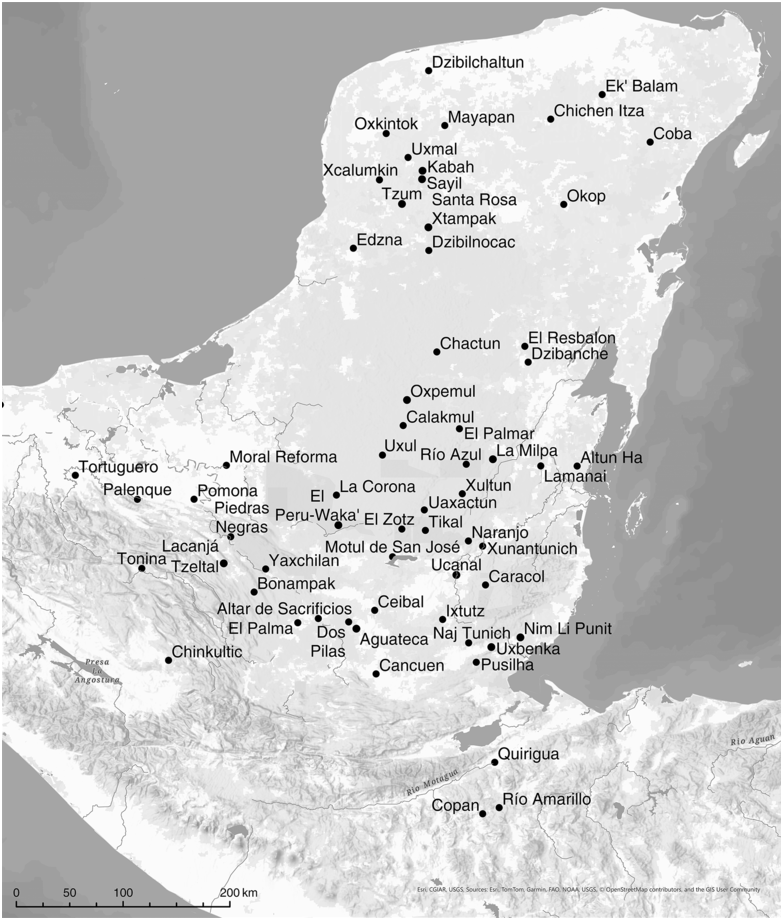
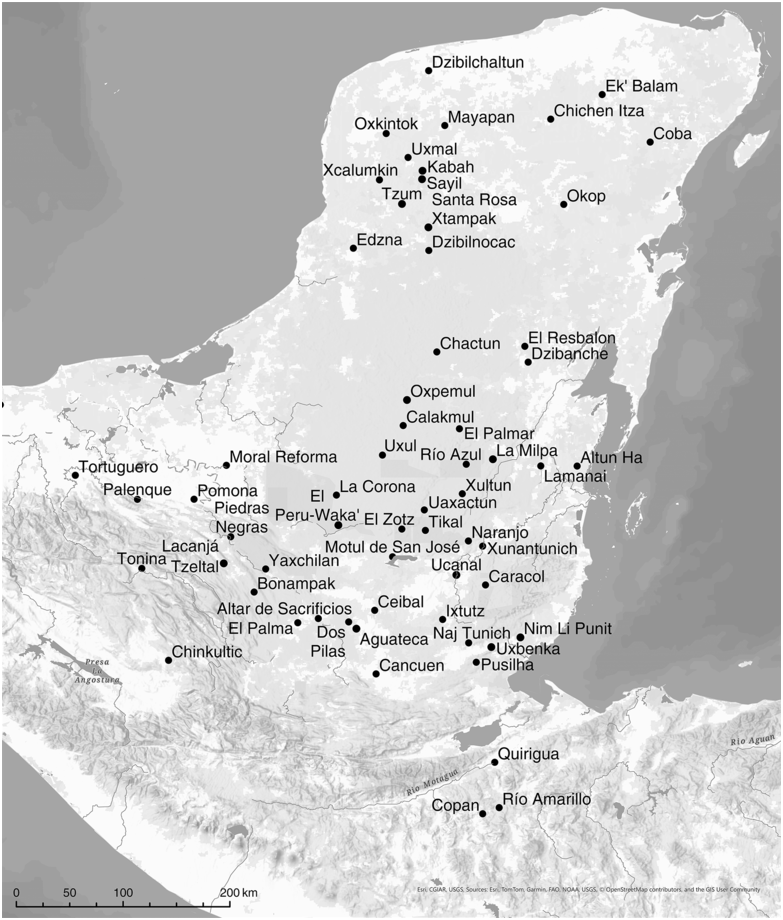
Since the late nineteenth century, scholars have defined Classic Maya civilization based on a series of common cultural traits that were shared across the lowlands of what are now southeastern Mexico, Guatemala, Belize, and western Honduras and El Salvador (Figure I.1).Footnote 1 Classic Maya kings and their kingdoms were interactively linked for centuries but never politically unified. Instead, they were joined in an interdependent web that, in the words of Simon Martin, remained “essentially heterarchical” despite “great asymmetries in power” between individual polities.Footnote 2 What the Classic Maya and especially their ruling elites did share, however, was a regional culture defined by such features as calendrics, rituals, mythology, and a hieroglyphic writing system. Over the course of more than a millennium, the hieroglyphs undergirded both ritual practice and the institution of divine kingship, in which the semidivine king was both political leader and principal mediator of community relations with the gods and ancestors.
Major archaeological sites in the Maya lowlands with hieroglyphic inscriptions.
This book offers a novel interpretation of the relationship between religion and writing in ancient civilizations by examining the intersection of scribal and religious practice. Specifically, it considers how Classic Maya elites promoted cultural cohesion across a politically fragmented landscape through ritual participation and exchange of religious artifacts. I start from the premise that ways of hieroglyphic writing – from sign choice to graphic representation to text composition – developed, spread, and were normalized through rituals shared among communities that were never unified under a central government. In other words, a common religious and especially ritual culture, not political affiliation, was the key factor in maintaining the hieroglyphic script’s mutual legibility over generations. At the same time, scribes shaped the practice of Classic Maya religion by integrating ritual materials and forms into their ways of writing.
Writing in the Classic Maya Lowlands
Maya hieroglyphic writing is decidedly distinct from early script traditions in Mesopotamia, Egypt, and China, and not only because of the highly malleable graphic forms of its signs, relatively recent decipherment, or hemispheric origins. First, surviving Classic Maya texts demonstrate what has been called “an elite obsession with cosmological symbols,” in the sense that scribes privileged “the more spiritual aspect” of the world when using the script compared to their counterparts in other ancient civilizations.Footnote 3 The hieroglyphs’ decidedly divine associations will be discussed in Chapter 3. For now, it is sufficient to note that ties between writing and religion manifest in the oldest known hieroglyphic inscriptions, which demonstrate a preoccupation with gods, ancestors, and the sacred kings tasked with mediating the community’s relationship with them.Footnote 4 These connections are also apparent in the astronomical, calendric, and divinatory contents of the only four codices or barkpaper books that have survived from the Postclassic period (925–1517 CE), over a millennium after the hieroglyphs’ ancient beginnings.Footnote 5
This book offers the first systematic study of the Classic Maya writing system’s development within local and regional dynamics of cultural exchange. It is not the first publication to suggest that religion and ritual practice were fundamental to cultural transmission across the Classic Maya lowlands, or more specifically to the development of hieroglyphic writing.Footnote 6 This idea was first articulated almost a century ago by John Teeple, who considered hieroglyphic distribution in making his argument that Classic Maya elites shared astronomical knowledge about the ritually significant lunar cycle.Footnote 7 More than sixty years later, John Justeson and Peter Mathews proposed that writing in Mesoamerica arose as “simply a variant form of precursor iconography emerging in the context of political use of that iconography in ritual” (emphasis added).Footnote 8 In the decades since, however, these proposals have remained largely unexplored, to the detriment of our understanding of Classic Maya civilization.
A second distinction between the Classic Maya and the other civilizations in which writing was innovated is the express absence of political unification. The logistical demands of long-distance trade and dynastic politics in the lowlands suggest that hieroglyphic writing was probably used for local administration, even if traces of that use barely survive.Footnote 9 Whereas cuneiform, Chinese characters, and Egyptian hieroglyphs developed into robust, full-fledged, normalized writing systems under the aegis of centralized governance, however, the cultural-historical context of Maya hieroglyphs was always one of political and economic decentralization, even up through their ongoing revitalization among contemporary Maya peoples since the 1990s.Footnote 10
By the late twentieth century, scholars of the Classic Maya had abandoned prior models of peer polities that coexisted relatively peacefully under the rule of priests who were largely uninterested in politics, in response to to mounting hieroglyphic and archaeological evidence for recurrent contests over political and military power.Footnote 11 According to contemporary historical reconstructions, two powerful dynasties achieved dual hegemony over the central lowlands during the Late Classic period (600–820 CE): the Mutul dynasty based at Tikal, now in the Department of Petén, Guatemala, and the Kaanul dynasty at Dzibanche and Calakmul, both in the Mexican state Campeche.Footnote 12 Yet despite both dynasties’ unprecedented regional influence, neither ever gained the upper hand for more than a few generations at a time or acquired more than a modest foothold in the more distant northern, western, or southern lowlands.Footnote 13 Archaeological evidence indicates that the two hegemons never dictated Classic Maya craft production or trade, either.Footnote 14 Scribal practice in and beyond their respective spheres of influence remained similarly decentralized. Although some hieroglyphic trends do appear more often with Kaanul or Mutul affiliation, scribes for the most part maintained local traditions of writing production through political shifts and exchanged knowledge about the script even with differently allied communities.Footnote 15 In other words, there is no evidence that a community’s political integration into or withdrawal from the Kaanul or Mutul hegemonic sphere coincided with a major shift in their scribes’ ways of writing.
Classic Maya hieroglyphs developed in a context of enduring political fragmentation, in which alliances were short-lived and a shifting constellation of contenders continually vied for regional power. Still, there is clear, abundant evidence for close ties between writing and religion throughout the history of the hieroglyphic script, even if the nature of those ties remains opaque. The premise of this book is that this chronological correlation has a causal explanation, namely that religion and ritual fostered development and maintenance of Maya writing. Ritual practice mediated many interpersonal encounters that fostered exchange of hieroglyphic and related cultural knowledge, including religion more generally. At the same time, writing played an important role in communicating ritual events, practices, and ideas through time and space. Religion and hieroglyphic writing were integral, interlocking components of the larger cultural-historical phenomenon that we now refer to as Classic Maya civilization.
Scribes, Ritual, and Hieroglyphic Transmission
As elsewhere in the ancient world, most studies of cultural transmission in the Classic Maya lowlands have focused on ceramics, architecture, or other traditional artifacts of archaeological analysis. This trend reflects a legacy of Maya archaeology and epigraphy developing along distinct trajectories, as well as different skill sets that the disciplines require. Seminal studies of the hieroglyphic script’s history, in turn, concentrate on the writing system itself and treat social and cultural correlates of its structure and development as an afterthought. Nor has transmission of Classic Maya religion – broadly defined here as actions and concomitant beliefs for navigating human relations with non-, often suprahuman entities – been systematically investigated, despite growing evidence of marked religious diversity among polities. This book is the first study of religion and ritual that links their practice to transmission of hieroglyphic writing and considers their collective role in shaping the Classic Maya world.
The following chapters apply perspectives from anthropology and religious studies to ask not how the Maya invented their script – that answer will probably always elude us – but how they maintained a coherent writing system for well over a millennium in a context of political heterarchy. Reconstructing hieroglyphic and ritual practices based on epigraphic and iconographic analysis, I trace trajectories of cultural exchange and contextualize them within economic and political interactions that defined Classic Maya society more generally. I focus on overlapping scribal and ritual communities among elites at different polities who were the primary creators and audiences of writing, highlighting loci of interaction and the cultural knowledge that they may have exchanged. Classic Maya scribes themselves were trained in and coproduced calendrical and other aspects of religious knowledge documented in their writings. Their hieroglyphic practice was informed by ritual engagement with the gods from whom they had inherited the script and by the creative capacity that its use entailed.
Ritual also shaped what and how scribes wrote as they integrated aspects of ritual performance into their hieroglyphic practice. Although part of their strategy was surely about making durable an otherwise ephemeral experience, scribes’ incorporation of ritual motifs into textual production also expressed writing’s relevance for mediating communication with the other-than-human realm. At the same time, transporting ideas and goods across the lowlands relied on the movement of people. Treating writing as a visible communicative practice that can only function with collective agreement on how to produce and interpret it compels us to acknowledge the exchange that necessarily underlies any successful script. Hints of human mobility are apparent from hieroglyphic references to foreign presence and from painted polychrome ceramics and other portable artifacts that are known to have been produced at a different polity from where archaeologists ultimately excavated them. Cultural transmission of religion and writing likely occurred even in contexts of interaction that were minimally or not at all motivated by ritual or scribal training.
Over the course of six chapters, I situate Classic Maya writing in its religious context and illustrate its co-development with ritual practice through a range of case studies. The first two chapters provide conceptual and historical background, beginning in Chapter 1 with my theoretical approach to religion and ritual. Proliferation of hieroglyphs in Maya society was closely tied to the rise of divine kingship as a political institution, and rulers vigorously documented rituals that they conducted on behalf of their subjects. Drawing on this history, I adopt ritual practice, including its relationship to a process known as ritualization, as a framework for interpreting the exchanges of ideas, objects, and persons through which Classic Maya scribes and ritual specialists circulated knowledge about the hieroglyphic writing system.
Chapter 2 contextualizes the Classic Maya case within a global history of early writing and human civilization by tracing the intertwined trajectories of religion and script in ancient Mesopotamia, Egypt, China, and Mesoamerica. For all the academic discussion of the role of political centralization, urbanism, and economy in the development of early writing, technologies of graphic notation were intimately tied to religious practice in all four areas of the world where they were independently invented. The Classic Maya were not unique in attributing their hieroglyphs to a divine source. Understanding writing as ritually relevant, across multiple civilizations, expands our consideration of the sociocultural contexts in which ancient peoples developed their distinct script traditions.
The remaining four chapters dive into the written, visual, and material data, profiling a series of case studies that illustrate how scribal transmission operated on varying scales of local and regional interaction. Chapter 3 initiates close examination of the Classic Maya context with the ritualized body of the scribe and the primordial link between writing and religion. Archaeological, iconographic, and epigraphic evidence indicates that elite scribe-artists had access to privileged spaces and forms of knowledge by virtue of their training and craft, which entailed producing a combination of both hieroglyphs and non-linguistic imagery. Although very few depictions of historical scribes survive, portraits of other-than-human beings engaging hieroglyphic writing embody the script’s godly origins. They also provide clues about ritual activities that the practice of writing implied for their human counterparts.
Chapter 4 explores the potential of scribes’ ritual observation and participation to shape practices of textual production. It applies a material perspective to religious transmission by considering what are arguably the most iconic – and certainly some of the most enduring – artifacts of Classic Maya religion today, namely monumental stone sculptures. I argue that monuments carved with the motif of a woven reed or rush mat were durable manifestations of the practice of covering or bundling such sculptures in perishable mats to mark them as surfaces for ritual performance. Scribe-sculptors drew on a long-standing tradition of cross-media citation to render an otherwise ephemeral practice in stone, an innovation that memorialized their roles as ritual actors at a monumental scale.
In Chapter 5, I consider ritual’s power to mobilize diplomatic actors whose travels across the lowlands inspired creation of hieroglyphic records, prompted dissemination of religious knowledge and artifacts, and fostered exchange of particular ways of writing. Joint ritual performance often brought together individuals of diverse, even conflicting dynastic affiliation, and it was not uncommon for such a meeting to be memorialized in the written history of one or more participating parties. The first example concerns interpolity and intradynastic exchange of a helmet adopted from central Mexico as a political symbol; the second addresses representatives of a minor kingdom traveling to perform rituals and to commune with the king and patron gods of another, more powerful dynasty. In both contexts, ritual performance offered a salient context in which rulers and their associates could express their cultural and political identity. At the same time, such interpersonal exchanges iteratively shaped a Classic Maya religious tradition that was shared among elites across the lowlands.
Chapter 6 addresses scribe-artists’ role in the production and circulation of material products of religious phenomena. It takes up the case of Classic Maya way, a supernatural being whose expansive and materially diverse expressions attest to ritual participation beyond the bounds of the royal court. Distribution of written and iconographic evidence suggests that the hieroglyphic signs used to write about shapeshifting, other-than-human co-essences, and other aspects of the way phenomenon circulated separately from imagery. Whereas portraiture of way beings concentrated in the central lowlands, scribal exchange about how to document way in writing attests to a more broadly regional religious tradition. This example provides a glimpse of the local diversity inherent in intergenerational scribal transmission and offers concrete evidence of artifact exchange as an important mechanism for circulating interrelated knowledge about writing, imagery, and ritual practice.
The history of early civilization is not the exclusive purview of political or economic historians. Key contributions can be made and are in fact needed from historians of religion as well. The Conclusion considers the consequences of the Classic Maya case for understanding cultural transmission as a social process that can foster political integration rather than just mirroring it. It proposes a revised model of writing’s origins in early civilization in which ritual and religion, which were inseparable from what we now call “politics” or governance, were crucial to development and maintenance of a cohesive system of graphic communication. Adopting this approach allows us to center other events and actors – including other-than-human beings – in reconstructing histories of the Classic Maya. It also recontextualizes the creation and maintenance of power beyond the kings, queens, and royal courts by accounting for the roles of scribe-artists, ritual practitioners, gods, and ancestors in upholding the Classic Maya institution of divine rulership.
The sharing of writing and religion was inextricable from much broader, ongoing exchanges of people, knowledge, and things across the Maya lowlands. If this book conveys a primary message, it is that religion was a force for cultural change and cohesion among Classic Maya communities. As elsewhere in the premodern world, religion was neither isolated from politics nor dependent on it for circulation through society. At the same time, religion, like politics or governance, harbors a potential to foster cultural cohesion that is often understated in accounts of ancient civilization. Although often divided by conflict or competing interests, the many dozens of polities spread across the lowlands remained culturally recognizable to each other thanks to generations of ongoing ritual performance and exchange. Religious interactions were a key mechanism through which Classic Maya scribes maintained a mutually intelligible hieroglyphic writing system for over a thousand years and across hundreds of square kilometers.
Notes on Orthography, Pronunciation, and Timekeeping
Since the beginning of Spanish colonialism in Mesoamerica in the early sixteenth century, Mayan languages have been written in a version of the Roman alphabet that varies by language and region. Generally, vowels and some consonants are very similar in pronunciation to their equivalents in English or Spanish. The main differences concern a set of ejective or glottalized consonants, usually denoted in writing by modifying the plain consonant with an apostrophe (’), that speakers articulate by temporarily restricting airflow out through the glottis. These and a few other sounds or letters may be unfamiliar to speakers of European languages:
| Letter (ALMG/INALI) | International Phonetic Alphabet Symbol | English Comparison |
|---|---|---|
| ’ | ʔ | brief catch in the throat between the syllables uh-oh |
| b’/b | ɓ | like bed with minimal air released behind the first consonant |
| ch’ | ʧ’ | like fetch with brief catch in the throat behind the final consonant |
| j | χ | like loch with the base of the tongue elevated toward the uvula |
| k’ | k’ | like back with brief catch in the throat behind the final consonant |
| p’ | p’ | like lip with brief catch in the throat behind the final consonant |
| q | q | like cat with the base of the tongue elevated toward the uvula |
| q’ | q’ | like cat with the base of the tongue elevated toward the uvula and brief catch in the throat behind the first consonant |
| t’ | t’ | like hot with brief catch in the throat behind the final consonant |
| tz/ts | ts | boots |
| tz’/ts’ | ts’ | like boots with brief catch in the throat behind the final consonant |
| x | ∫ | shell |
Mayan-language words or phrases quoted from cited sources reproduce the original author’s orthography unless otherwise specified. Modernized transliterations in Mayan languages other than Yucatec are rendered according to orthographic conventions established by the Guatemalan Academy of Mayan Languages (Academia de Lenguas Mayas de Guatemala, ALMG),Footnote 16 with the exception that some vowel complexity is not indicated. The ALMG conventions have been applied to many recent publications of colonial-period sources as well, including several referenced in this book. Modernized Yucatec spellings adhere to the conventions of the Mexican National Institute of Indigenous Languages (Instituto Nacional de Lenguas Indígenas, INALI),Footnote 17 which differ most notably from the ALMG standards in writing the letter <b> without an apostrophe (’) and using the digraph <ts> in place of <tz>.
Classic Maya hieroglyphs are transliterated in the Roman alphabet following the epigraphic norms summarized by James Fox and John Justeson and by George Stuart.Footnote 18 Transliterations are bolded; logographs are represented in UPPER CASE and syllabic signs in lower case. Hieroglyphs in a transliterated sequence are separated by hyphens (-), whereas square brackets [] in the transliteration enclose infixed elements. Transcriptions are italicized, and hyphens (-) in the transcription denote morpheme boundaries. Transliterations of Classic Maya hieroglyphic texts generally follow the ALMG orthographic standards, except that the letter <b> is written without an apostrophe (’).
On occasions when it is necessary to discuss specific graphemes or graphemic variants, I cite individual hieroglyphs using the epigraphic nomenclature of four-digit T-numbers established by J. Eric S. Thompson and updated by members of the Text Database and Dictionary of Classic Mayan project (Textdatenbank und Wörterbuch de Klassischen Maya, TWKM) at the University of Bonn, Germany, to include additional signs and to correct inconsistencies in Thompson’s original publication.Footnote 19 In the modified TWKM classification, each T-number bears a dipartite alphabetic suffix that provides additional detail about its graphic relationship to other signs.Footnote 20
Dates in the Classic Maya Long Count are cited throughout this book using the standard epigraphic format, which lists the five basic units of time in descending order, each separated by a full stop (.) (e.g., 9.0.0.0.0). Long Count dates have been correlated with the Julian calendar, the standard across Europe during the Mesoamerican Classic and Postclassic periods, according to Simon Martin and Joel Skidmore’s modified Goodman–Martínez–Thompson correlation of 584,286 days.Footnote 21 All correlations were calculated with the Maya Calendar Calculations tool (v1.0) developed by the TWKM project.Footnote 22

 Open access