

1. Introduction
Competition among reserve currencies is receiving renewed attention in the modern debate about global imbalances. Historical experience is often invoked, but little is known about the quantitative aspects or institutional features of reserve management.Footnote 1 According to earlier works, holding of foreign currency (in the form of foreign bills and deposits) was widespread in peripheries before World War I, with some countries relying more extensively on it than others.Footnote 2 The holdings of Russia, India and Japan accounted for more than half of global foreign exchange reserves.Footnote 3 Sterling was the primary reserve currency in 1913, followed by French francs and German marks.Footnote 4
The literature has documented that, in Japan, foreign exchange reserve accumulation began in the late nineteenth century through the initial buildup of reserves that resulted from China's war indemnity and Japan's adoption of the gold standard in 1897. This first episode of keeping foreign exchange reserves abroad terminated when foreign assets were later converted into gold and shipped to Japan.Footnote 5 After this, the Japanese authorities again accumulated foreign exchange reserves through foreign bond issues during the Russo-Japanese war (1904–5). They kept funds that were denominated in foreign currency and acquired through bond issues in London and New York, and the practice of holding foreign exchange reserve was institutionalized thereafter.Footnote 6 These bond issues, together with other foreign loans used to finance current account deficits, generated considerable amounts of financial flows.Footnote 7 Before World War I, Japan issued sovereign bonds largely in London, and most of them were sterling denominated.Footnote 8 Just before World War I, the combination of trade deficits and unfavourable conditions for international borrowing resulted in the gradual reduction in foreign exchange reserves until the outbreak of the war.Footnote 9 The significant expansion of exports triggered by World War I led to large current account surpluses, and the outstanding amount of foreign exchange reserves ballooned from 213 million yen at the end of 1914 to 2,045 million yen at the end of 1919.Footnote 10
These matters have been discussed previously, but little is known regarding the interwar period. However, information can be obtained using heretofore unexploited data from archival materials of the Bank of Japan, such as accounting books and other materials showing the views of contemporaries on reserve management and factors behind operations on foreign exchange reserves. We use this newly obtained data on Japanese foreign exchange reserves (and their currency decomposition) to explore the competition between sterling and dollars for the status of leading reserve currency in Japan during the interwar period. This competition was never entirely resolved, as leadership swung repeatedly. By combining the historical materials just described with econometric analysis, we are able to identify the factors that explain the choice of reserve currencies by the Japanese monetary authorities. In particular, we outline the importance of trade volumes and the currency denomination of external debt. These and other factors − such as the stability of the currency in question − proved crucial. Archival materials and the result of our empirical analysis suggest that the Japanese authorities were more inclined to hold currency that was less volatile. We also find qualitative evidence of such institutional factors as foreign exchange controls, restrictions on financial activities, and taxation.
This article is organized as follows. Section 2 provides information about Japan's exchange rate policy during the interwar period. Section 3 describes the institutional framework for foreign exchange reserve holdings and Section 4 details key facts regarding Japan's experience as revealed by our new data set. Section 5 discusses the mechanisms that drive reserve management from the viewpoints of contemporaries. Section 6 summarizes modern economic literature on the determinants of reserve currency composition and also provides an empirical analysis based on determinant factors. Section 7 concludes.
2. Japanese exchange rate policy during the interwar period
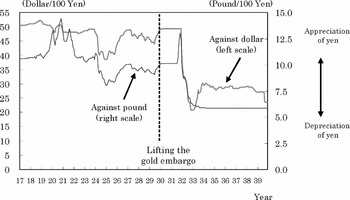
At the time when this story begins, Japan belonged to the periphery of the international economic and financial system.Footnote 11 The Japanese economy was far less developed than leading economies, and its gross domestic product (GDP) per capita suggests that economic development was lagging behind.Footnote 12 In 1925, Japanese GDP accounted for only 4.5 per cent of the world total and was only 15 per cent the size of US GDP. Japan's share of the global trading system was also modest, although Japan emerged before World War I as a regional trade and military power. International financial links were not well developed, and Japan relied on Western markets for external clearing and borrowing.Footnote 13 The Japanese authorities adopted the gold standard in October 1897, but they floated the yen in September 1917 following the US decision to suspend convertibility. World War I brought a succession of current account surpluses that, however, began to fade away when the war ended. Invoking this weak external position, Japanese policy makers delayed resumption of the gold standard even as they proclaimed it to be a most important economic policy goal.Footnote 14 As a result, yen exchange rates fluctuated until the return to the gold standard in 1930 (see Figure 1). The yen was stable against the dollar in the early 1920s, then collapsed in the mid 1920s and recovered afterwards. Contemporary observers mentioned that the exchange market was at the mercy of bankers.Footnote 15 The prewar consensus still prevailed: exchange rates should be left to market forces except for infrequent interventions by the authorities. Junnosuke Inoue, then a member of the House of Lords and a former finance minister, stated in 1926 that ‘the exchange rates have been left to the mercy of circumstances, or . . . of the exchange bankers, to do with them what they will. The idea seems to be that we should go on trading till the day comes when we find ourselves short. Then the Government is to step in and to provide, by selling its foreign currency balances at the current rate of exchange, the wherewithal for us to carry on.’Footnote 16
Yen exchange rates during the interwar period

In July 1929, the change in leadership (Tanaka of the Seiyukai Party was replaced as prime minister by Hamaguchi of the Minseito Party) triggered speculation of a return to gold at the prewar parity, as the Minseito Party had pledged.Footnote 17 The yen appreciated.Footnote 18 Japan finally returned to the gold standard in January 1930, but in retrospect the timing could not have been worse because it coincided with the onset of the Great Depression.Footnote 19 The British departure from the gold standard in September 1931 was followed by massive bear speculation against the yen, and Japan abandoned the gold standard in December of that year.Footnote 20 After departing from the gold standard, the yen temporarily plummeted by about 60 per cent against the dollar. The government initially adopted a laissez-faire exchange rate policy, but in 1932 it changed direction by embracing exchange rate stabilization policies along with controls on capital and foreign exchange.Footnote 21 The 1933 US gold embargo led the Japanese authorities to peg their currency to sterling in 1934.Footnote 22 This peg remained until 1939, when the United Kingdom imposed controls on foreign exchange following the outbreak of war in Europe. In October of that year, Japan began pegging to the US dollar.Footnote 23
3. Japan's holding of foreign exchange reserves: background
When the Genoa Conference in 1922 recommended adoption of the gold exchange standard, foreign exchange holdings by the monetary authorities were rationalized as a way to save on gold.Footnote 24 Another key motivation was that, unlike gold bars, foreign exchange bore interest.Footnote 25 As a result, countries were encouraged to hold assets denominated in foreign currency in foreign financial centres. Governments who borrowed abroad were naturally led to keep balances in the financial markets and currencies of the countries where they secured funding. This official practice was not different from the procedure used by corporate entities with international activities.Footnote 26
After the Genoa conference, the gold exchange standard spread among European countries. As a result, foreign exchange holdings of major central banks increased in the late 1920s and reached a peak in 1930. In 1931, wholesale liquidation of foreign exchange reserves began, and the outstanding amounts of foreign exchange reserves collapsed.Footnote 27
The evolution of foreign exchange reserves in Japan runs counter to this general trend. The post-World War I period saw Japan retreat from the gold exchange standard. In October 1919, its monetary authorities decided that they would limit the amount of foreign exchange reserve that could be used as backing for circulation of banknotes. The view was that, although balances in foreign currencies were useful, they had to be disconnected from domestic money creation because the huge increases in foreign exchange reserves during World War I could, it was feared, cause rapid monetary expansion and thus inflation. In August 1922, the Japanese government abolished the use of foreign exchange as reserve for issuance, a decision that was contrary to the spirit of the Genoa stipulations.Footnote 28
During the interwar period, the sum of official holdings of gold and foreign exchanges was defined as ‘specie’. Specie was divided into two categories − namely, ‘domestic specie’ and ‘overseas specie’ (zaigai seika) − that reflected the geography of holdings. Judging from historical materials, domestic holdings were in gold while overseas holdings consisted of foreign currency assets owned by the government and the Bank of Japan (hereafter BOJ),Footnote 29 although reserves abroad were sometimes held in gold.Footnote 30 ‘Specie’ thus means foreign exchange holdings, in contrast to what the word may suggest to an English-speaking reader.Footnote 31 In this article we shall use the more transparent wording ‘foreign exchange reserve’ instead of ‘overseas specie’. This is the topic of our study and so we leave aside ‘domestic specie’, which can be translated as ‘gold reserves’, altogether. See the Appendix for a more detailed discussion of the concepts involved.
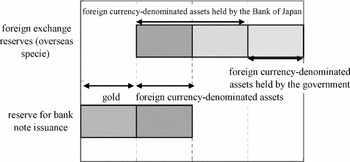
Another complication in the tracking of Japan's interwar foreign exchange reserves is agency competition, which affected and was influenced by successive policy arrangements. Foreign exchange was held by the central bank and also by the Ministry of Finance. Foreign exchange reserves thus fell into three categories: (i) foreign currency-denominated assets owned by the BOJ and adopted as reserve for banknote issuance; (ii) foreign currency owned by the BOJ but not adopted as reserve for issuance; and (iii) foreign currency owned by the government.Footnote 32 In practice, it makes sense to aggregate all official holdings in our attempt to measure ‘Japan's’ foreign exchange reserves. This follows the practice of contemporary monetary authorities and subsequent studies, which treated government and BOJ holdings, statutory or not, as substitutes. Eigo Fukai, who was one of the central figures for monetary policy in the 1920s and 1930s (he was executive director of the BOJ between 1918 and 1928, deputy governor between 1928 and 1935, and governor between 1935 and 1937), argued that it is reasonable for overseas funds held either by the Japanese government or by the BOJ to be called ‘overseas specie’ (Fukai Reference Fukai1928, pp. 319–28).Footnote 33
Another important entity involved in reserve management was the Yokohama Specie Bank (hereafter YSB), which provided services to the Japanese monetary authorities through its overseas branches in London and New York. It was through the YSB that both the government and the BOJ dealt with foreign exchanges.Footnote 34 The YSB had a mixed ownership, with the government holding a third of YSB's capital when it was established in 1880.Footnote 35 The bank's primary role was to provide trade finance, and it played a large part in Japan's foreign exchange policies because of its expertise in foreign exchange. It could hold reserves for official bodies during the interwar period, although the bank's role and importance varied over time.Footnote 36 In any case, YSB's own foreign currency holdings had the same status as those of any private concern; hence, in contrast with some authors, we exclude YSB own balances from our accounts in this article.Footnote 37
The government and the BOJ were the only official holders of foreign exchange reserves, but their respective roles changed over time to reflect institutional reforms. Before World War I, the BOJ was formally to be the main holder of foreign exchange reserves; a recurrent suggestion was that the government should abolish its foreign currency holdings, but this never occurred.Footnote 38 To cushion the expansionary effects of the rapidly growing current account surplus and to prevent exchange reserves from fuelling inflation, the Ministry of Finance purchased foreign currency-denominated assets in the open market. For this purpose, it mobilized funds from the general budget and also from its ‘Deposit Bureau’.Footnote 39 One result was that, after World War I, the government became a major holder of foreign exchange reserves.Footnote 40 When the plan to return to the gold standard was announced in 1929, finance minister Inoue stated his intention to abolish foreign exchange holdings by the government.Footnote 41 However, figures described later reveal that the government kept a certain amount of assets denominated in foreign currencies.Footnote 42
Finally, as far as the nature of the holdings is concerned, we find Japan to have been fairly typical. After poring over the statistics for holdings of the BOJ and the government, we find that their short-term holdings included deposits (current account, sight deposits and time deposits) and short-term securities, such as UK treasury bills.Footnote 43
4. The development of Japan's foreign exchange reserves
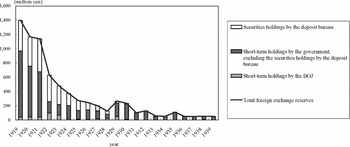
In this section, we examine the development of overall foreign exchange reserves by holder and by currency. We begin with Figure 2, which depicts the evolution of total reserves. As mentioned previously, reserves had sharply increased during World War I, and we see that the early 1920s inherited large holdings. Under the persistent external deficits in the 1920s, however, reserves were again gradually depleted and almost dried up by the end of the decade.Footnote 44 The expectation of returning to the gold standard in 1929 led to some efforts to replenish the reserves, but this recovery was reversed when the government actually announced its intention of returning to the gold standard in November 1929. Bank of Japan (1983b) mentions the role of profit taking by currency speculators who had played the yen up. When Japan finally returned to gold on 11 January 1930, ‘the condition surrounding overseas specie [foreign exchange reserves] did not allow having an optimistic view’.Footnote 45 In the first half of 1930, foreign exchange reserves fell again. Ito (Reference Ito1989) mentions the effects of continued profit taking, repayments for borrowing from abroad, and the seasonal demand for foreign exchange as reasons for the decline.Footnote 46 Two-thirds of foreign exchange reserves were lost during the period when the gold standard was restored. After the gold standard was abandoned at the end of 1931, it became increasingly difficult to meet external deficits. Capital inflows dried up as world bond markets collapsed, and plummeting world trade made it difficult to attract foreign currency.Footnote 47 As the level of foreign exchange reserves remained low, the Japanese government resorted to gold shipments in order to pay for outstanding overseas debts.Footnote 48 The balances held on the books of the YSB turned out to be too small to cover trade deficits in the late 1930s.Footnote 49 A balance-of-payment crisis came in 1937.Footnote 50
Foreign exchange reserve holdings

Figure 2 also indicates that the government, including the Deposit Bureau of the Ministry of Finance, dominates the foreign exchange reserve holdings in terms of outstanding amounts throughout the interwar period. This is in spite of the efforts and institutional changes in 1930 that were intended to make the BOJ a primary holder of foreign exchange reserves. Within the various government departments, the initial huge share of securities holdings by the Deposit Bureau declined steadily (from about 40 per cent of total government holdings to almost nil toward the end of the 1920s before disappearing entirely in 1934).
Eichengreen and Flandreau (Reference Eichengreen and Flandreau2009) argue that deposits, bills and foreign securities were the three main types of currency holdings during that period in other countries. Available information for Japan does support this finding.Footnote 51Table 1 displays information on the government's holdings for selected years.Footnote 52 Deposits consisted of current account, notice account and time deposits, with data suggesting that shifts across asset classes were not uncommon. As foreign exchange holdings fell during 1923–5, the share of UK treasury bills declined while that of current account deposits increased, perhaps reflecting a shift toward more liquid holdings. As reserves increased again in 1929, the share of treasury bills recovered.
Composition (per cent) of London holdings by the government for selected months

Notes: Securities held by the Deposit Bureau are excluded from this tabulation. Because of rounding, percentages may not actually sum to 100.
Sources: ‘The detailed accounting book for sterling-denominated assets held by London agency on behalf of the government [Rondon dairiten seifu eika meisai cho]’, Bank of Japan Institute for Monetary and Economic Studies Archives, documents 46113, 46114, 46115.
Archival evidence on portfolio management by some agencies sheds light on underlying strategies. For instance, we find that the Deposit Bureau, which concentrated its investments in UK treasury bills (though they also held other sterling-denominated securities until 1926), most probably resorted to a ‘buy and hold’ policy.Footnote 53 In support of this inference we have evidence of a comparable number of purchases and redemption operations, with the amount of each purchase nearly equal to the sum of redemption plus accrued interest.Footnote 54
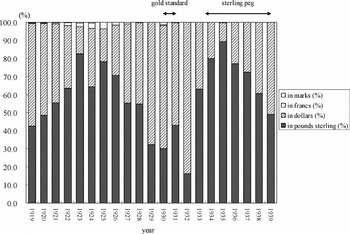
Foreign exchange reserves held by the Japanese authorities during the interwar period consisted of four currencies: British pound sterling, US dollar, French franc and German mark. The share of the latter two never reached even 5 per cent. This pattern is typical of other countries’ records, and it shows the tendency of foreign exchange holdings to concentrate on a limited number of international currencies. Sterling and the dollar were thus the main reserve currencies of the time, but without any clear or durable leadership emerging (see Figure 3). Lindert (Reference Lindert1969, pp. 18–19) argues that, in 1913, sterling was the dominant currency in Japan (with more than 80 per cent of the total). After World War I, we find that the dollar's share increased to reach more than 50 per cent in 1919 and 1920.Footnote 55 Sterling then recovered its status as the dominant currency throughout the 1920s. However, just before the return to the gold standard, the dollar regained the lead. After the dollar's devaluation in 1933, sterling recovered and remained the leading instrument as long as Japan continued pegging its currency to sterling. The US dollar became the primary currency in 1939 (although its ascendance began earlier), coinciding with the shift in Japanese currency peg from sterling to the dollar.Footnote 56
Foreign exchange reserves by currency

In sum, we find that Japan's foreign exchange reserves declined during the 1920s. This runs counter to the trend in other countries, where foreign exchange reserves were ballooning during this decade (Eichengreen and Flandreau Reference Eichengreen and Flandreau2009). On the other hand, the resilience of sterling and its characteristic unwillingness to surrender easily (in the mid 1920s and then again in the mid 1930s) is consistent with results for contemporaneous countries. Likewise, in Japan the US dollar had a heyday between 1929 and 1932 that echoed similar tendencies elsewhere.
5. Contemporary views on portfolio management
What did policy makers think of foreign exchange management? The government, the BOJ and the YSB have left material exhibiting their views on the matter. In this section we review archival evidence regarding reserve accumulation and currency selection. These materials help us to understand the factors affecting portfolio choices, to be discussed later on. Elements of concern to the Japanese authorities included liquidity, location of holdings, the portfolio of foreign exchange reserves and identifying the best international currency. At a broader level, of course, the question of how to accumulate foreign exchange reserves was related to a country's macro objectives. For instance, BOJ official Eigo Fukai pointed to factors in common with other gold standard countries, such as saving the costs of actual gold shipments.Footnote 57 In November 1919, BOJ governor Junnosuke Inoue explained that the bank's main purpose in acquiring foreign exchange was not earning profits but rather ‘enhancing trade’ in accordance with government targets, which we interpret as a policy to promote trade by providing financial instruments that would smooth settlements.Footnote 58 Inoue also stated that this imperative trumped profit motives, implying that foreign exchange accumulation could occur without reference to portfolio maximization. On the other hand, foreign exchange balances could be subjected to reallocation, and there is abundant evidence of sophisticated thinking on how best to accomplish this.
At the end of 1912, the Ministry of Finance stated that foreign exchange balances held by the government in the United Kingdom ought to be maintained at ‘first-class’ banks. Deposits were to be kept in instruments that would facilitate payments and, if the situation allowed, in instruments that would generate better returns. We have evidence that the Ministry of Finance occasionally purchased UK treasury bills instead of time deposits when the former became more profitable owing to changes in interest rates.Footnote 59 When the accumulation of foreign exchange reserves accelerated during World War I, proper management of the reserve became a more pressing issue. In 1916, the government set the principle that it would ‘purchase short-term profitable foreign securities in order to earn interest’.Footnote 60 In October 1919, the BOJ ruled that ‘deposits for overseas reserve should be in current accounts with a possibility of sight, or few days’ notice, withdrawals’.Footnote 61 It also decreed what banks were eligible for depositing funds; in the United Kingdom, it had to be the Bank of England. In the United States, only the Federal Reserve banks and a few large private banks in principal US cities were eligible.Footnote 62 In 1939 the Ministry of Finance emphasized liquidity for the holdings of the Deposit Bureau.Footnote 63
In 1927 the head of the New York branch of the YSB, as agent for foreign reserve management, wrote a letter to the YSB president about the general principles of such management, making several suggestions concerning Japan's expected return to the gold standard. He emphasized that foreign exchange should be liquid (kept in the form of ‘securities easily sold in order to obtain funds’), held in New York (because ‘the economic ties between Japan and the US are so strong and the global financial centre has shifted from London to New York’), and with maturities matching projected needs (‘when they are frequently used for maintaining foreign exchange rates, for example as they were after the Great Kanto earthquake, the largest part of them should be placed as deposits on current accounts. By contrast, some parts can be invested in short-term treasury bills when assets are not likely to be sold’).Footnote 64 The volatility of exchange reserve currencies was also an important factor. One BOJ document (to be discussed shortly) shows transaction records in the midst of the 1931 sterling crisis that suggest the government intended to shift sterling-denominated assets to dollar-denominated assets in order to avoid capital losses.Footnote 65
Sources also indicate that service of external debt (mainly government debt) was a primary driver of the selection of currency holdings. In the early 1930s, the fiscal and financial section (zaisei kinyu kakari) of the BOJ created a document entitled ‘The Record of Funds Located in the UK and the US from 20 September 1931 to the End of the Same Year’.Footnote 66 Although the precise date of this document is not known, it was created in early 1932 after the gold standard had been abandoned and in the context of collapsing exchange rates.Footnote 67 The document provides a kind of balance sheet of the foreign exchange needs in a context of capital outflows. On the one hand, the holdings of sterling- and dollar-denominated assets at the end of 1931 are shown. On the other hand, a simulation of foreign exchange needs for 1932 is provided based on both financial and trade factors. The calculation shows the importance of interest payments on external debts (which exceeded the trade deficit). It also reflects a kind of ‘cash in advance’ approach to foreign exchange management: needs were identified and budgeted, which led to the target values of currency holdings.
As for selecting where assets should be held, we found an explanation referring the status of the market as an international financial centre. In October 1939, when the yen was pegged to the US dollar, finance minister Kazuo Aoki declared that ‘now we can neither treat London as the centre for international settlements nor consider sterling as an international currency for settlement anymore’ and then raised three major conditions for a ‘reference currency’. The discussion that resulted is interesting because it reflects the close association, in the minds of policy makers, between reserve portfolio management and exchange rate targeting. We therefore provide the complete text of Aoki's declaration as follows.
The reasons why the reference currency for foreign exchange rates used to be sterling were that sterling kept relatively stable values and was free from restrictions in international settlements. Once meeting these conditions, it was considered to be an additional advantage that our country had a deep trade linkage with the sterling area. However, now sterling has lost its stability and as far as the transactions with our country are concerned, it has become a restricted currency. The reasons for taking sterling as a reference currency have gone. Under such circumstances, we have faced the situation under which it is necessary to re-think the basis of foreign exchange targeting. When it comes to the situation of our foreign trade, we note that about 70 per cent of the imports are from the US dollar area, while almost half of exports go there. The relationship with the US dollar area is deeper than with the sterling area. It is likely that this condition will last for a while. In addition, because the London market can no longer be used for foreign exchange settlements, operations must be shifted to New York. It is widely accepted that the US dollar is stable and that New York is the freest market for international settlements. Furthermore, there have been several examples where countries departing from a sterling peg have moved to the US dollar. For the reasons above, we have concluded that the most suitable decision is to choose the US dollar as a reference currency for Japan.Footnote 68
6. Factors determining Japanese reserve currency composition
In this section we describe our empirical study of the factors influencing the currency composition of foreign exchange reserves. We found earlier that the British pound sterling and the US dollar dominated other currencies; accordingly, our dependent variable is the relative share of sterling and the dollar in total foreign exchange reserves. We adopt an eclectic approach to determining explanatory variables. The previous section surveyed a number of factors that may have influenced contemporary policy makers. Modern empirical research has found various determinants of the composition of foreign exchange reserves. The influential work of Dooley, Lizondo and Mathieson (Reference Dooley, Lizondo and Mathieson1989) stresses the choice of the currency peg, the identity of the country's dominant trade partner and the composition of the country's foreign debt. These factors are also supported by the research of Eichengreen and Mathieson (Reference Eichengreen and Mathieson2001). Eichengreen (Reference Eichengreen2006, pp. 133–4) also emphasizes frictions in markets, foreign exchange controls and other institutional factors.Footnote 69 There are no previous empirical studies of the determinants of historical foreign exchange reserves, but Flandreau and Jobst (Reference Flandreau and Jobst2009) provide evidence on the related issue of the international reach of currencies in foreign exchange markets. The authors emphasize the role of geography, liquidity, trade and network externalities in conferring key currency status and in facilitating the spread of international currencies.
Our model considers three main explanatory variables: trade, finance and exchange rate instability. In some regressions, the trade and finance variables were aggregated to produce a synthetic indicator.Footnote 70 The effect of trade is measured by computing the ratio of trade with the sterling areas to trade with the United States.Footnote 71 Finance is proxied by external debt service on government debt, a major item of the balance of payments. Dooley, Lizondo and Mathieson (Reference Dooley, Lizondo and Mathieson1989) emphasize this as a powerful determinant for modern developing countries. Our specific variable is the ratio of the service on sterling debts to that on dollar debts.Footnote 72 Observe that this variable does capture to some extent the effect of specific institutional constraints, since limitations on foreign debt issuance or on payments in certain markets may have influenced debt denomination. It also captures inertia built into the financial system: between 1920 and 1931, Japan borrowed about 1.6 billion yen (or about 0.75 billion US dollars, according to the average exchange rate for that period), a large proportion of which was taken in New York.Footnote 73 Reasons for this included the rise of New York as an international financial centre for foreign bondsFootnote 74 and restrictions in London by the British monetary authorities (these were related to various schemes designed to control the capital account in such events as the 1925 return to the gold standard).Footnote 75 However, outstanding debt service did not adjust fully to the new conditions because of the long maturity of pre-World War I issues (the weighted averaged maturity was 25.4 years at the end of 1932).Footnote 76 Even in the early 1930s, debt service on sterling-denominated loans amounted to about half of the government's external payments.Footnote 77
Next we consider the relative stability of sterling versus the US dollar.Footnote 78 To capture the ‘quality’ of reserve currencies, we use a variety of measures. One is an indicator of relative strengthening (measured as sterling fluctuation against the dollar over the previous three years). Another measure is an indicator of past volatility (measured as the coefficient of variation of sterling in terms of yen divided by that of dollars, computed over the previous three years). In order to capture the effects of expectations on exchange rate volatilities, we compute the same coefficient but adjust it to cover a window from time t + 1 to t − 1. This measure also captures future volatility.Footnote 79 Finally, we add a year dummy to control for the effect of preparations for the 1935 redemption of a corporate bond issued by the South Manchurian Railway Company.Footnote 80 To sum up, we consider the following specification:

where
S = ratio of sterling-denominated assets to total foreign reserves at the end of each year;
D = ratio of dollar-denominated assets to total foreign reserves at the end of each year;
TRADES = annual sum of Japanese exports and imports to and from sterling-area trading partners;
TRADEUS: annual sum of Japanese exports and imports to and from United States;
DEBTS = annual interest payments on Japan's sterling-denominated sover-eign bonds;
DEBTD = annual interest payments on Japan's dollar-denominated sover-eign bonds;
FXSTAB = relative stability of exchange rate between pound sterling and US dollar; and
1935 = year dummy.
As can be seen, our basic equation is consistent with both earlier research and contemporary opinions. Accordingly, the expected effect of greater trade flows with the sterling area or larger interest payments in sterling is a larger relative share of sterling in total reserves. In contrast, holdings of sterling should be adversely affected by the currency's volatility, and its coefficient should be negative. The share of each currency's holdings to total foreign reserves is extracted from archival sources described in the Appendix. Trade and debt-service figures are collected from statistics published by the Ministry of Finance,Footnote 81 and foreign exchange rates are available in statistics published by the BOJ.Footnote 82 The estimation method is ordinary least squares, and the sample period is between 1924 and 1939.Footnote 83 The hypothesis of a unit root can be rejected for all variables by the DF-GLS test, which is supposed to have enhanced power in small samples.Footnote 84
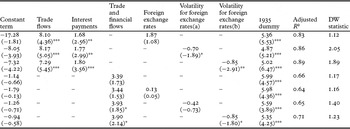
Results are shown in Table 2. Trade flows and interest payments are statistically significant when treated separately. In some cases, they are statistically significant when treated as an aggregate variable.Footnote 85 The Japanese monetary authorities raised (resp. reduced) their relative holdings of sterling-denominated assets when trade volumes with the sterling area increased (resp. decreased) with respect to trade volumes with the United States. The authorities also raised (reduced) sterling holdings when sterling-denominated external interest payments increased (decreased). This may have reflected the inclination of monetary authorities to hold currencies in which payments had to be made. This interpretation is consistent with the archival evidence showing that the Japanese authorities ‘budgeted’ their need for foreign exchange reserves. Because the currencies were not accumulated for sale to the private sector, another possible interpretation is that currencies associated with a large turnover faced smaller transaction costs and thus were more attractive vehicles.Footnote 86 We note that the effects of debt structure on the currency composition of foreign exchange reserves could partly explain the resistance of sterling against the dollar during the 1920s, given that sterling's share of debt stocks exceeded the dollar's share throughout the period.
Determinants of the currency compositions of foreign exchange reserves, 1924–39

Notes: Values as determined by equation (1); figures in parentheses are t-statistics. Annual data described in the text. Sterling area includes the United Kingdom and countries classified in Nurkse (Reference Nurkse and Eichengreen1944, p. 57) as ‘sterling area’ plus British colonies. These areas include Hong Kong, India, Straits Settlements, Sweden, Norway, Denmark, Portugal, Australia and Egypt. Sovereign bonds here include three issues of corporate bonds of the South Manchurian Railway Company, since their obligations were transferred to the government. Trade data with Japan are available in Reference Book of Financial Matters. Volatility for exchange rates (a) is computed over the previous three years, while (b) is adjusted to cover a window from time t + 1 to t – 1.
***significant at 1%; **significant at 5%; *significant at 10%.
Results regarding the stability are also generally consistent with predictions. Exchange rate appreciation is not significant, although the relative volatility of sterling compared to the dollar shows the expected negative sign. This volatility is significant when regressed against trade flows and interest payments separately but is not significant when trade and finance are lumped together. Relative volatilities with expectation also show negative and significant results in all cases. This implies that the Japanese monetary authorities shifted from sterling-denominated to dollar-denominated assets when the relative volatility of sterling increased or was expected to increase.Footnote 87
7. Conclusion
Japan introduced the gold exchange standard before World War I. It was a developing country and a net debtor with heavy debt-service burden. Therefore, management of foreign exchange reserves was one of the central issues in macroeconomic policies during the interwar period.
Archival materials and our recently collected data sets bring new knowledge on how policies were decided. Throughout the interwar period, the major holder of Japan's foreign exchange reserves was the government. Until the mid 1920s, many of these reserves were held through the Deposit Bureau, which was under government's supervision yet escaped parliamentary control. Both the government and the BOJ held foreign exchange reserves in the form of deposits (current accounts, deposits at notice, and time deposits) and treasury bills. The respective share of each asset changed frequently. Archival materials show that the monetary authorities of Japan were investment managers who cared about liquidity and safety, although they did not disregard returns. As for the currency composition of reserves, the pound sterling and the US dollar accounted for the lion's share. The sum of French francs and German marks never reached 5 per cent, a finding similar to that obtained for most countries during these years (see Eichengreen and Flandreau Reference Eichengreen and Flandreau2009). Currency leadership swung repeatedly between sterling and the dollar throughout the interwar period.
Both our archival exploration and statistical analyses of reserve currency composition reveal several determining factors in currency selection. First, archival material suggests that trade structures mattered. Results of empirical analysis suggest that trade flows can, to some extent, explain shifts of currencies in foreign exchange reserves. The channel through which trade flows affected currency composition may be transaction costs − to the extent that they were reduced by increased turnover. Archival evidence suggests that the authorities targeted expected trade flows when setting up their desired portfolio.
Second, the debt structure strongly affected reserve currency selection, according to both archival evidence and empirical analysis. Japan was a net debtor at the time, and the fund-raising environment determined its debt structure to some extent. Since the burden of debt service was considerable, a currency that could offer favorable conditions tended to be chosen for denomination. Therefore, a currency was favored if supported by a market that was capable of mobilizing funds and that was less regulated and less burdened with tax. Evidence suggests that it was essential to choose a currency with fewer restrictions. One of the important factors was that the currency be transferrable, suggesting that exchange controls played a significant role. The effects of debt structure could partly explain the inertia of preference for sterling, given the long maturity of sovereign bonds issued prior to World War I.
Finally, the stability of a particular currency's value was another critical determining factor. Archival materials provide supportive evidence. The results of empirical analysis for the period between 1924 and 1939 are in partial agreement, but more detailed data and evidence are needed to help deepen our future understanding of this issue. As a result of the factors described here, sterling maintained its status as a reserve currency during the interwar period − thanks, in part, to London's legacy as the sole international market before World War I. Sterling came to share this status with the US dollar, which emerged as a new reserve currency during the interwar period.
Acknowledgements
We are grateful to Haruhito Takeda for arranging access to archival sources of the Yokohama Specie Bank. For helpful comments on an earlier draft we thank Yoshio Asai, Seiichi Fujita, Alfredo Gigliobianco, Masanao Ito, Yoichi Matsubayashi, Mark Metzler, Ryuzo Miyao, Hisahiko Saito, Masato Shizume, Haruhito Takeda, Tomoyoshi Yabu and an anonymous referee, as well as the editors for the PPP3 and participants of the PPP3 conference in Genoa, the Monetary Economics Seminar at Kobe University, the seminar at the Bank of Japan, and staff members of the Institute for Monetary and Economic Studies of the Bank of Japan. Any errors herein are solely our own. Views expressed in this article are those of the authors and do not necessarily reflect the official views of the Bank of Japan.
Appendix
In this appendix we define foreign exchange reserves and provide details of the database concerning them.
As mentioned in the text, the sum of official holdings of gold and foreign exchanges was defined as ‘specie’. Specie consisted of ‘domestic specie’ located in Japan and ‘overseas specie’ located abroad. The BOJ and the government held foreign currency-denominated assets. The Deposit Bureau, as a part of the government, held a considerable amount of short-term securities (see Section 4), which were recorded separately from other assets owned by the government. We define as foreign exchange reserves the sum of foreign exchanges held by the BOJ and the government, including securities by the Deposit Bureau, regardless of whether or not the reserves were backing banknote issuance. See Figure A-1 for the relationship between specie, reserve for bank note issuance and foreign exchange reserves.
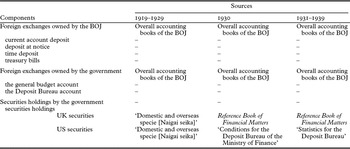
The figures in this article are constructed mainly from the BOJ's internal statistics and contemporary published statistics for some items (see Table A-1). Assets managed by the YSB as an agent for the BOJ were registered on the BOJ's balance sheet under ‘accounts for overseas agencies’. Since the BOJ held overseas assets on behalf of the government, the government's overseas assets also appeared in that account.Footnote 88 The ‘accounts for overseas agencies’ were divided into two subgroups: short-term holdings (shikin) and securities (yukashoken).Footnote 89
Components and sources for figures for foreign exchange reserves

Note: Components are based on the classification in ‘Domestic and overseas specie [Naigai seika]’.
Foreign exchange reserves and reserve for bank note issuance

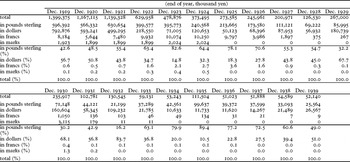
The total amounts for foreign exchange reserves reported in this article are the sum of short-term holdings by the BOJ and by the government as well as short-term securities held by the Deposit Bureau. This classification is based on the detailed items in one of the most well-known archival documents for specie figures: the internal statistics held by the BOJ Archives, known as ‘Domestic and overseas specie [Naigai seika]’ and containing data on foreign exchange reserves (Table A-1).Footnote 90 Short-term holdings of the government are divided into the general budget account and the Deposit Bureau. For the holdings of the Deposit Bureau, those in the form of deposits were recorded as short-term holdings of the governments whereas those in the form of short-term securities fell in the independent category. Unfortunately, this source provides data only until 1930, so we need to draw on other sources in order to construct consistent time-series data sets between 1919 and 1939.
Data for short-term holdings of the BOJ and the government are extracted from the annual ‘Overall accounting book [Sokanjo motocho]’ of the Bank of Japan.Footnote 91 As for securities held by the Deposit Bureau, figures in ‘Domestic and overseas specie’ mentioned previously are used from 1919 to 1929, and data after 1930 consist of figures for the holdings of UK and US treasury bills extracted from statistics regarding the Deposit Bureau.Footnote 92 It is likely that these sources after 1930 are enough to cover total short-term securities holdings by the Deposit Bureau because the only overseas securities it held from 1925 to 1939 were UK and US treasury bills (except in fiscal year 1927, according to figures in Ministry of Finance).Footnote 93
Table A-2 shows the results of our estimation.Footnote 94