Introduction
Periphytic organisms that live attached to surfaces projecting from the bottom of a freshwater aquatic environment generally attain high biomass and contribute up to 80% of the primary productionReference McIntire and Phiney1, Reference Moss2. As a food in aquaculture, periphyton may provide 75% metabolic energy to fishReference Haroon and Pittman3. The periphyton have been studied extensively in lakesReference Denny, Bowker and Bailey4, Reference Lucinska5, reservoirsReference Dickman and Gochnauer6, Reference Shachenko7, pondsReference Philipose, Nandy, Chakraborty and Ramakrishna8–Reference Keshavanath, Gangadhar, Ramesh, van Rooij, Beveridge, Baird, Verdegem and van Dam10, rivers and streamsReference Dickman and Gochnauer6, Reference Hanak-Schmager11. Its potential has also recently been evaluated through periphyton-based aquaculture (PBA) experiments in pondsReference Azim, Wahab, van Dam, Beveridge and Verdegem9, Reference Hepher12. However, in the wet rice environment, these biotic communities (periphyton) were reported along with planktonReference Whitton, Aziz, Kawecka and Rother13 and associated algaeReference Catling, Martinez and Islam14–Reference Das, Mitra, Mukhopadhyay and Choudhury17, but were rarely related to the contribution in the rice–fish system. Practically, the periphyton component has neither been assessed nor given much importance as a system component in concurrent rice–fish culture in this country or abroad.
An agrarian hill tribe of the Apatani plateau (>1500 m above mean sea level) in Arunachal Pradesh, India has cultured fish in rice fields merged with their traditional agronomic practices over the past 40 yearsReference Saikia and Das18. They stock their flooded rice plots with common carp (Cyprinus carpio L.) at fry stages (2.5–3.0 cm) in April–May just 10 days after transplanting the tender and healthy seedlings of local rice cultivars. The farmers do not supplement any feed for the fish but for rice they allow the stubble of the previous crop to rot in the field itself during the fallow period. Monocropping of the fields once in a year with wet rice facilitated such organic fertilization practice. During field preparation, they occasionally use cow dung and farmyard manure. Harvesting of fish is performed either sequentially at a periodic interval or once at the end of the season. The reared fish normally grow up to 480, 250 and 100–120 g, respectively, in culture durations of 5, 3 and 1–1½ months. The farmers assume that the fish keeps the field soil soft and clean thereby yielding better crops of rice. Many farmers also observed that the reared fish actively nibble on submerged rice stems in mornings and evenings of each day, keeping rice stands clean, and also feed on organisms and pollen dropping from the rice canopy.
With the above background, a study on periphytic life forms in rice fish plots of the Apatanis was conducted during three consecutive wet rice seasons of 2001–2003 to confirm farmers' traditional belief and experiences.
Materials and Methods
Samples were collected from rice fields during the rice growing seasons using standard methods for the measurement of field plankton19; stem periphytonReference Catling, Martinez and Islam14, Reference Das, Mitra, Mukhopadhyay and Choudhury17, Reference King and Ball20 and fish gut samplesReference Haroon and Pittman3 at weekly intervals regularly at morning hours. Randomly, total of 50 liters of field water was filtered through a 0.20 μm plankton net and preserved in 4% formalin in 25 ml glass vials for laboratory analysis. The submerged rice stems were collected from a depth of 7.0–8.0 cm below the water surface of the field and 5.0 cm above from the field bottom at a constant length of 5.0 cm and preserved in 25 ml culture containing 4% formalin until further processing. Fish were also sampled randomly from the field and the full-length gut from each was dissected out to preserve in 4% formalin for further laboratory analysis. In the laboratory, rice stems were scrapedReference Azim, Wahab, van Dam, Beveridge and Verdegem9 and gut contents were carefully removedReference Hanak-Schmager11. Besides, periphyton was also sampled from the field during early flood, flood and post-flood periods, respectively, following the modified glass slide methodReference Das, Mitra, Mukhopadhyay and Choudhury17, Reference Castenholz21. For the purpose, glass slides (15×35 mm) were used on a specially designed periphyton sampler in view of the shallowness (<40 cm) of the rice field. The sampler was comprised of a 70–80 cm long bamboo stick fitted into the center of a wooden float of area 10 cm2. The wooden float was equipped with iron nails to hold at least ten (10) glass slides tightly like the blades of fan around it. The samplers were placed into the field canals at the time of transplantation of rice seedlings in the field so that the slides remain submerged under water during the season. The qualitative and quantitative analysesReference Haroon22 of the samples were carried out to determine the commonness of periphytic members in gut contents of reared fish along with the diversity indicesReference Pielou23–Reference Saikia and Das26 for periphytic communities. Identification was performed using standard manualsReference Prescott27, Reference Edmondson28 up to the genera level of taxa and wherever possible to the species level.
Results and Discussion
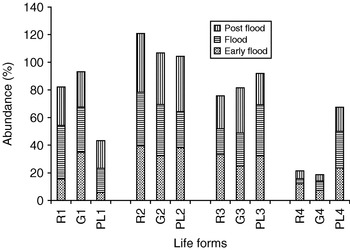
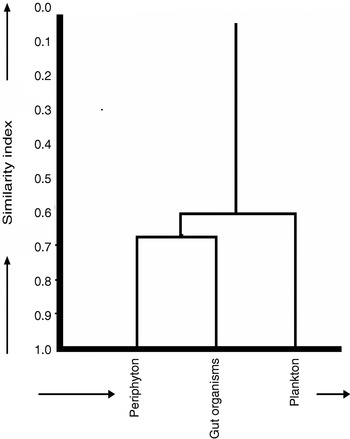
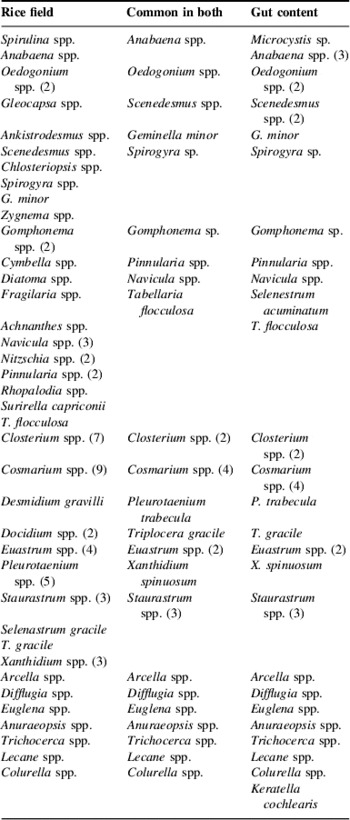
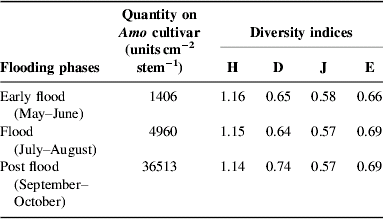
The analysis of gut contents of fish and organisms attached to rice stems in the rice–fish system showed that only 23 genera of periphytic members were common in both, whereas rice stems harbor about 38 genera and the reared fish consumed only 26 genera of the organisms (Table 1). The diversity of planktonic (suspended) forms in the rice field is comparatively less than periphyton (attached forms) on rice stem and also on glass slides (used for quantifying periphyton in relation to time) in the field (Fig. 1). Greater diversity of periphytic life forms was observed on rice stemsReference Das, Mitra, Mukhopadhyay and Choudhury17 compared to highest level of diversity as reportedReference Azim, Wahab, van Dam, Beveridge and Verdegem9 on bamboo substrates from the pond PBA systems. Probably the shallow and transparent water of the rice field allowed sufficient light5 to strike the field bottom and caused more periphyton growth compared to pond systems. Moreover, the periphytic diversity on rice stems throughout the season showed compositional similarity (Fig. 2) with the composition of available field plankton. The investigations clearly showed the richness of the periphytic resources both in abundances (Fig. 1) as well as in diversity (Table 2) in the rice–fish integrated field. The study also revealed that the reared fishes were probably more opportunisticReference Dempster, Beveridge and Baird29 and preferred periphytic forms of feed than suspended or planktonic forms which were available simultaneously within the system.
Abundance (%) of periphyton (on rice stems and on glass slides) and plankton (in field water) in rice–fish integrated fields of Apatani Plateau, Ziro. R=periphytic forms on rice stem; G=periphytic forms on glass slide; PL=planktonic forms; 1=Cyanophyceae; 2=Chlorophyceae; 3=Bacillariophyceae; 4=animalcules.

Dendogram showing the relationship among the diversity of periphyton in gut content, field periphyton and field plankton in the rice–fish system.

Periphytic organisms on rice stems and in gut contents of Cyprinus carpio L. in the rice–fish system.

Numbers in parentheses indicate identified numbers of species under the mentioned genera.
Density and diversity indices for periphyton in different flooding phases of the wet rice field under rice–fish culture at Ziro, Arunachal Pradesh, India.
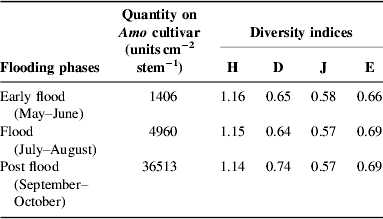
H=Shannon's' diversity index, D=Simpson's diversity index, J=Shannon–Weiner Evenness, E=Simpson's evenness.
From the viewpoint of the PBA conceptReference Azim, Wahab, van Dam, Beveridge and Verdegem9, Reference Hepher12, the indigenous practice of raising fish in rice adds a new dimension to the rice–fish system. It also explains the organic nature of the Apatani systemReference Saikia and Das18 scientifically in regard to production and harvest of fish from their mountain valley rice fields. The waterlogged rice fields, therefore, hold enormous potential to be used as a ‘self-substrating PBA’ (SSPBA) system for wet rice farmers as a whole. The system also reduces the need for and cost of extra input of substratesReference Azim, Wahab, van Dam, Beveridge and Verdegem9, Reference Keshavanath, Gangadhar, Ramesh, van Rooij, Beveridge, Baird, Verdegem and van Dam10 that are recommended for pond aquaculture. Practically, the substrate facilitates colonization of periphyton in the PBA systemReference Philipose, Nandy, Chakraborty and Ramakrishna8. All these functional, ecological and economic linkages of waterlogged rice agro-ecosystems have made the rice–fish farming technique a sustainable component of small-scale rural aquaculture30. Being an important crop diversification option in rice-based farmingReference Dwiyana and Mendoza31, the system needs intensified research and development of an interdisciplinary approach in rice-growing countries and most particularly in countries like India.
Conclusion
This study demonstrates the advantages of inbuilt biological synergies in a system of agriculture over exogenous energy-intensive inputs of other single-component systems. The study also indicates that periphytic organisms neither interfere with nor harm the rice or fish. Rather, they help in combined production of both in areas where farmers cannot afford increasingly expensive exogenous inputs. The linkages amongst the biological components, namely plankton, periphyton, rice and fish, within the system provide an insight into understanding the whole production process. It clearly supports the concept of integrating aquaculture with wet rice cultivation for sustainable and increased productivity based on biological synergies of more diverse multi-component systems.
Acknowledgements
We acknowledge our indebtness to the University Grant Commission, New Delhi for providing financial assistance for the study. Further, we are highly grateful to the rice–fish farmers of the Apatani tribe as a whole for their unstinted co-operation during the course of field study.