INTRODUCTION
Rock outcrops of diverse geological origins are a common feature in tropical landscapes, and share several adverse climatic and edaphic characteristics which make them a severe environment for organisms (Gaff Reference GAFF1987, Porembski & Barthlott Reference POREMBSKI and BARTHLOTT2000). Furthermore, populations are subject to genetic erosion and characterized by a high endemism, because of their isolation (Alves & Kolbek Reference ALVES and KOLBEK1994). Neotropical rock outcrops, whether quartzitic, granitic or metalliferous, predominate as from 1000 m asl, and are dominated by monocotyledons such as Orchidaceae, Cyperaceae and Velloziaceae, the last two with several representatives of poikilohydric plants (Gaff Reference GAFF1987, Porembski & Barthlott Reference POREMBSKI and BARTHLOTT2000). Individuals are adapted to drought and fire, and usually have very efficient physiological and morphological mechanisms to absorb nutrients. In addition to these adaptations, the particular edaphic conditions of metalliferous substrates select for heavy-metal-tolerant species (Porto & Silva Reference PORTO and SILVA1989, Silva et al. Reference SILVA, SECCO and LOBO1996).
Ironstone outcrops occur in very few areas in Brazil. They are concentrated around Serra dos Carajás and Quadrilátero Ferrífero (Iron Quadrangle), in north and south-east Brazil respectively (Klein Reference KLEIN2005). Ironstone fields in Brazil are presently one of the most threatened ecosystems, and least protected (Jacobi & Carmo, in press). Characteristically, successful plant species are epilithic and adapted to quick water uptake, and the few shrubs and trees grow in association with cavities or crevices. In spite of a relatively low plant α-diversity compared with the surrounding lowland vegetation, recent research has suggested that these haematitic fields may sustain a fairly high diversity of associated fauna, especially of invertebrates (Antonini et al. Reference ANTONINI, SOUZA, JACOBI and MURY2005, Vincent et al. Reference VINCENT, JACOBI and ANTONINI2002). In arid environments such as these, nectar represents a significant investment by a plant, and its availability in time and space may constitute a limiting resource for nectar feeders. Due to their size and energetic needs, defence of nectar sources is common among hummingbirds. Both theoretical models and empirical results have pointed out the convenience of defending smaller but high-value territories (Cotton Reference COTTON1998, Dearborn Reference DEARBORN1998, Temeles et al. Reference TEMELES, GOLDMAN and KUDLA2005), and reducing agonistic encounters when food is abundant, predictable, and of high quality (Powers & Conley Reference POWERS and CONLEY1994). When options are reduced, however, territory holders continue to defend a resource that is not energetically suitable (Heinemann Reference HEINEMANN1992).
One of the most characteristic plant species on ironstone fields is Stachytarpheta glabra Cham., to which a diversity of nectar-feeding insects has been related (Antonini et al. Reference ANTONINI, SOUZA, JACOBI and MURY2005). Hummingbirds, most notably Colibri serrirostris (Vieillot), have also been reported to use this species as a nectar resource (Vincent et al. Reference VINCENT, JACOBI and ANTONINI2002). In view of the environmental constraints for plant establishment, which reduces the variety and seasonal availability of resources for floral visitors, and more specifically nectar-feeders, S. glabra appears to be a key resource for this guild. Thus, our aims were (1) to evaluate the distribution of floral resources of S. glabra in time and space in a population growing over ironstone; (2) to determine the plant's dependence on pollinators and their behaviour; (3) to assess nectar defence by the territorial hummingbird C. serrirostris.
METHODS
Study area
The study was conducted in an area of ironstone outcrops belonging to Serra do Rola Moça State Park (20°03′60″S, 44°02′00″W, c. 1300 m asl), one of the very few conservation units in Brazil that harbour haematitic ecosystems. It is located within the Iron Quadrangle, a geological formation known for its high-quality iron-ore deposits (Simmons Reference SIMMONS1968). The climate in the region is mesothermic, with a mean annual rainfall of 1500 mm concentrated during November–March, and a dry season with high risk of fire (Nimer & Brandão Reference NIMER and BRANDÃO1989). These climatic conditions sustain savannas and fragments of Atlantic forest below 1000 m. Above this altitude, the very shallow soils (where they exist) preclude retention of water and organic matter, there is high daily thermal variation, and strong winds blow.
Study species
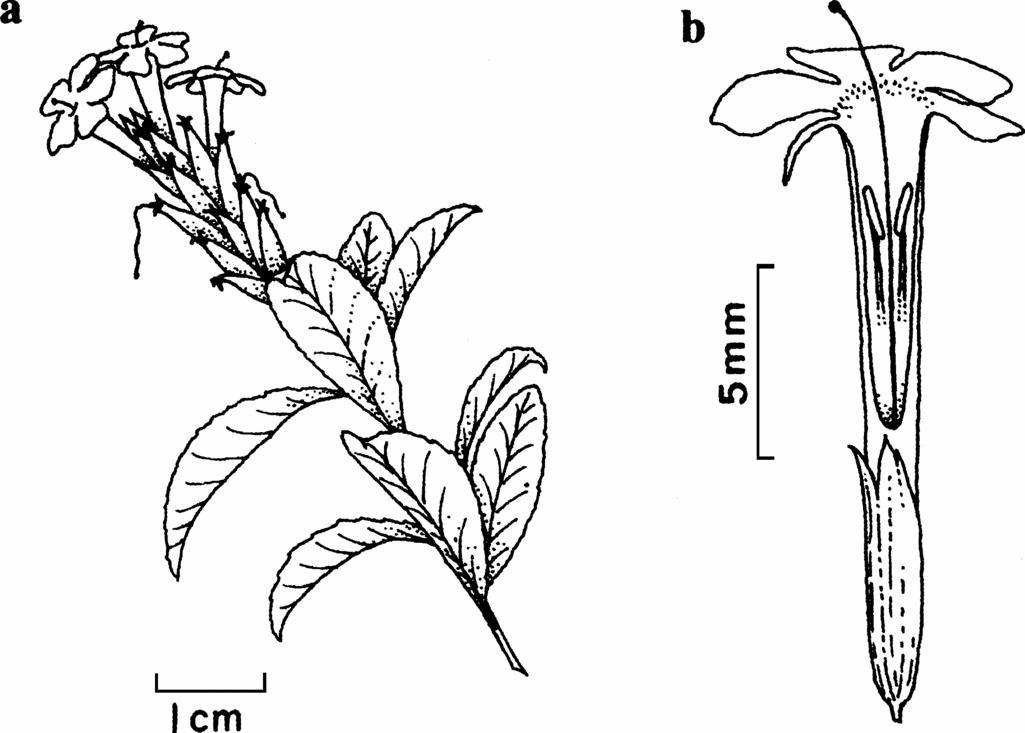
Individuals of S. glabra are shrubs occurring in large, dense patches, and the species is one of the most characteristic in ironstone outcrops (Jacobi et al. Reference JACOBI, CARMO, VINCENT and STEHMANN2007, Viana & Lombardi Reference VIANA and LOMBARDI2007). Inflorescences are conspicuous, terminal, and composed of tubular blue flowers (Atkins Reference ATKINS2005). Each inflorescence bears approximately 36 flowers, which open up to five at a time and last for 1 d. Each flower is 12.8 ± 1.44 mm long (n = 25), has a bicarpellate ovary with one ovule per locule, a long thin style ending in a small stigma protruding 2–3 mm beyond the corolla mouth (3.78 ± 0.23 mm, n = 25), two staminodes and two epipetalous stamens inside the corolla (Figure 1).
Terminal branch of Stachytarpheta glabra. (a) inflorescence, (b) details of anther location inside the corolla. Notice the spatial separation between anthers and stigma.

The white-vented violetear C. serrirostris is the most common hummingbird in the area (Vincent et al. Reference VINCENT, JACOBI and ANTONINI2002). Individuals have a mass of 6.0 ± 0.7 g (n = 5) and a bill length of 21.8 ± 1.3 mm (n = 8). Males and females are indistinguishable. The species is widespread in the cerrado biome (Sick Reference SICK1997). It is territorial and known for its constant calls while perching, which help territory owners defend their ground against conspecifics and other hummingbird species.
Floral phenology and nectar resources
To establish the predictability of nectar resources, we evaluated the quantity and duration of floral resources in a natural population. We censused, monthly over 2 y (2001–2002), 120 to 140 randomly chosen plants in the population, over an area of approximately 1 km2. Individuals smaller than 15 cm high were excluded. On each occasion we measured the height of each individual and the quantity of open flowers, and we classified each plant according to the predominance of four phenological categories: vegetative, flower buds, green fruits, and dry fruits. During the first year, the crown maximum diameter was also measured.
The density of floral resources was evaluated on four occasions, to compare dense and less-dense areas, at the peak and end of the flowering season. We counted the total number of plants and of newly open flowers in 40 1-m2 randomly located plots on each occasion. The pattern of plant distribution was determined in each case by testing the variance/mean ratio against a χ2 distribution, with 39 degrees of freedom (Southwood & Henderson Reference SOUTHWOOD and HENDERSON2004). If the ratio is significantly > 1, plants are aggregated.
Flowers (n = 40, from 10 plants) were bagged to estimate daily nectar volume and sugar concentration (using a pocket refractometer). Inflorescences with buds were bagged the night before, and the nectar from each flower was extracted with a micro-syringe twice in the morning (06h30 and 08h30) and twice in the afternoon (13h30 and 16h30). In addition, 21 flowers were bagged from 06h30 to 15h30 to estimate daily production without nectar removal. Sporadic concentration measurements in non-bagged flowers were performed as early as 05h30 and as late as 17h30.
Reproductive system and pollinator dependence
Individual flowers were manipulated to test the level of self-compatibility as well as the need for pollinating agents, on 100 plants, each of which was subjected to two or three treatments, depending on the availability of open flowers on the day of the manipulation. The treatments were (Dafni Reference DAFNI1992): hand cross-pollination (flowers pollinated with pollen from other individuals, n = 70), hand self-pollination (flowers pollinated with their own pollen, n = 60); spontaneous self-pollination (buds bagged without further manipulation, n = 70), and agamospermy (anthers removed, n = 30). In addition, we collected mature fruits from the same plants to evaluate seed production in natural conditions (n = 430).
Treatment flowers were marked and bagged with fine-mesh (c. 0.3 mm) nylon net bags until the fruits were fully developed. Very few flowers were lost or damaged during fruit development. The remaining fruits were collected and checked for seeds. The ratios of fruit set after hand self-pollination to hand cross-pollination (Self-compatibility index, SCI) and spontaneous to hand cross-pollination (Self-fertility index, SFI) were calculated following Lloyd & Schoen (Reference LLOYD and SCHOEN1992).
Floral visitors
Observation of insects was done during the period in which the plant population was in full bloom, approximately from November until April, and less frequently in May–October, usually between 09h00 and 16h00, totalling 200 h. We recorded the type of floral resource collected, approach and departure from the flowers, in particular if visitors touched reproductive structures, nectar robbing with damage to the corolla, and response to agonistic encounters. Insects not identified in the field were collected with insect nets and later mounted for identification.
Hummingbirds were photographed and identified with the help of an ornithologist. Observations of foraging and territory defence by C. serrirostris were made in periods of 6–10 h between 04h00 and 16h00, from November till May, totalling 600 h, to compare nectar intake with territory nectar availability. The number of flowers visited in each plant, duration and number of plants visited per bout, and agonistic behaviour were recorded. In addition, we estimated the size of 18 territories, in situations of high and low resource density, by determining the perching sites and foraging area of each individual. These observations provided also an estimate of the time individuals spent perching, foraging and chasing intruders.
The mean daily amount of nectar per hummingbird territory was calculated as follows: N = D × T × V, where D = flower density (flowers m−2), T = mean territory size (m2), V = mean daily nectar volume per flower (mL d−1).
The mean daily nectar intake per hummingbird was calculated as V × F × H, where F = flower visitation rate (flowers h−1), H = feeding time (h). The amount of nectar consumed was converted to energy values (kJ), where 20% sucrose = 0.216 mg μL−1, and 1 mg sucrose = 16.5 J (Kearns & Inouye Reference KEARNS and INOUYE1993).
RESULTS
Floral phenology and nectar resources
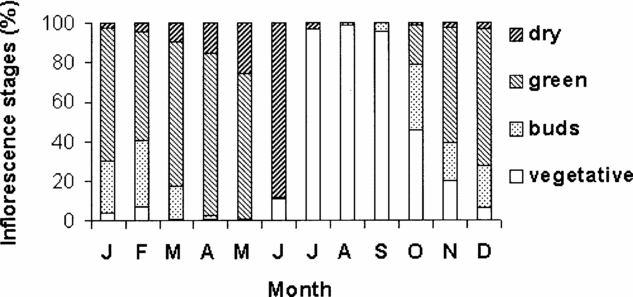
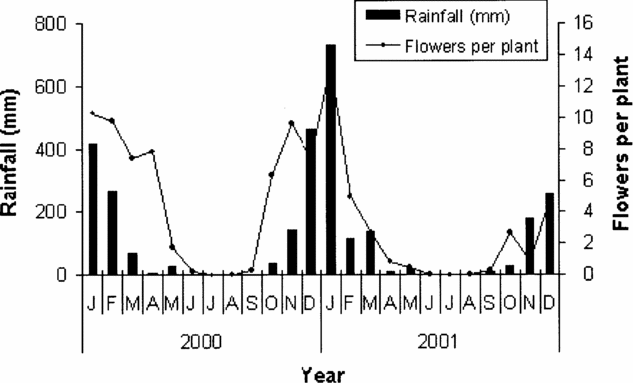
Bud formation starts around August, and bud production is high until the end of May (Figure 2). The flowering season is very long, initiating around October, at the beginning of the rainy season, and ending in May, already in the dry season (Figure 3). The flowering peak occurs from November to February, although with high variability of daily output (0–123 flowers per plant). The duration of individual inflorescences was estimated as 4–6 wk. Because of this longevity, each plant bears buds, flowers and fruits simultaneously in practically all months of the flowering season, with prevalence of fruits – green and mature – during the driest months (Figure 2).
Floral phenology of Stachytarpheta glabra: percentage of reproductive stages throughout the months.

Mean daily flower production per plant and monthly precipitation during the two years of observations (rain data: www.simge.mg.gov.br).

The maximum height of individuals in the area did not surpass 115 cm, and the most abundant size classes were those of 35 to 55 cm, correlating roughly with crown diameters ranging from 26.6 to 50.6 cm (Pearson's r = 0.76, n = 548 plants). The tallest plants presented a high variation of flowers and buds, and plants as small as 20 cm were reproductive. Plant density was quite variable in the study area, ranging from zero to 9 ind. m−2, which is consistent with the small size of most plants. The distribution of S. glabra is aggregated: of the four plant density estimates (Table 1), only one indicated a random distribution, while the others showed strong aggregation (values above χ239 = 72.1, P < 0.001). During the peak months, the mean flower density (±SD) was high, reaching 40.3 ± 22.8 flowers m−2 in dense patches, with a mean of 22.7 flowers per flowering plant. In less-dense patches the mean was 7.65 ± 8.65 flowers m−2 at the peak of the season, and 1.08 ± 1.15 flowers m−2 in the end (Table 1).
Plant and flower density (mean ± SD) of Stachytarpheta glabra in the study area, on four different occasions (n = forty 1-m2 plots each). Plant distribution patterns are based on mean/variance ratios.

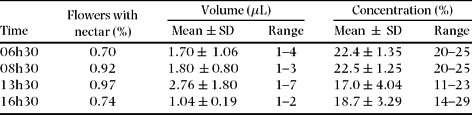
Not all flowers secreted nectar, especially in the early morning. Individual fresh bagged flowers produced up to 12 μL d−1 of nectar. Sugar concentration ranged from 11% to 29% (total mean = 19.7% ± 3.8%, n = 40), decreasing by the end of the day (Table 2). The mean sugar concentration of non-bagged flowers was 23.1% ± 2.9% (range = 11–27%, n = 96). Bagged flowers (n = 21), the nectar from which was not extracted, accumulated 8.26 ± 2.39 μL of nectar in 9 h. This amount is higher than the total average obtained by extracting nectar four times a day (6.19 μL), including nectarless flowers. Here, the percentage of empty flowers was higher at the beginning and end of the observation period.
Nectar production per flower in bagged flowers (n = 40, from 10 plants) throughout the day.

Reproductive system and pollinator dependence
Both flower shape and size favour pollination by hummingbirds and long-tongued insects, the only visitors capable of introducing their tongue far enough to reach the nectar deposit. Self-compatibility, and some ability to self-fertilize was confirmed by the SCI (0.53) and SFI (0.31) ratios respectively. As a result of anther location, and the stickiness and large size (c. 20 μm) of pollen grains, however, the species is highly dependent on pollen vectors. Within each treatment, spontaneous self-pollination produced less than 20% of fruits with seeds, while manually cross- and self-pollinated flowers produced 57% and 31% of fruits respectively. Emasculated flowers did not produce seeds. The percentage of control fruits with empty seeds was high (43.3%, n = 430), and similar to that of hand-outcrossed fruits.
Floral visitors
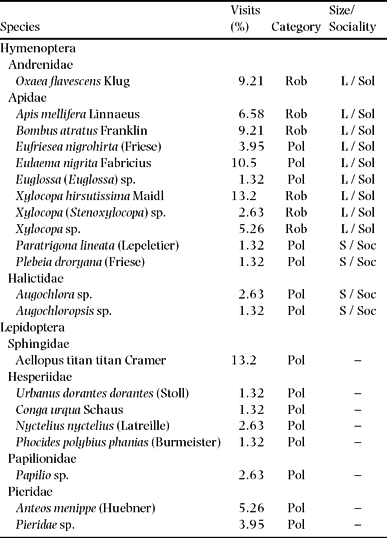
The flowers of Stachytarpheta glabra were visited by 21 insect species (Table 3) and two hummingbirds, C. serrirostris and the glittering-bellied emerald Chlorostilbon lucidus (Shaw).
Insect species visiting Stachytarpheta glabra at Rola Moça State Park. Rob = robber; Pol = pollinator; L = large; S = small; Sol = solitary; Soc = social.

Bees, moths and butterflies were the only insects that visited S. glabra flowers, in 76 visiting episodes recorded. Considering the sampling effort, this characterizes low visitation rates, but relatively high diversity. Thirteen bee species were responsible for 68.4% of the visits. Xylocopa hirsutissima was the most frequent (13%), followed by Eulaema nigrita, Bombus morio and Oxaea flavescens. Eight lepidopteran species were recorded in 24 episodes, accounting for 31.6% of the visits. Most of these were performed by the titan sphinx Aellopus titan, a sphingid with body size, shape, colour and foraging behaviour very similar to that of hummingbirds.
Insects exhibited three distinct resource-gathering behaviours. Large bees such as Xylocopa spp., B. morio and O. flavescens cut the base of the corolla from the outside to collect nectar, and were classified as robbers. All three orchid-bees (Euglossini), as well as lepidopterans, either landed on, or hovered over the flower and reached the nectar at the bottom of the corolla by sticking out their tongue. They almost always contacted the stigma and anthers, and were classified as pollinators. Finally, potential pollinators were small bees such as Augochlora sp. (Halictidae) and Paratrigona lineata (Apidae), which managed to enter the corolla tube to gather nectar (and less often pollen), and almost invariably emerged with pollen and touched the stigma both entering and leaving the flower. Insect visits were frequently interrupted by attacks of the territorial hummingbird C. serrirostris, the most common of both hummingbird species (90% of individuals).
Hummingbird territories were usually adjacent and ranged, at the peak of the season, between 240 and 624 m2 in dense areas (416 ± 129 m2, n = 11), and 310–1115 m2 (534 ± 277 m2, n = 7) in less-dense areas. With a mean nectar volume of 6.2 μL d−1 per flower (Table 2), the daily amount of nectar provided per mean size territory on the four occasions listed on Table 1 was estimated at 103.7 mL (January 2001), 68.6 mL (January 2002), 25.3 mL (February 2001) and 3.6 mL (May 2001), based on the respective flower densities.
Individuals of C. serrirostris initiated their activities – foraging bouts and vocalization from perches – shortly before sunrise, and vigorously defended their territory from intruders. Territory holders were very aggressive against conspecifics and also against C. lucidus, a low-reward trapliner which acquires resources by robbing. They also chased large bees, moths and butterflies. Apis mellifera was attacked less often, whereas small bees and skippers (Hesperiidae) were almost never chased away.
Around 10–12 foraging bouts h−1 were performed, lasting approximately 90–120 s, during which hummingbirds visited 14.6 ± 8.3 flowers from 4.67 ± 1.95 plants. After each bout they perched on a branch and remained silent, vocalizing, or chasing intruders. The estimated proportion of time spent foraging, perching, calling and chasing was 31.7%, 51.7%, 14.2% and 2.5% respectively. Considering a foraging period of 13 h d−1 and a conservative amount of 6.2 μL d−1 per flower, territory owners visit 2088 flowers d−1 and ingest about 13 mL of nectar daily, corresponding to 46 kJ. This nectar amount represents 13–51% of the daily available nectar per mean-size territory during most part of the flowering period. Territory defence ended around May, coinciding with a mean nectar standing crop of less than 4 mL per territory. Around this time of the year, hummingbirds were rarely seen, while flowers continued to be visited by insects.
DISCUSSION
Stachytarpheta glabra is notable as a dominant plant species on ironstone outcrops because it does not appear to have any of the characteristics that would allow it to overcome the harshness of these environments: it is a perennial phanerophyte, bears abundant large, tender and glabrous leaves, does not seem to have specific protection against fire or desiccation as is common in outcrop species, and is not a N-fixing plant. Although it is only one of many attractive resources for insect visitors, ironstone outcrops in the study area contain no other plant species that can provide nectar for hummingbirds in the required quantity and duration. Most of the other dominant species in these ecosystems are grasses, sedges, orchids and legumes (Viana & Lombardi Reference VIANA and LOMBARDI2007), none of which fulfils the conditions to provide nectar for hummingbirds, either because of floral mechanical constraints, the short flowering period, or lack of suitable nectar.
Other species of Stachytarpheta receive visits from a wide variety of insects, but, except for S. jamaicensis (Primack & Howe Reference PRIMACK and HOWE1975), no other species is known to attract hummingbirds. Plants are more usually visited by insects (Barbola et al. Reference BARBOLA, LAROCA, ALMEIDA and NASCIMENTO2006, Fonseca et al. Reference FONSECA, KUMAGAI and MIELKE2006). Indeed, in a population of S. glabra about 100 km from the study site, where C. serrirostris was seen sipping nectar, Antonini et al. (Reference ANTONINI, SOUZA, JACOBI and MURY2005) reported 312 insects distributed among 28 species in 242 h of observation, a higher visitation rate than in this study.
The constant production of flowers between the months of October and May is ensured through the combination of inflorescence longevity and asynchronous flowering among individuals, to overcome the short duration of individual flowers. Enhanced reproduction is known for environments with low-quality soils (Biere Reference BIERE1995, Tyler & Borchert Reference TYLER and BORCHERT2003, Zvereva & Kozlov Reference ZVEREVA and KOZLOV2005). A long flowering period, however, may result in low seed set or germinability due to lack of resources (Pico & Retana Reference PICO and RETANA2003), which might explain the large percentage of empty seeds found in all pollination treatments and naturally pollinated fruits. The maintenance of a costly flowering strategy is probably necessary to guarantee the presence of hummingbirds in the area, the main pollinators. These may also benefit the plant by preventing insects from damaging the corolla when robbing nectar.
The sugar concentration (around 20%) coincides with the mean for hummingbirds and other birds in nature (Baker Reference BAKER1975, Perret et al. Reference PERRET, CHAUTEMS, SPICHIGER, PEIXOTO and SAVOLAINEN2001). Although in captivity hummingbirds decrease volumetric intake with increased sugar concentration (McWorther & López-Calleja Reference McWORTHER and LÓPEZ-CALLEJA2000), a more concentrated solution would make nectar extraction more energetically demanding (Baker Reference BAKER1975), aside from the probable higher cost of foraging in nature. Also, a low concentration would be preferred since free water on ironstone outcrops is largely unavailable. Other food items for hummingbirds, such as insects, are less predictable or less easily detected in time and space compared with brightly coloured sessile flowers (Wolf et al. Reference WOLF, HAINSWORTH and STILES1972). It is probable that hummingbirds engage in insect trapping opportunistically, but that search is costly if compared to the energy intake acquired from foraging within a defended territory.
The estimated nectar reward per territory varied substantially in time and space, as a result of the plant's phenology and patchy distribution, and territories providing approximately 25 mL d−1 proved worth defending. Boyden (Reference BOYDEN1978) estimated the crop capacity of a 5-g hummingbird as 684 μL, and argued that the energy spent defending the territory against various intruders was necessary to prevent depletion of a territory. He showed that large bees have a crop capacity of approximately 100 μL, which they probably fill if left undisturbed. On the other hand, hummingbirds do not usually fill their crop since larger meals increase flight costs through weight (Carpenter et al. Reference CARPENTER, HIXON, HUNT and RUSSELL1991). The use of less than one-third of crop capacity applies to territorial hummingbirds, while trapliners or intruders benefit from a large crop that allows them to forage until chased away (Carpenter et al. Reference CARPENTER, HIXON, HUNT and RUSSELL1991, Tiebout Reference TIEBOUT1991, Reference TIEBOUT1993).
Flight cage experiments have shown that if the resource is abundant and predictable defence is irrelevant (Powers & Conley Reference POWERS and CONLEY1994). However, in the study area, in spite of the abundant resources, C. serrirostris spends energy in defensive calls and chasing conspecific intruders or the trapliner C. lucidus. Even aggressive behaviour against insects seems to be energetically rewarding, because nectar-robbing may increase spatial variability of nectar offer, and force hummingbirds to probe more flowers (Maloof & Inouye Reference MALOOF and INOUYE2000). Not defending a territory would mean that the owner or, in fact, any nectar-feeder, would face the risk of longer foraging bouts until a full meal is completed. In the study area, C. serrirostris spent little time per foraging bout and devoted most of the time to less demanding activities. The foraging time allows for a daily nectar intake of 13 mL, around 46 kJ d−1, compatible with their size and energetic needs (Powers & Conley Reference POWERS and CONLEY1994). The mean territory size, however, provides much more nectar than the owner can use. It is therefore likely that territorial defence is associated with predictability maintenance, which reduces the energetic cost of foraging (Temeles et al. Reference TEMELES, GOLDMAN and KUDLA2005). Aside from preventing depletion of resources, defence of large territories is probably associated to the high daily variability in flower output per plant.
If on one hand defence seems necessary, on the other the low intruder rate would make this activity fairly inexpensive (Eberhard & Ewald Reference EBERHARD and EWALD1994), especially in the case of C. serrirostris, which resorts to calls in order to discourage trespassers. Vocalizing is a low-cost activity compared to engaging in agonistic encounters with other hummingbirds. These characteristics favour the prevalence of C. serrirostris in the area and create a strong association with S. glabra, the only long-lasting, reliable resource for nectar-feeders in the area.
ACKNOWLEDGEMENTS
We thank the staff of Serra do Rola Moça State Park and IEF (Forest Institute of Minas Gerais) for logistic support, FAPEMIG (Minas Gerais Research Foundation, CRA 89/03) for financial support, Augusto C. F. Alves for the lively discussions on hummingbird energetics, Myrian M. Duarte for the artwork, Marcelo Vasconcelos for the hummingbirds identification, and Marcos Rodrigues for allowing access to the ornithological collection of the Zoology Department (UFMG). The final version of the manuscript was greatly improved thanks to two anonymous reviewers.