Basic Features of the Development of the Czech Republic and Slovakia
In history, the Czechs and Slovaks, two related West Slavic peoples, grew close culturally, as well as socially. There are several reasons for this, of which the most important is the great language affinity. Czechs have no difficulties in understanding Slovaks and vice versa (in the Slovak Republic, before literary Slovak was created in the eighteenth century, Czech was used instead). Even today a common treaty enables lectures delivered at Czech universities to be in Slovak and vice versa. The next reason for the bonding is a shared history, during which the predecessors of both of the nations alternately lived in common polities (Samo’s Empire in the seventh century, Great Moravia in the ninth century, Austria-Hungary in the nineteenth and early twentieth centuries, etc). The coexistence never faced any conflicts or critical situations.
During the existence of Czechoslovakia, Czechs and Slovaks also started to grow close economically. Slovakia, less economically developed as a result of its late industrialisation, came to reach almost the same level as the Czech economy. Czechoslovakia worked as a sovereign state, and the differences between the regions decreased, especially during socialism, which was, however, at the expense of external competitiveness. The period from 1948 to 1989 was characterised by a strong orientation towards Russia (at that time the Soviet Union). Czechoslovakia was, de facto, a Russian satellite, and its business was oriented mainly towards Russia and the countries of Eastern Europe (within the Council for Mutual Economic Assistance).
The geopolitical and geo-economic development of the Czech Republic and Slovakia after the dissolution of Czechoslovakia can be divided into several stages. During the Mečiar Administration (1993–1998), Slovakia became internationally isolated and began to lag behind in terms of its integration into European and transatlantic structures. While the Czech Republic, Hungary, and Poland joined the OECD in 1996 and NATO in 1999, Slovakia became a member of the OECD only in 2000 and a NATO member in 2004. It is necessary to mention the cooperation of the Visegrád Four (V4 – the Czech Republic, Hungary, Poland, and Slovakia), which was established in 1991 with the aim of fostering cooperation between the member countries during the transitional period. At the end of the 1990s, cooperation within the V4 was reduced and took on a more or less formal character. At the turn of the century, the alliance was restored and it was thought that it could guarantee the progress of its members and consolidate the position of the countries involved across Europe. The Czech Republic and Slovakia became members of the European Union in 2004, paradoxically at a time when the EU was modifying many of its original ideas, e.g. the countries did not keep later agreements (the Stability Pact, the free movement of persons for incoming countries, the varying levels of farm subsidies for existing and new members, etc). In 2009 Slovakia joined the monetary union and adopted the Euro. Again, this happened during a period when the EU had to face the emerging economic crisis and deal with the fiscal irresponsibility of some of its members.
The geographical position of both countries, part of Central Europe, can generally be considered to be relatively advantageous. Its location is on the boundary between ‘two worlds’; in the east–west direction it lies between Western Europe and the CIS countries and in the north–south direction between Scandinavia and the Balkans. In addition to all the facts mentioned above, it can be noticed that Slovakia differs from the other V4 countries in several other more or less significant ways. Slovakia is the smallest in size and population, and also its economic potential is the lowest. It does not have any metropolises with 1 million inhabitants, and Bratislava, compared with Prague, Budapest, and Warsaw, is the youngest capital, much smaller in size, and it is the only one of these four cities that has a noticeably off-centre location within the country. This location, in terms of fulfilling the capital’s functions, is geographically disadvantageous, but on the other hand its position seems to be advantageous in connection with the formation of a potentially significant European geo-economic axis. Slovakia is in close contact with the Austrian and Hungarian state borders and therefore it is predisposed towards mutually beneficial cooperation with these two neighbours. The distance from Vienna, the capital of Austria, is only 65 km, which is a unique situation in Europe; it is the smallest distance between the capitals of two different countries with totally different political and economic developments before 1989. The economic potential of the Vienna–Bratislava–Győr triangle is expected to be very beneficial in the future.
The range of mutual relations and cooperation between the Czech Republic and Slovakia is relatively wide. This paper will focus on foreign trade, labour and study migration, and cross-border relations in the Czech–Slovak borderland. The range of selected topics is not exhaustive but it can be considered sufficiently representative. The trade and migration relations are among the few that can be quantified and supported by data. The development of mutual trade indicates how the mutual economic relations have weakened and also the shift in the economic orientation of the Czech Republic and Slovakia towards Western Europe. Apart from the economic dimension, the migration relations and their development also have a social dimension, depending on the reasons for migration. The interaction of migration in Central Europe, and specifically the interaction between the Czech Republic and Slovakia, is a popular topic that has already yielded a number of studies.Reference Grasland and Cattan1–Reference Fassmann and Hintermann3 The social dimension of the mutual relations can be identified perfectly, especially on the local level, where the maintenance and development of the cross-border relations and cooperation is influenced by the regional and settlement structure of adjacent regions. The successful functioning of relations and cooperation in the borderland can be a model for the formation of mutual relations and cooperation on the national level.
Foreign Trade and Economic Relations between the Czech Republic and Slovakia
Both the Czech Republic and Slovakia used to show a long-term adverse trade balance (except for Slovakia in 1994, because of the influence of the introduction of a mark-up). The trade balance of both countries has recently become positive (in the Czech Republic since 2005, in Slovakia since 2009), which was caused mainly by the introduction or expansion of car production. The territorial structure of foreign trade also underwent very important changes. Until 1993, EU countries accounted for one-quarter of Slovakia’s exports, while in 2009 the percentage had increased to 86% (this was partly because of enlargement, by which many of Slovakia’s already existing export customer countries joined the EU, and partly because of an increased orientation towards Western European markets – 48% of Slovakian exports went to the 12 pre-1993 member countries). Despite its rapid reorientation towards western markets, the Slovak economy is still dependent on Russia for supplies. Even some industrial plants that are major exporters are dependent on eastern resources (Slovnaft, US Steel, Slovak Gas Industry).
Until the end of 1992, the Czech Republic and Slovakia formed one country, which was reflected in the interconnection of their economies, and which could still be seen in the first years after the dissolution of the federation. This phenomenon was supported by mutual knowledge of the markets, the existence of personal relations, etc. The Czech market continues to be strategic for Slovakia, as is the Slovak market for the Czech Republic, but the long-term stagnation of trade with the Czech Republic has meant that while there was a constant increase in the total foreign trade turnover for both countries, there was also a significant percentage decrease in Slovakia’s share of the Czech Republic’s foreign trade, and vice versa.Reference Halás4 The current Slovak share of Czech foreign trade is about 7%. The initial intermittent decline (in 1993 the share was about 18%) continued but it started to slacken gradually, and the recent period suggests that it could have stabilised. In 1998, Slovakia’s share of Czech foreign trade was overtaken by Germany’s hare, and in 1999 the volume of trade with Slovakia was comparable with the volume of trade between the Czech Republic and Austria. The same process can be seen in the Czech Republic’s share of the foreign trade of Slovakia; while, just after the dissolution, it was almost 40%, in 2007 this figure decreased to less than 12% and after that stabilisation began (Figure 1). This also means that the leading partner of Slovakia is no longer the Czech Republic but Germany.
Development of the share of foreign trade between the Czech Republic and Slovakia in the total foreign trade of Slovakia. (Source: data of the Statistical Office of the Slovak Republic.)

The main reason for the decline is undoubtedly the dissolution of the united Czechoslovak economy, in which a lot of cooperation and complementary production was planned and in which hardly any final product could be completed from products made only in one part of the former federation. While supplier–buyer relations were once centrally determined and Czech and Slovak companies had a prerogative to supply to the united market, nowadays it is possible to choose a supplier from any country. What is important now is which is the best offer in terms of technology and quality for the lowest price, the best possible terms of delivery, and the best possible financial and credit conditions. The decline was not intermittent but gradual, and until accession to the EU it was decelerated by the customs union, which created a preferential environment. But this could not change the trends mentioned above. Nowadays, the development of trade between the Czech Republic and Slovakia seems to be stabilised and its future progress will depend mainly on the overall strength of both economies in the competitive economic environment of Europe.
Something that is very important for the Czech Republic and Slovakia is their economic position in an integrated Europe, especially in the globalised world. No joint Czech–Slovak economic institutions can be found; the complementary production has gradually disappeared (with some exceptions) and both countries face an increasing inflow of international companies whose position in the industry is crucial; basically, all key exporters are part of international concerns (in the Czech Republic Škoda Auto, Foxcon, Panasonic AVC Network, and in Slovakia Samsung, Volkswagen Slovakia, Kia Motors, US Steel, and so on).
The partial resumption of cooperation and complementary production between the Czech Republic and Slovakia has recently been apparent in the automobile industry. All three major automobile concerns that function here have factories in both countries. The Volkswagen Group has its factories in Mladá Boleslav in Bohemia (Škoda) and in Bratislava (Volkswagen), the factories of PSA Peugeot Citroën lie in Kolín in the Czech Republic and in Trnava in Slovakia, and Kia–Hyundai’s factories can be found in Nošovice in the Czech Republic (Hyundai) and in Žilina in Slovakia (Kia), situated only 80 km from Nošovice. Škoda Auto Mladá Boleslav produces engines and transmissions both for itself and for other brands of the Volkswagen Group, and from 2008 to 2010 the Škoda Octavia was produced in Bratislava. The Hyundai Motor Company produces the Kia Venga model in the Czech Republic and, conversely, Kia Motors produces the Hyundai ix35 model in Slovakia. Nošovice produces, among other things, the transmissions for both concerns and Žilina supplies both brands with their engines. These companies are the international concerns that lead and determine the economic development of the Czech Republic and Slovakia. Many authors (e.g. Refs Reference Pavlínek5–Reference Myant and Smith9) emphasise the numerous risks involved. They point out the lower orientation towards development and a more sophisticated production sector, the future possible movement of assembly plants to countries with a cheaper labour force, or the tiny number of small companies that would, through regional subcontracting relations, strengthen the potential of local and regional structures.
Czech and Slovak banks are also part of international companies, usually of Central European or general European signature – CSOB is part of KBC Group, Česká spořitelna and Slovenská sporiteľňa are parts of the Erste Group, Tatra Banka of the RZB Group, Komerční Banka of Société Générale, and so on. Simultaneously, financial institutions of global significance (ING, AXA) have entered the markets of both countries. The highest number of joint venture projects can also be found in the financial and banking sectors. These are usually investment companies that emerged in one country and expanded into the second country of the former Czechoslovakia, or are trying to expand abroad. The biggest players on the financial markets corresponding to these characteristics are Penta Investments or J&T Group. A negative feature is that these groups are politically connected and show tendencies towards corruption.
Some of the joint Czech and Slovak companies operate in the fields of the food industry, iron production, and the chemical and pharmaceutical industries. The products of these joint food companies are also used by international retail chains in their Czech and Slovak shops (e.g. Ahold and Lidl are trying to increase the proportion of Czech and Slovak goods).
International corporations on the Czech–Slovak market have several interesting characteristics. Those that enter the Czech market gradually also move into the Slovak market (it can also be vice versa, or they can enter both markets together). The managements of Czech and Slovak branches or subsidiaries cooperate closely or they are related in some way. Recently, especially in connection with the economic crisis, efforts have been made to make management more effective, which has led to the unification of managements for the Czech Republic and Slovakia (e.g. Coca-Cola). Such a step is logical because the Slovak market is small and both markets are closely interconnected.
Labour Migration between the Czech Republic and Slovakia
The mutual employment of citizens of the Czech Republic and Slovakia has a long tradition continuing from the time of Czechoslovakia. At that time, the data on mutual employment were derived from the census, and information about labour commuting was used as a source. Such records were created for the first time in the 1961 census, followed by censuses in 1970, 1980, and 1991. Data derived from the 2001 census only provide us with limited information, and the level of labour migration between the Czech Republic and Slovakia cannot be precisely identified.
During the period under analysis, the number of Czechs on the Slovak labour market was relatively stable and slightly exceeded 5000 workers. The number of Slovaks on the Czech labour market decreased from 1961 to 1991 (Figure 2). The most significant drop (by almost 40,000 people) was recorded between 1961 and 1970. While in the 1950s and 1960s a relatively large number of economically active people living in Slovakia were applying for jobs in the Czech Republic, after the development of the national economy, which was supported by substantial investments, especially in the industrial infrastructure of Slovakia, this number of workers decreased continuously. The long-term decline was caused mainly by an improvement in the relationships between the sources of the labour force and the growth of employment opportunities in most of the Slovak districts. The companies whose interest in Slovak workers decreased most were mainly in heavy industry and construction sectors, and located in the Czech Republic. The decline of labour migration was also influenced by the fact that some of the Slovak workers became Czech citizens.Reference Marek and Toušek10
The long-term development of labour migration between the Czech Republic and Slovakia. (Source: census data; Ref. Reference Horáková19.)
After the dissolution of the federation, the rules for mutual employment between the Czech Republic and Slovakia were laid down in the Treaty (No. 317/1994 Coll.) that dealt with citizens of the Czech Republic and Slovakia employed in the contracting countries, and according to which mutual employment does not require any permission. However, an employer is obliged to register citizens of the partner country with an employment office in the seat of his business. Citizens of both countries are allowed to stay in the other country during the time of their employment.
Labour migration between the Czech Republic and Slovakia is significant only in the Slovakia–Czech Republic direction. Since 1994, the number of Slovaks working in the Czech Republic has increased significantly and regularly. Reasons for this are to be sought in tensions on the labour markets of both republics, and one of the main causes is the different unemployment rates. In 1997, the Czech Republic started to face a financial and political crisis, which substantially damaged its reputation as the most stable and prosperous post-communist country. In 1998, for the first time since 1992, its GDP declined (by 2.7%), industrial production began to fall in spurts, imports increased, and there occurred a sudden increase in the unemployment rate. The number of Slovaks working in the Czech Republic decreased slightly because foreigners were the first to be made redundant.Reference Tomšíčková and Toušek11, Reference Halás12 The second significant wave of growth in labour migration between the two countries started in 2004 (Figure 3). Since then the number of Slovaks working in the Czech Republic has been steadily rising and since 2007 it has remained at a historic high. On 31 December 2011, there were 117,831 Slovaks working in the Czech Republic; 106,425 were employees and 11,406 had a trade licence. The development of the total number of Slovaks working in the Czech Republic was not dependent on the situation in Slovakia but was mainly determined by developments in the Czech economy, and specifically the situation of the Czech labour market.
Development of labour migration from Slovakia to the Czech Republic. (Ref. Reference Horáková19.)
In the 1990s, Slovaks employed in the Czech Republic mainly worked in less appealing positions that Czechs did not want to fill, and they were also willing to work for lower pay, which led to a reduction of labour costs. The situation of the labour market has recently been changing and a number of highly qualified Slovaks (doctors, teachers, scientists, programmers, and so on) now work in the Czech Republic as replacements for a minor part of the Czech elite who have left to work in the west (succession of labour migration). According to the Classification of Occupations (Klasifikace zaměstnanosti – KZAM), 20% of Slovaks working in the Czech Republic at the end of 2006 were technicians, medical personnel, and teachers, scientists, lawmakers, senior officials, and managers.Reference Divinský13
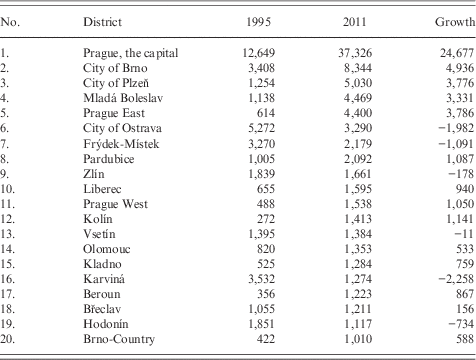
An analysis of the spatial differentiation of the labour migration from Slovakia to the Czech Republic is based on a comparison with the situation in 1995, which is the year when the first detailed data on Slovaks working in the Czech Republic were collected. From the spatial distribution point of view the situation in 1995 did not differ a lot from the situation before the dissolution of Czechoslovakia. In comparison with the period before 1995, we notice the rapid growth of migrant numbers in the big cities (Prague, Brno, Plzeň) and in the broad hinterland of Prague, especially along the main roads and railways (including Mladá Boleslav – the automobile industry). On the contrary (Figure 4), the share of borderland districts decreased from 20% to 8% (on 31 December 2011), while the share of Prague increased from 23% to 35%. At the end of 2011 only two border districts (Frýdek-Místek and Zlín) appeared in the top ten districts employing the most Slovak citizens, while in 1995 there were four districts in the ranking. The only Czech districts in which the number of Slovaks employed dropped significantly were those in the northern part of the common border region (Table 1) which was caused by a reduction in coal mining and also by the dismissal of redundant workers from companies in the metallurgical sector.
The spatial distribution of labour migration from Slovakia to the Czech Republic. (Source: Ref. Reference Horáková19, author’s own processing.)
Districts of the Czech Republic with the highest number of labour migrants from Slovakia.
Source: Ref. Reference Horáková19.
After a more comprehensive evaluation it can be said that the spatial differentiation of labour migration crossing the Czech–Slovak border is mainly determined by the offer of job opportunities on the labour market, and these are dependent on economic maturity and on the amount of business activity in a region, which is, however, highly variable. The labour market works elastically and undergoes quite dynamic changes. Therefore, workers from Slovakia started to apply for jobs in regions with the best labour market situation (enough job opportunities, the lowest unemployment rate, the highest number of investors, on arterial roads) even if in many cases these are at a considerable distance from the border.
One of the problems that cannot be overlooked in this regard is Slovak citizens working in the Czech Republic illegally (without employment contracts) who also draw unemployment benefits in Slovakia. They are not registered with any employment office in the Czech Republic and therefore we do not have any statistical record of them. Their actual number is questionable; estimates put the number of illicit workers within a relatively wide range – from 8,000 to 40,000 people.Reference Drbohlav and Toušek14 It is also assumed that this number changes at very short intervals (an employer is not bound by an employment contract and therefore he can use workers who are available immediately, according to current needs and with great flexibility) and it also has a strongly seasonal nature. This illegal activity is advantageous for Czech entrepreneurs because they do not have to pay social benefits and taxes for employees. Slovakia has recently been trying to eliminate these practices because Slovaks have a duty to report regularly to employment offices in the place of their domicile in Slovakia.
Study Migration between the Czech Republic and Slovakia
In the future, the development of labour migration between then Czech Republic and Slovakia will be influenced by several important factors, which can be divided into two groups – external and internal ones. The external factors include the gradual relaxation of the labour market within the European Union, which will have a strong influence on the development of migration from Slovakia, as well as from the Czech Republic. It is possible that some of the forms of labour migration from Slovakia will involve movement not to the Czech Republic but further to the west (three years after the opening up of the market 45,000 Slovaks were already working in the UK). The educational structure of labour migrants from Slovakia to the Czech Republic will probably increase and the cheaper labour force from the east will fill positions that do not require qualified workers.
Internal factors should not, at first sight, be so important because the mutual employment between the Czech Republic and Slovakia has been fully liberalised for a long time. But in fact, the mutual employment may also influence the mutual opportunities to study at universities and colleges. From the dissolution of Czechoslovakia up until 1998, the opportunity to study at a university or a college in the second country of the former federation was rather limited (80 students per year). Only in 1999 did the Ministries of Education negotiate the Agreement (No. 39/1999 Coll.) which allows study without limits, without reciprocity, and with only qualitative restrictions depending on students’ abilities and their capability to meet the criteria of an entrance exam. This allows Slovak and Czech students to study in the partner country under the same conditions as students from the host country, and to use the Slovak and Czech languages equally in exams.
While the number of Czech students at Slovak universities and colleges is still minimal, since 1999 the number of Slovak university students in the Czech Republic has been growing rapidly (Figure 5). In the period 1999–2004 the number increased by 1000–2000 per year, and since 2004 the number of Slovaks at Czech universities and colleges has risen by approximately 2000–3000 per year. However, this increase is considered to be more significant than that in the previous five-year period because while during 1999–2004 more and more new students entered universities and practically nobody graduated, since 2005 the increase has been reduced because of the students who left university. In the 2011/2012 academic year, approximately 24,500 Slovak students were studying in the Czech Republic, which represented roughly 2/3 of the total number of foreign students. The total number includes the still-increasing number of students pursuing a doctoral degree, some of whom received their Master’s degree in Slovakia.
Development of number of Slovak students at universities and colleges in the Czech Republic. (Source: data from the Czech Statistical Office.)
Slovak students are especially interested in internationally renowned universities and in some of the universities in Moravia (for the role of distance, see Figure 6). The universities ranked first and second are surely Charles University in Prague and Masaryk University in Brno, where for some of the faculties the number of Slovak students enrolled is almost equal to the number of Czechs. A large number of students from Slovakia can also be found at Brno University of Technology, VŠE in Prague (the University of Economics), and the VŠB-Technical University of Ostrava. A survey of the individual faculties revealed that Slovak students generally seek out the most attractive fields, such as medicine, economics, engineering, and law.
Academic study migration from Slovakia to the Czech Republic. (Source: data from the Czech Statistical Office, author’s own processing.)
The constantly increasing number of Slovak university students in the Czech Republic should be viewed in two ways. The first, positive for Slovakia, represents the use of finances from the state budget of the Czech Republic poured into Slovaks’ higher education. The second, positive for the Czech Republic, is that a certain number of students will not return to Slovakia but will settle in the Czech Republic (‘brain drain’). In connection with an ageing population and an adverse demographic development, it is important for the Czech Republic to attract an increased inflow of immigrants in order to avoid a collapse of the pension system (the same threat also exists in Slovakia). Social, economic, and political reasons indicate that it is advantageous to fill this deficit with young educated people with cultural values and customs similar to one’s own (the time of one’s studies is usually connected with finding a life partner and later also with getting a job). It is almost impossible to estimate the exact number of study migrants who have stayed in the country in which they studied. We can only rely on some of the existing surveys published in the media, which, however, revealed completely different numbers: the disparity of data on how many university students from Slovakia stay in the Czech Republic after their studies ranged from 20–70%.
Cross-border Relationships between the Czech Republic and Slovakia
The Czech–Slovak part of the border and its adjacent regions is not a typical borderland. Although it is a historical border, until the dissolution of Czechoslovakia in 1993 there was no barrier. After 1993, customs buildings and facilities started to be built on some of the border crossings, but after the two countries entered the Schengen area these lost their purpose and they do not have any meaningful use nowadays. Still, the Czech–Slovak borderland has a few specific features.
In 1996 the border was redrawn by a joint Czech–Slovak Boundary Commission: it was shortened from 285 km to 251.8 km, with 18 changes being made. The latter were mainly of a formal character (the border should lie in the middle of rivers, communications, watersheds, etc), but in two cases they concerned an inhabited area. The settlement of U Sabotů fell to Slovakia and the settlement of Sidonie to the Czech Republic. This redistribution elicited some slight tension, and in the case of the U Sabotů some of the inhabitants were financially compensated.
One of the features of the Czech–Slovak borderland is dispersed settlement. This is especially true for the Slovak side, with two out of the five major Slovak areas of dispersed settlement on the border: the Javorníky Mountains and the Slovak Beskids area, with as subareas Kysuce, Žilina and Považská Bystrica, and the White Carpathians, with as subareas Myjava and Trenčín.
The cross-border relationships in the Czech–Slovak borderland are highly intensified by differences in the economic environments on both sides of the border. A price difference for petrol causes heavy border traffic. Slovaks also travel to the Czech side of the border for cheaper groceries. This has actually developed into a mass activity over the last decade. The initial reason is to be sought in the fact that supermarkets and big shopping centres were first built on the Czech side of the border. The main reason today is the lower prices of groceries in the Czech Republic because of the lower rate of VAT.
In spite of the many similarities, the Czech–Slovak border does divide – if one analyses things on a higher geographical level slightly exceeding the borderland delimitation – two geographically quite different territories. In addition to the differences in demographic structure, a significant disparity in morphology and in the structure of the transport networks, and so on, can also be noted. Although the Czech–Slovak border is only 252 km long, even over such a short distance it is possible to identify a number of regions in various parts of the shared borderland that differ completely in terms of their structure and function. Figure 7 (after Refs Reference Halás15 and Reference Halás and Řehák16) charts these differences, and they are also briefly described in what follows.
A synthetic graphic model of the common borderland of the Czech Republic and Slovakia. (Source: Ref. Reference Halás15, modified.)
The northern part of the Czech–Slovak borderland is formed by two regions with different functions. Differences are usually the impulse for cross-border activities and the development of cross-border relations; in this case, however, the relations are highly asymmetrical (the mass labour migration from Slovak districts to the Ostrava region). The area on the Slovak side (Kysuce) suffers from an inappropriate employment policy from the socialist era, when it functioned as a reservoir for the labour force needed for the mining and metallurgy industries in Ostrava. The centres are more distant from the border with Slovakia, but in comparison with other parts of the border they are on a higher level. In the southern part of Kysuce the nodal influence of the centres of the Ostrava-Karviná area is significantly weakened by the influence of being near Žilina. Ideal natural preconditions (but still an insufficient material-technical base for tourism) could mean that the future relations (in terms of the further saturation of the potential relationship between Kysuce and Žilina) would not have to be so anomalous and that Kysuce could become a recreational area for the Ostrava region.
In the middle of the border, the borderline is mainly formed by the White Carpathians. On the Moravian side, the border region’s morphology and communications are more open to the interior. Only small regional centres are situated in the vicinity of the border, while centres on a higher hierarchical level can be found in the imaginary ‘second line’ (the natural features of a discontinuous geographic space). On the Slovak side (Central Považie – the region along the middle part of the River Váh) the region, in spite of its marginal location within the country, does not behave like a periphery. It is situated near a Slovak arterial road and it can even be classified as one of the most industrial and economically strong Slovak regions (even though it was affected by the conversion of the engineering industry, especially for military production, at the beginning of the 1990s). On the basis of these facts and with respect to its position, it can be defined as an exposed region with a dominant central traffic function in Slovakia. Its municipalities are predominantly under the influence of the linearly located centres of the Central Považie. The biggest barrier caused by the boundary can be seen in the contact between the districts of Vsetín and Považská Bystrica, which is particularly noticeable on the Slovak side, where one road belonging to many municipalities leads only to the axis of Považie. This is a widespread phenomenon affecting several parallel groups of municipalities lying on tributaries of the River Váh. Moreover, the distance between the Váh and the border is greatest in this section.
The spatial continuity is best preserved in the southern part of the Czech–Slovak borderland, despite the existence of the state border and the presence of the River Morava. In this area there is a specific feature, a settlement structure, which is a factual tri-city divided by the state border: Hodonín, Holíč, and Skalica, which creates very good conditions for the formation of inter-settlement relations (Skalica and Holíč are also the only border cities that have direct contact with the Czech Republic). Additional free elements of this group are perhaps Břeclav and Strážnice. The best preconditions for integration are also supported by the presence of a major Czech–Slovak road and the railway connecting Bratislava and Prague (on a higher hierarchical level, this link is a part of the important European line Berlin–Prague–Bratislava–Budapest–Athens). The urban system of the Pomoraví (i.e. the region along the River Morava – from Břeclav through Hodonín and Uherské Hradiště and further to the north) has a few features similar to the parallel system of Považie, but it does not have its exposed position and density.
The political development in Slovakia until 1998 meant that the conditions for the development of cross-border cooperation were not favourable, and it may be said that in some cases cooperation was even intentionally hampered. Efforts to preserve centralised power and not to weaken the country led to the suppression of all spontaneous local or regional initiatives, including cross-border cooperation. An agreement that was important for the border regions was the Agreement between Slovakia and the Czech Republic (No. 164/2001 Coll.) on cross-border cooperation. The first suggestions about establishing Euroregions in the Czech–Slovak borderland appeared only in the late 1990s. Nowadays there are three working Euroregions that basically respect the natural structure of the regions, their potential preconditions, and also the real indicators of cross-border relations. In the northern part of the borderland there is the Beskydy Euroregion, with cooperation also from the Polish side, in the middle part there is the White Carpathians Euroregion, and in the southern part the Pomoraví-Weinviertel-Jižní Morava Euroregion, with participation from the Austrian side.Reference Fňukal, Kladivo and Toušek17, Reference Halás18 The existence of all three Euroregions is more or less of a formal character and therefore I will not go into detail about them.
Conclusions
After an initial period of flux, after 1989 and the dissolution of Czechoslovakia, the political and economic positions of the Czech Republic and Slovakia have stabilised. Individual partial socio-economic features and processes have flexibly adapted to a gradually liberalised environment. This can also be said about Czech–Slovak relations (business relations, labour migration relations, study migration relations, and so on), which have still remained closer than average. However, recently they have conformed more flexibly to the process of natural development without any paternalistic intervention. They are therefore dependent on the current situation and the level of development in both countries. In spite of this, the common strategic progress and the cooperation of both countries (or even together with other Central European countries) can be advantageous for further development.
Foreign trade between the Czech Republic and Slovakia has gradually stabilised. Labour and study migration from Slovakia to the Czech Republic has been rising in the long term. Basically, what we see is the natural development of two countries that are close neighbours with historically dependent but slightly different economies and standards of living. The open shared border, with both countries part of the Schengen area, helps to maintain the intensity of relations. The labour markets of both countries are, even after the dissolution of the federation, completely open. The intensive (one-way) relations between the countries have increased the possibility of entering a university or a college in the partner country. Most probably this will result in a further growth of the number of Slovaks on the Czech labour market, with a lot of graduates staying on in the Czech Republic after their studies. The creation and maintenance of a liberalised economic environment (without customs duties or import surcharges, and even without indirect intervention such as subsidies to certain industries) is suitable for maintaining the intensity of the mutual economic relations of both countries. The maintenance of the liberal approach towards mutual employment and studying seems to be, as a result of one-way flows, more advantageous for the Czech Republic because it can be one of the minor contributions to a solution to its demographic situation.
Acknowledgements
This work was supported by the Internal Grant Agency of the Palacký University Olomouc under Grant Human behaviour and Activities in Geographical Environment: Analysis and Modelling of the Organisation of Space [number IGA_PrF_2014012].
Marián Halás is an associate professor in the Department of Geography of the Faculty of Science, Palacký University Olomouc. He is a member of the Centre for Analysis of Regional Systems (CENARS), which is generally concerned with theoretical and empirical aspects of spatial organisation of geographical phenomena. His research interests include various aspects of the identification and modelling of spatial interactions, issues of regional and settlement systems, and problems of particular types of regions, especially border and peripheral regions in Central Europe and the Czech–Slovak borderland.