Introduction
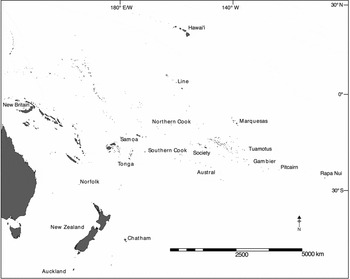
Rapa Nui (Easter Island, Chile) is a diminutive island located in the remote eastern Pacific (Figure 1). Polynesians first colonised the island when they sailed from central East Polynesia in voyaging canoes during the thirteenth century AD (Hunt & Lipo Reference Hunt and Lipo2006; Wilmshurst et al. Reference Wilmshurst, Hunt, Lipo and Anderson2011). Despite the island's size, remoteness and limited natural resources, the archaeological record of Rapa Nui is well known for its nearly 1000 multi-tonne statues, known as moai, that once stood atop massive stone platforms (Hunt & Lipo Reference Hunt and Lipo2011). The magnitude of the investment in monumental architecture stands in contrast to the island's desolate environment and low population levels. While earlier researchers (e.g. Heyerdahl & Ferdon Reference Heyerdahl and Ferdon1961a; Heyerdahl Reference Heyerdahl1989) argued that the island suffered grave conflict between Polynesians and Native South Americans, subsequent researchers have suggested that the paradox presented by the moai and the island's historic landscape is the consequence of an environmental catastrophe (Bahn & Flenley Reference Bahn and Flenley1992; Flenley & Bahn Reference Flenley and Bahn2003). This account has been popularised as the ‘collapse’ scenario (Diamond Reference Diamond1995, Reference Diamond2005).
Pacific Island locations mentioned in the text.

New research challenges this scenario, with empirical evidence that demonstrates Rapanui people flourished on the island until AD 1722 when Europeans arrived (e.g. Rainbird Reference Rainbird2002; Lipo & Hunt Reference Lipo and Hunt2009; Hunt & Lipo Reference Hunt and Lipo2011; Mulrooney Reference Mulrooney2012). Contrary to assumptions about large past population sizes, Rapa Nui's settlement patterns show that the inhabitants lived in dispersed and low-density communities (Hunt & Lipo Reference Hunt and Lipo2011; Morrison Reference Morrison2012). We have also learned that prehistoric people used lithic mulch to boost the island's nutrient-poor soil to support sustained cultivation (e.g. Stevenson et al. Reference Stevenson, Ladefoged and Haoa2002; Bork et al. Reference Bork, Mieth and Tschochner2004). Finally, we now know that the loss of the palm forest had little if anything to do with statue transport or a decline in carrying capacity (Hunt & Lipo Reference Hunt and Lipo2011; Lipo et al. Reference Lipo, Hunt and Haoa2013).
One persistent ‘collapse’ claim is that prehistoric Rapa Nui populations engaged in intense warfare when resources became scarce (Bahn & Flenley Reference Bahn and Flenley1992; Diamond Reference Diamond1995, Reference Diamond2005; Flenley & Bahn Reference Flenley and Bahn2003). Yet the island lacks evidence of systematic warfare. There is little trace, for example, of lethal trauma on skeletal material (Hunt & Lipo Reference Hunt and Lipo2011) and there are none of the defensive structures that are common on other islands in the Pacific with known traditions of warfare. Instead, claims of prehistoric warfare are largely based on oral traditions recorded in the twentieth century (e.g. Routledge Reference Routledge1919). Unfortunately, these accounts have an unknown relation to prehistory and, as Métraux (Reference Métraux1940) has argued, probably include recent introductions.
One lingering line of empirical evidence used to infer prehistoric warfare is the abundance of mata'a (Métraux Reference Métraux1940; Diamond Reference Diamond2005). Mata'a are flaked obsidian tools with narrow stems and wide blades. Their form is similar to artefacts found on other Polynesian islands such as New Zealand, Pitcairn, Hawai‘i and the Chatham Islands (e.g. Balfour Reference Balfour1917; Métraux Reference Métraux1957: 232; Skinner Reference Skinner1958), as well as on New Britain in Papua New Guinea (e.g. Torrence et al. Reference Torrence, Swadling, Kononenko, Ambrose, Rath and Glascock2009, Reference Torrence, Kelloway and White2013). On Rapa Nui, the general ‘spearhead’ form combined with historic visitor suppositions have led some to assume that mata'a were weapons and thus are linked to the presumed ‘collapse’ (e.g. Diamond Reference Diamond2005).
From a sample of 423 mata'a, we explored how shape can be used to support claims about their use as weapons of warfare. This exploration relied on morphometrics, an approach that treats shape as a continuous property of objects rather than nominal categories (Bookstein Reference Bookstein1982; Bookstein et al. Reference Bookstein, Chernoff, Elder, Humphries, Smith and Strauss1985; Kendall Reference Kendall1989). It allows the use of multivariate analyses and ordination approaches such as principal components analysis to test whether particular clusters of shapes map to particular locations, environments or source material. In this way, the approach provides a means of evaluating hypotheses regarding the prehistoric use of these enigmatic artefacts.
Approach
Mata'a have been noted by the earliest European visitors. In 1774, members of Cook's expedition to the island, for example, commented that the islanders “had lances or spears made of thin, ill-shaped sticks, and pointed with a sharp triangular piece of black glassy lava” (von Saher Reference von Saher1990: 35). Many of these early visitors assumed mata'a were used as spears simply due to their vague resemblance to European versions. Visitors such as Captain Don Felipe González (Haedo & Roggeveen Reference Haedo and Roggeveen1908: 99) speculated that mata'a were used in inflicting wounds, although they had no evidence that these objects were involved in warfare.
To avoid making assumptions about function based on what mata'a resemble, we can examine their physical evidence for clues. The shapes and configurations of mata'a should reflect the range of interactions that occurred between the artefact and its environment in the context of use. Constraints in shape relative to areas that vary freely inform us about the parts of the object that are subject to performance demands vs those that are not. Studying shape variability, therefore, provides a means of evaluating hypotheses about function.
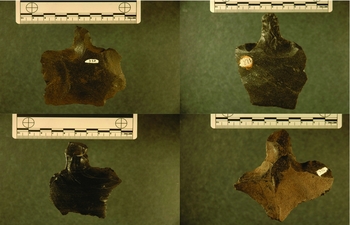
Mata'a are distinctive obsidian artefact classes that are 6–10cm in width and length (Figure 2). Technologically, they are formed from flakes created by hard hammer percussion on obsidian cores quarried from one of the island's four obsidian sources. Most of the work to create mata'a occurs during unifacial flaking of a stem. Lenticular in cross-section, the stem is formed from one of the lateral margins of the original flake, while the blade constitutes the remaining distal and opposite lateral edges; the shape of the parent flake dominates the resulting blade form.
Examples of mata'a from Rapa Nui (from collections at the P. Sebastian Englert Museum, Rapa Nui).

Notably, mata'a do not have the typical lanceolate form usually associated with weapons that are known to pierce the body, damage internal organs and cause bleeding. Instead, mata'a blades take a wide array of shapes, ranging from rounded to sub-angular, and from angular to complex (Mulloy Reference Mulloy, Heyerdahl and Ferdon1961). Early attempts to assign mata'a shapes to ethnographic categories using Rapanui words were unsuccessful, as clear divisions between shapes could not be identified (Routledge Reference Routledge1919). Other attempts to identify types based on characterisations of overall shape also failed to produce useful categories. Mulloy (Reference Mulloy, Heyerdahl and Ferdon1961: 151), for example, concluded that chance and manufacturing procedures, not design, dictated differences in the ultimate shape of mata'a.
Later studies of mata'a have suggested uses other than that of weaponry. In a technological study, Bollt and colleagues (Reference Bollt, Clark, Fisher and Yoshida2006) suggested that the manufacturing steps involved in mata'a production, rather than specific design decisions, strongly determined their overall shape. Studies of use-wear on mata'a also point to their employment in a variety of ways, including scraping and cutting (Church & Rigney Reference Church and Rigney1994; Church & Ellis Reference Church and Ellis1996).
In a recent study, Lipo and colleagues (Reference Lipo, Hunt and Hundtoft2010) used deterministic frequency seriation and stylistic classes built from the physical dimensions of mata'a to examine change over time and across space. The study showed that mata'a forms vary continuously and that the most systematic change can be seen in the angle of the shoulder and the stem shape rather than the blade. The seriation suggested that the information related to the production of the stem portion of mata'a is structured by local traditions for making the object. This study, however, did not explore how blade shape might provide information about patterns of use.
Of course, we should not assume that the overall artefact shape directly correlates with its function. Forms of artefacts are the result of multiple factors including technological constraints of the material, performance aspects based on the environments of use and variability as part of the manufacture and production processes. Given that use is an empirical property of the interaction of an object and the environment, we can measure the dimensions of objects that contribute to relative performance and can explain patterns of change in these attributes as a consequence of natural selection (Dunnell Reference Dunnell1978).
The task of explaining variability in shape consists of identifying selective pressures that affect the performance of shape, and determining whether their magnitude is sufficiently great enough to affect fitness. The greater the selective pressures on performance, the more constraint we would expect on the aspects of shape that have an impact on performance. If the effect on function and performance is sufficiently small enough, then other forces such as technological (i.e. material source, manufacturing steps and the like) or stylistic (stochastic or neutral) processes may be posited as playing a role in structuring shape, as well as when and where specific artefact classes occur in the archaeological record. In aspects of shape not under selection, we would expect to see a greater range of variability. It is possible, however, that not all mata'a were used in the same way. If the shape of mata'a was influenced by more than one function, either contemporaneously or over time, the selective context would differ and the ‘cause’ of mata'a shape should therefore vary. In this case, we would expect to see modal patterns of mata'a shape where shape variability forms statistically distinguishable groups.
To test notions about mata'a use, we began by assuming that the blade portion of mata'a shape was a functional element (Dunnell Reference Dunnell1978). The blade interacts with the environment and that affects the object's performance in cutting, puncturing or scraping.
In our study, we address whether blade variability identifies specific functional classes with performance constraints on the shape of the distal portion of the blade. For our analysis, we assumed that the functional aspects of the tool would be more constrained than those with no performance effects. Any constraints that affect performance will sort shape variability in proportion to the benefits or drawbacks. From this notion, we hypothesise that:
-
• If mata'a were systematic weapons of warfare, the distal end of the artefact will be constrained in its shape due to the demands of performance in combat.
-
• If mata'a were systematic weapons of warfare, the distal end of the artefact will show a tendency towards a spear-like shape that is consistent with the penetration of enemies.
-
• If mata'a were not weapons, there will be no such shape restriction of the distal end of the tool.
Methods and data
To evaluate these hypotheses, we used morphometrics, a quantitative analysis of form in terms of shape and size, in two or more dimensions (Bookstein Reference Bookstein1982; Bookstein et al. Reference Bookstein, Chernoff, Elder, Humphries, Smith and Strauss1985; Kendall Reference Kendall1989). Morphometric approaches have advantages over traditional studies of shape using global shape descriptors, or lengths and ratios of lengths. First, morphometrics avoids the problem of nominal shape (e.g. ‘triangular’, ‘square’, ‘round’) by transforming the overall qualitative characteristics into independent, quantitative variables. Second, with techniques available for standardising position, scale and rotation, morphometrics allowed us to compare and test for differences in the shape (form minus size) of artefacts.
With roots in biology, the earliest form of morphometrics focused on identifying the location of specific landmarks (e.g. Thompson Reference Thompson1917). As mata'a share few consistent identifiable morphological features that would be useful as landmarks, we alternatively used ‘semi-landmarks’, a fixed number of regularly positioned points around the outline of an object (Gunz & Mitteroecker Reference Gunz and Mitteroecker2013).
Our dataset consists of photographs of whole mata'a specimens available in museum and field collections (Tables S1 & S2 in online supplementary material). We used a collection of 118 mata'a from four locations that are currently housed at the P. Sebastian Englert Museum on Rapa Nui and that were collected by Sebastian Englert, William Mulloy and other researchers. To avoid bias in our choice of mata'a for the study, we included all available intact specimens that had provenience information. For comparison and to expand the number of locations, we also included eight mata'a photographs published by Heyerdahl (Heyerdahl & Ferdon Reference Heyerdahl and Ferdon1961a) and six mata'a that Hunt and Lipo (Reference Hunt and Lipo2008) photographed during pedestrian surveys of land parcels on the south coast of Rapa Nui.
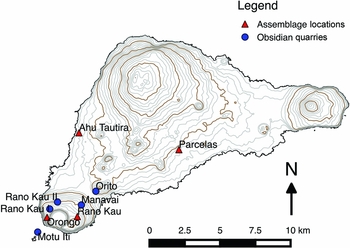
Finally, we included photographs of 291 mata'a housed at the Bishop Museum in Honolulu. Mulrooney and colleagues (Reference Mulrooney, McAlister, Stevenson, Morrison and Gendreau2014) documented these mata'a during their study of obsidian sourcing via pXRF. Although lacking provenance information and potentially biased by the actions of the original collectors looking for objects that met their preconceptions, this collection can be used to examine shape variability relative to obsidian source (Figure 3). Together, this collection of 423 mata'a allowed us to explore whether shape varies with material properties, or whether shape variability correlates to the locations on the island in which they were found. Bootstrap assessment showed that the sample size is sufficient for estimating basic metrics (Figure S1 in online supplementary material).
Locations of mata'a collections and obsidian sources on Rapa Nui.

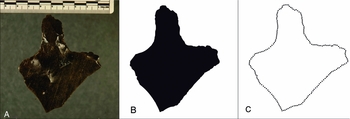
To produce comparable measures of shape, we aligned scaled photos of mata'a at the point where the stem midpoint meets the blade. We then created outlines for each mata'a composed of 200 Cartesian coordinates at points located equidistantly along the perimeter of each artefact (Figure 4).
Measurement process used to generate outline coordinates for each mata'a in the study: A) scaled digital photograph; B) isolated outline of mata'a; C) 400 semi-landmarks were placed along the perimeter of the artefact outline.

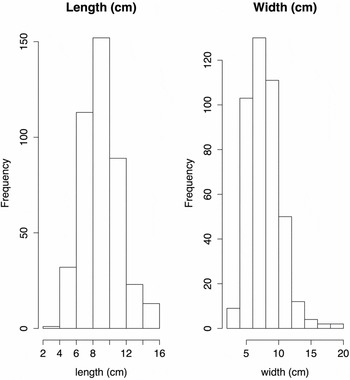
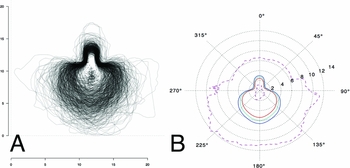
Simple metrics of length and width revealed a single distribution of these objects without clear-cut size modes (Figure 5). A more direct means of evaluating shape variability was accomplished by superimposing mata'a outlines (Figure 6). To analyse these data quantitatively, we calculated the distance to the perimeter in one-degree intervals for the 360-degree perimeter from a reference point where the centre of the stem intersects with the blade. This process enabled us to examine where shape varies and where it is more constrained (Figure 7). The 95% confidence intervals for the radial distances show that mata'a shape varies least at the point where the stem intersects with the blade. The systematic shape of the stem probably reflects the manner in which mata'a were hafted to a shaft or were held in the hand. Stem length, however, varies significantly, as does the overall shape and length of the distal blade edge. Notably, the portions of the mata'a shape related to its use and interaction with the environment vary widely.
Lengths and widths of Rapa Nui mata'a in the study.

Comparison of mata'a shapes from Rapa Nui: A) superimposed outlines aligned at the centre point of the stem where it meets the blade; B) variability in mata'a shape shown with mean and relative positions of 95% confidence intervals; the base of the stem is the most constrained portion of mata'a shape, while stem length and blade are more variable.

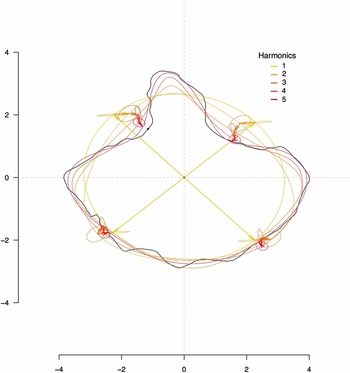
The first five harmonics of the elliptic Fourier analysis shown on the original outline of a mata'a; as the number of harmonics is increased, the better the reconstruction approximates the original shape.

Morphometric analyses: elliptic Fourier analysis
For Fourier-based analyses in order to study shape variability, we used Momocs v0.9 (https://github.com/vbonhomme/Momocs/), an R package (R Core Team 2015) developed by Bonhomme (Reference Bonhomme2012; Bonhomme et al. Reference Bonhomme, Picq, Gaucherel and Claude2014). All of the R code and data are available at https://github.com/clipo/mataaMorphometrics. Momocs uses elliptical Fourier analysis to examine the degree to which shape variability forms groups related to specific functions (Bonhomme et al. Reference Bonhomme, Picq, Gaucherel and Claude2014). Elliptical Fourier approaches treat shape as a periodic function that can be fitted using a sum of simple trigonometric functions. These simple functions are harmonics of one another. Lower harmonics provide approximation for the coarse-scale trends in the original periodic function, while the high-frequency harmonics fit its fine-scale variations (Figure 7; see online supplementary material).
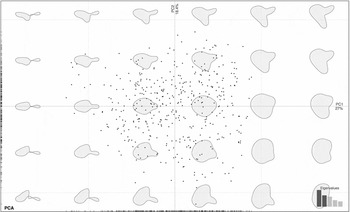
With elliptical Fourier characterisations, we used principal components analysis to determine if there were aspects of shape that might distinguish sub-groups from each other. Figure 8 presents the position of mata'a shapes on a factorial map, with shapes reconstructed from the first two principal component axes. Overall, mata'a shapes vary continuously in their outlines, and there were no subsets of distinctive, lanceolate-shaped objects or any other sub-groups. These results suggest that mata'a have no single function for which blade shape affects performance. This finding is consistent with use-wear studies that show that mata'a edges were used for general cutting and scraping (e.g. Church & Rigney Reference Church and Rigney1994; Church & Ellis Reference Church and Ellis1996; Church Reference Church, Christopher, Stevenson and Morin1998; Stevenson & Cardinali Reference Stevenson and Cardinali2008: 107).
Results of the principal component analysis (PCA) conducted on the elliptic Fourier descriptions of Rapa Nui mata'a shapes using the first 12 harmonics; this figure shows the first two principal components (PC1 and PC2 are on the x and y axes, respectively). Each point represents a mata'a described in terms of its shape along these two components; the short lines along each axis show the distribution of the points relative to the individual components; the bar graph at the bottom indicates the amount of shape explained by the first two components relative to the first five components.

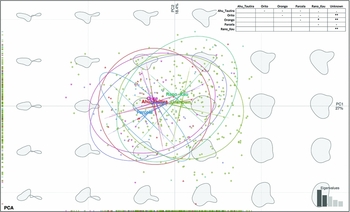
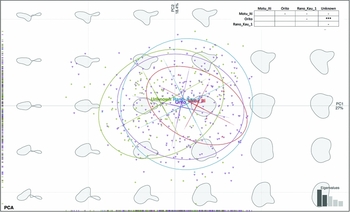
We can also explore whether there are systematic differences in mata'a shape that are related to locations in which these artefacts were found on the island or vary according to the obsidian sources used to make the objects. If mata'a use was related to different resources in the environment, we might then expect differences in shapes to correlate with space. Alternatively, it is possible that mata'a design depended on specific properties of the source material. Our analyses compared mata'a from four sites across Rapa Nui (Table S1). Figure 9 presents the distribution of sets of mata'a from multiple locations across the island, and it shows the distribution of shapes with 90% Gaussian confidence ellipses for each of the four sites. The overlap between the groups indicates that shapes from each of the sites cannot be distinguished. The same conclusion is reached from the analysis of shape variability relative to obsidian source (Figure 10). There is in essence no evidence that mata'a blade shape was constrained by functional performance, location or obsidian source.
Rapa Nui mata'a shapes grouped by site locations arrayed on the first two principal components of the elliptic Fourier shape descriptions. The mata'a are shown with the 90% confidence ellipses for the site location groups. MANOVA conducted on the PCA results (Table S3) show that while there is significant overlap between all of the groups, there are some differences in the overall shapes of a couple of sets. The Orongo, Orito and Rano Kau sets are significantly different from the group of mata'a from unknown locations across the island, a set from the Bishop Museum collection. The differences between the shapes of the Orongo and the Rano Kau assemblages are probably explained by the stylistic differences (Lipo et al. Reference Lipo, Hunt and Hundtoft2010).

Rapa Nui mata'a shapes grouped by identified obsidian sources relative to the first two principal components of the elliptic Fourier shape descriptions. The mata'a are shown with the 90% confidence ellipses for compositional groups. MANOVA conducted on the PCA results (Table S4) show that while there is significant overlap between the groups, there are some differences between Orito obsidian mata'a and those for which we have no obsidian source information.

Comparison with stemmed tools from other Pacific islands
It is notable that the mata'a of Rapa Nui are similar in shape to stone tools found on other Pacific islands. On New Britain, for example, Torrence and colleagues (Reference Torrence, Swadling, Kononenko, Ambrose, Rath and Glascock2009, Reference Torrence, Kelloway and White2013) have described stemmed obsidian tools that are similar to mata'a. They argue that these tools may have been used for a range of activities including tattooing and ritual scarification. An additional but limited comparison can be made with Pitcairn Island, where a few stemmed lithic tools have been found (Heyerdahl & Ferdon Reference Heyerdahl and Ferdon1961b). Stemmed chert tools, known locally as mataa, are also found on the Chatham Islands and in New Zealand (Jones Reference Jones1981).
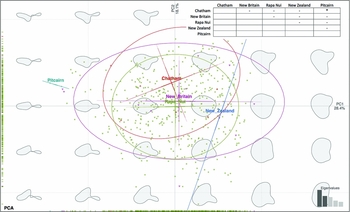
As a comparison, using the Rapa Nui procedure, we generated outlines for a sample of stemmed tools from other Pacific islands (Table S5) and conducted elliptic Fourier analyses of shape variability (Figure 11). Ultimately, the shapes of these artefacts are statistically identical to those from Rapa Nui, with the exception of those from Pitcairn Island. The Pitcairn sample (N = 2) is tiny, but their long and pointed shape is more consistent with hafted tools used in hunting or weapons. The New Zealand mataa are somewhat distinctive, as they appear to have substantially thicker stems than the Rapa Nui artefacts. Jones (Reference Jones1981) suggests that this might reflect tools that are hafted with the edge perpendicular to the shaft, such as an adze, and used for activities that include woodworking.
Variability in shapes among stemmed lithic objects from Rapa Nui, New Britain, New Zealand, and the Chatham and Pitcairn Islands, as characterised by elliptical Fourier analysis and the first 13 harmonics; artefacts grouped by island and arrayed against the first two principal components of the elliptical Fourier descriptions with 90% confidence ellipses. Results of MANOVA for the large assemblages (Table S6) and Wilcoxon rank-sum test (Table S7) for the small assemblages show that there are no significant differences between the shapes of the artefacts except for the comparison between the Pitcairn and the Chatham islands, a difference that is probably due to small sample size.

The New Britain artefacts are most similar to those from Rapa Nui. Based on this comparison, it is conceivable that Rapa Nui mata'a shared uses such as tattooing and scarification with New Britain tools. Tattooing is known from Rapa Nui through ethno-historic observation (Huish Reference Huish1839: 77; Thomson Reference Thomson1891: 22; Métraux Reference Métraux1940), and as markings on the prehistoric moai (Lee Reference Lee1992). Thus, it is possible that at least some mata'a objects were used in these types of ritual practices.
Conclusions
Our investigation of shape variability for Rapa Nui mata'a has produced evidence that fails to support hypotheses about the use of these objects as lethal weapons involved in systematic warfare (e.g. Keegan Reference Keegan1993). Our results conversely support findings from use-wear studies which suggest that these artefacts were used in cultivation and domestic activities (Church & Rigney Reference Church and Rigney1994; Church & Ellis Reference Church and Ellis1996). As with the myth of prehistoric Rapa Nui ‘collapse’, the evidence to support mata'a as lethal weapons of warfare does not exist (see also Ingersoll & Ingersoll Reference Ingersoll, Ingersoll and Lundy2013). Instead, there appear to have been no systematic performance requirements that influenced blade shape. While they have sharp edges, mata'a are no more lethal than any other kind of rock. Indeed, as documented in European accounts, rock throwing from high points was the primary way in which native Rapanui fought Europeans and would have more probably been used as a mode of lethal force than mata'a. This conclusion does not imply that prehistoric islanders did not experience violence, only that mata'a do not appear to be related to systemic warfare where performance as lethal weapons would be paramount.
Our conclusion that mata'a had more than one function is not surprising and one must resist the notion that any object be ascribed one inherent function (Dunnell Reference Dunnell1978). Mata'a wear patterns and their frequent occurrence in rock mulch suggests that at least some were employed in the context of cultivation. We also cannot rule out that some mata'a may have been used for general domestic and ritual practices such as scarification. The latter would be consistent with observations of healed scars made by Spanish visitors in AD 1770 (Eyzaguirre Reference Eyzaguirre2004).
Unfortunately, the myth of Rapa Nui ‘collapse’ continues despite any evidence to support it. For Rapa Nui archaeology, tradition has long trumped empirical inquiry, as seen in continued claims about mata'a as weapons. Commitment to the evidence matters. The island's prehistory is often promulgated as an exemplar of the consequences of ignoring the human impact on the environment. For example, the former UK Prime Minister Margaret Thatcher used Rapa Nui as a warning to the United Nations about how environmental degradation leads to deforestation, warfare and population collapse (Thatcher Reference Thatcher1989). Similarly, mata'a have been used as examples of mass effect ‘weapons’ in a study of terrorist tactics (Rasmussen & Hafez Reference Rasmussen and Hafez2010). Given the contemporary importance that Rapa Nui has gained in guiding our concerns for the future, we owe it to ourselves to make certain that we fully understand the prehistory of the island and that our understanding is based on well-documented and thoroughly researched evidence.
Acknowledgements
The authors wish to thank Francisco Torres Hochstetter, Director of the P. Sebastian Englert Museum, Hanga Roa, Rapa Nui; and Joanne Minerbi for kindly assisting us with the photograph to morphometric conversion. We also would like to thank Mara Mulrooney for sharing her compositional data for the Bishop Museum mata'a. This is publication ISEM 2015-253.
Supplementary material
To view supplementary material for this article, please visit http://dx.doi.org/10.15184/aqy.2015.189