Significant outcomes
Polymorphisms in NFKBIL1 were shown to be associated with ALTs in the studied population of twins.
The ALTs subdomain language impairment was significantly associated with the SNP rs2230365 in NFKBIL1 in boys after correction for multiple testing.
We furthermore found an association between rs2230365 and the genotype distribution in the case-control analysis, replicating associations previously seen in this SNP with autism.
Limitations
The A-TAC scores used in this study were based on parental reports, where response styles could vary between parents.
Associations between NFKB1 and NFKBIL1 polymorphisms and ALTs should be reproduced in a patient-control population.
Due to the limited number of subjects (especially girls) presenting ALTs scores above the cut-off for a proxy for ASD diagnosis, it was not possible to perform case-control analyses in girls.
Introduction
Autism spectrum disorder (ASD) describes a range of complex neurodevelopmental disorders which are characterised by impairments in social interactions and both verbal and non-verbal communication as well as by restrictive/repetitive behaviour. Several different risk factors have been proposed to contribute to the development of ASD, such as environmental toxicants (Rossignol et al., Reference Rossignol, Genuis and Frye2014), perinatal complications (Schieve et al., Reference Schieve, Tian, Baio, Rankin, Rosenberg, Wiggins, Maenner, Yeargin-Allsopp, Durkin, Rice, King, Kirby, Wingate and Devine2014) and infections (Meltzer & Van De Water, Reference Meltzer and Van De Water2017). These risk factors share a common feature, namely inflammation; a plausible underlying mechanism may be that cytokines and other inflammatory mediators are essential for brain development (Boulanger, Reference Boulanger2009). We have previously reported associations between immune-related genes and personality traits in different populations (Suchankova et al., Reference Suchankova, Henningsson, Baghaei, Rosmond, Holm and Ekman2009; Suchankova et al., Reference Suchankova, Baghaei, Rosmond, Holm, Anckarsäter and Ekman2011; Suchankova et al., Reference Suchankova, Klang, Cavanna, Holm, Nilsson, Jönsson and Ekman2012; Suchankova et al., Reference Suchankova, Pettersson, Nordenström, Holm and Ekman2012) showing the relevance of the immune system for mental functions. Therefore, it is reasonable to attribute the detrimental effects of inflammation due to, for example, hypoxia or infection with respect to ASD not only to an injurious inflammatory milieu but also to a direct involvement of a disturbed balance between pro- and anti-inflammatory substances in the mechanisms taking part in the developing brain regulating, for example, synaptic pruning, leading to a higher risk of neuropsychiatric disorders (Meltzer & Van De Water, Reference Meltzer and Van De Water2017). Indeed, ASD has been linked to an excess of neurons in the prefrontal cortex (Courchesne et al., Reference Courchesne, Mouton, Calhoun, Semendeferi, Ahrens-Barbeau, Hallet, Barnes and Pierce2011), maybe an effect of, amongst others, the abovementioned dysregulation of immune mediators in the brain. An increasing number of studies report associations between abnormalities in the immune system and ASD (Meltzer & Van De Water, Reference Meltzer and Van De Water2017) such as altered T-cell response (Ashwood et al., Reference Ashwood, Krakowiak, Hertz-Picciotto, Hansen, Pessah and Van de Water2011a) and reduced natural killer cell cytotoxicity (Enstrom et al., Reference Enstrom, Lit, Onore, Gregg, Hansen, Pessah, Hertz-Picciotto, Van de Water, Sharp and Ashwood2009). Elevated levels of inflammatory cytokines have been shown in both blood (Croonenberghs et al., Reference Croonenberghs, Deboutte and Maes2002; Ashwood et al., Reference Ashwood, Krakowiak, Hertz-Picciotto, Hansen, Pessah and Van de Water2011b) and brain tissue (Li et al., Reference Li, Chauhan, Sheikh, Patil, Chauhan, Li, Ji, Brown and Malik2009) of individuals with ASD when compared to controls. A recent study observing a vast number of subjects (n = 1 791 520) for up to 41 years reported significantly increased risks of autism and depression in subjects exposed to any maternal infection during pregnancy, including urinary tract infection (Al-Haddad et al., Reference Al-Haddad, Jacobsson, Chabra, Modzelewska, Olson, Bernier, Enquobahrie, Hagberg, Östling, Rajagopal, Adams Waldorf and Sengpiel2019). Several other studies also suggest a role of maternal immune system activation and inflammation in ASD (Lee et al., Reference Lee, Magnusson, Gardner, Blomström, Newschaffer, Burstyn, Karlsson and Dalman2015); increased levels of C-reactive protein in maternal sera (Brown et al., Reference Brown, Sourander, Hinkka-Yli-Salomäki, McKeague, Sundvall and Surcel2014) as well as maternal infection, such as rubella (Chess, Reference Chess1971; Hutton, Reference Hutton2016) and influenza (Atladottir et al., Reference Atladottir, Henriksen, Schendel and Parner2012), were shown to be significantly associated with ASD in offspring. Moreover, a link between autoimmune diseases and ASD has been reported (Gesundheit et al., Reference Gesundheit, Rosenzweig, Naor, Lerer, Zachor, Procházka, Melamed, Kristt, Steinberg, Shulman, Hwang, Koren, Walfisch, Passweg, Snowden, Tamouza, Leboyer, Farge-Bancel and Ashwood2013) as well as the presence of brain reactive autoantibodies in the plasma from mothers of children with ASD (Braunschweig et al., Reference Braunschweig, Krakowiak, Duncanson, Boyce, Hansen, Ashwood, Hertz-Picciotto, Pessah and Van De Water2013). A high degree of genetic heritability in ASD has been reported in twin studies (Tick et al., Reference Tick, Bolton, Happé, Rutter and Rijsdijk2016) and candidate genes situated in nearly all of the chromosomes have been proposed (Woodbury-Smith & Scherer, Reference Woodbury-Smith and Scherer2018).
In this study, we investigate two candidate genes that are central to immune functions: NFKB1 on chromosome 4, encoding a protein that is processed to a DNA binding subunit of the nuclear factor kappa-B (NF-κB) protein complex, and NFKBIL1 that encodes a protein suggested to regulate NF-κB (Boodhoo et al., Reference Boodhoo, Wong, Williamson, Voon, Lee, Allcock and Price2004; Ramasawmy et al., Reference Nudel, Simpson, Baird, O’Hare, Conti-Ramsden, Bolton, Hennessy, Monaco, Knight, Winney, Fisher, Newbury, Slonims, Clark, Watson, Simonoff, Pickles, Everitt, Seckl, Cowie, Cohen, Nasir, Bishop and Simkin2008) as well as alternative splicing of both human and viral genes (An et al., Reference An, Nakajima, Shibata, Arimura, Yasunami and Kimura2013). NF-κB is a protein complex functioning as a transcription factor that regulates the expression of pro-inflammatory genes and is also suggested to be of relevance for the regulation of neural growth and development (Gutierrez, Reference Gutierrez2005) as well as for synaptogenesis and plasticity (Methot et al., Reference Methot, Hermann, Tang, Lo, Al-Jehani, Jhas, Svoboda, Slack, Barker and Stifani2013). Also, NF-κB levels have been shown to be aberrantly expressed in both blood (Naik et al., Reference Naik, Gangadharan, Abbagani, Nagalla, Dasari and Manna2011) and brain tissues (Young et al., Reference Young, Campbell, Lynch, Suckling and Powis2011) of individuals diagnosed with ASD. NFKBIL1 lies within the human leucocyte antigen (HLA) class III region on chromosome 6; HLA is the human version of the major histocompatibility complex and the genes in the HLA region are involved in immunological processes such as histocompatibility, the complement cascade and autoimmunity (Fernando et al., Reference Fernando, Stevens, Walsh, De Jager, Goyette, Plenge, Vyse and Rioux2008). Involvement of the HLA region in the pathophysiology of ASD was first suggested over 30 years ago (Stubbs & Magenis, Reference Stubbs and Magenis1980). With respect to the HLA region, linkage studies in Italian families have shown associations between certain HLA haplotypes and ASD (Guerini et al., Reference Guerini, Bolognesi, Chiappedi, De Silvestri, Ghezzo, Zanette, Rusconi, Manca, Sotgiu, Agliardi and Clerici2011), and several other HLA gene associations with ASD have been reported (Torres et al., Reference Torres, Westover and Rosenspire2012; Torres et al., Reference Torres, Sweeten, Johnson, Odell, Westover, Bray-Ward, Ward, Davies, Thomas, Croen and Benson2016).
ASD has been suggested to represent the extreme end of a normal distribution of autistic-like traits (ALTs), which we studied in this report. ASD and ALTs have been shown to share common genetic influences, suggesting aetiological similarity between them (Robinson et al., Reference Robinson, Koenen, Mccormick, Munir, Hallett, Happé, Ronald, Plomin and Ronald2011; Lundström et al., Reference Bralten, Van Hulzen, Martens, Galesloot, Arias Vasquez, Kiemeney, Buitelaar, Muntjewerff, Franke and Poelmans2012; Bralten et al., Reference Bralten, Van Hulzen, Martens, Galesloot, Arias Vasquez, Kiemeney, Buitelaar, Muntjewerff, Franke and Poelmans2018). Studies showed that ASD is four times more prevalent in males than females, and the underlying reasons for this gender bias is still poorly understood (Lai et al., Reference Lai, Lombardo and Baron-Cohen2014; Werling, Reference Werling2016). Both male-specific risk models and female-specific protective effects have been proposed, the latter suggesting that females would have to have greater genetic and/or environmental load than males to manifest the same degree of impairment and reach diagnostic threshold. This notion is supported by a study of autistic traits conducted in dizygotic twins of two independent cohorts, where siblings of female probands displayed more autistic characteristics than siblings of male probands (Robinson et al., Reference Robinson, Lichtenstein, Anckarsater, Happe and Ronald2013). This emphasises the importance of stratification by sex in order to elucidate the possible mechanisms behind ASD etiology.
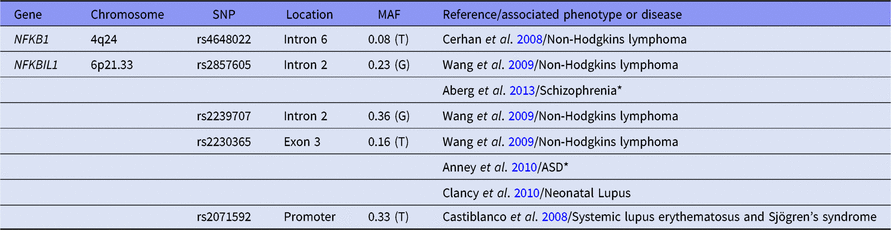
Polymorphisms in our chosen candidate genes have previously been associated with, for example, autoimmune diseases such as Grave’s disease and neonatal lupus, as well as with ASD and schizophrenia (for references, see Table 1). Of special note is a study by Anney et al. where a genome-wide scan to identify common risk variation for autism showed nominal association of the SNP rs2230365 in NFKBIL1 with ASD (Anney et al., Reference Anney, Klei, Pinto, Regan, Conroy, Magalhaes, Correia, Abrahams, Sykes, Pagnamenta, Almeida, Bacchelli, Bailey, Baird, Battaglia, Berney, Bolshakova, Bölte, Bolton, Bourgeron, Brennan, Brian, Carson, Casallo, Casey, Chu, Cochrane, Corsello, Crawford, Crossett, Dawson, de Jonge, Delorme, Drmic, Duketis, Duque, Estes, Farrar, Fernandez, Folstein, Fombonne, Freitag, Gilbert, Gillberg, Glessner, Goldberg, Green, Guter, Hakonarson, Heron, Hill, Holt, Howe, Hughes, Hus, Igliozzi, Kim, Klauck, Kolevzon, Korvatska, Kustanovich, Lajonchere, Lamb, Laskawiec, Leboyer, Le Couteur, Leventhal, Lionel, Liu, Lord, Lotspeich, Lund, Maestrini, Mahoney, Mantoulan, Marshall, McConachie, McDougle, McGrath, McMahon, Melhem, Merikangas, Migita, Minshew, Mirza, Munson, Nelson, Noakes, Noor, Nygren, Oliveira, Papanikolaou, Parr, Parrini, Paton, Pickles, Piven, Posey, Poustka, Poustka, Prasad, Ragoussis, Renshaw, Rickaby, Roberts, Roeder, Roge, Rutter, Bierut, Rice, Salt, Sansom, Sato, Segurado, Senman, Shah, Sheffield, Soorya, Sousa, Stoppioni, Strawbridge, Tancredi, Tansey, Thiruvahindrapduram, Thompson, Thomson, Tryfon, Tsiantis, van Engeland, Vincent, Volkmar, Wallace, Wang, Wang, Wassink, Wing, Wittemeyer, Wood, Yaspan, Zurawiecki, Zwaigenbaum, Betancur, Buxbaum, Cantor, Cook, Coon, Cuccaro, Gallagher, Geschwind, Gill, Haines, Miller, Monaco, Nurnberger, Paterson, Pericak-Vance, Schellenberg, Scherer, Sutcliffe, Szatmari, Vicente, Vieland, Wijsman, Devlin, Ennis and Hallmayer2010). Considering these previous associations, as well as the proposed role of autoimmune diseases in ASD and the known influence of NF-κB on brain development, these polymorphisms may be involved in the pathophysiology of ASD.
SNP details

SNP, single nucleotide polymorphism; MAF, minor allele frequency.
* Nominal association.
Aims of the study
The aim of this study was to investigate whether single nucleotide polymorphisms (SNPs) in the candidate genes NFKB1 and NFKBIL1 were associated with ALTs in a large cohort (n = 12 319) from the general population. Boys and girls were both analysed combined and separately in order to assess possible sex-dependent differences.
Material and methods
Cohort
Subjects included in this study were from the Child and Adolescent Twin Study in Sweden (CATSS), which is an ongoing study that targets all twins born in Sweden since July 1992 (Anckarsäter et al., Reference Anckarsäter, Lundström, Kollberg, Kerekes, Palm, Carlström, Långström, Magnusson, Halldner, Bölte, Gillberg, Gumpert, Råstam and Lichtenstein2011). Among the 12 426 individuals (6223 males and 6203 females) 2301 were monozygotic twin pairs, 3872 dizygotic twin pairs and 80 subjects without their co-twin. Zygosity was determined by a panel of 47 SNPs (Hannelius et al., Reference Hannelius, Gherman, Makela, Lindstedt, Zucchelli, Lagerberg, Tybring, Kere and Lindgren2007). Due to brain damage or known chromosomal abnormalities, such as Down syndrome and fragile X syndrome, 107 individuals were excluded from the statistical analyses, leaving a total of 12 319 individuals. The authors assert that all procedures contributing to this work comply with the ethical standards of the relevant national and institutional committees on human experimentation and with the Helsinki Declaration of 1975, as revised in 2008, and the protocol has been approved by the Karolinska Institutet Ethical Review Board. Informed consent for inclusion was given by parents of all participants (Anckarsäter et al., Reference Anckarsäter, Lundström, Kollberg, Kerekes, Palm, Carlström, Långström, Magnusson, Halldner, Bölte, Gillberg, Gumpert, Råstam and Lichtenstein2011).
Measurements
Parents were contacted when their twins were 9–12 years of age and asked to participate in a telephone interview containing, among other instruments, the Autism-Tics, ADHD, and Other Comorbidities Inventory (A-TAC), which is a validated tool for parental interviews screening general populations for childhood ASD and comorbid conditions (Hansson et al., Reference Hansson, Röjvall, Rastam, Gillberg, Gillberg and Anckarsäter2005; Larson et al., Reference Larson, Anckarsäter, Gillberg, Ståhlberg, Carlström, Kadesjö, Råstam, Lichtenstein and Gillberg2010). The A-TAC comprises 17 questions on ALTs. They reflect the three core symptom domains of ASD, as described in the Diagnostic and Statistical Manual of Mental Disorders, fourth edition (DSM-IV) (American Psychiatric Association, 1994): language impairment (six questions), social interaction impairment (six questions) and restrictive/repetitive behaviour (five questions). Each item has three possible answers: ‘no’ (coded 0), ‘yes, to some extent’ (coded 0.5) and ‘yes’ (coded 1). The total ALTs score is the sum of the 17 questions. A cut-off of ≥8.5 was used as a validated proxy for clinical ASD diagnosis (with a sensitivity/specificity of 0.71/0.95) (Larson et al., Reference Larson, Anckarsäter, Gillberg, Ståhlberg, Carlström, Kadesjö, Råstam, Lichtenstein and Gillberg2010; Mårland et al., Reference Mårland, Lichtenstein, Degl’Innocenti, Larson, Råstam, Anckarsäter, Gillberg, Nilsson and Lundström2017).
DNA extraction and genotyping
DNA was extracted from saliva samples using OraGene® DNA self-collection kits (DNA Genotek, Inc., Ottawa, ON, Canada). One SNP in NFKB1 (rs4648022) and four SNPs in NFKBIL1 (rs2857605, rs2239707, rs2230365 and rs2071592) were genotyped using the Kompetitive Allele Specific (KASPar®) PCR SNP genotyping system (LGC Genomics, Hoddesdon, UK), as shown in Table 1 with further information on position and previous studies reporting associations.
Statistical analysis
Statistical analyses to estimate the associations between SNPs and continuous measures of ALTs were performed using a linear mixed effect model in the PROC MIXED procedure of the SAS 9.3 (SAS Institute, Inc., Cary, NC) software. The validated research proxy for a clinical ASD diagnosis was used to model a case-control analysis using the generalised linear mixed model for binary data in the PROC GLIMMIX procedure in SAS 9.3. Due to the limited number of subjects (especially girls) with high ALTs scores, it was not possible to perform case-control analyses in girls only. While monozygotic twins share 100% of their genome, dizygotic twins share only about 50%. Two different variance–covariance matrices were modelled (1) for monozygotic twins and (2) for dizygotic twins. Correlations between individuals in groups (1) and (2) were calculated using R-side random effects with an unstructured variance–covariance matrix. Thus, all statistical analyses were adjusted for kinship and the CATSS population was analysed as a representative sample of children from the general population in Sweden. Mean scores and standard deviations were calculated using the ‘PROC MEANS’ procedure in SAS 9.3. The linkage disequilibrium (LD) was analysed using the pairwise LD measure D’ and a LD plot showing D’ and r 2 was generated using Haploview software (Barrett et al., Reference Barrett, Fry, Maller and Daly2005). To correct for multiple testing, the Bonferroni method was applied; the analyses of five SNPs and three ALT-modules as well as case-control resulted in 20 independent tests and the corrected p-value limit of 0.0025. The genotyping success rate was 96–98%, and all SNPs were found to be in Hardy–Weinberg equilibrium.
Results
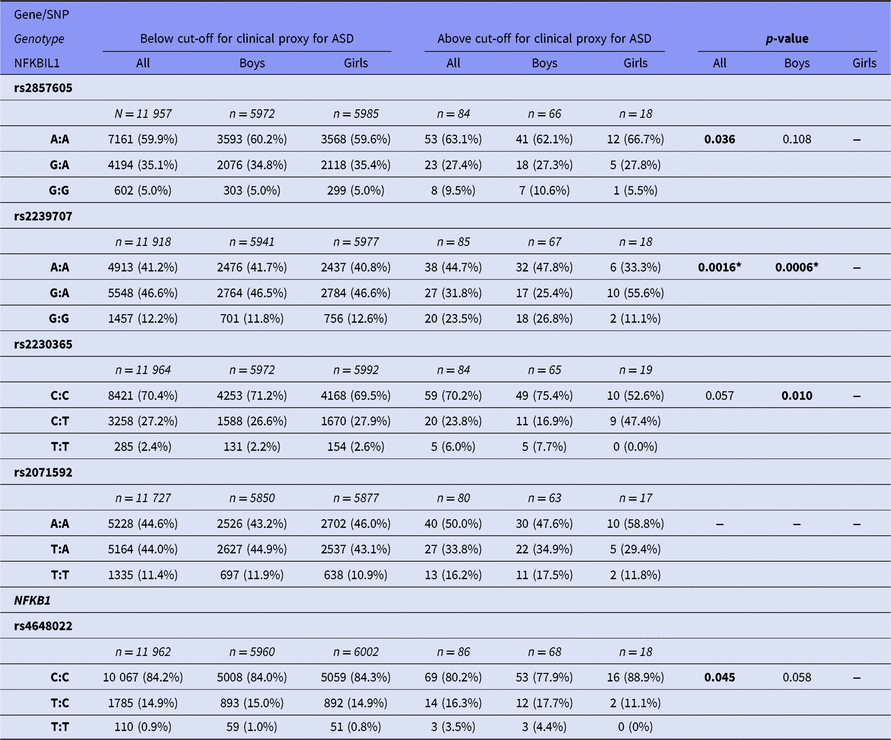
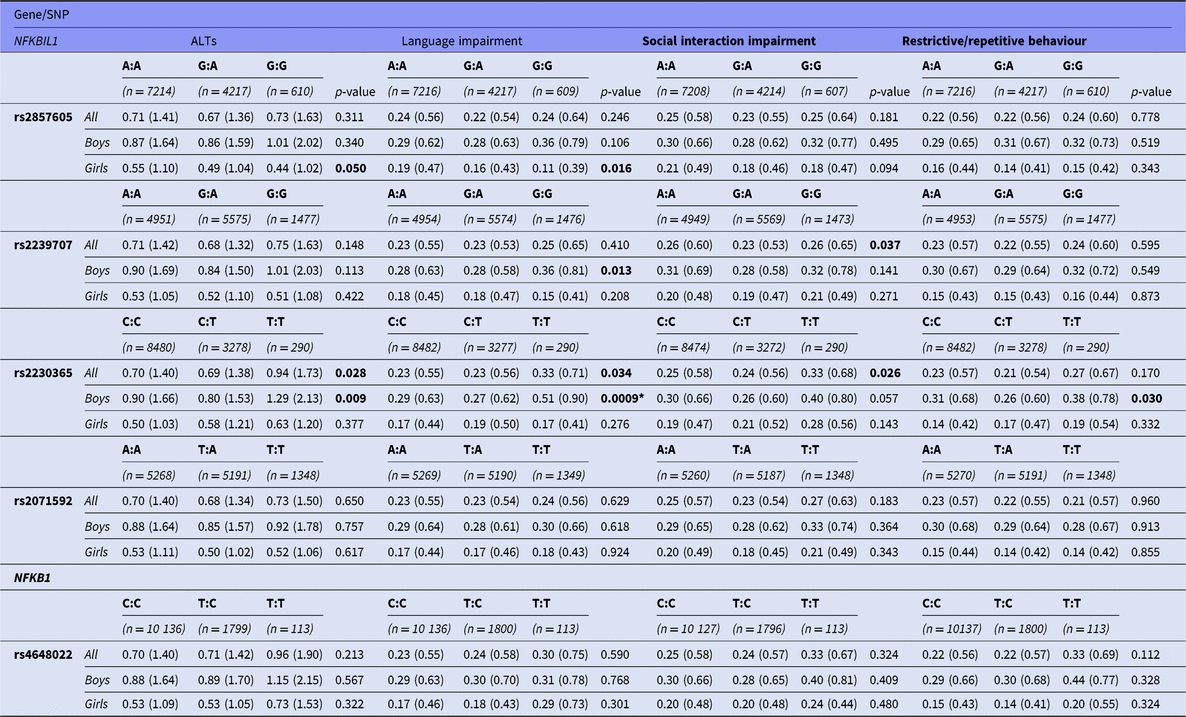
The results from the case-control analysis using the A-TAC score as a proxy for an ASD diagnosis are shown in Table 2. Associations between total ALTs as well as its modules language impairment, social interaction impairment and restrictive/repetitive behaviour and SNPs in NFKB1 and NFKBIL1, respectively, are shown in Table 3.
Distribution of genotype frequencies above and below cut-off for clinical proxy for ASD shown in number (%)

Significant p-values after correction for multiple testing are indicated by an asterisk (*). Missing p-values indicate that statistical analyses could not be performed (-).
Association analysis between polymorphisms and ALTs, as well as the modules language impairment, social interaction impairment and restrictive/repetitive behaviour shown in means (SD)

Significant p-values after correction for multiple testing are indicated by an asterisk (*).
Associations that survived Bonferroni correction were found for two SNPs in NFKBIL1; case-control analysis revealed a significantly different distribution of genotypes in rs2239707 in all individuals combined (p = 0.0016) and in boys only (p = 0.0006; Table 2), and rs2230365 was significantly associated with the ALT-module language impairment in boys only (p = 0.0009; Table 3).
The SNP rs2239707 furthermore showed associations with the modules language impairment (in boys only) and social interaction impairment (in all individuals combined), that did, though, not remain significant after correction for multiple testing. For rs2230365 we also found nominal associations: with total ALTs (in all individuals combined and boys only), the other two ALT-modules social interaction impairment (in all individuals combined) and restrictive/repetitive behaviour (in boys only), and in the case-control study (in boys only). Nominal evidence for association was moreover found for another SNP in NFKBIL1, rs2857605, and the total ALTs score as well as its module language impairment (in girls only). Both rs2857605 in NFKBIL1 and rs4648022 in NFKB1 showed a different distribution of genotypes in the case-control analysis (in all individuals combined). However, none of these remained significant after applying Bonferroni correction. We found no associations with ALTs for rs2071592 in NFKBIL1.
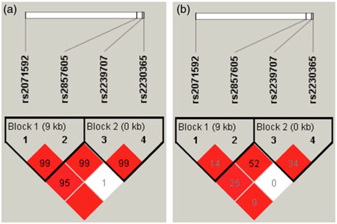
Fig. 1 shows the LD plot of the four SNPs in NFKBIL1 (rs2230365, rs2239707, rs2857605 and rs2071592).
The linkage disequilibrium between the four SNPs in NFKBIL1. Both D’ (a) measure and r 2 (b) measure are shown.

Discussion
Two of the four investigated SNPs in NFKBIL1 showed significant associations in the case-control analysis and with the ALT-module language impairment, respectively. Furthermore, the association between rs2230365 and ALTs replicates earlier findings by Anney et al. showing nominal association of this SNP with ASD (Anney et al., Reference Anney, Klei, Pinto, Regan, Conroy, Magalhaes, Correia, Abrahams, Sykes, Pagnamenta, Almeida, Bacchelli, Bailey, Baird, Battaglia, Berney, Bolshakova, Bölte, Bolton, Bourgeron, Brennan, Brian, Carson, Casallo, Casey, Chu, Cochrane, Corsello, Crawford, Crossett, Dawson, de Jonge, Delorme, Drmic, Duketis, Duque, Estes, Farrar, Fernandez, Folstein, Fombonne, Freitag, Gilbert, Gillberg, Glessner, Goldberg, Green, Guter, Hakonarson, Heron, Hill, Holt, Howe, Hughes, Hus, Igliozzi, Kim, Klauck, Kolevzon, Korvatska, Kustanovich, Lajonchere, Lamb, Laskawiec, Leboyer, Le Couteur, Leventhal, Lionel, Liu, Lord, Lotspeich, Lund, Maestrini, Mahoney, Mantoulan, Marshall, McConachie, McDougle, McGrath, McMahon, Melhem, Merikangas, Migita, Minshew, Mirza, Munson, Nelson, Noakes, Noor, Nygren, Oliveira, Papanikolaou, Parr, Parrini, Paton, Pickles, Piven, Posey, Poustka, Poustka, Prasad, Ragoussis, Renshaw, Rickaby, Roberts, Roeder, Roge, Rutter, Bierut, Rice, Salt, Sansom, Sato, Segurado, Senman, Shah, Sheffield, Soorya, Sousa, Stoppioni, Strawbridge, Tancredi, Tansey, Thiruvahindrapduram, Thompson, Thomson, Tryfon, Tsiantis, van Engeland, Vincent, Volkmar, Wallace, Wang, Wang, Wassink, Wing, Wittemeyer, Wood, Yaspan, Zurawiecki, Zwaigenbaum, Betancur, Buxbaum, Cantor, Cook, Coon, Cuccaro, Gallagher, Geschwind, Gill, Haines, Miller, Monaco, Nurnberger, Paterson, Pericak-Vance, Schellenberg, Scherer, Sutcliffe, Szatmari, Vicente, Vieland, Wijsman, Devlin, Ennis and Hallmayer2010).
The amino acid sequence of the NFKBIL1 protein has previously been shown to contain protein–protein interaction domains that most closely resemble those of the well-studied pro-inflammatory transcription factor NF-κB (Albertella & Campbell, Reference Albertella and Campbell1994), and thus NFKBIL1 has been suggested to be a member of the inhibitor of NF-κB family of proteins. However, NFKBIL1 isoforms have been proposed to be incapable of binding to NF-κB but instead associate with mRNA and proteins that are involved in the translation of mRNA into protein, suggesting that it may be involved in mRNA processing or the regulation of translation (Greetham et al., Reference Greetham, Ellis, Mewar, Fearon, an Ultaigh, Veale, Guesdon and Wilson2007). A study by An et al. demonstrated a role of NFKBIL1 in the regulation of alternative splicing in viral influenza genes and human immune-related genes (An et al., Reference An, Nakajima, Shibata, Arimura, Yasunami and Kimura2013). Whether or not NFKBIL1 can directly interact with NF-κB, these functional studies support the idea of NFKBIL1 as a regulator of gene expression and protein translation, which affects genes and pathways within the immune system. Furthermore, Chen et al. found NFKBIL1 levels prior to infection to be significantly associated with hepatitis C virus clearance (Chen et al., Reference Chen, Shen, Guha, Ding, Kulich, Ashimkhanova, Rinaldo, Seaberg, Margolick, Stosor, Mart�nez-Maza and Gupta2016), supporting a role of NFKBIL1 in the innate immune response to viral infections. This is of interest, because a connection has been proposed between viral infections and ASD (Libbey et al., Reference Libbey, Sweeten, McMahon and Fujinami2005).
Our results concerning rs2230365 and ALTs, replicating earlier findings in an independent cohort (Anney et al., Reference Anney, Klei, Pinto, Regan, Conroy, Magalhaes, Correia, Abrahams, Sykes, Pagnamenta, Almeida, Bacchelli, Bailey, Baird, Battaglia, Berney, Bolshakova, Bölte, Bolton, Bourgeron, Brennan, Brian, Carson, Casallo, Casey, Chu, Cochrane, Corsello, Crawford, Crossett, Dawson, de Jonge, Delorme, Drmic, Duketis, Duque, Estes, Farrar, Fernandez, Folstein, Fombonne, Freitag, Gilbert, Gillberg, Glessner, Goldberg, Green, Guter, Hakonarson, Heron, Hill, Holt, Howe, Hughes, Hus, Igliozzi, Kim, Klauck, Kolevzon, Korvatska, Kustanovich, Lajonchere, Lamb, Laskawiec, Leboyer, Le Couteur, Leventhal, Lionel, Liu, Lord, Lotspeich, Lund, Maestrini, Mahoney, Mantoulan, Marshall, McConachie, McDougle, McGrath, McMahon, Melhem, Merikangas, Migita, Minshew, Mirza, Munson, Nelson, Noakes, Noor, Nygren, Oliveira, Papanikolaou, Parr, Parrini, Paton, Pickles, Piven, Posey, Poustka, Poustka, Prasad, Ragoussis, Renshaw, Rickaby, Roberts, Roeder, Roge, Rutter, Bierut, Rice, Salt, Sansom, Sato, Segurado, Senman, Shah, Sheffield, Soorya, Sousa, Stoppioni, Strawbridge, Tancredi, Tansey, Thiruvahindrapduram, Thompson, Thomson, Tryfon, Tsiantis, van Engeland, Vincent, Volkmar, Wallace, Wang, Wang, Wassink, Wing, Wittemeyer, Wood, Yaspan, Zurawiecki, Zwaigenbaum, Betancur, Buxbaum, Cantor, Cook, Coon, Cuccaro, Gallagher, Geschwind, Gill, Haines, Miller, Monaco, Nurnberger, Paterson, Pericak-Vance, Schellenberg, Scherer, Sutcliffe, Szatmari, Vicente, Vieland, Wijsman, Devlin, Ennis and Hallmayer2010), suggest a possible role of rs2230365 in ASD. However, a more recent meta-analysis including further cohorts did not replicate this association (The Autism Spectrum Disorders Working Group of the Psychiatric Genomics Consortium, 2017). Apart from the obvious advantages of meta-analysis, there are also limitations to this method; considering the heterogeneity of pooled data, selection biases and the wide array of methods that can be used, meta-analysis data require careful interpretation and should be used with caution (Zeggini & Ioannidis, Reference Zeggini and Ioannidis2009). Also, one should take into consideration that the development of ASD is a multifactorial process with genetic factors causing a vulnerability for ASD and environmental factors such as infection increasing the incidence of this disorder, via for example gene–environment interactions (Nardone & Elliott, Reference Nardone and Elliott2016). It is therefore possible that individuals with the same genetic background develop differently due to divergent activation of both their own and their mothers’ immune systems, leading to not only inter-individual but also inter-population variation in the severity of phenotype. Nevertheless, another very recent study conducted in a large sample of individuals with ASD (n = 18 381) and controls (n = 27 969) also saw no genome-wide significant associations between SNPs in NFKBIL1 and ASD (Grove et al., Reference Grove, Ripke, Als, Mattheisen, Walters, Won, Pallesen, Agerbo, Andreassen, Anney, Awashti, Belliveau, Bettella, Buxbaum, Bybjerg-Grauholm, Bækvad-Hansen, Cerrato, Dellenvall, Chambert, Christensen, Churchhouse, Demontis, De Rubeis, Devlin, Djurovic, Dumont, Goldstein, Hansen, Hauberg, Hollegaard, Hope, Howrigan, Huang, Hultman, Klei, Maller, Martin, Martin, Moran, Nyegaard, Nærland, Palmer, Palotie, Pedersen, Pedersen, DPoterba, Poulsen, Pourcain, Reichert, Qvist, Rehnström, Reichenberg, Robinson, Roeder, Roussos, Saemundsen, Sandin, Satterstrom, Smith, Stefansson, Steinberg, Stevens, Sullivan, Turley, Walters, Xu, Stefansson, Geschwind, Nordentoft, Hougaard, Werge, Mors, Mortensen, Neale, Daly and Børglum2019), and our findings should be interpreted with caution.
Case-control analysis revealed a nominally significant association for rs2230365 in boys only, but not when including girls. Applying a mixed model analysis on the continuous measures of ALTs found the association between rs2230365 and ALTs to be nominally significant in boys and, albeit to a lesser extent, in all individuals, but not in girls, suggesting that this variant might contribute less to a phenotype in girls. A study investigating the effects of copy number variation and SNPs in probands with neurodevelopmental disorders as well as in an ASD cohort found that females carried significantly more neurodevelopmental-related genetic mutations than males with the same symptoms (Jacquemont et al., Reference Jacquemont, Coe, Hersch, Duyzend, Krumm, Bergmann, Beckmann, Rosenfeld and Eichler2014), suggesting an increased mutational burden and more resilience to genetic insults in females. Furthermore, a study investigating cytokine levels in children with ASD found significantly different cytokine responses between boys and girls (Masi et al., Reference Masi, Breen, Alvares, Glozier, Hickie, Hunt, Hui, Beilby, Ravine, Wray, Whitehouse and Guastella2017), further supporting the notion of a potential sex-specific biology, including immune functions, in the etiology of autism. These findings illustrate the importance of gender-stratification in autism research, and studies including larger female cohorts are required to better understand the influence of sex on neurodevelopmental disorders.
Several studies have shown associations between genetic variations in NFKBIL1 and susceptibility to inflammatory or autoimmune diseases such as neonatal lupus (Clancy et al., Reference Clancy, Marion, Kaufman, Ramos, Adler, Harley, Langefeld and Buyon2010) and systemic lupus erythematosus (Castiblanco & Anaya, Reference Castiblanco and Anaya2008) (Table 1). A haplotype analysis of the SNPs rs2857605-rs2239707-rs2230365 in NFKBIL1 furthermore showed associations with non-Hodgkins lymphoma (Wang et al., Reference Wang, Purdue, Cerhan, Zheng, Menashe, Armstrong, Lan, Hartge, Kricker, Zhang, Morton, Vajdic, Holford, Severson, Grulich, Leaderer, Davis, Cozen, Yeager, Chanock, Chatterjee and Rothman2009). The HLA region, where NFKBIL1 is located, has not only been implicated in autoimmune diseases (Gough & Simmonds, Reference Gough and Simmonds2007) but also in ASD (Anney et al., Reference Anney, Klei, Pinto, Regan, Conroy, Magalhaes, Correia, Abrahams, Sykes, Pagnamenta, Almeida, Bacchelli, Bailey, Baird, Battaglia, Berney, Bolshakova, Bölte, Bolton, Bourgeron, Brennan, Brian, Carson, Casallo, Casey, Chu, Cochrane, Corsello, Crawford, Crossett, Dawson, de Jonge, Delorme, Drmic, Duketis, Duque, Estes, Farrar, Fernandez, Folstein, Fombonne, Freitag, Gilbert, Gillberg, Glessner, Goldberg, Green, Guter, Hakonarson, Heron, Hill, Holt, Howe, Hughes, Hus, Igliozzi, Kim, Klauck, Kolevzon, Korvatska, Kustanovich, Lajonchere, Lamb, Laskawiec, Leboyer, Le Couteur, Leventhal, Lionel, Liu, Lord, Lotspeich, Lund, Maestrini, Mahoney, Mantoulan, Marshall, McConachie, McDougle, McGrath, McMahon, Melhem, Merikangas, Migita, Minshew, Mirza, Munson, Nelson, Noakes, Noor, Nygren, Oliveira, Papanikolaou, Parr, Parrini, Paton, Pickles, Piven, Posey, Poustka, Poustka, Prasad, Ragoussis, Renshaw, Rickaby, Roberts, Roeder, Roge, Rutter, Bierut, Rice, Salt, Sansom, Sato, Segurado, Senman, Shah, Sheffield, Soorya, Sousa, Stoppioni, Strawbridge, Tancredi, Tansey, Thiruvahindrapduram, Thompson, Thomson, Tryfon, Tsiantis, van Engeland, Vincent, Volkmar, Wallace, Wang, Wang, Wassink, Wing, Wittemeyer, Wood, Yaspan, Zurawiecki, Zwaigenbaum, Betancur, Buxbaum, Cantor, Cook, Coon, Cuccaro, Gallagher, Geschwind, Gill, Haines, Miller, Monaco, Nurnberger, Paterson, Pericak-Vance, Schellenberg, Scherer, Sutcliffe, Szatmari, Vicente, Vieland, Wijsman, Devlin, Ennis and Hallmayer2010; Gesundheit et al., Reference Gesundheit, Rosenzweig, Naor, Lerer, Zachor, Procházka, Melamed, Kristt, Steinberg, Shulman, Hwang, Koren, Walfisch, Passweg, Snowden, Tamouza, Leboyer, Farge-Bancel and Ashwood2013). Interestingly, autoimmune diseases have also been found to be more frequent in families with autistic children (Sweeten et al., Reference Sweeten, Bowyer, Posey, Halberstadt and McDougle2003), especially in mothers of autistic children (Comi et al., Reference Comi, Zimmerman, Frye, Law and Peeden1999). Furthermore, the NFKBIL1 SNP rs2857605 has been nominally associated with an increased risk for schizophrenia in a family-based replication study (Aberg et al., Reference Aberg, Liu, Bukszár, McClay, Khachane, Andreassen, Blackwood, Corvin, Djurovic, Gurling, Ophoff, Pato, Pato, Riley, Webb, Kendler, O’Donovan, Craddock, Kirov, Owen, Rujescu, St Clair, Werge, Hultman, Delisi, Sullivan and Van Den Oord2013). Variations in NFKBIL1 could be an early factor in the cascade of events leading from an underlying dysregulation of the immune system to neuropsychiatric disorders, via for example autoimmune mechanisms or response to infections.
Despite studies showing associations between rs2071592 in the promoter region of NFKBIL1 and increased disease risk for, amongst others, systemic lupus erythematosus (Castiblanco & Anaya, Reference Castiblanco and Anaya2008) suggesting functionality of this SNP, we saw no associations between rs2071592 and ALTs.
Different genetic influences may be of importance in various autistic endophenotypes and only a modest genetic overlap with respect to social and non-social ALTs have been reported (Ronald et al., Reference Ronald, Butcher, Docherty, Davis, Schalkwyk, Craig and Plomin2010). Considering autistic traits separately may be fruitful in order to elucidate how neuropsychiatric symptoms develop. Both SNPs that were associated with total ALTs, rs2857605 and rs2230365 in NFKBIL1, were found to be associated with the core symptom language impairment. This is of interest, as language impairment has been associated with HLA alleles previously in a case-control study (Nudel et al., Reference Nudel, Simpson, Baird, O’Hare, Conti-Ramsden, Bolton, Hennessy, Monaco, Knight, Winney, Fisher, Newbury, Slonims, Clark, Watson, Simonoff, Pickles, Everitt, Seckl, Cowie, Cohen, Nasir, Bishop and Simkin2014), suggesting a role of HLA loci in language disorders. Furthermore, the HLA region has been implicated with dyslexia (Cardon et al., Reference Cardon, Smith, Fulker, Kimberling, Pennington and DeFries1994).
With respect to the other gene investigated in this study, coding for a subunit in NF-κB, our case-control analysis revealed a different distribution of genotypes in the NFKB1 SNP rs4648022 that did, however, not survive correction for multiple testing.
Apart from its role in immunity, NF-κB is suggested to also regulate apoptosis and neurogenesis and to be involved in synaptic plasticity and memory (Malik et al., Reference Malik, Tauqeer, Sheikh, Wen, Nagori, Yang, Brown and Li2011; Crampton & O’Keeffe, Reference Crampton and O’Keeffe2013; Snow et al., Reference Snow, Stoesz, Kelly and Albensi2014), making it a regulatory molecule not only for immune functions but also for neurodevelopment. The NF-κB family consists of several structurally related proteins that form homo- and heterodimers with each other. One of the subunits is the DNA-binding p50, originating from NFKB1. Associations have been reported between the NFKB1 SNP rs4648022 and non-Hodgkins lymphoma, a blood cancer closely associated with immune function (Cerhan et al., Reference Cerhan, Liu-Mares, Fredericksen, Novak, Cunningham, Kay, Dogan, Liebow, Wang, Call, Habermann, Ansell and Slager2008). Although only nominally significant, our finding regarding rs4648022 supports previous findings on a potential role of NF-κB in autism; one of these studies reported elevated NF-κB levels in blood immune cells and significantly increased DNA binding activity of NF-κB in autistic children (Naik et al., Reference Naik, Gangadharan, Abbagani, Nagalla, Dasari and Manna2011). Aberrant levels and functionality of a key transcription factor such as NF-κB, as seen in individuals diagnosed with ASD, may cause changes in innate immunity, possibly leading to a dysfunctional neuroimmune environment affecting neurodevelopment. Even though one study found no differences in cerebellar expression and cerebellar and frontal cortex activity of NF-κB in autistic individuals (Malik et al., Reference Malik, Tauqeer, Sheikh, Wen, Nagori, Yang, Brown and Li2011), the lack of significant results in that study might be due to low expression levels of NF-κB, not detectable with the used method (Western blot). Another study from the same group regarding frontal cortex tissue of autistic subjects showed altered expression of genes that are regulated by NF-κB (Sheikh et al., Reference Sheikh, Malik, Wen, Chauhan, Chauhan, Gong, Liu, Brown and Li2010). An expression profiling study of the superior temporal gyrus of autistic subjects revealed an increase in transcription levels of several immune system-related genes as well as genes that are involved in cell communication, differentiation and apoptosis, including 22 genes within the NF-κB pathway (Garbett et al., Reference Garbett, Ebert, Mitchell, Lintas, Manzi, Mirnics and Persico2008). Moreover, a whole genome transcriptomic analysis of brains of individuals with ASD found significant differences in candidate pathways of immune regulation and alternative splicing regulation, suggesting that the observed immune upregulation may be related to abnormal ongoing plasticity in the brain of ASD patients (Voineagu et al., Reference Voineagu, Wang, Johnston, Lowe, Tian, Mill, Cantor, Blencowe, Daniel, Horvath, Mill, Cantor, Blencowe and Geschwind2013). Associations between polymorphisms in NFKB1 and bipolar disorder have been reported in a susceptibility loci replication study (Gonzalez et al., Reference Gonzalez, Gupta, Villa, Mallawaarachchi, Rodriguez, Ramirez, Zavala, Armas, Dassori, Contreras, Flores, Jerez, Ontiveros, Nicolini and Escamilla2016), further supporting involvement of NF-κB pathways in neuropsychiatric disorders.
The ALTs-associated SNP rs2230365 in NFKBIL1 is synonymous and rs4648022 in NFKB1 as well as rs2857605 and rs2239707 in NFKBIL1 are located in intronic regions, which makes their functional significance uncertain. However, a meta-analysis of 14 independent ASD cohorts identified an intronic marker to be the only genome-wide significant risk locus (The Autism Spectrum Disorders Working Group of the Psychiatric Genomics Consortium, 2017). Although intronic, this marker lies in a region that overlaps several genes, including a transcription factor playing a role in neuronal differentiation. Furthermore, another meta-analysis study surveying over 2000 publications found that synonymous SNPs, which cause no change to the encoded amino acid, are as likely to be involved in disease mechanisms. Indeed, synonymous and non-synonymous SNPs share similar likelihood and effect size for disease association (Chen et al., Reference Chen, Davydov, Sirsota and Butte2010). Studies have furthermore demonstrated that synonymous SNPs can affect mRNA splicing, stability and structure (Hunt et al., Reference Hunt, Sauna, Ambudkar, Gottesman and Kimchi-Sarfaty2009) as well as protein folding and subsequent changes in substrate specificity (Kimchi-Sarfaty et al., Reference Kimchi-Sarfaty, Oh, Kim, Sauna, Calcagno, Ambudkar and Gottesman2007). Regarding LD and the high D’ values in the LD plot of the four SNPs in NFKBIL1 (Fig. 1), the moderate r 2 values motivated investigation of all SNPs. It is furthermore unclear whether our findings reflect indirect association; the SNPs may be in LD with another, unidentified functional variant in the vicinity. However, this does not exclude effects of these SNPs on the expression of NFKBIL1 via mechanisms such as alternative splicing or binding of non-coding RNAs (Cooper, Reference Cooper2010).
The limitations of the present study concern the data collection by means of parental reports, the non-clinical diagnostics applied and the limited number of subjects, especially girls, presenting ALTs scores above the cut-off for a proxy for ASD diagnosis. Although all statistical analyses were adjusted for twins, problem behaviour may be under-reported in the co-twin of individuals perceived by the parent as having more severe emotional–behavioural problems, and response style could vary between parents where some admit a larger amount of problems, and others deny them throughout. However, this should be compensated for considering the size of this study. Since our study was not conducted in a patient versus control cohort, but a sample representing the general population with ALTs measured using a continuous scale, the groups with high ALTs scores were often very small, especially when looking at girls separately. It was, thus, not possible to perform case-control analyses for girls. Further studies of NFKB1 and NFKBIL1 in relation to ASD in a patient-control population are therefore highly warranted. It should furthermore be noted that the general utility of candidate gene studies has been questioned, as it has been difficult to replicate findings from most studies; a recent study investigating the effect of commonly published candidate genes in depression found no significant association between these genes and depression phenotypes (Border et al., Reference Border, Johnson, Evans, Smolen, Berley, Sullivan and Keller2019), questioning the validity of findings from candidate genes studies. However, one should take into account that although both autism and depression are very heterogenous in phenotypes and in their genetic architecture, autism has one of the highest heritability estimates among neuropsychiatric disorders (Sullivan & Geschwind, Reference Sullivan and Geschwind2019), and while depression certainly has a strong genetic component, epigenetic mechanisms influenced by, for example, stress and childhood adversity seem to play a highly important role (Shadrina et al., Reference Shadrina, Bondarenko and Slominsky2018). Furthermore, while genome-wide association studies examine associations at thousands of common variants across the genome, with no underlying hypothesis as to what kind of genes or pathways might be involved, candidate studies allow for a hypothesis-driven investigation of endogenous molecules. Considering the intricate and complex relationship between the immune system and brain functions, it is not always evident if immune system dysregulation is causing a phenotype or caused by it, and the advantage of the candidate gene approach is that possible associations between the genetic code and a phenotype can be established. Another frequent point of criticism regarding candidate gene studies is the small sample sizes frequently employed, and that many of these studies have likely been severely underpowered, contributing to a false positive discovery rate, for example as discussed by Border et al. (Reference Border, Johnson, Evans, Smolen, Berley, Sullivan and Keller2019). However, this concern seems unfounded in the light of the size of this study.
In conclusion, we have shown that genetic variation in NFKBIL1 may possibly contribute to ASD susceptibility, perhaps via for example dysfunctional effects on brain development directly, an altered inflammatory response to external stimuli and/or autoimmune mechanisms leading to neurodevelopmental impairments. However, although some of our results in NFKBIL1 replicate earlier findings, other studies showed no associations between variants in this gene and ASD, and the present genetic data needs to be confirmed in future studies.
Author ORCIDs
Nina Strenn 0000-0001-9103-9362
Acknowledgements
We wish to thank the study participants and their relatives who have made this study possible.
Authors contributions
NS and AE conceived and designed the study; NS, DH and LJ analysed the data; AE, PL, HA and SL contributed study and laboratory materials; NS wrote the paper. All authors revised the article critically and gave approval of the version to be published.
Financial support
This study was supported by the Foundation for Psychosomatic and Clinical Research and the Bertil Hållstens Foundation, the Swedish Medical Research Council (PL, grant number 2016-01989), the Swedish Research Council for Health, Working Life and Welfare (PL, grant number 2012-1678) and the Wilhelm and Martina Lundgren Foundation (NS, grant number 2015-0626).
Statement of interest
None.