In this article I examine the epistemic practices, theories, and classificatory imaginaries through which colonial boundaries in Island Southeast Asia became, or failed to become, racialised during the twentieth century. By looking at the case of East Timor, I explore the classificatory work required to hold racial typologies together with spatial distributions of colonial significance. This viewpoint builds on, and contributes to, a growing body of literature in colonial studies and the history of science and geography. Since the 1990s scholars have been exploring the close ties between mapping practices, colonial power, and cartographic representations in the period of European national and colonial expansionism.Footnote 1 Cartographic inscriptions of imageries of human difference may have a deeper history in European mapping traditions. Yet racial mapping as such gained momentum during the nineteenth century, prompted by the establishment of geography and anthropology as companion scientific disciplines, and the strengthening of colonialism, racialism, and nationalist ideologies of ethnic identity.Footnote 2
These historical processes bear singularly on the European imaginaries of Island Southeast Asia during the colonial period. As historian Bronwen Douglas recently argued, the geography and cartography of wider Oceania — encompassing Island Southeast Asia — was ‘inherently racialised’ since the early nineteenth century, a process clearly revealed in Dumont d'Urville's seminal divide of Oceania into two racially opposed spaces, Melanesia and Polynesia, in 1832.Footnote 3 As racial science hardened over the course of the century, ethnological reasoning became closely associated with the inscription of racialised visions of human difference onto space and onto maps.Footnote 4 The terms Indian, Indo-Malay or Malay Archipelago came into being at the juncture of geographical and ethnological language in this context. By the 1840s to 1860s they were widely used by ethnologists to designate the vast world of islands lying in between Asia and the Pacific as a coherent ethno-geographical ‘region’.Footnote 5 This circumscribed a space for intense classificatory debates over racial difference; it also circumscribed a space for political dispute between European colonial powers. While anthropologists sought to inscribe race types into maps and spatial distributions, Portuguese, Spanish, Dutch, French, British, German, Japanese, and then North Americans struggled to appropriate and impose colonial forms of territorial rule in the archipelago. Race types were devised; geographical distributions were mapped; ethnological lines were drawn. Simultaneously, territorial claims for colonial control and for accompanying political borders were made. Boundary-making among as well as within islands was at stake. In this arena of multiple and conflicting lines, at once epistemic and political, problems of racial classification could emerge as problems of colonial geography. In some instances, racial lines challenged certain colonial orderings, but in other cases racial orderings came into being as doubles of colonial arrangements. The demarcation of race types blended with the demarcation of colonial borders.
Timor Island provides an illuminating case study for reflecting upon these issues. Located between the Asian and the Pacific worlds, at the southeastern tip of the Lesser Sunda Islands, Timor's geographical position became critical to the international debate on the races of the Malay Archipelago by the mid-nineteenth century. The Timorese Islanders came to stand paradigmatically for the region's ethnological complexity. In particular, they epitomised in racial thinking the classificatory tension between the then two main categories of ‘Oceanic races’ in competition, the ‘Malay’ or ‘Malayan’ and the ‘Papuan’. The history of these two plastic notions, or classificatory regimes, was closely connected with the consolidation of a racialised spatial imaginary of human difference in the region.Footnote 6 Displaying apparently contradictory physical characters, the Timorese seemed to resist categorisation between the Malayan categories, representing an affiliation to Asia and yellow race types, and the Papuan, standing for affiliation with Melanesian and black race types. As such, Timor came over time to encapsulate the race-mixing problem of these two autochthonous types.
This trajectory as a contested and ambivalent scientific object in anthropological taxonomy coexisted with the turbulent political history of Timor as a colonial space. During the last three centuries Timor Island was a divided territory disputed by external powers. From the seventeenth to the twentieth centuries, Timor was broken into two zones of European colonial influence: the Portuguese in the East, and the Dutch in the West. This colonial division may have partly articulated a former distinction between two great zones — Servião (West) and Belos (East) — that possibly preceded the Europeans.Footnote 7 The geographical borders between the two colonial zones, as well as the shifting political allegiance of both Western and Eastern indigenous kingdoms to either Portuguese or Dutch rulers, remained unclear and ambivalent for many years. Dutch and Portuguese territorial enclaves were also preserved in both sides of the island until a late date. Portugal and Holland agreed with difficulty on demarcated borders, first in a treaty of 1859 and in a final, definitive agreement in 1914. The colonial border thereafter divided the island into two contiguous territories, West (Dutch) and East (Portuguese) Timor. Even after diplomatic agreements, ‘Portuguese Timor’ (Timor Português) included a small part of West Timor, the Oecussi and Ambeno enclave. In 1975 the Indonesian army invaded the country and expelled the Portuguese; in 1999, after decades of resistance, a popular referendum decided for independence, leading to the establishment of the Democratic Republic of Timor-Leste in 2002. Today, East Timor's political borders basically match those defined in the late Portuguese colonial period, including the preservation of the Oecussi enclave as a district of Timor-Leste in western territory.
What classificatory processes, I ask herein, are involved in transforming an ethnically heterogeneous and politically fragmented territory, such as Timor Island, into clear-cut categories of racial difference? How do race categories come to merge with bordered colonial territories in anthropological classificatory work? How and when, in particular, did the political and colonial unity ‘Portuguese Timor’ become a relevant object of racial taxonomy? In this article, I will address these questions in the anthropological work of António Augusto Mendes Correia (1888–1960), arguably the most influential Portuguese racial and physical anthropologist of the first half of the twentieth century. Between 1916 and 1945, at the University of Porto in metropolitan Portugal, Mendes Correia put forward a novel anthropogeographical theory that took the Portuguese colony of Timor as its main object of classification. Correia began his anthropological writings on the colonies with a set of papers on Timor and Angola in 1916. Drawing primarily on anthropometric records from the enclave of Oecussi, he stood out for originally advocating the classification of the East Timorese of Portuguese Timor as distinctly Malayan, rejecting former views that associated Timor Island with a dominant Papuan racial type. From this Correia was to derive an alternative racial cartography of the Malay Archipelago that interfered with the ‘ethnological line’ famously set down by Alfred Russel Wallace in 1869. Correia's coup de force, however, was achieved through a singular conjunction of racial typology and colonial geography. The political divide of the island organised his approach to the problem of the ethnological line. Correia's classification of ‘Portuguese Timor’ as racially Malayan, Proto-Malayan, or Indonesian, was brought into being at the conjunction of a certain racial and colonial geographical imagination. In this context, the contradictory political and physical geography of the enclave of Oecussi would both enable and complicate Mendes Correia's classificatory work to tailor race science to colonial order.
I first look at Correia's elaborations in the context of both the international debate on the ethnology of Timor, and the politics of his biography as a young academic eager for scientific authority. I then examine Correia's use of Fonseca Cardoso's records and the interaction established with Dutch and French scholarship. In describing these materials, it is my purpose to bring to light the political ontology behind Correia's scientific racialisation. Building on data from the enclave of Oecussi and Ambeno, located on the Western (Dutch) side of the island, Correia laid the basis for the creation of a sort of Malayan racial type for ‘Portuguese Timor’ as a whole. Finally, I look at how political geography translated into racial ontology in Correia's revised representation of Wallace's ethnological line in 1944–45.
The discovery of the Oecussi and Ambeno ‘Malayan type’
‘Travellers,’ summarised the influential British ethnologist and traveller George W. Earl in 1853, ‘have great difficulty in coming to a conclusion as to whether they [the Timorese] belong to Malayan or Papuan races, so balanced are their characteristics.’Footnote 8 His comments followed a visit to Timor, including a sojourn in Portuguese Timor's capital, Dili, and alluded to the contemporary consensus in Europe over racial classifications of the island's population. The all-embracing ‘Malayan type’ proposed in the late eighteenth century by the German craniologist Johann Friedrich Blumenbach was used in early anthropological classifications of the Timorese, but was soon considered insufficient. From the outset, the tendency to classify the islanders within a vague and undifferentiated Malayan type coexisted with the conviction that the Timorese represented a virtually inextricable ‘juxtaposition’, ‘fusion’, or ‘mixture’ of yellow and black, Malayan and Papuan, races. But whereas some saw Timor as a classificatory dead-end, others, including Earl, regarded it as a promising land for ethnological reasoning. George Earl returned to Europe persuaded that in Timor's intricate racial blend there lay a solution to the general problem of the archipelago's ‘race-mixing’ conundrum.Footnote 9
Earl's vision of Timor as a productive brainteaser, a model case for testing broader racial geographies, was reinforced in the next three decades. By the 1850s scholars had abandoned the primacy of an Asian linkage and turned to a new hypothesis, that the essential racial identity of the islanders ought to be found in a primitive black race type. The idea that the Timorese belonged to a vague ‘Malayan type’ lost ground to the idea that they should be affiliated primarily with some sort of dark race, such as the ‘Papuan race’. This viewpoint held sway largely as a result of Alfred Russel Wallace's book The Malay Archipelago of 1869. In this highly influential work, Wallace proposed a dualistic racial cartography of the region, expressed by an ethnological line that split up the archipelago into two opposed ‘primary races’: ‘the Malays who inhabit almost exclusively the western half of the archipelago and the Papuans whose head-quarters are New Guinea and some of the adjacent islands’.Footnote 10 It was an unambiguous categorisation of Timor that bypassed the mixed nature of the inhabitants while preserving the entire island as object of discussion. Timor was placed near the line of junction, acknowledging its peoples’ state of ‘commixture’. However, it was also classified unequivocally within the Papuan race, on the eastern side of the map. This influentially set Timor into a classificatory position as Papuan, and continued to force the debate to be addressed dichotomously: either the Timorese were Malays — or they were Papuans. More importantly, perhaps, as a consequence of continuing to appear on a borderline position in Wallace's map, Timor acquired a pivotal significance for undermining Wallace's construct. The remote island held the potential to interfere with the very configuration of the ethnological line, and the underlying logic of the map.
Wallace's line became a driving force of ethnological research on Timor. In this international context, the island constituted the valid spatial unit for racial classification. The island, not the colonial territories, was at stake in classificatory work. Internal physical geography, however, did matter for categorising the island, regardless of political borders. The distinction between coastal lowlands (where mixed populations and intrusive invading Malayan races presumably prevailed) and interior highlands (where the purest, aboriginal, darker-skinned, peoples were expected to survive) was critical for ethnological considerations.Footnote 11 Interpreted either as Papuan, Malayan, or Negrito, it mattered little whether evidence concerned Dutch, or Portuguese Timor. The purpose was to produce a classificatory generalisation, capable of disentangling aboriginal race-mixture and bringing the indigenous islanders together under one racial category. Therefore, in the context of the international debate, the ethnological line and the political geography of Timor followed separate lives. This separation faded away, however, as the debate settled in Portugal in the first half of the twentieth century, and an aspect of the international discussion was transformed. The relevant ethnological problem was not just whether one or many races existed on the island. It was rather whether or not one colonial space — Portuguese Timor — could, or could not, be condensed in one distinct race category.
The ethnological line in twentieth-century Portugal
Wallace's configuration left few clear traces in published works in Portugal.Footnote 12 While European scholars debated the races of the ‘Malay Archipelago’, Portuguese archaeology and ethnology focused on metropolitan matters; the emerging experts in racial science were dedicated principally to endogenous ethnogenic problems. Former colonial officials touched on the subject of Timorese ethnology and racial composition in generalist publications, but the issue was rarely addressed at length, from the perspective of race science, or using field or museum evidence gathered by Portuguese observers themselves.Footnote 13 Timor and the ethnological line, in other words, entered only tangentially into self-proclaimed anthropological scholarship in metropolitan Portugal — until the arrival on the scene of young Professor Mendes Correia from Porto University.
In 1916, an article entitled Timorenses de Okussi e Ambeno (notas antropológicas sobre observações de Fonseca Cardoso) (Timorese of Okussi and Ambeno [anthropological notes upon Fonseca Cardoso's observations]) proposed to address the ethnological problem of Timor from the perspective of the latest racial theories and scientific evidence.Footnote 14 Published in a Portuguese academic journal, the paper was based on a wealth of anthropometric field records — complete measurements of 107 living subjects — obtained in Timor by the late army captain and colonial administrator Artur da Fonseca Cardoso. It claimed to bring new evidence about yet unknown ‘native’ tribes from the secluded Portuguese enclave of Oecussi and Ambeno in Dutch territory, off the north coast of West Timor. In Porto, Portugal's second city, Captain Fonseca Cardoso was no ordinary colonial officer. He was a well-known intellectual figure, a pioneer of racial anthropology, and a respected author of anthropometric studies on metropolitan types.Footnote 15 During his colonial service in Angola (1904–06) and Timor (1908–12), he also collected a great deal of anthropological materials. However, in 1912 Cardoso died suddenly in central Timor from malarial fever; he never returned home to publish his data.
The article thus did not appear under the captain's name; his authorship was acknowledged only for the raw ‘data’. The named scientific author was António Mendes Correia, a lecturer in anthropology at Porto University. Within 15 years Correia would become the leading voice on race science in Portugal and a chief scientific authority on colonial matters, but in the 1910s he was still a young and ambitious anthropologist, eager for academic prominence and public recognition. Born of a respectable upper-class Porto family, Correia followed the footsteps of his father, a medical doctor and local politician and intellectual, and graduated in medicine at the Porto Medical-Surgical School in 1911 with a dissertation on The Genius and Talent in Pathology. The young graduate eventually caught the attention of his academic mentors. In 1912, aged 24, he was asked to lecture the new course in anthropology at the recently founded Faculty of Sciences of the University of Porto.Footnote 16 The Porto Anthropology Course drew on a vision of anthropology inspired by the work of the French anthropologist Paul Broca in the 1860s — an eclectic pluri-disciplinary field centred on the primacy of comparative anatomy and physical characteristics with a view to racial analysis. Until 1919 Correia also lectured on geography and ethnology at the Porto Faculty of Humanities, where he likely began to develop his anthropogeographical visions.Footnote 17
Encounters with anthropometric records
Correia never met the captain, who was twenty years his senior, in person. But he was aware of his reputation as an anthropologist. Sometime in 1913, while struggling to establish an academic reputation, he encountered Fonseca Cardoso's notebooks. He became a close acquaintance of one of the captain's sons, Armando da Fonseca Cardoso, who lived in Porto. In March 1915, through the latter's intercession, he persuaded the family to bequeath to the Anthropology Cabinet of the university the rich collections of artefacts and manuscript records that the late captain left behind.Footnote 18 Prior to his encounter with Fonseca Cardoso's papers, Correia's knowledge of Timor — a most remote colony of little interest in Portugal — was unlikely to have been more than a jumble of imperial–nationalistic generalisations and prejudices. Yet he was quick to recognise the power of these records to interfere with wider ethnological debates abroad. Data from Timor in particular was highly valued in the ongoing discussion about the racial geography of the ‘Malay Archipelago’. Moreover, Fonseca Cardoso's anthropometry was methodologically opportune. At a juncture when craniology was losing credibility, field anthropometry ‘in the living’ fed on new hopes for solving the enigmas of racial typology. In possession of Fonseca Cardoso's notes, then, perhaps Mendes Correia saw a golden opportunity to establish his scientific authority as an expert in race science, both at home and abroad. A trove of anthropological data from the colonies had suddenly landed upon his desk. He wasted no time.
The unexpected appropriation of the captain's records would put the colonial at the centre of Correia's concerns and help him put his academic career on track. This archival encounter came at a vigorous yet stressful period in Correia's early career. In the mid-1910s Correia was under attack by academic rivals and his anthropology position at the university was at risk.Footnote 19 He was called to compulsory military duty and only by special ministerial favour was he excused from fighting with the Portuguese army on the deadly front in France. Yet Correia's devotion to research, teaching, and publication remained obsessive and diverse. He alone taught the anthropology course and struggled to provide the university cabinet and museum with fresh collections and research materials. Dominated by a fierce dedication to the problem of the racial ethnogeny of Portugal, he wrote and published prolifically on archaeology, social hygiene, eugenics, education, and criminology, always with reference to metropolitan populations.Footnote 20 This thematic profusion was marked by an underlying nationalism; his racial science was patriotically ‘Portuguese’ by definition. At home as well as overseas, Correia routinely merged his scientific objects with authoritarian, conservative, nationalistic and imperialistic ideologies. In 1919, he expressed his convictions that the existence of one biologically homogeneous and ancient metropolitan ‘Portuguese race’ could guarantee the nation's prosperity and a vigorous colonial empire.Footnote 21 Patriotic verve underpinned his epistemic endeavours. It pervaded his anthropological thinking, and guided the selection and analysis of his research objects — an orientation that also henceforth prevailed in his creative ‘coordination’ of Fonseca Cardoso's anthropometric records as a revelation of Portuguese Timor races.
Timorese of Oecussi and Ambeno would also launch Correia's international reputation and spearhead his political vision to institutionalise a research field of ‘colonial anthropology’ in Portugal. Centred in metropolitan universities, led and supervised by the authority of university experts, and supported by the imperial state, Correia's colonial anthropology was presented as an aid to the governance of indigenous populations.Footnote 22 ‘Colonial administration,’ he wrote in 1915, ‘should to a great extent draw inspiration from directions found in the study of native populations.’Footnote 23 Because colonial anthropology was intended to contribute to Portugal's empire building, its object of knowledge was the ‘natives’ inhabiting the colonies under Portuguese rule. Mendes Correia's ultimate attachment to a nationalistic vision of colonial anthropology thus cannot be dissociated from his continuing insistence on making ‘Portuguese Timor’ the geographical unit for the purposes of racial classification. He would not be alone in his attempts to explain the Timorese races by claiming a Malayan affiliation for the Portuguese colony, but these early works and the authority they inspired would be crucial in drawing out an association between one race and one colony, between a Malayan racial type and Portuguese Timor.Footnote 24
Batak in Oecussi
In the months following the acquisition of Fonseca Cardoso's records, Mendes Correia dedicated himself fully to their ‘coordination’ for publication. It was not a work of field observation but an armchair work of data interpretation and classificatory synthesis: ‘among Fonseca Cardoso's papers,’ Correia claimed at the start of his piece, ‘I did not find any manuscript containing a synthetic notion of the Timorese of Okussi and Ambeno.’Footnote 25 Fonseca Cardoso's records were precious, but they lacked anthropological order. Correia saw his contribution as a grand synthetic view that would bring order upon otherwise fragmented notes.
The location of Fonseca Cardoso's originals is now unknown. Nonetheless, I am led to believe that Correia's emphasis on the raw, uncoordinated, nature of the records subtly dismissed the presence of an embedded anthropogeographical theory that presumed a distinction between (aboriginal, pure, black) highlanders and (mixed, invading, Malayan) coastal types — a highly popular theory amongst late nineteenth-century ethnologists, as mentioned above. Correia's own text suggests that Fonseca Cardoso's survey, including his preliminary organisation of the records, explicitly followed a spatial opposition between coast and mountains — not a Dutch/Portuguese geo-colonial divide.Footnote 26 Moreover, in the vein of international scholars in the late 1890s, he was probably inclined to assume the dominance of black racial types in Timor's aboriginal identity. According to a close acquaintance in Dili in 1908–09, Fonseca Cardoso eventually reached the hypothesis that the Timorese mixture was above all defined by a ‘primitive Australian strata’.Footnote 27
In his synthesis Correia selectively used Fonseca Cardoso's coast/mountains divide. He dismissed the latter's inclination to a dark race hypothesis, while turning evidence from the highlanders into a pillar of his Malayan classification of Oecussi. Moreover, the underlying highland/lowland order of the records became instrumental to a racial argument that privileged political over physical geography. Correia's proposed ‘synthesis’, in effect, is expressive of an effort to implicitly subordinate literature and evidence to a presupposition: his inner determination to see a certain anthropogeographical distinction alongside a certain geopolitical divide.
Mendes Correia began by tentatively reviewing the early literature on the races of Timor. He listed Wallace, Quatrefages, Hamy, Lesson, Forbes, and Cunha, summarising their arguments. It is doubtful that Correia himself read all of them directly, including Wallace's classic, The Malay Archipelago. Wallace and Forbes, for instance, were footnoted ‘cit. by Barros e Cunha’; Freycinet as ‘cit. by Lesson’; Hamy's 1875 paper on Timor was misquoted.Footnote 28 Clearly, though, Correia's main references were not the early works, in which he disliked the ‘out dated’ emphasis on the ‘predominance’ of a black or Papuan racial type.Footnote 29 Principally, he envisaged a dialogue with the work of Dutch anthropologist and adventurer Herman Ten Kate, where ‘the question’, Correia observed, ‘appears better clarified’.Footnote 30
In 1890, after studying medicine in Leiden and then anthropology with Armand de Quatrefages and Paul Topinard in Paris, Ten Kate was officially invited by the Royal Netherlands Geographical Society to undertake anthropometric fieldwork in the Timor Archipelago. In the wake of Wallace, his ‘scientific mission’ was to determine the exact Papuan imprint on the Timorese, and thereby decide where to draw the ethnological line in the Timor Archipelago.Footnote 31 Ten Kate's commissioned expedition is thus revealing of the centrality of Timor as regards the problem of Wallace's line. Between 1890 and 1893 Ten Kate travelled and collected numerous materials in the west and centre of Timor Island; in 1893–94 the first results of his field anthropometry were published as articles in L'Anthropologie, then the main French journal on racial science.Footnote 32 Ten Kate's observations reiterated the old European puzzlement over the ‘Melanesian and Indonesian’ mixed nature of the islanders and also tended to presume the Papuan element as more authentic and primitive. However, they also pointed to new directions. In particular, Ten Kate suggested a twofold categorisation of the island, Papuan/Atoni and Malayan/Belos, and a corresponding internal geographical distribution, opposing western and central areas. For Ten Kate, it was possible to say that the Papuan, ‘black element’, predominated in West Timor among the Atoni, whereas the Malayan, ‘yellow element’, prevailed in the centre, among the so-called Belos or Belus (or Ema-Belos), the ethnonym commonly applied by colonial writers and travellers to generally designate the inhabitants of East Timor.Footnote 33
Correia promptly appropriated this latter idea from the Dutch anthropologist to contest the view ‘that a Papuan type’ was ‘dominant all across the island’.Footnote 34 Additionally, he concluded that there was an unmistakable affiliation of the Oecussi-Ambeno people to a Malayan racial type because, in his view, the highlanders displayed a ‘lesser Papuan influence’. ‘Fonseca Cardoso,’ he claimed, ‘recorded Papuan influence in some cases on the coast, in none on the mountain.’Footnote 35 Thus inventively using the opposition coast/mountains contained in Fonseca Cardoso's anthropometry, Correia classified the Oecussi and Ambeno enclave as primarily ‘Malayan’. This latter ‘type’ was dominant in the interior mountains of the enclave; therefore it had to be considered more ‘primitive’ and aboriginal than the mixed people on the coast.Footnote 36 ‘Anthropological heterogeneity’ followed a rule according to which people were more racially Malayan as one moved up into the hilly regions, the true racial heart of the country. Henceforth based on this inference, Correia made a case contesting Papuan homogeneity in the island: ‘This anthropological study on the territories of Okussi and Ambeno, however, does not allow the statement that a Papuan, Melanesian or Australian type may be dominant in the whole island,’ Correia concluded. ‘On the contrary, in both territories [Oecussi and Ambeno], types of principally Malay origin prevail.’Footnote 37
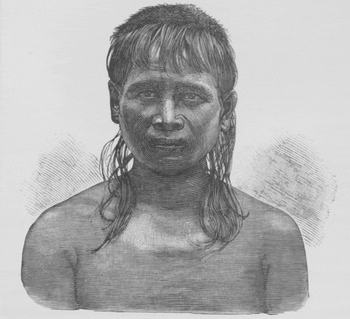
Correia finally proposed to express visually what anthropometry revealed. No anthropological photographs survived from Fonseca Cardoso's journeys in Timor, but in one of Armand de Quatrefages's publications, Correia found the archetypal image of the Timorese race that he had never met in person. He thus prompted readers to accompany his conclusions with an illustration from Quatrefages: ‘In my view and based on the conclusions at which I arrive, the average Timorese studied herein should resemble much with the batak of which Quatrefages offers us a good portrait in his Histoire génerale des races humaines [of 1887].’Footnote 38 Quatrefages's portrait of what he designated as a Battak, or ‘Batta from Sumatra’ — an exemplary sub-type of his ‘Indonesian race’ (race Indonésienne) — was perceived by Correia to be the visual quintessence of the anthropometric Malayan type discovered in Oecussi and Ambeno (fig. 1). The illustration itself was not reproduced in Correia's article, though. Readers were left to either consult Quatrefages's images or to imagine the batak type themselves.
‘Battak from Perak in Malaysia [Malaisie]’.

Hypothesising an anthropogeographical rule
Timorese of Oecussi and Ambeno postulated a ‘Malayan race’ of Indonesian affiliation in the Portuguese enclave, thereby undermining a classification of all Timorese as Papuan. But another implicit classificatory claim, I believe, was also being announced: the author's intention to determine a distinct racial identity for the Portuguese colony, devising an anthropogeographical rule that would merge racial category and political borders. Mountains and hills, as we saw, were instrumental in reclassifying Oecussi as Malayan. The next step was to make this assertion valid not only for the enclave, but for the whole Portuguese territory. Political geography, rather than physical geography, was then to lead anthropological explanation. Soon the arguments made on the racial type of the Oecussi enclave were generalised to the Portuguese colonial territory as a whole.
Correia's imagery of the Oecussi type materialised in Quatrefages's illustration of a batak. A couple of months later, this visual insight translated into a bold anthropogeographical hypothesis. Indeed, still in 1916, Correia published a companion reflection, Antropologia Timorense (Timorese Anthropology) that complemented his anthropometric conclusions with further synthetic speculations.Footnote 39 Two reasons were offered for writing again on the topic. First, new evidence arrived. Correia claimed to have ‘just received further manuscript notes from Fonseca Cardoso's passage in Timor’. The captain's new manuscripts made synthetic claims concerning an ‘Ambeno type’ with ‘marked negroid characters’ as representative of the ‘autocthonous or native of Timor’.Footnote 40 Nonetheless, Mendes Correia dismissed Fonseca Cardoso's suggestions as impressionistic. Instead, for Correia, Cardoso's new notes offered only further credence to his Malayan thesis. Second, new relevant international publications by Ten Kate had just appeared. Correia claimed that he had not had time to ‘integrate’ the Dutch anthropologist's recent work in the first piece and wished to do so now.Footnote 41
Ten Kate was a model, but also a competitor. In 1915, he published a new series of articles in L'Anthropologie where he advanced broader arguments about the ‘Timor Archipelago’. Ten Kate's analysis presumed a distinction between West and East. He saw the ‘West Timorese’, the Atoni Timor ‘inhabiting the western part of the island’ as Melanesians. The Atoni were the real representatives of ‘the Timorese properly called’, representing a mixture of ‘negroid and yellow race characters, with predominance of Papuan blood’.Footnote 42 In contrast with Correia's thesis, then, Ten Kate saw the Papuan as defining the authentically aboriginal of Timor, the western Atoni. However, Ten Kate also acknowledged a lesser variant of this essentially Papuan type, a suggestion Correia later appropriated for his own purposes. Among the so-called Belos (or Ema-Belos) of the centre and the north coast of Timor, Ten Kate recognised ‘little trace of negroid blood’, overall acknowledging a lesser manifestation of negroid characteristics.Footnote 43 He only observed this so-called Eastern Belos in Dutch territory, especially in the settlement of Atapupu — not far, curiously, from Oecussi. But in spite of these tentative considerations, Ten Kate refused to advance an anthropogeographical rule for the island — something that could not, he believed, be achieved. ‘If one seeks a correlation of certain physical characters among the natives of the Timorese Archipelago,’ he stated conclusively, ‘one finds no “law”, no ruling principle.’Footnote 44 Rather than a ‘fusion’, then, Timor was a ‘desperate confusion, a blend that challenges every analysis’.Footnote 45 After years of travel and hundreds of anthropometric measures, Ten Kate came to the conclusion that Timor was anthropogeographically unruly — that no ethnological line could be drawn.
Correia relied on Ten Kate's work to devise a Malayan affiliation for Oecussi-Ambeno. But he could not share the latter's classificatory scepticism. He was determined to trust his little anthropometric treasure from Oecussi to advance a lawful hypothesis on the racial geography of the island. The Portuguese enclave, again, was meant to give him leverage in the debate. In a convoluted rhetorical manoeuvre, Mendes Correia both acknowledged and contradicted Ten Kate. He partly agreed with Ten Kate; he ‘did not find a law of the criss-crossing [entrecruzamento] of characters in Timorese peoples’ so that ‘from East to West, from North to South, one general anthropogeographical rule’ was yet to be found.Footnote 46 Nonetheless, the young Portuguese challenged the eminent Dutch scholar by in fact venturing an anthropogeographical rule. In extrapolating Oecussi-Ambeno's revelations to the whole island, Mendes Correia brought forward a new anthropogeographical division:
Subjecting this synthesis to new confirmations, I consider: that an Indonesian spot spreads out from the centre of the Belos territory mainly to the East; that the North (Okussi) is principally Malay with greater or lesser Melanesian infusion; finally that the West (and Southwest) is more negroid, excluding the region of Kupang, which is close to the Belos from the anthropological point of view.Footnote 47
Based upon data collected by Fonseca Cardoso in Oecussi, Mendes Correia offered a grand claim about an anthropogeographical divide between East and West. The valid anthropological unit was now the Portuguese colonial territory. The enclave's anthropometric records became evidence for racial genealogies in Portuguese Timor. In other words, because Oecussi (a Portuguese territory in West Timor) was Malayan, the Portuguese colony in East Timor should also be classified as Malayan. Papuans in the Dutch country, and Malayans in the Portuguese land: this absolutely diverged from previous suggestions on the dominance of Melanesian or Papuan races in Timor; it also diverged from former classificatory attempts that took the island only as the unit of analysis. Furthermore, Correia's argument closely followed the island's political borders. In spite of its physical location in West Timor, then, Oecussi was formally understood as a part of Portuguese Timor. It was, moreover, a historical and symbolic stronghold of Portuguese sovereignty on the island. Indeed Portuguese Timor was not a spatially contiguous or continuous country. Throughout most of the European colonial period, Dutch and Portuguese enclaves were preserved in both sides of the island, the last and most resilient of which was Oecussi. The Oecussi and Ambeno enclave had a complex history of military and political fighting for local hegemony. In Oecussi, in the settlement of Lifau, the Portuguese first arrived in the sixteenth century and later established the seat of government, until they were forced to flee to Dili in 1769 under pressure of a powerful local mestizo aristocracy, the Topasses. Yet the local indigenous rulers preserved a formal allegiance to the King of Portugal over the centuries. Perhaps coincidentally, Correia's publications came out when the enclave's political boundaries were being settled at the highest diplomatic level. In 1914, Dutch and Portuguese governments agreed over the Oecussi and Ambeno borders, further confirming Portugal's sovereignty in the territory.Footnote 48
Mendes Correia's anthropogeographical hypothesis constituted an extrapolation of racial typology from a singular political geography. The Oecussi Malayan type stood for the whole Timorese population inhabiting the Portuguese colony. Findings from the enclave were generalised to its companion political territory in the East, even if the two colonial territories were in fact physically discontinuous. Racial order followed political order. In Correia's eyes, in fact, the two seemed to be one and the same. These were bold claims on the international debate on Timor and the Malay Archipelago, and they did not pass without notice abroad.
A review from France
In the late nineteenth century it was not uncommon for Portuguese publications to be reviewed on the pages of leading French anthropology journals. As a rule this international visibility was reserved for studies on the archaeology and ethnogeny of Portugal and the Iberian Peninsula; rarely did French anthropology take note of Portuguese racial research on overseas territories. Yet, although voiced from the periphery of the international scene, Correia's works caught the attention of French scholars, perhaps because of their unusual anthropometric evidence, and their verve. Correia's papers were reviewed in L'Anthropologie the year they were published, by the eminent Professeur René Verneau, Chair of Anthropology at the Paris Museum of Natural History. Formerly E.T. Hamy's laboratory assistant, Verneau became after the latter's death in 1909 one of the leading voices of mainstream racial anthropology in Paris.
Verneau praised the timely publication of the papers. In the light of the scarce evidence available, and the great difficulty in reaching a consensus on the racial character of the Timorese (‘il ne renferme pas une race unique’, he stated), Correia's analysis of Cardoso's ‘precise data’ was to be welcomed.Footnote 49 Verneau read Fonseca Cardoso's evidence and Correia's ‘interesting conclusions’ on the Oecussi Malayan type principally as a means to resume the old French case (made first by his mentors Quatrefages and Hamy in the 1870s) against Wallace's line: ‘contrarily to Wallace,’ he observed, ‘it is not the Papuan, Melanesian or Australian element that predominates in the whole island.’Footnote 50 The Portuguese evidence proved Wallace's anthropological categorising wrong about Timor Island. The island, in effect, was the valid geographical unit in Verneau's reading. It is meaningful that Verneau misinterpreted the enclave as if it was part of a Dutch rather than Portuguese political geography: ‘These two districts [Oecussi and Ambeno] are placed in the north of the island in the Dutch part.’Footnote 51 But Verneau's critique did not concern the study on the enclave per se. Instead, it was directed towards Correia's disavowal of Ten Kate and the irreverent proposal of an anthropogeographical rule for Timor: ‘contrarily to the opinion of [Dr. H. Ten Kate]’, Verneau observed, ‘published in our journal’, ‘[Mendes Correia] considers that it is possible to establish a rule concerning the geographical distribution of anthropological types in Timor.’Footnote 52
For decades, Portuguese academics looked to French anthropology for a model. Paris was the apex of academic visibility and reputation. Thus Correia possibly received Verneau's critical review with a mixture of thrill and preoccupation. He was quick to try to soothe the damage. Correia wrote Verneau a letter to ‘correct some errors’ and make some ‘precisions’.Footnote 53 Accordingly, Verneau decided to add an ‘Errata’ to his review in L'Anthropologie, in which excerpts of Correia's letter were transcribed, accompanied by Verneau's comments. It seems clear that Correia's message was principally aimed at toning down his opposition to the senior figure of Ten Kate. ‘Mendes Correia states in the letter,’ Verneau paraphrased, ‘that he would not dare to cut into pieces in just two words an hypothesis advanced by M. Ten Kate, who, besides the consideration he rightly deserves, has visited the island in person.’Footnote 54 Not without ambivalence, Correia further remarked to Verneau that he did not claim to have ‘found a general anthropogeographical rule that allowed to determine summary ideas about the distribution and coexistence of races in the Timorese territory’; instead, he simply offered a ‘synthesis’, ‘provisional’ and ‘subject to further confirmations’.Footnote 55 ‘This is,’ Verneau concluded, correcting Correia's correction: ‘the opinion that I have exactly expressed.’ Thus claiming to have the upper hand, Verneau paternalistically recommended Correia's ‘prudent reservations’ as indicator of ‘true scientific spirit’, and urged the Portuguese scholar to continue his investigations.Footnote 56
Correia's studies on Timor brought him to the attention of senior international authorities in the field. He soon took strategic advantage of this exposure to expand his networks and build his own authority. In 1918, Mendes Correia launched a new anthropological society in Porto, the Sociedade Portuguesa de Antropologia e Etnologia (Portuguese Society of Anthropology and Ethnology) (SPAE). Both René Verneau and Herman Ten Kate accepted an invitation to join the society as ‘corresponding members’.Footnote 57 Eventually, Correia also ended up maintaining a friendly letter exchange with Ten Kate himself. In 1931, Ten Kate died poor and lonely in Cartago. In a posthumous eulogy, Correia praised him as ‘glorious intellectual wanderer’, and came to refer to him affectionately as ‘my late dear colleague and friend, the eminent Dutch anthropologist’.Footnote 58 In the decade following his publications on Timor, Mendes Correia's scientific career prospered and so did his political career. He became an active supporter and a leading political voice of the nationalist and imperialist Estado Novo regime, the fascist dictatorship established in Portugal in 1933. He presided over the Porto City Council between 1936 and 1942; became a Deputy to the National Assembly from 1945 to 1956; gained prominence as head and ideologue of scientific policy for the colonies; and was appointed by the minister to the presidency of the Geographical Missions and Colonial Research Board in 1946. For almost two decades, he did not return to Timor as a subject in his publications. Interest in the ethnological line did not, however, die out.
Redrawing the ethnological line
In 1934, Correia wrote a short notice aimed at a non-academic audience which recalled his early works on Timor and confidently reiterated his thesis of Malayan affiliation.Footnote 59 These were prosperous times for his vision of ‘colonial anthropology’ as a discipline allied with the imperial project. From the colonies the government had just sent more than one hundred ‘natives’ — among them a handful of East Timorese — intended for public display at the First Portuguese Colonial Exhibition held in Porto in 1934, to celebrate the grandeur of the Portuguese Colonial Empire. Over the years, he grew more confident about the ‘ethnogenic conclusions’ achieved in 1916. How ‘glad’ he had felt when in 1918, a talk by Colonel Leite de Magalhães — a colonial officer and amateur ethnologist, contemporary of Fonseca Cardoso in Timor in 1910–12 — ‘explicitly confirmed’ his view that the ‘average Timorese of Oecussi and Ambeno should physically resemble the batak (Indonesians of Sumatra) portrayed by de Quatrefages’.Footnote 60 This officer's data moreover supported Correia's visionary claim that the Oecussi Malayan type was, in reality, not limited to Oecussi. It was representative of all East Timorese, of all Ema-Belu, in Portuguese Timor.
Taking place parallel to the 1934 Exhibition was the First National Congress of Colonial Anthropology, sponsored by the imperial state and under the aegis of Correia and the Porto academics. One of the chief lines of discussion proposed by the Congress Committee was ‘Timor and Wallace's ethnological divide’. Although no paper on the topic came out in the proceedings, the decision to single out Timor and Wallace's line as a problem of ‘Portuguese colonial anthropology’ clearly indicated its central significance in Correia's research programme. It perhaps also signalled Correia's desire to become an authority on the subject. At the Congress he did not address the ethnology of Timor, but in the next decade he built up his intellectual notoriety and, in 1944, proposed a novel configuration for the ethnological line in Timor and the Malay Archipelago.
A new line for ‘Portuguese Timor’
Timor Português: Contribuição para o seu Estudo Antropológico (Portuguese Timor: Contribution to its Anthropological Study) was Mendes Correia's magnum opus. Funded by the Geographical Missions and Colonial Research Board and published in 1944, it was luxuriously printed and illustrated and over 200 pages long. This was the outcome of his decade-long dedication to Timorese ethnology at his university office. For the book, Correia again did not visit Timor and used mostly secondary evidence provided by colonial officials. In fact, although he would finally pay a one-month visit to ‘Portuguese Timor’ later in life, Correia embraced the role of armchair anthropologist, laboratory scholar, and data ‘coordinator’: ‘I am a modest anthropologist,’ he declared in 1950, ‘more precisely, a cultivator of the sciences of Man. I am, preferably, a cabinet scholar, a laboratory and museum worker, more than a field worker, a bushman, a jungle man, and, even less, a sea man.’Footnote 61 During the colonial exhibitions — 1934 in Porto; 1940 in Lisbon — Correia received special permission to ‘observe’ a handful of East Timorese natives. Now he believed his early observations would be crucially complemented with the analysis of new and decisive anthropological evidence: an album of over 100 portrait photographs of indigenous ‘types’. Representing different language groups and regions of East Timor, the album had been prepared in the colony of Timor by Governor Álvaro de Fontoura in the late 1930s. The album, which came to bear the governor's name as the Fontoura Album, was originally prepared for the colonial Exhibition of the Portuguese World in Lisbon in 1940, and was then handed to Correia for anthropological analysis.Footnote 62
Correia's general theories were aimed at both a national and an international audience.Footnote 63 Based on ‘the coordination of national and foreign works already produced,’ he explained to readers, ‘together with the new materials that I have been happy to obtain, I will dare to express still a synthetic opinion on some general anthropological problems related to the populations of Australasia and Oceania.’Footnote 64 First, as a solution to the lasting debate on the Timorese mixed race, he rehearsed a polygenist argument: ethnic heterogeneity was less a product of the history of contact, migrations, and mixing, than of a ‘spontaneous’ internal process. Timor, in Correia's words, was a ‘primeval centre of ethnic differentiation’ rather than ‘a zone of racial metamorphism of contact’.Footnote 65 Second, from a colonial ontology (‘Portuguese Timor’) he proposed a revised anthropogeography — a point the book's title, Timor Português (Portuguese Timor) subtly announced. Due to its closeness to the line, Timor Island had the potential to transform the drawing of the racial map of the archipelago. Taking on this potential, he set forth to revising Wallace's ethnological line.
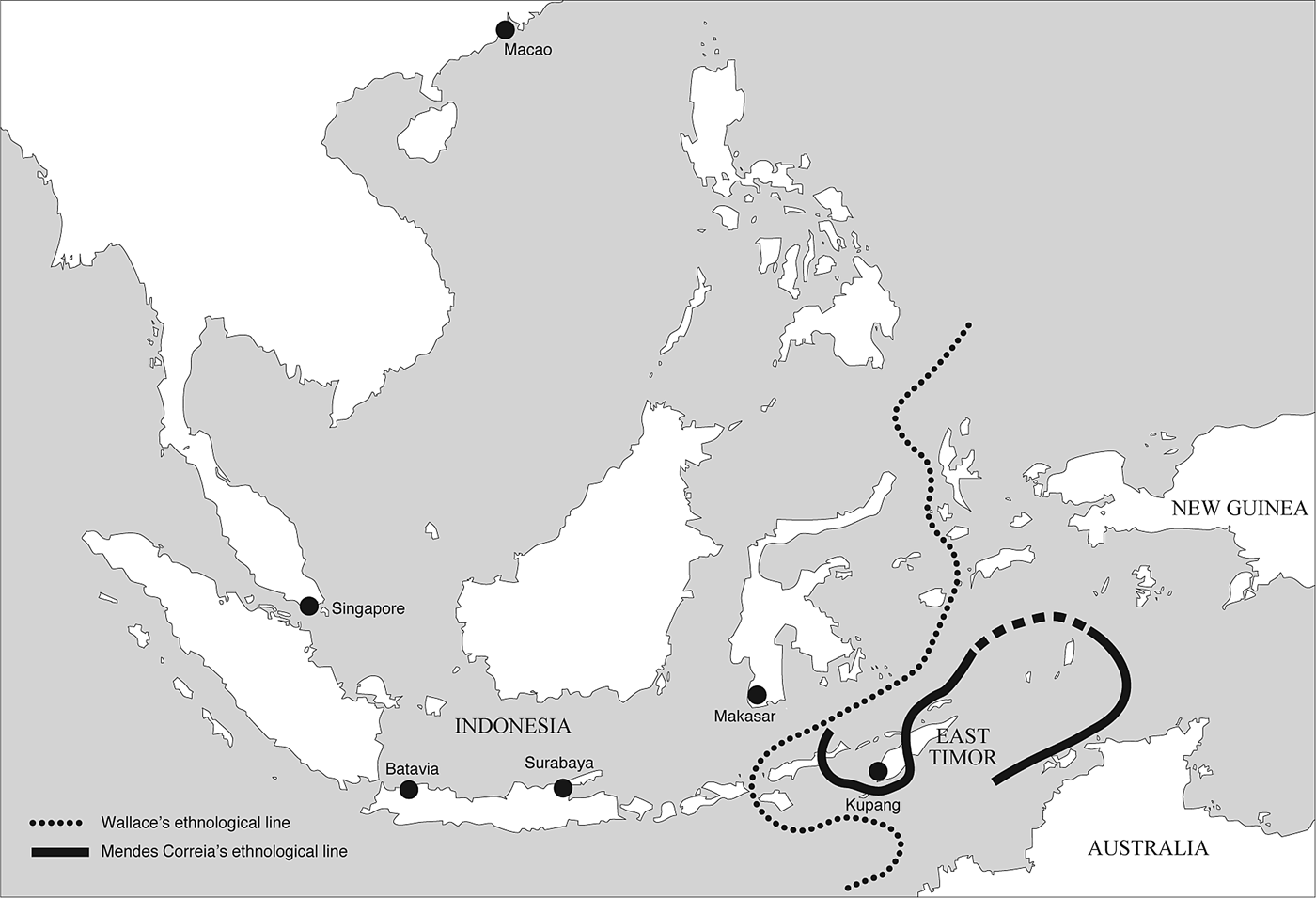
Mendes Correia returned to his early argument in full force, and again had to deal with the rival visions of authoritative Dutch anthropologists. In the 1910s–20s, another Dutch fieldworker and physical anthropologist, Hendrik J. Bijlmer, went in Ten Kate's footsteps to confirm the latter's data in Timor. By choosing Timor as the focus of his anthropological studies, Bijlmer aimed also to reconfigure Wallace's ethnological line. He too thought Timor fell outside the Malayan category: ‘In Timor and East Flores,’ he remarked, ‘one feels one is absolutely no longer among Malays.’Footnote 66 Instead, Bijlmer argued that the Timorese islanders should be classified dominantly as Melanesian, an opinion he grounded mostly on his understanding of the negroid nature of the Western Atoni. And with regard to the demarcation problem between ‘Melanesian’ and ‘Mongolian’ within the island, he, like Ten Kate, distrusted the possibility of drawing a perfectly clear-cut line.Footnote 67 But Bijlmer's observations concerned mainly the western side of the island, a fact that Correia used to his advantage. Because he did not visit the ‘Portuguese part of the island’, Bijlmer's classificatory argument could not be held valid for the Belos of East Timor.Footnote 68 As such, Correia argued, the peoples of Portuguese Timor belonged to a different sort of racial type: they were ‘predominantly’ ‘Proto-Malay’ or ‘Proto-Indonesian’. In racial science, since the late nineteenth century, the ‘Proto-Malay’ category had been used to refer to those most ancient inhabitants of the archipelago who had presumably migrated from the Asian mainland in a remote past.Footnote 69 Drawing on this reclassification, Mendes Correia confidently put forward a new ethnological line, alternative to that of Wallace. ‘First of all,’ he concluded, ‘Wallace's and Bijlmer's divides do not correspond to ethnological reality in what concerns the centre and east of Timor and even other islands close by. […] Given the lower number of Atoni in relation to the Belos, we can even say that, altogether, Timor belongs, racially, to Indonesia.’Footnote 70 Portuguese Timor — and perhaps even the island itself — was racially Indonesian. Accordingly, it was necessary to redraw the ‘bio-ethnic limit between Indonesia and Melanesia’ (Fig. 2).Footnote 71
Mendes Correia's ethnological line.

Mendes Correia's ethnological line cut the island into two halves basically coincidental to the colonial border: Portuguese Timor was racially ‘Indonesian’; Dutch Timor (excluding the Kupang area) was of ‘Melanesian’ race. Correia's scientific theories merged with his avowed imperial nationalism. Only half of the island, after all, belonged to Wallace's Papuan divide. However, in order now to sustain this ethnological line, Mendes Correia seemed close to sacrificing the piece that led him originally to classify Portuguese Timor within the ‘Proto-Malay type’. It was time for Oecussi to suffer a final classificatory shift.
Twisting the Oecussi enclave
Correia's ethnological line evolved from his extrapolations of the Oecussi Malayan type to the whole political territory of ‘Portuguese Timor’. His early racial synthesis of Oecussi and Ambeno, then, became a generative and critical piece in shifting Wallace's line. Surprisingly, though, in his 1940s speculations, Correia elaborated an ambivalent, even contradictory, reversal of his original argument. For a moment he seemed ready to give Oecussi away.
In 1944–45, Correia came to regard Oecussi as much less Malayan than Portuguese Timor itself. He even hypothesised that Oecussi could be classified as Melanesian on account of being an enclave in West Timor physically closer to the Atoni type. However, he simultaneously held firmly to the political affiliation of Oecussi to keep on claiming a racial classification of this territory as Malayan. Correia now was especially absorbed in his analysis of Fontoura's photographs, in which he eventually recognised a strong imprint of Melanesian characters on Oecussi types, for instance, in the notably curly or frizzy hair of the people.Footnote 72 Against his own beliefs about the Batak prototype of Oecussi, he admitted that some sort of ‘special Melanesian type’ could characterise the enclave. Yet, he now refused to extrapolate the Melanesian type altogether to Portuguese Timor. ‘Perhaps [the Oecussi and Ambeno type] is not perfectly comparable to the Batá of Samatra [sic], which, years ago, I wrote that it resembled, upon agreement with Leite de Magalhães.’ Nonetheless, Correia continued firmly defending his Malayan categorisation: ‘But the Indonesian exists,’ he observed, ‘and pervades strongly in Oecussi, just like it happens across almost all Portuguese Timor territory.’Footnote 73 Indeed, even before contradictory evidence, Correia was not willing to give up his classificatory order. ‘The Indonesian did not disappear there submerged by Melanesian blood’, he claimed; ‘And, if no relatives or descendants of the Batá are here to be found, they must exist in some other point of the island.’Footnote 74 Oecussi was Portuguese territory, and therefore racially (Proto-)Malayan it ought to remain.
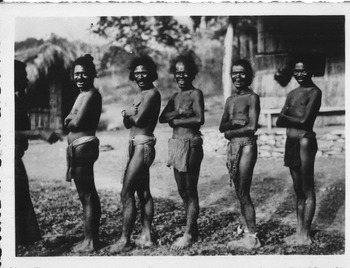
Correia thereafter maintained an uncomfortable and ambiguous relationship with his own acknowledgement of the Oecussi inhabitants’ negroid or Melanesian features, yet he never moved his ethnological argument away from colonial geography (fig. 3). This discomfort was expressed in a couple of publications written almost immediately after his monograph, in 1945. There, he ambivalently declared Oecussi-Ambeno people to have more ‘negroid figures’ while at the same time defending the predominance of the ‘Indonesian-malayan’ race.Footnote 75 At times, the Malayan identity of Oecussi seemed to fade away, diluted in the wider Melanesian type of Dutch West Timor. And yet Correia did not give the whole away. The ‘Portuguese region’ — the Oecussi enclave included — corresponded to a Malayan race type. The enclave ambivalently classified as Melanesian and Malayan, depending on the explanatory value differently accorded to either physical or political geography. If physical geographical location was preferred, Oecussi seemed to be Melanesian; but if political geographical belonging was emphasised, the enclave's population counted as an instance of a Malayan race. Ultimately, Correia preferred the latter option. Perhaps expressing this tension, the 1944 map of Correia's new ethnological line did not include the enclave. Viewers were thus left with the decision of either subsuming the Oecussi racial type in its western physical geography, or in its eastern political affiliation.
In the original Fontoura Album, this photograph bears no caption and appears in a section titled ‘Characteristic types in general’. Yet in his book Mendes Correia retitled this photo ‘Men from Oecussi’ and presented it as evidence of Oecussi's ‘Melanasoide or Papuasian affinity, not lacking, however, Indonesian traits’. This is another example of Correia's epistemic shifts. Correia, Timor Português, pp. 74–5.

Conclusion
The racialisation of an insular territory in Southeast Asia was here explored as a process at the juncture of geographical, colonial, and ethnological theories, categories, and imaginaries. I approached the ways through which anthropological classifications constituted two connected entities: geographically bounded race categories, on the one hand; and racially circumscribed colonial spaces, on the other. In early twentieth-century Timor, I have argued, problems of classification of human races configured problems of political, and particularly colonial, geography. Racial categories and colonial spaces were mutually constitutive entities that reinforced each other's existence. The scientific making of race categories was entailed in political geography and colonial demarcation. This conflation between racial and colonial lines came into being as the unstable and contingent outcome of a process of classificatory work, here unfolding in the Portuguese anthropologist Mendes Correia's racial theories during the first half of the twentieth century.
Between 1900 and 1945, Correia put forward Malayan versions of racial identity for a unified category of people, so-called ‘Belos’, thought to be the indigenous inhabitants of a distinct political country under colonial rule, ‘Portuguese Timor’. Portuguese ‘colonial anthropology’ was the meaningful framework within which to understand Correia's continuing efforts to constitute one race and one colony simultaneously. Enclaves are complex and ambivalent units in the politics of boundary-making. They are also complex and ambivalent units in racial classificatory work. In this light, Correia's classificatory extrapolations regarding Oecussi and Ambeno are exemplary. Correia's boundary-work in anthropology struggled to convert a disconnected spatial entity (Oecussi and Ambeno) into a valid racial prototype, to be used to generalise about the anthropogeography of a broader political territory. This classificatory work repeatedly projected racial topology onto political geography, and vice-versa. In this process of spatial racialisation, political geography was privileged, to the detriment of physical geography. But over time, as we have seen, it became hard to hold colonial and racial geographies together in classificatory work. The story of Correia's Malayan type of Oecussi and Ambeno, from its invention in 1916 to its epilogue in 1944–45, expresses the difficult work required to keep colonial borders and race lines stably together. Despite the anthropologist's contorted efforts to ‘coordinate’ and ‘synthesise’ available data, the two worlds, race and colony, seemed constantly on the verge of drifting apart.
In Portugal and even beyond, Mendes Correia's 1944 monograph Portuguese Timor was for years considered the definitive perspective on the subject of the racial anthropology of Timor.Footnote 76 In a private letter to Correia, British physical anthropologist Sir Arthur Keith, then retired and elderly, praised the book for ‘such excellent additions to our knowledge, not only of Timor, but of the region you have happily named Insulaind? [sic]’, and complimented his ingenious use of photographs: ‘if you cannot diagnose a man's race from his photograph, you will never succeed by callipers or mathematics’.Footnote 77 In the 1950s to 1960s, Portuguese anthropologist António de Almeida came in the wake of Correia to lead a series of state-sponsored anthropobiological field surveys in Portuguese Timor, with a view to proving Correia's thesis of a dominant ‘Indonesian Mongoloid affiliation’.Footnote 78 Still, principally abroad, the work may not have received the unanimous praise for which Correia, presumably, yearned.Footnote 79 Furthermore, contrary to Correia's declaration, the issue was, and still is, far from settled. The position of Timor Island, and East Timor in particular, remains ambivalent in geography, politics, and anthropology. In his geohistorical atlas, geographer Frédéric Durand emphasises East Timor's ‘transitional space lying between the two worlds of Asia and Melanesia’.Footnote 80 New research in human biology and genetics has been conducted in order to ascertain whether it is possible to decide about the ‘Austronesian or Papuan ancestry’ of the East Timorese.Footnote 81 The merging of ethno-racial categories and political geography has resumed as a powerful political issue in East Timorese nation-building. During the Indonesian period, as Rebecca Strating observed, the ethnic association of the East Timorese with either Indonesia or Melanesia was a contested political terrain.Footnote 82 Indonesia's propaganda sought to legitimate its domination internationally by claiming ‘close ethnic and cultural links between the peoples of East Timor and Indonesia’; no actual political or ethnic divide presumably existed between West (Indonesian) and East Timor peoples.Footnote 83 The East Timor resistance movement, in contrast, repudiated ethnic affiliations to Indonesia and instead emphasised Melanesian and Pacific roots for the East Timorese. ‘In fact,’ José Ramos-Horta stated at the United Nations in 1976, ‘there is good reason to think of … [East Timor] as having more ethnic and cultural affiliation not with Java to the west, but with Papua and New Guinea to the east.’Footnote 84 New forms of racialisation, alongside constructs of ‘culture’, ‘ethnicity’, or ‘people’, for example, can follow attempts at creating a distinct national geography — just as they have accompanied the making of colonial geography in the past.