Nonsuicidal self-injury (NSSI) is defined as the deliberate damaging of one's own body tissue without the intent to die. It is more common among females than among males (e.g., Wilcox et al., Reference Wilcox, Arria, Caldeira, Vincent, Pinchevsky and O'Grady2012) and the age of onset is usually early to midadolescence (Csorba, Dinya, Plener, Nagy, & Páli, Reference Csorba, Dinya, Plener, Nagy and Páli2009). Reports of self-injurious behavior among adolescents appear to be increasing, with current prevalence rates estimated at 15%–20% (Jacobson & Gould, Reference Jacobson and Gould2007; Nock & Favazza, Reference Nock and Favazza2009), although without prospective, longitudinal data conclusions regarding secular changes are difficult to draw. There does appear to have been an increase in research on the correlates of NSSI. A PubMed search revealed 449 published papers in human populations in which the title included the terms NSSI or self-injury. The first paper was published in 1966, but nearly half were published in the past 5 years. The proliferation of empirical work is partly due to the difficulty in linking NSSI to a specific nosologic construct (Wilkinson, Reference Wilkinson2013). In an introduction to a special section on suicide and NSSI, Prinstein (Reference Prinstein2008) stated that past research has suggested the equifinality of self-injurious behaviors, referring to the developmental psychopathology concept that a common outcome will develop over time from different starting points (Cicchetti & Rogosch, Reference Cicchetti and Rogosch1996). Evidence for equifinality would indicate that the psychological processes underlying the behavioral phenomenon varies. Prinstein's observation was based primarily on the aggregate of extent research, largely comprising separate studies focused on a single risk domain. In the present study, we aim to further test the hypothesis of the equifinality of NSSI by examining multiple domains of developmental precursors within a single sample of girls whose development has been followed over time. We adopt a gendered developmental approach to NSSI, as described by Crick and Zahn-Waxler (Reference Crick and Zahn-Waxler2003). Specifically, we aim to reveal salient developmental processes for girls by identifying adolescents who engage in a problem behavior that is more prevalent among females, in this case NSSI, and testing the presence of hypothesized developmental precursors in childhood.
Many studies have been conducted with the aim of identifying correlates of NSSI. Because of the observed co-occurrence between NSSI and suicidal thoughts and behaviors (e.g., Asarnow et al., Reference Asarnow, Porta, Spirito, Emslie, Clarke and Wagner2011), much of the research on correlates has been focused on mood dysregulation, borderline personality disorder, and a family history of suicidal behavior, factors that have been shown to predict risk for suicidal behavior. The results from these studies demonstrate that there are shared but also different correlates of NSSI compared to suicidal thoughts and behaviors. Depression, for example, is not always associated with self-reported NSSI in nonclinical populations (Glenn & Klonsky, Reference Glenn and Klonsky2011). Among high-risk populations, both depression and aggression are associated with NSSI. Cox et al. (Reference Cox, Stanley, Melhem, Oquendo, Birmaher and Burke2012) conducted a cross-sectional study of NSSI among 507 offspring of parents who had been diagnosed with mood disorders as adults, half of whom also had made a suicide attempt. Over 90% of offspring who had engaged in NSSI were correctly classified by high levels of aggression and depression, and by lifetime suicidal ideation. Similar profiles of individuals engaging in NSSI are observed for inpatient samples. Nearly a third of a sample of 98 consecutive admissions to a child psychiatry inpatient unit engaged in at least one act of self-injury, and of those 94% also engaged in other directed aggression (Vivona et al., Reference Vivona, Ecker, Halgin, Cates, Garrison and Friedman1995). In a community sample of nearly 3,000 Chinese adolescents, self-reported NSSI was associated with verbal and indirect aggression (Tang et al., Reference Tang, Ma, Guo, Ahmed, Yu and Wang2013). Thus, both aggression and depression are observed to co-occur with NSSI.
NSSI has also been conceptualized as a response to environmental stress among vulnerable individuals, and several prospective studies have been conducted to test this hypothesis. In a sample of approximately 100 hospitalized adolescents, Geurry and Prinstein (Reference Guerry and Prinstein2010) tested the unique and combined effects of depression scores, attributional style, and life events to NSSI during 18 months following discharge. Depression scores were the only significant predictors of both initial levels of NSSI and change in frequency of NSSI in the first 6 months postdischarge. In a similarly conceived study of cognitive vulnerability for NSSI, Hankin and Abela (Reference Hankin and Abela2011) recruited a convenience sample of 103 11- to 14-year-olds, which was followed for 2.5 years. Fourteen percent of the sample reported engaging in NSSI for the first time during the follow-up. Among multiple measures of cognitive style, rumination, coping, and depression, negative cognitive style at baseline was the only significant predictor of later NSSI. Thus, in clinical and community samples, depressogenic features, but not life events, were significant predictors of later NSSI.
Such conceptually driven studies are useful for testing a specific theoretical model, such as a cognitive diathesis–stress model. However, a test of equifinality may be best served by data from longitudinal community or epidemiologic samples given that a broad range of domains of functioning and stressors are typically measured. An example of such an opportunity is the E-risk study, a longitudinal study of 2,232 British twins recruited at birth. Fisher et al. (Reference Fisher, Moffitt, Houts, Belsky, Arseneault and Caspi2012) used the E-risk sample to test the hypothesis that exposure to bullying would increase the risk of self-harm. Among the 62 children (2.9% of the sample) who had engaged in self-harm at age 12, slightly more than half (56%) had been bullied. Because the vast majority of children who had been victims of bullying did not go on to self-harm, the investigators further explored which concurrent factors discriminated between bullied children who did and did not engage in self-harm. The strongest predictors were family history of suicide attempt or completion, maltreatment history, attention-deficit/hyperactivity disorder and conduct disorder, and borderline characteristics.
These data raise the possibility that there may be multiple pathways to NSSI. Separate tests of emotional and behavioral symptoms and disorders provide evidence for concurrent and prospective associations with NSSI. It is not known whether girls who later engage in self-injury are characterized by multiple, co-occurring behavioral and emotional problems and stressors, or whether subgroups of girls can be identified in terms of dimensions of problematic childhood functioning (e.g., aggression vs. depression). In addition, data demonstrating that the onset of NSSI is typically in early adolescence calls for consideration of the developmental period within which risk factors should be assessed. One possibility is that adolescent onset of NSSI is immediately preceded by a marked deterioration in functioning and/or a change in exposure to stressful live events. Another possibility is that chronic deficits across childhood and/or stress exposure provide the foundation for maladaptive behaviors that emerge during adolescence. Elucidating the developmental pathways in terms of timing and chronicity may lead to a reduction in the hypothesized heterogeneity of NSSI and an increase in the likelihood of generating data that is both etiologically relevant and informative for preventive interventions.
The aim of the present study is to address these questions using prospectively collected data on a community sample of girls followed from childhood into early adolescence. We test the association between developmental precursors within three domains: aggression, depression, and environmental stressors, which were assessed repeatedly in childhood, and NSSI in early adolescence. These three broad domains are theoretically meaningful with regard to NSSI and have some empirical support as reviewed above. Given our focus on adolescent girls, we include dimensions that appear to be developmentally salient for this population. In the domain of depression, lack of asserting one's own needs is a theoretically meaningful construct with regard to depression (Abramson, Seligman, & Teasdale, Reference Abramson, Seligman and Teasdale1978; Beck, Epstein, & Harrison, Reference Beck, Epstein and Harrison1983). Lack of assertion has been associated with depressive symptoms in nonreferred college students (Culkin & Perotto, Reference Culkin and Perrotto1985; Olinger, Shaw, & Kuiper, Reference Olinger, Shaw and Kupier1987) and clinically referred patients (Hartlage, Arduino, & Alloy, Reference Hartlage, Arduino and Alloy1998). Further, we have demonstrated that lack of assertiveness is prospectively associated with depression symptoms in preadolescent girls and moderates the association between exposure to stressors and depression symptoms (Keenan, Hipwell, Feng, et al., Reference Keenan, Hipwell, Feng, Rischall, Henneberger and Klosterman2010). Somatic complaints are markedly more common in females with depression (Bair, Robinson, Katon, & Kroenke, Reference Bair, Robinson, Katon and Kroenke2003; Haugland, Wold, Stevenson, Aaroe, & Woynarowska, Reference Haugland, Wold, Stevenson, Aaroe and Woynarowska2001), and this association is evident in early adolescence. For example, Egger, Costello, Erkanli, and Angold (Reference Egger, Costello, Erkanli and Angold2004) reported that girls with depression were close to 13 times more likely to report musculoskeletal pains and 4 times more likely to report headaches than were girls without depression. Sex- and age-related changes in physical complaints (Kolip, Reference Kolip1997; LeResche, Mancl, Drangsholt, Saunders, & Van Korff, Reference LeResche, Mancl, Drangsholt, Saunders and Von Korff2005) are similar to those observed for depression.
In the domain of aggression, we include symptoms of conduct problems, which include aggression directed toward others and objects, as well as indirect or relational aggression. Crick and Grotpeter (Reference Crick and Grotpeter1995, Reference Crick and Grotpeter1996) and Bjorkqvist Lagerspetz, and Kaukiainen (Reference Björkqvist, Lagerspetz and Kaukiainen1992) have argued that girls are more likely to engage in indirect aggression (e.g., spreading rumors or gossip) than direct or physical forms of aggression. We also include lack of self-control in interpersonal conflicts. Such lack of restraint, especially in the context of stressful interactions, has been identified by a number of developmental psychopathologists as a putative risk factor for disorder in girls, including borderline personality disorder (Crick, Murray-Close, & Woods, Reference Crick, Murray-Close and Woods2005; Stepp, Pilkonis, Hipwell, Loeber, & Stouthhamer-Loeber, Reference Stepp, Pilkonis, Hipwell, Loeber and Stouthamer-Loeber2010), and may be a risk factor that is specific to self-injury by girls (Hawton, Rodham, Evans, & Weatherall, Reference Hawton, Rodham, Evans and Weatherall2002).
Finally, consistent with literature supporting both higher levels of self-reported interpersonal stressors and the importance of such stressors on girls' psychological functioning (e.g., Hankin & Abramson, Reference Hankin and Abramson2001), the assessment of environmental stressors is focused on those relating to family and peers including harsh parenting, negative family events, and peer victimization.
Methods
Participants
In the Pittsburgh Girls Study (PGS; Keenan, Hipwell, Chung, et al., Reference Keenan, Hipwell, Chung, Stepp, Stouthamer-Loeber and Loeber2010), a stratified, random household sampling, with oversampling of households in low-income neighborhoods, was used to identify girls who were between the ages of 5 and 8 years. Neighborhoods in which at least 25% of the families were living at or below the poverty level were fully enumerated (i.e., all homes were contacted to determine if the household contained an eligible girl), and a random selection of 50% of the households in nonrisk neighborhoods were enumerated during 1998 and 1999. The enumeration identified 3,118 separate households in which an eligible girl resided. From these households, families who moved out of state and families in which the girl would be age ineligible by the start of the study were excluded. When two age-eligible girls were enumerated in a single household, one girl was randomly selected for participation. Of the 2,992 eligible families, 2,875 (96%) were successfully recontacted to determine their willingness to participate in the longitudinal study. Of those families, 85% agreed to participate in annual in-home interviews of the caregiver and youth, resulting in a total sample size of 2,450. The 2,450 girls were relatively evenly distributed across the four age groups (5–8 years). Approximately half of the girls were African American (52%), 41% were European American, and the remaining girls were described as multiracial or representing another race. Nearly all the primary caregivers were biological mothers (92%). More than half of the caregivers were cohabiting with a husband or partner, about 47% of parents had completed 12 years or less of education, and 25% of the families had a yearly income of less than $15,000.
Retention of the sample has been very high, ranging from 96.7% for age 8 to 87.8% for age 14 data. Some of the variability in retention from year to year is due to difficulty tracking participants; a minority of families refused to participate over the years. Comparisons of those assessed and those not assessed at each age were conducted using chi-square tests. Girls lost to attrition were more likely to be from families not receiving public assistance and were more likely to be European American. The University of Pittsburgh Institutional Review Board approved all study procedures. Written informed consent was obtained from the primary caregiver and verbal assent from the child.
Measures
NSSI
A single item was used to assess NSSI at ages 13 or 14 by either the child or the parent: “In the past year, did you hurt yourself on purpose, like cutting or burning, even if you did not mean to die?” based on an item from the Structured Clinical Interview for DSM Disorders, Research Version, Nonpatient Edition (First, Spitzer, Gibbon, & Williams, Reference First, Spitzer, Gibbon and Williams2002).
Child functioning: Aggression domain
Physical and object-related aggression and other disruptive behaviors were assessed using the 15 items from the conduct disorder section of the Child Symptom Inventory—4 (Gadow & Sprafkin, Reference Gadow and Sprafkin1994), each of which is scored on a scale of 0 (never) to 3 (all the time). We used the maximum severity score reported by either child or parent at each age, consistent with best estimate approaches to assessing conduct problems. Internal consistency in the PGS was high with α coefficients ranging from 0.73 to 0.76.
Assessment of relational aggression was based on parent report using the relational aggression subscale of the Children's Peer Relationship Scale (Crick & Grotpeter, Reference Crick and Grotpeter1995). This subscale includes five items rated on a scale from 1 to 5. In the present study, the sum of these items was used at each age (8–12 years). Concurrent and predictive validity has been established via negative associations with peer acceptance and liking and psychological adjustment (Crick & Grotpeter, Reference Crick and Grotpeter1995; Crick, Ostrov, & Werner, Reference Crick, Ostrov and Werner2006). Internal consistency for this scale was high across age (α range = 0.84–0.86).
Self-control was measured using parent report of the nine-item self-control subscale from the Social Skills Rating System (Gresham & Elliott, Reference Gresham and Elliot1990). The subscale assesses the child's capacity to control behavior and emotions during interpersonal challenges with peers and adults (e.g., responds appropriately to teasing, able to compromise, and controls temper). Items are rated on 3-point scales from 0 (never) to 2 (often). The internal consistency for the current study was high (α range = 0.78–0.81).
Child functioning: Depression domain
Child report of depression scores was obtained by administration of the Short Moods and Feelings Questionnaire (Angold, Costello, Messer, & Pickles, Reference Angold, Costello, Messer and Pickles1995) to the girls. This 13-item scale had high internal consistency (α range = 0.86–0.89) and has been used to successfully discriminate between children with and without depressive disorders generated by structured clinical interview (Angold et al., Reference Angold, Costello, Messer and Pickles1995).
Somatic complaints were measured by child report on the Child Somatization Inventory (Walker, Garber, & Greene, Reference Walker, Garber and Greene1991; Walker & Greene, Reference Walker and Greene1989). This inventory provides a list of 18 somatic symptoms based on DSM-IV criteria for somatization disorder with modifications made for use in children and has a response format ranging from 0 (not at all) to 4 (a whole lot). The 18 items were summed in each year (ages 8–12 years). Good internal consistency, test–retest reliability, and concurrent validity with measures of functional impairment and depression have been reported for both clinical and community samples of children (Garber, Walker, & Zeman, Reference Garber, Walker and Zeman1991; Walker & Garber, Reference Walker and Garber2003). The internal consistency of youth and maternal report on the Child Somatization Inventory for the current sample was high (Cronbach α ranged from 0.77 to 0.82).
Assertiveness was measured by parent report on the assertion subscale of the Social Skills Rating System. The subscale consists of 10 items on initiation of social interactions (e.g., asks classmates to join activity), responding to peer pressure and insults (ignores teasing by peers, which is reverse coded) each rated on a 3-point scale and summed (Cronbach α ranged from 0.74 to 0.79).
Childhood functioning; Environmental stressors
Victimization by peers was measured using the Peer Victimization Scale (Vernberg, Jacobs, & Hershberger, Reference Vernberg, Jacobs and Hershberger1999). This nine-item scale includes victimization by physical aggression and exclusion rated on a scale ranging from never to a few times per week. Internal consistency was high with α coefficients ranging from 0.83 to 0.87.
The child also was the informant for harsh parenting based on the Conflict Tactics Scale—Parent/Child Version (Straus, Hamby, Finkelhor, Moore, & Runya, Reference Straus, Hamby, Finkelhor, Moore and Runyan1998), which was used to assess the level of child-directed aggression from the parent. Items (e.g. “In the past year, if your daughter did something that she is not allowed to do or something that you didn't like, how often did you shout, yell, or scream at her”) were scored using a 3-point answer format (1= never, 3 = often). Straus et al. (Reference Straus, Hamby, Finkelhor, Moore and Runyan1998) reported adequate discriminant and construct validity for this subscale. Five items from the psychological aggression subscale were combined with a single item referring to the use of spanking to generate a construct of harsh punishment. In the PGS sample, the internal consistency of this score was moderate with Cronbach αs ranging from 0.71 to 0.75.
Report of the total number of negative family events was based on parental report on the Difficult Life Circumstances (Barnard, Johnson, Booth, & Bee, Reference Barnard, Johnson, Booth and Bee1989), which includes 28 yes/no questions about chronic stressful circumstances, such as trouble finding an affordable place to live, having a bad credit rating, and having problems with a former partner. This scale was developed for use with mothers living in inner-city poverty. The 1-year test–retest correlation for the total score was 0.70 (Barnard et al., Reference Barnard, Johnson, Booth and Bee1989). The internal consistency ranged from 0.63 to 0.66.
Analytic approach
Of the 2,450 participants, 2,180 (89.0%) were included for the present analyses: those with data on self-harm at ages 13 or 14 by either parent or child report. Weighted data were used to account for the oversampling of homes in low-income environments. For each girl, two summary measures were calculated for all childhood predictors: the initial level and the change over time (i.e., the slope from individual linear regression models with age as the independent variable). Data are based on repeated measures from ages 8 to 12 years with the exception of peer victimization, the data for which were available for all girls at age 10–12 years. Initial level and the change over time were used as the predictors of adolescent self-harm. Differences in initial levels and change over time between those included and those excluded owing to missing data were examined via general linear models. Of the 18 comparisons, two were significantly different: excluded participants had higher initial levels of self-control (mean = 13.2 vs. 12.7, p < .01) and lower initial levels of relational aggression (mean = 9.4 vs. 10.1, p < .01).
The association between initial level and change during childhood for all predictors within each domain and maternal- and/or youth-reported self-harm at ages 13–14 was tested via logistic regression using IBM Statistical Package for the Social Sciences Statistics, Version 20. Risk indices were then calculated using the 85th or 15th percentile. Thus, for predictors shown to confer risk for adolescent self-harm via a high initial level or an increase across childhood, scores that fell at or above the 85th percentile for initial level or change over time were coded as risk scores. For predictors shown to confer risk via low initial levels and either decreases or less steep increases over time, scores that fell at or below the 15th percentile for initial level or change over time were coded as risk scores. Combinations of risk scores were then used to identify pathways to adolescent self-harm.
Results
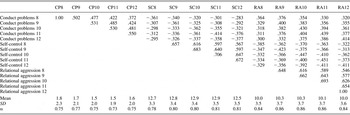
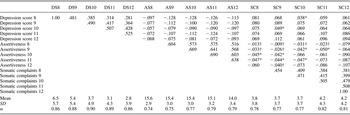
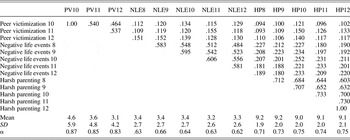
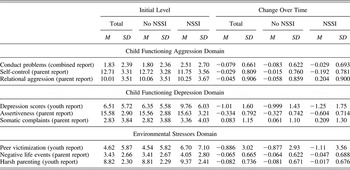
Of the 2,180 girls providing data at ages 13 and/or 14, 131 (6.0%) engaged in NSSI according to either youth or parent report. Descriptive statistics and first-order correlations, and indices of internal consistency for independent variables within each of the three domains are presented in Tables 1–3. Within the aggression domain, all correlations were significant and in the small to medium range; conduct problems were negatively correlated with self-control and positively correlated with relational aggression; self-control was negatively correlated with relational aggression (Table 1). Within the depression domain, depression and assertiveness scores were significantly negatively correlated; somatic complaints were positively associated with depression and negatively associated with assertiveness, and the vast majority of correlations were statistically significant (Table 2). The three variables on the environmental stressors domain were all significantly positively correlated with small effect sizes on average (Table 3). Descriptive statistics for the initial levels and changes over time for each independent variable within each of the three domains are presented in Table 4.
Intercorrelations, means, and standard deviations for aggression domain

Note: Intercorrelations were tested using Spearman rank order correlations. All correlations are significant at the .01 level.
Intercorrelations, means, and standard deviations for depression domain

Note: Intercorrelations were tested using Spearman rank order correlations. All correlations are significant at the .01 level except as noted.
†ns. *p < .05.
Intercorrelations, means, and standard deviations for environmental stressors domain

Note: Intercorrelations were tested using Spearman rank order correlations. All correlations are significant at the .01 level.
Descriptive statistics for initial levels and change over time in child functioning and environmental stressor domains

Note: NSSI, nonsuicidal self-injury.
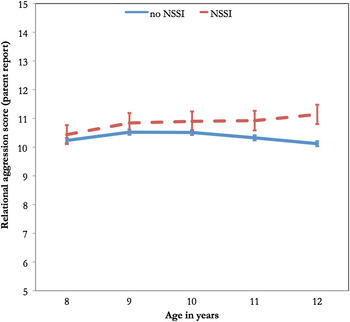
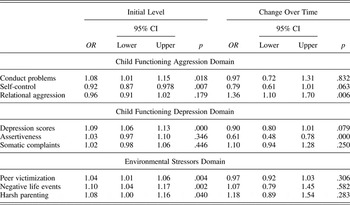
The results from the six logistic regressions for the initial levels and changes over time for each domain are presented in Table 5. Within the domain of aggression, initial levels of conduct problems (odds ratio [OR] = 1.08, p = .018) and self-control (OR = 0.92, p = .007) were significantly associated with self-harm in adolescence, with higher levels of conduct problems and lower levels of self-control conferring risk (Table 5). Although initial levels of relational aggression were not associated with risk for NSSI, increases in relational aggression over time were (OR = 1.36, p = .006). This is depicted graphically in Figure 1, in which average levels in relational aggression for girls with and without later NSSI are plotted, controlling for changes in conduct problems and self-control. A generalized linear model confirmed that the effect over time was best characterized as linear.
(Color online) Average levels across age in relational aggression model as a function of adolescent self-harm.

Association between initial levels and change in child functioning and environmental stressors on self-harm at ages 13–14 years

Note: The effects of initial level and change over time on self-harm were tested via logistic regression for each domain. Change data are based on repeated measures from ages 8 to 12 years with the exception of peer victimization, which was based on assessments from 10 to 12 years.
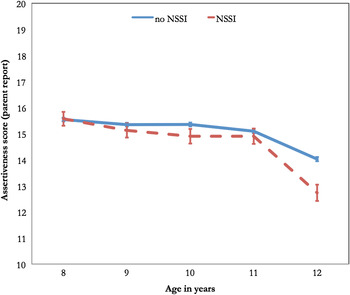
Within the depression domain, initial levels in self-reported depression scores predicted NSSI (OR = 1.09, p < .001). Decreases in assertiveness during childhood were associated with later risk for NSSI (OR = 0.61, p < .001). Examination of the average change in assertiveness by group indicates that levels of assertiveness were comparable up through age 9, with differences beginning to emerge at age 10 years. By age 12, levels decrease for both groups but more markedly for the adolescent self-harm group (see Figure 2). A generalized linear model confirmed that the effect over time was best characterized as linear. Neither initial level nor change in somatic complaints explained a significant amount of variance in risk for NSSI.
(Color online) Average levels across age in assertiveness as a function of adolescent self-harm.

Among the factors measured in the environmental stressor domain, initial levels in peer victimization (OR = 1.04, p = .004) and negative life events (OR = 1.04, p = .002) were predictive of later self-harm. There was a trend toward significance for harsh parenting, but the confidence interval included 1.0. Changes over time in the three environmental stressor variables were not significantly associated with later NSSI (Table 5).
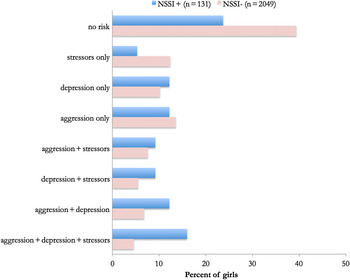
To further explore multiple pathways to adolescent NSSI, risk levels were defined for each significant predictor in each domain. For the aggression domain, scores that fell at or above the 85th percentile for initial level of conduct problems and changes in relational aggression over time, and scores at or below the 15th percentile for initial level in self-control, were included. In the depression domain, scores at or above the 85th percentile for depression and at or below the 15th percentile for changes in assertiveness, representing greater decrease in assertiveness over time, were included. Finally, scores at or above the 85th percentile for peer victimization, negative life events, and harsh parenting were included from the environmental stressors domain. The distribution across all possible combinations of risk was compared for girls with and without NSSI. The results are presented in Figure 3. Close to 80% of girls with adolescent NSSI had scores that fell within the defined level of risk for at least one domain. The most common pathway to NSSI was via the combined aggression, depression, and environmental stressor domains (16.0%), and the least common was via environmental stressors only (5.3%). The distribution of girls with NSSI across the remaining risk categories was relatively equal (range = 9.2%–12.2%).
(Color online) Profile of childhood risk domains among adolescent girls with and without nonsuicidal self-injury.

The distribution for girls engaging in NSSI significantly differed from that for those not engaging in NSSI, χ2 (7) = 52.26, p < .001. More than three times as many girls with NSSI (16.0%) had risk scores in all three domains as did girls without NSSI (4.6%), and more than twice as many girls without NSSI (15.0%) compared to girls with NSSI (7.6%) had risk scores in the stressor domain only. What appeared to be specific to risk for self-harm was depression risk in combination with at least one other risk.
Discussion
Data from a prospective longitudinal community based study were used to test the hypothesis that multiple pathways to NSSI exist. Each of the three domains tested in the present study explained variance in later NSSI as indicated by significantly increased risk of child or parent report of NSSI in early adolescence. Beginning with the aggression domain, higher initial levels of conduct problems, lower initial levels of self-control, and increases in relational aggression over time explained variance in risk of NSSI. Aggression is a heterogeneous construct, and children and adolescents with such problems may also demonstrate deficits in the regulation of negative emotions. It may be the co-occurrence of negative emotions that explains the association between aggression and NSSI. Thus, self-injury within the context of childhood aggression could be an attempt to regulate negative affect, as several theoretical models propose (e.g., Chapman, Gratz & Brown, Reference Chapman, Gratz and Brown2006). Aggression and emotional phenotypes, including reactive and proactive aggression and inhibited and disinhibited emotionality, will need to be more rigorously assessed in order to further pursue this hypothesis.
These associations between childhood aggression and adolescent NSSI raise the question as to whether NSSI that emerges in girls with a history of aggression and conduct problems is phenotypically different from NSSI that emerges in girls with a history of depression and, more specifically, whether there is a subgroup for whom self-injury is due in part to underarousal. Data from recent experimental studies of individuals with and without NSSI reveal patterns of arousal to emotionally salient stimuli that are similar to the patterns observed in adolescents with conduct problems. Female adolescents engaging in repetitive NSSI show attenuated cortisol response to a social stressor, compared to healthy controls (Kaess et al., Reference Kaess, Hille, Parzer, Maser-Gluth, Resch and Brunner2012). Adolescent girls engaging in NSSI show a significantly stronger brain response in the amygdala, hippocampus, and anterior cingulate cortex to visual stimuli of self-injury (Plener, Bubalo, Fladug, Ludolph, & Lulé, Reference Plener, Bubalo, Fladung, Ludolph and Lulé2012). Similarly, adolescent girls with aggressive conduct problems show lower cortisol levels than did both girls with other types of psychopathology and healthy controls. (Pajer, Gardner, Rubin, Czambel, & Wang, Reference Pajer, Gardner, Rubin, Perel and Neal2001; Pajer et al., Reference Pajer, Tabbah, Gardner, Rubin, Czambel and Wang2006). Adolescent girls and boys with conduct problems show greater amygdala activation in response to images of injury (Decety, Michalska, Akitsuki, & Lahey, Reference Decety, Michalska, Akitsuki and Lahey2009). These similar patterns of brain response to stress and injury stimuli between individuals who engage in NSSI and those with conduct problems, together with the evidence supporting a distinct pathway to NSSI via childhood aggression, suggests that the existence of a subtype of girls who engage in NSSI as a means to increase arousal should be seriously considered.
The association between increases in relational aggression over time and NSSI could reflect similar issues as raised above in terms of either regulation of negative affect or underarousal. Another possibility is that girls whose adolescent NSSI is preceded by increases in relational aggression are engaging in social forms of NSSI. Relational aggression is a complex construct associated with both negative and positive social standing. For example, longitudinal studies provide evidence for the co-occurrence of positive intimate friendships and engagement in relational aggression (Murray-Close, Ostrov & Crick, Reference Murray-Close, Ostrov and Crick2007). Prinstein et al. (Reference Prinstein, Heilbron, Guerry, Franklin, Rancourt and Simon2010) published data indicating early adolescent girls are uniquely susceptible to the influence of their best friends' engagement in NSSI on their own future engagement in NSSI. In one of the few studies to identify subgroups of young adult self-injurers, Klonsky and Olino (Reference Klonsky and Olino2008) revealed several classes for whom engaging in self-injury with others was common. Parsing the heterogeneity of early adolescent NSSI would be an important next step on building on the present results and refining developmental pathways to specific types and patterns of NSSI.
Within the depression domain, only depression scores at age 8 years and changes in assertiveness over time explained unique variance. These results underscore the prognostic importance of childhood depression, even at the nondiagnostic level. In a subsample of the PGS, we have shown that childhood symptoms of depression are stable and predictive of later disorder (Keenan et al., Reference Keenan, Hipwell, Feng, Hinze, Babinski and Henneberger2008). The present results add to that finding by demonstrating risk conferred by subthreshold levels of depression for other negative sequelae, in this case NSSI. The pattern of results for assertiveness is notable for what appears to be a decrease that occurs later in development. Initial levels did not increase risk for NSSI, and examination of the slopes based on grouped average scores suggests that risk is incurred by decreases in assertiveness during the transition from childhood to adolescence. This perhaps is a developmental window for preventive intervention for NSSI. Lack of assertiveness with peers in the context of peer victimization has been prospectively associated with depression during a similar developmental period (Keenan, Hipwell, Feng, et al., Reference Keenan, Hipwell, Feng, Rischall, Henneberger and Klosterman2010). Low assertiveness in the form of extreme peer orientation has been linked to other maladaptive behaviors and poor functioning in adolescence (Fuligni, Eccles, Barber, & Clements, Reference Fuligni, Eccles, Barber and Clements2001). A tendency for self-injurers to have friends who self-injure (Prinstein et al., Reference Prinstein, Heilbron, Guerry, Franklin, Rancourt and Simon2010) suggests that there may be a subgroup of individuals who are vulnerable to the exposure to peers engaging in NSSI. It is also plausible that engaging in NSSI leads to a decrease in assertiveness. The current study design did not provide an opportunity to test hypotheses regarding direction of effects, but such bidirectional influences should be tested in future studies.
Regarding the environmental stressors, initial levels, but not changes in level over time, of peer victimization, negative life events, and harsh discipline all were significantly associated with adolescent self-harm. One could interpret these data as indicating that chronic exposure to environmental stressors beginning in childhood, as opposed to a change in exposure in adolescence, is associated with NSSI, thereby refuting the hypothesis that self-injury is precipitated by an acute change in environmental stressors. However, chronic exposure in childhood could lead to increased sensitization to stress exposure in adolescence. Linking epidemiological findings such as these to experimental studies of stress exposure, emotion, and pain, for example, would provide a more nuanced test of the role of stress exposure and potentially yield profiles of types of stress exposure that explain additional variance in risk for NSSI.
At the domain level, NSSI was predicted uniquely by each of the three domains tested in the same sample, over the same developmental period, providing preliminary evidence for equifinality. The distribution of girls with NSSI across combinations of domains (depicted in Figure 3) provides further evidence. Together, risk in at least one of the domains was present for close to 80% of the sample of girls engaging in NSSI. Among the risk domains measured, the most common pathway to NSSI was via the combined aggression, depression, and stressor domains. The remaining girls, however, were relatively equally distributed among all other risk categories, providing further evidence of equifinality. When considering the specificity of the findings, depression risk either alone or in combination with other stressors appears to be useful in differentiating girls at risk for NSSI from those not at risk. Assuming these findings can be replicated, developmental models of NSSI will need to accommodate distinct pathways that may or may not reveal distinct etiologies. The two most plausible pathways to NSSI revealed by the present data involve low and high levels of arousal and emotionality, each of which could require different strategies for achieving a more modulated state.
A number of limitations should be acknowledged and hopefully addressed in future studies. In the PGS, questions regarding NSSI were introduced at age 13. Although epidemiologic data support early adolescence as the primary period for the onset of NSSI, extending the window of assessment earlier and including later assessments is necessary for capturing the entire period of risk. In addition, the assessment of NSSI was limited to a single question. There are dimensions of NSSI that may be important for determining morbidity, including the frequency and context (e.g., social or nonsocial) of NSSI, and these dimensions might be relevant for further delineating the multiple pathways to NSSI. Finally, one disadvantage to testing developmental models of NSSI in community-based samples is that the rate of suicidal behaviors is quite low, and therefore the capacity to explore pathways to the subtype of NSSI that confers risk for suicidal behavior is limited. This is an area of research with significant public health implications, and given the temporal association between NSSI and suicidal behavior, NSSI may serve as an opportunity to effectively intervene and reduce the risk of suicide, a leading cause of death among older adolescent females (Centers for Disease Control and Prevention, 2012).
To summarize, a gendered developmental approach to testing the equifinality of NSSI in adolescent girls revealed evidence for childhood risks in the domains of aggression, depression, and environmental stressors. To a large extent, risk for adolescent NSSI seems to have its origin in childhood, with early emerging depression and aggression, and childhood stress exposure setting the foundation for later risk as opposed to deficits emerging or exposure immediately preceding the occurrence of self-injury. The two exceptions to the pattern were increases in relational aggression and decreases in assertiveness, both of which may be useful as targets of preventive intervention. In addition, the present data support further exploration of psychological processes that may differentiate subtypes of NSSI and possibly distinguish NSSI that does and does not confer risk for suicidal behavior.