Introduction
The implementation of pension systems has been one of the most important achievements in terms of social policy in the developed world during the twentieth century. However, discussions on the ‘pensions crisis’ have rapidly emerged due to demographic and budgetary pressures.
Population ageing is likely to put pressure on the ability of pension schemes to redistribute income from younger to older generations. This makes inevitable the need to reform pensions in order to deal with increasing demand for pension expenditure and to address the trade-off between generosity, poverty and cost. Indeed, when the population ages, pension systems need to adapt, either through budget changes or through structural reforms; implying changes to the levels of generosity and/or coverage. Pensions systems may also encounter political difficulties due to the challenge of meeting historical commitments in relation to pension rights.
In practice, the implementation of the reform process in almost all European countries is slow, particularly because of the political dimension to the issue and the likely willingness of citizens to maintain the current pension arrangements. If, as suggested by Brooks and Manza (Reference Brooks and Manza2007), people's preferences have an important impact on welfare state policy, then it is important to elicit individuals’ attitudes and opinions towards a possible reform of the actual pension system.
There may be several factors influencing people's attitudes towards reforming the pension system. As reviewed by Galasso and Profeta (Reference Galasso and Profeta2002), the self-interested argument is the most advanced by political economy theory to account for people's support for a particular pension scheme. Political economy models of social security, with the seminal work by Browning (Reference Browning1975), emphasise the role of age in shaping preferences. Other personal characteristics, such as gender (Estes, Reference Estes2004), may also influence people's opinion towards the way pension benefits are provided (see also van der Heijden et al., Reference van der Heijden, Nelissen and Verbona1997).
As pension schemes are inherently redistributive, preferences to the way pension benefits are provided are directly linked to preferences for redistribution. Schwarze and Härpfer (Reference Schwarze and Häpfer2007) summarise the hypotheses advanced by economists to explain demand for redistribution. These are inequality aversion (Schwarze and Härpfer, Reference Schwarze and Härpfer2003), the efficiency argument and the self-interested argument (Meltzer and Richard, Reference Meltzer and Richard1981). Corneo and Grüner (Reference Corneo and Grüner2002) find that individual net pecuniary gain from governmental redistribution significantly drives individual preferences for redistribution. However, other factors may also have significant effects, particularly in formerly Socialist countries. Ravallion and Lokshin (Reference Ravallion and Lokshin2000) find empirical evidence that egoistic pecuniary motives are a major determinant in explaining individuals’ support for redistribution. On the contrary, when exploring the impact of beliefs about the causes of income on demand for redistribution, Fong (Reference Fong2001) finds that social preferences are more important (see also Kenworthy and McCall, Reference Kenworthy and McCall2008). Van Groezen et al. (Reference van Groezen, Kiiver and Unger2009) find that national effects and the desire to maintain the current arrangements shape people's opinions towards the preferred pension system type. Lynch (Reference Lynch2006) does not find strong support for the hypothesis according to which individuals who benefit from pension systems will be against the retrenchment of the state. Delaney and O'Toole (Reference Delaney and O'Toole2006) examine preferences for specific forms of redistribution in Ireland and find support for self-interested preferences (see also Delaney and O'Toole, Reference Delaney and O'Toole2007).
In this article, we will focus particularly on attitudes towards the redistributive features of the Irish pension scheme. Ireland is currently characterised by a very low dependency ratio and will move to a higher one due to increased longevity and fertility decline.1 In the period 2005 to 2007, life expectancy at birth was 76.8 years for males and 81.6 years for females. It is expected to rise to 77.8 in 2031 for males and 83.8 for females (Central Statistical Office, 2009). In addition, the old have witnessed high poverty rates in the recent past and a majority of pensioners would be at risk of poverty without pension benefits’ transfers (see O'Donoghue, Reference O'Donoghue2002; Prunty, Reference Prunty2007). Population ageing, along with the risk of poFootnote 1verty among the elderly, make inevitable the need to make some changes to the Irish pension system.
In this context, we make use of ‘stated preference’ questionnaire techniques in order to value people's preferences regarding the current Irish state pension system and its potential reform options. The opinion of pensioners is particularly important given the relative influence of the grey vote. Although in Ireland older voters are less visibly influential than say in the USA, they have been quite effective in preventing a cut in a universal entitlement to medical care and in social welfare cuts as part of the austerity programme (Carney, Reference Carney2010). A further objective of the article is to check whether identifiable disagreements over the pension system can emerge in accordance with theoretical expectations.
Context of the study: the Irish pension system in an ageing society
The pension system in Ireland is typical of the Anglo-Saxon type. It is a multi-pillar system composed of two main parts: a state-run social welfare system; and a voluntary supplementary pension system.
The public pension system includes four components:
• a state pension (contributory), available from age sixty-six and independent from employment status;
• a state pension (transition), available from age sixty-five and conditional on retirement;
• a state pension (non-contributory), available from age sixty-six;
• a survivor's pension.
The first pillar is mandatory, relatively small and based on the Pay As You Go (PAYG) principle. It consists of flat rate social insurance payments and means-tested social assistance payments, the latter are provided to residents whose income falls below a threshold. Flat rate pensions are provided to those entitled to pension benefits who fulfil contributory conditions. State pensions in Ireland account for about 90 per cent of the income of more than 60 per cent of the retired population. The weekly rate of payment for the full rate state pension (contributory and transition) is €230.30, which is below the poverty line.
The second and third pillars (occupational and individual) provide an income replacement function in the pension system. Supplementary schemes are administered by employers and/or private companies. According to the Central Statistical Office survey in 2002, the coverage rate amongst workers was 50.7 per cent and 51.5 per cent in 2005. In recent years, there has been a move from defined benefits (DB) to defined contribution (DC) schemes, increasing from 12 per cent in 1992 (National Pensions Board, 1993) to 33 per cent in 2008 (National Pensions Board, 2008).
Today, the greatest challenges to the Irish pension system are the risk of poverty among older people and population ageing. It is nevertheless acknowledged that Ireland has a longer period, than its counterpart European countries, to prepare for a transition from low to high old age dependency ratios (Connell and Pringle, Reference Connell and Pringle2004). Unless addressed by adequate pension reform, this can undermine the ability of the Irish pension system to fulfil its main objective, notably income adequacy. Indeed, an increase in the population of older people can result in lower income replacement levels and higher poverty if the productivity gains are not large enough (Baroni and O'Donoghue, Reference Baroni and O'Donoghue2010).
The recent pension policy debate in Ireland has seen a number of documents published in order to tackle the financial sustainability of the system. These present an overview of the Irish pension system and possible reform options. For example, the Green Paper on Pensions (Department of Social and Family Affairs, 2007) reviews the cost implications of different potential pension policy options. However, although these reports have covered a wide range of issues, people's opinions regarding the future of the pension system have rarely been taken into consideration.
Demand for redistribution and pensions
Political economy models of social security, based on the seminal work by Browning (Reference Browning1975), emphasise the role of age in shaping preferences for a reformed pension system. According to that framework, younger people prefer to pay a smaller share of their income for public pensions as they have more time than older individuals to invest in privately managed pension systems and can benefit from higher returns from investing in the capital market.Footnote 2 Clery et al. (Reference Clery, Humphrey and Bourne2010) investigate attitudes towards saving for retirement and find that younger people are less interested in saving for retirement than older individuals. The older segment of the working age group and pensioners instead prefer a higher contribution rate to the pension system as they are more likely to benefit from public pension benefits in the near future. In the same spirit, individuals who benefit the most from the PAYG pension system will oppose any retrenchment measures that would result in lower pension benefits (Pierson, Reference Pierson1994).
Income may also be an important explanatory variable as the different potential systems imply different degrees of redistribution from high income to low income individuals. Education can also play a significant role, as highly educated individuals may have a better knowledge of pension and market issues and thus are more likely to make better financial decisions. People with more education also tend to have a higher probability of being employed and consequently to participate to an occupational pension scheme. This statement is consistent with the findings of Boeri et al. (Reference Boeri, Börsch-Supan and Tabellini2001) where the degree of opting out from public pensions increases with income and education whereas it decreases with age. Political affiliation may also have an impact on reforming pensions, as in Devroye (Reference Devroye2003).
In general, there are a number of hypotheses advanced by economists to explain the demand for redistribution. Schwarze and Härpfer (Reference Schwarze and Häpfer2007) summarise these hypotheses into three arguments:
• the inequality aversion argument, implying that governments respond to these altruistic preferences by implementing a tax-financed transfer policy (Schwarze and Härpfer, Reference Schwarze and Härpfer2003);
• the efficiency argument, which posits that individuals are willing to pay to reduce the risk associated with their ex ante income distribution because they may be risk averse;
• the self-interested argument, which considers that egoistic pecuniary motives are a major determinant of individual preferences (see Meltzer and Richard, Reference Meltzer and Richard1981; Esping-Andersen, Reference Esping-Andersen1985; Iversen, Reference Iversen2005). However, both on theoretical and empirical grounds, the median voter hypothesis has often been questioned (Fong, Reference Fong2001; Kenworthy and McCall, Reference Kenworthy and McCall2008).
Recently, stated preferences techniques have been introduced to analyze preferences for redistribution. Corneo and Grüner (Reference Corneo and Grüner2002) find empirical evidence that egoistic pecuniary motives are a major determinant in explaining individuals’ support for redistribution. Ravallion and Lokshin (Reference Ravallion and Lokshin2000) find the same result from another data source. On the other hand, Fong (Reference Fong2001) finds that social preferences are more important in explaining demand for redistribution.
In the field of distributive preferences for pension programmes, a strand of the literature has developed recently to analyze preferences concerning pensions. Boeri et al. (Reference Boeri, Börsch-Supan and Tabellini2001) find that citizens in France, Germany, Italy and Spain are aware of the unsustainability of the PAYG pension system, but lack information about the costs. Van Groezen et al. (Reference van Groezen, Kiiver and Unger2009) analyze the determinants of people's preferences for particular kinds of pension provision (public, occupational and private) in fifteen European countries. The authors find that it is not so much individual characteristics that shape people's opinions towards the preferred pension system type, but national effects, such as different cultures, languages and historical developments, and the desire to maintain the current pension arrangements. Lynch (Reference Lynch2006) tests whether individuals who benefit from pension systems will oppose the retrenchment of the state in twelve European countries but does not find strong support for that hypothesis. Attitudes towards the welfare state in general and perceptions of individual economic well-being, both appear to have more impact on the support for public pensions.
Delaney and O'Toole (Reference Delaney and O'Toole2006) examine preferences for specific forms of redistribution in Ireland, namely unemployment payments, old age pensions and child benefit. The authors find support for self-interested preferences. Delaney and O'Toole (Reference Delaney and O'Toole2007) analyze the determinants of government expenditures and their size in Ireland. Among respondents, a majority were in favour of ‘same level of government spending and taxation’. However, those on higher incomes were more likely to support reducing public expenditure. Further, almost all respondents supported extra spending on health and education, whereas the support for increases in social welfare expenditure was less significant. Respondents on higher incomes display higher levels of support for spending on health and education and are less supportive of social welfare expenditures.
Data from the attitudinal questionnaire presented in this article enables us to explore several of the issues raised above. In particular, it looks at the impact of individual characteristics, such as income, age and education, on preferences for reforming the state Irish pension scheme.
The survey data
A surveyFootnote 3 was collected from an indicative sample of the Irish population in September 2008. The final survey was the result of several stages of testing. Ideally, the sampling strategy would have been a national random sample, however costs resulted in this being infeasible. Instead, although representative, but resulting in a higher confidence interval, the sampling approach followed a two-stage stratified procedure. Sampling was first stratified according to the two principle Irish area classifications: urban and rural. The second stage involved the choice of locations that are representative of the Irish population in terms of age, gender and socio-economic status.
The survey was administered to a sample of 498 respondents drawn from the adult Irish population entitled to vote. Ultimately, 326 questionnaires were ready to analyze. The overall response rate for the survey was 65 per cent, which is typical of face-to-face interviews. Time and resources available for the survey did not allow for a bigger sample and more areas to be covered. These two limitations represent the main methodological weaknesses of the approach used. The survey was administered randomly using door-to-door techniques. In 80 per cent of the cases, the researchers explained the object of the survey to respondents and dropped off the questionnaires to be completed and then collected later at an arranged time. In the remaining 20 per cent of cases, the researchers administered the survey face-to-face, for example where individuals were finding it difficult to complete the questionnaire.
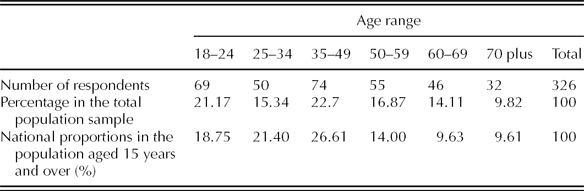
Table 1 shows the sample age range proportions as compared to the national proportions as provided by the Central Statistical Office statistics (Central Statistical Office, 2006). Comparing our results to the different age populations relative to the population over fifteen shows that the age group that is the best represented is the population over seventy years of age. The age ranges twenty-five to thirty-four and thirty-five to forty-nine are slightly underrepresented as compared to the national adult population, while the remaining age groups are slightly overrepresented. Weightings are used to correct for the differences with the national distribution.
Proportions of the different age ranges in the total population (sample and national proportions)

Results I: distributional preferences and the welfare state
As pension systems are inherently redistributive, preferences as to the way pension benefits are provided are directly related to preferences for redistribution. Corneo and Grüner (Reference Corneo and Grüner2002), Rehm (Reference Rehm2005) and Schwarze and Härpfer (Reference Schwarze and Häpfer2007) have notably used survey data to assess citizens’ views of whether it is the government's responsibility to reduce income differences, and have studied the determinants of these preferences. In this context, in the present subsection, we turn to evaluating Irish citizens’ opinion of broader questions related to inequality perception and redistribution by the state.
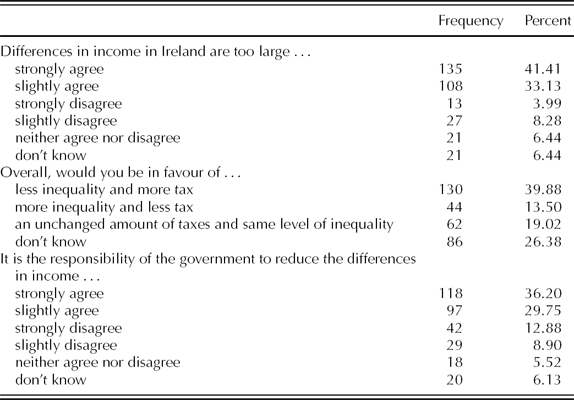
We asked people to give their opinion about the statement ‘Differences in income in Ireland are too large.’ As shown in Table 2, more than 41 per cent of respondents strongly agreed with that statement (among whom 80 per cent were under sixty-five), followed by 33 per cent that chose the option ‘slightly agree’ (among whom 57 per cent were under forty-four). Only 4 per cent of respondents strongly disagreed with this statement (all of whom were under sixty-five).
Attitudinal profile of the respondents
A second question was included to test how people would react to income inequality. Forty per cent were in favour of less inequality and more tax (among which the highest proportion, 29 per cent, had a household income between €20,000 and €40,000) and only 14 per cent chose the option more inequality and less tax (with the highest proportion belonging to an annual household income between €40,000 and €60,000). Nineteen per cent thought that the situation should remain the same (among which the highest proportion, 29 per cent, had an annual household income between €20,000 and €40,000). This question is characterised by a relatively high proportion of respondents (26 per cent) who answered ‘don't know’. This may be explained by the sensitive nature of the question and the fact that people who did not want to disclose their real preference may have chosen the ‘don't know’ option.
The last question concerned people's attitudes regarding the statement ‘It is the responsibility of the government to reduce the differences in income.’ As shown in Table 2, the highest proportion (36 per cent) of individuals strongly agreed with this view. Among these, 37 per cent were young (less than forty-four), 42 per cent were middle-aged (between forty-four and sixty-five) and 20 per cent were older than sixty-five. Of respondents who strongly disagreed with the government being responsible for redistributing income, the highest proportion (57 per cent) belonged to the younger age group.
Respondents’ distributional preferences should be indicative of people's preferences for redistribution through pension benefits. Indeed, as compared to Bismarckian pension schemes, the Irish pension system is highly redistributive as contributions are earnings-related whereas benefit payments are flat rate. Besides, pension benefits represent a large proportion of older people's income.
Results II: are people informed about the Irish pension system?
One of the issues emphasised in the empirical literature is related to the role that people's knowledge about pensions has in shaping their preferences and acceptance for various directions of reform (Boeri et al., Reference Boeri, Börsch-Supan and Tabellini2001; Boeri and Tabellini, Reference Boeri and Tabellini2005). For instance, Boeri and Tabellini (Reference Boeri and Tabellini2005), in an opinion poll conducted in Italy, found that respondents who were more informed about the costs and functioning of the Italian pension system were more willing to accept reforms consisting of increasing the retirement age and/or cutting pension benefits. Knowledge may also lead to a higher impact of information on people's decisions related to saving (Pensions Commission, 2005).
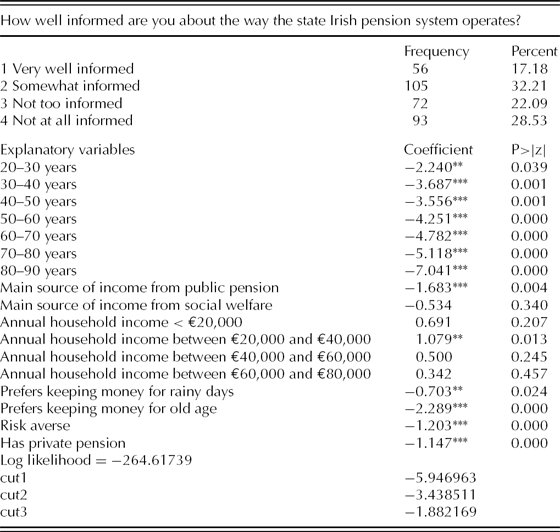
Here the general level of pensions knowledge is low (Table 3). To the question ‘How well informed are you about the way the state Irish pension system operates?’, the highest proportion (32 per cent) said that they were ‘somewhat informed’, followed by 29 per cent who chose the option ‘not at all informed’. To the question, ‘Can you make a reasonable estimate about the level of your (likely) retirement income?’, almost 34 per cent chose the ‘No idea’ option.
Knowledge about the functioning of the state Irish pension system (ordered logit)
Notes: *significant at 10 per cent; **significant at 5 per cent; ***significant at 1 per cent.
Reference category: younger than 20 years of age, working, receiving income from employment, belonging to a household earning over €80,000/year, having short-term spending behaviour and neutral to risk.
In order to shed light on the characteristics of respondents that influence their degree of knowledge, and to help establish whether people who benefit the most from pension benefits, and who have longer time horizon, are those who are more informed, Table 3 shows the results of an ordered logit estimation, the aim of which is to link the respondents’ personal characteristics to their knowledge about pensions. The ordered logit model is appropriate when the dependent variable is ordinal, that is the categories can be ranked, but the distance between the categories is unequal. Given the way variables are specified, positive estimated coefficients correspond to a lower level of knowledge.
Results confirm that individuals that are more informed tend to be older. Coefficients associated with age bands are negative, significantly different from zero, and more pronounced for the oldest. This finding may be explained by the fact that out-of-work individuals have more time to spend thinking and discussing issues such as pensions (Mulligan and Sala-i-Martin, Reference Mulligan and Sala-i-Martin1999). Clery et al., Reference Clery, Humphrey and Bourne2010 found evidence that older respondents and men tend to be more informed about how pensions operate in practice. Respondents whose main source of income is public pensions are also likely to be better informed. Income does not seem to have a great impact on knowledge as only individuals belonging to a household earning between €20,000 and €40,000 a year tend to say they are more informed, with the associated parameter being negative and significant at the 5 per cent significance level. Similarly, individuals who prefer keeping money for rainy days and who choose to save for old age are more informed than respondents displaying short-run spending behaviours. Risk-averse individuals also tend to be more informed as the associated parameter is negative and significant at the 1 per cent significance level. Finally, respondents who benefit from a private pension benefit are also more informed about the way the state pension system operates.
Results III: attitudes to pensions’ goals and likely future reforms
What pensions system is preferred by the majority? Respondents were presented with various questions concerning their opinions of the characteristics of the Irish pension system as well as potential directions of reforms. These questions allow us to elicit demand for redistribution through the PAYG pension system, and to investigate the underlying value orientations of the respondents. These questions are normative, relating to the political feasibility and desirability of policy reform on pensions.
How should state pension benefits be provided in Ireland?
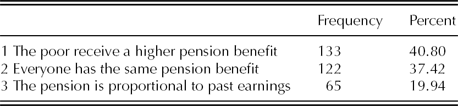
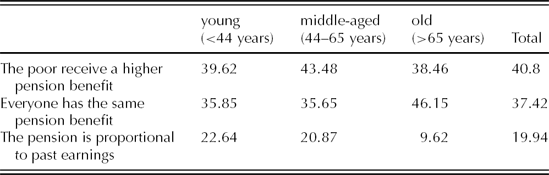
To the question ‘How should state pension benefits be provided in Ireland?’, 41 per cent responded in favour of a higher pension benefit for the poor, and 37 per cent in favour of the same pension benefit for everyone. Only 20 per cent of individuals favoured an earnings-related pension system (see Table 4).
According to you, how should state pension benefits be provided in Ireland?
This is an interesting result as it at least suggests that the fundamental principle of pension provision in Ireland, that is the Beveridgean principle, seems to be the one preferred by citizens. Table 5 shows clearly that pensioners are the group most in favour of a universal pension provision as 46 per cent state that everyone should have the same pension benefit. This same age group is the least in favour of earnings-related pensions as only 10 per cent think that pension benefits should be proportional to past earnings.
According to you, how should state pension benefits be provided in Ireland? (distribution by age group, percent)
What pension reform is the most popular?
Privatising social security has been and is still a subject of great interest (Kay, Reference Kay1999; Brooks, Reference Brooks2005). Discussions have centred around the ability of private pension schemes to redistribute income between and within generations, the impact of shifting from an unfunded to a funded system of saving and the performance of private retirement accounts to deal with market uncertainty. Recently, some articles have dealt with preferences with regard to the privatisation of social security (Devroye, Reference Devroye2003; van Groezen et al., Reference van Groezen, Kiiver and Unger2009).
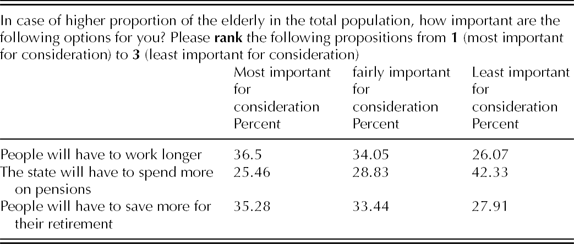
In order to tackle the likely preferences of Irish citizens in relation to a more privately managed pension system, respondents were presented with three options to deal with demographic ageing. The solution that seemed to be the most popular was the one of increasing the retirement age, a parametric reform that induces a reduction in the size of the public pension pillar, followed very closely by saving more for retirement. The least popular solution was that the government spends more on pensions, although 25 per cent of respondents thought that this option was ‘most important for consideration’ (Table 6).
Ranking of pension policy options to deal with population ageing
Results IV: perception of pension principles
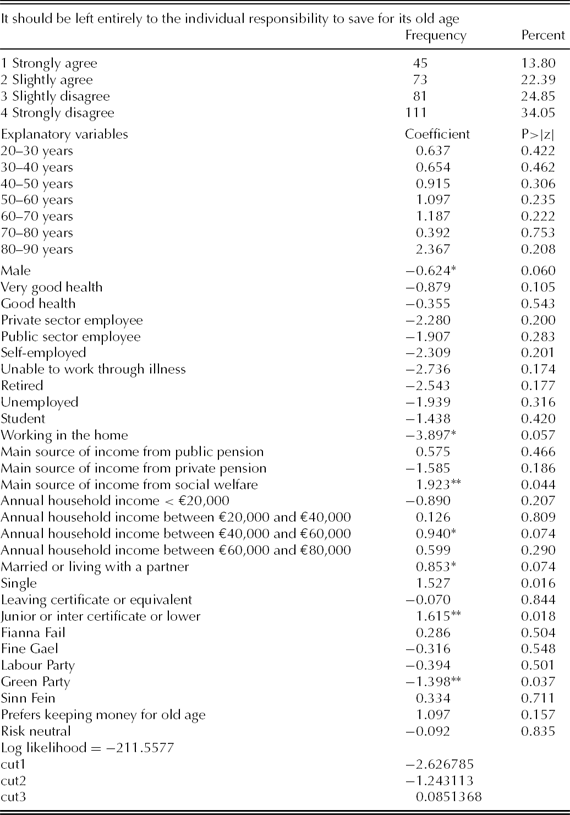
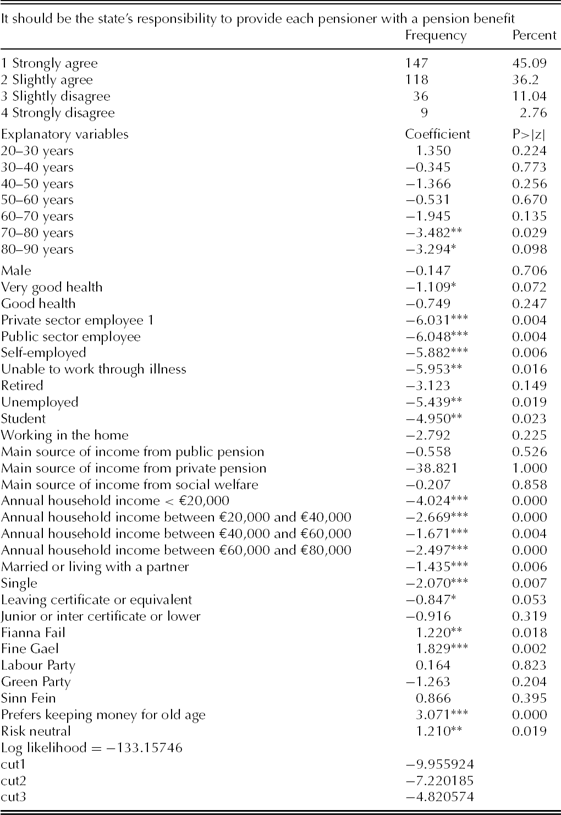
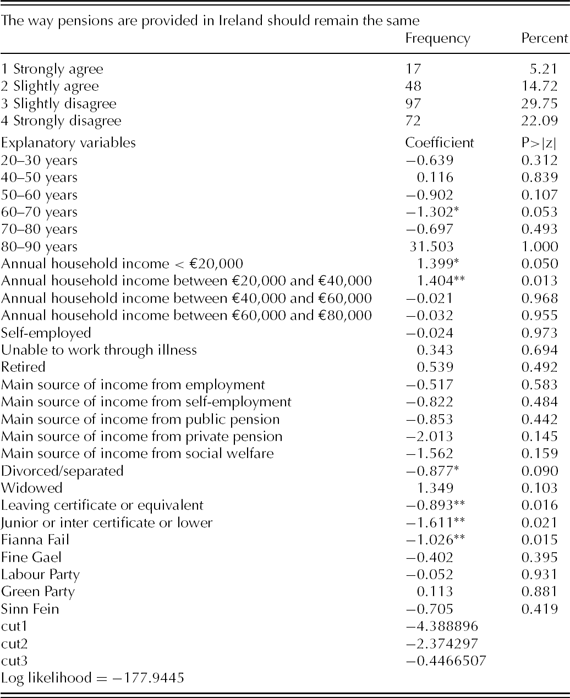
Self-interest is often presented as being the most important determinant of people's attitudes and opinions regarding the pension system. To gain an insight into this view, respondents were asked to what extent they agreed with three pension principles, namely, (i) individual responsibility to save for old age; (ii) state responsibility in providing pension benefits; and, (iii) somewhere in between, equivalent to the Irish pension system, which combines a state anti-poverty measure with private savings. Thirty-four per cent of respondents strongly disagreed with the principle that it is an individual's responsibility to save for old age (a further 25 per cent slightly disagreed). Forty-five per cent strongly agreed with the statement that it should be the state's responsibility to provide pension benefits (with 36 per cent slightly agreeing). And 22 per cent strongly disagreed that the way pensions were provided in Ireland should stay the same (with 30 per cent slightly disagreeing) (see Tables 7, 8 and 9).
Individual responsibility to save for old age (ordered logit)
Notes: *significant at 10%; **significant at 5%; ***significant at 1%.
Reference individual is: younger than 20 years of age, female, not in a good health, having income from private pension, belonging to a household earning more than €80,000/year, having a recognised third level education, having a short-term time horizon and risk averse.
State responsibility in providing pensions (ordered logit)
Notes: *significant at 10%; **significant at 5%; ***significant at 1%.
Reference individual is: younger than 20 years of age, female, not in a good health, having income from private pension, belonging to a household earning more than €80,000/year, having a recognised third level education, having a short-term time horizon and risk averse.
Preferences for the status quo (ordered logit)
Notes: * significant at 10%; **significant at 5%.
Reference individual is: younger than 20 years of age, belongs to a household earning more than €80,000/year, is married or single, has a recognised third level education.
A great majority of individuals, therefore, think it is the government's responsibility to provide each pensioner with a state pension even though the general idea behind these questions is that the status quo is not the preferred option.
A similar question was included in van Groezen et al. (Reference van Groezen, Kiiver and Unger2009) who found that a majority of respondents preferred public pensions across fifteen European countries. However, preferences varied according to the country in question. While in Spain a majority of individuals favoured public pensions, the majority in Germany, The Netherlands and Finland had preferences for occupational pensions.
In order to investigate the determinants of people's preferences regarding the pension system principles above, we applied three ordered logit models to three dependent variables, where respondents are asked to say if they strongly agree, slightly agree, slightly disagree or strongly disagree with the three statements presented above.
As shown in Table 7, age does not appear to have an impact on preferences for individual responsibility to save for old age. Compared to women, males were more likely to prioritise individual responsibility for saving for old age (see Estes, Reference Estes2004). The associated parameter is negative and significant at the 10 per cent significance level. It seems that preferences for funding the pension system do not depend on employment status as only people working in the home tended to agree with that reform proposal. This last effect is negative and significant at the 10 per cent significance level. Respondents whose main source of income was social welfare tended to disagree with individual responsibility to save for old age, the corresponding parameter is positive and significant at the 5 per cent significance level. Only individuals earning an annual household income between €40,000 and €60,000 tended to disagree with personal responsibility to save for pensions. Finally, ideological orientations also seem to have a small impact as only supporters of the Green PartyFootnote 4 were more likely to favour individual responsibility to save for old age.
Table 8 shows that the older the respondent the more likely he/she was to agree with the view that it is the state's responsibility to provide pension benefits. This effect is negative and significant at the 5 per cent significance level for the age band seventy to seventy-nine and at the 10 per cent significance level for the age band eighty to eighty-nine. People in very good health also seemed to favour government provision of pension benefits. The same result holds for private sector employees, public sector employees and the self-employed, and the associated parameters are negative and significant at the 1 per cent level. Those people unable to work through illness, or unemployed people and students were also more likely to favour government responsibility in providing pension benefits. The associated parameters are negative and significant at the 5 per cent significance level. Respondents belonging to a household earning less than €80,000 a year tended to favour public provision of pensions. The associated parameters for all income bands are negative and significant at the 1 per cent significance level. This last result is consistent with the fact that social preferences are important determinants of people's preferences. Respondents who were married or living with a partner and single respondents were both more likely to favour state provision of pension benefits. Associated parameters are negative and significant at the 1 per cent significance level. The same result holds for people with a leaving certificate or equivalent. Supporters of centre-right parties (Fianna Fail and Fine Gael) tended to disagree with the statement that it is the state's responsibility to provide pension benefits. Respondents that preferred to keep money for old age, and those who were risk neutral, also tended to be unfavourable to public provision of pensions.
Concerning preferences for maintaining the current Irish pension scheme, as shown in Table 9, the results are not totally in accordance with what is suggested in theory as people who benefit the most (or who are likely to benefit the most) from social welfare are not always those who are more likely to favour maintaining the current system. Notably, older people should be favourable to maintaining the status quo in accordance with theory predictions (Pierson, Reference Pierson1994). The impact of age is actually weak, as only individuals aged between sixty and seventy are likely to favour the current system. The associated parameter is negative and significant at the 10 per cent significance level. Individuals who had an annual household income below €40,000 tended to disagree with maintaining the same pension system. This might be justified by their likely preference for a system providing higher state pension benefits. The means-tested component of the state pension scheme might also explain why low income individuals do not support the current system; indeed, evidence in the UK (Ginn, Reference Ginn2006) shows that means-testing is characterised by a low take-up, which is an evidence of its unpopularity. People who were divorced or separated were likely to favour the current system. Respondents who had a leaving certificate (upper secondary) or equivalent or a junior or inter certificate (lower secondary) or lower tended to agree with maintaining the status quo. The associated parameters are negative and significant at the 5 per cent significance level. Finally, only supporters of the centre-right Fianna Fail Party tended to agree with maintaining the current Irish pension scheme.
Summary and policy conclusions
The descriptive analysis based upon the survey provided a wealth of information concerning people's distributional attitudes and general opinion about the role of the pension system in redistributing income. This analysis also allowed us to identify potential sources of taste variability among respondents with regard to the way the state pension system operates in Ireland.
What emerges from the analysis is that people believe in the role of the state in reducing inequalities and redistributing income. There also seems to be a high tendency towards inequality aversion among all groups in society. These general distributional attitudes are also prevalent in the field of pensions, as a majority of respondents view provision of pension benefits by the state as a way to reduce poverty among the elderly.
In line with these findings, the majority of respondents are likely to favour a system in the Beveridgean tradition, and in particular its universal aspect. Similarly, the government's responsibility in providing pensioners with pension benefits is important for the persons interviewed. However, maintaining the current parameters of the Irish pension scheme does not seem to be the most preferred alternative.
From this analysis, there also appear to be cleavages around various issues along age and income dimensions. Notably, older people are much more informed about issues related to pensions in Ireland than younger people. On the other hand, income only plays a small differentiator role as preferences seem to be more influenced by inequality aversion. Still, low income individuals are not likely to favour the status quo, because they do not expect to benefit from it, which supports the self-interested argument.
These findings provide interesting insights in terms of policy implications as they inform us about desired directions for reforms. Utilising survey techniques it is possible to study individual preferences in relation to the size and scope of the pension system in Ireland. Clearly, a majority are likely to favour a universal pension scheme. This seems to be in accordance with the actual policy undertaken in Ireland as regards the evolution of the current pension system. Indeed, while we can observe some kind of inertia in Ireland, as in other European countries, in the sense that no structural reforms are undertaken. Even if the shift to a universal state pension system represents an important ‘philosophical’ and ‘ideological’ deviation from the current pension scheme, as it implies moving from a contributory to a residence principle, the actual policy in Ireland is somehow moving towards some variant of a universal provision of state pension benefits. From actual public policies undertaken in Ireland recent years, there seems to be a strong correspondence between national policies and the opinion of the majority as we observe convergence to universality. This implies that recent policy changes are similar to the preferences indicated in the empirical results presented in this article. When we compare the outcome from the empirical aggregation process with ‘revealed preference’ data from the policy undertaken in Ireland during the last ten years, we observe that the number of beneficiaries of old age benefits of all types, that is both contributory and non-contributory, rose considerably from 1998 to 2007, whereas individuals over sixty-five receiving survivor's benefits fell. For instance, in 2004, 67 per cent of pensioners were beneficiaries of a social welfare pension (old age or retirement pensions), compared to 59 per cent in 1994, with the number of recipients of social insurance contributory benefits exceeding the number of recipients of means-tested benefits. However, future evolutions imply that the system will come under pressure as demographic changes will result in lower replacement rates. In this respect, some policy solutions, such as education (Thoresen, Reference Thoresen, Tangen and Thoresen2008), could be thought to address the lack of awareness and knowledge about pensions. Improving citizens’ understanding of issues related to the Irish pension scheme and challenges of population ageing might increase acceptance of proposed reforms to the pension system. However, other behavioural barriers, such as myopia, cynicism and inertia, can still inhibit policy actions in relation to pensions, including structured advice and information designed to improve understanding.
Acknowledgements
The authors gratefully acknowledge financial assistance from the Department of Economics of the National University of Ireland (NUI), Galway.