I. INTRODUCTION
In 1967, the Institution of Electrical Engineers (IEE), UK, reviewed the concept of a second conference on Ferrimagnetics and Plasmas, and P.J.B. Clarricoats, who initiated the first Conference, suggested that instead they should hold an International Microwave Conference [Reference Vander Vorst and Clarricoats1]. Another member of the committee, E.A. Ash, who was then working in Industry and was very pro Europe, went the next stage and said: “Why not a European Microwave Conference?” The Committee Chairman and natural microwave leader in the UK at that time, H. Barlow, was designated as Conference Chairman. Later, E.A. Ash became co-chairman.
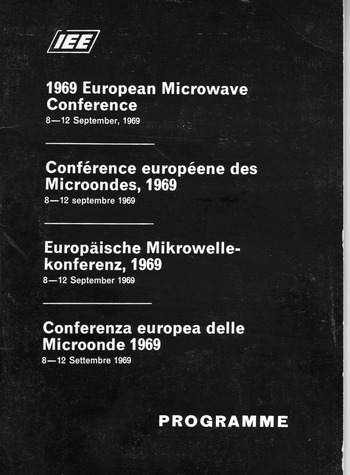
The story of Microwaves in Europe started with this first European Microwave Conference, called EMC, in London, 1967 (Fig. 1). There were two parallel sessions. The Conference fee was £15 for members of sponsoring bodies and this was a 5-day conference. The Organizing Committee with its 12 members represented the IEE, the Institution of Electronic and Radio Engineers (IERE), UK, the European Region of the Institute of Electrical and Electronic Engineers (IEEE) as well as the IEEE Group on Microwave Theory and Techniques. There was also an international group of 34 corresponding members, including among others: F. Borgnis, G. Epprecht, A. Grivet, R.C. Hansen, B. Oguchi, A.A. Oliner, A. Smolinski, M. Tiuri, A. Vander Vorst, and L. Young.
Advance Program of the first EuMC, London 1969.

The EMC was first established in the fall of every odd year: London 1969, Stockholm 1971, and Brussels 1973. Starting with Montreux in 1974, it became an annual event, organized with the support of Microwave Exhibitions and Publishers Ltd. (MEPL), UK, led by R. Marriott, as professional conference organizer, and combined with an exhibition of manufacturers of microwave components, systems, and test equipment. A paper written on the occasion of the 40th anniversary of the first EuMC summarizes the history of Microwaves in Europe, with a number of specific references [Reference Vander Vorst2]. Other papers have described more specifically both the geographical and technical development of Microwaves in Europe [Reference Sorrentino3, Reference Sorrentino and Vander Vorst4].
II. EVOLUTION OF THE EMC
The second EMC was held in Stockholm, 1971, with B. Agdur as Chair and F.E. Bolinder as Technical Program Committee (TPC) Chair. J. Van Bladel then proposed Brussels for 1973, with himself as Chair and A. Vander Vorst as TPC Chair. A meeting was held in 1973 between them and R. Marriott and G. Saville, directors of MEPL, to start considering EMC as an annual event together with an exhibition, run by a professional organizer.
From a report written by J.H. Collins [Reference Collins5], it appears that Brussels 1973 was quite a success: a four-day event; record attendance: 780 registrants; massive support from Britain, West Germany, France; significant support from The Netherlands, Sweden, Italy, Belgium; “Iron Curtain countries” and USA were present, each with 40 participants. There were 12 invited papers, 215 papers presented, and three parallel sessions.
The organization of future conferences was planned by forming a Board of Directors (BoD) including one member from each of “the 11 European nations”, holding a Convention with both Conference and Exhibition in Montreux, 1974. A little later, a Management Committee (MC) replaced the BoD, with F. Gardiol as first chairman, for 3 years. A balanced representation of entire Europe was worked out: H. Barlow, J. Van Bladel, E.A. Ash, P. de Santis, A. Smolinski, T. Berceli, J.O. Scanlan, H.J. Schmitt, J. Deutsch, H. Steyskal, M.T. Vlaardingerbroek, J. Le Mezec, and B.V. Atkinson, Secretary of the Committee. F. Gardiol introduced the name EuMC in 1974 to avoid confusion with the ElectroMagnetic Compatibility Symposium.
There are many anecdotes and R. Marriott mentioned some at the Special Session on the 40th anniversary, Rome, 2009 [Reference Vander Vorst2]. As an example in Rome, 1987, under the Chairmanship of F. Fedi, they came across an unexpected problem: the World Games were being held at the same time as the EuMC! Roads were closed or being diverted, members of the TPC experienced difficulties due to the closures and diversions, etc. To cap it all, on the last day of the event the Official Parking Area for the event logistic lorries was completely sealed off. With the event about to close, R. Marriott finally managed to get the lorries out by cutting the padlocks with bolt cutters kindly loaned by one of the drivers!
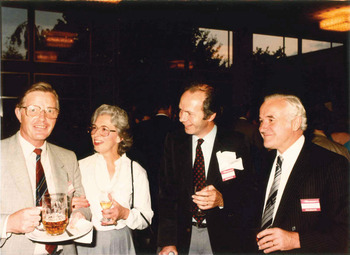
EuMC defined its European character in two ways: firstly as a peripatetic event that visited many European countries, secondly by composing the MC with engineers from more than a dozen different European countries. EuMC extended its conception of Europe's boundaries ahead of political developments. Significantly a EuMC was held in Poland in 1980 and in Hungary in 1990. The conference drew on a burgeoning European microwave fraternity and, in turn, helped to engender that fraternity (Fig. 2).
Chatting at EuMC, Nuremberg 1983, from left to right: M. Van Vlaardingerbroek (Chair EuMC 1981), Joan (MEPL secretary), A. Vander Vorst (Chair EuMC 1984), R. Mariott (MEPL Director).

At the EuMC 1995 in Bologna, it appeared that the financial situation of the EuMC had become critical: MEPL had transferred to Reed Exhibitions its interest in EuMC, and Reed after 1 year only transferred it to Nexus Business Communications. This was the occasion for the members of the MC to take a bold step and redefine EuMC dramatically, believing that it could be recreated in a more vibrant, relevant, and successful form. An ad-hoc committee (F. Landstorfer, A. Madjar, A. Räisänen, and A. Vander Vorst) was appointed by the MC to revisit the operation and scope of the EuMC. The key decisions were taken in a series of meetings at EuMC Prague, 1996. Implementation started at EuMC Jerusalem, 1997, and the transformation was completed at EuMC Amsterdam, 1998.
Firstly, the decision was taken to create a Steering Committee (StC) “with the task of working on long range planning, finance, future venues, exhibitions, industry participation, publications, liaison with the organizer, on behalf of the MC, and taking urgent decisions when necessary”. The StC comprised six members, five elected by the MC and one appointed by the Microwave Theory and Technique Society (MTT-S) of the IEEE. The Chairman of the StC was also serving as Chairman of the MC. The first StC was composed of L. Ligthart, A. Madjar, H. Meinel, S. Nightingale, and R. Sorrentino, who were the elected members, while R. Jansen was appointed by MTT-S. R. Sorrentino was elected as Chair. R. Jansen resigned a few months later and MTT-S appointed A. Vander Vorst. The first StC decided to break with Nexus and a local company organized the next EuMC in Jerusalem, 1997. During this EuMC, the MC approved a new contract with Miller-Freeman, and the basic structure of a new organization, the European Microwave Association (EuMA), was identified. The six 1997 StC members founded the EuMA (L. Ligthart, A. Madjar, H. Meinel, S. Nightingale, R. Sorrentino, and A. Vander Vorst).
Secondly, EuMC would become the centerpiece of a newly created European Microwave Week (EuMW). An important principle was to reinvigorate the relationship with an exhibition. From 1998 to 2002, the contract with Miller Freeman, led to a massive expansion of the exhibition, which was critical to the success of the first EuMW. Since 2003, with Horizon House Ltd. UK, as professional organizer, the exhibition has been stabilized and is steadily growing. At the same time EuMA has stayed true to its principles – its European focus, the peer review, investing surpluses in the EuMW, and creating the best possible events for the European microwave community.
Thirdly, the EuMC would restrict its peripatetic travels to five countries: France, Germany, Italy, The Netherlands and the UK, and choose locations where a strong microwave community could support the EuMW and in particular the exhibition.
The major StC tasks were to investigate the conditions for a successful EuMW. The program should cover components, devices, systems, and networks, in scientific, technology, and application-oriented sense. It should also be profitable. A link between Microwaves and Wireless was planned. The EuMW program should reflect: three conferences with breakthrough presentations (invited, focused, industrial, joint, and regular papers); a European R&D platform; presentations on major developments outside Europe; tutorial and workshops; the most important microwave exhibition outside of the USA; awards, and grants for students and ex-Soviet Union countries researchers.
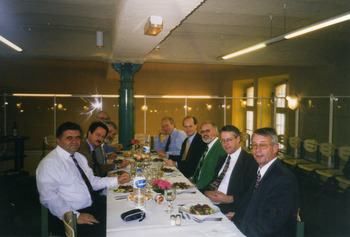
The General Chairman and Secretary of the EuMW 1998 were L. Ligthart (TUD) and D. Vanhoenacker-Janvier (UCL), respectively. The EuMW included three conferences: the 28th EuMC (L. Ligthart, D. Vanhoenacker-Janvier); GAAS 98 (G. Gatti); and MTT-S European Wireless 98 (R. Jansen) [Reference Ligthart6] (Fig. 3).
EuMA StC meeting, Paris 13 December 1997, from left to right: A. Madjar, R. Sorrentino, P. Russer, S. Nightingale, A. Vander Vorst, P. Jackson (Miller-Freeman), H. Meinel, A.F. Wilson, L. Ligthart.

The Call for Papers was widely distributed, resulting in a huge increase in the number of received abstracts. The abstract handling (D. Vanhoenacker-Janvier and UCL team) necessitated a professional approach, in: increasing the number of reviewers; designing a system for distributing abstracts per conference; informing reviewers, committees, and organizer; and preparing three separate TPC meetings, linked together. Here are some statistics about the 1998 Conferences: EuMC: 228 regular accepted papers, 12 invited papers, 52 special papers (focused, industrial, etc.), 55 workshop papers; EuMW: 488 accepted regular and invited papers, 62 workshop papers; Registrations were: EuMC 660, GAAS 319, Wireless 223, and Workshops 282.
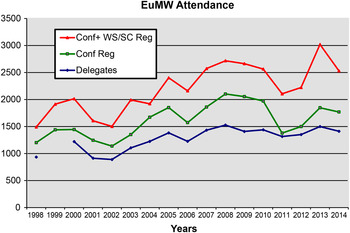
The attendance at the EuMW has grown steadily and significantly. Figure 4 illustrates the attendance in number of Delegates, Conference registrations, and Total registrations to Conferences, Workshops and Short Courses, respectively, from 1998 to 2014 (provisional).
EuMW attendance from 1998 to 2014 (provisional).

At the EuMW in Milan, 2002, the StC-MC structure of the EuMC was merged into the EuMA structure with a BoD and a General Assembly. Later developments of the EuMA have been published [Reference Vander Vorst and Sorrentino7, Reference Vander Vorst and Sorrentino8].
III. INDUSTRIAL SUPPORT IN EUROPE
Colleagues from Academia have been instrumental in these achievements. It was probably easier for them to justify such activities in their report of activities than in industry. Colleagues from industry have been explicitly present, however, since the microwave industry in Europe significantly grew during the second part of the 20th century. A very succinct overview is presented here. The reader may find more information in papers that describe the growth of the microwave industry in Europe, country by country [Reference Sorrentino3, Reference Sorrentino and Vander Vorst9, Reference Sorrentino and Grahn10].
After World War II, the microwave infrastructure in Europe has grown extensively, encompassing university, industry, and government ministries, in support of comprehensive research, development, and production of microwave practices to meet wide-ranging applications covering all microwave fields from radio to terahertz frequencies. In the early decades, this was motivated by military needs, more recently however, civil broadcast and communication interests have become increasingly dominant.
Such a very large quantitative growth has been spurred by the dramatic growth of applications, particularly of telecommunications systems. At the same time, the main research fields have evolved substantially. For example, from the mathematical solution of Maxwell's equations in conventional waveguides to the complete analysis of three-dimensional circuits, including passive and active devices under dynamic conditions; from the optimization of microwave power tubes to studies of new generations of transistors (Heterojunction bipolar transistors, Field-effect transistors) for power or very high bit-rate applications; and from the design of discrete devices or components to the design of complete active phase-array antennas. One of the most exciting fields over the last 50 years has been in microwave solid-state devices with associated integrated circuits.
Networks of microwave research centers have been constituted and a strong cooperation among them has been developed. In order to reach critical masses, the creation of large laboratories grouping from 50 to 100 permanent researchers has been encouraged for the industrial part and for the academic part as well. A number of facilities in terms of microwave measurements and device processing are now available.
One must mention the development of advanced radio frequency front-ends (including antennas) for integration into novel microwave and millimeter-wave radar and radio systems and networks. Specific technologies were developed for ultra-wide-band radar technologies (50 MHz/6 GHz frequency band) to be applied in various ground penetrating radar systems.
Some European companies started covering large areas in microwaves, with business units in automation and drives, components, energy, information and communication, medical technology, traffic technology, and transportation system. Terahertz bandwidth fiber optical systems were on the way, and there was a shift in R&D objectives from hardware-oriented to system and software-oriented topics. Semiconductor devices and complete system solutions were produced for a range of wireless applications, including cellular and cordless telephone systems, and devices used in connection with digital system telephony.
Many companies engaged in traffic sensing and vehicular technology, with applications of microwaves to automotive technologies being focused by the demand for intelligent and reliable safety systems in today's vehicles. Finally, as is well known, Aeronautic Defence and Space is now a major activity in Europe.
Making Microwave Technology and Industry more visible and coordinated within Europe has been a growing concern. Early in the 21st century, Chalmers GHz Centre (Sweden) created the European Radio and Microwave Interest Group (EuRaMIG), one specific objective being: “Align each other when approaching pan-European R&D agendas within EC-ERA, Eureka, COST and EDA”. EuRaMIG became a Topical Group of EuMA in 2011.
IV. IEEE ACTIVITIES IN EUROPE
A) Introduction
Development of Microwaves in Europe has been concomitant with a strong development of the presence of the IEEE in Europe, thanks to the efforts of a number of European colleagues.
The IEEE came from the merging of two institutions in the USA. The American Institute of Electrical Engineers (AIEE) was founded in 1884; it became increasingly focused on electrical power. The Institute of Radio Engineers (IRE) was founded in 1912; it was devoted to radio, and then broadly to electronics. On 1 January 1963, the AIEE and the IRE merged to form the Institute of Electrical and Electronics Engineers (IEEE). At its formation, the IEEE had 150 000 members, 140 000 of whom resided in the USA [11]. The comparison with the present situation of the IEEE is rather astonishing: the IEEE now has more than 430 000 members, more than 50% of whom resides out of the USA [12].
The IEEE is composed of Regions, presently 10, which are large parts of the world, on one hand. It is also composed of Technical Societies concentrating on specific fields on Electrical and Electronic Engineering, presently about 40, on the other hand. The Region is composed of Sections, usually coinciding with Nations but not always. The Section has Student Branches, regrouping Student Members at local level. It also has Chapters, related to one or more Technical Society. One can say that an IEEE Chapter has two “parents”: the Section/Region and the Technical Society, respectively.
The IEEE Region 8 (R8). Director 2013–2014, M. J. Bastiaans, wrote a history of the IRE Region 9/IEEE R8 at the occasion of the 100th R8 meeting in Madrid, April 2013 [Reference Bastiaans13]. Here are some excerpts. On 3 March 1961 a petition was sent to the IRE by H. Rinia, Chair, and B. B. Barrow, Secretary-Treasurer, on behalf of the Benelux section of the IRE, asking for the establishment “without delay” of an IRE Region “in western Europe”, labeled IRE Region 9. Petitions from other IRE Sections then followed: France, Italy, Geneva, and the UK, which led to an even wider consensus in Europe. The IRE BoDs gave its final approval on 24 May 1962 and the inaugural meeting took place in Geneva on 6 June 1962, with invitations launched to six Sections: Benelux, Egypt, France, Geneva, Israel, and Italy. H. Rinia was elected as IRE Region 9 Director. When IEEE was formed, the IRE Region 9 became the IEEE R8.
At its formation in 1963, the IEEE was a US institution. In 1965, there were 10 Sections and four Student Branches in R8. In comparison, at the end of 2012, there were 56 Sections and about 380 Student Branches. Similarly, when R8 decided to develop activities on Chapters in 1986, there were 36 Chapters. There were about 100 Chapters 6 years later and about 500 at the end of 2012.
It is worth observing that R. Sorrentino was Chair of the Middle and South Italy Section in the mid-1980s while A. Vander Vorst was Chair of the Benelux Section in the mid-1970s, and that they were both founder members of the MTT Chapter in their respective Section.
In April 2013, R8 celebrated its 50 years of existence and the 100th R8 Committee meeting, and a history session was organized. A. Vander Vorst made two presentations, on how the two R8 activities started and developed in which he had been instrumental over the years: Student Activities from 1967 to 1986 [Reference Vander Vorst and Jespers14], and Chapter Coordination from 1986 to 2004 [Reference Vander Vorst and Davies15], respectively. The text that follows is based on these presentations.
B) Student Activities in R8, how they started
In 1965, J. Lebel, R8 Director, suggested to develop student activities and P. Jespers was appointed Chair of the Student Activities Committee (SAC) in 1966. He proposed A. Vander Vorst to join, first as SAC secretary then as SAC Vice-Chair. They initiated activities:
-
• First R8 Student Newsletter in January 1967, which paved the way to the R8 Newsletter;
-
• First R8 Undergraduate Student Paper Contest, Lausanne, September 1967;
-
• Trips, to stimulate the creation of Student Branches.
A. Vander Vorst attended his first R8 Committee meeting in London, May 1967, with about ten officers to attend. His first trip in Europe to stimulate the creation of Student Branches was with J. Lebel: in 6 days in October 1967, they visited Universities in Trondheim, Stockholm, Uppsala, Gothenburg, Helsinki, and Lyngby. This induced the founding of six Branches. After that, they went to France, Germany, Italy, etc.
In those early years, the R8 officers were extremely careful in respecting local activities and Associations. There was one basic rule: “do never compete with local, geographical, and national entities”. This attitude has certainly been a strategic key for the success of IEEE in R8. Officers had to cope within IEEE with a much US-oriented attitude. They received a yearly visit from the IEEE President who usually gave the impression that what was good in the USA was also good in Europe.
When R8 officers disagreed with some IEEE practices, they never hesitated in making proposals for changes and they were often successful. Fortunately, R8 depended on the Regional Activities Board (RAB), which was always supporting initiatives coming from R8. RAB was also powerful enough to transfer these to BoD with success. R. Winton, secretary of R8 Committee for a number of years, was heard to say at that time: “From New York to San Francisco, but which way around?”
In the mid-1970s, the IEEE decided to move toward a transnational policy. The word was new. It meant that, for IEEE, national borders were not to be taken into account anymore. In principle… This was quite a significant step. R. Winton however preferred to say: “Do not talk about being transnational, just be it…”
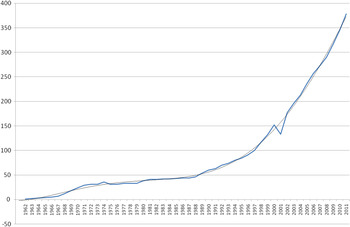
It is important to note that the rapid and significant development of IEEE in R8 was due to the interest and activity of IEEE members residing in R8 and of nobody else. They cared very much about European specificities. This was a key to success: as an example, there were four Student Branches in 1965, while there were about 380 in 2011 (Fig. 5).
Number of Student Branches in Region 8: from four in 1965 to 380 in 2011.

C) Chapter Coordination in R8, how it started
In 1985, B. Osborne, R8 Director, asked A. Vander Vorst to be officer for Educational Activities, an office he had already held earlier. A. Vander Vorst had some thoughts and proposed in 1986 to the new R8 Director, H. Ruechardt, to separate Chapter activities from the other educational activities. The Director was quite enthusiastic about this proposal.
Sections are geographical entities while Societies are technical entities. Concentrating on Chapter activities at the R8 level, however, led to investigate both Section technical activities and Society geographical activities. This was quite a challenge. The goal was defined: to increase the activity of existing Chapters; to encourage the formation of new Chapters; to set up R8 Chapter Chairs’ meetings; and to establish links with Society management.
At its first meeting in 1986, the R8 Committee decided to set up a R8 Chapter Coordination Committee (CCC), with five or six members, liaising each with one or more Society. R8 first selected Societies with the highest number of members in the Region. It allocated a significant budget to the committee. A. Vander Vorst was appointed as the first Chair.
The R8 CCC was formally launched in 1988, with: J. Baal-Schem, Communications; A. Davies, Circuits and Systems; P.M. Larsen, Automatic Control; B. Papadias, Energy; and A. Vander Vorst, Antennas and Propagation, and Microwave Theory and Techniques (MTT-S), as first members. Successive Chairs have been: A. Vander Vorst (1988–1993); B. Papadias (1994–1996); A. Davies (1997–2000); J. Modelski; N. Stojadinovic, etc.
During these years, some IEEE Societies started to be active in R8. The Circuits and Systems (CAS) Society appointed J. Neirynck as Vice-president for R8 in the 1980s, followed by A. Davies after six years of office. Similarly, the Communications Society (ComSoc) as well as the Antennas and Propagation Society (AP-S), held administrative meetings in R8 in the 1980s. This was also the case for the Automatic Control Society. Other Societies, such as MTT-S for example, were absent.
A. Vander Vorst set up the first MTT-S Chapter Chairs in R8 at the EuMC Paris, 1985. The meeting was pleasant, not formal; it lasted for about an hour and a half at the end of an afternoon. There were about ten participants, who expressed their wish for having such a meeting on an annual basis.
The first contact with MTT-S was at the MTT Symposium, Saint Louis, 1985. A. Vander Vorst, together with R. Marriott, met H. Howe (MTT President), M. Maury, and R. Sparks (MTT International Officer). He proposed an exchange program between the EuMC and the MTT Symposium, with three speakers appointed on each side, to present in the partner's event that was happening in Microwaves in their specific part of the world, respectively. There was enthusiastic acceptance from MTT and the program went on for more than 10 years.
As R8 officer, A. Vander Vorst invited R. Sparks to co-chair the second meeting of the MTT Chapter Chairs at the EuMC, Dublin 1986, so that the two Chapter “parents” – R8 and Society, respectively, – would be present. This was the start of a long series of annual MTT Chapter Chair meetings, at EuMC. This Region-Society cooperation led A. Vander Vorst to attend MTT-AdCom meetings twice a year since then, through 2006.
During the years 1985–1995, the R8 CCC went beyond expectations, obtaining results in: encouraging activities and enhanced Chapter management; stimulating formation of new Chapters; assisting Chapters to link with Society and gain Society support; assisting development of Chapter to Chapter contacts; supporting initiatives for Workshops, Conferences, etc.; and encouraging Society management to increase interest in their respective R8 Chapters.
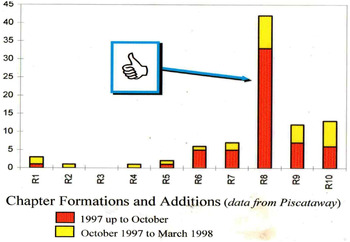
When the CCC started its activities in 1986, there were about 36 IEEE Chapters in R8. After the 2–3-year terms of A. Vander Vorst, there were about 100. At the end of 2012, there were about 500. As an example: in 1997–1998, the number of Chapter formations and additions was more than five times larger in R8 than in any other Regions (Fig. 6).
Chapter formations and additions in the 10 IEEE Regions in 1997–1998.

V. CONCLUSIONS
The European Microwave Conference has had a sustained and distinguished development since its first meeting in 1969. It has become one of the two premier conferences in its field in the world and has re-invented itself successfully in the past decade to create a secure foundation for a long and equally successful evolution into the future. Since the earliest days, the conference has sought to create a successful blend of scientific and industry interests and has adapted itself to and indeed shaped the many existing technical changes that have characterized and continued to be at the core of the field of microwave engineering. This development occurred in a European environment that was very active in the field of electrical and electronic engineering in general.
Simultaneously indeed, R8 IEEE members were very active in the second half of the 20th century to develop activities: Student Activities, Chapter Coordination, and R8 Conferences. They started from a situation where on 1 January 1963 IEEE had 150 000 members, among which 140 000 were residing in the USA, and contributed to the present situation where IEEE has 430 000 members with a majority of members residing outside of the USA. They exerted a significant activity. They have been instrumental in taking into account European specificity and the sensitivity, and in avoiding competition with local, national, and geographical entities. The result shows that this policy was successful.
At the end of the 1980s, some IEEE Societies were present in R8: ComSoc, AP-S, CAS, and AC-S. Other Societies, like MTT-S, did not engage very much on this road and remained rather absent: the first contacts with MTT-S were established by a R8officer, who set up the first R8 MTT-S Chapter Chairmen meeting and invited MTT-S officers to attend the next one.
ACKNOWLEDGEMENT
The author expresses his warm thanks to Andrew F. Wilson who kindly accepted to review the manuscript.
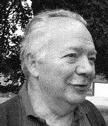 André Vander Vorst received his Electrical and Mechanical Engineer degrees and Ph.D. degree from the Université catholique de Louvain (UCL), Belgium, and his M.Sc. degree from MIT, USA. He has been a Professor at UCL until 2001 when he became Professor Emeritus. He has been with MIT and with Stanford University. In 1966, he founded the Microwave Laboratory, UCL. He has authored or co-authored seven books. He is one of the founders and secretary-treasurer of the European Microwave Association. He received awards and prizes, including the 2004 Microwave Career Award (IEEE MTT-S), and is an IEEE Life Fellow.