

Introduction
In recent years a number of longitudinal, population-based studies of health and aging have been initiated, primarily in Europe and North America (Reference Bild, Bluemke, Burke, Detrano, Diez Roux and Folsom1–Reference Seematter-Bagnoud and Santos-Eggimann8). In Canada, there has been ongoing discussion amongst researchers and government about the need for large-scale cohort studies that incorporate biology and genetics with the physical and social environment to address the health of the population (9–12), and a number of initiatives are poised to begin. The success of such large-scale studies depends, to a large extent, on the engagement of the public initially, and on maintaining participant interest thereafter. While we know from national surveys that Canadians value and support health research in general (13), we have much less information on their willingness to participate in an intensive, long-term initiative. This study explored the views of Canadians regarding one such study, the proposed Canadian Longitudinal Study on Aging (CLSA).
Like many longitudinal studies, the CLSA will require the long-term participation of individuals randomly drawn from the general population. Participation will entail providing a variety of health and lifestyle information using multiple data collection methods including telephone and face-to-face interviews, physical assessments, and the provision of biological samples such as blood and urine. Thus, the present study included four specific objectives: (a) exploring Canadians’ acceptance of, and support for, a long-term study on healthy aging; (b) exploring attitudes toward providing health, psychosocial, lifestyle, and biological data using a variety modes of data collection; (c) exploring willingness to participate, and facilitators and barriers to participation, including response burden; and (d) exploring beliefs and attitudes around privacy issues associated with the future use of archived data including biological samples.
Methods
Study Design
We used focus group methodology to collect qualitative data using a structured interview guide. Focus groups were considered to be the most appropriate form of data collection, given that individuals were expected to have limited personal experience as participants in longitudinal health research, and therefore the discussion would be enriched by hearing and expanding on the views of others to construct the participants’ view (Reference Lehoux, Poland and Daudelin14). Literature reviews guided the development of a set of questions around specific topics, such as privacy and confidentiality, the provision of biological samples, and response burden. The focus groups were held in six proposed CLSA data collection sites in June 2005: Halifax, Montreal, Hamilton, Winnipeg, Calgary, and Vancouver. All focus groups were conducted in English, with the exception of the Montreal group, which was conducted in French. Ethics approval was obtained from the research ethics boards at each of the three lead institutions: Dalhousie, McMaster, and McGill universities.
Participant Recruitment
Recruitment for the focus groups was conducted by telephone using a two-stage process. First, a commercial agency (ASDE Inc.) was used to draw the sample by generating random telephone numbers based on the working residential telephone exchanges within a 100-kilometre radius of each of the six study centres; the 100-km radius was consistent with the proposed CLSA protocol to recruit both urban and non-urban-dwelling participants.Footnote 1 Second, using this sample, the Institute for Social Research (ISR) at York University undertook the recruitment of participants using computer-assisted telephone interview (CATI) techniques. Consequently, 12 participants were recruited for each focus group.
Using the eligibility criteria originally proposed for the CLSA, individuals 40 years and olderFootnote 2 were eligible for recruitment. An age and sex balance within each focus group was desirable in order to obtain the views of both men and women; balanced groups were achieved by observing quotas within age and sex groups (female 40–59, female over 60, male 40–59, and male over 60).
When a telephone call resulted in contact with an individual eligible for the study, the person was provided with a brief description of the study and asked if he or she would be willing to participate. Those who indicated that they would be willing to participate were given specific information about the date, time, and location of the focus group. They were also asked to provide their mailing address so that a letter of confirmation could be sent. Recruits were then mailed a brochure describing the CLSA, a copy of the consent form, and written confirmation of their focus group meeting details. A toll-free telephone number and e-mail address were provided to allow recruits to obtain additional information on the consent process or any other aspect of the focus groups.
Focus Groups
Upon completion of informed consent, focus group attendees participated in a guided discussion concerning their views on participating in a long-term study of healthy aging. The interview guide covered the following five topics: (a) general beliefs and attitudes toward healthy aging and a long-term study to address healthy aging, (b) attitudes toward the collection of bio-samples and genetic information, (c) linkage of information with existing databases, (d) willingness and motivation to participate given the high response burden of a longitudinal study, and (e) privacy and confidentiality issues. The focus groups were, on average, two hours in duration. All participants received a $40 honorarium and were offered a summary of the group findings.
Analysis
Framework analysis was used to guide the analysis of the data. Framework analysis is a qualitative approach that lends itself well to asking specific research questions while not excluding the possibility of emergent themes. Framework analysis also allows for a clear explication of the stages of the analytical process (familiarization, identifying a theoretical framework, coding, charting, and interpretation) (Reference Lacey and Luff15–Reference Ritchie, Spencer, Bryman and Burgess18).
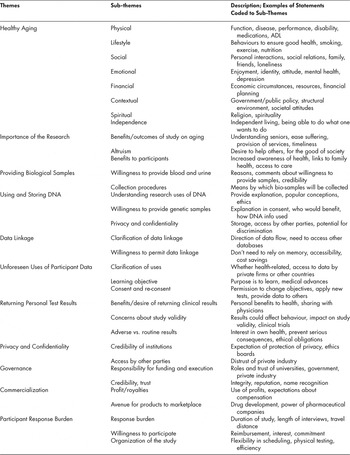
All focus groups were audiotaped, and field notes were taken. The audio tapes were subsequently transcribed. The transcript from the French language focus group was translated into English. Data generated from the focus groups were organized into themes based on a priori identified research questions in the interview guide. Two members (GS and SD) of the research team independently coded all transcripts using NVivo qualitative software. The coding was then compared and differences resolved through consensus. Sub-themes were identified based on the participant narratives within coded themes. A total of 11 themes were generated; findings are presented here from selected themes and supported by quotes from individual participants. The thematic framework is summarized in Table 1.
Thematic framework

Participant Characteristics
The focus groups ranged in size from 4 to 10 participants with a total of 43 participants across all six groups. Individually, and in combination, the groups were well balanced by sex and age group. In all, there were 22 males and 21 females. Participant age ranged from 41 to 79 with a mean age of 59; there were equal proportions of participants in the 40-to-59 age group and the 60 and older group. Participants varied in terms of education, with 16 (37%) having completed high school or less, 10 (23%) with vocational training or community college training, 6 (14%) with some university training, and 11 (25%) with one or more university degree. The majority of participants (35, or 81%) were born in Canada. In terms of ethnicity, almost half of the participants (20, or 47%) indicated British Isles origins; 7 (17%) indicated French origins, and a further 10 (23%) indicated other European origins. The remainder indicated African, Asian, or Latin, Central, or South American origins. One participant indicated aboriginal origins. Concerning marital status, 26 (60%) of the participants were married, while 13 (30%) were widowed, separated, or divorced; 4 (10%) were never married. In terms of employment, 19 (44%) of the participants were employed either full or part time, and 18 (42%) were retired. The remaining 6 (14%) were unemployed, homemakers, or disabled. Household income varied widely with 11 (25%) of the participants reporting less than $25,000 and 11 (25%) reporting $75,000 or more, with the remaining 22 participants (52%) between these levels.
While no claims can be made for representativeness, it is evident from this profile that focus group participants were diverse in terms of their age, education, employment status, and income. However, participants were also likely to be “research friendly”, and health conscious. Thus, there may be additional issues affecting acceptability and feasibility that did not arise in these focus groups. Our findings should be viewed with this limitation in mind.
Results – Major Themes
Healthy Aging
The concept of healthy aging is a central theme of the CLSA, underlying much of the proposed research. As such, it provided an interesting and useful starting point for the focus group discussions. Participants were asked, “What first comes to mind when I say healthy aging?” Concepts identified by participants included the notion of comfort, and linked to this, freedom from pain, illness, disability, and medications. There was a keen awareness of the importance of lifestyle choices but also recognition of the difficulty inherent in making the right choices. It was noted that longevity was of little consequence if it did not include good health.
“I think it’s living to a ripe old age without being incapacitated.” (G1c)Footnote 3
“But if we’re going to live longer, I want to be healthier while I’m doing it.” (G3x)
The focus group discussions generally revealed an evolution of thinking on the part of participants. Initial comments tended to be toward the physical and lifestyle aspects of healthy aging, while later comments moved into the social, emotional, and spiritual aspects of healthy aging. Overall, participants demonstrated an understanding of aging as a complex multidimensional process.
“Too many people, when you say healthy aging, they think only physical health but healthy aging has to do with using yourself spiritually, your growth, your intellectual growth as well as your physical growth and also having the finances to maintain a lifestyle.” (G3b)
Importance of Conducting Research on Aging
Most participants understood, and verbalized, the benefits of conducting research on aging. Aging was a reality for the majority of participants, either from their own personal experience, or that of close friends and relatives. They also recognized the timeliness of a study on aging given the changing demographic profile of the Canadian population.
“My first reaction is that this is very important and it should be happening right now. The aging population is the largest population in this country now, and growing… it’s a good thing, I highly approve of it.” (G6c)
Participants commented on the rising cost of health care and the need for individuals to take responsibility for their own health as a way of controlling these expenditures. The results of a study on aging were seen as a means of identifying lifestyle and other factors that would help promote healthy living. However, participants were aware that most of the benefits of the study would accrue to society in general or to future generations rather than to the individual study participants.
“Results after 20 years is not really for us but for the next generation.” (G2x)
The social policy implications of undertaking a study on aging were raised by participants who reasoned that it would provide valuable information to governments in terms of planning for future needs of an aging population. Several participants expressed the view that the study would only have value if the results were translated into policy.
“There are a lot of studies about this that are sitting on shelves. You can have the best study but if the government ignores it, it means nothing.” (G2x)
Altruism was a major motivating factor for most participants who indicated that they would be willing to take part in the study if it would “help others.” This motivation was repeated in all the focus groups in many different discussions.
“If it’s for the good of society, no problem. I would be content knowing I participated in a good social cause.” (G2x)
However, participants could also see that there might be some benefits to themselves or their families by participating in a long-term study. Many felt that it would make them more health-conscious simply because their health was being monitored. Participants did not view the study as a substitute for care by their health care providers, but did recognize that the study might find something of which they or their provider was unaware.
“My mother … and my grandmother … both died of breast cancer, so if something like this could benefit … my daughters or my granddaughters, then I think it would be a good thing.” (G4a)
“This way, if they’re keeping track of you, they might be tracking a few other things that you haven’t thought of …” (G4g)
While monetary rewards were eschewed, other forms of recognition were clearly valued. Participants wanted to be thanked for their efforts and to know that their participation was helpful to others.
“… basically your primary reason for doing it would be to help others. So if all of a sudden they come back and say, hey, what you’ve done has helped in this way; that would be kind of nice …” (G1y)
Providing Biological Samples
The majority of participants had no concerns about providing blood and urine samples in the context of a research study. Many indicated that they already do this on a regular basis for their family doctors, so it would not bother them to do it for a research study. Interestingly, there was the sense from participants that collecting blood and urine samples added credibility to the study.
“I think that would validate it, if they are taking actual medical information.” (G4f)
“It adds credibility …. You’re going to see … where people are. Are they improving or not improving, that sort of thing? You know, nobody likes to get their blood taken but I’d say it’s a good reason to have it done.” (G3x)
A number of participants felt that the testing might have diagnostic value for them, uncovering something of which they were unaware.
“Sometimes it’s a good thing to find out because if they find out in time they can cure it.” (G2x)
Others, however, had questions about why a blood sample was needed. In this context one group brought up the spectre of discrimination by private companies based on the results of blood and urine tests. A few participants said they would provide samples as long as they were not identifiable as the donors of those samples.
“I just know that some things that have been found through testing, people have been discriminated against for it.” (G6g)
Using and Storing DNA
The potential value of DNA was recognized in furthering our understanding of many diseases, perhaps leading to treatments and even cures.
“… genetic material is the key … I think if you start studying stuff like that, then you’re starting to see things that people inherit …. We know that there is a lot of diseases and stuff that people have that … if studied with a big enough population you might be able to see some kind of pattern and perhaps break the pattern …” (G4i)
Others wanted to know why DNA was needed as part of the study and what it would be used for.
“Well I don’t think anyone [would] ask that question without explaining why it was needed. I don’t think anyone would agree to it without being informed why. And if there were a benefit to it … I wouldn’t object in any way to it as long I was given a full explanation of why and if it would be of benefit and how.” (G5a)
There was considerable conjecture about the use of DNA in various settings. Awareness of DNA seemed to be largely based on controversial images such as human cloning, eugenics, and its use in law enforcement.
“Hopefully, you’re not doing Frankenstein type stuff with my DNA. If I see someone that looks like me walking … I know who to come after.” (G4i)
“Would it be used for law enforcement, or any of that stuff, or just in the study?” (G1z)
Ethical questions arose surrounding the collection and use, or misuse, of DNA. On multiple occasions, participants indicated that only those with “something to hide” would be wary of a DNA test.
“I’m not planning any murders or anything in the future, so they can keep my DNA.” (G4f)
“But generally speaking, I think that the only people that are concerned about confidentiality issues are those with something to hide.” (G1y)
Among some participants, the mention of DNA evoked a negative response.
“I would feel leery about it. Right away, I got my back up against the wall.” (G6g)
Despite the reservations expressed, most participants would be agreeable to providing a sample of their DNA for research purposes providing that their questions and concerns about consent, privacy, and confidentiality were adequately addressed. Individuals wanted assurances of how their DNA would be used for research and how their privacy would be protected. Generally, participants felt that knowing the project had been approved by an ethics review board would be an important consideration for them in deciding to provide DNA material.
Data Linkage
Participants were told that, with consent, it was possible to link information that people provide in a research study with individual health records maintained by their provincial health care system using health card numbers. They were asked how they would feel about having the information they provided linked with existing health care records in this manner. Most participants had no problem with the concept of data linkage and thought that it would be beneficial to the study. However, several participants found the idea somewhat troubling.
“I don’t think that the government has all that much information and I don’t think that I would want a study like this linked to the government at all.” (G5b)
There was considerable discussion of the mechanics of data linkage, including the direction of data flow. Some participants expressed that they did not want data from the study to be shared with provincial health authorities while others had no problem with this concept.
Speaker A: “Oh, which way is it going; from them to you or from you to them?”
Moderator: “No, from them to the study…”
Speaker A: “But they don’t have access to what you get out of this?”
Moderator: “Right.”
Speaker A: “Okay, that’s [was] my concern.” (G6g)
Some participants did not understand why the study would want or need to access their health records, reasoning that they could provide the necessary information themselves. In some cases other participants addressed this concern arguing that people’s memories were not always accurate or that the records might contain information of which the person was unaware. One participant summed up the process in this way:
“Basically, you’re taking a shortcut to get the information instead of going through it all yourself … you’re saving money, that’s still OK. It’s still confidential, just an accessible thing.”(G1y)
Unforeseen Uses of Participant Data
Participants were asked how they would feel if the information that they provided was used for future research that could not be foreseen at the time they agreed to participate. Despite some initial confusion, most participants understood, or came to understand, the nature of the question and were agreeable, provided the research did not deviate from its initial objectives.
“Has anybody got a crystal ball? … the parameters of the study may very well change five years into the study, simply because of medical advances.” (G1y)
“I would expect it because the idea of this study is to learn.” (G4i)
“… if you’re going to find something different, or you want to use it for something different, it … extends the validity of the study and how far the study can go, then why would they say no?” (G3x)
Much of the concern over unforeseen uses of the data was based on the potential for inappropriate uses of the data by other groups or other organizations.
“… you don’t know where it’s going and then all of a sudden these people [are] no longer involved in the study and some group from the United States are involved in this study and then the whole integrity part of that is gone.” (G3x)
Some of those who understood that new tests might be developed and applied to data that had been previously collected expected to be notified and, if the original parameters of the study changed, asked for their consent.
“You don’t agree to carte blanche and say do what you want to do with it. You agree to: this is the study as I understand it. I’m going to sign and that is the study I’m doing. If you want to do something else with my information, you have to come to me and explain to me what you’re trying to do.” (G3x)
Returning Personal Test Results
Participants were interested in their own health and were eager to have additional means of monitoring it. While receiving individual test results was perceived as a benefit of participating, it was also recognized that the distribution of routine results would be time consuming. Some participants wanted the information collected as part of the study to also be shared with their physicians indicating that, in some ways at least, they see participating in the study as a way of supplementing their health care monitoring.
“Because I think if you went into this study, I think your own personal doctor should be notified that you’re doing this and that they’re getting a report on how you’re doing …” (G1z)
Some participants were cognizant of the fact that returning individual test results could affect behaviour or lead to treatment that could potentially alter the study outcomes. This led to debate in some groups between those favouring a “pure” study and those who wanted to receive their results. It was clear that some participants had knowledge of how clinical trials have been conducted and felt that the study should also proceed in this manner. Others felt that this study was different and that individual results should be shared with participants.
“In the interest of science, I think it has to be cold-hearted myself … are we trying to fix people or are we just trying to figure out, is there a problem?” (G4i)
“... what you’re talking about is more like a double-blind drug company study. This is more of a health and lifestyle study … and there’s nothing wrong with knowing the results …” (G4j)
There was general interest in receiving the results of individual tests, but some felt that they already received this information from their doctors so it was not critical to know. The sense conveyed by most participants was that it would be beneficial but not essential. However, participants were concerned about receiving any adverse findings and felt that the study should be responsible for passing on such information either to the participants or their physicians. A number of participants felt that only adverse findings should be reported back, reasoning that individuals were responsible for their own health.
“And I don’t think the study should report back on everything they find, but if they find something serious, I think they should let you know.” (G4c)
“Yeah, but ultimately our health is our own responsibility and it is up to us to go to our own doctor on a regular basis … so it shouldn’t be their responsibility to … say, yeah you’re healthy or you’re not healthy, but if something big was found, then, yeah, I’d like to hear about it.” (G4f)
Privacy and Confidentiality
Most participants had no specific concerns about privacy and confidentiality and those that did focused mostly on the privacy of genetic material. There was an assumption among participants that their confidentiality would be protected, and there was a trust in universities to make that guarantee.
“That’s why I think if the research is done by a credible group like a university, I think you can rely that they will keep it confidential.” (G4c)
A few participants had concerns about who would have access to the data or expressed the view that they would like more information about how their privacy would be protected.
“I suppose it would all be within the hands of the study. I presume it’s not for sale.” (G4z)
“There are private things that I would not want to share … so if I had that right I would not be worried.” (G2x)
Participants were reassured by the consent process used for the focus groups and the guarantees of confidentiality that were given for the data collected in these groups.
Governance
Participants were asked, “Who do you think should be responsible for conducting a study like this?” Probes to this question included these: “Is it important to you to be able to recognize the name of the organization that is conducting the study?” and “Is there a particular organization, or type of organization, that would make you feel more comfortable about participating in a study like this?”
Participants spoke of general characteristics such as integrity or reputation, but most of them specifically identified universities. Universities were seen as credible organizations to carry out the research and were trusted to do so in an ethical manner. A number of participants indicated that the only reason they agreed to attend the focus group was because of the university affiliation, and in particular recognizing the name of a university with which they were familiar.
Speaker A: “That’s why I was here tonight because I said to the young lady that was on the phone: “who are you with?” and she said who she was with; then I was willing to listen.” (G3x)
Speaker B: “I would have turned it down otherwise.” (G3a)
Commercialization
Participants were wary of government involvement in the conduct of the study but felt that government should fund the research. However, they expressed reticence at the prospect of private funding from commercial enterprises, particularly pharmaceutical companies. Some participants did not support the idea of commercializing research discoveries while others had mixed feelings, recognizing the potential benefits.
Speaker A: “… I’ve just read too much about the manipulations done by the drug companies. They’re very powerful.” (G4j)
Speaker B: “But you know, on the other hand, the drugs that we have today are saving lives …” (G4c)
Most participants wanted to be notified if research discoveries made as a result of a study they participated in were commercialized. The primary motivation for this was acknowledgement of their contribution to the study. A few others felt that notification, especially if it involved approval, would be impractical.
“… but I think if I’m agreeing to the study, I also can’t expect somebody to be calling me up every few months to say: we’ve produced this drug, do you agree with it? I think at some point I’d have to trust that … whatever you do with the results is up to you …” (G6c)
Some participants felt that it was acceptable for research discoveries from the CLSA to be developed and marketed provided that all revenues were re-invested in furthering the research conducted by the study.
“I like the idea that if it was attributable directly to this study, yeah, use it for ongoing research, put it back; roll it back into the study.” (G1c)
Participant Response Burden
Participants were asked a number of questions that probed their willingness to participate in a study that imposed a relatively high level of response burden. They were asked their feelings about committing to a 20-year study, visiting a clinic for a four-hour physical assessment and interview every 3 years, and their motivations for participating or not participating in the study. As a final question, participants were asked if they would agree to participate if asked at that moment. All of these questions and their attendant probes were designed to elicit responses that would help to determine if the proposed study design would impose an unreasonable burden on participants and if there were particular elements of the research design that might make participants less likely to want to participate in the study.
The length and the intensity of measurement in the study did not seem to concern most participants. Similarly, coming to a central location for a physical assessment and interview that could last up to four hours was not problematic for most.
“I think if one is being asked to participate in a 20-year study … you would expect to be contacted regularly, otherwise there’s not going to be much studying done.” (G1y)
“I’d be disappointed if it didn’t happen that way. I think that if you’re going to do the study, then you should know the subject …” (G5c)
Some of the specific concerns mentioned by participants included the types of testing and physical measures that would be performed, who would be conducting the testing, the difficulty elderly participants might encounter in getting to a central location and what would happen to participants if they moved elsewhere during the study.
“But I’d have to know what kind of tests you’re going to run me through. One thing, I couldn’t go in some goddamn machine, just stick you right in the hole … I get claustrophobic, right? I ain’t going in that thing.” (G1d)
“A lot of people that are older can’t get around on their own. They’re going to be relying on their support group … friends or family, so a lot more people would be involved in these studies than just these people who’ve consented.” (G5b)
The distance they would have to travel was not problematic for participants as long as it was not to another city. Participants in most cases expected that they would have to travel to a central location for this type of assessment. As noted, recruitment around the data collection sites was subsequently reduced from a radius of 100 kilometres to 25 kilometres. Thus, the participants in this feasibility study were drawn from a wider area around each of the sites. We might speculate that barriers to recruitment and retention of this group might be greater than for those who live closer to the sites. An important consideration that was mentioned in almost all groups was flexibility in scheduling appointments. Participants did not want to be given a date and time with the expectation that they would appear, but rather, expected to be consulted and a mutually agreeable date and time set. Participants also wanted the flexibility of night and weekend appointments and the ability to split the assessment and interview over more than one session.
“It would depend on whether they tell you to come in on a Monday at 2 o’clock or whether they, say, give us a call and make an appointment and set something up.” (G3a)
Speaker A: “It would be nice if it was, say, on a weekend because most of us work through the week, and have weekends off, so we wouldn’t have to take a day off work.” (G4f)
Speaker B: “Or evening maybe.” (G4z)
Speaker C: “But if you schedule the time, some people can go in the evening; some people can go during the day. I mean you just schedule it.” (G4c)
Most participants were interested in volunteering for the study. In a few cases, participants felt they needed more information about the study and their role in it before making a decision, but no one indicated that they would refuse outright to participate. Several participants made the comment that those who would not participate had already been screened out by not agreeing to participate in the focus groups.
“I have no problem either. I’d gladly participate. I think that it’s a wonderful study.” (G4c)
“I think the guys who wouldn’t participate; I don’t think they’re in this room.” (G4y)
“I’m pretty sure I would do it but I’d like to have something before I agree that says this is exactly what we’re going to do and this is what we expect of you.” (G3c)
Almost all participants expressed positive interest in the CLSA and were not intimidated by the length of the study nor its requirements. Participants related a few conditions that would inhibit their participation, chiefly the involvement of pharmaceutical companies. When asked about their motivations for participating, most indicated that it was a desire to contribute to a good cause or to help others, either society in general or future generations. Virtually all participants agreed that receiving the results of their individual tests would motivate them to participate in the study, and they would also be very interested in learning the overall results of the study, including how they themselves compared to others in their age group, via ongoing communication. Participants did not want to lose money because of their participation but also did not expect to be paid for their involvement.
Discussion
The focus group methodology provided a rich environment in which to explore an array of views on multiple aspects of participating in a longitudinal study. There was fundamental support for longitudinal research on health and aging among members of the focus groups. A study such as the CLSA was considered to be relevant, timely, and worth the investment of individuals’ time and effort for the benefit of society. This perspective is consistent with previous quantitative work in the broader health domain, where it has been documented that a large majority of Canadians strongly support health research (13). Specific to the CLSA, we found that participants were willing to go to considerable lengths to participate in such a long-lasting and information-intensive study, but in turn, they expected the study to be cognizant of their needs. This was true of logistical aspects such as scheduling appointments as well as more fundamental issues such as providing assurances of privacy and confidentiality.
Given that the collection of biological samples in large-scale epidemiologic studies such as the CLSA has become increasingly feasible, we were particularly interested in participant perceptions regarding the provision and storage of blood and urine. Generally, focus group participants felt that providing biological samples was essential to health research and added credibility to a study. Participants were familiar with providing samples as part of routine medical care and had few concerns extending this to research. The UK Biobank has also conducted focus groups to assess the public’s attitudes toward collecting and storing biological samples in the context of research (19). Key findings in common include a preference for understanding what the biological samples will be used for and a desire for reassurances of safeguarding confidentiality.
While genetic information tended to be perceived as more personal than non-genetic information, there was general support in the focus groups for the collection, storage, and analysis of DNA. However, popular misconceptions about genetics and associations with the uses of genetics such as forensic DNA testing and cloning suggest the need for clear and careful explanations regarding the use of genetic information during the consent process. These qualitative findings are consistent with previous quantitative studies examining Canadians’ perceptions regarding genetic information. An opinion poll conducted in 2000 found that 90 per cent of Canadians strongly agree (61%) or agree (29%) that genetic information is different from other types of personal and health data and that this type of information needs stronger protections (20). Further, a 2003 report prepared for the Government of Canada found that 78 per cent of Canadians were willing to provide information from genetic testing for inclusion in a database used for medical research. The support increased to 90 per cent when people were told that privacy protections would be applied and that there could be research benefits (21).
In the present study, focus group participants clearly saw the need for detailed health information to be collected and were generally trusting in research institutions to put appropriate privacy safeguards in place. Although participants indicated that they had few concerns with respect to privacy and confidentiality when directly asked, many of the concerns raised throughout the discussions were of this nature. The inherent tension between the need for information and the need for privacy was most clearly appreciated in the context of linkage with other data sources and with respect to future unforeseen uses of the data. However, participants were often thinking about these issues for the first time, and had little awareness of the processes that would be required. These findings are similar to a 2004 EKOS/Queens University study, which reported that people did not place a high priority on privacy of personal information, and few knew basic information about existing privacy legislations or the technologies used to collect, store, and transmit their personal information electronically. A recent Ontario study by Willison et al. (Reference Willison, Keshavjee, Nair, Goldsmith and Holbrook22), which examined patients’ preferred consent method for use of their electronic medical records, concluded that “most patients had given little or no prior thought about the use of their personal information for anything other than their own health care.” However, in our present study, when pressed to reflect on the issue, most wanted to be asked permission for the use of their health records. Our findings draw attention to the need for clear and explicit explanations to be provided to participants, as well as offer an opportunity for participants to reflect upon and ask questions prior to signing an informed consent. As part of the consent process, participants should be made aware of their privacy rights and how personal information will be both used and kept confidential.
Participants clearly believed that universities, not government, were the appropriate institutions to conduct a longitudinal study on aging, and recognition of institutional names was viewed as an important element in conveying trustworthiness and credibility. Government was viewed as the appropriate funder of such a study, whereas private for-profit organizations were regarded with a high degree of suspicion. A general lack of trust in government has been expressed as a barrier to participation in other settings involving physical measures (Reference Kelly and Allard23); however, in pilot work conducted with Statistics Canada in preparation for the CLSA it was found that participants reported some uneasiness in allowing a non-government agency to access their personal information (24). This could be due to the fact that individuals were asked to release their information to an unknown entity, the Canadian Lifelong Health Initiative. It may also have been due in part to social desirability bias, where participants report what they think will be viewed favourably by the investigators. Moreover, as noted by the participants themselves, those who took part in the focus groups were, by their involvement, more favourable to such a study than would be expected from the general population as a whole, and thus could skew the findings. For example, participants who trusted universities may have been more likely to agree to participate in the focus groups, so it would follow that they would be more likely to prefer universities to conduct the research.
Although the major themes in this study were primarily identified a priori based on the interview guide, a number of sub-themes emerged as influential factors. Altruism emerged as a key motivation to participate in health-related research; this was interlinked with the notion of providing benefit to future generations. A number of factors that would act as facilitators of participation were also acknowledged, reinforcing their importance in the CLSA protocol. For example, while participation was not seen to involve personal gain, recognition of individual contributions to the study in terms of study updates and regular communication about the way in which the findings could be used to help others was clearly valued. Receiving individual results from physical and clinical assessments was viewed as greatly facilitating recruitment and retention, but was considered as a benefit rather than a requisite for participation. Logistical factors facilitating participation included flexibility in scheduling and reimbursement for out-of-pocket expenses. Although there were few barriers to participation expressed, it is important to be aware of general concerns about the potential misuse of genetic materials, future commercialization of participant data, and privacy issues related to data linkage. Our findings regarding willingness to participate correspond to those from focus groups conducted by Statistics Canada to assess participant views on including physical measures in the Canadian Health Measures Survey (Reference Kelly and Allard23).
It should be noted that focus groups, similar to other research modalities, have inherent limitations. For example, study participants told us that they would be willing to come to a “central location” for a physical assessment and an interview, which would last up to four hours. However, expressing willingness in a hypothetical scenario may not directly correspond to what participants will actually do. We also could not be sure that our focus group participants understood the concept of a “central location” in the same way that we did. These practical kinds of issues are of prime importance to the CLSA, both for recruitment and for retention purposes. Focus groups, while helpful in terms of exploring such issues, cannot be exhaustive in uncovering logistical concerns.
In summary, exploring the beliefs and attitudes of Canadians toward a comprehensive, longitudinal study allows us to design the CLSA in a way that is most acceptable to participants, and thereby to maximize recruitment and retention. Healthy aging is a topic that the general population understands, values, and supports as a timely focus for longitudinal research in Canada. Personal interest in health is strong, and the provision of individual results is likely to be an important catalyst to long-term involvement. While there is considerable trust and good will toward longitudinal research, safeguards with respect to privacy and confidentiality will be key to public acceptance. These findings have already informed current, and will inform future, work in the CLSA, and also provide useful information to a broad spectrum of researchers who undertake longitudinal studies in Canada and internationally.