Introduction
Quality of life (QoL) has become a key outcome for assessing the efficacy of pharmacological and therapeutic interventions in dementia care (Katona et al., Reference Katona, Livingston, Cooper, Ames, Brodaty and Chiu2007). In recent years, assessment of QoL in people with mild to moderate dementia has been increasingly carried out using a range of self-reported measures. Such measures offer a valuable focus on the person experiencing dementia and these have also been shown to provide consistent and reliable information regarding QoL issues (Trigg et al., Reference Trigg, Jones and Skevington2007a).
The factors that best predict self-reported QoL ratings from people with dementia nonetheless remain unclear. Depression seems to have a strong association (Logsdon et al., Reference Logsdon, Gibbons, McCurry and Teri2002) and recent evidence suggests that level of insight may be another important predictor, such that individuals who are more aware of their cognitive deficits tend to report a lower QoL (Trigg et al., Reference Trigg, Watts, Jones and Tod2011). Perhaps surprisingly, however, objective measures of cognitive function and activity performance seem to have little association with self-reported QoL ratings (Banerjee et al., Reference Banerjee2009).
Discrepancies between self-reported and proxy QoL ratings are also notable, with self-reported ratings generally being more positive than those provided by a proxy (Novella et al., Reference Novella2001; Logsdon et al., Reference Logsdon, Gibbons, McCurry and Teri2002). This has led some to query the usefulness and validity of self-reported data (Whitehouse, Reference Whitehouse1999). Others have used the same evidence to propose that proxy and self-reported ratings of QoL represent distinct modes of assessment, reflecting different types of appraisal (Trigg et al., Reference Trigg, Watts, Jones and Tod2011). While proxy QoL ratings (and the measures designed to gather them) are heavily focused on the observable and objective aspects of the person with dementia's current function and performance, self-reported ratings seem to take the person's subjective feelings and mood states as their primary point of reference.
This latter observation links the self-reported ratings of people with dementia to “top-down” theories of subjective well-being in the wider population (Diener, Reference Diener1984). These theories suggest that self-reported QoL ratings are not derived primarily from a systematic appraisal of specific performances, events, and experiences, but instead reflect a person's overall feelings of well-being. In other words, QoL ratings are driven more by personal attitudes and personality traits than by the vagaries of changing situations (Ormel, Reference Ormel1983). Heyink (Reference Heyink1993), for example, points out that people who have positive attitudes about their lives in general will also tend to appraise specific events or aspects of their lives more positively. This alternative conceptualization may also go some way to explain why self-reported QoL ratings seem so resistant to changes in health status (Albrecht and Devlieger, Reference Albrecht and Devlieger1999). The possession of positive life attitudes in older age has the potential to induce an internal or psychological resilience to health changes that could never be registered or predicted by QoL ratings derived by reference to observable attributes alone.
The benefit of retaining positive attitudes, and particularly positive attitudes to aging, has been well documented in research with older adults. Levy et al. (Reference Levy, Slade, Kunkel and Kasl2002), for example, found that those with more positive perceptions of aging lived on average 7.5 years longer (after controlling for age, gender, socioeconomic status, loneliness, and functional health). In addition, negative attitudes and age stereotypes have been linked to increased cardiovascular responses to stress (Levy et al., Reference Levy, Hausdorff, Henke and Wei2000), damaging health behaviors, such as higher tobacco use (Levy and Myers, Reference Levy and Myers2004), reduced memory performance (Hess et al., Reference Hess, Hinson and Statham2004), and deleterious effects on mood and dependency (Levy, Reference Levy1996). Scholl and Sabat (Reference Scholl and Sabat2008) also argue that people with mild to moderate dementia – individuals who may be aware of their failing memories – are particularly likely to see negative age stereotypes as applying to themselves.
Despite this body of evidence, however, which clearly links attitudes to aging with well-being in older adults, the former have never previously been assessed in people with dementia. The current paper addresses this issue via administration of the Attitudes to Aging Questionnaire (AAQ) (Laidlaw et al., Reference Laidlaw, Power and Schmidt2007; Chachamovich et al., Reference Chachamovich, Fleck, Laidlaw and Power2008) to a sample of people with mild-to-moderate stage dementia. Having been developed for use with older adults, the first goal of data collection is to establish the acceptability of the attitudes to aging tool amongst this new population. The data will then be used to assess the attitudes to aging of people with mild-to-moderate dementia to (i) see whether these attitudes differ significantly from older adults without dementia; (ii) ascertain the main factors that predict these attitudes; and (iii) explore any relationship that exists between attitudes to aging and the self-reported QoL ratings of people with dementia.
Methods
Participants
Fifty-six participants with a diagnosis of dementia according to DSM criteria (DSM-IV-TR; American Psychiatric Association, 2000) and their caregivers took part in the study. The data were collected during the first six-month follow-up in a two-year longitudinal study of QoL changes in people with mild stage dementia (indicated by a Mini-Mental State Examination score at recruitment of 18 or above; Tombaugh and McIntyre, Reference Tombaugh and McIntyre1992). The baseline data for the longitudinal study (N = 69) have been reported elsewhere (Trigg et al., Reference Trigg, Watts, Jones and Tod2011). All participants were recruited from a memory clinic setting.
A convenience sample of 84 community-dwelling older adults was also recruited to complete the AAQ as a means of providing comparative attitudes to aging data. Inclusion criteria were being aged 60 years or more and no current diagnosis of dementia. Participants were self-selecting in that they responded to local advertisements to take part in the study.
Measures
Bath Assessment of Subjective Quality of Life in Dementia (BASQID)
The BASQID (Trigg et al., Reference Trigg, Skevington and Jones2007b) is a 14-item self-report measure of QoL. It can be scored as a single scale or as two subscales which assess life satisfaction and feelings of positive life quality. Responses are transformed to give scores ranging from 0 to 100, with higher scores indicative of a better QoL. The BASQID is suitable for use with people with mild to moderate stage dementia and demonstrates good reproducibility, internal consistency, and construct validity.
Attitudes to Aging Questionnaire (AAQ)
The AAQ (Laidlaw et al., Reference Laidlaw, Power and Schmidt2007) is a measure developed by the WHOQOL Group to assess subjective perceptions of aging. It comprises eight statements in each of three domains: “Psychological Growth,” “Physical Change,” and “Psychosocial Loss.” Respondents are asked to indicate their own feelings about aging using a five-point scale ranging from “strongly disagree” to “strongly agree” for seven of the questions and “not at all true” to “extremely true” for the remainder. The Physical Change subscale contains statements about vitality, such as “I have more energy than I expected for my age,” while the Psychological Growth subscale reflects possible gains made with age, including “Wisdom comes with age.” Both subscales reflect positive attitudes to aging. The Psychosocial Loss subscale includes statements such as “Old age is a time of loneliness” and thus reflects a negative attitude to aging. Scores can be calculated separately for each domain and range from 8 to 40, with a higher score indicating a stronger endorsement of the attitude. The AAQ has demonstrated robust psychometric properties. Items were generated through focus group work and a subsequent Delphi exercise in 15 centers across the world, ensuring cross-cultural validity. The subscale structure and reliability have been confirmed through factor and the Rasch analytic methods (Laidlaw et al., Reference Laidlaw, Power and Schmidt2007).
Memory Functioning Scale (MARS-MFS)
The MARS-MFS (Clare et al., Reference Clare2002) is a 13-item subscale of the Memory Awareness Rating Scale (MARS) that captures views on the ability of the person with dementia to “manage” across a range of everyday memory situations. It is administered to both the person with dementia and their caregiver. Discrepancy scores assess the memory awareness of the person with dementia. A positive discrepancy value indicates that the person has some lack of insight in relation to their memory function. The MARS-MFS has good internal consistency, reproducibility, and criterion validity.
Alzheimer's Disease Cooperative Study Activities of Daily Living Inventory (ADCS-ADL)
The ADCS-ADL (Galasko et al., Reference Galasko1997) is a 23-item informant-completed questionnaire about basic and instrumental ADL. It assesses the capacity of the person with dementia to perform independent daily activities. Total scores range from 0 to 78 with higher scores indicating better functioning. Test-retest reliability of the ADCS-ADL is good and the measure has demonstrated sensitivity to the progression of disease.
Mini-Mental State Examination (MMSE)
The MMSE (Folstein et al., Reference Folstein, Folstein and McHugh1975) is a widely used measure of cognitive function, with a maximum score of 30 points. A higher score indicates better cognitive function. The measure has demonstrated good test-retest and inter-rater reliability and has been extensively validated (Tombaugh and McIntyre, Reference Tombaugh and McIntyre1992).
Procedure
All participants were required to provide written informed consent. The participants with dementia and their caregivers were assessed in their homes. The person with dementia completed the BASQID, AAQ, MMSE, and MARS, while the caregiver completed the ACDS-ADL and MARS-MFS. The AAQ was administered by interview. A copy of the questionnaire was placed in front of the participant and the researcher read aloud the questions and response options. Participants were encouraged to tell the researcher of any questions that they found difficult to answer. The researcher kept a record of such instances and probed for further information where necessary. If the participant was unsure about the response to be given to a question, he/she was asked to choose the one that appeared most appropriate, while keeping in mind his/her standards, hopes, pleasures, and concerns. Participants were encouraged to think about their life in general. Standardized prompts were provided to participants who required further explanation of a question's meaning. The AAQ was posted to the sample of older adults without dementia using a prepaid return envelope. Participants were asked to return the AAQ within two weeks and to complete the assessment as a reflection of their own personal views about aging.
Data analysis
Descriptive statistical data for all scales were calculated and scores for the three AAQ subscales were compared across both samples using t-tests. Differences across individual item scores for the AAQ were calculated using the Mann–Whitney U test due to the ordinal nature of single-item scores. The level of significance was adjusted using the Bonferroni correction in instances where multiple comparisons were made. The internal consistency reliability of AAQ scales was assessed using Cronbach's α.
Spearman bivariate correlations between the main study variables were calculated. Due to multiple univariate analysis, the p < 0.01 level of significance was used. A multiple linear regression was employed to explore the predictors of the three AAQ subscales within the sample of people with dementia. Due to the exploratory nature of this analysis, variables were entered into the regression analysis in a stepwise method. A hierarchical multiple linear regression analysis was used to determine whether the AAQ scores could improve a predictive model of self-reported QoL ratings for people with dementia. Mediation pathways within the regression model were confirmed using the Sobel test (see MacKinnon et al., Reference MacKinnon, Lockwood, Hoffman, West and Sheets2002)
Results
Out of the 56 participants with dementia, 45 (80%) had Alzheimer's disease/mixed dementia, five (9%) had vascular dementia, three (5.5%) had dementia with Lewy bodies, and three (5.5%) had frontotemporal dementia. The mean age of the group was 78.77 years (SD = 6.53; range 60–93), and 30 (53.6%) were male. The MMSE scores were distributed around a mean of 21.96 (median = 22.5; SD = 2.89; range = 14–27). At the time of the current data collection, the MMSE score for four of the participants had dropped below 18 (suggesting a diagnosis of moderate dementia).
Out of the 84 older adults without dementia, 42 (50%) were male and the mean age was 73.04 years (SD = 6.16; range = 65–95). An independent samples t-test (t 138 = 5.26, p < 0.01) confirmed that this group was significantly younger than the sample of persons with dementia. Bivariate correlations demonstrated no significant association between age and any of the three AAQ subscales within the sample of people with dementia, the sample of people without dementia, and the participants as a whole.
Using the AAQ in a sample of people with dementia
All 56 participants with dementia attempted the AAQ. Out of 24 questions within the measure, 13 were completed by all the participants. The highest level of missing data was 3/56 (5%) for Q10 (“I am more accepting of myself as I have grown older”), Q13 (“My identity is not defined by my age”), and Q14 (“I have more energy now than I expected for my age”). These were caused by problems of semantics. Four participants had difficulty understanding the phrase, “accepting of myself” in Q10, while five participants needed clarification of the term “identity” in the context of Q13. In relation to Q14, five participants stated no particular expectations about their energy levels, an occurrence that was repeated relative to their health in Q23 (“My health is better than I expected for my age”). Further feedback comments provided by participants suggested that 16 of the participants also had difficulty in understanding to whom or what the “difference” was referring to in Q19 (“I believe my life has made a difference”). Most of the participants were nonetheless able to provide answers to these questions following clarification by the researcher.
Internal consistency and reliability was moderate to good across all three subscales of the AAQ. The “Psychosocial Loss,” “Physical Change,” and “Psychological Growth” subscales demonstrated α = 0.71 (N = 54), 0.67 (N = 51), and 0.72 (N = 51), respectively, in the sample of participants with dementia. For comparison purposes, α = 0.75 (N = 82), 0.76 (N = 80), and 0.55 (N = 74) for the respective subscales when used in the sample without dementia.
Comparing attitudes to aging in people with and without dementia
Table 1 displays the attitudes to aging data for the two groups of participants. There was no difference in the scores of people with dementia and older adults without dementia in relation to the “Physical Change” and “Psychological Growth” subscales. For the subscale relating to “Psychosocial Loss,” however, a significant difference of three points was observed between the groups, with a negative attitude being more strongly endorsed by the sample of people with dementia.
AAQ subscale scores for dementia and no dementia groups

* p < 0.01.
The Mann–Whitney U tests were conducted to explore whether particular questions within the “Psychosocial Loss” subscale accounted for this difference between the groups. The significance level was adjusted to 0.0063 due to the multiple comparisons being made. Of the eight questions in this subscale, three demonstrated a significant difference in ratings between the two groups: Q15: “I am losing my physical independence as I get older” (z = 2.78, p = 0.005); Q17: “As I get older, I find it more difficult to make new friends” (z = 3.18, p = 0.001); and Q20: “I don't feel involved in society now that I am older” (z = 4.38, p < 0.001). Participants with dementia endorsed each of these statements more strongly than those without dementia.
Predictors of attitudes to aging in people with dementia
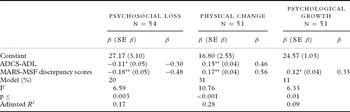
Bivariate correlations were calculated to explore associations between the three AAQ subscales, the MMSE, ADCS-ADL (N = 56, mean = 47.92, SD = 13.07, range = 17–74) and MARS-MFS (N = 56, mean = 19.16, SD = 13.18, range = −18–44) amongst the sample of people with dementia. A moderate correlation (r 46 = 0.55, p < 0.01) was found between the “Physical Change” and “Psychological Growth” subscales of the AAQ. The “Psychosocial Loss” subscale was not significantly associated with the other attitude subscales, but it did display a significant negative correlation with scores on the MARS-MFS (r 52 = −0.39, p < 0.01). This correlation suggests that individuals with greater awareness of their memory dysfunction endorsed more strongly the negative attitude that aging is characterized by psychosocial loss. No other correlations reached significance at the 0.01 level.
Three exploratory stepwise hierarchical regressions were then conducted to determine whether scores on each of the three attitude subscales of the AAQ could be predicted by scores on the MMSE, ADCS-ADL, MARS-MFS, as well as the participant's age or sex. The final regression model for each attitude scale is displayed in Table 2.
Significant predictors of the AAQ subscale scores in people with dementia

ADCS-ADL = Alzheimer's Disease Cooperative Study Activities of Daily Living Inventory; MARS-MFS = Memory Functioning Scale.
*p < 0.05; **p < 0.01.
The MARS-MFS was a significant predictor for all three attitude subscales of the AAQ, suggesting that lower levels of insight relative to memory dysfunction in people with dementia resulted in more positive attitudes to aging. The MARS-MFS was the only significant predictor of scores on the “Psychological Growth” scale. For the “Physical Change” and “Psychosocial Loss” subscale scores, the ADL function was also found to be a significant predictor such that better ADL function was associated with more positive attitudes to aging.
The influence of attitudes to aging on the self-reported QoL ratings of people with dementia
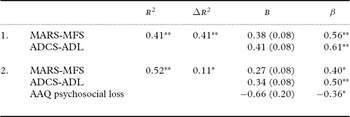
Baseline data from the current sample of people with dementia have suggested that both the MARS-MFS and ADCS-ADL scores are likely to predict QoL as measured by the BASQID (see Trigg et al., Reference Trigg, Watts, Jones and Tod2011). This preliminary model was tested using the current data set, with the three AAQ subscale scores added in order to examine their potential for improving the model. The MARS-MFS and ADCS-ADL scores were entered as the first block in a hierarchical multiple regression analysis and then the three attitudes to aging scores (for “Physical Change,” “Psychological Growth,” and “Psychosocial Loss”) were entered as a second block in stepwise method (see Table 3).
Predictors of BASQID scores in people with dementia (N = 53)

ADCS-ADL = Alzheimer's Disease Cooperative Study Activities of Daily Living Inventory; MARS-MSF = Memory Functioning Scale; AAQ psychosocial loss = psychosocial loss subscale of the Attitudes to Aging Questionnaire.
*p < 0.01; **p < 0.001.
Together, the MARS-MFS and ADCS-ADL explained 41% of the variance in QoL scores as measured by the BASQID, with ADL being marginally the strongest predictor of the two. When the three attitudes to aging were added to the model in block two, “Psychosocial Loss” proved to be the only significant predictor. The addition of “Psychosocial Loss” to the preliminary model increased its explanatory power to 52% of the variance in QoL scores. The MARS-MFS and ADCS-ADL remained as significant predictors in this updated model, although their β-values reduced with the addition of scores for “Psychosocial Loss.” The largest reduction occurred in relation to the MARS-MFS.
Since the MARS-MFS is a significant predictor of the “Psychosocial Loss” subscale (see Table 2), it seemed logical to explore the possibility that a partial mediation pathway may be operating, whereby some of the influence of the MARS-MFS on self-reported QoL ratings is carried through its effect on attitudes. The Sobel test confirmed that “Psychosocial Loss” is indeed a partial mediator in the relationship between the MARS-MFS and the BASQID (z = 2.43, SE = 0.014, p < 0.05). The possibility of a second partial mediation pathway from the ADCS-ADL to the BASQID via “Psychosocial Loss” was also tested, although in this case the Sobel test did not confirm the presence of such a pathway (z = 1.83, SE = 0.039, p > 0.05).
Discussion
This study suggests that people with mild to moderate dementia are able to report on questions relating to their attitudes to aging using the AAQ administered via interview. Cronbach's α values indicate that internal consistency reliability for the three subscales of the AAQ were acceptable relative to both the sample of older adults without dementia and those reported during earlier validations of the tool (Laidlaw et al., Reference Laidlaw, Power and Schmidt2007; Chachamovich et al., Reference Chachamovich, Fleck, Laidlaw and Power2008). Most problems of understanding were easily overcome using researcher prompts, and levels of missing data for any question did not rise above 5%. The addition of a set of standardized prompts should further improve the usability of the AAQ relative to people with dementia and other cognitive deficits.
The attitudes to aging of people with dementia were then compared with those of a sample of older adults without dementia. There were no significant differences in the attitudes relating to physical change or psychological growth. These two attitudes reflect the degree to which the respondents view old age positively, as a time of health and vitality, and as a bringer of wisdom, experience, self-assuredness, and positive psychological benefits. Notably, however, the sample of people with dementia did display a significantly higher endorsement of the negative attitude that aging is characterized by psychosocial loss. Although the subscales within the AAQ should always be used in their entirety to ensure that validity and reliability are maintained, it was clear that this difference in attitude was generated, in particular, by a heightened sense that aging would result in a loss of physical independence, reduced involvement within the community, and increasing difficulties in making new friends.
The question therefore arises as to the possible causes of this difference. Perhaps the most obvious explanation is that people with dementia actually experience more instances of loss than those without dementia, particularly with respect to their physical independence, social contacts, and community involvement. This seems a reasonable assumption. On the other hand, assuming that psychosocial loss is an inevitable repercussion of dementia should, at least, alert us to the dangers of a self-fulfilling prophecy. Attitudes to aging in people with dementia are also likely to be influenced by the attitudes and actions of people with whom they interact. Kitwood (Reference Kitwood1993), for example, has stressed the importance of social environment for people with dementia and the potential damage that can be caused by the so-called “malignant” or “iatrogenic” psychosocial contexts (see also Downs, Reference Downs, Hughes, Lloyd-Williams and Sachs2010). Establishing an appropriate context for people with dementia is clearly a matter of some importance.
Another possible explanation involves the particular vulnerability of people with dementia to negative self-stereotyping (Scholl and Sabat, Reference Scholl and Sabat2008). The analyses presented in this paper suggest that the attitudes to aging of people with dementia are closely associated with their level of awareness relative to their memory problems. Awareness of memory problems was a significant predictor of all three attitudes measured by the AAQ, with higher levels of awareness being linked to more negative attitudes. Notably, however, the actual level of cognitive function (registered in the participants’ MMSE scores) was not a predictor of attitudes. This supports the idea of negative self-stereotyping in people with dementia insofar as it is the awareness of memory problems, not the nature or extent of the memory problems themselves, which seems to catalyze their more negative view of aging as a time of psychosocial loss.
The finding that people with dementia are more likely to endorse a negative attitude to aging becomes even more important when such attitudes are considered relative to issues of life quality. Perhaps the most important conclusion that can be drawn from the current set of analyses is that attitudes to aging appear to have a direct impact on the self-reported QoL ratings of people with dementia, with more negative attitudes leading to a lowered QoL. Once again, psychosocial loss was the key to this impact, with attitudes to this construct proving to be a significant predictor of QoL in dementia. Indeed, inclusion of the psychosocial loss attitude within a previously confirmed model of QoL (which also included insight/awareness of memory and ADL function as significant predictors) allowed an additional 11% of variance in QoL ratings to be explained. Within this improved model, psychosocial loss attitude also acted as a partial mediator for the relationship between memory awareness and QoL. In other words, a stronger awareness of memory deficit seems to foster attitudes to aging that are characterized by a greater sensitivity to psychosocial loss, which, in turn, seems to produce reductions in self-reported QoL ratings. This mediation pathway is nonetheless “partial” insofar as it does not account for all of the impact of awareness on QoL.
Chachamovich et al. (Reference Chachamovich, Fleck, Laidlaw and Power2008) suggest that while attitudes to aging reflect quite stable judgments and perceptions relative to various physical, social, and psychological domains, QoL measures are derived using “a more circumstantial aspect.” Yet the direct influence of attitudes to aging on QoL reported in the current study rather conflates this distinction. The self-reported QoL ratings of people with dementia are, in part at least, generated by their ongoing attitudes to aging and not just by a simple appraisal of current life events and circumstances. Demonstrating this kind of “top-down” generation in people with dementia might also help to explain the disparity between their own QoL ratings and those provided via a proxy or through third-party observations. Trigg et al. (Reference Trigg, Watts, Jones and Tod2011) have argued that the two forms of assessments are derived through different forms of appraisal, the latter prioritizing observable function and performance, the former prioritizing the ongoing mood states, feelings, and attitudes of the person with dementia.
This study has provided some preliminary evidence to support such a view. It is, however, important to acknowledge the limitations imposed by the samples used in this study. The small sample size of people with dementia means that the regression and mediator analysis should be interpreted with caution. Similarly, the self-selecting nature of the sample of older adults without dementia means that they may not be truly representative of the population. Further studies with larger samples will be needed to corroborate and qualify the arguments involved, to develop improved models of the predictors of both self-reported and proxy QoL ratings and, in so doing, to better understand how to interpret these two forms of QoL assessment. It may also be necessary to standardize administration of the AAQ in future studies in order to be certain that observed differences in attitudes to aging are not attributable to alternative modes of administration (Tourangeau et al., Reference Tourangeau, Rips and Rasinski2000). It is also apparent that the AAQ was designed as a self-completed measure and this suggests the impact of administering the questions at an interview to people with dementia warrants further exploration.
These concerns aside, the analyses presented in this paper have demonstrated that the attitudes to aging of people with dementia almost certainly have a significant role to play in the generation of their self-reported QoL ratings. The idea that aging is characterized by psychosocial loss – particularly loss of physical independence, loss of social networks, and loss of community involvement – seems to be central to this process. It may, therefore, be very important that the care of people with mild to moderate dementia challenges such negative stereotypes by focusing on what is retained, rather than what is lost. This may even involve a fundamental shift in our own attitudes to dementia and a rejection of definitions that solely focus on the loss of cognition, the loss of function, the loss of self, and so on (for example, Whitehouse and George, Reference Whitehouse, George and 2008). Efforts should be made to focus on the abilities that are retained by the person with dementia, to promote their ADL function in particular, and to encourage them to use those retained attributes to reach achievable goals. In this way the process of care can work to alleviate negative attitudes to aging and encourage a better QoL for people with dementia.
Conflict of interest
None.
Description of author's roles
Dr. Trigg and Professor Jones were responsible for the initial conception and design of the study. Dr. Trigg was responsible for carrying out the data analysis, interpretation of results, and preparation of the draft paper. Dr. Watts assisted with interpretation of results and preparation of the paper. Professor Jones, Ms. Tod, and Ms. Elliman reviewed the results and contributed to the final drafting of the paper. Ms. Tod was also responsible for the acquisition of all data. All authors have approved the final version of the paper.
Acknowledgments
The study was supported by BRACE – Funding Research into Alzheimer's. The sponsors had no involvement in the design of study, the collection and analysis of data, or in the decision to submit the paper for publication. We would like to thank the staff at the Research Institute for the Care of Older People, Bath, UK, and, in particular, Ms. Dulcie Cormack for her practical contribution to the study.