INTRODUCTION
Questions about relations between nouns and verbs in early child vocabulary are long-standing and important to linguistic theory. One frequently investigated issue concerns primacy in the acquisition of nouns versus verbs. At the turn of the second year of life, most children acquiring most languages exhibit a tendency to produce nouns before verbs (Bornstein et al., Reference Bornstein, Cote, Maital, Painter, Sung-Yun, Pascual, Pêcheux, Ruel, Venuti and Vyt2004; Gentner, Reference Gentner and Kuczaj1982; Longobardi, Rossi-Arnaud, Spataro, Putnick & Bornstein, Reference Longobardi, Rossi-Arnaud, Spataro, Putnick and Bornstein2015; Rescorla, Frigerio, Sali, Spataro & Longobardi, Reference Rescorla, Frigerio, Sali, Spataro and Longobardi2014; Waxman & Lidz, Reference Waxman, Lidz, Kuhn, Siegler, Damon and Lerner2006) – even though cross-linguistic studies have reported that children learning Korean, Mandarin-Chinese, Cantonese, and Japanese speak verbs as early as nouns and in equivalent frequency (Choi & Gopnick, Reference Choi and Gopnik1995; Kim, McGregor & Thompson, Reference Kim, McGregor and Thompson2000; Tardif, Reference Tardif1996; Tardif, Shatz & Naigles, Reference Tardif, Shatz and Naigles1997; but see Rescorla, Lee, Oh & Kim, Reference Rescorla, Lee, Oh and Kim2013, for a study reporting a significant noun bias in Korean). In reviewing this literature, Waxman, Fu, Arunachalam, Leddon, Geraghty, and Song (Reference Waxman, Fu, Arunachalam, Leddon, Geraghty and Song2013) argued that the early noun advantage may not be a universal feature of vocabulary development, but a consequence of the particular language being acquired, and proposed a distinction between noun-friendly and verb-friendly languages.
A second issue, which has been less frequently investigated, concerns cross-class relations between early nouns and verbs (i.e. noun-to-verb and verb-to-noun relations). This is a central issue to developmental psycholinguistics, both theoretically and practically. From a theoretical point of view, predictive associations provide important clues about the ways in which children might exploit their knowledge of nouns and verbs at a given age to acquire new words at later ages. From a practical point of view, predictive associations can inform educational practices by indicating what aspects of vocabulary are most worthy of being enriched in specific developmental periods. In view of this gap in the literature, the aim of the present exploratory study was to ascertain whether children's production of nouns or verbs at 1;4 and 1;8 predicted their later production of verbs or nouns at 1;8 and 2;0.
Our predictions were based on two widely known theoretical frameworks – the Natural Partitions/Relational Relativity (NP/RR) hypothesis and the Emergentist Coalition Model (ECM). The NP/RR hypothesis (Gentner, Reference Gentner and Kuczaj1982, Reference Gentner, Hirsh-Pasek and Golinkoff2006; Gentner & Boroditsky, Reference Gentner, Boroditsky, Bowerman and Levinson2001, Reference Gentner, Boroditsky and Mueller Gathercole2009) proposes that the chief limiting factor on early vocabulary growth resides in the conceptual properties of nouns and verbs. Learning nouns is privileged because most nouns can be easily mapped to concrete objects in the world, and their meanings are fairly stable across languages. In contrast, verbs convey more abstract referents of relational concepts, and verb semantic structures vary substantially across languages (Gentner, Reference Gentner, Hirsh-Pasek and Golinkoff2006). Because of these conceptual differences between nouns and verbs, the NP/RR hypothesis predicts that: (i) there should be a universal early noun advantage in production; and (ii) having an initial stock of nouns should facilitate the process of learning verbs (Gentner, Reference Gentner, Hirsh-Pasek and Golinkoff2006, pp. 546–547). In accord with the NP/RR model, a number of parent-report studies have indicated that the production of verbs gradually increases with total expressive vocabulary (Bates et al., Reference Bates, Marchman, Thal, Fenson, Dale, Reznick, Reilly and Hartung1994; Bornstein et al., Reference Bornstein, Cote, Maital, Painter, Sung-Yun, Pascual, Pêcheux, Ruel, Venuti and Vyt2004; Caselli et al., Reference Caselli, Bates, Casadio, Fenson, Fenson, Sanderl and Weir1995; Fenson, Dale, Reznick, Bates, Thal & Pethick, Reference Fenson, Dale, Reznick, Bates, Thal and Pethick1994). Caselli et al. (Reference Caselli, Bates, Casadio, Fenson, Fenson, Sanderl and Weir1995), for instance, reported that the percentages of verbs produced between 8 and 16 months of age increased from less than 1% in children with 1 to 5 words to about 7% in children with more than 50 words. Likewise, Bornstein et al. (Reference Bornstein, Cote, Maital, Painter, Sung-Yun, Pascual, Pêcheux, Ruel, Venuti and Vyt2004) found that verbs increased from 4% in children with vocabularies of 0 to 50 words to 19% and 46% in children with vocabularies of 101 to 200 words and 201 to 500 words, respectively. In addition, a study by Marchman and Bates (Reference Marchman and Bates1994) on a sample of 1,130 toddlers between 1;4 and 2;6 showed that verb vocabulary size correlated highly with total production vocabulary (r = 0·97). Because nouns constitute the largest portion of children's early vocabulary, these data have been interpreted to indicate that “lexical verbs do not develop until common nouns are a well-established component of the emerging lexicon” (Caselli et al., Reference Caselli, Bates, Casadio, Fenson, Fenson, Sanderl and Weir1995, p.180).
For the earliest period of language development, the predictions of the NP/RR hypothesis converge with those advanced by the ECM (Fisher, Hall, Rakowitz & Gleitman, Reference Fisher, Hall, Rakowitz and Gleitman1994; Gleitman, Reference Gleitman1990; Gleitman, Cassidy, Nappa, Papafragou & Trueswell, Reference Gleitman, Cassidy, Nappa, Papafragou and Trueswell2005; Golinkoff & Hirsh-Pasek, Reference Golinkoff and Hirsh-Pasek2008; Papafragou, Cassidy & Gleitman, Reference Papafragou, Cassidy and Gleitman2007). Proponents of the ECM maintain that several sources of evidence (observational, syntactic, and semantic) contribute to lexical learning, but that only one type of information is available at the beginning of the process: namely, the observation of the word's situational contingencies (i.e. the co-occurrences of a word and its concrete referent). Such a word-to-world mapping procedure allows children to construct a foundational vocabulary of concrete, highly imageable nouns (McDonough, Song, Hirsh-Pasek, Golinkoff & Lannon, Reference McDonough, Song, Hirsh-Pasek, Golinkoff and Lannon2011), which would play a critical role in the acquisition of those words that cannot be learned by observation alone, such as verbs (Gleitman et al., Reference Gleitman, Cassidy, Nappa, Papafragou and Trueswell2005; Snedeker & Gleitman, Reference Snedeker, Gleitman, Hall and Waxman2004).
Importantly, however, the predictions of the NP/RR and the ECM diverge at later points in development, because only the ECM suggests that older children should exploit their growing knowledge of the semantic and syntactic constraints of known verbs to home in on the meaning of novel nouns (Ferguson, Graf & Waxman, Reference Ferguson, Graf and Waxman2014) – a process known as structure-to-world learning (Gleitman et al., Reference Gleitman, Cassidy, Nappa, Papafragou and Trueswell2005; Snedeker & Gleitman, Reference Snedeker, Gleitman, Hall and Waxman2004). As an example, an early study by Goodman, McDonough, and Brown (Reference Goodman, McDonough and Brown1998) showed that children at 2;0 were able to infer the meanings of novel nouns after hearing them in sentences that contained semantically constraining verbs (e.g. Mommy feeds the ferret).
The present study aimed at testing the validity of these predictions by examining longitudinal relations between children's noun and verb production at 1;4, 1;8, and 2;0. Based on the aforementioned hypotheses, we expected that: (i) children's production of nouns at 1;4 should predict their later production of verbs at 1;8 (consistent with both the NP/RR and the ECM); and (ii) children's production of verbs at 1;8 should predict their later production of nouns at 2;0 (consistent with the ECM, but not with the NP/RR, model).
METHOD
Participants
Thirty Italian full-term children (16 girls; 17 first-born) and their mothers participated in a three-wave longitudinal study, when children were approximately 1;4 (M = 1;3·5; range = 1;2·7–1;3·9), 1;8 (M = 1;7·9; range = 1;6·2–1;8·3), and 2;0 (M = 1;11·6; range = 1;10·7– 2;0·1). Families were recruited from childcare nurseries or pediatricians’ offices, were middle socioeconomic status, and lived in Rome. All children were acquiring Italian as their first language. None was reported to suffer health or linguistic risk conditions. The mean age of mothers was 34;4 (SD = 3;5): ten of them had a university degree and twenty had a high-school diploma.
Procedure and language measures
Child language was assessed through video speech recordings of free-play sessions at 1;4 and 1;8, and a parent-report questionnaire was used at 2;0 to ensure the largest adherence of participants to the last round of data collection. This choice limits the generalizability of our conclusions, but there are reasons to believe that it did not unduly affect the results, because previous research has shown strong correlations between the expressive vocabulary estimates derived from the two methods in English (Dale, Reference Dale1991; Dale, Bates, Reznick & Morisset, Reference Dale, Bates, Reznick and Morisset1989; Fenson et al., Reference Fenson, Dale, Reznick, Bates, Thal and Pethick1994) and in Italian (Camaioni & Longobardi, Reference Camaioni and Longobardi1995).
Mother–child dyads were video-recorded at home during 15-min sessions of free play with familiar toys. Measures of child language at 1;4 and 1;8 were derived from transcripts of the recorded sessions. They were the total number of words and the raw frequency of noun and verb types produced in the entire session. For the purposes of analysis, the latter measures were transformed into percentages by dividing the raw number of noun and verb types by the total number of word types (see Camaioni & Longobardi, Reference Camaioni and Longobardi2001; Longobardi et al., Reference Longobardi, Spataro, Putnick and Bornstein2015). Following Tardif (Reference Tardif1996), we adopted a strict coding criterion, counting only common nouns (excluding proper nouns) and main verbs (excluding auxiliaries, copulas, adverbs, and adjectives). Coding of child language was carried out by two independent trained coders who were Italian native speakers and had backgrounds in linguistics. Inter-rater agreement was 85%, and cases of disagreement were discussed and resolved with the first author. We limited our analysis to types because the primary debate has focused on the predominance of noun types (not tokens) in children's early vocabularies (Gentner, Reference Gentner and Kuczaj1982; Tardif, Gelman & Xu, Reference Tardif, Gelman and Xu1999). Our use of the terms nouns and verbs refers to the existence of formal rather than functional classes in adult language (Lieven, Pine & Barnes, Reference Lieven, Pine and Barnes1992) – that is, the fact that different types of words tend to be classified as nouns or verbs in adult grammar. We do not assume that these words are necessarily conceived of as nouns and verbs by young children in the second year of life (Gentner, Reference Gentner and Kuczaj1982, p. 304).
In addition to measures of child language, we computed the percentages of noun and verb types produced by mothers at 1;4 and 1;8. In the present study, these measures were exclusively employed in the regression analyses to assess the potential confounding influence of maternal language on children's production of nouns and verbs (Hoff & Naigles, Reference Hoff and Naigles2002; Huttenlocher, Haight, Bryk, Seltzer & Lyons, Reference Huttenlocher, Haight, Bryk, Seltzer and Lyons1991; Longobardi et al., Reference Longobardi, Spataro, Putnick and Bornstein2015; Naigles & Hoff-Ginsberg, Reference Naigles and Hoff-Ginsberg1998). However, given our specific focus on cross-class relations in children's language, maternal measures were not included in any other analysis (see Longobardi et al., Reference Longobardi, Spataro, Putnick and Bornstein2015, for additional information).
At 2;0, mothers completed the Toddler form of the Italian version of the MacArthur–Bates Communicative Development Inventory (CDI: Words and Sentences; Il Primo Vocabolario del Bambino: Caselli & Casadio, Reference Caselli and Casadio1995). This parent-report questionnaire comprises a vocabulary checklist of 680 words. Mothers indicated which words their children spontaneously produced among those listed. For the present purposes, three measures were coded: the total vocabulary size and the number of nouns and verbs attributed to children. The latter two variables were transformed into opportunity scores by dividing by the total number of nouns and verbs included in the CDI. To be consistent with the coding scheme adopted in the analysis of mother–child interactions, we only took into account the common nouns included in the sections Animals, Vehicles, Toys, Food, Clothes, Body, Small Household Objects, Furniture, Outside Things, and Places, and the main verbs included in the section Actions (see Tardif et al., Reference Tardif, Gelman and Xu1999, Note 2). That is, we excluded the categories Proper Nouns, Routine Nouns, Adjectives, and Auxiliary Verbs. Opportunity scores were utilized to ensure that individual differences in children's production of nouns and verbs were not affected by differences in the size of the two categories in the CDI (nouns are typically over-represented in parent-report questionnaires: Papaeliou & Rescorla, Reference Papaeliou and Rescorla2011; Rescorla et al., Reference Rescorla, Frigerio, Sali, Spataro and Longobardi2014).
RESULTS
Children's noun and verb production
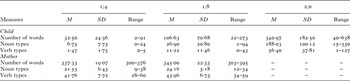
Table 1 shows the total number of words produced by children at each age, along with the raw numbers of noun and verb types. All child measures increased linearly from 1;4 to 2;0, and a noun advantage was present at all ages. Also, individual differences (as reflected in ranges and standard deviations) were always larger for nouns than for verbs (see ‘Discussion’ below).
Child raw measures at 1;4, 1;8, and 2;0 and mother raw measures at 1;4 and 1;8

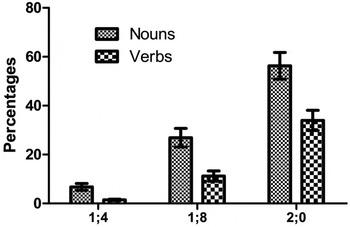
These qualitative impressions were born out by statistical analyses. More specifically, the percentages of noun and verb types produced at 1;4 and 1;8, illustrated in Figure 1, were submitted to a 2 × 2 ANOVA, considering Lexical Category (nouns vs. verbs) and Age (1;4 vs. 1;8) as within-subjects variables. The results revealed significant main effects of both factors (F(1,29) = 119·74, p < ·001, η p 2 = ·81, and F(1,29) = 57·24, p < ·001, η p 2 = ·66): children produced nearly three times more noun than verb types (M = 18·56% vs. M = 5·73%), and the overall percentages nearly doubled from 1;4 to 1;8 (M = 8·27% vs. M = 16·02%). Although the two-way interaction approached significance (F(1,29) = 3·75, p = ·062, η p 2 = ·12), follow-up analyses with the Bonferroni adjustment for multiple comparisons confirmed that the advantage of nouns over verbs held at both ages (F(1,29) = 36·49, p < ·001, η p 2 = ·56 at 1;4, and F(1,29) = 101·67, p < ·001, η p 2 = ·78 at 1;8), and that type percentages increased from 1;4 to 1;8 for both lexical categories (F(1,29) = 25·97, p < ·001, η p 2 = ·47 for nouns, and F(1,29) = 35·98, p < ·001, η p 2 = ·55 for verbs) (see Figure 1).
Measures of child language: observed percentages of nouns and verbs at 1;4 and 1;8, and opportunity scores at 2;0. Bars represent standard errors.

At 2;0, children's opportunity scores were again higher for nouns than for verbs (t(29) = 9·89, p < ·001, M = 56·30% vs. M = 33·98%) (see Figure 1). Comparing opportunity scores at 2;0 with the percentages of nouns and verbs at 1;4 and 1;8 yielded significant increases in all cases (ts(29) > 6·70, all ps < ·001).
Finally, Table 1 also reports descriptive statistics for maternal measures at 1;4 and 1;8. To be consistent with child analysis, the raw frequencies of noun and verb types were transformed into percentages. A series of t-tests for repeated measures showed that mothers produced more verb than noun types at both ages (M = 12·38% vs. M = 6·35%, t(29) = −14·74, p < ·001 at 1;4, and M = 12·81% vs. M = 7·00%, t(29) = −11·95, p < ·001 at 1;8) (see Camaioni & Longobardi, Reference Camaioni and Longobardi2001; Longobardi et al., Reference Longobardi, Spataro, Putnick and Bornstein2015).
Correlations among noun and verb production
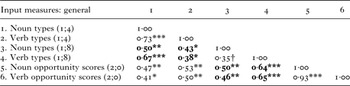
Table 2 reports Pearson correlations among child measures at 1;4, 1;8, and 2;0. All correlations were positive and significant, except that between the percentages of nouns and verbs produced at 1;8, which was marginally significant (p = ·058). As expected, the noun and verb estimates derived from parent reports and observational language samples were strongly and significantly correlated (range: 0·41–0·65; see Table 2) – replicating Camaioni and Longobardi (Reference Camaioni and Longobardi1995).
Pearson correlations between the percentages of nouns and verbs produced by children at 1;4, 1;8, and 2;0. Bold correlations are those involved in the regression analyses

notes: * p ⩽ .05; ** p ⩽ .01; *** p ⩽ .001; † .05 < p < ·10.
In a more focused analysis of the two sets of correlations involved in the regression analyses (indicated in bold in Table 2), we compared the differences between all pairs of overlapping (with one variable in common) and non-overlapping (with no variable in common) dependent correlations following the procedures outlined in Diedenhofen and Musch (Reference Diedenhofen and Musch2015). The only significant difference was due to the percentages of verb types at 1;8 being more strongly correlated with the percentages of noun types at 1;4 (.67) than with the percentages of verb types at 1;4 (.38) (Z = 2·60, p = ·009). This finding might suggest that individual differences in verb production exhibit relatively low stability in the earliest phases of language acquisition (see D'Odorico, Carubbi, Salerni & Calvo, Reference D'Odorico, Carubbi, Salerni and Calvo2001, and D'Odorico & Fasolo, Reference D'Odorico and Fasolo2007, for similar results). Although the correlation between the percentages of nouns at 1;4 and verbs at 1;8 (.67) was no larger than the correlation between the percentages of nouns at 1;4 and 1;8 (.50), the numerical difference suggests that the within-class prediction may be no stronger (and perhaps weaker) than the cross-class prediction.
Hierarchical regressions: predicting children's percentages of nouns and verbs at 1;8
To investigate predictive relations between nouns and verbs at the three age points, we computed a series of hierarchical regressions.
The first set of regressions tested (i) whether children's percentages of nouns at 1;4 (entered at the second step) predicted their later production of verbs at 1;8 after controlling for child and mother percentages of verbs at 1;4 (entered at the first step); and (ii) whether children's percentages of verbs at 1;4 (entered at the second step) predicted their later production of nouns at 1;8 after controlling for child and mother percentages of nouns at 1;4 (entered at the first step). Given the high inter-correlations between the child measures (see Table 1), it was important to assess whether the results of the regression analyses were affected by multicollinearity. To this end, variance inflation factors (VIFs) were computed. As a rule of thumb, Stevens (Reference Stevens2002) suggested that VIF values greater than 10 should be considered problematic. Our values never exceeded 2·38, suggesting that any impact of multicollinearity was negligible.
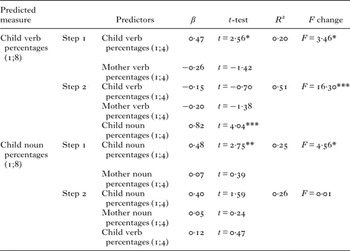
Table 3 shows that children's percentages of noun types at 1;4 significantly predicted their later production of verb types at 1;8; in the first regression analysis (upper panel of Table 3), in particular, the inclusion of the noun measure at the second step strongly increased the proportion of variance explained by the model (from 20% to 51%). In contrast, the percentages of verbs produced at 1;4 did not predict the percentages of nouns produced at 1;8 (lower panel of Table 3).
Hierarchical regressions predicting children's percentages of verb and noun types at 1;8

notes: * p ⩽ .05; ** p ⩽ .01; *** p ⩽ .001.
Hierarchical regressions: predicting children's noun and verb opportunity scores at 2;0
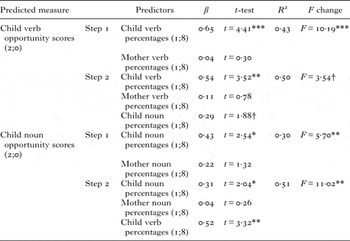
The second set of hierarchical regressions tested (i) whether children's percentages of nouns at 1;8 (entered at the second step) significantly predicted later verb opportunity scores at 2;0, after controlling for child and mother percentages of verbs at 1;8 (entered at the first step); and (ii) whether children's percentages of verbs at 1;8 (entered at the second step) significantly predicted later noun opportunity scores at 2;0, after controlling for child and mother percentages of nouns at 1;8 (entered at the first step).
Table 4 (upper panel) illustrates that children's verb opportunity scores at 2;0 were significantly predicted by the percentages of verbs they produced at 1;8, with the contribution due to the percentages of nouns produced at 1;8 being marginal (p = ·071). More importantly, children's noun opportunity scores at 2;0 were strongly predicted by the percentages of verbs they produced at 1;8 and, to a lesser extent, by the percentages of nouns they produced at 1;8 (see the lower panel of Table 4).
Hierarchical regressions predicting children's verb and noun opportunity scores at 2;0

notes: † .05 < p < ·10; * p ⩽ .05; ** p ⩽ .01; *** p ⩽ .001.
DISCUSSION
The present study examined longitudinal relations between noun and verb production in a longitudinal sample of thirty Italian-speaking children seen at 1;4, 1;8, and 2;0. To summarize, we found that: (i) verb percentages at 1;8 were predicted by noun percentages at 1;4; (ii) noun opportunity scores at 2;0 were predicted by verb and, less strongly, by noun percentages at 1;8; and (iii) verb opportunity scores at 2;0 were predicted by verb percentages at 1;8.
When considered together with the overall dominance of nouns over verbs in child language, the first finding is consistent with the predictions of both the NP/RR hypothesis (Gentner, Reference Gentner and Kuczaj1982, Reference Gentner, Hirsh-Pasek and Golinkoff2006; Gentner & Boroditsky, Reference Gentner, Boroditsky, Bowerman and Levinson2001, Reference Gentner, Boroditsky and Mueller Gathercole2009) and the ECM (Gleitman et al., Reference Gleitman, Cassidy, Nappa, Papafragou and Trueswell2005; Golinkoff & Hirsh-Pasek, Reference Golinkoff and Hirsh-Pasek2008; Papafragou et al., Reference Papafragou, Cassidy and Gleitman2007). As illustrated above, the NP/RR hypothesis assumes that nouns should be learned earlier than verbs, because most nouns can be directly mapped to concrete objects in the world, and the availability of an initial stock of common nouns should facilitate the acquisition of less transparent verbs (Gentner, Reference Gentner, Hirsh-Pasek and Golinkoff2006, pp. 546–547). Similarly, the ECM argues that, once children acquire some basic-level nouns through the observation of words’ situational contingencies (i.e. the co-occurrences of a word and its concrete referent), they can then use nouns to learn verbs because the nature of nouns provides children with a powerful source of evidence for constraining the meaning of novel verbs (Gleitman et al., Reference Gleitman, Cassidy, Nappa, Papafragou and Trueswell2005; Snedeker & Gleitman, Reference Snedeker, Gleitman, Hall and Waxman2004). In a demonstration of this mechanism, Arunachalam and Waxman (Reference Arunachalam and Waxman2011) required English-speaking 24-month-olds to view a scene (e.g. a girl petting a dog) while listening to novel verbs either in a rich linguistic context (i.e. with both actors and objects: The girl is blicking the dog) or in a sparse linguistic context (i.e. with nouns dropped: She is blicking). At test, children were presented with two different scenes: in the Familiar Object scene, the same actor (e.g. a girl) performed a novel action (e.g. kissing) on the familiar object (e.g. the dog), whereas in the Familiar Action scene the same actor performed the familiar action (e.g. petting) on a novel object (e.g. a Frisbee). Children were asked to answer questions such as Where is she blicking something? by pointing to the correct scene. Children pointed more often to the Familiar Action scene in the rich than in the sparse linguistic context, suggesting that they utilized their knowledge of the surrounding arguments (nouns) to infer the meaning of novel verbs.
Whereas the predictions of the NP/RR and the ECM coincide in the early phases of language acquisition, only the ECM maintains that older children exploit the semantic and syntactic constraints of known verbs to learn the meaning of novel nouns (Goodman et al., Reference Goodman, McDonough and Brown1998). In agreement, we found that the percentages of verbs produced by children at 1;8 strongly predicted their noun opportunity scores at 2;0. This result is consistent with the conclusions reached by Ferguson et al. (Reference Ferguson, Graf and Waxman2014), who presented 15- and 19-month-olds with two unfamiliar images of an animal and an artifact object. Children listened to a short dialogue in which one of the images was mentioned using nonce words. In the Informative condition, the novel noun was located in the subject position of a known verb that selected for an animate object (e.g. The dax is crying), whereas in the Neutral condition the novel noun was included in a sentence that did not select for either an animate or inanimate referent (e.g. The dax is right here). Later, the images reappeared and children were prompted to choose the object mentioned in the dialogue (e.g. Where is the dax?). The results showed that 19-month-olds looked significantly more often towards the animate object (i.e. the animal) in the Informative than in the Neutral condition; by contrast, 15-month-olds failed to exhibit a clear preference for the animate referent, suggesting that comprehension of the semantic constraints of verbs may help children acquire novel nouns, but the process appears to be incompletely developed before about 19 months. By contrast, the NP/RR hypothesis does not envisage any mechanism by which verbs can assume a pivotal role in further language acquisition: this theory continues to predict that the percentages of nouns produced by children at 1;8 should predict their later verb opportunity scores at 2;0 – a prediction which held only marginally in our data.
Two other points merit discussion. First, in the period between 1;4 and 2;0, significant within-class (i.e. noun-to-noun and verb-to-verb) correlations emerged for both nouns and verbs, consistent with previous research showing moderate stability in early child language (see Table 1; Bornstein, Hahn, Putnick & Suwalsky, Reference Bornstein, Hahn, Putnick and Suwalsky2014; Bornstein & Putnick, Reference Bornstein and Putnick2012; Longobardi, Spataro, Putnick & Bornstein, Reference Longobardi, Spataro, Putnick and Bornstein2015). Second, the percentages of noun and verb types produced by mothers did not exert significant effects on child language, which contrasts with other data reported in the literature (Goodman, Dale & Li, Reference Goodman, Dale and Li2008; Hoff & Naigles, Reference Hoff and Naigles2002; Huttenlocher et al., Reference Huttenlocher, Haight, Bryk, Seltzer and Lyons1991). However, Longobardi et al. (Reference Longobardi, Spataro, Putnick and Bornstein2015) showed that, in Italian, the positional salience of nouns and verbs in maternal utterances is more important than their overall frequency in predicting children's language. By averaging frequency across all utterance positions, our current maternal measures may have been too blunt to reveal a significant impact on child expressive vocabulary.
Finally, we acknowledge that the present study has limitations and that alternative explanations can be advanced. In particular, we cannot discard the possibility that our findings were partly driven by differences in the psychometric properties of noun and verb measures at the three age points. Indeed, as Table 1 shows, child proportions of verb types exhibited low variability at 1;4 (as indicated by both the range and standard deviation). Such a reduced range of variation might have contributed to the absence of significant predictive relations with noun and verb measures at 1;8. Two considerations allay this concern, however. First, the correlations reported in Table 2 demonstrate that the proportions of verb types at 1;4 were significantly associated with later noun and verb measures at 1;8 and 2;0. Considering the relatively small sample size, this result suggests that the reduction in the variability of verb types at 1;4 was not so severe as to preclude the detection of significant correlations. Second, standard deviations and ranges were greater for noun than for verb measures at all ages, implying that the proportions of noun types were always the best indicators of children's individual differences in lexical skills. As a consequence, this variable should have always accounted for the greatest portion of variance in our regression analyses. The fact that such a prediction did not hold at 1;8 (see Table 4) might suggest that the acquisition of additional nouns is less important than the acquisition of verbs, once children have a large stock of nouns. Put in other words, because verbs are learned later than nouns, by 1;8 verbs may become a more sensitive predictor of individual differences in overall language progress (Marchman & Bates, Reference Marchman and Bates1994). Additional studies in verb-friendly languages, such as Korean, Mandarin-Chinese, and Japanese (in which the frequency and the variability of verb measures are likely to be higher: Waxman et al., Reference Waxman, Fu, Arunachalam, Leddon, Geraghty and Song2013), might be useful to further explore these questions.
In conclusion, the present study provided converging information about the mechanisms underlying children's early acquisition of nouns and verbs by showing that, during the second year of life, the roles of nouns and verbs undergo dynamic changes that are more consistent with the predictions of the ECM (Gleitman et al., Reference Gleitman, Cassidy, Nappa, Papafragou and Trueswell2005; Golinkoff & Hirsh-Pasek, Reference Golinkoff and Hirsh-Pasek2008; Papafragou et al., Reference Papafragou, Cassidy and Gleitman2007) than with the predictions of the NP/RR hypothesis (Gentner, Reference Gentner and Kuczaj1982, Reference Gentner, Hirsh-Pasek and Golinkoff2006).