





Te Whare Tapa Whā is an Indigenous Māori model (Figure 1), developed by Sir Mason Durie drawing on his seminal work of 1985, “A Māori Perspective of Health.”Footnote 1 Te Whare Tapa Whā compares hauora, holistic health and well-being, to the four walls of a whare (house), all four being necessary to ensure strength and symmetry, though each represents a different dimension: taha wairua (spiritual health), taha hinengaro (mental and emotional health), taha tinana (physical health), and taha whānau (family and social health). There is also a fifth element to the model, taha whenua, the land and our connections to place. Durie argues that taha wairua implies a spiritual communion with the environment where the whenua (land) has a spiritual significance.Footnote 2 In Māori culture, the concept of whenua carries profound significance as it means both land and placenta. This two-fold meaning reflects a deeply philosophical and holistic worldview reinforcing the connection between human-kind and Papatūānuku, the Earth Mother, symbolically echoing how both the placenta and the Earth nourish and sustain humanity.
Image of the Te Whare Tapa Whā Model. (Source: unknown artist licensed under CC BY-NC).

Māori tikanga (cultural knowledge) is implicit within the Te Whare Tapa Whā model, and for this reason the model provides Māori with a voice within healthcare services. Though, since its conception in the mid-1980s when Te Whare Tapa Whā was positioned within the medical and social sciences, it has expanded into the humanities and education and is also included in the English-medium curricula on health.Footnote 3
Heaton argues that it has been emancipating to include a Māori perspective of health in English-medium curricula, yet simultaneously, it has been restrictive in that the dominant Whare Tapa Whā discourses sanctioned within English-medium curricula potentially omit many of the ways a “whare” model of health and its contribution to well-being can be known. She argues that the whare can be viewed as more than a metaphor for health and well-being and invites educators to restore life back into the whare and to perceive it as being synonymous with being human.Footnote 4
The close connection of the whare to the human form underpins the rationale for the naming of the Māori health model Te Whare Tapa Whā. In traditional Māori culture, a wharenui (large meeting house) was more than a building. It is conceptualized as a metaphor for the body, and whare tupuna (ancestral house) is viewed, figuratively, as the living body of an important tribal ancestor. Features of human anatomy are represented throughout the whare. The carved figure at the very top of the roof represents the Kōruru/Tekoteko (head of the ancestor). The large sloping boards on the front of the roof symbolize Maihi and Raparapa (arms) reaching out in a welcoming embrace. The main ridgepole running down the centre of the roof represents the Tāhuhu (spine). The rafters inside the whare fanning out from the ridgepole represent the Heke (ribs). The Poutokomanawa (heart) is represented by the large central pole holding up the roof. The windows on the front of the house represent the Matapihi (eyes). The front door is the symbolic Kūwaha (mouth) and the inside of the house represents the Kōpu (womb), a safe and warm haven to gather.Footnote 5 All four walls are necessary to ensure strength and symmetry, though each represents a different dimension: taha wairua (spirituality), taha hinengaro (intellectual), taha tinana (physical), and taha whanau (family). All four walls are supported by the whenua, (land), the foundation on which the house stands.Footnote 6
Traditionally, iwi (tribe) and hapū (subtribe) have their own marae (meeting place) on which wharenui and other buildings are located. Marae are very important to Māori, as they represent tūrangawaewae (place to stand and belong). The marae can be conceptualized as the home-place where cultural identity is reinforced and maintained within the collective identity of the iwi and hapū. Footnote 7
Within contemporary society, however, many marae are pan-tribal. This change has come about since the period of urbanization when many Māori left traditional rural areas and moved to the cities seeking employment after World War II. For many Māori, the marae, whether a pan-tribal one or a traditional one based in an iwi and hapū rohe (traditional territory), represents a metaphorical home and a space for cultural practices to continue within the context of post colonization, modernity, and urbanization.
My hapū marae is Ōwae Whaitara marae located in Waitara, Taranaki, on the lower west coast of the North Island of Aotearoa New Zealand. The whare whakairo (carved meeting house) at my marae was named Te Ikaroa-a-Māui in honour of Sir Māui Pōmare (Figure 2). The name translates to “the long shadow/pathway of Māui” and serves as a memorial to Sir Māui Pōmare.Footnote 8 It is within this whare that I feel the structure as being synonymous with being human. To be cocooned within its four walls is akin to being wrapped in aroha (love) and to feel insulated and protected, much like the foetus that is nurtured within the mother’s uterus.
Photograph of Te Ikaroa-a-Māui, the whare whakairo (carved meeting house), June 2013, Ōwae Whaitara marae (also known as Manukorihi Pā), located in Waitara, Taranaki, Aotearoa New Zealand. It is the “home” whare whakairo (carved meeting house) of the author. Te Ikaroa-a-Māui was opened in 1936. (Source: Author).

Figure 2. Long description
The whare whakairo features a steep red roof with white bargeboards decorated in black and red kowhaiwhai patterns. At the apex of the roof is a carved tekoteko figure. Below it, the koruru mask sits at the junction of the bargeboards. Two large carved amo uprights support the ends of the gables, featuring stacked ancestral figures. The front wall is cream-colored with a central red door and a window to the right, both framed by ornate pare and whakawae carvings. A small carved figure stands on the porch near the entrance. To the right of the main structure, a small wooden bell tower stands on a green lawn. The building extends back with a long white weatherboard side wall punctuated by several windows. The foreground consists of a dark paved area leading to the grass.
1. Whakapapa narratives
Narratives of whakapapa articulate identity and place, conveying geographic, social, and historical locations. Narratives of whakapapa also locate us to both the spiritual and secular worlds and can be viewed as affirming our place and identity as tangata whenua (people of the land). I begin my narrative with my whakapapa (genealogy) locating myself as Māori.
Narratives of whakapapa declare Māori heritage and legacy and also reinforce the importance of whakapapa to identity as Māori within the postcolonial space where intermarriage has not erased Māori genealogies.
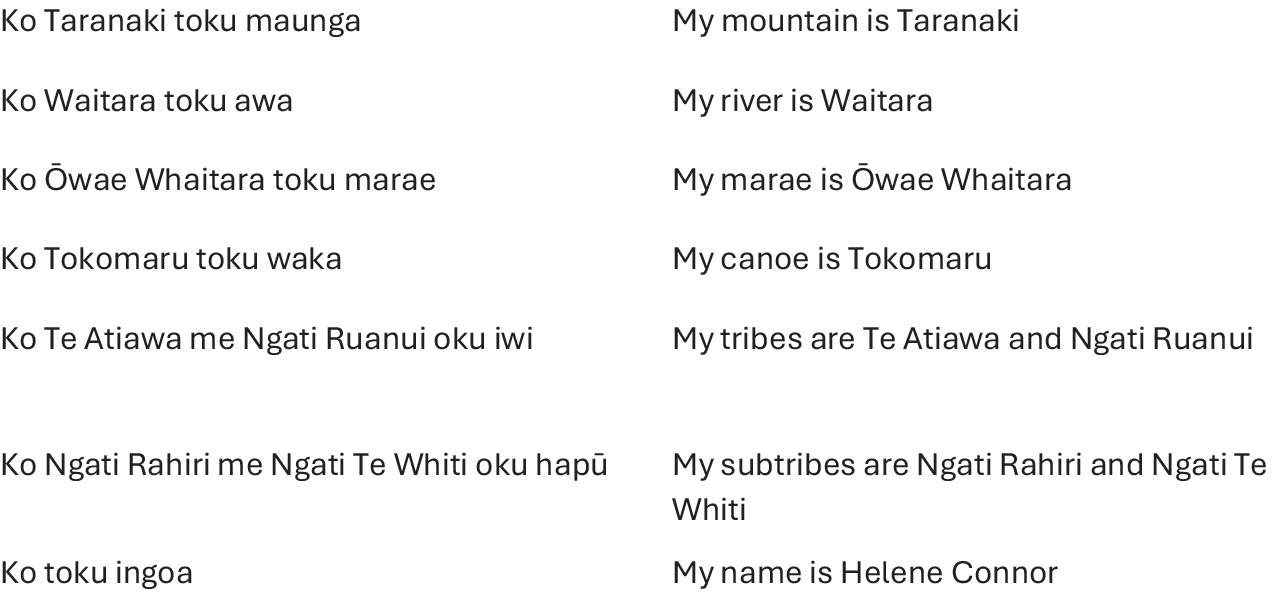
My pepeha (Figure 3); Māori device for introducing oneself) locates me to the region of Taranaki, my rohe (traditional area of land), my turangawaewae (a place to stand), and my papakāinga (home base), where my iwi (tribe) exercise mana whenua (historical and territorial rights over land). The province of Taranaki is situated on the west coast of the lower half of the North Island of Aotearoa New Zealand. Narratives of whakapapa and identification with traditional land are crucial to Māori identity articulated in a language of place through the pepeha which shares both connections to the land and to tupuna (ancestors). My personal cancer narrative is grounded in my Māori identity whakapapa. Through my Māori mother, Tui, my ancestry is associated with the rich, fertile, volcanic whenua (land) of Taranaki, dominated by Taranaki Maunga (Mt Taranaki), a stunning dormant stratovolcano that local the iwi considers a tupuna (ancestor). Taranaki Maunga became a legal person in January 2025 as a Treaty of Waitangi settlement and was passed into law (Paewai).Footnote 9
Pepeha of the author. (Source: Author)
.

Figure 3. Long description
The text is arranged in seven rows across two columns.
Row 1. Left: Ko Taranaki toku maunga. Right: My mountain is Taranaki.
Row 2. Left: Ko Waitara toku awa. Right: My river is Waitara.
Row 3. Left: Ko Owae Whaitara toku marae. Right: My marae is Owae Whaitara.
Row 4. Left: Ko Tokomaru toku waka. Right: My canoe is Tokomaru.
Row 5. Left: Ko Te Atiawa me Ngati Ruanui oku iwi. Right: My tribes are Te Atiawa and Ngati Ruanui.
Row 6. Left: Ko Ngati Rahiri me Ngati Te Whiti oku hapu. Right: My subtribes are Ngati Rahiri and Ngati Te Whiti.
Row 7. Left: Ko toku ingoa. Right: My name is Helene Connor.
I also have Pākehā (European) whakapapa. On my paternal side, I am descended from Irish immigrants. The Irish were also colonized by the English, and the remnants of this bitter colonial past remain as one of the intricate historical complexities for Irish identity just as it does for Māori identity. The ancestry of my father, Norman, is connected to County Cork in Ireland with his family being well established in the Whitford and Howick area of East Auckland by the 1860s.
As Gerbic and Muriwai argue, for wāhine Māori, our Māoritanga (expression of cultural identity) is deeply rooted in whakapapa (genealogy), connection to whenua (land), and Te Ao Māori (Māori worldview), and all these elements provide a foundation of belonging and continuity that is central to our well-being.Footnote 10 Hence, it is important to articulate my whakapapa background before presenting my ovarian cancer narrative.
2. Framing my ovarian cancer personal narrative within Te Whare Tapa Whā
My ovarian cancer narrative is written from the perspective of wāhine Māori (Māori women) acknowledging both wāhine moe tāne (heterosexual woman) and takatāpui wahine (lesbian women). I also acknowledge whakawāhine (transgender women). While these women do not have a whare tangata (uterus), hua kūao (ovaries), or pūkākano (fallopian tubes), they nevertheless carry the wairua (spirit) of women, and within the Te Whare Tap Whā model, may well be supporting and caring for wāhine who have been diagnosed with ovarian cancer.
This paper is also grounded within a mana wāhine Māori theoretical perspective and Māori feminist discourses, which examine the intersection of being both Māori and female.Footnote 11 The Mana Wahine theory provides theoretical and analytical spaces that reinforce and sustain movements of cultural and political reclamation that sit alongside the wider aspirations of the Māori people.Footnote 12 Māori feminism can work to strengthen Māori women’s experiences of health and other issues at both a collective and individual levels.Footnote 13 Within the context of cancer narratives, Māori feminist perspectives can be viewed as literary extensions of whakapapa, as they provide spaces to speak and write about both cultural and actual physical survival.
Cancer is like an earthquake that shakes the foundation of the whare. Indeed, feelings of shock are very common after an initial cancer diagnosis. My personal narrative is framed within Te Whare Tapa Whā with reference to each of the four dimensions or pillars. The themes of endurance, resilience, and courage are linked to the four pillars, which are deeply integrated and interdependent.
I did not consciously draw on Te Whare Tapa Whā when I was first diagnosed with ovarian cancer. Rather, as I navigated each of the phases of my treatment I realized I had intuitively, albeit, in an unconscious way, turned to each of the four pillars to provide structure to contain all of what I was experiencing and going through. In some ways, Te Whare Tapa Whā provided a “safety net” and coping strategy.
In the words of Deepika Bahri, “Stories of illness matter as we work towards crafting more holistic health care.”Footnote 14 Narratives of cancer and illness provide a framework for documenting diagnostic and therapeutic options holistically. Personal narratives also offer a method for addressing both the biological and emotional elements of coping with a cancer diagnosis.Footnote 15
Schultz argues that women’s cancer narratives position the narrator to claim greater discursive autonomy and to render visible previously submerged elements of cancer experiences. Cancer autopathographies present a “symptomology” of the varying narratives of cancer as a cultural phenomenon that moves in tandem with oncological advances.Footnote 16 Cancer autopathographies also have therapeutic and pedagogic benefits for both the narrator and the readers and can augment understanding about cancer and the embodiment of the post-cancer body.Footnote 17
Historically, ovarian cancer narratives have tended to be less visible compared to breast cancer narratives where women may be alerted to potential cancer on finding a breast lump, often detected in the upper outer section of the breast, which is the area closest to the armpit.Footnote 18
Ovarian cancer is associated with the interior of the female body, the ovaries and the fallopian tubes, and symptoms are often vague; hence, it’s often labelled the hidden cancer. Personal cancer narratives, particularly, cancers such as ovarian, that are less visible, can be useful in initiating improvements to cancer care and understanding the subjective experiences of cancer patients.Footnote 19 As Lisa Finucane asserts, “there’s the issue of women’s cancers being overlooked and gynaecological cancers being harder to bring into the public space.”Footnote 20 Finucane’s observation is perturbing, as ovarian cancer is the second most common gynaecological cancer in Aotearoa New Zealand after endometrial cancer, with an average of 371 women newly diagnosed each year (from 2015 to 2020). Currently, ovarian cancer can be challenging to diagnose, as there is no reliable screening test, and symptoms may be subtle and non-specific, such as abdominal or pelvic pain, abdominal bloating or distention, loss of appetite, early satiety, and increased urinary frequency or urgency.Footnote 21
Many women are woefully lacking in knowledge about ovarian cancer symptoms, and it’s often not diagnosed until it’s at stage 3 or 4. In my own case, I was diagnosed with advanced, stage 3 high-grade serous ovarian cancer and had to undergo urgent life-saving surgery and chemotherapy.
One of the most sobering facts about ovarian cancer is that it is the least survivable of women’s cancers and the fifth leading cause of cancer death among wāhine (women) in Aotearoa.Footnote 22 Only 15% of women with ovarian cancer are diagnosed at stage 1, while 85% are diagnosed in the later stages when treatment options are limited, and rates of survival particularly poor. The average five-year survival rate for women diagnosed with late-stage ovarian cancer is approximately 40 percent. In comparison, women who have had breast cancer have a five-year survival rate of more than 80 percent.Footnote 23
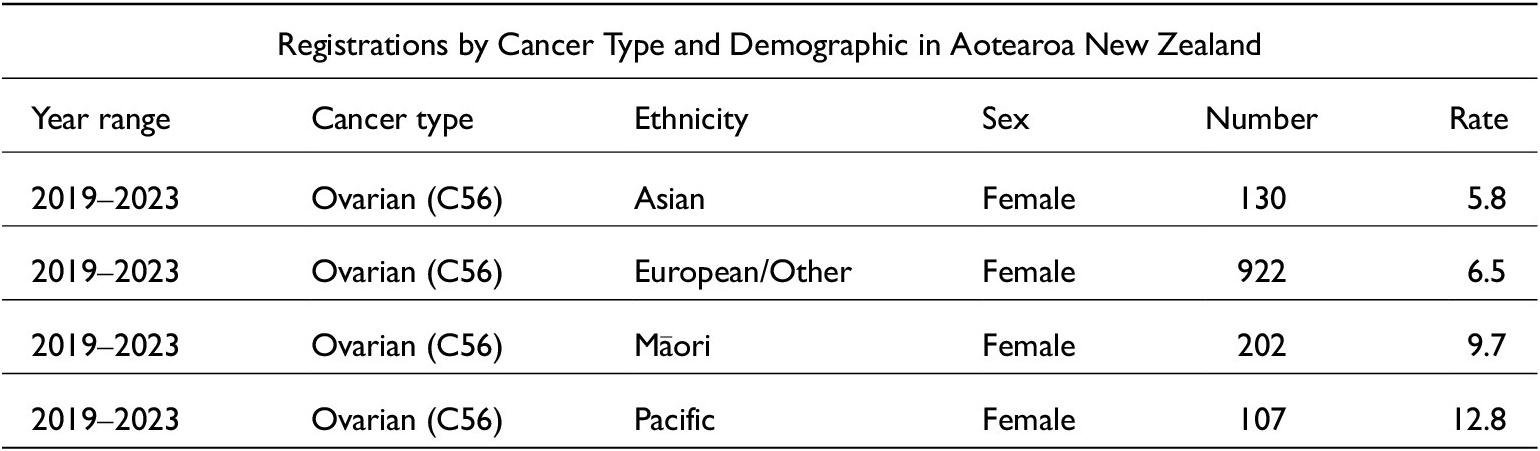
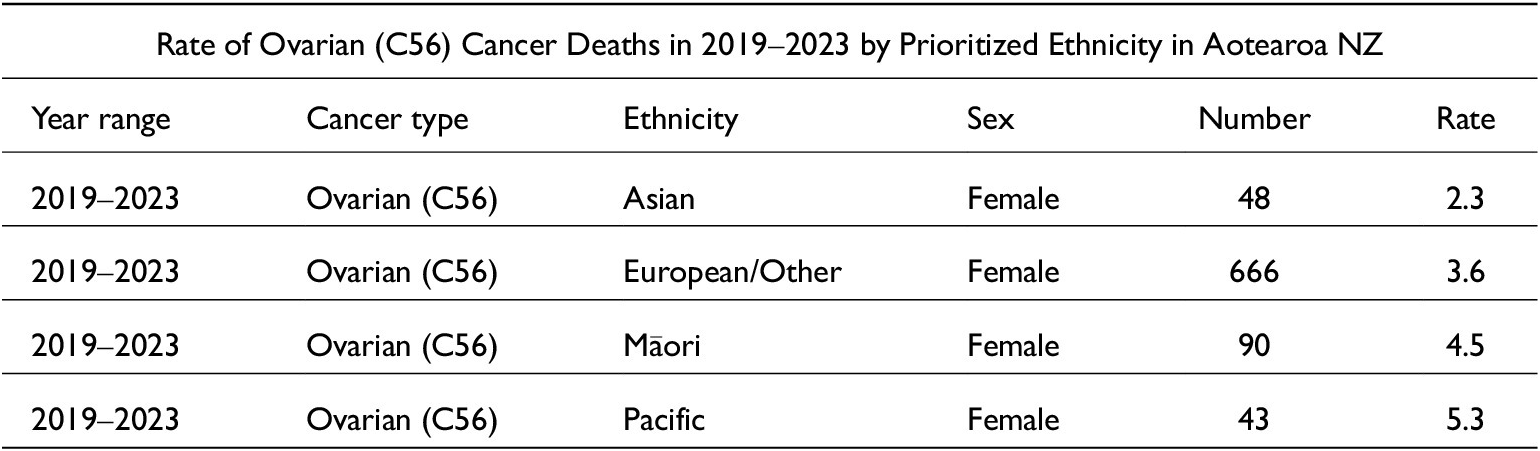
Te Whatu Ora – Health New Zealand has developed a cancer web tool which presents data about primary cancer diagnoses, and registered deaths where cancer was recorded as the underlying cause of death in Aotearoa New Zealand. Table 1 displays ovarian cancer registrations between 2019-2023 and Table 2 displays ovarian cancer death data between 2019-2023.
Number of registrations of women, sorted by their demographic, who were diagnosed with ovarian cancer between 2019 and 2023. Pacific women had the highest rate of diagnosis for ovarian cancer, followed by Māori women

Table 1 Long description
The table is titled Registrations by Cancer Type and Demographic in Aotearoa New Zealand. It contains six columns: Year range, Cancer type, Ethnicity, Sex, Number, and Rate. All data refers to the year range 2019 to 2023, the cancer type Ovarian (C 56), and the female sex. The rows are organized by ethnicity as follows:
* Asian: 130 registrations with a rate of 5.8.
* European/Other: 922 registrations with a rate of 6.5.
* Māori: 202 registrations with a rate of 9.7.
* Pacific: 107 registrations with a rate of 12.8.
Table shows the number of ovarian cancer deaths between 2019 and 2023

Table 2 Long description
The table is titled Rate of Ovarian C 5 6 Cancer Deaths in 2019 to 2023 by Prioritized Ethnicity in Aotearoa N Z. It contains six columns: Year range, Cancer type, Ethnicity, Sex, Number, and Rate. All data refers to the 2019 to 2023 year range, Ovarian C 5 6 cancer type, and Female sex. The data rows are as follows:
* Asian: 48 deaths with a rate of 2.3.
* European or Other: 666 deaths with a rate of 3.6.
* Māori: 90 deaths with a rate of 4.5.
* Pacific: 43 deaths with a rate of 5.3.
An attribution note states that Pacific women had the highest rate of deaths, followed by Māori women.
Pacific women had the highest rate of deaths, followed by Māori women.
Ministry of Health. 2019, web tool, https://tewhatuora.shinyapps.io/cancer-web-tool/
Trends in mortality rates since 1981 for Māori and Pacific people with cancer demonstrate little, if any, improvement.Footnote 24 In a 2009 study, Rebecca Firestone et al. found that Pacific and Māori women experience higher incidence and mortality from ovarian cancer than non-Māori and non-Pacific women.Footnote 25 The study suggests further research is warranted to examine these ethnic differences and to develop improvements in current cancer prevention strategies, particularly in Pacific women.
It is heartening though that there are organizations such as Te Aho o Te Kahu | Cancer Control Agency that are working towards an optimal cancer care pathway for people with ovarian cancer.Footnote 26 Although Te Aho o Te Kahu notes that there is no national ovarian cancer screening programme, they suggest that primary and community healthcare services need to improve awareness of ovarian cancer symptoms and the importance of knowing family histories of cancer.
I was aware that ovarian cancer was one of the most virulent types of cancer when I first suspected I might have it, and it was with some trepidation I made an appointment to see my General Practitioner (GP) on 13 July 2022. My main symptoms were fatigue, abdominal bloating, and urinary frequency, the same symptoms, my good friend, Kate, had also experienced, prior to her diagnosis of ovarian cancer.
Returning to the metaphor of ovarian cancer being a “hidden cancer” and associated with the interior of the female body, this metaphor can also be applied to messaging about ovarian cancer. It tends to be hidden from public view and hidden from health promotion. I only knew the symptoms because my friend had experienced similar symptoms. Kate, also, wahine Māori, had not known the symptoms of ovarian cancer until her own diagnosis. As ovarian cancer is more common in Māori and Pacific women, with mortality rates around a third higher for these ethnicities than in European and other ethnic groups, it is concerning that many of us do not know the symptoms.Footnote 27 From an Indigenous perspective, this sharing of knowledge can be located within the Taha Whanau pillar—women looking out for one another, women telling each other their stories of ovarian cancer, women writing personal narratives of their ovarian cancer experiences, and women founding organizations such as Talk Peach, which help educate women about gynaecological cancers.Footnote 28
After consultation with my GP, she sent me for a CA125 blood test. CA125 is a protein that both women and men have in their blood, and a high level of CA125 in the blood is a possible indicator of ovarian cancer, as CA125 can sometimes be produced by ovarian cancer cells.
For most women, a CA125 level below 35 units per millilitre (U/ml) is considered normal. However, it is important to note that some women naturally have levels above this range without any health concerns. Levels over 35 U/ml may indicate the presence of cancer or other conditions. However, it is also important to note that the CA125 blood test is not used as a screening tool for ovarian cancer, as an elevated CA125 reading may be caused by other factors including a chest infection, pregnancy, endometriosis, or fibroids, for example. In addition, some women will have a naturally elevated level with no cause for concern.Footnote 29
My CA125 result of 855 U/ml was significantly elevated, and within days I was referred for a transvaginal ultrasound and soon after, for a computed tomography (CT) scan. The results of these tests revealed a suspicious ovarian mass and omental mass, and I was referred to the Gynaecology Oncology service, Auckland District Health Board.
To say I was overwhelmed at suddenly finding myself in this situation would be a massive understatement. I was in shock and very emotional and anxious. Nevertheless, I consider myself to be incredibly fortunate to have been under the care of Gynaecological Oncologist Consultant Surgeon, Dr Tom De Greve. Not only did he bring his extensive medical expertise to my care, but he brought a “human touch”, treating me as an individual and making an effort to connect on a personal level with empathy and compassion. His interactions with me also gave me a modicum of participation in that I was a participant in decision making albeit in a limited way.
An ovarian cancer diagnosis is very stressful and frightening. Within the Te Whare Tapa Whā model, the pillar of Taha Hinengaro represents mental and emotional well-being—the health of one’s mind, consciousness, and thoughts. It is frequently described as the pillar that assists with navigating life’s challenges, coping with stress, and maintaining a positive sense of self. Anxiety is a core part of my temperament, and I had to consistently engage with the Taha Hinengaro pillar to maintain emotional equipoise and balance by practising mindfulness and mantra meditation. I also very consciously focused on developing courage, resilience, and endurance.
Dr Tom De Greve was very much aware of my anxiety and took the time to talk with me in a calming and mindful manner. The surgical procedure of cytoreductive (debulking) for ovarian cancer was carefully outlined with an extensive explanation as to the need for surgery to make a diagnosis. Throughout this interaction with Dr Tom De Greve, the taha hinengaro (intellectual) was at the forefront but on another level so too was taha wairua (spirituality). In essence, the consultation was not just about the surgical procedure and what to expect; it was also about the meaning of life and facing the possibility of death.
The aim of debulking surgery is to remove as much cancerous tissue in a patient’s abdomen as possible. “Optimal debulking” reduces tumour size to <1 cm to make subsequent treatment strategies (chemotherapy or radiation) more effective. Debulking surgery typically removes the ovaries, uterus, cervix, and fallopian tubes.Footnote 30 Debulking is not for the “faint-hearted.” The first few days post surgery often involve significant pain and fatigue, and reliance on caregivers. Some women may have temporary or permanent stomas (colostomy or ileostomy), urinary catheters, and drains. Susan Gubar in her Memoir of a Debulked Woman describes her debulking operation as the “Mother of All Surgeries”.Footnote 31 She compares the procedure to “gutting”, “evisceration”, and “vivisection or disembowelling”, writing graphically about her appalling experience with the treatment she received for ovarian cancer. Her experiences were, frankly, terrible. I was deeply shaken reading her memoir and felt intense compassion for her and what she had endured. Fortunately, my experience was not as harrowing as Gubar’s. Nevertheless, both surgeries for ovarian cancer were heavy-going and profoundly distressing.
Within the context of cancer treatment, there are many conversations that can be viewed as “courageous conversations”. Courage can be perceived as developing the mental fortitude to confront pain and uncertainty, particularly the emotional courage to “open oneself” to the surgeon’s knife, to the vulnerability, and the fear of harm or even death. There are also those conversations about how the cancer-afflicted female body can be embodied.Footnote 32
Ovarian cancer surgery typically results in external vertical abdominal scars. In my case, the vertical incision was below the breastbone running down to the pubic bone to allow for extensive exploration. As I needed two surgeries, the resultant scar tissue developed into thicker hypertrophic scars resulting in, I freely admit, some aesthetic distress. Scars on the post-cancer body can take a while to become accustomed to. Many women struggle to accept their post-cancer bodies because of cultural normative views about embodied femininity and sexuality.Footnote 33 Yet the compulsion to confront perceptions of an altered body within cancer narratives “functions not to mitigate but to reinforce the embodied subject’s experience of fragmentation in the face of a shared vulnerability to loss”.Footnote 34
From the onset, I knew that treatment for ovarian cancer was likely to take some time, and I would need to have the endurance to withstand and sustain a prolonged stressful period. Endurance in the context of cancer treatment involves managing treatment-related fatigue and sustaining daily activities despite the physical stresses. I would consciously engage with the pillar of Taha Hinengaro and actively notice any challenging thoughts. During these periods, I would use affirmations and positive self-talk to “take the edge off”.
I also spent time thinking about building my resilience and managing setbacks and challenges that were beyond my control. Building in self-care and mindfulness, ensuring I got adequate rest, and maintaining connections with whanau (family) and friends were very important at this very difficult time. This aspect of my recovery was located within the Taha Whanau pillar. Taha Whanau was about social support, reaching out to friends, learning to ask for help, and gratefully accepting offers of support. My amazing daughter, Cara, was one of my main supporters.
Cara has been wonderful coming to the hospital appointments with me and taking notes in a notebook—there is just so much to take in and it’s all so over-whelming. (email message to Stephanie, 25 July 2022).
I was scheduled for surgery on 30 August 2022. My case was quite complex and required major surgery which took over 8 hours and required a hospital stay of 7 days.
Unfortunately, the surgery discovered more cancer than anticipated. The large mass attached to my left ovary was removed and also the omentum. However, there is also some cancer on the bowel, bladder and spleen surfaces, and Dr Tom De Greve, decided it would be a better outcome if I have three rounds of chemotherapy starting in about 4 weeks time so the remaining cancer cells can shrink and then they will go back in and operate again in December. After which I will have another three rounds of chemotherapy. Really devastating news but Dr Tom is quite optimistic about this plan of action. The thought of having to have more surgery is somewhat daunting. (email message to Stephanie, 6 September 2022).
I am so sorry and upset to hear your news. It’s a terrible shock to be told that things are worse, rather than better than expected. I can imagine how hard it must be to cope with the new reality, of chemotherapy and surgery, and the interruption to normal life. And how upsetting for Cara. I do remember vividly the shock when I had my cancer diagnosis, reviewing my whole life! I am lucky I only needed radiotherapy.
It does sound though as if you are able to enjoy and appreciate the lovely things around you—and little Vivi such a comfort. Our dogs are so essential to our happiness, aren’t they?! (email message from Stephanie, 7 September 2022)
The Taha Whanau pillar is also about the support our pets can provide. My darling little Bichon Frisé, Vivi, was a staunch and devoted support throughout my entire recovery period. The Bichon Frisé is well known for its affectionate, cheerful, sensitive, and gentle temperament, and all these qualities were evident in my loyal, loving canine companion.
In a recent research project where pet owners with cancer were surveyed, it was found they highly valued the emotional support their pet provided and felt it helped them recover from cancer treatment. Yet many worried that they were unable to provide the usual care for their pets whilst going through treatment and recovery.Footnote 35 This was certainly true for me, and I am immensely grateful to my lovely friend, Huia, who kindly took Vivi for walks, took her to her grooming appointments, and gave generously of her time.
Knowing how beloved my little Vivi is, Tifa Rain, gifted me a sweet depiction of me holding Vivi, standing alongside my daughter, Cara (Figure 4). I was so very touched to receive such a special gift, and it is now a framed reminder of Tifa’s thoughtfulness in creating such a wonderful image.Footnote 36
“Helene, Cara and Vivi”. (Source: created by Tifa Rain [digital media])

Within Te Whare Tapa Whā, the four walls or pillars interact with each other, and each one requires attention to maintain stability. It is a holistic model and emphasizes a whole-person approach. The mind (taha hinengaro), the body (taha tinana), the family (taha whānau), and the spirit (taha wairua) need equal attention. Neglecting one pillar can decrease the strength of the other pillars. I was very much aware of this and focused on each pillar. Nevertheless, the pillar of taha wairua (spirituality) underpins my ovarian cancer narrative. Durie argues that the taha wairua pillar is the most basic and essential requirement for health. He argues that without a spiritual awareness, an individual is considered to be lacking in well-being.Footnote 37 The taha wairua pillar was my “tower of strength” all the way through my cancer diagnosis and treatment. I would invoke the powerful mantra “Om Namah Shivaya” every time I attended an appointment or underwent a procedure or treatment, focusing on the inhaled breath and then on the exhaled breath.Footnote 38 The taha wairua can be understood as a revitalization of knowledge about spirituality. It helps to confront tough emotions and helps to calm the mind. Taha wairua is often described as the “invisible” element that connects all other elements of Te Whare Tapa Whā.
I also drew upon the fifth element of the Te Whare Tapā model, taha whenua, the land and our connections to place. Connecting to taha whenua was also intertwined with connecting with taha wairua. Going for nature walks, feeling my feet firmly standing on Papatūānuku (Earth Mother), paddling in the moana (sea), and breathing in fresh air were all vital to my healing and well-being. The whakatauki (proverb) “Ko au te whenua, te whenua ko au” (I am the land, the land is me) expresses how intrinsically Māori identity is inseparable from the whenua (land). For Māori, the wairua or spiritual essence is connected to one’s mauri or life force and cannot be separated. It represents who you are, where you come from, and your mana whenua (the land of your tupuna, (ancestors).Footnote 39
My approach to taha wairua involved a synthesis of spiritual practices and perspectives that helped bring about equipoise and was both sustaining and calming. I drew on Western and Eastern traditions and Indigenous perspectives. For Māori, wairua can be viewed as two waters because it allows people to exist fully and fulfil their potential in both Te Ao Kikokiko (the seen world) and Te Ao Wairua (the unseen world).Footnote 40
Within Māori philosophical analyses of worldviews wairua connects all things, the tangible to the intangible, the living to the dead and it is not viewed as a separate dimension of human existence. It is connected through tikanga (method, formality), beliefs and values and is an intrinsic part of the whole being.Footnote 41
Māori healers approach their work with a sense of wairua and perceive Rongoā Māori, a holistic system of healing based in Māori cultural traditions, as having benefits to wider populations. Māori healing practices originate from traditional cultural knowledge which view the mind, body, spirit, family, and land as essential aspects of health and well-being.Footnote 42 Rongoā Māori is increasingly being integrated into New Zealand public hospitals to provide holistic, patient-centred care alongside Western medicine.Footnote 43 I drew on Rongoā Māori once I started chemotherapy, using mirimiri (massage) and rongoā rākau (herbal remedies).
The taha wairua pillar was also connected to Catholicism. My paternal grandmother was Irish and a devout Catholic. We were very close and unsurprisingly, I found myself turning to the Catholic practice of reciting novenas. A novena is usually recited over a 9-day period to petition a patron saint to request a special favour at a time of particular need. Before each of my surgeries, I recited a novena to Saint Barbara, the patron saint of surgeons and anaesthetists, timing it to conclude on the day before the scheduled surgery. I also recited a novena to Saint Peregrine, the patron saint of people afflicted with cancer. Several friends and family members recited the novenas with me. The ritual of lighting candles, invoking the saints, and reciting the novenas over 9 days with intentional faith was both powerful and compelling.
The recitation of prayers, invocations, and gifts from cherished friends and whānau who gave of their time, made meals, brought flowers, and sent cards and poems were imbued with wairua and aroha (love) and exemplify both the essence of taha wairua and taha whanau. An email to my friend Stephanie, who lives in Australia, demonstrates the importance of Taha Whānau and social and emotional support from friends and family.
Thank you so much for your lovely gifts which arrived this morning. I was beyond thrilled. I absolutely love the fragrance of the hand cream. And the lip balm is sublime—feels really moisturising. Apparently, lips can get quite dry and sore during chemo so this will be very helpful. The colours of the Pashmina are so my colours. It will nicely match a turban I’ve ordered for the dreaded hair loss. I gently washed your shawl in a lavender wool wash so I will have it with me when I start chemo—I just want to feel wrapped in your love. (email to Stephanie, 10 October 2022).
Before starting chemotherapy, I met with medical oncologist Dr Rosalie Stephens. She explained that I would be receiving the “Gold Standard” treatment—platinum-based chemotherapy (carboplatin and paclitaxel). Dr Rosalie has a very pleasant manner and was very reassuring. She alerted me to possible side effects and reassured me that the advantage of having three cycles prior to the second surgery was that it was likely to be less extensive as the chemotherapy would have destroyed the majority of any remaining cancer cells.
My first chemotherapy infusion on 11 October 2022 was very tiring. I found the insertion of the IV cannula into my hand very painful, and it was long day in the oncology outpatient ward. The chemotherapy side effects hit with a vengeance around 2.00 am the following day. I woke up with excruciating pain in my legs. I later learnt that these symptoms of myalgia (muscle pain), arthralgia (joint pain), and ostealgia (bone pain) were relatively common, though not necessarily as intense as I experienced. Throughout the six cycles of chemotherapy, three before the second surgery and three cycles afterwards, I experienced this intense, awful pain. Other side effects included nausea, vomiting, fatigue, and hair loss. Towards the end of chemotherapy, I developed chemotherapy-induced peripheral neuropathy (CIPN) in my hands causing numbness, tingling, and weakness due to nerve damage. Fortunately, this side effect diminished over time.
The pillar of taha tinana called for physical support, and I relied on prescription medication for pain relief and nausea during this period. I also sought relief from a range of complementary medicine including massage and CBD oil, a non-psychoactive cannabis extract containing cannabidiol, which helped relieve the pain and helped with sleep.
Cara massaged my legs with some magnesium oil which helped. I just don’t know how I’m going to get through as it’s all really awful, but I know it will pass.
Cara was a beautiful child and has grown into a beautiful young woman. Her beauty is not just external though. She really does have a beautiful soul. I have been very grateful she came into my life. I just hope I get through all of this and can be with her for some years hence. She still needs her mumsy! (email to Stephanie, 20 October 2022).
Many women with ovarian cancer experience significant chemotherapy-related adverse effects during treatment, and some are unable to complete the treatment. Three main themes related to women’s experiences of dealing with chemotherapy for ovarian cancer have been identified: “optimistic tenacity”, which illustrates a specific stoic identity that women assumed during treatment; “self-care”, which reflects the health behaviours and activities women engaged in and lifestyle adjustments they made; and “support systems”, which emphasize the importance of social, emotional, and medical support.Footnote 44
These three themes are very much aligned with the pillars of Te Whare Tapa Whā. “Optimistic tenacity” is an important element in taha hinengaro and taha wairua. Engaging with taha hinengaro calls for positive self-talk, using affirmations and mindfulness, and negating negative thoughts and worries. Being mindful of taha wairua and the invisible world can also assist with optimistic tenacity and the ability to draw on one’s reserves and simply to “keep going”. “Self-care” is also an important element in taha hinengaro and, also, taha tinana. Self-care supports the tinana, the physical as well as the hinengaro, our mental health. Daily rituals of mantra meditation, focusing on the breath and spending time in nature nurture our bodies, mind, and spirit. “Support systems” are an important element of taha whānau. Drawing on our circle of family and friends and ensuring we have emotional and social support are paramount in our journeys of recovery.
One of the challenges of chemotherapy for ovarian cancer patients is hair loss. Becoming bald is a visible embodiment and aesthetic consequences of cancer treatment.Footnote 45 Conventional representation of feminine beauty traditionally has associations with women’s hair. Long hair is often seen as a woman’s “crowning glory”. Hair is also seen as an indicator of good health.
In Māori culture, the head is tapu (sacred), and hair consequently holds mana (power). Traditionally, Māori women only cut their hair when in mourning as a sign of grief.
I’m really struggling with the hair loss. I had my hair cut very short in preparation—I’ve never really had short hair! Anyway, it’s falling out in large amounts. I have a wig and various hats and turbans, but I just hate the whole process. (email to Stephanie, October 31, 2022)
Hair loss during chemotherapy provides visual confirmation of cancer treatment, and while there is no physical pain associated with hair loss, there is often emotionally pain, illustrated by the quote from Jane Schultz below.
It is only a matter of days before my eyebrows, eyelashes, and the rest of my body hair disappears. My attempts to get away from this new self are fruitless. I see my image and want to jump out of my skin, for I do not recognize what I am seeing.Footnote 46
I totally related to Jane Schultz’s description of hair loss. As my hair fell out and later as my eyebrows thinned and most of my eye lashes fell out, I was traumatized. I avoided looking in the mirror as I no longer recognized myself.
My mother, Tui, died of ovarian cancer and her sister, my Aunt Chloe, died of both ovarian and breast cancers. My mother died in 1990 when treatment options were less optimal. The main symptom I recall her having was severe abdominal pain. Sadly, she died shortly after her diagnosis. After her death, I asked my GP if ovarian cancer was a hereditary cancer. I was informed it wasn’t! However, researchers, including Dr Mary-Claire King’s group, reported in 1990 that a gene on chromosome 17q was responsible for a significant proportion of inherited breast and ovarian cancers.Footnote 47
Port argues that Māori perspectives and tikanga (cultural values) in the area of genetic testing, counselling, and other services need to be taken into account. Her research into genetic testing found that some Māori feel that DNA testing would interfere with their whakapapa, while others embraced the opportunity to ascertain their risk of developing cancer.Footnote 48 With my family history, I was offered genetic testing, and I had no hesitation about being tested and subsequently, found out I have the BRCA2 mutation. Approximately one in five people with high-grade serous ovarian cancer carry a mutation in the breast cancer (BRCA) 1 or 2 gene. Mutations in the BRCA gene are more common if people have a family history of ovarian cancer, breast cancer, prostate cancer, and pancreatic cancer.Footnote 49
Within the Te Whare Tapa Whā model, there is some overlap between the pillars Taha Whanau, Taha Hinengaro, and Taha Tinana, as I processed the implications of having the BRCA 2.
My brother was also advised to be tested and found he has also inherited the BRAC2 mutation. Fortunately, neither his daughter nor my daughter have inherited the mutation.
Clark argues that much of the literature regarding BRCA1 and BRCA2 is predominately scientific with little about the psychosocial ramifications of those testing positive for BRAC1 and BRAC2. She argues that narratives of the women who are living with such mutations could heighten knowledge about potential psychological and sociological experiences stemming from the women’s stories, including those women who opt for prophylactic (preventive) mastectomy and salpingo-oophorectomy (removal of ovaries and fallopian tubes), which can significantly reduce their risk of developing breast or ovarian cancer.Footnote 50
While I have been offered a prophylactic double mastectomy to reduce my risk of developing breast cancer, I’ve also been advised that after two major abdominal surgeries and chemotherapy, it would inflict further stress on my body. While I’ve opted not to have preventive surgical intervention at this time, I am under medical surveillance with annual mammograms and breast ultrasound scans at the Auckland District Health Board Breast Clinic.
Cancer narratives can uncover psychological and sociological experiences of testing positive for BRAC1 or BRAC2 and opting (or not) for preventative surgeries. Kathie Irwin in her seminal work on Māori feminism advocates for Māori women to tell our herstories, in the pursuit of equity and empowerment.Footnote 51 For wahine Māori, herstories and cancer narratives can provide the resources necessary to make informed choices about genetic testing and the options available to reduce the risk of developing cancer.
Many women with BRCA2 mutations respond well to chemotherapy primarily because their tumours are deficient in homologous recombination (HR), a vital DNA repair mechanism. Chemotherapies like platinum agents and anthracyclines induce severe DNA damage and because the cancer cells cannot repair this damage, they die.Footnote 52
Following surgery and chemotherapy, my CA125 blood tests fell within the normal range. I was also eligible for a newly funded drug in New Zealand, olaparib (Lynparza), a PARP inhibitor, which research is showing can significantly improve the life expectancy for many women who have had successful surgery and chemotherapy for ovarian cancer.Footnote 53 It works by blocking enzyme-mediated DNA repair, causing cancer cells to die.
I was on Lynparza for two years, completing the treatment on 18 April 2025. The main side effects I experienced were fatigue and nausea, marginal inconveniences for long-term gains. When I was first prescribed Lynparza, my medical oncologist explained that this treatment was the first new treatment for advanced ovarian cancer in decades. Although Lynparza cannot help all women diagnosed with ovarian cancer, it has been revolutionary and a complete game-changer for those who respond well.
Overall, I had exceptional treatment and care from the Gynaecology Oncology team at Te Whatu Ora Health. However, on one occasion I felt compelled to make a complaint about the way I had been treated by one of the doctors within the Gynae-oncology team. Excerpts from my letter of complaint are noted below.
She did not use any kind of warm salutation to greet me. Her opening words to me were: “Do you know what you are here for?”
Obviously, I did know I was seeing someone in the gynae oncology team to find out the results of my CT Scan and to find out about the surgery I needed to undertake! Needless to say, I was feeling anxious about the results and very vulnerable. In these kinds of situations, patients need to be reassured and put at ease as much as possible.
She then proceeded to provide the worst-case scenarios and outcomes of the surgery, leaving me and my daughter shaken and tearful. She also carried out another internal examination which was very painful and entirely unnecessary. She also insisted on feeling my breasts and poked her fingers very roughly into my arm pit. The whole experience was excruciating and violating. I felt disempowered and very worried that I would be subjected to seeing her again. I, therefore, respectfully request, that I am not put in a position again, where she is part of my treatment team.
It is not easy to make a complaint, especially when you are in a vulnerable position and feeling physically, psychologically, and emotionally debilitated. Indeed, most patients on the receiving end of poor medical care choose not to make a complaint.Footnote 54 As Ahmed argues, the person who makes the complaint is often already experiencing the trauma or stress of the situation they are complaining about which is what occurred in my case.Footnote 55
Fortunately, my complaint was taken seriously and responded to immediately, and this doctor was removed from my treatment team. I was also reassured that my concerns and feedback would be used to improve services.
Feminist theory applied to women’s health practice begins from the standpoint of women as actors and as definers of their experience. As a political discourse, feminist theories attempt to change existing structural power relations in society. In the doctor–patient relationship, women need to be treated as relational beings where the relationship is one of mutual reciprocity and respect.Footnote 56
From a feminist perspective, the importance of self-advocacy regarding complaints against medical professionals frames complaints not merely as feedback but as a political act of self-preservation and a demand for bodily autonomy.
Within Te Whare Tapa Whā, my complaint about a doctor who made me feel disempowered, disrespected, and denigrated can be framed within all four pillars. Within the taha wairua pillar, my wairua was wounded. My mana (dignity) was diminished as wahine Māori, as a mother, and as a patient. From the perspective of the taha hinengaro, I felt emotionally traumatized and deeply upset by the experience, which had a significant impact on my mental health. The brutal way I was physically examined can be viewed as being harmful to my taha tinana and the emotional impact on my daughter, who witnessed the whole reprehensible episode impacted the foundation of taha whānau. No daughter should witness her mother being poorly treated by a medical professional and the fact that she became deeply distressed, crying uncontrollably, was completely unacceptable and was one of the reasons I made my complaint.
Rochford contends that Te Whare Tapa Whā can be seen as a unified theory of health and argues that in addition to being so (and therefore emphasizing its power as an analytical tool), it can be used to design a response to a complex disease.Footnote 57
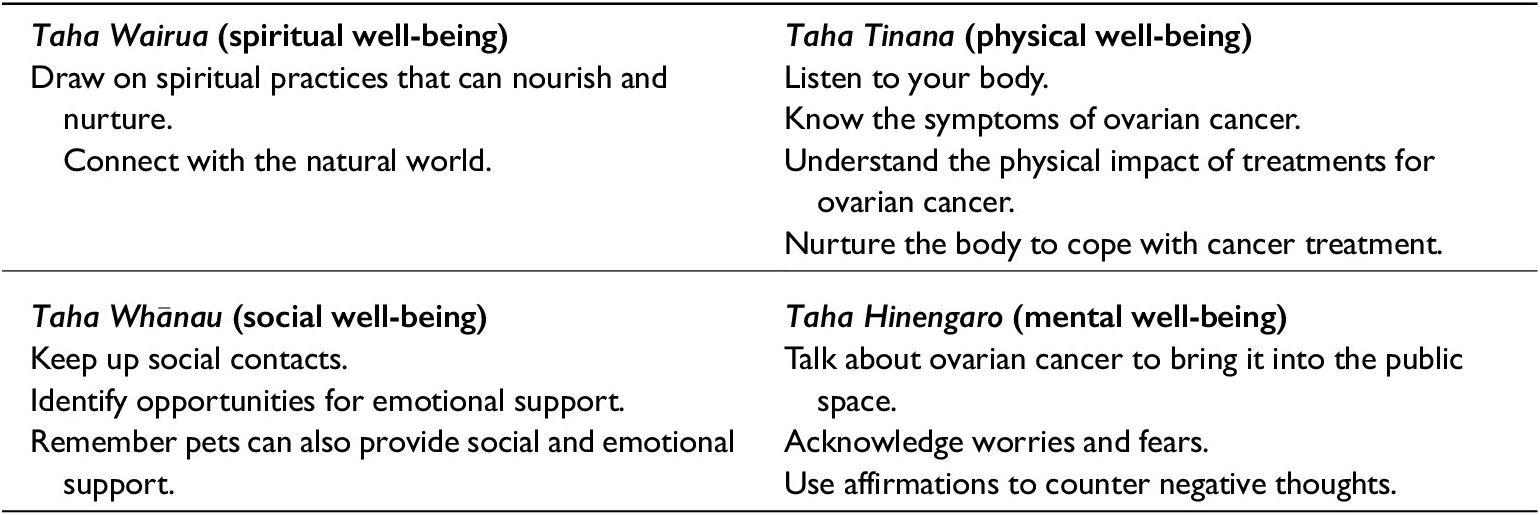
In this paper, I have provided several examples of how I used Te Whare Tapa Whā as a framework to respond to ovarian cancer. Table 3 provides a summary.
Table demonstrating how the four pillars of Te Whare Tapa Whā can be utilized in an ovarian cancer diagnosis

Table 3 Long description
The table is organized into four quadrants representing different aspects of well-being.
* Top-Left Quadrant: Taha Wairua (spiritual well-being). This section advises drawing on spiritual practices that nourish and nurture, and connecting with the natural world.
* Top-Right Quadrant: Taha Tinana (physical well-being). This section emphasizes listening to the body, knowing ovarian cancer symptoms, understanding the physical impact of treatments, and nurturing the body to cope with treatment.
* Bottom-Left Quadrant: Taha Whanau (social well-being). This section focuses on keeping up social contacts, identifying opportunities for emotional support, and noting that pets can provide social and emotional support.
* Bottom-Right Quadrant: Taha Hinengaro (mental well-being). This section suggests talking about ovarian cancer to bring it into the public space, acknowledging worries and fears, and using affirmations to counter negative thoughts.
Writing my ovarian cancer narrative has in many ways been difficult and challenging; nonetheless, I consider cancer narratives to be important, not only for the empowerment of patients but also to bring about awareness of the diversity in experience.Footnote 58
The writing of my ovarian narrative has brought to the forefront those memories of feeling shocked and terrified about the future, wondering in fact if there was a future. Yet it has also brought back memories of the mostly exceptional care I received and the kindness and love of family and friends.
One of the central “takeaway” messages from this ovarian cancer narrative is that women need to be vigilant in paying close attention to their bodies and to know the symptoms of ovarian cancer. However, as Stoddard Holmes argues, increased awareness of the early symptoms of ovarian cancer is not without its problems with the potential for overdiagnosis and overtreatment. Nevertheless, early diagnoses would have the benefit of drawing more lightly on health resources and returning women’s energies to their work and communities more rapidly.Footnote 59 It is also important to be vigilant about recognizing a recurrence. Although ongoing surveillance can be anxiety provoking while waiting for blood test and imaging scan results, it is preferable to be aware of any symptoms that could indicate recurrence and to seek medical advice.
World Ovarian Cancer Day is May 8. It is a key day that should be on every woman’s calendar. Established in 2013 by a group of leaders from ovarian cancer advocacy organizations around the world, May 8, World Ovarian Cancer Day, unites efforts to raise awareness, improve early detection, and support those affected by the disease. It highlights significant symptoms such as abdominal pain, bloating, and urgent urination.Footnote 60
During my cancer treatment, I had the opportunity to work with Māori Health Psychologist Eva Morunga. Eva is a beautiful being, overflowing with the light of her wairua. During my sessions with her, I took part in the programme Meaning-Centred Psychotherapy, a programme designed to help cancer patients with the challenges of a cancer diagnosis. Part of the programme required participants to work on a project, Life as a Living Legacy, in order to generate a sense of meaning in light of their life and illness. I drew from the following whakatauki (proverb), which I quoted in my personal project. It seems an apt ending to this article.
E hara taku toa i te toa takitahi, engari he toa takitini.
My success is not mine alone but is the strength of many.Footnote 61
Acknowledgements
I would like to acknowledge the Gynaecology Oncology team, Te Whatu Ora Health, Aotearoa New Zealand, Hospitals and Health Care, Tāmaki Makaurau, Auckland, with particular appreciation and thanks for their exceptional expertise and compassionate care: Gynaecological Oncologist Consultant Surgeon, Dr Tom De Greve and his Assistant Surgeons: Dr Anna Unsworth and Dr Joseph Gudex; Medical Oncologists: Dr Rosalie Stephens, Dr Kathryn Chrystal, and Dr Michelle Wilson; Gynae-Oncology Nurse Specialists: Sachi Perera, Claudia Main, and Rozlyn Ali; and Health Psychologist, Eva Morunga.
To all the nurses in Ward 97, Auckland City Hospital, who provided gynae-oncology preoperative and postoperative support, thank you for your care and kindness.
To General Practitioner, Dr Helena Simpson Cabellero, Tend Medical Centre, thank you for your kindness, care, and support and keeping me up to date with test results.
I would also like to acknowledge whānau, friends, and colleagues who supported me from the time of diagnosis, through surgery, chemotherapy, and beyond.Footnote 62
Firstly, to my beautiful, courageous daughter, Cara, thank you for all your love and support and for simply being you!
To my dear friend Stephanie, thank you for all your emails, messages, and gifts, and for your friendship and love over all these years.
To all those friends who sustained me with their prayers and invocations; to Jennifer, a much-loved friend of many years, now living in Australia; to dear Anne from Manchester and her Saint Vincent De Paul group for keeping me in your prayers; to Anne and lovely Frances F., who participated in novenas to St Barbara, patron saint of surgery and anaesthetists and St Peregrine, patron saint of people afflicted with cancer; and to Phanidda, who recited daily Buddhist prayers for me.
Special thank you to Sandra, who made me a stunning, traditional Diné Nation Medicine bag and to Angie who gifted me several healing crystals and a beautiful candle to be used for karakia and prayers.
To my lovely friend Huia, thank you for taking Vivi for walks, and taking her to her grooming appointments.
To those friends who gave so generously of their time, I will be forever grateful: Phyllis who so kindly drove me to and from each and every one of my chemotherapy sessions; Kate who took me to hospital appointments; Frances K. who provided delicious fresh baking to have after my chemotherapy; Phanidda who made a nourishing broth with chicken dumplings and the freshest and tenderest of Asian greens; my very good neighbour, Rebecca, who brought nutritious home-cooked meals; and Te Kawehau, who brought a range of beautifully precooked meals.
To Barbara and Simon, who gifted me the original sketches on the koru model, thank you for your generosity and to Tifa for the beautiful depiction of me, Vivi, and Cara, thank you so much!
Many thanks to my manager, Professor Mark Barrow, who supported me while I was on sick leave and to all my colleagues on the Faculty Leadership team who sent flowers and good wishes.
To all those friends and colleagues who made regular phone calls and sent messages, flowers, and cards, thank you so much for your care and for “checking in” so regularly: Allen, Ali, Anais, Anne, Barbara, Bonnie, Diana, Don, Elisabeth, Frances H, Frances K, Jane, Jen, Kate, Ksenija, Liz, Piata, Sandra, Sheridan, Stephanie, Tony C, Tony O, Tony T, and Ursula.
To the three anonymous reviewers and to Dr Mary K. Bryson and Dr Bryant Lin, Guest Editors, Public Humanities of this special edition, “Cancer’s Dirty Margins: Minoritized Scholars’ Pathographies”, who read my preliminary paper and offered helpful comments and suggestions to strengthen and consolidate the paper, I offer my thanks and appreciation.
Author contribution
Author contribution was entirely individual.
Funding statement
No funding was accessed for this paper.
Conflicts of interest
No potential conflict of interest was reported by the author.




 Open access

