I. INTRODUCTION
To alleviate the impacts of nonrenewable energy resources, resulting from environmental concerns and economic issues, the changeover from fossil fuels to renewable energy sources is crucial. Among renewables, the conversion of solar energy to electricity by using solar cells is the most promising candidate to be utilized worldwide. To achieve high-efficiency solar cells, the applied compound semiconductor has to satisfy two vital conditions: firstly, the direct bandgap nature of the band structure is needed, and secondly, the bandgap width should belong to a certain range of optimum values, because by widening the bandgap, V oc increases while it has a detrimental effect on the J sc (Morales-Acevedo, Reference Morales-Acevedo2010). Unlike silicon-based solar cells, suffering from indirect bandgap, thin-film solar cells usually possess absorber materials with a direct bandgap structure. The well-developed thin-film solar cells, such as CuInGaS2 (CIGS) and CdTe, have shown 22.8% and 22.1% efficiencies, respectively (Kamada et al., Reference Kamada, Yagioka, Adachi, Handa, Tai, Kato and Sugimoto2016; Powalla et al., Reference Powalla, Paetel, Ahlswede, Wuerz, Wessendorf and Magorian Friedlmeier2018). Despite the massive progress that has been made in constructing these thin films, they are dealing with substantial problems comprising the scarcity of In and Ga elementals in the earth crust and the toxicity of Cd (Kavlak et al., Reference Kavlak, McNerney, Jaffe and Trancik2015). Cu2ZnSnS4 (CZTS) thin film is also a potential candidate absorber layer for a terawatt-scale solar energy conversion application. It has a large absorption coefficient of 104 cm−1 (Dhakal et al., Reference Dhakal, Peng, Tobias, Dasharathy and Westgate2014). For supplying renewable energy on a large-scale comparable to the world's electricity consumption, mineralogically a fraction of elemental constituents produced annually is sufficient and toxic elements are avoided in this class of thin films.
The CZTS absorber layer resembles CIGS in several ways. Similar to CIGS, the deposition methods of CZTS can be classified into two major categories of vacuum- and non-vacuum-based techniques. Thermal evaporation (Chalapathi et al., Reference Chalapathi, Uthanna and Raja2017), pulsed laser deposition (Cazzaniga et al., Reference Cazzaniga, Crovetto, Yan, Sun, Hao, Estelrich, Canulescu, Stamate, Pryds, Hansen and Schou2017), and sputtering (Zhou et al., Reference Zhou, Cheng, Zhao, Yu and Jia2017) are among the vacuum-based techniques, while the non-vacuum-based procedures are spray pyrolysis (Bouzida et al., Reference Bouzida, Battas, Benamar, Schmerber, Dinia, Abd-Lefdil and Regragui2021), SILAR (Banerjee et al., Reference Banerjee, Das and Ghosh2019), sol–gel (Müller et al., Reference Müller, Ricardo, Di Maggio and Scardi2013), and spin-coating (Xiong et al., Reference Xiong, Gao and Gao2020). Unlike CIGS photovoltaic which possesses high efficiencies (Kamada et al., Reference Kamada, Yagioka, Adachi, Handa, Tai, Kato and Sugimoto2016), the power conversion efficiency (PCE) of CZTS thin-film solar cells is much lower than its theoretical limit (Shockley and Queisser, Reference Shockley and Queisser1961). V oc-deficit (E g/q-V oc) is considered as the main cause of this retardation of CZTS PCE from its theoretical limit (Shin et al., Reference Shin, Saparov and Mitzi2017). Several reasons, such as the presence of secondary phases (Kumar et al., Reference Kumar, Dubey, Adhikari, Venkatesan and Qiao2015), short minority carrier's lifetime, which is one or two orders of magnitude lower than its CIGS counterpart (Metzger et al., Reference Metzger, Repins and Contreras2008), interface band alignments, bulk defects (Yan et al., Reference Yan, Liu, Song, Ng, Stride, Tadich and Hao2014), and band tailing issues (Chen et al., Reference Chen, Walsh, Gong and Wei2013) are presumed to be the cause of V oc-deficit. Due to the non-stoichiometric synthesis circumstances of leading devices, the formation of secondary phases and antisite defects are feasible (Kumar et al., Reference Kumar, Dubey, Adhikari, Venkatesan and Qiao2015). Hence, by reducing/removing undesirable secondary phases, minority lifetime should increase, interface band alignments will improve, and bulk defects and band tailing issues can be optimized, leading to narrowing the efficiency gap between CZTS and CIGS solar cells. Thus, the initial step would be the preparation of high-quality kesterite CZTS thin film by a suitable deposition approach that has the potential to be utilized in large-scale production. The vacuum-based sputtering is a promising deposition candidate to fulfill the desired requirements.
There are several paths towards synthesizing CZTS powders (target) including hydrothermal (Agrawal et al., Reference Agrawal, Jain, Pasricha and Chand2013), hot injection (Ahmad et al., Reference Ahmad, Distaso, Azimi, Brabec and Peukert2013), microwave irradiation (Wang et al., Reference Wang, Shen, He and Li2014), and ball-milling (Lin et al., Reference Lin, Chi, Hsieh, Chen and Huang2016). Due to advantages like high efficiency, being eco-friendly, cost-effectiveness, and short time-consuming process, the mechanochemical method has gained a lot of attention (Mitzi et al., Reference Mitzi, Gunawan, Todorov, Wang and Guha2011; Wu et al., Reference Wu, Xue, Zhou, Liu and Xu2014). Lin et al. (Reference Lin, Chi, Hsieh, Chen and Huang2016) used Cu2S, ZnS, and SnS2 as precursors to prepare CZTS powder by the mechanochemical process. Nevertheless, Cu2S and SnS2 are expensive materials. In another work reported by Wang and Gong (Reference Wang and Gong2011), they used elemental Cu, Sn, Zn, and S powders to synthesize CZTS powder. Li et al. (Reference Li, Yao, Li, Xiao, Ding, Zhao, Zhang and Zhang2015) investigated the annealing temperature of the CZTS powder followed by sulfurization in the H2S atmosphere. The milling parameters (time and rotation speed) of the mechanochemical process and sintering temperatures were examined by Liu et al. (Reference Liu, Wen, Wang, Liu, Wang, Jiang, Ding, Xu and Chai2017). They investigated sintering temperatures in the range of 550−700 °C.
In this contribution, we report the formation of the kesterite CZTS powder from CuS, ZnS, Sn, and S powders synthesized by the method of ball-milling to obtain a sputtering target. At first, we systematically investigate the annealing condition of samples including annealing temperature, annealing time, and the heating rate of the furnace in order to obtain the optimized condition. In the second step, we study the influence of the ball-milling period. Precise control of secondary phases and defect generation is required to obtain a high-quality p-type CZTS absorber layer. For this purpose, the optimum conditions of annealing parameters and ball-milling time were combined. In order to survey the structural, morphological, and optical characteristics of the powders and to improve the quality of the specimens to meet the requirements of the well-behaved absorber layer, various analyses were performed.
II. EXPERIMENTAL DETAILS
In order to prepare quaternary sulfide with the general formula of Cu2ZnSnS4 by the mechanochemical ball-milling process, copper monosulfide (CuS), zinc sulfide (ZnS), and elemental tin (Sn) and sulfur (S), purchased from Sigma Aldrich, were weighted in an appropriate atomic ratio. The purity of all the powders was 99.99% except for S (99.9%). The metal ion ratios were selected to be Cu/(Zn + Sn) = 0.75 and Zn/Sn = 1.2 aiming to produce Cu-poor and Zn-rich CZTS powder, which has been confirmed to be in the range of optimum condition for solar cell application of CZTS thin films (Wang and Gong, Reference Wang and Gong2011). A mechanochemical blending procedure was performed in a planetary ball-milling system (NARYA MPM). Absolute ethanol was employed as a dispersant to prevent the agglomeration of particles in the mixture and enhance the process efficiency. This solvent has been selected to avoid over-pressuring inside the bowl to perform a longer ball-milling process. In the high-energy milling process, the zirconia balls were used and the ball to powder ratio was 8:1. To systematically investigate the influence of the mechanochemical process on the phase and other related behaviors of the powders derived from the milling procedure, the rotation speed was set at 400 rpm and according to milling time, 5 types of powders were synthesized at 5, 10, 20, 30, and 45 h, respectively. The ball-milling system is operated by a 10-min rotation cycle and a 10-min idle period. Then, the as-prepared powder was evaporated/dried at room temperature, resulting in the dark gray solid.
Afterward, the powders were placed in an alumina crucible and were subjected to annealing treatment in the vacuum at a temperature ranging from 400 to 550 °C for three different annealing times of 5, 10, and 15 h. Additionally, the powders were also annealed at four different heating rates of 4.5, 9, 14, and 22 °C min−1. Sequentially, the annealed specimens were allowed to cool down to room temperature without any external biasing.
The crystalline structure of the resultant powder was examined using a STOE stadi-p X-ray diffractometer in a 2θ range of 10−80° using CuKα radiation (λ = 1.5418 Å). The generator was set at 40 mA and 40 kV. The Debye–Scherrer formula, D = (kλ/βcosθ), was used to estimate the crystalline size, where D is the mean size of crystallites, k is the shape factor, λ is the X-ray wavelength, β is the line broadening at half of the maximum intensity (FWHM), and θ is the Bragg angle. The Rietveld refinement was also carried out for structural refinement and confirmation of the kesterite phase with the GOF = 2.9.
To verify the kesterite nature of the phase and identify possible secondary phases, a Takram P50C0R10 Raman scattering spectrometer equipped with InGaAs detector and Nd-YAG (532 nm) laser excitation source was employed. A QUANTA 200 field-emission scanning electron microscopy (FE-SEM) was also used to analyze the surface morphology at room temperature. In order to determine the elemental composition of CZTS powder, energy-dispersive X-ray spectroscopy (EDS) attached to FE-SEM was employed. To prevent charging effects, a thin Au film was coated on the powders. The EDS and FE-SEM pictures were taken with 25 kV accelerating voltage. The optical properties were characterized by (AvaSpec-3648, Avantes, Netherlands) UV-Vis spectroscopy through 200−900 nm wavelength range. The X-ray photoelectron spectroscopy (XPS) analysis was performed utilizing a BesTec XPS system (Germany) using an ultra-high vacuum (~10−10 mbar). Monochromatic Al kα (hv = 1486.6 eV) was used as an X-ray source and C 1 s was applied to calibrate elemental binding energies.
III. RESULTS
The annealing process is one of the most important stages of the CZTS-kesterite phase formation. Several annealing parameters such as (temperature, time, and rate) were varied to investigate their influence on kesterite phase formation. The X-ray diffraction (XRD) patterns of samples synthesized at different annealing temperatures, times, and rates were investigated in detail. All the specimens were polycrystalline and showed intensive peaks at 28.42°, 32.94°, 37.93°, 47.30°, 51.08°, 56.17°, 69.2°, and 76.45° corresponding to (112), (200), (121), (220), (031), (312), (008), and (332) planes, respectively, according to PDF entry 00-026-0575 (Gates-Rector and Blanton, Reference Gates-Rector and Blanton2019), consistent with the kesterite crystalline structure. Figure 1 represents the XRD patterns of CZTS powders annealed at various temperatures for 10 h to explore the temperature effect on the XRD pattern. Three peaks of CZTS, appeared at 28.42°, 47.30°, and 56.17° accompanied by an excess peak situated at 26.8° which can be attributed to ZnS phase according to PDF 00-005-0566. Among the patterns which have high diffraction intensity (450, 500, and 550 °C), the sample annealed at 500 °C possesses the lowest peak intensity of the ZnS phase (at 26.8°). Moreover, by increasing the temperature to 550 °C, the CuS phase peak (according to PDF 00-006-0464) at 31.8° appears. By considering these factors, the sample annealed at 500 °C was considered to be the best specimen for the rest of the research.
The XRD pattern of CZTS powders annealed at four different temperatures.

Formation of the CZTS phase from Cu2S, SnS, ZnS, and S precursors can be expressed by the following formulae (Li et al., Reference Li, Wang, Jiang, Yang, Lu, Liu, Zhao and Hao2016):
 $$\eqalign{{\rm 2C}{\rm u}_ 2{\rm S}_{{\rm ( s) }}{\rm} + {\rm 2Sn}{\rm S}_{{\rm ( s) }}{\rm} + {\rm 2Zn}{\rm S}_{{\rm ( s) }}{\rm} + {\rm S}_ {2{{\rm ( g) }}} & \mathbin{\lower.3ex\hbox{$\buildrel\textstyle\rightarrow\over {\smash{\leftarrow}\vphantom{_{\vbox to.5ex{\vss}}}}$}} {\rm 2CZTS} \cr {\rm Sn}{\rm S}_{{\rm ( s) }}& \mathbin{\lower.3ex\hbox{$\buildrel\textstyle\rightarrow\over {\smash{\leftarrow}\vphantom{_{\vbox to.5ex{\vss}}}}$}} {\rm Sn}{\rm S}_{{\rm ( g) }}} $$
where g and s are representation gas and solid phases, respectively. At equilibrium condition, both forward and backward reactions are occurring at the same rate. A small portion of CZTS is continuously forming and decomposing because of dynamic equilibrium. Above a certain temperature, evaporation of SnS and S will accelerate because of the volatile nature of tin and sulfur; however, CuS and ZnS are not the volatile types of materials in these temperatures. According to the kesterite equilibrium reaction formula, if a small portion of SnS or S evaporates then the product would decompose to its reactants. So, the existence of CuS and ZnS can be predicted beyond a certain annealing temperature (550 °C).
Another important factor to improve the quality of the Cu2ZnSnS4 phase is annealing duration. For this purpose, Figure 2 exhibits the XRD patterns of the prepared samples at 500 °C for 5, 10, and 15 h. According to diffraction patterns, unwanted CuS diffraction peak was eliminated only in the 5-h annealed sample. Thus, the kesterite phase with a relatively low-intensity ZnS peak (26.8°) is shown in this sample. In the 10-h and 15-h specimens, this impurity strengthened with expanding annealing time which can be attributed to the decomposition of CZTS to its constituents because of the evaporation of SnS and S from the system which is resulted from extensive energy supply. Based on the obtained results, the 5-h annealing time was chosen for the rest of the project.
The XRD pattern of CZTS powders annealed at different durations.

In the next step, the heating rate was investigated. The XRD patterns of the prepared powders with different heating rates are shown in Figure 3. It is clear from this figure that despite decreasing the peaks intensity at a higher heating rate (above 9 °C min−1), the XRD patterns of the synthesized powders have similar XRD patterns (prominent CZTS-kesterite peaks with very low-intensity ZnS peaks). The crystallite sizes of the specimens estimated from the Debye–Scherrer equation are in the range of 22−25 nm.
The XRD pattern of CZTS powders annealed at four various heating rates.

In previous steps, we optimized the annealing conditions of CZTS powders. Finally, in order to study the effects of milling time on the quality of the synthesized material, the powder blending duration was examined, and then they were annealed at 500 °C for 5 h with 9 °C min−1 heating rate. The XRD patterns of powders ball-milled for 5, 10, 20, 30, and 45 h are presented in Figure 4. The overall XRD patterns of samples have almost the same features without any significant differences, and these results are very similar to Figure 3 patterns. The impact of milling time on powders' crystallinity can be detected in their crystallite sizes. The Debye–Scherrer equation was utilized to calculate the crystallite size of powders which are 26 nm for the 10-h sample and 22 and 23 nm for the other samples. By increasing the milling time, the crystallite size increased and the peaks became sharper. Thus, it can be said that the structural quality of the 10-h-milled powder is slightly better. Moreover, Figure 5 represents the Rietveld refinement plot of CZTS powder annealed at 500 °C for 5 h with a heating rate of 9 °C min−1 and milled for 10 h. The obtained refinement parameters are R expected (R exp) = 7.2, R profile (R p) = 8.85, weighted-profile R (R wp) = 12.4, goodness of fit (GOF) = 2.9, and site occupation factors (SOFs) are either 0.5 or 1 for elements. Table I summarizes the atomic and Wyckoff positions of elements of the CZTS structure. In kesterite structure, Cu (2c) occupies  $\left({\matrix{ 0 \hfill & \raise.5ex\hbox{$\scriptstyle 1$}\kern-.1em/ \kern-.15em\lower.25ex\hbox{$\scriptstyle 2$} \hfill & \raise.5ex\hbox{$\scriptstyle 1$}\kern-.1em/ \kern-.15em\lower.25ex\hbox{$\scriptstyle 4$} \hfill \cr } } \right)$, Cu (2a) is at
 $\left({\matrix{ 0 \hfill & 0 \hfill & 0 \hfill \cr } } \right)$ position, Zn (2d) situated at
 $\left({\matrix{ 0 \hfill & \raise.5ex\hbox{$\scriptstyle 1$}\kern-.1em/ \kern-.15em\lower.25ex\hbox{$\scriptstyle 2$} \hfill & \raise.5ex\hbox{$\scriptstyle 3$}\kern-.1em/ \kern-.15em\lower.25ex\hbox{$\scriptstyle 4$} \hfill \cr } } \right)$, Sn (2b) is at
 $\left({\matrix{ 0 \hfill & 0 \hfill & \raise.5ex\hbox{$\scriptstyle 1$}\kern-.1em/ \kern-.15em\lower.25ex\hbox{$\scriptstyle 2$} \hfill \cr } } \right)$, and S (8i) occupies
 $\left({\matrix{ x \hfill & y \hfill & z \hfill \cr } } \right)$ (Nozaki et al., Reference Nozaki, Fukano, Ohta, Seno, Katagiri and Jimbo2012). The Wyckoff position of each component as well as atomic positions match with the kesterite structure (Nozaki et al., Reference Nozaki, Fukano, Ohta, Seno, Katagiri and Jimbo2012). The comparison between lattice parameters and peaks intensities of experimental and calculated patterns is shown in Table II. As can be seen from the table, the lattice constants extracted after the refinement process were a = 0.5427927 nm, c = 1.081862 nm, and c/2a = 0.996 which are in good agreement with previous reports (Gurieva et al., Reference Gurieva, Guc, Bruk, Izquierdo‐Roca, Pérez Rodríguez, Schorr and Arushanov2013). In this contribution, the refined parameters are of the CZTS powder correspond perfectly to the kesterite phase.
The XRD pattern of CZTS powders ball-milled at five different periods.

The Rietveld refinement plot of CZTS powder annealed at 500 °C for 5 h with a heating rate of 9 °C min−1. The red curve is the obtained XRD pattern of the powder, the black one is the calculated pattern, the vertical lines represent the Bragg reflections positions, and the blue line is the difference between the actual and calculated patterns.

Wyckoff and atomic positions of CZTS powder.

Lattice parameters and peak intensity of CZTS powder.

Raman spectroscopy is an analytical characterization method that clearly discriminates the ZnS and Cu2SnS3 impurities from the pure CZTS phase (Kumar et al., Reference Kumar, Dubey, Adhikari, Venkatesan and Qiao2015). Figure 6 represents the Raman spectra of the powders synthesized at five different ball-milling time durations. As shown in the figure, the 5-h sample has a relatively low-intensity peak at 286 cm−1 and a wide peak at 330 cm−1. The presence of the wide peak at 330 cm−1 may be because of the existence of disorder in cationic sites and residual compression tension in CZTS powders which may be resulted from insufficient attrition and blending in the ball-milling procedure (Zhou et al., Reference Zhou, Xi, Sun and Wu2016). Furthermore, a peak at 473 cm−1 is attributed to the CuS secondary phase. The combination of low-intensity and wide peaks of kesterite with an additional CuS peak indicates the poor crystal quality for the 5-h sample. For 10- and 20-h samples, strong peaks at 286 and 336 cm−1, and also a weak peak at 367 cm−1 can be observed, these peaks have no deviations from the ideal kesterite Raman shift (Tao et al., Reference Tao, Liu, He, Zhang, Jiang, Sun, Yang and Chu2014). In the XRD pattern of the 10-h sample, there is a peak positioned at 26.8°, which is considered to be related to the ZnS, but there is no sign of neither ZnS nor any binary or ternary secondary phases in the Raman spectra. Therefore, it can be understood that the contribution of ZnS secondary phase in the CZTS structure might be relatively small in a way that Raman spectroscopy cannot detect it. Raman measurement in combination with the XRD pattern confirms the formation of the quaternary high-quality kesterite CZTS for these samples. The Raman analysis peaks at 282 cm−1 for 30-h sample and 282 and 342 cm−1 for 45-h exhibit a little deviation from kesterite peaks at 286 and 336 cm−1, respectively. Note that the CuS peak at 473 cm−1 is very intense in 30- and 45-h samples and that the peak at 470 cm−1 attributed to CuS impurity has a little blue shift. These deviations may have resulted from residual micro-stresses, existed in the synthesized powders (Soltanmohammadi et al., Reference Soltanmohammadi, Karimi, Alee, Abrari, Ahmadi and Ghanaatshoar2021).
Raman spectra of the powders ball-milled at different time durations.

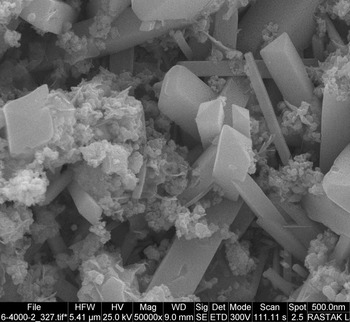
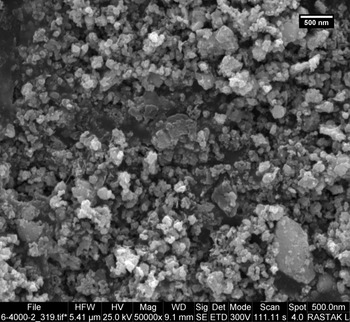
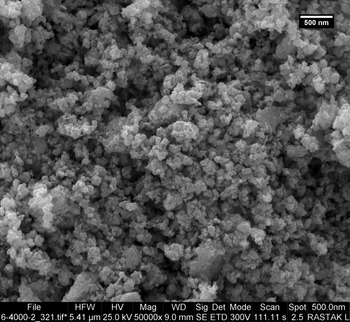
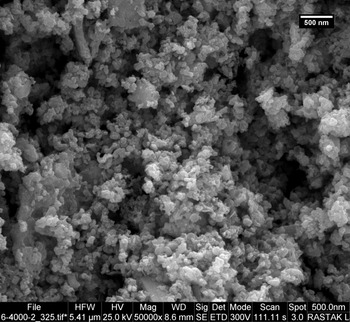
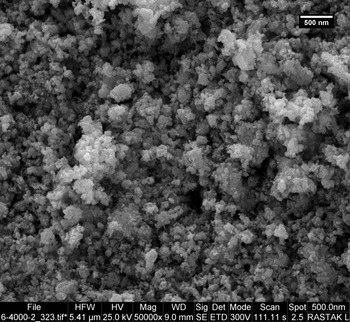
Top view FE-SEM images of the powders with different milling times are shown in Figures 7–11. According to Figure 7, the 5-h sample contains a non-uniform polygonal structure with rough edges. This suggests that 5 h of milling time is insufficient to form high-quality CZTS powder. By analyzing Figures 8–11, it is clear that all the samples above 5 h milling time show homogeneous and uniform distribution; however, the grain size varies slightly. Particularly 10-h milled powder possesses more uniform particles compared to the rest of them.
Surface morphology of the powders ball-milled for 5 h.

Surface morphology of the powders ball-milled for 10 h.

Surface morphology of the powders ball-milled for 20 h.

Surface morphology of the powders ball-milled for 30 h.

Surface morphology of the powders ball-milled for 45 h.

Energy-dispersive X-ray spectroscopy was utilized to investigate the compositional ratios. Table III shows atomic ratios of powders. The results indicate that the ratios of [Cu]/([Zn] + [Sn]) and [Zn]/[Sn] vary between 0.56–1.04 and 1.16–1.32, respectively. These proportions for 10-h sample were 0.72 (for [Cu]/([Zn] + [Sn])) and 1.18 (for [Zn]/[Sn]), agreeing with the high-performing sample, reported in literature (Kumar et al., Reference Kumar, Dubey, Adhikari, Venkatesan and Qiao2015). The [Zn]/[Sn] ratio of 30-h sample is a little beyond the optimum range (1.1–1.2) which is the main reason we chose the 10-h sample for the rest of the research (Kumar et al., Reference Kumar, Dubey, Adhikari, Venkatesan and Qiao2015). The [Cu]/([Zn] + [Sn]) ratios were measured to be about 0.81 and 1.04 for 30- and 45-h samples, respectively. It is acceptable for 30-h but very high for 45-h sample representing significant tin and zinc loss. According to the above discussion and experiments, the structural and morphological characteristics of the 10-h-milled powder are better than the other specimens.
Atomic ratios of the powders obtained from EDS.

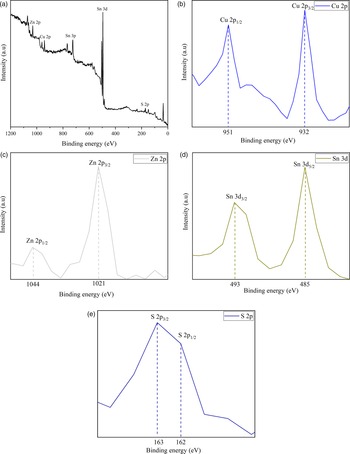
Atomic form factors of Cu+ and Zn2+ are close to each other (they are neighbors in the periodic table), so they cannot be discerned by traditional XRD patterns if they coexist in a structure (Ito, Reference Ito2014). So, to investigate energy states, X-ray photoelectron spectroscopy (XPS) was used to investigate the valence states of copper, zinc, tin, and sulfur of 10-h powder. Generally, the photoelectrons mean free path is several atomic layers. Therefore, the XPS analysis is a highly surface-sensitive method providing information from the uppermost atomic layers (around a few nm). The calibration was carried out according to C 1 s at 284.8 eV. Figure 12 shows the overall view and various chemical components of CZTS powder core-level spectra. As can be seen, the binding energies of Cu 2p are situated at 932.4 and 951.9 eV corresponding to Cu 2p3/2 and Cu 2p1/2, respectively, close to Cu+ transition atoms. The Zn 2p3/2 and Zn 2p1/2 splitting lines are observed at 1021.9 and 1044.9 eV, respectively, which are attributed to Zn2+. Peaks at 486 and 494.5 eV with a peak separation of 8.5 eV correspond to the binding energies of Sn 3d5/2 and Sn 3d3/2, respectively. Furthermore, it should be noted that the core levels of S 2p1/2 and S 2p3/2 lie at 161.2 and 162.5 eV, respectively, which are attributed to the sulfide state form of sulfur. Thus, besides Raman and XRD techniques, XPS confirms the formation of the desired CZTS (Song et al., Reference Song, Green, Huang, Hu and Hao2018).
The XPS spectra of 10-h-milled powder: (a) survey scan, and core-level spectrum for (b) Cu 2p, (c) Zn 2p, (d) Sn 3d, and (e) S 2p.

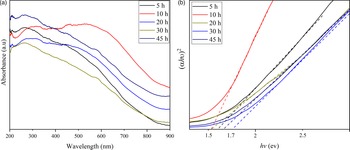
Figure 13(a) shows the absorption spectra of 5-, 10-, 20-, 30-, and 45-h milled powders. Figure 13(b) represents the plot of (αhv)2 versus photon energy (hv) of the CZTS powders obtained from various ball-milling times. Tauc method was used to evaluate the bandgap of prepared powders according to the following equation:
 $$( \alpha {\it h}\nu ) = A{\rm ( \it{h}}\nu \ndash E_{\rm g}) ^n$$
where h is Planck's constant, v is the frequency of the incident photon, E g is the optical band gap, A is a constant, and n is an index characterizing the type of optical transition. For a direct allowed transition, n is equal to 1/2. By extrapolating the linear part of (αhv)2 versus hv, the optical bandgap is obtained. As shown in Figure 13(b), the E g values of the five samples are in the range of 1.5–1.7 eV. The optimum value for the CZTS bandgap is 1.5 eV. The nearest value for this measure is the 10-h and 20-h specimens with 1.53 eV while others show higher bandgap values of 1.6, 1.7, and 1.66 eV for 5, 30, and 45 h annealing times, respectively. These deviations from the optimum value may be because of the formation of secondary phases. As evident from Raman spectroscopy, patterns of 5-, 30-, and 45-h samples have a strong CuS peak at 473 cm–1. The bandgap of CuS is above 1.8 eV which is higher compared to kesterite CZTS (Chaki et al., Reference Chaki, Deshpande and Tailor2014). This combination of CZTS and CuS phases affects the bandgap of the material.
(a) Absorption spectra and (b) the Tauc plot of the samples.

IV. CONCLUSIONS
CZTS powders were synthesized through the ball-milling procedure from CuS, ZnS, Sn, and S precursors followed by annealing in vacuum. Firstly, the annealing process was systematically investigated and some parameters were optimized including annealing temperature, time, and ramp rate. This approach made a clear path towards annealing conditions leading to the formation of high-quality powders. Material characterizations indicated that the crystallinity of the CZTS powders is very sensitive to annealing conditions. The study specified that the powder annealed at 500 °C for 5 h with the heating rate of 9 °C min−1 possesses proper crystallinity and phase. Furthermore, the effect of the ball-milling time on the powders was studied. The XRD pattern and the Rietveld analysis confirmed that the structure possesses the kesterite phase. According to XRD patterns, by increasing milling time, the crystallite size reduced because of the extended attrition time. The formation of the kesterite phase was also verified by investigating the oxidation levels of Cu and Zn provided from XPS spectroscopy. The morphological characteristics of the powders beyond 10 h milling time did not show considerable differences, but the uniformity of the 10-h sample was slightly better among the powders. The optimized CZTS specimen (10-h) exhibited higher absorption spectra with a 1.53 eV energy bandgap.