Our cities have been occupied by illegal immigrants. We will take them back. (Antonis Samaras, pre-election campaign, June 15, 2012)Footnote 1
[People who are] unable to speak English [like] those living here or not really wanting or even willing to integrate . . . have created a kind of discomfort and disjointedness in some neighbourhoods. (David Cameron, Speech on Immigration, April 14, 2011)Footnote 2
INTRODUCTION
Recent research into European citizenship policies maintains that governments tend to approach immigration as either a threat or an opportunity for the construction of a (supra)national identity (Bauböck & Wallace, Reference Bauböck and Wallace2012; Modood, Triandafyllidou, & Zapata-Barrero, Reference Modood, Triandafyllidou and Zapata-Barrero2006; Wodak, Reference Wodak2012). Europe consists of 28 nation-states with their respective histories, different cultures, different languages, different political, national, regional and local interests and traditional ideologies, different economic concepts, and so forth (Krzyżanowski & Wodak, Reference Krzyżanowski and Wodak2011). Multilingualism is an important feature of the European Union (EU); as for now there are 24 official languages of the EU that are connected to the strategies of inclusion/exclusion that we intend to examine in this article. European identity was first defined officially in the Declaration of Copenhagen, December 14, 1973. There, the most important values are listed explicitly, among these also multilingualismFootnote 3:
The Nine European States might have been pushed towards disunity by their history and by selfishly defending misjudged interests. But they have overcome their past enmities and have decided that unity is a basic European necessity to ensure the survival of the civilization which they have in common. The Nine wish to ensure that the cherished values of their legal, political and moral order are respected, and to preserve the rich variety of their national cultures. . .. they are determined to defend the principles of representative democracy, of the rule of law, of social justice—which is the ultimate goal of economic progress—and of respect for human rights. All of these are fundamental elements of the European Identity.Footnote 4
Language competence plays a central role in EU migration policies:Footnote 5 Since the turn of the century a large number of European states have made specific linguistic skills, defined according to European CEFR levels (Common European Framework of Reference for Languages Footnote 6), a requirement for permanent residence, citizenship or even the acquisition of an entry visa (Krzyżanowski & Wodak, Reference Krzyżanowski, Wodak, Berthoud, Grin and Lüdi2013; Extramiana, Pulinnx, & Van Avermaet, Reference Extramiana, Pulinnx and Van Avermaet2014). Although European legislation presents language requirements and language testing as a means of “integration,” language requirements seem to represent an obvious formal legislative obstacle to migration and determine who should or should not belong to the EU (de Cillia & Dorustkar, Reference de Cillia, Dorustkar, Dahlvik, Reinprecht and Wiebke2013; Milani, Reference Milani2009; Wodak, Reference Wodak2013).
The main aim of our article is to explore the complex interaction between supranational EU identity, policies and strategies on language requirements on the one hand, and subsequent national policies, as recontextualized and implemented via National Action Plans (NAPs), on the other, with respect to the access of third-world migrants to entry, work and education, and their linguistic integration as a precondition for acquiring citizenship. To this end, we explore the national legislation and regulations on migrants’ long-term residence and their linguistic integration in two EU member states, Austria and Greece, and how these two states implement the respective EU legislation via their NAPs in systematic detail. Moreover, we investigate how belonging and the discursive construction of individual and collective national identities are becoming linked more and more to language policies and whether and how nationalist ideologies shape policies on migrants’ acquisition of citizenship and linguistic integration. In other words, language competence seems to take on the role of “gatekeeper” to legal immigration.
In this context, language testing “serves to show” that the applicant has enough knowledge of the official language to be able to “understand and carry out the rights and duties conferred through citizenship” (Piller, Reference Piller2001, p. 266). It is obvious that language should not be viewed as “a tool” in the creation of what Gal (Reference Gal2010) defined as “sociolinguistic regimes.” As Gal argued, the EU has gradually become a typical late-modern sociolinguistic regime in the Foucauldian sense in that, though officially multilingual, it conceives of its multilingualism in rather limited ways. Gal (Reference Gal2010) claimed that the EU can indeed be considered a “top-down regime of multilingual standardization that tries to manage increased diversity in the same ways nation states managed non-standard varieties.” Gal (Reference Gal2010) enumerated a set of “constitutive others” which include “minority languages, migrant languages and vehicular languages (linguae francae, mainly English).”
As described extensively in Wodak and Fairclough (Reference Wodak and Fairclough2010), the European Council's (EC's) Open Method of Coordination, which serves to implement general European policies such as the Immigration Directive, comprises a number of interrelated steps, such as a “‘joint diagnosis of a problem’; a ‘commitment to solve the problem via Europe-wide guidelines’; identifying ‘good practices’; developing ‘quantitative and qualitative indicators for benchmark purposes,’ preparing National Action Plans (NAPs), implementing these, and so forth” (Wodak & Fairclough (Reference Wodak and Fairclough2010, p. 346). However, these attempts were doomed to fail, as illustrated by Falkner, Treib, Hartlapp, and Leiber (Reference Falkner, Treib, Hartlapp and Leiber2005) and Robertson (Reference Robertson, Jessop, Fairclough and Wodak2008). As Falkner et al. (Reference Falkner, Treib, Hartlapp and Leiber2005) were able to prove in their comparative study of a number of EU directives and their implementation, some nation-states complied, some partially complied and some did not implement the respective directives at all. This can be explained by differences in historical traditions and specific context-dependent sociopolitical interests. On the basis of this comprehensive empirical study, Falkner et al. (Reference Falkner, Treib, Hartlapp and Leiber2005) proposed “three worlds of compliance”: the “world of law observance,” the “world of domestic policies” and “the world of neglect” (p. 322). In the first case, the directive is highly valued and made a national priority; in the second case, it is one of many priorities and politically backgrounded; in the third case, the directive is not an aspiration, the bureaucracy rejects it and inertia seems to be the outcome.
In our detailed discourse and argumentation analysis, we trace these processes via the concept of recontextualization, by deconstructing the history of related documents and their textual transformations in the respective national contexts (Wodak & Fairclough, Reference Wodak and Fairclough2010).
Our analysis is based on the following research questions:
1. How are national policies on language, migration, long-term residence and citizenship shaped on the basis of respective EU supranational policies?
2. What arguments in the regulations serve to justify and legitimize who belongs or does not belong (to a specific country and the EU) and in which ways do these arguments emphasize language competence and linguistic skills in the host (majority) language?
3. What effect do such regulations have on the discursive construction of migrants as “others”?
Our theoretical approach and analysis draws on the Discourse-historical Approach (DHA) of critical discourse studies which provides a coherent theory on the discursive construction of identities and a methodology to study the discursive strategies which support the intricate dynamics of inclusion/ exclusion in legislative texts.Footnote 7 In analyzing recontextualization and predicational and argumentation strategies (Reisigl & Wodak, Reference Reisigl, Wodak, Wodak and Meyer2009), we first analyze the official hegemonic discourse about the “other” and, second, examine if and how the NAPs comply with EU supranational policies; moreover, we explore the symbolic role of the “national language” (i.e., the mother tongue of the majority) in indexing belonging and allowing integration (Wodak, de Cillia, Reisigl, & Liebhart, Reference Wodak, de Cillia, Reisigl and Liebhart2009; de Cillia & Wodak, Reference de Cillia and Wodak2006; Blackledge, Reference Blackledge2005; Wodak, Reference Wodak2015). In the following, we summarize our theoretical approach and focus on theoretical sociolinguistic and political science/ sociological approaches to citizenship, (supra)national identities, language ideologies and language policies.
CITIZENSHIP IN TIMES OF EUROPEAN INTEGRATION: (SUPRA)NATIONAL IDENTITY, LANGUAGE AND BODY POLITICS IN THE EUROPEAN UNION
The EU is neither a state, nor a nation state, nor a federation. As Jessop (Reference Jessop2008) noted, the EU consists of a variety of states, which introduces a social and economic heterogeneity into the European economy that the mechanisms of the EU try to diminish by treaties and common strategies (pp. 212–213). Hence, the European institutions (the European Commission, the Council of the European Union and the European Parliament) work together with national governments, although the EU's regulatory policies, such as language policies usually surpass the national legislation, and are adopted by the member states.
There are many different approaches to European identity (Boukala, Reference Boukala2013; Krzyżanowski, Reference Krzyżanowski2010; Wodak & Boukala, Reference Wodak, Boukala, Carta and Morin2014, Reference Wodak and Boukala2015). Here, we emphasize the dynamics of supranational European identity. We assume that European identity was and continues to be constructed through the actions and aims of national elites whose needs transcend national borders (Checkel & Katzenstein, Reference Checkel and Katzenstein2009; Cinpoes, Reference Cinpoes2008). In other words, this approach emphasizes the role of political elites in the top-down construction of European identity.
“Identity” as a theoretical concept is always defined via similarity and difference (e.g., Ricoeur, Reference Ricoeur1992; Wodak, Reference Wodak and Flowerdew2014, Reference Wodak and Boukala2015; Wodak et al., Reference Wodak, de Cillia, Reisigl and Liebhart2009). Language choice, and language itself, is a necessary part of identity construction (both individual and collective), as has been extensively documented in sociolinguistic research from the 1970s onwards (see Triandafyllidou & Wodak, Reference Triandafyllidou and Wodak2003, for an extensive overview). Language and language use manifest “who we are”; and “we” define reality partly through “our” language and linguistic behavior.
The manifold discursive forms of inclusion and exclusion define who are “Europeans” and create an “imagined community” (Anderson, Reference Anderson1991; Castoriadis, Reference Castoriadis1981) that necessarily excludes “others.” Indeed, the study of mainstream voices (Krzyżanowski & Oberhuber, Reference Krzyżanowski and Oberhuber2007) illustrates how European elites, like members of the European Parliament (Wodak, Reference Wodak2011a), define Europeanness and how they continuously produce in-groups and out-groups through discursive strategies of positive-self and negative-other representation. Furthermore, hegemonic discursive forms of inclusion and exclusion create an “imagined community” that does not comprise “others”: “those that are not worthy of becoming Europeans” (Wodak, Reference Wodak2007, p. 651; Reference Wodak, Delanty, Jones and Wodak2011b) and usually represented as “strangers” (Simmel, Reference Simmel1950; Bauman, Reference Bauman1995), or even “enemies.” In many ways as also exemplified below, the EU constructs its identity via its distinction from the “other” and accomplishes the discursive construction of supranational identity inter alia through policies of citizenship and language policies.
Here, we also draw on Lamont's work on racial and ethnic boundaries (Lamont & Molnar, Reference Lamont and Molnar2002), which suggested that groups can create and cross boundaries simultaneously and that people construct “boundary ideologies” distinguishing between “us” and “them” in their everyday discourse while drawing on “the cultural resources to which they have access to and the structural conditions in which they are placed” (pp. 167ff.). In a similar vein, Wodak (Reference Wodak2007) described how European elites proceed to the discursive construction of a “European nexus”: “discursive practices can accomplish exclusion in its many facets without the explicitly acknowledged intention of actors, exclusion becomes normality and acceptable, integrated into all dimensions of our societies, while in other cases, exclusion is practised explicitly, through language tests, citizenship and so forth” (p. 643).
Delanty (Reference Delanty2000) defined citizenship as “membership of a political community that involves a set of relationships between rights, duties, participation and identity. These may be termed the components of citizenship, the defining tenets of group membership. Citizenship in the classical tradition of modern liberal thought has generally been held to be a particular relationship of rights and duties” (p. 9). At the same time, citizenship is to be perceived as a legal institution of the 28 member states of the EU and one that determines who belongs or does not belong to the EU (Delanty, Jones, & Wodak, Reference Delanty, Jones and Wodak2011; Krzyżanowski & Wodak, Reference Krzyżanowski and Wodak2009). Since 2000, many (most) European countries have required migrants to demonstrate proficiency in the national language of the host country in order to secure citizenship and integration (Extramiana et al., Reference Extramiana, Pulinnx and Van Avermaet2014). Such a revival in the importance of competence in the national language as a gatekeeping device leads to re/nationalizing tendencies (Wodak, Reference Wodak2013, Reference Wodak and Flowerdew2014, Reference Wodak2015) which reintroduce the in-group of “us,” “European citizens,” and the out-group of “non-European others,” or “illegal,” “undocumented” or “irregular” migrants.
But who are these illegal or irregular migrants thus invoked? A recent study on the representation of migrants, refugees and asylum seekers in British newspapers over a decade (1996–2006) provides evidence that the concepts of migrants, refugees and asylum seekers are conflated into one large category of “others”, that is, strangers, in the media reporting of both tabloids and broadsheets (although less so in the latter) (Baker et al., Reference Baker, Gabrielatos, KhosraviNik, Krzyżanowski, McEnery and Wodak2008; KhosraviNik Reference KhosraviNik2010, pp. 22–23). These findings resonate with earlier studies on the representation of refugees and migrants such as post-1989 in Austria (Matouschek, Wodak, & Januschek, Reference Matouschek, Wodak and Januschek1995), where similar flood metaphors as well as topoi of criminality, danger and burden were identified. These findings allow us to conclude that much discourse about migrants and immigration seems to bear (several) almost universal features, throughout Europe and beyond, which can be explained by social theories about “othering” and the discursive construction of “the stranger” and “fear of the stranger,” as mentioned above. Border and identity/body politics converge to keep specific strangers out while letting others in. Moreover, poor and destitute insiders are suddenly defined as strangers and also excluded.
“Border politics” is part of national identity politics and is now increasingly defined by the national language (“the mother tongue”), ethnicity and culture, thus transcending the political borders of the nation state. Such language policies imply a return to national language policies which essentialize the nation state, promoting a homogeneous culture, language and territory. Obviously, the concept of a mother tongue relates to what Wodak (Reference Wodak2015) labels nativist “body politics,” that is, viewing and conceptualizing the nation as a body with the mother tongue symbolizing the national language (Musolff, Reference Musolff, Okulska and Cap2010). Accordingly, much research illustrates that renationalizing tendencies can be observed across several EU member states and thus a nativist body politics seems to be “celebrating” such a revival (de Cillia & Dorustkar, Reference de Cillia, Dorustkar, Dahlvik, Reinprecht and Wiebke2013; Norocel, Reference Norocel2013). By extending the model of Norocel (Reference Norocel2013), we claim that not only does the “family” as source domain imply the “nation” as target domain, but that the original source domain actually consists of the human (male) “body” (the Volk), which becomes a “family” (multiple bodies incorporated by the Volk) and then encapsulates the “nation” (p. 94).Footnote 8
In this article, we primarily focus on nomination (how events/ objects/ persons are referred to) and predication (what characteristics are attributed to them) strategies. The DHA also employs Aristotle's rhetorical topoi and elaborates Toulmin's argumentation scheme (Reference Toulmin2003) as and when appropriate.Footnote 9 Kienpointner (Reference Kienpointner, Ostman and Verschueren2011) defined topoi as “search formulas which tell you how and where to look for arguments” (p. 265). At the same time, topoi are warrants which guarantee the transition from argument to conclusion.”
LANGUAGE POLITICS AND THE EU DIRECTIVE ON “THE STATUS OF THIRD-COUNTRY NATIONALS WHO ARE LONG-TERM RESIDENTS”
Our analysis links two concepts—language policies and language ideologies—to citizenship and (supra)national identity strategies. Language policies can be defined as “regulatory tools governing how language should coexist and be used in specific social, political and economic contexts; these are always inherent representations of different language ideologies, that is, beliefs, visions and conceptions of the role of certain language(s) held by different (most commonly institutional) social actors” (Wodak, Reference Wodak and Flowerdew2014, p. 135). Language ideologies can be viewed as “cultural ideas, presumptions and presuppositions with which different social groups name, frame and evaluate linguistic practices” (Gal, Reference Gal, Mar-Molinero and Stevenson2006, p. 13). At the level of micro-interactions, they must however be conceived of as (re-)constructed and negotiated in debates “in which language is central as a topic, a motif, a target, and in which language ideologies are being articulated, formed, amended, enforced” (Blommaert, Reference Blommaert and Blommaert1999, p. 1). Such language-ideology debates are apparent in both public and semipublic spheres. Accordingly, language ideologies are “produced in discourses, in news media, in politics, in narratives of national belonging, in advertising, in academic text, and in popular culture” (Blackledge, Reference Blackledge2005, p. 44). In our case, language ideologies support the salient role of the mother tongue in defining the nation, thus emphasizing the notion of Kulturnation (Wodak et al., Reference Wodak, de Cillia, Reisigl and Liebhart2009).
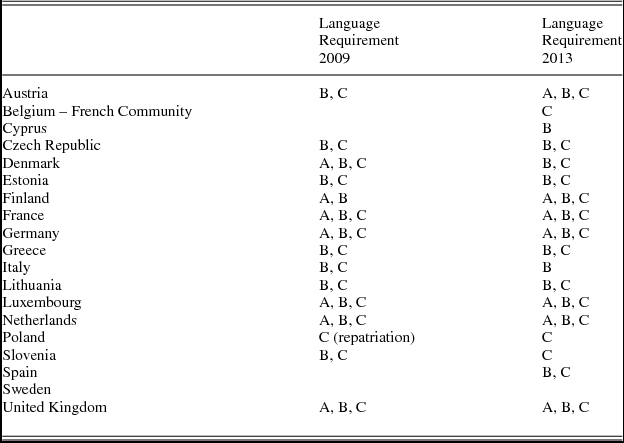
In the following, we approach the EC directive “concerning the status of third-country nationals who are long-term residents” as the hegemonic apparatus of a dominant, supranational political eliteFootnote 11 that defines who belongs and who does not belong in the EU through language and language testing. Increasingly, specific language tests are employed to test language competence before acquiring citizenship; language proficiency has thus become one of the key gatekeepers. Bauböck and Wallace (Reference Bauböck and Wallace2012) also provided evidence for ever more restrictive regulations: in 1998, only six states had citizenship and/or language tests; by 2010, the number had grown to 18; by 2013, to 23 (see Table 1; note that this table is already outdated and the situation is constantly changing).
Citizenship and language requirements in selected EU countries (A indicates a language test before entering; B a language test is required for a work permit; C a language test is required for citizenship.)Footnote 10

By 2014, 26 of the 36 countries participating in the survey reported that migrants have to demonstrate a specified level of competence in the language of the host country in order to obtain citizenship and 23 require migrants to have a certain level of proficiency in the national language in order to obtain a residence permit. Nine countries to date have reported a pre-entry language requirement: Austria, Albania, Germany, Finland, France, Liechtenstein, The Netherlands, Poland, and the United Kingdom (Extramiana et al., Reference Extramiana, Pulinnx and Van Avermaet2014). Sixteen states offer naturalization to close relatives of citizens or to persons who are perceived as long-term residents and acknowledged to be ethnically or linguistically related to the majority population (Bauböck & Joppke, Reference Bauböck and Joppke2010; Michalowski, Reference Michalowski2011).
Of course, such regulations allow for a plethora of interpretations—after all, who defines what is regarded as similar or different and on what authority? What criteria are used for comparison? How integrative or assimilationist are these new policies in a specific sociopolitical context? And, finally, what kind of knowledge is tested—more to the point, what is conceived of, and by whom, as comprising salient knowledge of a language or of the hegemonic political and cultural knowledge of a specific country? It is important to add at this point that these requirements contradict important strategies of the EU's multilingual policies, which explicitly recommend acceptance of difference and diversity with respect to language and culture.
The discourse about citizenship thus constitutes new categories, new groups, new “real” citizens and “other” people who are regarded as having one or more “deficits” of some kind. They construct and essentialize new realities (see the overview in Michalowski, Reference Michalowski2011, pp. 750–752). This function has been well described by Orgad (Reference Orgad2010) for German citizenship tests, which
mirror not only what German culture is, but also what the Germans want it to be. [. . .] Although the Länder tests have been replaced by a federal test, they indicate an ideological concept of Kulturnation. By adopting these policies, Germany embraces a strict rule of forced cultural assimilation. (pp. 69–70)
In our analysis of the Council of the European Union directive 2003/109/EC concerning the status of third-country nationals who are long-term residents, we investigate if and how the EU (and/or nation-states) distinguish “us,” Europeans, from “them,” “third-country nationals.” The directive opens with the statement:
The European Council, at its special meeting in Tampere on 15 and 16 October 1999, stated that the legal status of third-country nationals should be approximated to that of Member States’ nationals and that a person who has resided legally in a Member State for a period of time to be determined and who holds a long-term residence permit should be granted in that Member State a set of uniform rights which are as near as possible to those enjoyed by citizens of the European Union.
Three social actors are presented in the above extract, the EC, member state(s) and “third-country nationals.” The nomination “third-country national” is contrasted to “European citizens”; it remains open to speculation why the term “national” is used and not “citizen” and what kind of latent meanings are conveyed by establishing such a contrast. Furthermore, the role of the EC is emphasized here, insofar as it is the authority that decides the rights of “third-country nationals who are long-term residents.” This is an example of the topos of authority (Reisigl & Wodak, Reference Reisigl and Wodak2001) that is based on the conclusion rule: “the legal status of third-country nationals should be approximated to that of member states” nationals because the EU says that it has to be done. Another important point is that the EU states that long-term residents “should be granted in that Member State a set of uniform rights which are as near as possible to those enjoyed by citizens of the European Union”; in this way it makes a distinction between “third-country nationals who are long-term residents of a EU member state” and “citizens of the European Union.”
The directive continues:
The integration of third country nationals who are long term residents in the Member States is a key element in promoting economic and social cohesion.. . .
Member States should give effect to the provisions of this Directive without discrimination on the basis of sex, race, colour, ethnic or social origin, genetic characteristics, language, religion or beliefs, political or other opinions, membership of a national minority, fortune, birth, disabilities, age or sexual orientation.
The main criterion for acquiring the status of long term resident should be the duration of residence in the territory of a Member State. Residence should be both legal and continuous in order to show that the person has put down roots in the country.
As there is a distinction between “third-country nationals” and “citizens of the EU,” the EC proposes “integration.” Via the topos of advantage, which can be paraphrased as “the integration of ‘third-country nationals’ should be performed by member states because it is a key element of the economic and social cohesion of the European Union,” integration is called for, on nondiscriminatory terms. Thereafter, the EC maintains its authority by advising that the directive should be applied “without discrimination,” while simultaneously recognizing the existence of discriminatory practices in EU member states. The force of this argument is realized by the topos of law that can be deconstructed in the conditional: “if a directive forbids any discriminatory actions, member states have to avoid them.” Finally, the usage of the metaphor “the person has put down roots in the country” highlights the importance of long-term residence in a EU member state by drawing a very common analogy between “belonging” and “having put down roots” (Krzyżanowski & Wodak, Reference Krzyżanowski, Wodak, Caldas-Coulthard and Iedema2007).
However, the EC does refer to specific conditions for integration: “To acquire long-term residence status, third-country nationals should prove that they have adequate resources and sickness insurance to avoid becoming a burden for the Member State.” Article 18 clarifies that “Member States may refuse applications for residence from long-term residents or their family members where the person concerned constitutes a threat to public health.” The underlying presuppositions imply in vague ways that the applications of “third-country nationals” can be rejected through a combination of arguments that are based on the topos of burden, according to which “if a person is burdened by specific problems, one should act to diminish these burdens,” and the topos of threat (summarized by the conditional: “if a political action or decision may have specific dangerous, threatening consequences—against the general public health—it should not be performed”). This section is, of course, open to many interpretations as threats to public health can be defined nationally. Articles 6 and 17 of the directive state that “third-country nationals who wish to acquire and maintain long-term resident status should not constitute a threat to public policy or public security.” It is clarified that:
Member States may refuse to grant long-term resident status on grounds of public policy or public security. When taking the relevant decision, the Member State shall consider the severity or type of offence against public policy or public security, or the danger that emanates from the person concerned.. . . The refusal shall not be founded on economic considerations.
The topos of threat dominates: The EC transfers the initiative to the member states implementing the directive to decide who should be refused entry due to security provisions—a measure open to much interpretation. The EC also recognizes the national responsibility to restrict equal treatment of third-country nationals (Article 11): “Member States may require proof of appropriate language proficiency for access to education and training.” Moreover, Article 15 refers to the conditions for residence in a second Member State and clarifies that “the persons concerned may be required to attend language courses,” thus using epistemic modality. Language skills allow cultural, social and legal separation between groups of people in a society. Language competence is thus used by the EC and respective member states as a tool that legitimizes the exclusion of the “other” from the nation state and thus the EU.
In May 2011, Directive 2011/51/EU of the European Parliament and the Council amended Directive 2003/109/EC to extend its scope to beneficiaries of international protection.Footnote 12 The directive also states that member states shall enact the necessary laws, regulations and administrative provisions to comply with the directive. Below, we analyze the kinds of compliance seen in Greece and Austria, respectively, and trace the implementation of the directive via the process of recontextualization.Footnote 13
CASE STUDIES: AUSTRIA AND GREECE IMPLEMENTING THE COUNCIL’S DIRECTIVE
Apart from the nationalities and personal experience of the two authors, a number of other political and social factors support the selection of these two countries as case studies. These are the rise of extreme right parties and movements and the subsequent emphasis on the legitimation of their anti-immigration discourses and policies, also by mainstream parties, although the countries have different economic statuses in the EU and have developed different migration policies (see Kallis, Reference Kallis, Wodak, Khosravinik and Mral2013; Krzyżanowski & Wodak, Reference Krzyżanowski and Wodak2009).
Austria
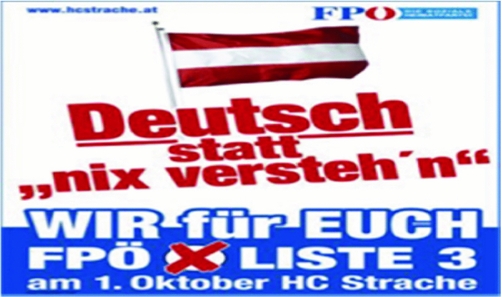
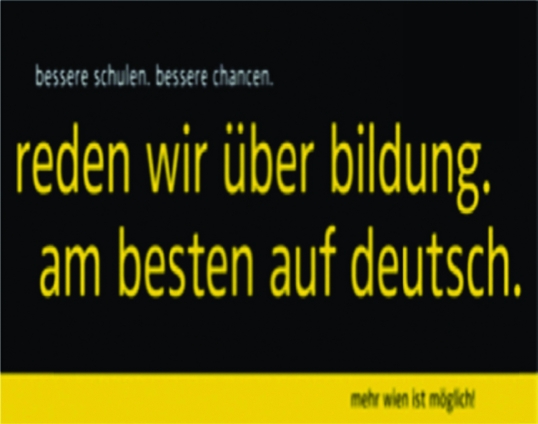
In 2012, c. 48,000 migrants from third countries came to Austria; 15,000 came from the former Yugoslavian countries, 4,500 from Turkey, and the rest from other countries. The Integration Agreement, first launched in 2003 and then reformulated in 2012, obliges applicants for permanent residence (other than asylum seekers and refugees, whose status is regulated by different laws) to complete a Deutsch-Integrations-Kurs (German Integration Course). Applicants are required to reach Level A1 of the six levels identified in the CEFR before entry. It is important to state at this point that the Austrian right-wing populist Freedom Party (FPÖ) had campaigned and continues to campaign explicitly against immigration, emphasizing time and again, over many years, that Austria is not a “country of immigration.” The political slogans are usually oriented against the Turkish minority living in Austria and against Muslim immigrants. Moreover, proficiency in the German language is highlighted as a/THE necessary condition for immigration and integration (see Figure 1). Other mainstream parties such as the Austrian Conservatives (ÖVP) quickly followed the program of the FPÖ and launched similar campaigns (see Figure 2) (for an extensive discussion of the Austrian debates about migrants and immigration, see Wodak, Reference Wodak2015; de Cillia & Dorustkar, Reference de Cillia, Dorustkar, Dahlvik, Reinprecht and Wiebke2013).
FPÖ poster, Vienna Election Campaign 2010 (personal photo), Deutsch statt Nix Verstehen, “German instead of ‘no understanding’; We for You; 1 October for HC Strache.”

ÖVP poster, Vienna Election Campaign, 2010 (personal photo), the poster says, in English, “Better Schools. Better chances. Let's talk about education. Preferably in German. More Vienna is possible!”

Migrants to Austria have to acquire a Rot-Weiss-Rot Card before entry (i.e., Red-White-Red Card indicates the colours of the Austrian flag). Most migrants (except highly qualified ones) must reach the C2 level of proficiency after 24 months in the country (see: www.oe24.at/oesterreich/politik/Rot-Weiss-Rot-Card-fuer-Auslaender/1503102 for details). In 2012, the emphasis of the NAP was reframed and now focuses primarily on the importance of language proficiency. Austria has also reframed its restrictive integration policy to become a so-called “welcoming country” for those migrants who really want to achieve something. In this way, a new form of categorization has been introduced: migrants who are welcome (highly qualified achievers) and migrants who are not welcome (neither educated nor qualified).
The NAP consists of three parts: the “integration report” which monitors integration in seven domains (Handlungsfelder), from language and education to health, media and sports and leisure. Second, so-called “integration indicators” have been established and are continuously monitored; these concern school completion, employment, proficiency in German and so forth. Statistics are published annually which document specific numbers for migrant groups in terms of age, sex, education and so forth. The third report concerns “measures” which are implemented locally and which serve to operationalize the more general proposals of the NAP, for each of the seven domains, some of which correlate with the EC directive. Due to space restrictions, however, we focus below mainly on the measures related to language proficiency.
In the NAP.I, the acquisition of German language skills is emphasized as a prerequisite for taking part in economic and social life in Austria. The intention here is not to downgrade the value of other languages or impose monolingualism upon society. Quite the contrary, multilingualism is acknowledged and promoted as a valuable resource. At the same time, however, according to the NAP.I,
skills in speaking the common language should be improved, because only such skills enable immigrants to take part in the processes and communications concerning society as a whole—namely beyond their own community.
In this extract, the contrast between multilingualism and “the common language” is clearly highlighted. Multilingualism is defined as a valuable resource; the “common language” (i.e., German), however, is promoted as the means to be able to participate in society. It is also presupposed that remaining within one's own community might not make sense. Through a quite sophisticated rhetorical twist in this extract, the topos of advantage is employed in respect of acquisition of the “common language.”
In the eyes of an Expert Council which advises the government, the focus in the last few years was on long-term anchoring of and improvement in language promotion in early childhood, so as “to make use of intuitive acquisition of the German language.” The objective in this context is that
three- to six-year-olds who cannot speak German are supported at childcare centres in such a way that their knowledge of German is sufficient for them to take part actively in classes once they enter school.
The second extract illustrates the focus on early childhood and the support for small children while learning German. It is presupposed in this extract that this policy is directed only toward migrant children—although, of course, also many Austrian children whose native and first language is German have no competence in Standard German. In this way, a division is constructed between Austrian children who know German and migrant children who do not. In the following extract, the concept of “integration” is explicitly defined:
“The NAP.I is based on an understanding of integration that aims to improve the opportunities for participation; the question about cultural homogeneity is relegated to the background, because, among other things, cultural homogeneity in a pluralistic society is a fiction that inhibits inclusion. Yet pluralism does not automatically result in an arbitrary fragmentation of society into sub-groups not related to one another but, instead, requires common basic values as an integrative tie so that it can work. Only when there is a basic consensus on the values based on the rule of law is cultural diversity in a liberal society unobjectionable from the vantage point of security and enrichment from the vantage point of culture. Thus the European principle of (cultural) diversity in (legal) unity [in the meaning of the Copenhagen Criteria] is fulfilled at the national level.”
On the one hand, it is officially acknowledged that Austria is a pluralistic society and that the imaginary of a homogeneous society necessarily remains a myth. On the other hand, a potential danger is evoked by the topos of threat, that is, by stressing fragmentation as a possible consequence of pluralism, should common values—which are presupposed and not defined—not be observed. In conclusion, it is made clear that pluralism always depends on necessary security measures; pluralism thus remains open to change and interpretation by the government. In this way, important criteria and concepts remain semantically vague and can be redefined whenever necessary. Finally, by referring to the Copenhagen Declaration of 1973 (see above), the topos of authority is employed in order to legitimize the measures of the Austrian NAP. This and other intertextual references to the Directive of the EC and other European documents and treaties illustrate well the processes of recontextualization from the original EC directive into the Austrian NAP. Not only are the same domains referred to as in the EC directive, but the same positive values are evoked and the Europeanness of Austrian policies is thus co-constructed.
This brief summary of the Austrian case is a good example of the ever tougher regulations governing migration and of the introduction of language proficiency as a significant threshold for entry to Austria. Both residence and citizenship legislation have become much more restrictive in recent years, albeit reframed in a more positive achievement-oriented, neo-liberal way: language proficiency is now defined as a goal which every individual is able to achieve if they only try hard enough; the positive Austrian national identity is emphasized—integration thus implies being “proud of being an Austrian.” Here, the Austrian identity is imagined as homogeneous, stable, and positive, defined primarily culturally and economically, something which a migrant could easily adopt and wear, like a coat: Austrian identity is thus essentialized;Footnote 14 language proficiency has been clearly attributed the status of a powerful gatekeeper, along with other factors such as education, money, profession and age.
Greece
Greece already has 20 years’ experience as an immigrant host country; however, its migration policies remain underdeveloped and oriented toward border management (Triandafyllidou & Kouki, Reference Triandafyllidou and Kouki2013; Triandafyllidou & Dimitriadi, Reference Triandafyllidou and Dimitriadi2013). Greece is currently experiencing an economic and sociopolitical crisis that is hampering migrants’ integration, while irregular migration toward the country is growing and contributing to a rise in racist and xenophobic political discourse, which is not limited to extreme right-wing parties; quite the contrary, it also penetrates governmental statements.Footnote 15 Today, approximately 11% of Greece's population (1.2 m) is of migrant origin. Almost one-third of all migrants (around 400,000) are co-ethnics (Pontic Greeks and ethnic Greek Albanian citizens) who enjoy preferential conditions in terms of integration and citizenship policies. There are also 400,000 legal migrants and 392,000 undocumented migrants in Greece (Triandafyllidou, Reference Triandafyllidou2014). Since 2000, increasing numbers of people have been arriving from Pakistan, Bangladesh, Afghanistan, Somalia, Iraq and the North African countries. They are mostly Muslim and trapped in a condition of irregular status because of the absence of an effective migration policy. As Triandafyllidou and Kouki noted:
“Greek national identity is believed to be predominantly defined in ethno-cultural terms. Until very recently, the definition of Greek citizenship had been based almost exclusively on the ius sanguinis principle and difference in the country is understood at two inextricably connected levels: ethnicity/nationality and religion.
. . . people have to be of Greek ancestry even if they do not speak the language. Having Greek ancestry is conceived to bring with it necessarily a Christian Orthodox religious identity. In other words, Christian Orthodoxy is a necessary, but not sufficient, condition while being of Greek descent is a necessary and sufficient condition.” (Triandafyllidou & Kouki, Reference Triandafyllidou and Kouki2013, p. 714)
In March 2010, the Greek Parliament adopted law 3838/2010 on citizenship and naturalization. The new law refers to knowledge of the Greek language and culture by immigrants wishing to be naturalized. In addition, it introduced full local political rights for foreign residents who have lived legally in Greece for at least five years. This law was introduced by the then socialist government and signaled a new direction in Greek migration policy that unfortunately did not last very long. In 2012 the Council of State rescinded law 3838/2010 and ruled that naturalization and participation in civil society are mainly linked to the law of blood (ius sanguinis) (Triandafyllidou, Reference Triandafyllidou2014). Hence, Greek policies on migration and citizenship were restricted to the adoption of EC Directive 2003/109/EC.
In November 2008, the Greek state introduced, on the basis of the EC directive, a legislative act for a program that leads to the social integration of third-country nationals who are long-term residents in the country (ΦΕΚ Β’ 2363/20.11.2008). This program is called Hestia,Footnote 16 a name that can be considered another example of body, family and nation politics (Wodak, Reference Wodak2015) highlighting the unification of the Greek “family” and the exclusion of strangers. According to Article 1 of the legislative act:
“The main aim of Hestia is the social integration of third-country nationals, who legally and continuously reside in Greece. [This can be achieved] on the basis of European legal experience and through the ensuring of a number of civic rights, which are as near as possible to those enjoyed by Greek citizens and citizens of the EU.”
The usage of the metonymic nomination “third-country nationals” is an example of recontextualization of EC directives and how the legal terms of the EU are adopted by a national legal discourse that usually refers to “irregular immigrants.”Footnote 17 In addition, the Greek legislative act has articles similar to those of the EC directive. However, some of these differ from the respective articles of the European Authority: article 6 refers to public health and states that a Greek Authority—the Ministry of Public Health—has adopted certain measures:
. . . “to prevent the phenomenon of ghettos . . . to create special media units for the prevention of epidemics in areas around the borders of the Greek state and . . . to create medical units where a large number of third-country nationals reside.”
Migrants are implicitly represented as an anonymous mass and a potential epidemic threat to public health. The Greek state thus constructs “a dangerous other” through the topos of threat: “if there is a threat to the public health from migrants, then the Ministry of the Public Health should act to prevent it.” It is noteworthy here that the Greek legislative act does not refer to further threats against public security.
Article 5 that refers to education and language is one of the most important articles. It explicates in detail the linguistic integration of “third-country nationals” and is linked to articles 9 and 10 that apply to funding for teaching the Greek language and culture:
“The Greek Authorities [the Ministry of Education and Religious Affairs], through the prism of the equal participation of third-country nationals in the Greek education system, introduces specific measures that convert the educational system into a cultural bridge that unifies third-country nationals with Greek society.. . . These measures refer to: learning of the Greek language by third-country nationals; improvements to Greek language teaching; the creation of language teaching groups in Greece and abroad (third countries); improvements to teaching programmes for Greek history and culture; the creation of Greek history and culture teaching groups in the countries of origin [of third-country nationals]. NGOs, migrant groups, universities and the Greek Church will participate in the fulfilment of the above measures.. . . The programme will be sponsored by the national budget, the EU, the Greek Church and private institutions.”
The bridge metaphor underlines the linguistic integration of migrants into Greek society. However, the emphasis on knowledge of the Greek language, history and culture illustrates an attempt by the Greek state to exclude the “other.” In contrast to Austria, Greece uses both the national language and culture as gatekeepers to restrict the integration of the “other.” Hence, the Greek state formulates its migration policy on the basis not only of language proficiency, but also of the national culture and religion. The participation of the Greek Church in the above program is indeed relevant to Greek ethnicity.
Moreover, on the basis of the above measures and the EU directive of 2011, article 31 of law 4115/2013 maintains that “sufficient knowledge of the Greek language, history and culture is confirmed by a certificate in Greek language knowledge at B1 Level or Greek language and history testing” and reveals the usage of language and history as strategies for exclusion of the “other” and the protection of (supra)national identity.
CONCLUDING REMARKS
The above analysis of the ways in which two EU member states—with different economic and social conditions—have adopted the EC directive illustrates the hegemonic role of the EU/EC in the discursive construction of in-groups of “Europeans” and out-groups of “third-country nationals.” Following Falkner et al. (Reference Falkner, Treib, Hartlapp and Leiber2005) “three worlds of compliance,” we argue that the two member states—Austria and Greece—complied with the EC directive; the respective implementation is an example of the “world of law observance” (p. 322) that shapes immigration and language policies. Proficiency in the national languages of EU members is used as a strategy for the exclusion of “strangers” and the enforcement of a (supra)national identity via border and body politics. Hence, the multilingualism of the EU is limited to member states’ national languages, in spite of the wording of official EU multilingualism policies (Ersbøll, Kostakopoulou, & Van Oers, Reference Ersbøll, Kostakopoulou and Van Oers2010; Krzyżanowski & Wodak, Reference Krzyżanowski and Wodak2011). Moreover, the representation of migrants as an anonymous mass and potential threat to public health, public security, and national identities legitimizes exclusion of the “other.”
In this vein, Greece, a country with an increasing number of so-called irregular immigrants and an underdeveloped migration policy, adopted the EC directive on the basis of its national interests and identity. The requirements for knowledge of the Greek language, culture and history illustrate the Kulturnation approach and lead to a renationalizing of traditional Greek values (Boukala, Reference Boukala2013; Tsoukalas, Reference Tsoukalas2013). On the other hand, Austria focuses mainly on the financial and educational status of migrants that seek permanent residence, and having adopted the political agenda of the extreme right wing under the mask of political correctness, this highlights the role of language proficiency as a powerful gatekeeper. Furthermore, the adoption of the EC directive by these two countries reveals some general migration strategies characteristic of each country. Officially, Austria refers to pluralism and positive integration of immigrants in the Austrian society, although the country's lawmakers represent the Austrian identity as homogeneous, cultural, and stable; Austrian citizenship remains based on ius sanguinis. The Greek lawmakers, in contrast, explicitly insist on the law of blood and implicitly represent the migrants as dangerous others that have to assimilate to the Greek society. However, the absence of any “Greek ancestry” implies that most of the migrants remain third-country nationals who are long-term residents in Greece.
In April 2014, Amnesty International published a report on human rights violations affecting migrants and refugees arriving in Greece and seeking entry to the EU. As the report notes,
“Greece is not acting in isolation in its decision to prioritize the security of EU borders over the lives of migrants and refugee flows from the EU's wider policies. It is at the behest of the EU that Greece has been building sustained capacity for guarding its borders. The EU has provided significant financial and material support to Greece to police its borders as part of efforts to control irregular migration to the EU through Greece.” (Amnesty International, 2014, p. 24)
The above extract illustrates that the main strategy of “fortress Europe” is the protection of Europe's borders from “strangers.” Hence, the European values of solidarity and integration as mentioned in the Copenhagen Declaration 1973 are challenged insofar as the EU resorts to strict border policies and highlights proficiency in European national languages as an institutionalized gatekeeper that determines who belongs or does not belong to the EU.