Early research on bilingual memory representation mainly focused on the issues of whether the bilingual representation is separate or shared (Weinreich, Reference Weinreich1953; Ervin and Osgood, Reference Ervin, Osgood, Osgood and Seboek1954; Kolers, Reference Kolers1963). More recently, numerous studies have shown that the conceptual representation is shared while the lexical representation is separate. However, in what way is the conceptual representation shared? Many researchers have pointed out that the link between the lexical representations of the two languages and the link between the lexical and conceptual representations of the two languages tend to be different depending on the different levels of second language proficiency. Researchers have proposed three kinds of hierarchical models according to the variation of the bilinguals’ second language proficiency: the Word Association Model, the Concept Mediation Model, and the Revised Hierarchical Model (Potter, So, Von Eckhart and Feldman, Reference Potter, So, Von Eckhart and Feldman1984; Kroll and Curley, Reference Kroll, Curley, Gruneberg, Morris and Sykes1988; Chen, Reference Chen1990; Kroll and Stewart, Reference Kroll and Stewart1990, Reference Kroll and Stewart1994).
These classic models depicted in Figure 1 all assume separate L1 and L2 lexical representations (where L1 refers to the native and dominant language and L2 refers to the second and nondominant language, so the L2 lexicon was hypothesized to be smaller than the L1) and one common conceptual representation. In the Word Association Model (Potter et al., Reference Potter, So, Von Eckhart and Feldman1984) shown in Figure 1a, there are links between the L1 and L2 lexical representations and between the L1 lexical representation and the conceptual representation. In contrast to the Word Association Model, the Concept Mediation Model (Potter et al., Reference Potter, So, Von Eckhart and Feldman1984) shown in Figure 1b posits that there are direct links between the L2 lexical representation and the conceptual representation. Given that bilingual memory may be a function of second language proficiency, Kroll and Stewart (Reference Kroll and Stewart1994) incorporated both the Word Association Model and the Concept Mediation Model into a general model of bilingual memory representation (see Figure 1c). The Revised Hierarchical Model is an influential model which posits that there are links between all representations, and the model also makes specific assumptions about the strengths of the links: the link from the L2 lexical representation to the L1 lexical representation is stronger than the opposite link and the link between the L1 lexical representation and the conceptual representation is stronger than that between the L2 lexical representation and the conceptual representation.
Alternative models of bilingual memory representation: (a) Word Association Model, (b) Concept Mediation Model, and (c) Revised Hierarchical Model. See text for details.

In order to provide an adequate test of these models researchers have attempted to exclude or reduce the participants' use of translation and used an implicit memory task. Long-term cross-language repetition priming is one such paradigm. It consists of a study phase (coding) and a test phase (extraction). At issue is whether participants' responses to the targets in the test phase are influenced by the translation equivalents in another language learned in the study phase: the participants are supposed to respond faster and more accurately to the targets whose translation equivalents have been studied recently than to the words whose translation equivalents have not been studied. If the coding process at study recurs in the extraction process at test, then long-term cross-language repetition priming will be obtained in test task; otherwise, there will be little evidence for long-term cross-language repetition priming in test task (Francis, Reference Francis1999; Kirsner, Smith, Lockhart, King and Jain, Reference Kirsner, Smith, Lockhart, King and Jain1984; Roediger, Reference Roediger1990; Zeelenberg, Wagenmakers and Raaijmakers, Reference Zeelenberg, Wagenmakers and Raaijmakers2002; Zeelenberg & Pecher, Reference Zeelenberg and Pecher2003; Mo, Li, & Wang, Reference Mo, Li and Wang2005).
If the bilinguals' conceptual representation is shared, long-term cross-language repetition priming will be revealed in a conceptual task. If the bilinguals' lexical representations are separate, then there will not be such priming in a lexical decision task (Kirsner et al., Reference Kirsner, Smith, Lockhart, King and Jain1984; Zeelenberg et al., Reference Zeelenberg, Wagenmakers and Raaijmakers2002; Roediger, Reference Roediger1990; Zeelenberg et al., Reference Zeelenberg and Pecher2003). The findings in Kirsner et al.'s study (Reference Kirsner, Smith, Lockhart, King and Jain1984) showed no effects of long-term cross-language repetition priming in a lexical decision task when the words in the first language and their translation equivalents were non-cognates. More importantly, the long-term cross-language repetition priming effect was still absent in the animacy decision (conceptual) task requiring participants to decide whether a word refers to something ‘animate’ or ‘inanimate’ (Kirsner et al., Reference Kirsner, Smith, Lockhart, King and Jain1984).
More recently, and in contrast with the data of Kirsner et al. (Reference Kirsner, Smith, Lockhart, King and Jain1984), Zeelenberg and Pecher (Reference Zeelenberg and Pecher2003) did provide evidence of long-term cross-language repetition priming in high proficiency Dutch–English bilinguals. In particular, their results supported the Concept Mediation Model as they indicated that bilinguals access the conceptual representation directly from the L2 lexical representation. Zeelenberg et al. (Reference Zeelenberg and Pecher2003) proposed that two factors might help explain the absence of the effects of long-term cross-language repetition priming in the Kirsner et al. study; first, there were too few participants (only 12); and second, different conceptual tasks were used at the study and test (participants were required to generate meaningful sentences that included the target words at study and decided whether the target words referred to something ‘living’ or ‘nonliving’ at test). A recent study by Mo et al. (Reference Mo, Li and Wang2005) demonstrated long-term cross-language repetition priming on fluent Chinese–English bilinguals and thus confirmed the explanation of Zeelenberg et al. (Reference Zeelenberg and Pecher2003).
It remains unclear in what way bilingual memory representation is shared in studies using long-term cross-language repetition priming paradigm. The findings from these studies (Zeelenberg et al., Reference Zeelenberg and Pecher2003; Mo et al., Reference Mo, Li and Wang2005) were based on experiments with participants who were fluent in their second language. The present study examined the possible effects of long-term cross-language repetition priming in a group of Chinese–English bilinguals with low proficiency in English. Experiment 1 was designed to examine the issue of whether conceptual representation is shared for less fluent Chinese–English bilinguals.
Experiment 1
Method
Participants
Forty students from South China Normal University participated in the study for a small monetary reward. Participants were randomly divided into two groups: twenty students were assigned to the same-language repetition condition and the other twenty students to the cross-language repetition condition. All participants in the present experiment were Chinese natives aged between 18 and 20 years for whom English was their second language. They were non-English-majors yet to pass CET Band 4 (the national College English Test is carried out for college students and many students in their year of college can pass CET Band 4 which is the lowest band of CET). They had studied English for about 11–13 years from elementary school in grade 6 or from middle school in the first year.
Materials and design
Study status (studied vs. non-studied) was manipulated within subjects whereas language condition (same-language vs. cross-language) was manipulated between subjects. In the same-language repetition condition, Chinese single-character words were presented during the study phase and repeated in the test phase. In the cross-language repetition condition, English words (e.g., tree) were presented in the study phase and their Chinese translation equivalents (e.g., 树) were presented in the test phase. The dependent variables were reaction time and accuracy of judging the Chinese words in the test phase. Repetition priming was assessed by comparing performance for studied words to performance for the non-studied words.
The experimental stimuli consisted of 48 Chinese–English translation equivalent pairs. Twenty-four pairs were living things (e.g., pig – 猪, goose – 鹅) and 24 pairs were nonliving things (e.g., boat – 船, paper – 纸). Frequency counts were obtained from the Modern Chinese Frequency Dictionary. The median frequency per million was 327.7 (range 2.3–5844.5) for the Chinese words. A complete listing of the experimental stimuli is provided in the Appendix.
Twenty-four translation pairs were used as fillers in the study phase. In the cross-language condition the English words were presented as fillers and in the same-language condition the Chinese words were presented (i.e., word fillers were always presented in the same language as the experimental stimuli). Additional 24 Chinese words were used as fillers in the test phase. Fillers were never repeated in the experiment. Four different study–test list combinations were generated for counterbalancing purposes. Across the four study–test list combinations each word appeared only once in each of the four conditions (i.e., studied vs. non-studied crossed with cross-language vs. same-language).
Procedure
The experiment was carried out on computers using E-Prime software. Participants received spoken and written instructions. They were instructed to make a “living” decision if the word represented something living (e.g., animal or plant) or part of a living thing (e.g. hand) and to make a “nonliving” decision if the word represented something not living. The experiment consisted of a study block and a test block. Participants completed the animacy decision task for both blocks. Some of the words presented in the study block were repeated in the test block. Participants were not informed about the relation between the study and the test block.
Words were presented once at a time on a computer screen. Each trial started with the presentation of a fixation mark (*******) for 500 ms. The fixation mark was followed immediately by the target stimulus that remained on the screen until the participants had made a response by pressing the J/F key for living/nonliving response. The computer automatically recorded the response time and accuracy of the participants. If the participant made an error, the word “错误 (error)” was presented for 1000 ms. Before the start of the experiment, the participants were required to put their left index finger on “F” key and the right index finger on “J” key and told that their response time would be recorded so that they should try their best to respond quickly but should read every word carefully before making a decision. There was a one-minute break between the study block and the test block. In cross-language condition, participants were informed about the change in language immediately before the start of the test block. The experiment took about 10 minutes. The data of the filler trials were excluded.
The study block consisted of 48 trials and started with the presentation of 12 filler words to familiarize participants with the animacy decision task. Subsequently, 24 experimental stimuli and the additional 12 fillers were presented randomly. In all experiments reported in this paper a different random order was used for each participant. The study block was followed by a test block consisting of 72 trials. Filler words were presented on the first 12 trials. Subsequently, 48 experimental stimuli and 12 additional fillers were presented randomly. The 48 experimental stimuli consisted of 24 new words (i.e., words that had not been presented earlier in the experiment) and 24 old words (i.e., words that had been presented in the study phase, either in the same language or in a different language). Twelve of the 24 new words and 12 of the 24 old words referred to living things and the other 12 new words and 12 old words referred to nonliving things.
Results and discussion
The data of two participants whose accuracy was less than 80% in the study phase were excluded. Mean reaction times for correct responses were calculated for each condition excluding responses more than 2.5 SD above or below each participant's mean. The same outlier criterion was used in all subsequent experiments. Trimming resulted in the removal of 2.8% of the reaction times. Response times to the Chinese words were significantly faster than that to the English words during the study phase, t1(36) = 6.37, p = .0001; t2(47) = 4.17, p = .0001. Accuracy rates were consistent with response times. Chinese words were responded to more accurately than English words, t1(36) = 7.91, p = .0001; t2(47) = 16.76, p = .0001.
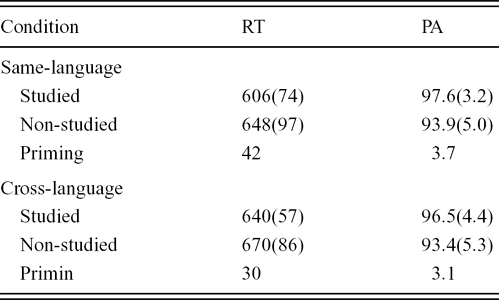
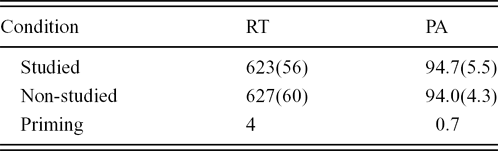
During the test phase, trimming resulted in the removal of 2.9% of the reaction times. The mean reaction times and percent accuracy are shown in Table 1. As can be seen, effects of cross-language repetition priming and same-language repetition priming were obtained.
Mean animacy decision times (RT; in milli-seconds) and percent accuracy (PA) in Experiment 1. Standard deviations are in brackets.

These results were supported by two-way ANOVAs on the response times and accuracy rates with repetition condition (studied vs. non-studied) as a within-subjects factor and language condition (same-language vs. cross-language) as a between-subjects factor. The ANOVA on reaction times showed the main effect of repetition, F1(1,36) = 17.25, p = .0001; F2(1,47) = 13.13, p = .001.The response to the studied words was significantly faster than that to the unstudied words. However, the main effect of language condition was not significant by subject, F1(1,36) = 1.34, p > .05, but was by item, F2(1,47) = 7.334, p < .01. More importantly, the interaction between study condition and language condition was not significant, F1(1,36) = 0.51, p > .05; F2(1,47) = 1.34, p > .05. And most importantly, the repetition priming effect was significant in both the same-language condition and in the cross-language condition, t1(18) = 3.18, p < .01; t2(47) = 2.88, p < .01, and t1(18) = 2.68, p < .05; t2 (47) = 3.79, p = .0001, respectively.
The ANOVA on the accuracy rates showed a main effect of repetition, F1(1,36) = 12.06, p = .001; F2(1,47) = 5.05, p < .05. Neither the main effect of language condition nor the interaction between repetition and language condition was significant, F1(1,36) = 0.48, p > .05; F2(1,47) = 0.70, p > .05; and F1(1,36) = 0.11, p > .05; F2(1,47) = 0.10, p > .05, respectively. Simple effects showed that in the same-language condition the repetition priming effect was significant by subject, t1(18) = 2.345, p < .05 and marginally significant by item, t2(47) = 1.94, p = .059. In the cross-language condition the repetition priming effect was significant by subject, t1(18) = 2.69, p = .015, and marginally significant by item, t2(47) = 1.83, p = .073.
The most important finding of the present experiment is that low fluency Chinese–English bilingual participants also show reliable effects of long-term cross-language repetition priming in an animacy decision task – a conceptual implicit memory task. Such results are consistent with those from the previous studies with fluent Dutch–English bilinguals (Zeelenberg et al., Reference Zeelenberg and Pecher2003) or fluent Chinese–English bilinguals (Mo et al., Reference Mo, Li and Wang2005). It is evident that for low fluency Chinese–English bilinguals the conceptual representation is also shared. However, can long-term cross-language repetition priming be obtained when individuals perform a lexical decision task at both study and test? Given a shared conceptual representation in low fluency Chinese–English do we also find separate lexical representations? If the lexical representation of Chinese and English is separate in low fluency Chinese–English bilinguals, there should be no long-term cross-language repetition priming but there should be an effect of same language repetition priming. This issue was explored in Experiment 2.
Experiment 2
Method
Participants
Forty students from South China Normal University participated in the study for a small monetary reward. Twenty of them were randomly assigned to the same-language repetition condition and the other 20 students were assigned to the cross-language repetition condition. All participants in the present Experiment were Chinese natives aged between 18 and 20 years for whom English was their second language. They were non-English-majors yet to pass CET Band 4. They had studied English for about 11–13 years from elementary school in grade 6 or from middle school in the first year.
None of the participants participated in more than one experiment of the present study.
Materials and design
The experimental stimuli were identical to those of Experiment 1. A set of 60 nonwords and 12 words was constructed for the test phase. Two sets of 30 nonwords and 6 words (one for the English study condition and one for the Chinese study condition) were constructed for the study phase. All English nonwords were pronounceable and constructed by changing one or two letters from an existing word. All Chinese nonwords are not consistent with Chinese orthographic principles and have no meaning. Nonwords were never repeated in the experiment.
Procedure
In both the study phase and the test phase, stimuli were presented in a lexical decision task. The design and presentation procedure was almost identical to that of Experiment 1. Participants were required to make a lexical decision by pressing the “J” key for “word” response and “F” key for “nonword” response. The experiment took about 10 minutes. Data of the filler trials were not taken into account.
The study block consisted of 72 trials and started with the presentation of 12 fillers (6 words and 6 nonwords) to familiarize participants with the lexical decision task. Subsequently, 60 stimuli were presented, consisting of 24 experimental words, 6 word fillers, and 30 nonword fillers. The study block was followed by a test block consisting of 120 trials. The test phase started with the presentation of 6 word fillers and 6 nonword fillers. Subsequently, 48 experimental words, 6 additional word fillers and 54 nonword fillers were presented. The 48 experimental words consisted of 24 new words and 24 old words.
Results and discussion
During the study phase, data of three participants were excluded from the analyses and trimming resulted in the removal of 2.7% of the reaction times. Response times to the Chinese words were significantly faster than that to the English words, t1(35) = 3.72, p = .001; t2(47) = 12.66, p = .0001, but there was no difference in accuracy between the Chinese and English words t1(35) = 0.96, p = .345; t2(47) = 1.08, p = .288.
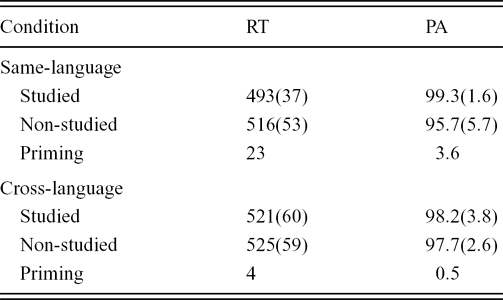
During the test phase, trimming resulted in the removal of 2.5% of the reaction times. The mean reaction times and percent accuracy are shown in Table 2. As can be seen, we obtained long-term same-language repetition priming but no cross-language repetition priming.
Mean lexical decision times (RT; in milli-seconds) and percent accuracy (PA) in Experiment 2. Standard deviations are in brackets.

These results were supported by two-way ANOVAs on the reaction times and accuracy rates. The ANOVA on the mean reaction times showed a main effect of study condition, F1(1,35) = 5.06, p < .05; F2(1,47) = 8.96, p < .01. The main effect of language condition was not significant by subject, F1(1,35) = 1.22, p > .05 but was significant by item, F2(1,47) = 15.16, p = .0001. The interaction between study condition and language condition was marginally significant by subject, F1(1,35) = 2.68, p > .05, p = .10 but significant by item, F2(1,47) = 4.584, p < .05. Most importantly, simple effects showed significant repetition priming effect in the same-language condition, t1(18) = 2.50, p < .05; t2(47) = 3.57, p < .01, but not in the cross-language condition, t1(17) = 0.50, p > .05; t2(47) = 0.54, p > .05. There was evidence for long-term repetition priming in the same-language condition but not in the cross-language condition.
The ANOVA on the accuracy rates showed a main effect of repetition by subject, F1(1,35) = 4.94, p < .05, but not by item F2(1, 47) = 0.017, p > .05. There was no main effect of language condition, F1(1,35) = 0.25, p > .05, F2(1,47) = 0.44, p > .05. The interaction between repetition condition and language condition was marginally significant by subject, F1(1,35) = 2.98, p = .093, but not significant by item, F2(1,47) = 0.30, p > .05. Simple effects showed that in the same-language condition the repetition priming effect was significant by subjects, t1(18) = 2.55, p < .05, but not by item, t2(47) = 0.25, p > .05. And in cross-language condition the repetition priming effect was not significant, t1(17) = 0.40, p > .05, t2(47) = 0.44, p > .05.
The results of Experiment 2 are consistent with the results of the previous studies with the fluent Dutch–English bilinguals (Zeelenberg et al., Reference Zeelenberg and Pecher2003) or fluent Chinese–English bilinguals (Mo et al., Reference Mo, Li and Wang2005). Together with the results of Experiment 1, the present findings support the view of a shared conceptual representation but separate lexical representations.
In Experiment 3, we addressed the issue of whether it is necessary to present words in a conceptual task at both study and test phases to obtain long-term cross-language repetition priming. Words were presented in an animacy decision task at study and in a lexical decision task at test. The bilingual memory representation models (the Word Association Model, the Conceptual Mediation Model and the Revised Hierarchical Model) discussed above make different predictions. According to the Word Association Model, if an L2 word is presented in a task that requires access to the conceptual representation participants access the conceptual representation via L1 lexical representation. If so, there will be cross-language repetition priming when L1 translation equivalents are presented in a lexical decision task at test. By contrast, the Concept Mediation Model predicts no cross-language repetition priming effect because the conceptual knowledge is accessed directly from the L2 lexical representation. Predictions of the Revised Hierarchical Model depend on L2 proficiency. For less fluent bilinguals, access to the conceptual representation is via the L1 lexical representation and therefore they should show cross-language repetition priming when L1 translation equivalents are presented in lexical decision tasks at test. Fluent bilinguals, however, access the conceptual representation from L2 words directly and therefore no cross-language repetition priming is predicted. The Revised Hierarchal Model therefore predicts cross-language repetition priming for less fluent bilinguals in Experiment 3 in which L2 words are presented in a conceptual task at study and their L1 translation equivalents are presented in a lexical decision task at test.
Experiment 3
Method
Forty students from South China Normal University were recruited for a small monetary reward. Twenty students were assigned to the same-language repetition condition and the other 20 students were assigned to the cross-language repetition condition. All participants in the present Experiment were Chinese natives aged between 18 and 20 years for whom English was their second language and who were yet to pass CET Band 4. They had received tuition in English education for about 11–13 years from elementary schools in grade 6 or from middle school in the first year.
Stimuli were presented in an animacy decision task at study (using the materials from Experiment 1) and in a lexical decision task at test (using the materials from Experiment 2). All other aspects of the materials, design and procedure were identical to those of Experiments 1 and 2.
Results and discussion
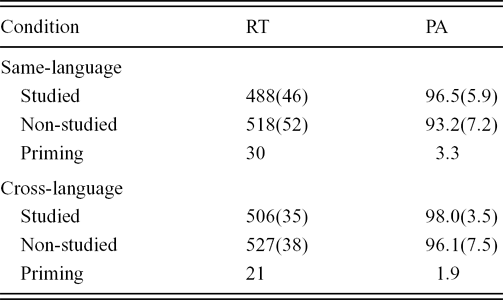
Data of two participants were excluded from the analyses. Trimming resulted in the removal of 2.6% of the reaction times. The mean reaction times and percent accuracy are shown in Table 3. As can be seen, we did obtain same-language long-term repetition priming and also cross-language long-term repetition priming.
Mean lexical decision times (RT; in milli-seconds) and percent accuracy (PA) in Experiment 3. Standard deviations are in brackets.

These results were supported by two-way ANOVAs on the response times and accurate rates. The ANOVA on the mean reaction times showed a main effect of repetition, F1(1,36) = 49.76, p = .0001; F2(1,47) = 29.44, p = .0001. Language condition was significant by item, F2(1,47) = 9.292, p < .01, but not by subjects, F1(1,36) = 1.02, p > .05. The interaction between study condition and language condition was not significant, F1(1,36) = 1.83, p > .05; F2(1,47) = 0.53, p > .05. Most importantly, simple effects showed that the repetition priming effect was significant both in the same-language condition and in the cross-language condition, t1(18) = 6.62, p = .0001; t2(47) = 3.42, p = .001, and t1 (18) = 3.69, p = .002; t2(47) = 3.10, p = .003, respectively. The effects of long-term repetition priming were evident in both of the same-language condition and the cross-language condition.
The ANOVA on the accuracy rates showed a main effect of repetition, F1(1,36) = 10.94, p = .002; F2(1,47) = 14.15, p = .0001. The effect of language condition was significant by item, F2(1,47) = 6.56, p < .05, but not by item, F1(1,36) = 1.38, p > .05. The interaction was not significant, F1(1,36) = 0.68, p > .05; F2(1,47) = 0.24, p > .05. Simple effects showed a significant repetition effect in the same-language condition, t1(18) = 2.91, p < .01; t2(47) = 2.71, p < .01. In the cross-language condition the repetition priming was marginally significant by subject, t1(18) = 1.761, p = .095, and significant by item, t2(47) = 2.283, p < .05.
The most important result of Experiment 3 is that the effect of long-term cross-language repetition priming was obtained when L2 words were presented in a conceptual task during study phase and their L1 translation equivalents were presented in a lexical task during test phase. When L2 words are required to access the conceptual representation, low fluency bilinguals tend to access the conceptual representation via their L1 translation equivalents. Together with the results of Experiments 1 and 2, it is concluded that for less fluent bilinguals the conceptual representation is shared and the lexical representation is separate. These results are consistent with the assumption of the Revised Hierarchical Model. According to this model, less fluent bilinguals tend to rely more on the link between L2 and L1 lexical representations and less on the links between the L2 lexical representation and the conceptual representation. Hence no cross-language repetition priming would be predicted when L1 words are presented in a conceptual task at study and subsequently their L2 translation equivalents are presented in a lexical task at test. Experiment 4 was designed to test this hypothesis.
Experiment 4
Method
Twenty students from South China Normal University were recruited for a small monetary reward. All participants in the present experiment were Chinese natives aged between 18 and 20 years for whom English was their second language. They were non-English-majors yet to pass CET Band 4. They had studied English for about 11–13 years from elementary schools in grade 6 or from middle schools in the first year.
Given that the central issue was whether the effect of cross-language repetition priming would be obtained when L1 words were presented in a conceptual task during study and L2 words were presented in a lexical task during test, only the cross-language condition was presented in the experiment.
The procedure was similar to that of Experiment 3 except that Chinese single-character words (e.g., 树) were presented at study while their English translation equivalents (e.g., tree) were presented at test. In the study phase stimuli were presented in an animacy decision task (using the materials from Experiment 1) and in the test phase stimuli were presented in a lexical decision task (using the materials from Experiment 2).
Results and discussion
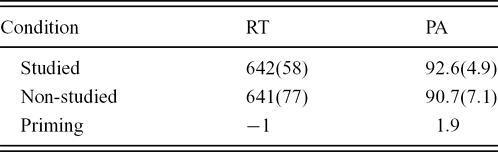
Data of two participants were excluded from the analyses. Trimming resulted in the removal of 2.7% of the reaction times. The mean reaction times and percent accuracy are shown in Table 4. As can be seen, we did not obtain long-term cross-language repetition priming effect.
Mean lexical decision times (RT; in milli-seconds) and percent accuracy (PA) for less fluent Chinese–English bilinguals in Experiment 4. Standard deviations are in brackets.

These results were supported by t tests on the reaction times and accuracy rates. For the mean response times, as well as for the accuracy rates, the repetition effect was not significant, t1(17) = 0.052, p > .05; t2(47) = 0.89, p > .05, and t1(17) = 0.93, p > .05; t2(47) = 1.03, p > .05, respectively. Thus, there was no evidence for long-term cross-language repetition priming when Chinese single-character stimuli were presented in a conceptual task during study and English translation equivalents were presented in a lexical task during test. Such a result indicates that low fluency Chinese–English bilinguals directly access the conceptual representation of the Chinese single-character words without activating their English translation equivalents.
We further examined the result of Experiment 4 with fluent Chinese–English bilinguals. The participants were native Chinese speakers aged between 22 and 25 years who, as English majors, have passed the test for English Major-8, which is the highest national test for English majors in China.
Data of two participants were excluded from the analyses. Trimming resulted in the removal of 2.6% of the reaction times. The mean reaction times and percent accuracy are shown in Table 5. As can be seen, we did not obtain long-term cross-language repetition priming effect.
Mean lexical decision times (RT; in milli-seconds) and percent accuracy (PA) for fluent Chinese–English bilinguals in Experiment 4. Standard deviations are in brackets.

Results of Experiment 4 with fluent Chinese–English bilinguals show no difference in response time between the studied words and the non-studied words, t1(17) =0.51, p > .05; t2(47) = 0.71, p > .05, and no difference in their accuracy rates, t1(17) = 0.44, p > .05; t2(47) = 0.57, p > .05, which is consistent with the findings of less fluent bilinguals in the present experiment.
Differences between the response times for the fluent Chinese–English bilinguals and the less fluent Chinese–English bilinguals were not significant by subject, t1(34) = 0.83, p > .05 and marginal by item, t2(47) = 1.95, p < 0.1. However, fluent Chinese–English bilinguals made fewer errors, t1(34) = 1.99, p = .05; t2(47) = 2.02, p = .05.
General discussion
Numerous findings (e.g., Potter et al., Reference Potter, So, Von Eckhart and Feldman1984; Kroll and Curley, Reference Kroll, Curley, Gruneberg, Morris and Sykes1988; Chen, Reference Chen1990; Kroll and Stewart, Reference Kroll and Stewart1990, Reference Kroll and Stewart1994) suggest that L2 proficiency affects conceptual access. However, the experimental tasks used in previous studies were mainly explicit memory tasks. A few studies have examined long-term cross-language repetition priming with high fluency bilinguals (e.g., Zeelenberg et al., Reference Zeelenberg and Pecher2003; Mo et al., Reference Mo, Li and Wang2005). It is thus important to extend the paradigm to low fluency bilinguals. Some researchers (e.g. Guo and Peng, Reference Guo and Peng2002) explored the semantic access mechanism of the low fluency Chinese–English bilinguals using lexical decision task under cross-language priming condition. They found that low fluency Chinese–English bilinguals access the conceptual representation via the corresponding L1 lexical representation consistent with the Revised Hierarchical Model (Kroll et al., Reference Kroll and Stewart1994). The issue then is whether data from the long-term cross-language repetition priming paradigm with low fluency Chinese–English bilinguals also support the Revised Hierarchical Model.
Experiment 1 showed long-term repetition priming in same-language and cross-language conditions when a conceptual task was used during both study and test. Experiment 2 tested whether the bilinguals’ lexical representation was also shared. The lexical decision task was used during both study and test and the findings indicated separate lexical representation for low fluency Chinese–English bilinguals. Together, the findings of Experiments 1 and 2 demonstrate that for low fluency Chinese–English bilinguals there is a shared conceptual representation but separate lexical representations. However, it remains unclear whether long-term cross-language repetition priming effect can only be obtained using conceptual decision task during both study and test, and whether low fluency Chinese–English bilinguals can directly access the conceptual representation or only access it indirectly via the corresponding L1 lexical representation. The critical difference between the Concept Mediation Model and the Word Association Model is that in the former model bilinguals access the conceptual representation directly from L2 lexical representation whereas in the latter they access via L1 lexical representation. According to the Revised Hierarchical Model access depends on L2 fluency.
In order to explore the contrasting predictions of these models, Experiment 3 presented English stimuli in a conceptual task during study and Chinese stimuli in a lexical decision task during test. The result showed long-term repetition priming in both of same-language and cross-language conditions. According to the logic of the paradigm, low fluency Chinese–English bilinguals can only access the conceptual representation of English words via their Chinese lexical equivalents. By contrast, L1 words need no mediation by L2 words. So we should obtain no cross-language repetition priming if L1 stimuli are presented in a conceptual task at study and L2 stimuli are presented in a lexical task at test.
Experiment 4 addressed this issue. Only the cross-language condition was used. Chinese single-character words were presented in a conceptual task at study while English translation equivalents were presented at test for lexical decision. There was no long-term cross-language repetition priming effect. English (L2) lexical representations are not activated during access to the meanings of Chinese words. The extension of this experiment to high fluency Chinese–English bilinguals also failed to find an effect.
In summary, long-term cross-language repetition priming effects were obtained for low fluency Chinese–English bilinguals in conceptual tasks, but not in lexical decision tasks. Low fluency bilinguals can only access the conceptual representations of L2 words via L1 lexical representation. On the other hand, fluent participants in previous studies (Mo et al., Reference Mo, Li and Wang2005) were able to access L2 conceptual representation directly using the same materials. This difference between the present and previous studies thus represents an extension in the literature and is consistent with the expectations of the Revised Hierarchical Model. However, further work is needed to understand when L2 lexical representations are activated by a conceptual task using L1 at study. In conclusion, for low fluency bilinguals, long-term cross-language repetition priming can be obtained when a conceptual task is used at study and at test and when an L2 conceptual task is used at study and an L1 lexical task at test.Footnote 1
Appendix. Stimuli used in Experiments 1–4