1. INTRODUCTION
Popular votes generally promote pure majority ruleFootnote 1 and are therefore often suspected of threatening minority rights (Matsusaka Reference Matsusaka2004, 115). Thus, over the past decade, several researchers have tried to prove or disprove the assumption that minority groups suffer at the polls. The present article connects to these previous studies, but aims at a more comprehensive view of the effects of direct democracy on a specific group of minorities.
Many of the previous analyses simply counted the relevant popular votes that affected minority rights in Switzerland or in California — the two states (respectively member states) with the most frequent use of direct democratic instruments (Gamble Reference Gamble1997; Frey and Goette Reference Frey and Goette1998) — and produced ambiguous results. In California, popular votes seem to endanger minority rights (Gamble Reference Gamble1997; Donovan and Bowler Reference Donovan and Bowler1998; see also Haider-Markel, Querze, and Lindaman Reference Haider-Markel, Querze and Lindaman2007), whereas in Switzerland no such effects could be detected (Frey and Goette Reference Frey and Goette1998; Bolliger Reference Bolliger, Freitag and Wagschal2007). The main shortcomings of most of these studies are that comparisons with the representative arena are absent and indirect effects of direct democracy are disregarded. While popular votes have direct effects on policy if they change the status quo or, conversely, inhibit change, they can also have indirect effects on policy by influencing the decisions made by government and parliament.
Furthermore, Gerber (Reference Gerber1996), Gerber and Hug (Reference Gerber, Hug, Mendelsohn and Parkin2001), Hug (Reference Hug2004) as well as Bolliger (Reference Bolliger, Freitag and Wagschal2007) suggest that the effects of direct democracy on minority rights cannot be generalized since it is necessary to differentiate between minority groups and their degree of integration in society. They point out that the adjustment of parliamentary outputs to voters’ preferences is the most important indirect effect of direct democracy, and that, furthermore, the existence of direct democratic instruments in a political system will only lead to negative effects for a minority group if that group is unpopular. This article attempts to take these considerations into account by distinguishing between in-group and out-group minorities.
In order to do this adequately, we focus on religious minorities as a very specific group of minorities. Previous studies have often included a variety of different minority categories that could hardly be compared to each other (Gamble Reference Gamble1997; Frey and Goette Reference Frey and Goette1998). An additional consideration is that religious issues have regained political salience. For many decades, permanent immigration has increased the number of religious communities and the size of Muslim minorities in Western societies in particular, resulting in struggles about cultural values and orientation (Cesari Reference Cesari2004; Bowen Reference Bowen2007; Sniderman and Hagendoorn Reference Sniderman and Hagedoorn2007; Helbling Reference Helbling and Kriesi2010; Altermatt, Delgado, and Vergauwen Reference Altermatt, Delgado and Vergauwen2006). As a consequence, a number of conflicts have arisen over the legal situation of these foreign religious communities. Governments need to develop ways of dealing with this new situation, and as a semi-direct democracy, Switzerland faces special challenges since politicians do not only have to decide on how to integrate foreign religions, but also have to find popular support for their propositions.
As issues concerning churches and other religious groups fall under the competencies of the Swiss member states (called cantons) rather than the federation (Rutz Reference Rutz, de Mortanges, Rutz and Winzeler2000), we therefore focus on the rights of religious minorities in the Swiss cantons. Switzerland generally is a useful “laboratory” for comparative analyses of the effects of direct democracy: while the cantons differ a lot with respect to attributes like the party system, they are very similar to one another with respect to other variables, which facilitates empirical analyses.
To summarize, this article focuses on whether direct democratic instruments lead to more liberal or more restrictive regulations for religious communities, and whether the effect of direct democracy varies across different religious groups. In order to shed light on these research questions, we look at both the direct democratic and the parliamentary arena. Direct effects occur in the former and indirect effects in the latter. With this two-fold analysis, we aim to improve the analysis of the effects of direct democracy that have so far suffered from the outlined shortcomings — especially when it comes to minority issues.
The study is structured as follows. In the next section, the theoretical framework is presented and several hypotheses are derived from it. This is followed by a short overview of religious groups and the state-religion relationship in Switzerland. The third section focuses on empirical data. Direct effects of direct democracy will be analyzed by examining all popular votes that legally affected religious minorities, whereas indirect effects will be explored by investigating legislative processes. Finally, we will summarize our findings and present our conclusions.
2. THEORY
Two theoretical approaches are fundamental to our analyses: the difference between direct and indirect effects of direct democracy on the one hand, and the distinction between different types of minority categories on the other. These two distinctions will be explained in greater detail below; subsequently, differences across the cantons will be discussed.
2.2. Direct and Indirect Effects of Direct Democracy on Minority Rights
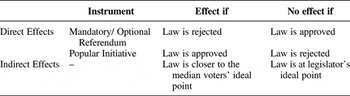
By definition, effects of direct democracy occur when a given policy output is different from what it would be if there were no direct democratic instruments (see Gerber and Hug Reference Gerber, Hug, Mendelsohn and Parkin2001). Direct effects of direct democracy come about if the voters refuse a legislators’ proposition in a referendum or approve a popular initiative. There is no effect if people approve a referendum, because in that case the outcome does not differ from the outcome of the legislative process. To isolate indirect effects, one has to look at the legislative process. If the legislator passes a law that departs from its ideal outcome, but is closer to the median voter's position, indirect effects occur (Gerber Reference Gerber1996). These different kinds of effects can be seen in Table 1. It shows that effects — no matter whether direct or indirect — occur only if the legislator's preferences are different from the voters’ preferences concerning a particular measure. But why should the preferences of the legislator regarding the rights of religious minorities differ from those of the electorate? Even though not many empirical studies exist on this issue, a number of theories have been advanced explaining why parliamentary decisions are more in favor of minority rights than popular votes. The following three arguments are most commonly put forward to explain the different outcome and different preferences.
Direct and indirect effects

First, parliamentary processes are regarded as more deliberative than election campaigns. They have more discursive filters, such as commissions or special hearings that include in-depth debates and a broad exchange of information and arguments (Gamble Reference Gamble1997, 247; Bolliger Reference Bolliger, Freitag and Wagschal2007, 424). Deliberation also includes the possibility of deals and logrolling (Clark Reference Clark1998, 456 and seq.; Tullock Reference Tullock1970). These deliberative discussions provide more opportunities for minorities to bring their interests into the legislative process. Small groups may be able to achieve their goals at least in part by negotiating about packages. These negotiations are not possible in a popular vote where voters can only approve or reject a measure.
Second, popular votes are anonymous. Voters do not have to justify their decisions; nobody has to say how he or she voted, and why. This is significantly different from politicians who are to a certain extent compelled to account for their decisions. If voters also had to explain their voting behavior to the public, they might come to different decisions from those taken in a secret vote (Papadopoulos Reference Papadopoulos1998, 177).
Finally, preferences per se might differ between politicians and voters. Compared to the political elite, citizens are less educated and less involved in international relations. Both facts lead to a less liberal attitude toward cultural diversity and policy change (Marcus et al. Reference Marcus, Sullivan, Theiss-Morse and Wood1995; Sniderman and Hagendoorn 2007, 105–106; Widmer Reference Widmer2003, 19). This assumption also appears in the United States debate about the outcome of direct democracy (Ranney Reference Ranney, Butler and Ranney1978, 84; Smith and Tatalovich Reference Smith and Tatalovich2003, 176).
These three arguments imply that voters decide more restrictively on minority rights than parliaments. This is in line with the findings of a number of legal scholars who point out that counter-majoritarian filters are needed in a democracy to protect minorities, and that these filters are almost completely absent in popular votes (Eule Reference Eule1990, 1525; Niblock Reference Niblock1993, 179). Thus, minority rights might fare better in representative than in direct democracy.
However, there might be a mechanism to avoid negative effects on minorities even though the electorate is conservative. There are two possible strategies for representatives to pass a law in spite of an impending popular vote: “softening a law,” that is, giving in to the pressure of direct democracy, or avoiding a popular campaign that focuses on the sensitive issue. Kriesi (Reference Kriesi2005, 313) showed that such campaigns have a disproportionately strong mobilization effect on opponents of a given piece of legislation. Thus, politicians may try to redirect the public debate to other issues by embedding the sensitive one in a broad bill, e.g., in a total revision of a cantonal constitution. The first strategy, as Gerber and Hug (Reference Gerber, Hug, Mendelsohn and Parkin2001) noted, is an adoption of the opinion of the median voter. The second strategy enables politicians to implement their own policy preferences by bundling several issues together, resulting in a multidimensional bill. This, in turn, minimizes the risk of the sensitive issue being focused on in the campaign (Besley and Coate Reference Besley and Coate2008). In other words, we assume that the negative indirect effects of direct democracy on minority rights can be minimized by embedding a sensitive piece of legislation into a broader bill, such as a total revision of the constitution.
2.3. Different Types of Religious Minorities in Switzerland
The effects of direct democracy depend on the relative preferences of the parliament and the median voter (Gerber Reference Gerber1996). We assume that the preference gap between the two actors and, hence, the strength of the negative impact of direct democracy is not equal across all minorities. Social identity theory (Tajfel and Turner Reference Tajfel, Turner, Austin and Worchel1979) posits that humans are social animals in that they identify with certain groups or categories called in-groups. Social identities are motivated by a desire for assimilation and conformity, which logically entails a desire for distinction from other groups and categories which are called out-groups (Brewer and Silver Reference Brewer, Silver, Stryker, Owens and White2000). Within-group differences are attenuated and between-group differences exaggerated. Moreover, humans tend to favor their in-groups at the costs of other groups (Tajfel and Turner Reference Tajfel, Turner, Austin and Worchel1979). In other words, not identifying with a group can lead to discriminatory behavior (Gibson and Gouws Reference Gibson and Gouws2000; Weldon Reference Weldon2006).
Which of the Swiss religious minorities are out-groups, then? Figure 1 provides an overview of the most important religious categories in Switzerland. Catholics and Protestants constitute still by far the largest communities, although their membership numbers have decreased the most since 1970. Smaller Christian communities (like the Christ-Catholic church) and the Jewish communities have declined as well, whereas Islamic communities have experienced a strong increase in membership over the past few decades. To complete the picture, the number of people living in Switzerland without any religious affiliation — the third largest group — is added in Figure 1.Footnote 2 While Jews, Muslims, and small Christian communities are a minority in all cantons, the minority/majority status of Catholics and Protestants varies across the Swiss member states. For reasons of simplicity, we distinguish only between Christians, Jews, and Muslims for the following analyses. Since there are no time series data available to determine the aggregate identity with the three categories, we have to rely on a much cruder criterion. Out-groups are therefore operationalized as those minorities whose members usually do not have a Swiss passport and thus do not belong to the “Swiss nation” (see Helbling Reference Helbling2008, 28 and seq.). According to the data from the Swiss Federal Statistical Office, only Muslims meet this condition. We therefore assume that negative effects of direct democracy occur first and foremost when a given policy is intended to affect Muslims.
Membership numbers for religious communities in Switzerland (in millions, BfS 2005).

2.4. Differences in Parliament and Voter Preferences across Cantons
We have seen that preferences are important concerning the effect of direct democracy. Thus, we also have to account for parliament and voter preferences that differ across cantons.
Beginning with the electorate, there are member states with relatively liberal as well as conservative median voters, as the results of popular votes and elections show (Linder, Zürcher, and Bolliger Reference Linder, Zürcher and Bolliger2008). As aforementioned, a popular vote on the rights of Muslims is presumably better supported by a liberal than a conservative electorate.Footnote 3 As a consequence, we expect negative direct effects of direct democracy to occur if (1) the bill legally affects the rights of Muslims and if (2) the electorate is conservative. Both conditions need to be simultaneously met.
Turning to the parliaments, negative indirect effects are also expected to mainly occur regarding bills that affect Muslims. In the previous paragraph, we discussed the strategy to avoid a popular vote on a sensitive issue by embedding it in a broad bill. Whether politicians choose such a strategy depends on how far their preferences diverge from the voters’ preferences. If a strong party within the parliament is close to the voters’ preferences, it might try to urge the “softening a law” strategy instead of trying to hide a critical law in a broader bill. Additionally, “softening a law” might be a successful campaigning strategy for a specific party. It can show its supporters that it achieved a policy change in their favor — maybe even against the other parties.
2.5. Hypotheses
To sum up, negative effects of direct democracy are hypothesized to affect Muslims, only. Jews and Christians, by contrast, are expected to fare well in both representative and direct democracy. However, the direct negative effects on Muslims are expected to be limited to the cantons with a more conservative electorate. In cantons with liberal voters, Muslim rights should be protected in both types of democracy. Regarding indirect effects, legislators might be able to avoid negative effects on Muslims by embedding a critical law in a broader ballot measure.
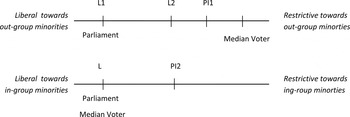
Figure 2 summarizes the outlined hypotheses in a spatial model inspired by Gerber (Reference Gerber1996). The upper graph shows the expected effects of direct democracy for out-group minorities. The parliament's ideal point is more liberal; the median voter has a restrictive attitude. If the parliament proposes L1, a direct effect is most likely to occur; the voters will refuse the proposition. Only a strategic hiding of L1 in a broader bill might be an alternative. Otherwise, the parliament has to propose L2 to get the voters’ approval — an indirect effect occurs. It can also be seen that the strength of the effect depends on voter and parliament preferences. The lower graph shows the situation for in-group minorities. As parliament and voter preferences are expected to be the same, direct democracy has no effects. PI1 and PI2 add the possibility to launch an initiative. In the upper graph, such an initiative is likely to be approved if it is between any L and the position of the median voter — that would be a direct effect. In the lower graph no such initiative should be successful — no effect occurs.
Preference Configurations concerning in- and out-groups.

3. EMPIRICAL ANALYSES
In the present section, we will test the proposed hypotheses. By analyzing popular votes as well as legislative processes concerning rights of religious minorities in the Swiss cantons, we will try to identify direct and indirect effects of direct democracy on minority rights. First, more information on the rights of religious minorities in Swiss cantons will be given. Then, direct and indirect effects will be detected in two different steps.
3.1. State-Church Relationship
To clarify which kind of political processes are being analyzed in the empirical section, we need to add a few comments on the relationship between religious groups and the state in Switzerland in general. On the whole, Switzerland has a cooperative State-Church relationship where religious communities can be recognized legally by the state. This recognition guarantees specific rights, such as the right to teach at public schools, to raise taxes, or to free access to demographic data. Furthermore, recognition generally entails some duties, such as a democratic self-organization in most cases (Cattacin et al. Reference Cattacin, Cla Reto Famos and Hans2003, 16).
As mentioned in the Introduction, the specific relationship between the state and religious communities differs across the cantons (article 74, paragraph 1 federal constitution; Rutz Reference Rutz, de Mortanges, Rutz and Winzeler2000). The religious majority in all of the 26 Swiss cantons is one of the two large Christian denominations, either the Roman-Catholic or the Evangelical-Protestant Church, which are equally recognized by the state in every canton. Only Geneva and Neuchâtel feature a rather laical model; they officially recognize the two large denominations, but in contrast to most other cantons, those churches are regulated by private instead of public law. Besides the two large Christian denominations, Jewish groups are recognized in eight cantons, and the Christ-Catholic Church in 11 cantons. As there are no further recognized religious groups, Swiss cantons have a rather restrictive attitude toward small religious communities compared to their German-speaking neighbors. Germany also recognizes Jehovah's Witnesses, Austria recognizes Muslims, Buddhists, and Mormons (Pahud de Mortanges Reference Pahud de Mortanges and de Mortanges1998, 23). However, there have been some attempts on part of the cantons to extend this legal recognition to other religious groups. These political processes are empirically analyzed in the following sections.
3.2. Direct Effects: Religious Minorities in popular votes
3.2.1. Case Selection
For the analysis of direct effects, all popular votes that legally affected the rights of religious minorities in the Swiss cantons were identified. We selected a given bill if religious minorities (e.g., “the Jewish Community of Berne”) or globally (e.g., “religious minorities not recognized by the state so far”) were explicitly named. On the basis of these criteria, 34 relevant popular votes that took place between 1963 and 2007Footnote 4 were identified. Nineteen were total revisions of the cantonal constitutions. The rest consists of three optional and 12 mandatory referendums (no initiatives took place). All these bills intended to expand the rights of religious minorities by recognizing them or providing the possibility of recognition by the state.Footnote 5 None tried to restrain them.Footnote 6
3.2.2. Research Design
To detect direct effects of direct democracy, the research design is straightforward. If one of the bills, of which all were proposed by the government or parliament, is rejected by the voters, there is a negative effect. If a bill is approved, there is no effect, since the parliamentary output is not altered. In order to determine whether there is a relationship between negative effects and the legal recognition of Muslim minorities, all bills that included the extension of the rights of Muslims were identified. Since we expect that bills that concern the rights of Muslim minorities are more likely to be rejected if the electorate is conservative, we need to find an appropriate preference measure. We chose the share of votes all parties at the extreme right as well as the Swiss Popular Party (SVP) gained in the cantonal election, which is closest to when the popular vote took place.Footnote 7 The SVP is the largest right-wing populist party in Switzerland today (Kriesi et al. Reference Kriesi, Lachat, Selb, Bornschier and Helbling2005) and stands for defending traditional values and restrictive immigration rules (Lachat Reference Lachat, Kriesi, Grande, Lachat, Dolezal, Bornschier and Timotheos2008; Bornschier and Helbling Reference Bornschier, Helbling, Kriesi, Lachat, Selb, Bornschier and Helbling2005, 34). After an overview of all votes and some bivariate analyses, we present a short summary of some case studies in order to underline our theoretical argument.
3.2.3. Results
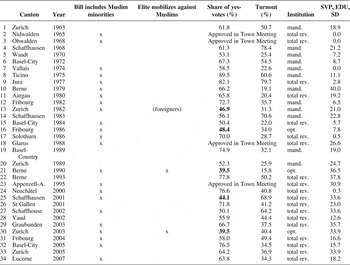
Table 2 provides an overview of the identified referendums and variables. First, we can see that only five out of 34 bills were rejected, that is, in five cases negative effects of direct democracy are observable, which seems to be a rather low number. Twenty-three bills implicitly included the extension of the rights of Muslims. We assumed that negative effects occur only in these cases. Indeed, all the rejected bills provide the possibility for any religious community — including Muslims — to become recognized by the state under certain conditions. However, 18 other bills include this provision as well, but were not rejected. Thus, Muslim minorities per se do not seem to be victims of direct democracy. We further specified that negative direct effects on the rights of Muslims are more likely to occur if the electorate is somewhat conservative. A bivariate correlation between the outcome of the popular vote (1= approved; 0 = rejected) and the strength of the right-wing parties including the 23 cases legally affecting the rights of Muslim minorities turns out to be moderately strong and negative, as model 1a in Table 3 shows.
Popular votes on minority rights 1963–2007

Notes: mandatory referendum (mand.); optional referendum (opt.). In Nidwalden 1965, Obwalden 1968, Glarus 1988, and Appenzell-Ausserrhoden 1995 the bill was decided on in town meetings where the votes are not counted but assessed by sight.
Bivariate correlations between the outcome of the vote and the electorates’ conservatism

Notes: * p < 0.05; ** p < 0.01; p < 0.001. Outcome is dichotomous in models 1a and 1b and continuous in models 1c, 1d, and 1e. Models 1c to 1e do not include the cases Nidwalden 1965, Obwalden 1968, Glarus 1988, and Appenzell-Ausserrhoden 1995 because the bill was decided on in town meetings.
The profile of the SVP has become right-wing populist only from the 1980s on (Kriesi et al. Reference Kriesi, Lachat, Selb, Bornschier and Helbling2005). Therefore, the SVP's share of the vote can only be considered an appropriate indicator of conservatism to a limited extent before that time. In addition, Muslim minorities were hardly perceived as such before the 1980s, they were rather seen as immigrants who came to Switzerland for work (see Kepel Reference Kepel, Altermatt, Delgado and Vergauwen2006). Thus, a bill implicitly expanding the rights of Muslims did probably not polarize to a great extent because Muslims did not polarize, either. As a consequence, the correlation might be stronger if we exclude the observations before the 1980s. However, in model 1b, Pearsons's r is even lower. When we conduct the analysis shown in models 1a and 1b with the share of voters who approved the bill instead of the dichotomous outcome of the vote, the correlations are much higher and significant, and the difference between the two coefficients is as we expected (models 1c and 1d). Taking the share of voters supporting a bill as the dependent variable requires also the inclusion of the bills not affecting Muslim minorities because the correlation with the right-wing parties’ share might be high in that sub-sample as well. This, in turn, would not meet our expectations. Model 1e includes all bills since 1980 showing that the correlation is substantially lower than in model 1d which supports our hypotheses.
Table 2 and the bivariate analyses yield empirical evidence in favor of our expectations, but they do not tell us whether Muslim minorities were really the cause of the rejection of the five bills. We therefore reviewed all newspaper articles that were published with respect with respect to the five rejected referendums.Footnote 8 Since a close relationship between the arguments of the political parties and the arguments of their voters has been shown to exist in a direct democratic vote (Selb et al. Reference Selb, Kriesi, Hänggli and Marr2009; Milic Reference Milic2008), we assume that public opinion tells us something not only about the parties, but also about their voters. Muslim minorities were mobilized against only in two out of the 34 referendums — both bills were rejected. In the 1990 vote in Berne, members of the extreme rightist party Eidgenössisch Demokratische Union (EDU) characterized Islam as a dangerous heresy and dominated the media coverage. In Zurich 2003, the right-wing populist party SVP (Schweizerische Volkspartei) was in charge of the opposition; one of the most prominent slogans was “Taxes for Koran schools?”
A third referendum that was disapproved because a right-wing party mobilized against the measure took place in Zurich in 1982. In this case, the SVP mobilized against foreigners, another typical out-group. This was because besides the possibility of recognition of any religious group, voters also had to decide on a recognized religious community's right to determine who of its members was to have the right to vote on internal matters. Also foreigners could therefore be given the right to vote, even if only within their own religious communities, which was not accepted by the populist SVP and some of the centrist parties — especially if non-indigenous religious communities could be recognized by the state in the future. They argued that this novelty might be mistaken as a signal for the extension of political rights to immigrants. Moreover, the Church was said to have substantial political influence that should be limited to Swiss citizens.
In the campaigns preceding the other 28 referendums, out-group minorities such as Muslims and foreigners were not a salient topic at all. The two other rejections in Fribourg 1986 and Schaffhausen 2001 had different reasons. In Fribourg, an optional referendum took place because of detailed regulations concerning priest's offices. In Schaffhausen, the total revision of the cantonal constitution was rejected because of various reasons that did not include any attention for the recognition rules of religious communities. For instance, voters feared a weakening of direct democracy in the canton and opposed regulations concerning the merger of some municipalities.
These details support our hypotheses that direct democracy has a restrictive effect if out-groups are perceived as being affected by the votes, as was the case in Zurich in 1982 and 2003, and in Berne in 1990. All measures that were accepted by a majority of voters had no previous public debate about out-group minorities such as Muslims or foreigners. The measures in Fribourg and Schaffhausen were rejected for different reasons, not related to the extension of rights for religious communities.
3.3. Indirect Effects: Rules for Recognition of Religious Minorities in Parliamentary Debates
To find indirect effects, we look at the outcome of the legislative process and whether it has been influenced by the threat of a popular vote. Gerber (Reference Gerber1996) detected indirect effects by comparing voters’ preferences to legislative output. This is not possible for the present case, as no surveys regarding the specific question of the rights of religious minorities exist. Moreover, it might be even more decisive how parliament perceives the median voter's position than its exact preference. Thus, indirect effects will be detected by looking for references to the threat of a referendum in the parliamentary debate. Indirect effects occurred if we find that recognition rules for religious minorities are systematically more restrictive if the threat of a referendum has been discussed in parliament. If recognition rules that are introduced within a broader bill are more liberal, parliament has probably felt less restricted by the median voter's position in such cases.
As also mentioned before, the strength of right-wing populist parties like the SVP might influence the implementation of liberal recognition rules in the parliamentary process. They strive for restrictive policies on foreigners and immigration and attempt to uphold traditional values (Kriesi et al. Reference Kriesi, Grande, Lachat, Dolezal, Bornschier and Frey2008; Kitschelt Reference Kitschelt1998, 20; Kailitz Reference Kailitz, Backes and Jesse2006, 312). Therefore, it can be expected that strong right-wing parties lead to restrictive rules on recognition.
We still expect that indirect effects will primarily occur if out-groups such as Muslim minorities are affected. With respect to Jewish minorities, representatives from all factions usually argue that the Jewish religion has the same cultural and historical roots as the Christian denominations, and therefore has to be recognized legally. Controversial discussions only occur if Members of Parliament (MPs) fear that recognition of a Jewish community could lead to further recognitions of other religious communities, which do not have a similar cultural background (as mentioned in a parliamentary discussion in St. Gallen, June 15, 1992). If, on the other hand, Muslims minorities are concerned, we expect negative effects of direct democracy to occur.
All these variables can interact with each other. In a vote on a total revision, both the strength of the SVP and whether or not Muslim minorities are affected become less important factors, since the probability that voters base their decision on the rules for religious minorities is comparatively low. Moreover, the effect of an impending referendum, that is, indirect effects of direct democracy should appear primarily if Muslim minorities are mentioned in the parliamentary debate and/or if right-wing parties are strong.
3.3.1. Research Design
Thirteen parliamentary debates concerning the official recognition of religious communities by the Swiss cantons shall be explored. Eleven of them have already been marked in Table 2 (gray). The remaining two were not analyzed in the first empirical part because they were not subjected to a popular vote. In Schwyz and Basel-Land, only the parliament discussed the new rules for recognition, no referendum was launched against their decision afterward. Due to availability of parliamentary protocols, and because every canton is included only once, we have significantly less cases compared to the first empirical part. Since parliamentary processes are hard to cut into pieces because they continue if a law fails at the polls, the unit of analysis is the legislative process concerning recognition rules for religious minorities in a canton.Footnote 9
In order to analyze the data we decided to use a Fuzzy Set QCA, which combines a qualitative and quantitative approach. The three main arguments for this mixed method are as follows: (1) The aim of a QCA is to find causal conditions, called necessary and sufficient conditions. All hypotheses can be formulated as such conditions for liberal or restrictive rules for religious recognition (e.g., impending popular votes make parliaments establish restrictive rules for the recognition of religious minorities). (2) In particular, combinations of explanations are taken into account, sometimes called “complex causation” (Befani, Ledermann, and Sager Reference Befani, Ledermann and Sager2007, 173). (3) The deep knowledge of every case that can be achieved by studying the protocols of the parliamentary debates allows for a well-grounded coding of the variables.
The Fuzzy Sets version of a QCA has been chosen because it allows a more precise coding. In a standard QCA, the coding is only binary. In the Fuzzy Set version, all values between zero and one including the critical 0.5 point of “maximum ambiguity” are possible (Ragin 2000, 8). Attributes that are coded with a value under 0.5 are called absent (i.e., they are more “out” of the group), with values over 0.5 counted as present (i.e., they are more “in” the group).
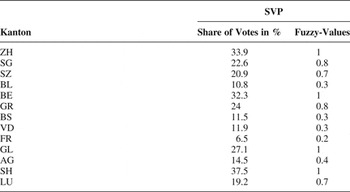
We aim to explain the variance of the rules for religious recognition in the different Swiss cantons. Therefore, an index for the extent of liberality of these rules has to be developed. To make the index Fs-QCA compatible, it will be coded between zero and one. Values under 0.5 will be interpreted as restrictive, values over 0.5 as liberal. Zero is given to the cantons that do not have any rule for the recognition of new religious communities, even though they have discussed it. If the rules for recognition are limited to Christians and Jews, the variable takes the value 0.2. Some cantons feature a two-step procedure of recognition: first, the executive checks whether the religious minority applying for recognition fulfils the criteria determined by law. Then, if the criteria are fulfilled, the government passes the request on to the parliament that decides whether or not the minority should be recognized. If a two-stage procedure is required, the canton is coded 0.4. A total of five cantons are categorized as restrictive or rather restrictive. The more liberal values from 0.6 upward are given to the other eight cantons. The value 0.6 means that the constitution explicitly allows for a new law to recognize a religious community. Most cantons in our data are rather liberal and chose rules that are coded 0.8 or even 1. The significant difference between these cantons and those with lower values is that there is no necessity of a new law to recognize another religious community. In these cantons, a simple parliament decision (“Beschluss”) is enough to award a symbolic (0.8), or official (1) recognition by public law. This is a rather liberal regulation as referendums can generally only be initiated against laws and not against simple decisions.Footnote 10
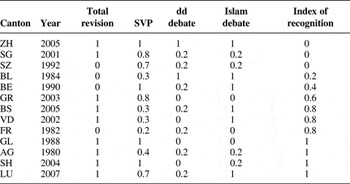
In our analysis, we have four explanatory factors. The threat of an impending popular vote is measured by counting the corresponding statements in parliament. The database consists of the parliamentary protocols. The impending popular vote is coded as a present factor if MPs mention that the people might veto a law that is too liberal more than twice in a parliamentary debate; otherwise it is coded as an absent factor. More than four references to an impending popular vote mean a full present factor that is coded as one. These thresholds correspond to the idea that a real discussion begins with more than two references to a topic. If only one or two MPs mention the issue, they are probably alone in their opinion and cannot greatly impact the result of the parliamentary process. As can be seen from Table 4, we observed only “no reference,” “one,” or “more than four references,” to direct democracy. This supports the assumption that a real discussion starts with more than two or three MPs referring to the issue.Footnote 11
Cases and fuzzy values

Notes: ZH = Zurich, SG = St. Gallen; SZ = Schwyz; BL = Baselland; BE = Bern; GR = Graubünden; BS = Basel-Stadt; VD = Vaud; FR = Fribourg; GL = Glarus; AG = Aargau; SH = Schaffhausen; LU = Luzern.
How often the parliament embedded a liberalization of recognition rules into a broader bill can be easily observed. A total revision of a cantonal constitution that includes the new rules for recognition is coded as one. If the only part of the constitution that is changed is that which regulates the relation between the state and religious minorities, the case is coded as zero. The role Muslim minorities played in the parliamentary debate are also measured by counting the references to this issue by the members of the cantonal parliaments. The strength of the right-wing party in parliament is measured by the share of votes of the SVP in the last cantonal elections. It is argued that the SVP needs a critical strength that enables the party to threaten a popular vote. If it is just a small party in a canton, such as before its rise in the 1990s (Kriesi et al. Reference Kriesi, Lachat, Selb, Bornschier and Helbling2005), it is not sufficiently supported by the people and is coded as an absent factor.Footnote 12Table 4 shows the 13 cantons and their fuzzy values in the different conditions.
3.3.2. Results
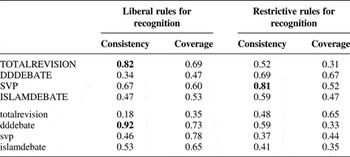
There are two important steps in a QCA. The first step is to scan the data for necessary conditions, the second to look for sufficient conditions. Both results will be presented in this paragraph. In QCA-language, a condition written in all-lower-case characters like “totalrevision” indicates the absence of the attribute, while a condition written in all-upper-case characters like “TOTALREVISION” indicates the presence of the attribute. As can be seen from Table 5, there is one necessary condition for liberal rules, which achieves a consistency (0.92) that is sufficiently high (Schneider and Wagemann Reference Schneider and Wagemann2007, 234). The absence of “dddebate” is necessary for liberal rules, which means that such rules could only be passed by the cantonal parliaments if there had been no debate on the risk of a popular vote. Two further conditions have relatively high consistency values but they are too low to be called necessary. It becomes obvious, though, that it is difficult to pass liberal rules as a separate piece of legislation not embedded in a total revision. It is also difficult to pass liberal rules when a strong SVP is present.
Necessary conditions for liberal and restrictive rules for recognition

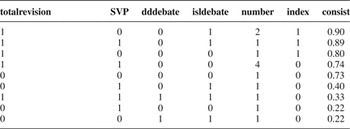
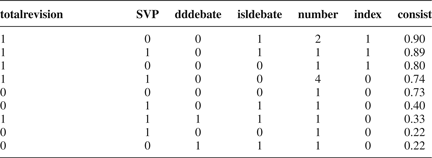
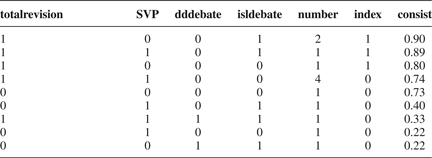
In the next step, the sufficient conditions are analyzed. Here, the combinations of conditions are important; they are called paths in QCA-language. By means of the fsQCA program's truth table algorithm, we find those paths that are sufficient for liberal or restrictive rules, respectively. The truth tables can be found in the Appendix of this article. At this point, only the results shall be presented.
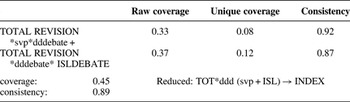
Table 6 shows the two paths that lead to liberal rules for recognition. Liberal rules were passed if they were embedded in a total revision and no debate on the risk of direct democracy took place. Additionally, either the SVP was only weakly represented or Islam was an issue in the parliamentary debate. Only the last point does not meet our expectations and seems surprising. Apart from this, all hypotheses and also the assumed interactions can be supported by this result.
Sufficient conditions for liberal rules for recognition

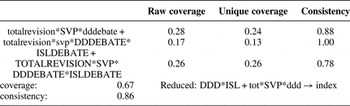
Sufficient conditions for restrictive rules for recognition

Regarding restrictive rules for recognition, we find three paths that can be simplified into two. This reduced version can be read as follows: restrictive rules for recognition were passed either if there was a debate on the risk of a popular vote and on Islam (path 1), or if the bill was not embedded in a total revision, the SVP was strong, and there had been no debate on the risk of a popular vote (path 2). Again, these results support our hypotheses, including the interaction hypothesis. The debate on direct democracy appears as a present and an absent factor, which seems inconsistent. In fact, this is a specialty of the applied method. As all cases in which there was a debate on direct democracy are represented in the first path already, debates about direct democracy appear as an absent attribute in the second path.
Altogether, we could support the hypothesis that an impending popular vote leads to restrictive rules for recognition. The absence of such a debate is nearly necessary for liberal rules, and the factor impending popular vote appeared in one path as sufficient for restrictive rules. We could also show that total constitutional revision is important for implementing liberal rules for recognition. All rules that were distinctly liberal have been embedded in a total revision. It is a present attribute in both sufficient paths for liberal rules and an absent attribute in one of the paths for restrictive rules. It seems that a total revision of a cantonal constitution provides a good opportunity either to change outdated regulations, or to pass the new law through the popular vote. A strong SVP is close to a necessary condition for restrictive rules for recognition, and from the parliamentary debates it can be seen that it was always this right-wing party that opposed the liberal laws. Since the SVP is an absent factor in the sufficient path for liberal rules and a present factor in the path for restrictive rules this finding can also be supported by the QCA.
The situation is different where Muslim minorities are concerned. Unlike the other hypotheses, this one cannot be confirmed unequivocally by the QCA. On the one hand, the presence of Muslim minority-related arguments in combination with a debate on direct democracy is sufficient for restrictive rules. On the other hand, this presence is also sufficient in one of the paths leading to liberal rules. However, this supports the hypothesized indirect effect of popular votes. If the parliament does not fear a popular vote, then the Muslim factor does not lead to restrictive rules. If there is the risk of a referendum, the parliament decides for restrictive rules fearing that voters will not agree to a law that is liberal toward Muslims.
With respect to the embedding-hypothesis, there are two outliers. The cantons of Zurich and St. Gallen (1982, 2003) both faced a total revision of their constitution, and neither included liberal rules for recognition. Looking at Zurich, this can be explained by the two former attempts to liberalize laws regarding religious minorities, which both failed at the polls. Strong direct democracy was a significant reason why they did not try again in the total revision. The case of St. Gallen is more difficult to explain because the protocols do not exactly show which arguments led to the restrictive rules. However, a working group involved in the political process of developing the new constitution makes one remark that indicates that the risk of losing at the polls had been a relevant factor. This working group advises a “cautious proceeding” regarding the “people's opinion” (final report of the working group 1 “Cantonal system”, 8 November 1989, Cantonal Archive St. Gallen), with reference to the liberalization of the rules for recognition.
4. DISCUSSION
Our central hypothesis is that the negative effects of direct democracy chiefly occur when a given policy is intended to affect out-groups such as Muslim minorities. By contrast, in-group minorities fare well in both the representative and the direct democratic arena. To be more specific, direct negative effects on Muslims are expected to be limited to member states with a more conservative electorate. Regarding indirect effects, legislators might be able to avoid negative effects on Muslims by embedding a critical law in a broader ballot measure.
To examine the direct effects of direct democracy, we investigated 34 popular votes all aiming at extending the rights of religious minorities. Five out of these 34 bills were rejected by the voters, that is, in five cases negative direct effects are observable, which is a comparatively low number. All of the rejected cases implicitly included the extension of Muslim rights. However, there are 18 bills also extending the rights of the Muslim minority that were approved by the voters. Bivariate correlation analyses of the 23 bills including Muslim rights showed that the electorates in the cantons where the proposals were rejected are more conservative than in the other referendums. A review of the newspaper articles concerning the referendums showed that in two out of the five rejected cases, populist right-wing parties heavily mobilized against Muslims. In the campaign preceding another defeated referendum, the political right mobilized against immigrants who could be considered as another prominent out-group. Since a close relationship between the arguments of the political parties and the voters’ arguments has been shown to exist (Selb et al. Reference Selb, Kriesi, Hänggli and Marr2009; Milic Reference Milic2008), we assume that Muslims and foreigners played a decisive role for the voters. In all the other 30 cases, out-groups were not a salient issue during the campaign. The empirical evidence therefore supports our expectations.
Turning to the indirect effects, the analysis of the parliamentary debates reveals that a combination of fearing a popular vote, and a debate about Muslim minorities, leads to more restrictive minority rights. This means that Muslim minorities are excluded from those rights. It seems that potential out-group minorities are discriminated against not only by direct effects, but also by indirect effects. Interestingly, parliaments nevertheless develop strategies to enforce their interests, such as embedding liberal rules for recognition in total revisions. In such a large bundle of issues, the political actors’ attention in the referendum campaign might be distracted from the rules for recognition of religious minorities. Instead, the issues under discussion seem to be positively evaluated by the voters, boosting the support of the whole package including minority rights. Even though total revisions of constitutions do not occur very often, this result might be an interesting advice for legislators, since unflavored regulations can also be hidden in a group of other measures or within a revision of a complex law.
The empirical findings of our study corroborate the theoretical expectations of many political scientists. Direct democracy has negative effects on minority rights. However, these effects are limited to out-group minorities. Ironically, those are the social groups that are most in need of support by the state, because they suffer from (latent) intolerance by the majority. However, direct democracy has not only a downside for these minorities. All issues and bills analyzed in this article attempted to change the status quo by extending the rights of religious minorities. This is not due to coincidence or selection bias; there are simply no cases aiming at restricting them at the cantonal level. In other words, when there were negative effects of direct democracy for religious minorities in Switzerland, they always took the form of a status-quo bias, i.e., an inhibition of the extension of minority rights — at least during the period investigated here.Footnote 13 Direct democracies never brought about a restriction of the status quo. This is in line with the findings of Vatter and Danaci (Reference Vatter and Danaci2010) that analyzed direct effects of direct democracy on various social minorities in Switzerland and found that the negative effects of direct democracy are confined to bills that aim at the extension of minority rights. Regarding indirect effects, embedding religious rights for out-group minorities in total revisions of the cantonal constitution seems to be a promising means of protecting minority rights.
Turning to popular votes, there are very few negative direct effects of direct democracy and even fewer effects that are obviously due to intolerance towards religious minorities. Yet, we might more frequently observe popular votes in the future in which Muslims play a significant role. One recent example is the initiative to ban the construction of minarets in Switzerland, which took place at the federal level on November 29, 2009, and was accepted by 57.5 percent of the voters.Footnote 14 As a consequence, no more minarets may be built. Since this study focused on religious minorities in Switzerland, future research could develop the topic further by placing other minority groups on the in- and out-group continuum, and could look at how they fare at the polls. For instance, the in- or out-group potential of homosexuals, whose rights are limited by direct democracy in United States-member states (Tolbert and Smith Reference Tolbert and Smith2006, 32) but are supported by voters in Switzerland (Vatter and Danaci 2010), would be an interesting puzzle to tackle.
APPENDIX
Truth table for liberal rules for recognition

Truth table for restrictive rules for recognition
Coding of the strength of the SVP

Notes: Ladner 2003, Homepages of the cantons.