INTRODUCTION
Damselfish (family Pomacentridae) includes 390 species worldwide (Eschmeyer & Fong, Reference Eschmeyer and Fong2013), and are among the best known herbivore fish resident of tropical and temperate waters of all oceans. They play a relevant role in controlling algal populations (Allen, Reference Allen, Paxton and Eschmeyer1998), and also present other important and characteristic traits including the formation of well delimited territories (Peterson & Warner, Reference Peterson, Warner and Sale2002), and the construction of nests in algal turfs that in addition to providing protection for the eggs, helps to increase the rates of nitrogen fixation in reefs (Fong & Paul, Reference Fong, Paul, Dubinsky and Stambler2011). Although most damselfish are found in the Indo-Pacific (Allen & Erdmann, Reference Allen and Erdmann2012), there are 22 species resident of the eastern Pacific, from 7 genera; they mainly inhabit coral and rocky reefs from western Mexico and the United States, to Chile (Robertson & Allen, Reference Robertson and Allen2013). Five of these species belong to the genus Chromis (Cuvier, 1814): C. alta (Greenfield & Woods, 1980); C. atrilobata (Gill, 1862); C. crusma (Valenciennes, 1833); C. intercrusma (Evermann & Radcliffe, 1917); and C. limbaughi (Greenfield & Woods, 1980).
The blue and yellow damselfish, C. limbaughi, is a small, endemic fish (12 cm maximum recorded length) (Aguilar-Medrano et al., Reference Aguilar-Medrano, Frederich, de Luna and Balart2011), that inhabits rocky and coral reefs in the central and southern Gulf of California, and the Revillagigedo Islands, at depths of 5 to 75 m (Robertson & Allen, Reference Robertson and Allen2013). The individuals are usually seen swimming in schools about 1 to 2 m above the rocky bottom (Robertson & Allen, Reference Robertson and Allen2013), and feed on zooplankton and fish eggs (trophic level between 2.88 and 3.02) (Aguilar-Medrano et al., Reference Aguilar-Medrano, Frederich, de Luna and Balart2011; Froese & Pauly, Reference Froese and Pauly2013). This damselfish presents allometric growth (Balart et al., Reference Balart, González-Cabello, Romero-Ponce, Zayas-Álvarez, Calderón-Parra, Campos-Dávila and Findley2006), has benthic eggs and a larval period of 20 to 27 days (Victor & Wellington, Reference Victor and Wellington2000).
The species is considered as in ‘Least Concern’ by the Red List of the International Union for Conservation of Nature, because it is not used for human consumption, it is relatively abundant and common, and has no reported reduction in population density (Allen & Robertson, Reference Allen and Robertson2010). In addition, it is not listed in any appendix of the Convention of International of Trade in Endangered Species of Wild Fauna and Flora (CITES). Notwithstanding, the Mexican Federal Government includes C. limbaughi in its register of protected species in the category of ‘Protección especial’ (‘Special protection’), as this is one of the three most important fish in the aquarium trade in the country and has been commercialized since the 1970s (Piña-Espallargas et al., Reference Piña-Espallargas, Reyes-Bonilla, Ortuño-Manzanares, García-Núñez, Mendoza-Vargas and González-Ania2001; Reyes-Bonilla et al., Reference Reyes-Bonilla, Herrero-Perezrul, Fernández-Rivera Melo, Urciaga García, Beltrán Morales and Lluch Belda2009). According to governmental information, allowed catches added up to 2,330 individuals in 2006, but rose to 15830 in 2009 (F. Chillopa-Morales, Dirección General de Vida Silvestre, Secretaría del Medio Ambiente y Recursos Naturales, personal communication, June 2009). Because of this situation there are a number of protective measures established for the species in Mexico, including the allowance of a limited number of permits (five in the country), specific quotas (usually not exceeding 4,000 fish captured per permit), and the demarcation of only eight fishing areas, located especially on the western coast of the gulf (SEMARNAT, 2012; F. Chillopa-Morales, personal communication, June 2009).
A number of monitoring programmes of the reef fish fauna of the Gulf of California have been established in the last decade, and from them, new and detailed information about the distribution of many species is available. Taking advantage of these efforts, we present information obtained by different organizations in order to improve the knowledge about the distribution range of C. limbaughi; in specific, here we include a number of new records of the species from the northern Gulf of California, obtained from fieldwork in the years 2010 to 2013. This information is important considering that the species is under an increasing fishing pressure, and this will probably continue in years to come.
MATERIALS AND METHODS
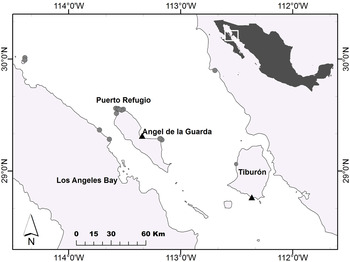
The northern Gulf of California is here defined as the section north of 28°N in this inner sea (Figure 1), that is a very dynamic area from the oceanographic perspective. The bottom is very shallow (less than 200 m deep) except at the Ballenas Channel between the peninsula and Angel de la Guarda Island, and west of Tiburón Island (Figure 1). Tides are particularly intense and range up to 8 m (Lluch-Cota et al., Reference Lluch-Cota, Aragón-Noriega, Arreguín-Sánchez, Aurioles-Gamboa, Bautista-Romero, Brusca, Cervantes-Duarte, Cortés-Altamirano, Del-Monte-Luna, Esquivel-Herrera, Fernández, Hendrickx, Hernández Vázquez, Herrera-Cervantes, Kahru, Lavín, Lluch-Belda, Lluch-Cota, López-Martínez, Marinone, Nevárez-Martínez, Ortega-García, Palacios-Castro, Parés-Sierra, Ponce-Díaz, Ramírez-Rodríguez, Salinas-Zavala, Schwartzlose and Sierra-Beltrán2007): that circumstance helps to have a relatively well mixed and productive water column, with average annual productivity of over 500 mg C/m2/yr (Alvarez-Borrego, Reference Alvarez-Borrego2012).
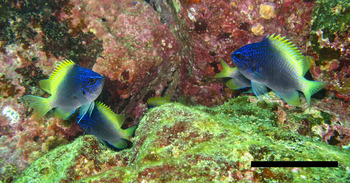
Two Chromis limbaughi specimens observed at Puerto Refugio (10 m deep). Scale bar = 10 cm (photograph by Israel Sánchez-Alcántara).

The new records of the blue and yellow damselfish (Figure 1) were obtained in three field campaigns conducted in September 2007 (mainland coast), June 2009 and June 2010 (west coast plus Tiburón Island and its surroundings), and October 2009 and 2010 (Los Angeles Bay and San Lorenzo Archipelago). Fish were observed inside transects of 30 × 2 m at depths of 3 to 30 m (N = 215 census in the five campaigns). The specimens of C. limbaughi were identified on the basis of the diagnostic traits presented by Allen & Robertson (Reference Allen and Robertson1994) and Humann & DeLoach (Reference Humann and DeLoach2004), and they include a conspicuous blue body with a blue-grey head, and yellow dorsal, caudal and anal fins and caudal peduncle (Figure 2). Divers estimated the size of the observed specimens in intervals of 5 cm, based on the method described by Hill & Wilkinson (Reference Hill and Wilkinson2004).
New records of blue and yellow damselfish Chromis limbaughi in the northern Gulf of California. Triangles, northernmost limits according to Robertson & Allen (Reference Robertson and Allen2013) and GBIF (2013); circles, new records of the species (for detailed information see Table 1).

In addition to the fieldwork, to determine the currently accepted geographical range of the species we surveyed specialized literature (Allen, Reference Allen, Paxton and Eschmeyer1998; Aguilar-Medrano et al., Reference Aguilar-Medrano, Frederich, de Luna and Balart2011; Robertson & Allen, Reference Robertson and Allen2013), and checked information about specimens housed in over 20 collections of Mexico and the United States, available in the Global Biodiversity Information Facility webpage (GBIF), the Ocean Biogeographic Information System (OBIS), FishBase (Froese & Pauly, Reference Froese and Pauly2013) and the Mexican Comisión Nacional para el Conocimiento y Uso de la Biodiversidad (CONABIO) (2013). These data were used as a baseline to compare our records against the known boreal limits of C. limbaughi in the eastern Pacific region.
RESULTS
According to the literature and web pages consulted, the northernmost records of the blue and yellow damselfish are 29°N and –113.5°W in the western side of the gulf (at Los Angeles Bay; from Robertson & Allen (Reference Robertson and Allen2013), Ocean Biogeographic Information System (2013); Comisión Nacional para el Conocimiento y Uso de la Biodiversidad (2013)), and 28.765°, –112.366° (southern Tiburón Island: from Global Biodiversity Information Facility (2013)) in the east. However, in our surveys we found the damselfish in 17 georeferenced sites placed north of the putative limits (Figure 1), with extreme coordinates at 29.897722°N –112.6953861°W in the east (Puerto Libertad), and 30.01168°N –114.39163°W in the west (Bajo Poma, Encantadas Islands). This updated information increases the known geographical range of C. limbaughi by about 140 km north in the western gulf and about 170 km in the east (Figure 1).
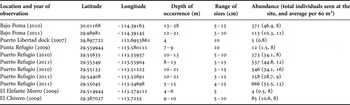
The detailed location of all new records, depth of presence of the fish, estimated size (5 cm intervals), number of specimens seen and calculated local population density, are presented in Table 1. From that information it is possible to say that C. atrilobata in the northern Gulf of California occurs at depths from 3 to 28 m, and chiefly between –9 and –10 m. Sizes ranged from 5 to 10 cm, although at Bajo Poma (Encantadas Islands), Puerto Refugio (north Angel de la Guarda Island) and Salsipuedes Island (in the San Lorenzo Archipelago) at least one individual was larger than 10 cm. Also, in most areas the population density exceeded one individual per square metre, with a peak of >70 ind/m2 at Coronadito Island, in Los Angeles Bay (Table 1); also, at Puerto Refugio the density surpassed 28 ind/m2 (both in 2010 and 2011), indicating a stable and abundant population. Finally, we also observed juvenile specimens (bright blue in colour, with a yellow tail, peduncle and dorsal fin; see illustration in Robertson & Allen, Reference Robertson and Allen2013) in areas at 29°N, especially at Puerto Refugio but also at Coronadito and Salsipuedes Islands.
Sites, coordinates of occurrence and additional information on the new records of Chromis limbaughi in the northern Gulf of California.

DISCUSSION
The finding of C. limbaughi about 150 km of its northernmost recognized geographical limit (Figure 1) is important as species richness of pomacentrids is very low in the northern Gulf of California (>29°N); before this paper, only the scissortail damselfish, C. atrilobata Gill, 1862 and the seargent major Abudefduf troschelli (Gill, 1962) were reported to occur there (Robertson & Allen, Reference Robertson and Allen2013). Ecologically, these species fulfil very different functions as the scissortail damselfish is a planktivore that lives in the water column, while the blue and yellow damselfish is more demersal and in addition to feeding on plankton, it also consumes small reef invertebrates (Hobson, Reference Hobson1965; Aguilar-Medrano et al., Reference Aguilar-Medrano, Frederich, de Luna and Balart2011; Robertson & Allen, Reference Robertson and Allen2013).
Surveys of the fish fauna in the Gulf of California have shown that the depth of occurrence of C. limbaughi depends on latitude, as the fish occupies shallow habitats in Los Angeles Bay (28°N; Viesca-Lobatón et al., Reference Viesca-Lobatón, Balart, González-Cabello, Mascareñas-Osorio, Reyes-Bonilla, Torreblanca, Danemann and Ezcurra2008), but prefers to live deeper (from –15 to over –60 m) in the central and southern gulf (Thomson et al., Reference Thomson, Findley and Kerstitich2000). Our results (Table 1) confirm this pattern as in latitudes of 29°N or more, the species was seen as shallow as 3 m and usually from 8 to 12 m deep. Also, as the fish is absent in the tropics, south of Banderas Bay (20°N; Robertson & Allen, Reference Robertson and Allen2013) the information evidences the preference of the species for relatively cold water.
Most of the recorded individuals of C. limbaughi from Table 1 were easily identified because they presented the typical coloration of the adult and had sizes of over 5 cm in total length (Table 1; Figure 2), but we also observed juveniles in some areas. The occurrence of the two basic ontogenetic stages in the northern gulf, the widespread occurrence of the individuals and their high abundance and population density, are good evidences to suggest that this damselfish has actual reproductive populations in the northern gulf. It is noteworthy that earlier detailed studies of the fish fauna in that region (Thomson et al., Reference Thomson, Findley and Kerstitich1979; Hastings & Findley, Reference Hastings, Findley, Felger and Broyles2007) did not mention the species anywhere in the area, and for that reason we suggest that its arrival and establishment in that region is relatively recent. It is possible that the reason why the species has found a more adequate environment for the development of its populations is the small but significant warming of the waters that has occurred in the last decades in the northern gulf. Satellite data from 1984 to 2008 indicate that temperature has increased in the entire Gulf of California (Lluch-Cota et al., Reference Lluch-Cota, Parés-Sierra, Magaña-Rueda, Arreguín-Sánchez, Bazzino, Herrera-Cervantes and Lluch-Belda2010) and in specific the study area (29°N and 30°N) has become warmer by an average of 0.028°C/year since 1982, according to the databases in the Hadley Centre for Climate Change (Rayner et al., Reference Rayner, Parker, Horton, Folland, Alexander, Rowell, Kent and Kaplan2003). The most probable source of this increase might be the effect of global change that has resulted in conditions that favour the entrance of tropical species such as C. limbaughi, Scarus spp. (parrotfish) and others, to northern sites in the Gulf of California (Ayala-Bocos & Reyes-Bonilla, Reference Ayala-Bocos and Reyes-Bonilla2009; González-Cuéllar et al., Reference González-Cuéllar, Reyes-Bonilla, Fourriére, Rojo, Hernández-Velasco, Sánchez-Alcántara and Pfister2013). This hypothesis has to be tested in more detail but evidence is increasing in its favour.
In conclusion, the results of this paper extend the currently known distribution range of the blue and yellow damselfish Chromis limbaughi by about 150 km to the north. The abundance, relative occurrence, and the finding of adults as well as juveniles in the northern Gulf of California point to the existence of actual reproductive populations in the area, probably settled during the last two decades, as the species was not observed in the area in numerous surveys in the 1970s and 1980s. Probably, the fact that sea temperature in the northern gulf has been increasing albeit slightly in the last decade, has favoured the colonization of C. limbaughi, a tropical reef fish species.
ACKNOWLEDGEMENTS
The study was funded by Pesca Artesanal del Norte del Golfo de California, Ambiente y Sociedad (PANGAS), David and Lucile Packard Foundation and Fondo Mexicano para la Conservación de la Naturaleza. We thank the crew of the ‘Rocío del Mar’, and all members and scientific divers that took part in the 2010 and 2011 research and monitoring cruises. During the preparation of the study M.M.T. and F.J.F.R.M. (register 274238) had scholarships granted by Sistema Nacional de Investigadores de México and Consejo Nacional de Ciencia y Tecnología, respectively. Finally, many thanks to administration and staff of the Reserva de la Biosfera Bahía de los Ángeles, Canales de Ballenas y Salsipuedes, Área de Protección de Flora y Fauna Islas del Golfo de California en Baja California and Sonora and Parque Nacional Zona Marina Archipiélago de San Lorenzo for the facilities and permissions to generate this study.