Introduction
Blueberry is an important crop in North Carolina, worth nearly $67 million (USDA 2016). Nationally, North Carolina ranks sixth in production, with blueberry grown on 2,900 ha in 2016 (USDA 2016). Blueberry has a very diverse genetic background, with highbush, rabbiteye, and lowbush (Vaccinium angustifolium Aiton) commonly grown in North America (Delaplane and Mayer Reference Delaplane and Mayer2001; Die and Rowland Reference Die and Rowland2013). Although blueberry is indigenous to North America, highbush blueberry has only been commercially cultivated for approximately 80 yr (Demchak Reference Demchak2013). North Carolina blueberry production is mostly (95%) southern highbush types and about 5% rabbiteye cultivars (Roberts Reference Roberts2009). Soil properties are predominantly responsible for the disproportionate amount of southern highbush blueberry produced within the region relative to rabbiteye blueberry (B Cline, personal communication) and a limiting factor for expansion of commercial hectares within the state (Strik and Yarborough Reference Strik and Yarborough2005). These unique soil properties include pH between 4 and 5, well-drained but moist soil (typically with a shallow water table between 35 and 75 cm), and organic matter content greater than 2% (Krewer et al. Reference Krewer, Cline and NeSmith2015).
Weeds are common pests in blueberry, with weed populations consisting of a mixture of both annual and perennial weeds (Roberts Reference Roberts2009). Weeds compete with plants for water, nutrients, sunlight, and space, and often affect plant growth, fruit bud set, flower initiation, yield, and fruit quality in blueberry as well as in tree fruits (Basinger et al. Reference Basinger, Jennings, Monks, Mitchem, Chaudhari, Heitman, Havlin, Howard and Spayd2018a, Reference Basinger, Jennings, Monks, Mitchem, Perkins-Veazie and Chaudhari2018b; Buckelew et al. Reference Buckelew, Mitchem, Chaudhari, Monks and Jennings2018a, Reference Buckelew, Mitchem, Monks, Chaudhari, Jennings and Mehra2018b; Sciarappa and Pavllis Reference Sciarappa and Pavllis2004). Weeds may serve as alternate hosts for insects and diseases and may produce a favorable environment for vertebrate pests such as voles (Retamales and Hancock Reference Retamales, Hancock, Retamales and Hancock2012). As with other perennial crops, blueberry fields tend to harbor difficult to control perennial weeds in mature plantings (Meyers et al. Reference Meyers, Jennings, Monks, Ballington and Jordan2016; Monaco et al. Reference Monaco, Weller, Ashton, Monaco, Weller and Ashton2002; Roberts et al. Reference Roberts, Jennings and Monks2016, Reference Roberts, Jennings, Monks, Burton and Stowe2017).
Several management tools, including mowing, cultivation, mulching, herbicides, and hand weeding, are used to manage weeds in blueberry fields (Monaco et al. Reference Monaco, Weller, Ashton, Monaco, Weller and Ashton2002; Roberts Reference Roberts2009). Although several herbicides are registered for broadleaf weed control in blueberry (NCCE 2016), North Carolina growers currently rely primarily on glyphosate, glufosinate, halosulfuron, hexazinone, and paraquat (KM Jennings, personal communication). Overreliance on a limited number of herbicides increases selection pressure and potentially increases the population of herbicide-resistant weeds (Powles Reference Powles2008). Therefore, it is important to identify new herbicide chemistries for use in blueberry.
Saflufenacil (Weed Science Society of America Group 14) is a protoporphyrinogen IX oxidase (PPO)-inhibitor herbicide belonging to the pyrimidinedione chemical family. It affects growth of sensitive plants by competitively inhibiting the PPO enzyme (Duke et al. Reference Duke, Lydon, Becerril, Sherman, Lehnen and Matsumoto1991), which results in a rapid loss of membrane integrity and tissue necrosis followed by plant death. Saflufenacil provides both contact burndown and rate-dependent residual broadleaf weed control (Anonymous 2011). It is readily absorbed by plant foliage and root. Once absorbed, it is mainly translocated in xylem tissue, with limited mobility in the phloem (Liebl et al. Reference Liebl, Walter, Bowe, Holt and Westberg2008). It is registered for broadleaf weed control in certain field and row agronomic crops (preplant or PRE) and tree fruit crops (POST-directed) (Anonymous 2011, 2013; Ashigh and Hall Reference Ashigh and Hall2010).
In a greenhouse study, Geier et al. (Reference Geier, Stahlman and Charvat2009) reported that saflufenacil applied PRE and POST at 6 and 9 g ai ha−1, respectively, reduced average biomass of five weed species [blue mustard, Chorispora tenella (Pall.) DC.; flixweed, Descurainia sophia (L.) Webb ex Prantl; Palmer amaranth, Amaranthus palmeri S. Watson; redroot pigweed, Amaranthus retroflexus L.; and tumble pigweed, Amaranthus albus L.] by at least 90% compared with nontreated controls. Jhala et al. (Reference Jhala, Ramirez and Singh2013) found saflufenacil to be complementary with indaziflam and/or glufosinate in citrus. Tank mixes of saflufenacil and glufosinate were more effective than glyphosate alone, and the addition of indaziflam to the mixture of saflufenacil plus glufosinate provided longer residual and increased spectrum of weed control in citrus groves. Singh et al. (Reference Singh, Malik, Ramirez and Jhala2011) reported that single or sequential applications of saflufenacil at the registered rate did not cause any phytotoxic effects on citrus and provided adequate control of several broadleaf and grass weed species when applied as a tank mix with glyphosate and pendimethalin.
Blueberry fields are often heavily infested with annual and perennial weeds (Meyers et al. Reference Meyers, Jennings, Monks, Ballington and Jordan2016; Roberts et al. Reference Roberts, Jennings and Monks2016, Reference Roberts, Jennings, Monks, Burton and Stowe2017), and growers would benefit from having a new herbicide registration with activity on weeds that is safe to blueberry. Saflufenacil is registered in citrus, tree nut, and pome fruits; however, it is not registered in blueberry. Therefore, the objective of this research was to conduct greenhouse and field studies to determine the tolerance of blueberry cultivars to saflufenacil.
Materials and Methods
Greenhouse Studies
Greenhouse studies were conducted at the BASF research facility at Research Triangle Park, NC (35.88°N, 78.86°W) in 2011 and 2012. Woody, rooted cuttings of southern highbush ‘Legacy’, ‘New Hanover’, and ‘O’Neal’ and rabbiteye ‘Columbus’ blueberry were dug from a commercial blueberry nursery at Ivanhoe, NC (34.58°N, 78.24°W). Cuttings were transplanted into 18.5-cm-diameter pots containing 1.75 L of a white coarse sand (Sands and Soils, Durham, NC) with 0.1% organic matter, pH 5.8, and CEC 1.2 cmol kg−1. Cuttings were transplanted on September 9, 2011, for the first run and February 23, 2012, for the second run. Plants were fertilized one time per week with water-soluble fertilizers (Jack’s Professional®, JR Peters, Allentown, PA) that delivered 228, 24, 194, and 1.85 ppm nitrogen, potassium, phosphorous, and iron, respectively. At 2 wk after transplanting, ammonium sulfate was applied at 372 kg ha−1 (1 g pot−1) to adjust soil pH down into an appropriate range (approximately pH 4.8) for blueberry growth.
The experimental design was a randomized complete block with five replications. Treatments consisted of a factorial arrangement of five saflufenacil (TreevixTM herbicide, BASF, Research Triangle Park, NC) rates (0, 50 [1X registered field rate in tree, nut cropping systems], 100, 200, and 400 g ai ha−1) by four blueberry cultivars. Herbicide was applied on November 14, 2011, and May 23, 2012, for the first and second runs, respectively. At time of application, blueberry plants were approximately 30-cm tall and had 15- to 25-cm new growth. Herbicide treatments were applied directly to the soil surface in an aqueous solution of 10 ml pot−1 distributed evenly across the soil surface using a serological pipettor (Pipet-Aid®, Drummond Scientific, Broomall, PA). Following application, pots were watered lightly to incorporate the herbicides but not so much as to allow leaching through the pots. Plants were then watered as needed, typically one time per day to minimize leachate. Saucers were placed under each pot to capture any leachate draining out of pots, and then the leachate was reintroduced back into the pot to ensure continuous exposure of plants to herbicide throughout the experiment. Greenhouse day/night temperatures were 28/24 C with a 14-h photoperiod. Supplemental lighting was triggered when ambient light fell below approximately 350 µmol m−2 s−1 and was provided by high-pressure sodium lamps.
Each pot was treated as a single experimental unit. Data collected included visible injury observed as purpling or chlorosis of foliage and leaf drop (scale of 0% = no injury to 100% = death) determined at 7, 14, 28, and 56 d after treatment (DAT) (Frans et al. Reference Frans, Talbert, Marx, Crowley and Camper1986). In addition, plant growth (change in height) accumulated in 49 d was determined by calculating the difference in height measurements recorded at 7 and 56 DAT. Blueberry height was measured from the soil surface to the tip of the longest stem. Soil plant analysis development (SPAD) readings were measured on five subsamples per plant taken at random at 7, 14, and 28 DAT with a chlorophyll meter (Konika Minolta model SPAD-502, Ramsey, NJ). Destructive harvest of blueberry plants was conducted at 56 DAT. Plants were removed from pots, and then soil was removed from roots by gentle shaking followed by a steady stream of water applied through a garden hose. Shoots and roots from each plant were then placed in paper bags and oven-dried at 60 C for 1 wk, before whole-plant dry biomass was determined.
Field Studies
Nonbearing Blueberry
In 2012 and 2013, field studies were conducted at a commercial blueberry farm near Burgaw, NC (34.60°N, 77.85°W) with the southern highbush blueberry ‘Duke’ (<3-yr-old and too immature to produce fruit) (Roberts et al. Reference Roberts, Jennings and Monks2016). Soil was a Murville muck (sandy, siliceous, thermic Umbric Endoaquods) with 6% to 10% organic matter, 13.6 cmol kg−1 CEC, and pH 4.3. Herbicide treatments were applied either before budbreak (pre-budbreak) or during active vegetative growth stage. Herbicide treatments consisted of saflufenacil at 50, 100, and 200 g ha−1; saflufenacil at 50 g ha−1 plus glyphosate (Roundup WeatherMax®, Monsanto, St Louis, MO) at 870 g ae ha−1; saflufenacil at 50 g ha−1 plus glufosinate (Rely 200®, Bayer CropScience, Research Triangle Park, NC) at 1,096 g ai ha−1; glyphosate alone; glufosinate alone; and hexazinone (Velpar L®, DuPont, Wilmington, DE) at 1,120 g ai ha−1. Nontreated plots were included for comparison. Methylated seed oil (1.87 L ha−1) and ammonium sulfate (400 g ha−1) were included with all treatments containing saflufenacil. Ammonium sulfate, methylated seed oil, and nonionic surfactant (0.4 L ha−1) were included with glyphosate alone, glufosinate alone, and hexazinone treatments, respectively. Herbicide treatments were POST-directed to soil beneath the blueberry plants in a 76-cm band on both sides of the blueberry row and were applied using a CO2-pressurized backpack sprayer with two AIXR 110015 nozzles (TeeJet® Technologies, Springfield, IL) calibrated to deliver 187 L ha−1. Herbicide treatments at pre-budbreak and active vegetative growth were applied on March 23 and May 4 and March 14 and May 17 in 2012 and 2013, respectively. Each plot was a single row (4.8-m long by 1.5-m wide) of blueberry plants and consisted of four plants spaced 1.2 m apart. The distance between rows was 3 m. Data were collected from the center two plants in each plot. Herbicide treatments at each application timing were arranged in a randomized complete block design with four replications.
Injury to blueberry from POST-directed application of saflufenacil occurred as necrotic lesions on leaf, change in leaf color, leaf crinkling, and leaf fall. Visible crop injury was determined at 7, 14, and 28 DAT on the scale described earlier.
Bearing Blueberry
In 2012 and 2013, field studies were conducted at a commercial blueberry farm near Burgaw, NC (34.60°N, 77.85°W) with the southern highbush blueberry cultivar Duke (>3-yr-old and mature enough to bear fruit) (Roberts et al. Reference Roberts, Jennings and Monks2016). Studies with bearing blueberry had identical treatments as the nonbearing blueberry studies, except that the herbicide applications were made only at one time (pre-budbreak stage in 2012 and at the active vegetative growth stage in 2013). Herbicide treatments were applied on March 23, 2012, and May 17, 2013. Visible crop injury was determined at 13, 27, and 42 DAT in 2012 and at 10 and 17 DAT in 2013 using the scale described earlier.
Blueberry plant growth was measured from both nonbearing (2012) and bearing blueberry (2012 and 2013) studies by flagging three branches (at the time and 2 wk after herbicide application for active vegetative growth and pre-budbreak treatments, respectively) of a representative plant in each plot and recording the change in length 14 d after flagging. Commercial blueberry plants generally grow for 2 to 3 yr before they are harvested for fruit. Therefore, no fruit was harvested from the nonbearing blueberry study. From the bearing blueberry study, all the berries from 1 plant plot−1 were harvested at once to measure yield. After harvesting, berries were separated into ripe (blue) and unripe (green) berries and weighed separately. A berry was considered ripe if >80% of the surface was blue. Ten samples each of 100 ripe or unripe berries were weighed to measure mean ripe or unripe berry weight, and then total unripe berry weight was converted to predicted ripe berry weight using Equation 1. Total ripe berry yield was measured by combing ripe and predicted ripe berry weight. Similar techniques to report blueberry yield have been employed by other researchers (Meyers et al. Reference Meyers, Jennings, Monks, Ballington and Jordan2016; Roberts et al. Reference Roberts, Jennings and Monks2016).
 $$\eqalign{\hskip-21pt{\rm {Predicted \ ripe \ berry \ weight}}\cr = \ ({\rm {mean \ ripe \ berry \ weight/mean \ unripe \ berry \ weight}})^{\times } \cr \ {\rm {total \ unripe \ berry \ weight}}}$$
 $${\rm {Total \ ripe \ berry \ yield}} ({\rm {kg \ plant}}^{-1}) = {\rm {ripe \ berry \ weight}} \ + \ {\rm {predicted \ ripe \ berry \ weight}}$$
Both greenhouse and field data were subjected to ANOVA and analyzed by PROC MIXED in SAS v. 9.3 (SAS Institute, Cary, NC). All data were checked for homogeneity of variance by plotting residuals. For greenhouse data, fixed effects included saflufenacil rate, cultivar, and their interaction, and random effects included run and replication within run. For the nonbearing blueberry field studies, fixed effects included herbicide, application timing, and their interaction. However, for the bearing blueberry field studies, only herbicide was considered as a fixed effect. Year and replication within year were included as random effects when data were combined for both years, otherwise replication was considered as a random effect.
Results and Discussion
Greenhouse Study
Due to a lack of treatment-by-experimental run interaction for all measured variables, data were combined across runs for all of the measured variables. Further analyses indicated that the two-way interaction among herbicide and cultivar was not significant (P > 0.05) for all the measured variables, except for visible injury; therefore, results are presented with respect to significance of main effects or their interactions.
Visible Injury
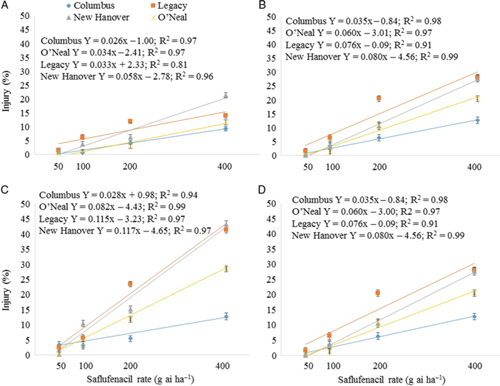
Injury to blueberry plants had a linear relationship with saflufenacil rate and increased as saflufenacil rate increased from 50 to 400 g ha−1 at all assessment timings (Figure 1A–D). At 7 DAT, injury did not exceed 10% across rates of saflufenacil for all blueberry cultivars, except for New Hanover (20%) and Legacy (15%) at 400 g ha−1 (Figure 1A). The highest level of injury was reported at 28 DAT (Figure 1C), with Columbus displaying the highest tolerance (slope value of 0.028), followed by O’Neal (0.082), Legacy (0.115), and New Hanover (0.117). At 28 DAT, injury to all blueberry cultivars was ≤5% and 10% for 50 and 100 g ha−1, respectively. However, injury from saflufenacil at 200 and 400 g ha−1 ranged from 7% to 20% and 12% to 43%, respectively. Plant injury values were lower at 56 DAT (Figure 1D) compared with 28 DAT. However, injury trends remained the same as in previous observations, with Columbus displaying the greatest tolerance, followed by O’Neal, Legacy, and New Hanover. These results demonstrate the differential response of blueberry cultivars to saflufenacil.
Response of blueberry cultivars to soil-applied saflufenacil at (A) 7 d after treatment (DAT), (B) 14 DAT, (C) 28 DAT, and (D) 56 DAT in the greenhouse at Research Triangle Park, NC. Data were pooled over experimental runs. Points are means ± SE.

Plant Growth
Blueberry plant growth accumulated over 49 d (determined by calculating the difference in plant height recorded at 7 and 56 DAT) did not differ with respect to saflufenacil rate and cultivar and ranged from 10 to 14 cm regardless of saflufenacil rate and cultivar. This result indicated that saflufenacil had no negative impact on blueberry plant height.
SPAD
No significant saflufenacil rate effect was observed at any timing for SPAD values, which ranged from 35 to 40 (Table 1). The effect of cultivar was significant at 7 and 28 DAT. At 7 DAT, New Hanover had a lower SPAD value (34) compared with Columbus (37), O’Neal (37), and Legacy (36). However, at 28 DAT, both Columbus and New Hanover had a SPAD value of 37 compared with 40 and 41 for Legacy and O’Neal, respectively. Despite the change in appearance of leaf color from green to a red/purple at higher saflufenacil rates, SPAD values did not appear to be a good indicator of blueberry injury after saflufenacil soil application.
Main effects of cultivar (C) and saflufenacil rate (SR) on blueberry plant growth, soil plant analysis development (SPAD), and whole-plant dry biomass in the greenhouse at Research Triangle Park, NC, in 2011 and 2012.a

a Data were combined over 2011 and 2012.
b Means within columns for dependent variables (cultivar or rates) followed by the same letter are not significantly different according to Fisher’s protected LSD (α = 0.05).
c Plant growth refers to the difference in height measurements recorded at 7 and 56 DAT.
d DAT, days after treatment.
Whole-Plant Dry Biomass
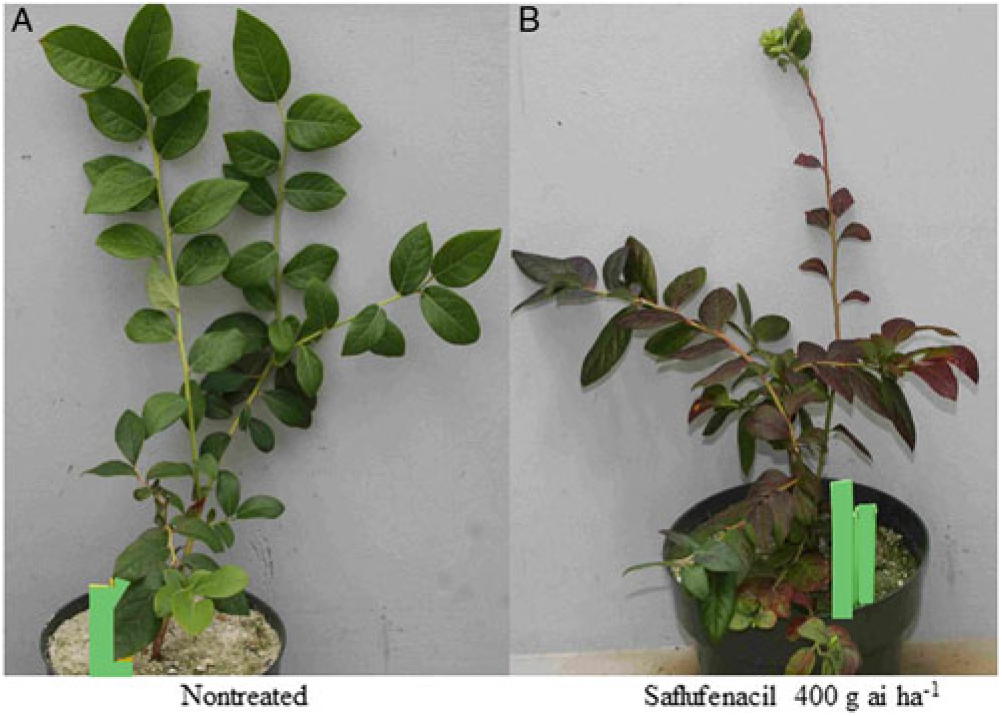
The effect of cultivar was significant for plant dry biomass, with higher biomass for Columbus (rabbiteye blueberry) than all three southern highbush blueberry cultivars (Table 1). The difference in biomass with respect to cultivar might be due to the inherent growth variability among these cultivars, because there were no within-cultivar differences in plant growth in saflufenacil treatments. Although leaf abscission was observed with increasing saflufenacil rate (Figure 2), this did not appear to affect the final biomass. However, leaf number data were not collected in this study and may have provided better information with regard to effect of saflufenacil rates on leaf drop. Also, in hindsight, separating blueberry plants at the crown to get both shoot and root weight might have given more insight into how plants were being affected. Hixson (Reference Hixson2008) reported that soil placement of saflufenacil had a large effect on tolerance of soybean [Glycine max (L.) Merr.], and root growth was reduced at least 68% when seeds were planted in saflufenacil-treated soil (80 g ha−1). However, no visible differences in root growth were observed at harvest in this study, but separate recording of both shoot and root biomass would have served as confirmation of no effect on growth above- and belowground.
Blueberry plants (A) not treated and (B) treated with soil-applied saflufenacil at 400 g ai ha−1 at 28 DAT in the greenhouse at Research Triangle Park, NC.

Field Studies
Nonbearing Blueberry
In 2012 and 2013, no visible injury to blueberry plants was observed where glyphosate or hexazinone was applied alone (unpublished data). Pre-budbreak applications in 2012 caused no injury at 7 and 13 DAT, but minor (≤3%) injury was observed at 27 DAT from treatments that contained saflufenacil (unpublished data). In 2013, injury to blueberry from saflufenacil treatments applied at pre-budbreak was <5% at all evaluation timings (unpublished data). However, injury from saflufenacil treatments applied to actively growing blueberry was ≤11% and 7% in 2012 and 2013, respectively, regardless of evaluation timings (unpublished data).
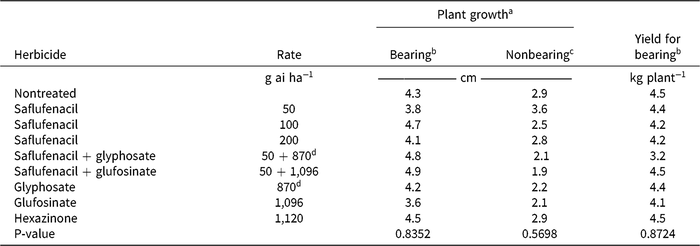
The application timing by treatment interaction was not significant for blueberry plant growth; therefore, data were combined over application timings (Table 2). Further analysis indicated that blueberry plant growth, measured as change in branch length after 14 d (1.9 to 3.6 cm), was not influenced by herbicide treatments.
Effect of herbicide treatments on southern highbush blueberry cultivar Duke plant growth and yield at Burgaw, NC, in 2012 and 2013.

a Blueberry plant growth was measured by flagging three branches (at the time and 2 wk after herbicide application in case of active vegetative growth stage and pre-budbreak treatments, respectively) of a representative plant in each plot and recording the change in length 14 d after flagging.
b Data from bearing plants were combined for 2012 and 2013, because year-by-treatment interaction was not significant (P = 0.3325).
c Plant growth data from both application timings during 2012 were combined, because application timing-by-treatment interaction was not significant (P = 0.5703).
d Glyphosate application rate was 870 g ae ha−1.
Bearing Blueberry
In 2012 and 2013, no visible injury to blueberry plants was observed where glyphosate or hexazinone was applied alone (unpublished data). In 2012, no injury was observed at 13 and 27 DAT, and ≤6% injury was observed at 42 DAT from the treatments that contained saflufenacil. However, in 2013, injury ratings were only recorded at 10 and 17 DAT due to early blueberry harvest, and injury was ≤10% from saflufenacil treatments at these evaluation timings (unpublished data).
The year by treatment interaction was not significant for blueberry plant growth and yield; therefore, data were combined over years (Table 2). Further analysis indicated that herbicide treatments did not reduce blueberry plant growth (3.6 to 4.9 cm) or yield (3.2 to 4.5 kg bush−1).
Overall, these results indicate that blueberry cultivar response to saflufenacil differs, with Columbus (rabbiteye blueberry) displaying the greatest tolerance followed by O’Neal, Legacy, and New Hanover (southern highbush blueberry). Similarly, a cultivar difference to saflufenacil tolerance has been reported in several crops (Correia and Gomes Reference Correia and Gomes2015; Miller et al. Reference Miller, Soltani, Robinson, Kraus and Sikkema2012). Observed differences in this study generally occurred at 200 and 400 g ha−1, which are greater than the registered field rate (50 g ha−1) in fruit and nut tree production systems. However, injury from saflufenacil at 50 and 100 g ha−1 was ≤10% for all cultivars, and no differences in plant growth and plant dry biomass were observed with respect to saflufenacil rate.
Although there is no uniform standard, according to Wu and Boyd (Reference Wu and Boyd2012) commercially acceptable herbicide injury to wild blueberry (Vaccinium angustifolium L.) generally ranges between 15% and 20% depending on the grower and severity of weed infestation. In general, blueberry plants recover from low to moderate levels (<20%) of herbicide damage, and growers are willing to accept this level of damage in cases of severe weed infestation (KM Jennings, personal communication). In both field studies, <11% injury was reported on nonbearing and bearing blueberries regardless of application timing (pre-budbreak or active growth stage) from saflufenacil at 50, 100, and 200 g ha−1. Blueberry plants recovered from this level of injury, and no impact of saflufenacil rate was observed on plant growth and yield. Similarly, Singh et al. (Reference Singh, Malik, Ramirez and Jhala2011) reported no injury from a single or sequential application of saflufenacil at 140 or 280 g ha−1 on citrus (Citrus spp.) at 7, 15, and 30 DAT. No injury was observed when saflufenacil alone or in combination with glyphosate was POST-directed to coffee (Coffea spp.) and citrus (Goncalves et al. Reference Goncalves, Junior, Pereira, Marchi and Martins2016).
It is very likely that herbicide-resistant weeds also infest North Carolina blueberry fields, because they are widespread in other cropping systems throughout the state (Heap Reference Heap2018). Therefore, the addition of saflufenacil will provide diversity with respect to the modes of action of herbicides that can be used to manage weeds in blueberry. Saflufenacil at the expected 1X rate should be considered safe to blueberry in terms of injury, especially when precautions are taken to minimize physical spray drift.
Author ORCID
Sushila Chaudhari https://orcid.org/0000-0002-8794-0825
Acknowledgments
The authors would like to thank the North Carolina Blueberry Council for funding and Cavell Brownie for her support in statistical data analysis. The authors also thank students in the vegetable and fruit weed science group and colleagues at BASF Corporation for providing help in experimental setup/design and data collection. No conflicts of interest have been declared.