Case report
The mucopolysaccharidoses are inherited lysosomal storage disorders caused by the absence of functional enzymes that participate in the degradation of glycosaminoglycans. The progressive systemic deposition of glycosaminoglycans results in multi-organ system dysfunction. Cardiac involvement has been reported in mucopolysaccharidoses syndromes and is a common feature of mucopolysaccharidosis types I, II, and VI.Reference Braunlin, Harmatz and Scarpa 1 Valve pathology is the most prominent and uniform cardiac manifestation of patients with mucopolysaccharidoses.Reference Fesslova, Corti and Sersale 2 Heart rhythm abnormalities including tachycardia, bradycardia, and an irregular heart rhythm have been reported in a total of 13% of patients on the basis of the Hunter Outcome Survey of Mucopolysaccharidosis type II patients.Reference Wraith, Beck, Giugliani, Clarke, Martin and Muenzer 3 However, bradycardia was only present in 2% of patients with a median age of onset of 13.9 years. To date, there have been no reports of early childhood onset of high-grade atrioventricular block in patients with Hunter syndrome (mucopolysaccharidosis type II).
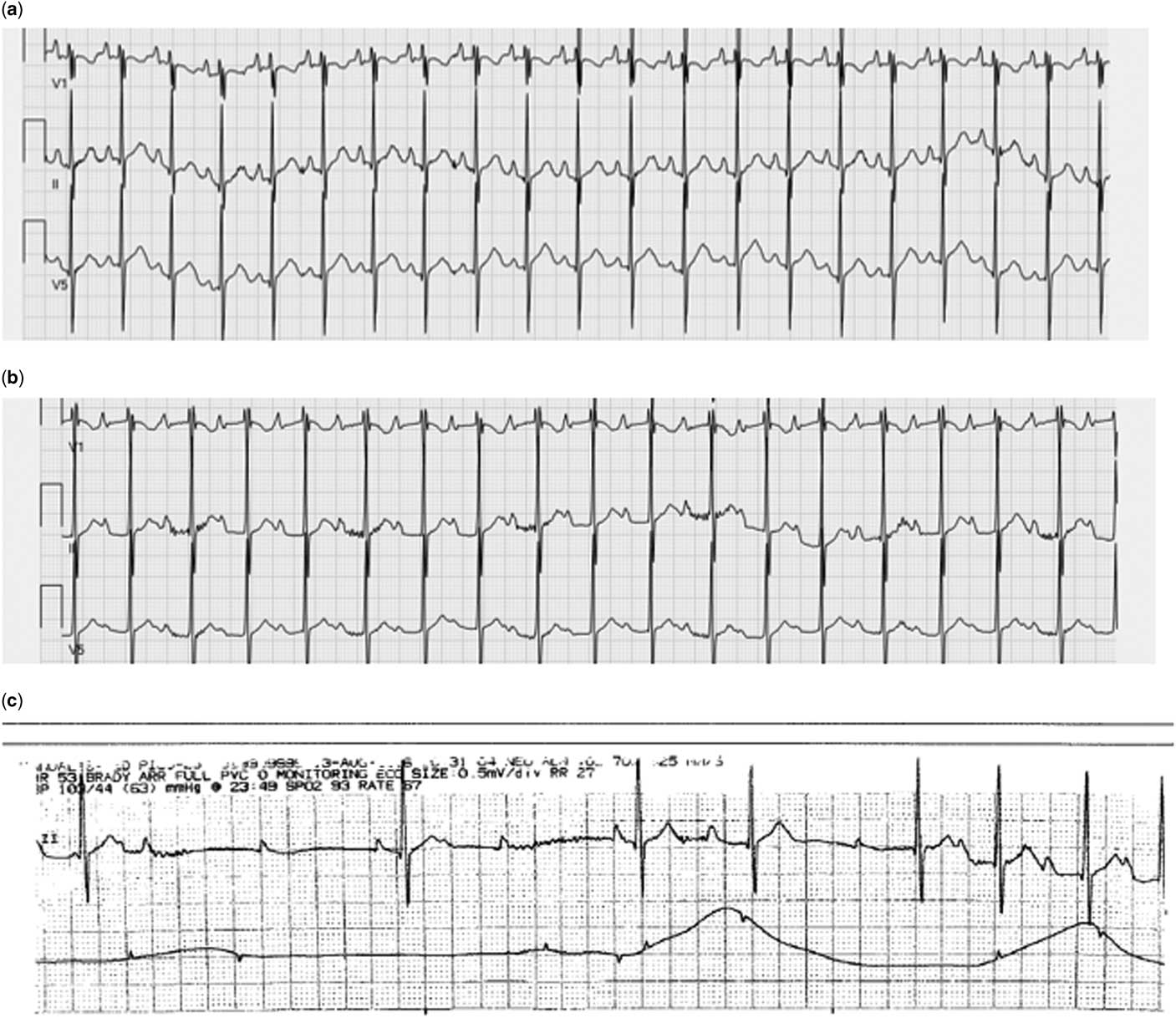
We present a case of a 3-year-old boy with Hunter syndrome and known large atrial septal defect and bicuspid aortic valve who was admitted for respiratory syncytial virus bronchiolitis. His presenting electrocardiogram showed significant first-degree atrioventricular block, a change from his baseline normal electrocardiogram obtained 4 months before his admission demonstrating a normal PR interval with no evidence of heart block. He was followed up by our metabolic genetic team and was on weekly enzyme replacement therapy (Elaprase). He had missed his infusion the 3 weeks before presentation because of viral symptoms and fever. On admission, he was found to have various degrees of atrioventricular block, including first-degree and second-degree Mobitz type II, and high-grade heart block with pauses >3 seconds, intermittent 2:1 block, and periods of a junctional escape rhythm around 35 beats per minute (Fig 1). He was transferred to the paediatric ICU for close monitoring given his severe bradycardia. He was not treated for severe bradycardia as he remained haemodynamically stable with adequate perfusion. After resolution of his respiratory symptoms, he underwent primary surgical closure of his atrial septal defect, and simultaneous placement of a dual-chamber bipolar epicardial pacemaker. Despite the presence of concurrent respiratory syncytial virus illness as a confounder that may have contributed to bradycardia and transient heart block in this case, the patient continues to demonstrate underlying sinus rhythm with first-degree atrioventricular block and remains ventricularly paced around half of the time at his most recent follow-up and pacemaker interrogation 1 year later. This is as a result of physiologic pacemaker programming owing to an underlying native prolonged PR interval up to 260 milliseconds seen at times.
Electrocardiogram/telemetry strips showing; (a) baseline four months prior to presentation with normal sinus rhythm and normal atrioventricular conduction. (b) First degree atrioventricular block at presentation. (c) Variable degrees of atrioventricular block including Mobitz type 1 and high grade atrioventricular block, with concomitant sinus bradycardia.

Discussion
Patients with mucopolysaccharidoses have an 11% incidence of sudden death.Reference Krovetz and Schiebler 4 Some cases may be attributable to cardiac conduction system abnormalities such as progressive atrioventricular block. Histopathologic studies suggest infiltration of storage cells and degenerative changes of the His bundle and bundle branches as possible aetiologies for atrioventricular block.Reference Okada, Rosenthal, Scaravelli and Lev 5 There are no prior published reports of conduction system abnormalities such as high-grade atrioventricular block in young children.
This case highlights the importance of early routine cardiac screening for conduction abnormalities in patients with mucopolysaccharidoses syndromes and close follow-up given the progressive nature and often sudden onset of disease. In cases of high-grade heart block, implantation of a pacemaker should be considered to prevent morbidity and sudden death.
Acknowledgements
None.
Financial Support
The authors have no financial relationships relevant to this article to disclose. No author received an honorarium, grant, or other form of payment to produce the manuscript.
Conflicts of Interest
None.