Introduction
Trematode parasites can cause serious risks to the health of their vertebrate hosts, including humans, and as such, can have negative agricultural and economic impacts (Abe et al., Reference Abe, Guan and Guo2018; Dodangeh et al., Reference Dodangeh, Daryani, Sharif, Gholami, Kialashaki, Moosazadeh and Sarvi2019). The life cycles of parasitic trematodes are usually complex, but a common feature is that various freshwater snails can act as the first and/or the second intermediate hosts (Keiser & Utzinger, Reference Keiser and Utzinger2009). In Thailand, trematode larval stages have been reported parasitizing snails like Filopaludina spp., Bithynia spp., Melanoides tuberculata, Tarebia granifera, Thiara scabra and Anentome sp. (Chantima et al., Reference Chantima, Chai and Wongsawad2013, Reference Chantima, Suk-Ueng and Kampan2018; Chontananarth & Wongsawad, Reference Chontananarth and Wongsawad2013; Chomchoei et al., Reference Chomchoei, Wongsawad and Nantarat2018).
The freshwater assassin snail (genus Anentome Cossmann, 1901) belongs to the family Nassariidae (Galindo et al., Reference Galindo, Puillandre and Utge2016; Strong et al., Reference Strong, Galindo and Kantor2017) and occurs in lower river reaches, lakes and ponds in southern China and throughout Southeast Asia, including Thailand. They are non-selective predators and scavengers of a wide variety of gastropods (Bogan & Hanneman, Reference Bogan and Hanneman2013; Strong et al., Reference Strong, Galindo and Kantor2017). Recently, Anentome sp., in particular Anentome helena (von dem Busch, 1847), has become a popular ornamental pet to control herbivorous snails in aquaria (Ng et al., Reference Ng, Tan, Wong, Meier, Chan, Tan and Yao2016). Yet, Anentome sp. is also an intermediate host of several trematode parasites (Chantima et al., Reference Chantima, Chai and Wongsawad2013; Chomchoei et al., Reference Chomchoei, Wongsawad and Nantarat2018), and in Thailand, it acts as intermediate host of the families Brachylaimidae (Brachylaima virginianum), Cyathocotylidae (Mesostephanus appendiculatoides), Echinostomatidae (Echinostoma revolutum), Lissorchiidae (Apatemon gracilis) and Opecoelidae (Allopodocotyle lepomis) (Krailas et al., Reference Krailas, Chotesaengsri, Dechruksa, Namchote, Chuanprasit, Veeravechsukij, Boonmekam and Koonchornboon2012; Chantima et al., Reference Chantima, Chai and Wongsawad2013, Reference Chantima, Suk-Ueng and Kampan2018; Yutemsuk et al., Reference Yutemsuk, Krailas, Anancharoenkit, Phanpeng and Dechruksa2017; Chomchoei et al., Reference Chomchoei, Wongsawad and Nantarat2018; Wiroonpan et al., Reference Wiroonpan, Chontananarth and Purivirojkul2020). Moreover, the families Brachylaimidae, Cyathocotylidae and Echinostomatidae include zoonotic trematodes that cause various clinical infections in humans (Chai & Jung, Reference Chai and Jung2019; Wiroonpan et al., Reference Wiroonpan, Chontananarth and Purivirojkul2020). Given that Anentome sp. is widespread in Thailand and is exported all over the world via the aquarium trade, it is necessary to assess its importance as a reservoir and vector for these parasitic trematodes.
The morphological identification of larval trematodes is difficult due to their small size, the limited number of taxonomically useful morphological characters and the intraspecific variability, but at the same time interspecific or even intergeneric homogeneity of these characters (Choudhary et al., Reference Choudhary, Ray, Pandey and Agrawal2019). Therefore, the morphological identification of larval trematodes should be corroborated by DNA sequence data, since these are capable of identifying trematodes in any stage of their life cycle (Choudhary et al., Reference Choudhary, Ray, Pandey and Agrawal2019). In this context, the nuclear ribosomal internal transcribed spacer 2 (ITS2) and the mitochondrial cytochrome c oxidase subunit 1 (COI) genes are popular and informative markers for the identification and taxonomic interpretation of larval trematodes (Barnett et al., Reference Barnett, Miller and Cribb2014; Anucherngchai et al., Reference Anucherngchai, Tejangkura and Chontananarth2016; Dunghungzin & Chontananarth, Reference Dunghungzin and Chontananarth2020), particularly if they are used in combination with species delimitation methods (Pérez-Ponce De León et al., Reference Pérez-Ponce De León, Garciá-Varela, Pinacho-Pinacho, Sereno-Uribe and Poulin2016; Gordy & Hanington, Reference Gordy and Hanington2019).
Against this background, this study aims to investigate the diversity and prevalence of trematode larvae in two species of the assassin snail genus Anentome in Thailand based on morphological and DNA sequence data.
Materials and methods
Freshwater snails sampling and identification
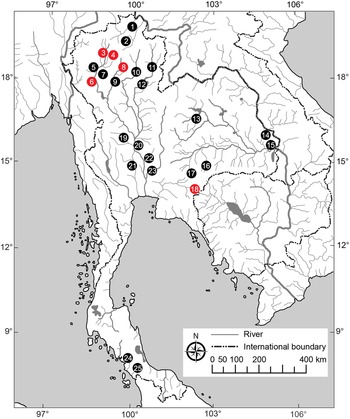
Anentome samples were collected throughout Thailand (table 1 and fig. 1) from January 2017 to February 2021 using the count per minute method (Chomchoei et al., Reference Chomchoei, Wongsawad and Nantarat2018). Specimens were obtained from streams, rivers, irrigation canals, weirs and ponds. The snails were identified based on shell morphology and by comparison with their original descriptions (Brandt, Reference Brandt1974).
Sampling localities of Anentome sp. in Thailand. Trematode-infected localities are marked in red and uninfected localities are marked in black.

List of localities and Anentome species examined and infected with trematode larvae in Thailand.

Larval trematode identification
Larval trematode infections were investigated using crushing methods (Caron et al., Reference Caron, Rondelaud and Losson2008) under a stereomicroscope Olympus SZ40. The cercarial and metacercarial cysts were morphologically observed, excysted under a stereomicroscope and photographed with a microscope camera Optikam Pro 3LT-4083.11LT under a compound microscope Olympus CX31. The specimens were fixed with 4% formalin, stained with haematoxylin, dehydrated using an ethanol gradient, cleared with xylene and mounted in Permount. The permanent slides of specimens were measured in μm using an eyepiece micrometre under a compound microscope. The cercariae and metacercariae were then classified according to morphological characteristics described by Frandsen & Christensen (Reference Frandsen and Christensen1984), Kanev et al. (Reference Kanev, Fried and Radev2009) and Schell (Reference Schell1970). Next, individual cercariae and metacercariae were stored in 95% ethanol until use for DNA sequencing. Four parameters were estimated: (1) prevalence of the parasite species (percentage of individual host snails infected by parasite species); (2) mean intensity of the metacercariae infection (the mean number of metacercariae per individual infected host snail); (3) mean abundance of the metacercariae infection (the mean number of metacercariae per individual host snail); and (4) population prevalence (percentage of populations infected per host species). The population prevalence between host species populations was compared by a t-test (p < 0.05) using IBM SPSS Statistics version 20.0 (IBM Corp, 2013).
DNA extraction, polymerase chain reaction (PCR) amplification and sequencing
Genomic DNA was extracted from individual cercariae or metacercariae using 150 μl of Chelex® 100 and 3 μl of Proteinase K. Samples were incubated at 55°C for 1 h and 95°C for 30 min, then centrifugated at 13000 rpm. DNA extracts were stored at −20°C until use. ITS2 and COI were amplified using the following primers: ITS3 (5′-GCATCGATGAAGAACGCAGC-3′) and ITS4 (5′-TCCTCCGCTTATTGATATGC-3′) for ITS2 (Barber et al., Reference Barber, Mkoji and Loker2000) and JB3 (5′-TTTTTTGGGCATCCTGAGGTTTAT-3′) and JB4.5 (5′-TAAAGAAAGAACATAATGAAAATG-3′) for COI (Bowles et al., Reference Bowles, Blair and McManus1992). PCR reaction mixtures contained 0.3 μL of Taq DNA polymerase, 0.7 μl of 50 mm magnesium chloride, 1 μl of each primer, 2 μl of 10X ViBuffer A, 0.4 μl of Deoxynucleoside triphosphates (dNTPs) and 1 μl of the DNA template. Thermal cycling conditions were as follows: 94°C for 2 min, followed by 35 cycles of 94°C for 1 min, 48°C for 30 s, 72°C for 45 s and a final extension step of 72 C for 7 min for ITS2 and 95°C for 3 min, followed by 40 cycles of 95°C for 1 min, 50°C for 1 min, 72°C for 1 min and a final extension step of 72°C for 7 min for COI. The amplified products were checked with 1% (w/v) agarose gel electrophoresis using 1x TBE buffer (Tris-Borate-EDTA). Gels were run at 100 V for 20 min and visualized with RedSafe® nucleic acid staining solution and ultraviolet transillumination. PCR products were purified and sequenced using the BigDye® Terminator v3.1 cycle sequencing kit chemistry and 1st BASE DNA Sequencing Services (Applied Biosystems, Selangor, Malaysia).
Phylogenetic analysis
DNA sequences were edited and aligned with ClustalW (Thompson et al., Reference Thompson, Higgins and Gibson1994) in MEGA version 7 (Kumar et al., Reference Kumar, Stecher and Tamura2016). COI sequences were checked for stop codons and frameshift mutations. All sequences have been deposited in GenBank (see supplementary table S1). Phylogenetic trees were inferred using neighbour joining (NJ), maximum likelihood (ML) and Bayesian inference (BI). The genus Schistosoma was used as outgroup. The best-fit evolutionary substitution models based on the Akaike Information Criterion (Akaike, Reference Akaike1974) implemented in jModelTest version 0.1.1 (Darriba et al., Reference Darriba, Taboada, Doallo and Posada2012) were applied: GTR + I + G for both COI and ITS2, and HKY + G for concatenated datasets. NJ (Saitou & Nei, Reference Saitou and Nei1987) trees were constructed using PAUP* version 4.0 (Swofford, Reference Swofford2003) with 1000 bootstrap replicates. ML (Sullivan, Reference Sullivan2005) trees were constructed using PhyML version 3 (Guindon et al., Reference Guindon, Delsuc, Dufayard and Gascuel2009) with 1000 bootstrap replicates. Bootstrap values higher than 70% were considered as providing strong support (Hillis & Bull, Reference Hillis and Bull1993). Bayesian inference was performed using MrBayes version 3.1.2 (Ronquist et al., Reference Ronquist, Teslenko and van der Mark2012). The Markov Chain Monte Carlo (MCMC) search was run with four chains for 10,000,000 generations, with the heating parameter set at 0.07, tree sampling every 100 generations and burn-in set at 25%. Posterior probabilities were considered significant when ≥0.95 (San Mauro & Agorreta, Reference San Mauro and Agorreta2010). Tree topologies were drawn with FigTree version 1.4.3 (Rambaut, Reference Rambaut2010). Genetic distances between species were examined using Kimura 2-parameter (K2P) (Srivathsan & Meier, Reference Srivathsan and Meier2012) distances calculated in MEGA version 7 (Kumar et al., Reference Kumar, Stecher and Tamura2016).
Species delimitation
Species delimitation methods were applied to the COI data using the (1) assemble species by automatic partitioning (ASAP) (Puillandre et al., Reference Puillandre, Brouillet and Achaz2021), (2) generalized mixed Yule-coalescent (GMYC) (Fujisawa & Barraclough, Reference Fujisawa and Barraclough2013) and (3) Bayesian Poisson tree processes (bPTP) (Zhang et al., Reference Zhang, Kapli, Pavlidis and Stamatakis2013) methods.
ASAP was run on the web server (https://bioinfo.mnhn.fr/abi/public/asap/) with the default settings. The input tree for GMYC and bPTP was produced using the relaxed log-normal clock algorithm implemented in the BEAST version 1.8.2 package (Suchard et al., Reference Suchard, Lemey, Baele, Ayres, Drummond and Rambaut2018). The GTR + I+G model was applied to reconstruct the tree for 1 × 10⁷ generations with sampling every 1000 steps. The MCMC output was examined in Tracer version 1.645 (Rambaut et al., Reference Rambaut, Drummond, Xie, Baele and Suchard2018) and analysed with TreeAnnotator version 1.7.4. The tree file was displayed in FigTree version 1.4.3 (Rambaut, Reference Rambaut2010). GMYC was performed using both a single and a multiple threshold and run on the web server (https://species.h-its.org/gmyc/). bPTP was carried out on the bPTP web server (https://species.h-its.org/ptp/).
Results
Larval trematode infections in Anentome spp.
In total, 1107 specimens of Anentome sp. were identified from 25 localities (table 1 and fig. 1), involving two species: A. helena (n = 822) and A. wykoffi (n = 285). Sixty-two individuals of A. helena (n = 33) and A. wykoffi (n = 29) were infected by parasites. The overall prevalence was 5.6% (62/1107; table 1), and the infected specimens came from five localities (seen fig. 1): A. helena from four localities, the districts of Mae Rim (no. 3), San Kamphaeng (no. 4), Chom Thong (no. 6) and Meuang Pan (no. 8); and A. wykoffi from one locality – Aranyaprathet district (no. 18).
There were three types of larval trematodes infecting A. helena and A. wykoffi, including zoogonid cercariae, heterophyid metacercariae and echinostome metacercariae. The highest prevalence was found for echinostome metacercariae in A. wykoffi with 10.2% prevalence (29/285; table 2). The population prevalences were as follows: A. helena = 21.1% (4/19) and A. wykoffi = 16.7% (1/6) (table 3).
Overview of larval trematode infections in Anentome sp. from Thailand.

Population prevalence of larval trematode infections in Anentome sp. from Thailand.

* Significant difference at p < 0.05.
Larval trematode morphology
Zoogonid cercariae (number of larvae = 11)
Host. Anentome Helena.
Localities. Mae Rim district, Chiang Mai province (18°53′35.0″N, 98°57′39.3″E) (no. 3; fig. 1).
GenBank accession numbers. MZ822059 and MZ822060 for COI, and MZ825155 and MZ825156 for ITS2.
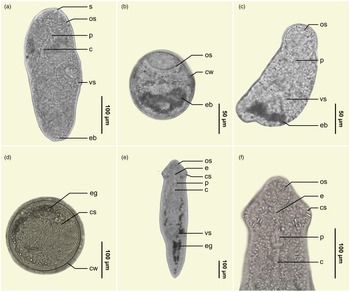
Description. Body, no tail, fusiform, mean length 322.0 μm (range: 240.0–392.5 μm) and mean width 140.2 μm (range: 107.5–197.5 μm), with widest point immediately anterior to ventral sucker. Oral sucker, with stylet, ventrally subterminal, mean length 40.9 μm (range: 22.5–55.0 μm) and mean width 35.5 μm (range: 20–57.5 μm). Ventral sucker, near the middle of part of the body, mean length 50.5 μm (range: 27.5–75.0 μm) and mean width 42.7 μm (range: 20.0–72.5 μm). Pharynx, mean length 9.5 μm (range: 7.5–10.0 μm) and mean width 7.0 μm (range: 5.0–7.5 μm). Excretory bladder, oval, mean length 32.6 μm (range: 29.0–37.0 μm) and mean width 26.4 μm (range: 23.4–30.1 μm). Penetration glands, numerous (fig. 2a).
Light microscopic photographs of trematode cercariae and metacercariae infecting Anentome sp. in Thailand: (a) zoogonid cercariae; (b) heterophyid metacercarial cyst; (c) excysted heterophyid metacercaria; (d) echinostome metacercarial cyst; (e, f) excysted echinostome metacercaria. Abbreviations: c, caecum; cs, collar spine; cw, cyst wall; e, oesophagus; eb, excretory bladder; eg, excretory granule; os, oral sucker; p, pharynx; s, stylet and vs, ventral sucker.

Heterophyid metacercariae (number of larvae = 3)
Host. Anentome helena.
Localities. Mae Rim district, Chiang Mai province (18°53′35.0″N, 98°57′39.3″E) (no. 3; fig. 1) and Meuang Pan district, Lampang province (18°32′04.0″N, 99°28′26.8″E) (no. 8; fig. 1).
GenBank accession numbers. MZ822061 and MZ822062 for COI, and MZ825157 and MZ825158 for ITS2.
Description. The metacercarial cyst, almost spherical, mean diameter 110.99 μm (range: 109.6–112.8 μm), with a thick outer wall of about 8 μm (fig. 2b). The excysted metacercaria, elongated, oval, mean length 197.7 μm (range: 184.5–222.5 μm) and mean width 92.5 μm (range: 76.1–105.6 μm). Body, with fine spines. Oral sucker, globular or oval, ventrally subterminal, mean length 50.2 μm (range: 45.1–57.7 μm) and mean width 50.2 μm (range: 45.1–53.5 μm). Ventral sucker, globular or oval, mean length 35.2 μm (range: 32.4–39.4 μm) and mean width 35.7 μm (range: 33.8–38.0 μm). Pharynx, spherical, mean length 23.9 μm (range: 21.1–25.4 μm) and mean width 22.1 μm (range: 21.1–22.5 μm). Excretory bladder, c-shaped, rather small (fig. 2c).
Echinostome metacercariae (number of larvae = 9)
Host. Anentome helena and A. wykoffi.
Localities. For A. helena, the districts San Kamphaeng (18°46′02.8″N, 99°07′06.3″E) (no. 4; fig. 1) and Chom Thong (18°16′36.2″N, 98°38′38.2″E) (no. 6; fig. 1) in Chiang Mai province, and for A. wykoffi, Aranyaprathet district, Sa Kaeo province (13°40′05.6″N, 102°31′24.8″E) (no. 18; fig. 1).
GenBank accession numbers. MZ822063, MZ822064, MZ822065 and MZ822066 for COI, and MZ825159, MZ825160, MZ825161 and MZ825162 for ITS2.
Description. The metacercarial cyst, with collar spines, almost spherical, mean diameter 208.9 μm (range: 189.4–227.7 μm), with a thick outer wall of about 10 μm. Excretory granules, large, round in two descending canals of the main excretory bladder (fig. 2d). The excysted metacercariae, elongated and oval, mean length 600.0 μm (range: 584.6–623.1 μm) and mean width 151.9 μm (range: 146.2–161.5 μm). Oral sucker, ventrally subterminal, with a prominent head crown, mean length 61.2 μm (range: 59.6–63.8 μm) and mean width 54.3 μm (range: 51.1–61.7 μm). Collar spines, 37 in total, clearly visible around the head collar, with five corner spines on each side and 27 ventral, lateral, and dorsal spines, in two alternating rows. Ventral sucker, near the equatorial line of the body, mean length 84.1 μm (range: 82.6–84.6 μm) and mean width 75.0 μm (range: 73.1–76.9 μm). Pharynx, mean length 32.7 μm (range: 30.8–38.5 μm) and mean width 32.7 μm (range: 30.8–38.5 μm). The metacercariae, mainly in the stomach of the snails (fig. 2e, f). No morphological differences were observed between the echinostome metacercariae of the different populations.
Phylogenetic analyses
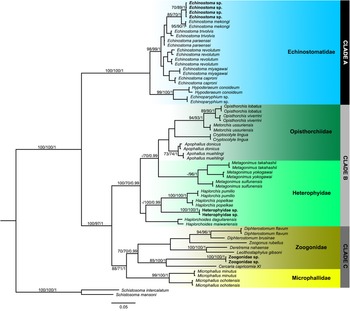
Nucleotide sequences of the COI (387 bp), ITS2 (715 bp) and the concatenated dataset of the two DNA fragments (1102 bp) were aligned, along with Schistosoma mansoni and Schistosoma intercalatum as outgroups. The numbers of variable/parsimony-informative characters were: 196/186 (COI), 377/328 (ITS2) and 573/514 (concatenated dataset). The phylogenetic trees obtained by applying NJ, ML and BI to the concatenated dataset showed three well-supported clades (fig. 3) coinciding with five trematode families: Echinostomatidae (clade A), Heterophyidae and Opisthorchiidae (clade B), and Zoogonidae and Microphallidae (clade C), with clades B and C jointly forming a clade with strong supports. The trees based on the concatenated datasets will be used for further discussion. Not unexpectedly, the trees based on the separate analyses of COI and ITS2 (see supplementary figs S1 and S2) were somewhat less well resolved, but were still largely congruent or did not significantly contradict the concatenated analyses.
The BI tree obtained from DNA sequence analysis of the concatenated dataset of ITS2 and COI (1102 bp). Numbers at the branches are NJ bootstrap (BP)/ML bootstrap (BP)/BI posterior probability (PP) values, respectively. Values of BP < 0.95 and PP < 70 are not shown. New sequences from this study are highlighted in bold. Scale bar refers to a phylogenetic distance of nucleotide substitutions per site.

Clade A included sequences of the genera Echinostoma, Echinoparyphium and Hypoderaeum from the family Echinostomatidae that were joined with maximum supports. Within clade A, the sequences of the echinostome metacercariae from Thai A. helena and A. wykoffi were joined in a well-supported clade with sequences of Echinostoma mekongi. The mean K2P distance between echinostome species was 12.61% (3.02–23.93%) for COI and 5.92% (1.53–13.59%) for ITS2.
Clade B consisted of the families Heterophyidae and Opisthorchiidae. The heterophyid metacercariae from Thai A. helena were joined and nested in this clade with strong supports. The mean K2P distance between heterophyid species was 23.37% (14.92–31.39%) for COI, and 13.65% (2.00–19.66%) for ITS2. However, the family Heterophyidae appeared to be paraphyletic with respect to the Opisthorchiidae.
Clade C consisted of the families Zoogonidae and Microphallidae. The zoogonid cercariae from Thai A. helena were nested in this clade as a sister group of Cercaria capricornia XI with good support. The mean K2P distance between zoogonid species was around 12.04% for COI and 24.82% (9.87–37.69%) for ITS2.
The mean K2P COI divergence between Cambodian E. mekongi and Thai Echinostoma sp. was 3.02%, whereas the mean K2P COI divergences within Thai Echinostoma sp. or within Cambodian E. mekongi were 0.01% and 0.54%, respectively. Moreover, the mean K2P COI divergences within Echinostoma caproni and within Echinostoma trivolvis were 1.64% and 1.63%, respectively (table 4). The mean K2P COI divergences between Thai Echinostoma sp. or Cambodian E. mekongi and the most closely related Echinostoma species in the tree of fig. 3 (E. trivolvis) were 7.65% and 8.23%, respectively.
Mean COI divergences (K2P model: % ± standard error) among the Echinostomatidae taxa included in the phylogenetic tree of fig. 3. Average intraspecific distances within each taxon are shown in bold.

Species delimitation
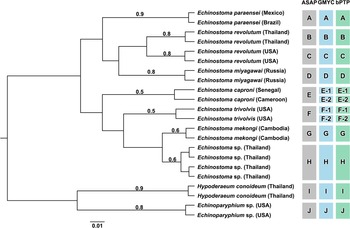
The three species delimitation methods (ASAP, GMYC and bPTP) confirmed the classical species boundaries in the Echinostomatidae included in fig. 3. Yet, they also separated Cambodian E. mekongi and Thai Echinostoma sp. into two putative species, while GMYC and bPTP split E. caproni and E. trivolvis each into two putative species (fig. 4).
Species delimitation analyses of Echinostoma spp. based on COI using ASAP, GMYC and bPTP. Putative species are indicated in the columns on the right. Numbers at the branches are the highest Bayesian support values.

Discussion
This is the first nationwide study of the diversity and prevalence of larval trematodes in the assassin snail genus Anentome in Thailand. It shows that in Thailand, A. helena is a first intermediate host for zoogonid cercariae and a second intermediate host for heterophyid metacercariae and echinostome metacercariae, while A. wykoffi is a second intermediate host for echinostome metacercariae. For A. helena, this was already reported in previous studies (Krailas et al., Reference Krailas, Chotesaengsri, Dechruksa, Namchote, Chuanprasit, Veeravechsukij, Boonmekam and Koonchornboon2012; Chantima et al., Reference Chantima, Chai and Wongsawad2013, Reference Chantima, Suk-Ueng and Kampan2018; Yutemsuk et al., Reference Yutemsuk, Krailas, Anancharoenkit, Phanpeng and Dechruksa2017; Chomchoei et al., Reference Chomchoei, Wongsawad and Nantarat2018; Wiroonpan et al., Reference Wiroonpan, Chontananarth and Purivirojkul2020); however, it is the first record of an infection of A. wykoffi by larval trematodes. Although A. wykoffi showed the highest prevalence within a single population (22.3%, compared to the maximum of 16.3% in an A. helena population), the population prevalence in A. wykoffi (1/6 = 16.7%) was somewhat significantly lower than that of A. helena (4/19 = 21.1%), demonstrating again that prevalence is highly variable. Yet, there was no obvious geographic patterning in the prevalence. This is not surprising since the local prevalence of larval trematodes may depend on a plethora of factors, such as the abundance and diversity of the intermediate snail hosts, the presence of definitive hosts, water levels, season, water temperature, pH, salinity, habitat complexity, surrounding land use, etc. (Thaenkham et al., Reference Thaenkham, Phuphisut and Nuamtanong2017; Butboonchoo et al., Reference Butboonchoo, Wongsawad, Wongsawad and Chai2020).
Zoogonid cercariae and heterophyid metacercariae were only detected in A. helena. This may relate to their strict intermediate host specificity and the ecology of their definitive hosts (e.g. feeding habits, abundance, habitat or environmental factors). As such, zoogonid cercariae and heterophyid metacercariae seem to show a strict specificity to nassariid hosts (Barnett & Miller, Reference Barnett and Miller2018; Gilardoni et al., Reference Gilardoni, Etchegoin, Cribb, Pina, Rodrigues, Diez and Cremonte2020), which may be linked to the hosts’ physiological and behavioural resistance strategies with respect to controlling parasite growth, recovery from infection and tolerance against infection (Moore, Reference Moore2002).
The zoogonid cercariae observed in this study are morphologically similar to C. capricornia XI (Barnett et al., Reference Barnett, Miller and Cribb2014), but differ from this species by their morphometrics and by having a stylet, which C. capricornia XI lacks (Barnett et al., Reference Barnett, Miller and Cribb2014). Still, both the morphology and phylogenetic position of these cercaraeium cercarcariae tentatively suggest that they belong to the family Zoogonidae. This family includes intestinal trematodes of teleosts and elasmobranchs (Wardle, Reference Wardle1993; Barnett et al., Reference Barnett, Miller and Cribb2014; Gilardoni et al., Reference Gilardoni, Etchegoin, Cribb, Pina, Rodrigues, Diez and Cremonte2020), with gastropod species from the families Buccinidae, Columbellidae, Fasciolariidae, Nassariidae and Naticidae as first intermediate hosts (Barnett et al., Reference Barnett, Miller and Cribb2014; Gilardoni et al., Reference Gilardoni, Etchegoin, Cribb, Pina, Rodrigues, Diez and Cremonte2020). All of these gastropods are marine, except for the freshwater nassariid genera Anentome and Clea (Strong et al., Reference Strong, Galindo and Kantor2017). As such, this study is the first report of zoogonid parasites infecting freshwater nassariids of the genus Anentome.
The heterophyid metacercariae found in this study are morphologically similar to heterophyid metacercariae with a c-shaped and rather small excretory bladder (Scholz et al., Reference Scholz, Ditrich and Giboda1991). The DNA data nested them with strong support within a heterophyid clade comprising several genera. Moreover, the mean K2P distance between heterophyid species was 23.37% (14.92–31.39%) for COI and 13.65% (2.00–19.66%) for ITS2. Similar COI distances are indicative of species-level differentiation in other heterophyids, such as in the genus Stellantchasmus (Wongsawad et al., Reference Wongsawad, Nantarat, Wongsawad, Butboonchoo and Chai2019), so both the morphological and DNA evidence suggest that the heterophyid metacercariae in this study indeed belong to Heterophyidae. Still, this tentative conclusion needs further corroboration since heterophyid metacercariae are usually found encysted in fish (Waikagul & Thaenkham, Reference Waikagul, Thaenkham, Waikagul and Thaenkham2014) and the family Heterophyidae appeared paraphyletic with respect to the Opisthorchiidae; however, if the assignment of Heterophyidae is correct, then this is the first report of heterophyid metacercariae infecting the snail A. helena.
The echinostome metacercariae in this study have 37 collar spines and belong to the ‘Echinostoma revolutum group’, which comprises at least 16 valid and ten tentatively valid species worldwide (Chai et al., Reference Chai, Cho, Chang, Jung and Sohn2020). Based on the phylogenetic tree (fig. 3), the Thai echinostome metacercariae are well separated from E. mekongi in Cambodia by a mean K2P distance for COI of 3.02% (table 4), whereas the mean K2P divergence among E. mekongi haplotypes of COI was 0.54%. Given this pattern of divergence, it may be no surprise that ASAP, GMYC and bPTP supported a tentative species-level distinction between the Thai and Cambodian echinostome metacercariae (fig. 4); however, further research is needed to assess whether this tentative species-level differentiation is corroborated by the adult morphology of the parasites or whether it reflects geographical variation and population structuring.
A similar situation is observed in E. caproni, E. trivolvis and E. revolutum (fig. 4), where GMYC and bPTP supported species-level divergences within each of these three species, while ASAP further underpinned this suggestion within E. revolutum. In these cases, further research is needed to determine if geographic separation and host–parasite specificity limit gene flow between the trematode populations (Brunner & Eizaguirre, Reference Brunner and Eizaguirre2016; Wongsawad et al., Reference Wongsawad, Nantarat and Wongsawad2017) to the extent that they might represent different species. Hence, the current data suggest that the taxonomy of genus Echinostoma in Asia needs to be revised.
In conclusion, based on morphological and DNA sequence data, we found cercaraeium cercariae, heterophyid metacercariae and echinostome metacercariae in two species of assassin snails (genus Anentome). As such, this is the first report of (1) A. wykoffi being infected by larval trematodes, (2) putative zoogonid cercariae in A. helena and (3) putative heterophyid metacercariae in A. helena. We also provide evidence of tentative species-level differentiation between Thai Echinostoma sp. and Cambodian E. mekongi, as well as within E. caproni, E. trivolvis and E. revolutum.
Supplementary material
To view supplementary material for this article, please visit http://dx.doi.org/10.1017/S0022149X22000463
Acknowledgements
This research work was partially supported by Chiang Mai University. We are grateful for the financial support that we received from the Human Resource Development in Science Project (Science Achievement Scholarship of Thailand, SAST). We are indebted to the Applied Parasitology Research Laboratory for allowing us to use their lab infrastructure.
Financial support
This work was supported financially by the Human Resource Development in Science Project (Science Achievement Scholarship of Thailand, SAST).
Conflicts of interest
None.
Ethical standards
All experimental hosts were managed according to the guidelines approved by the Institute of Animals for Scientific Purpose Development (IAD), National Research Council of Thailand (permit number U1-07724-2561, issued to Nithinan Chomchoei). This study complied with all the relevant national regulations and institutional policies for the humane care and use of animals.