


1. Introduction
Cross-pollination between theorizing in biological and social sciences has a long and fruitful history, most of which explores connections between rational choice and evolutionary theory. The usual focus is how evolutionary concepts and principles illuminate models of the economic world and vice versa. Evolutionary economics exemplifies the former; evolutionary game theory, the latter. Recent philosophical work targets the same confluences: evolutionary origins of the social contract (Skyrms Reference Skyrms1996), risk aversion, and analogies between fitness and utility (Okasha Reference Okasha2011), among others. Evolution, however, is but part of biology; ecology is another. And an ecological perspective is as indispensable to evolutionary theorizing as evolution is to ecology. Fruitful cross-fertilizations of social-scientific and ecological theorizing should therefore be expected, but these surprisingly remain almost entirely unexplored.
Connections between methodological individualism (MI) and individual-based modeling are part of that untold story. In the social sciences MI constitutes a constraint on how social phenomena should be conceptualized and represented. It means different things to different thinkers, but privileging individuals in explanations, representations, and theories of higher-level phenomena is a common denominator (Heath Reference Heath and Zalta2010). In ecology, MI finds clear expression in a new modeling strategy: individual-based modeling (see Grimm and Railsback Reference Grimm and Railsback2005). Just as expected utility calculations and actions of individual agents constitute the preferred level of analysis according to MI in social sciences, behaviors and physiologies of individual organisms function similarly for individual-based ecological models (IBMs). Describing and defending this analogy is this paper’s first task. Evaluating how much light it sheds is the second. Debates about MI in the social sciences reveal important insights about how individual-based ecological modeling should be understood. For example, when properly construed, MI need not commit to population- or community-level properties ontologically reducing to individual-level properties, or any metaphysical view about what marks the “real.” MI does require explanatory and representational priority on individuals, and the rationale underlying this requirement buttresses the role of IBMs in ecological theorizing.
Section 2 describes significant differences between classical and individual-based ecological modeling. Section 3 considers confusions about what MI involves and the particular way MI aligns with reductionism. Sections 4 and 5 clarify how a representational priority on individuals yields a cogent albeit deflationary account of ecological emergence and can underpin the unification of disparate models and theories in ecology.
2. Classical versus Individual-Based Ecological Modeling
Almost every introduction to ecological modeling begins with the canonical Lotka-Volterra one-predator, one-prey community model:


where V and P designate prey and predator abundances, respectively. Besides the pedagogical virtues of starting simple before tackling more sophisticated representations, equation (1) exemplifies standard modeling strategy in ecology. Basic units are biological populations, and ecological processes such as predation and competition are typically represented with differential or difference equations at the population level. When available, information about properties of individual organisms is statistically aggregated into population-level state variables representing birth, death, capture rates, and so on. More often than not it is unavailable, in which case state variables simply abstract away from individual-level details.
The approach has several advantages. It situates ecological modeling in a mathematically precise, rigorous, and well-developed analytic framework that has proved fruitful in many sciences: dynamic systems theory. Theorems and derivational techniques within this framework constitute powerful tools for analyzing systems in other domains—classical and fluid mechanics, chemical kinetics, and many more—and are thought to do the same for ecology (see Justus Reference Plutynski2008b). Second, abstracting from the individual level not only accommodates the relative paucity of available ecological data on individual organisms and their interrelations; it better facilitates general theorizing about population and community dynamics. Rather than become mired in sundry details about individuals, focusing on state variables seems to offer the best prospects for uncovering generalizations that hold across different configurations of individuals into populations and communities. Without the abstraction, it seems unlikely that highly regarded fruits of ecological theorizing such as the competitive exclusion principle or island biogeography theory would have been found.
Classical ecological models are typically highly idealized and unrealistic. For example, prey only die by predators consuming them and predators only increase by converting prey into births in equation (1). More sophisticated models better avoid such conspicuously unrealistic assumptions, but ignoring individuals means sacrificing maximal realism. This need not detract from the insights the models provide. Besides the tractability simplifying assumptions afford, they also help make representations of complex systems cognitively evaluable, especially in ecology (Odenbaugh Reference Odenbaugh2005). Aggregating or abstracting from individual-level details also seems reasonable since organisms of a single species share most properties in virtue of that fact. It is increasingly being appreciated, however, that classical models overlook two significant drivers of ecosystem dynamics: variability between organisms, even of the same age and species, and locality of interactions, both spatially and temporally. Classical models are blind to these features; IBMs are not. This significant advantage was recognized early by supporters of IBMs: “The assumption that all individuals are equally affected by increasing population density disagrees with empirical evidence . . . and leads theoretical population biology into a blind alley” (Łomnicki Reference Łomnicki1978, 473).
Organisms rather than populations are the basic units of IBMs, and organismal behavior, development, reproduction, and interactions are represented explicitly at the level at which they occur. A set of variables represents each individual, and a set of equations represents relations between them and abiotic factors such as precipitation, temperature, and soil acidity. These variables and equations are intended to reflect the detailed physiologies and spatially specific interactions usually absent from classical models and, crucially, their variance across individuals. Biologically, organisms of a species are not created equal, and IBMs capture this important fact. And with spatial and temporal dynamics explicitly represented, the effects, for instance, of neighborhood relations and the locality of environmental gradients on overall ecosystem dynamics—these individuals of those species are adjacent to this individual, that region is sunny and dry while this one is shaded and moist, and so on—can thereby be investigated. Admittedly, this attention to detail has a cost. IBMs contain hundreds, sometimes thousands, of variables and equations linking them and are therefore analytically intractable, only solvable by simulation.
Despite this computational hurdle, some ecologists believe that integrating the individual-level information lost with state variables lends a crucial advantage to individual-based modeling. A recent comprehensive introduction to IBMs, for example, acclaims, “Individual-based models have demonstrated the potential significance of individual characteristics to population dynamics and ecosystem processes. Even in its infancy, individual-based modeling (IBM) has changed our understanding of ecological systems” (Grimm and Railsback Reference Grimm and Railsback2005, xiii). Others are much less impressed. Roughgarden (Reference Roughgarden2012) suggests, “IBMs as defined by Grimm and Railsback seem primarily applicable only to very large organisms such as vertebrates and trees, and even then might be worthwhile only for special applications where the individuals are each specifically identified, tagged and tracked.”
To adjudicate this emerging controversy, a much clearer understanding is needed of the modeling strategy IBMs employ, its epistemic credentials, and its potential deficiencies. Fortunately, IBMs instantiate a general individualistic approach to representing the world labeled ‘methodological individualism’ (MI) that has been applied extensively and fruitfully in other sciences, particularly social sciences, and over which much ink has been spilled. Extant debates about its legitimacy offer insights about how individual-based ecological modeling should be conceptualized. But as Kincaid (Reference Kincaid1997, 13) aptly observes, debates about MI have been “long on rhetoric and short on clarity.” The next section navigates through potential confusions to pinpoint the defensible sense in which IBMs realize MI.
3. Methodological Atomism, Individualisms, and Reductionism
MI is but one of numerous individualisms. Defensibly construed, it does not require ontological individualism, the idea that only individuals exist and aggregates, collections, and other wholes do not, or do not somehow exist “over and above” their individual constituents. Quine’s forceful arguments notwithstanding, methodological commitments within scientific modeling, or epistemic inquiry generally, do not necessitate a particular thread in the tangle of metaphysical issues concerning ontology (see Azzouni Reference Azzouni2004).
Nor is MI the same as methodological atomism, the idea that wholes are only explainable by properties of individuals, not their interrelations. This view—sometimes attributed to Hobbes’s account of how the civil state emerges from “solitary,” presocial creatures in the state of nature (Heath Reference Heath and Zalta2010)—would disallow even binary, pairwise interactions invoked in microeconomics to explain macroeconomic patterns (Hoover Reference Hoover2010). Interactions between individuals and their environments that drive ecosystem dynamics are similarly at the core of ecological IBMs.
This inclusivity prompts a clarification and raises important issues. I will first give the clarification. Within social sciences, MI prioritizes individual properties and actions, interactions they catalyze, and ultimately the underlying intentional states motivating both. These supply the base from which all social phenomena can be accounted for according to MI. Methodological atomism is more restrictive: the origin and content of these intentions must be individualistically pure. They might arise from individual-level selective history, developmental processes, percolating quantum indeterminacy, or something entirely sui generis, but broader sociological, political, cultural, or other nonindividualistic factors are prohibited. For example, aspirations of increasing the general welfare of others or fear of societal decay, both of which reference extra-individual social factors, cannot be responsible for individuals’ intentions and subsequent actions for methodological atomists. If they were, higher-level factors would contaminate the unadulterated lower-level individualistic basis that supposedly accounts for social phenomena. Similarly, interactions cannot be invoked to account for social phenomena, unless perhaps they follow trivially from the properties of individuals atomistically conceived. Invoking associative or neighborhood effects caused (even partially) by broader social dynamics is therefore disallowed.
Despite assertions from some of its critics,Footnote 1 plausible versions of MI are unencumbered by this utterly implausible view of human psychology. Besides representing individuals explicitly, MI endeavors to represent them realistically. Social, political, and cultural factors obviously influence individuals’ beliefs, intentions, and actions, and MI can correctly accommodate that fact.Footnote 2 The lesson is the same in individual-based ecological modeling. Properties organisms possess reflect selection histories that depend on particular past environments and fitness landscapes, both of which population dynamics influence. Physiologically onerous male traits of many species—the peacock, Irish elk, marvelous spatuletail—display the selective power of such dynamics. And apart from evolutionary considerations, ecological dynamics exhibit similar dependencies. Organisms’ properties, physiologically and behaviorally, can differ dramatically based on status and pedigree in populations, particularly as cognitive sophistication and social complexity increase. In a congress of orangutans, for example, alpha and beta males of similar age and heredity look and act very differently.
Beyond the origin of individual properties and intentional content, realistically representing even binary interactions between individuals also requires rejecting the stringency of methodological atomism because these interactions are often shaped by extra-individualistic factors. For example, broad structural features of populations can partially determine which conspecifics organisms associate with and how, something that would not follow from their dubiously conjectured atomistic properties. But this prompts a difficult question: If representing binary interactions with these influences is permissible for MI, are higher-order n-ary relations as well? Realism seems to again dictate yes, at least for some n > 2. In humans and simians, for example, instances of complex, higher-order relationships abound. That less cognitively endowed organisms sometimes exhibit similar complexity is less appreciated. Fire ants (Solenopsis invicta) in North America typically outcompete native ant species to local extinction. But if even low densities of parasitoid flies from their native range are present, Solenopsis consumes less, grows to smaller size, and competes less effectively against native ants (Mehdiabadi and Gilbert Reference Mehdiabadi and Gilbert2002). Accurately representing these interactions seems to require ternary relationships, and it is an open empirical question whether and how often higher-order relations are necessary to represent systems across different scientific domains. This presents a potential impediment: although it also seems entirely arbitrary to posit that an n exists above which MI is abandoned, as n increases, recognizing n-ary relations surely departs from an individual-level focus. Whether this recognition would necessitate rejecting MI depends on the ultimate origin of those relations (see below).
Such permissiveness raises another concern: it ostensibly precludes reducing higher-level phenomena. ‘Methodological individualism’ and ‘reductionism’ are frequently considered synonymous labels (Kincaid Reference Kincaid1997). At the very least, reductionism is taken to require MI. But if MI condones appropriating extra-individualistic information when modeling systems, this seems to preclude rather than facilitate reduction.
An unnecessarily strong conception of MI underlies these concerns. Unlike methodological atomism, the epistemic priority MI places on individuals does not necessitate that particular representations of systems be individualistically pure, free from any influence of extra-individualistic factors. Such a stringent criterion is tantamount to stipulating that mathematical proofs contain logical derivations for every proposition they utilize, however foundational or well established. For proofs in all but a small subset of issues in the most foundational fields, the goal is not to establish theorems from the axiomatic ground up. Rather, specific proofs establish new theorems conditional on others, some of which may be controversial or even actively doubted. IBMs function similarly for reductionist programs. They establish how properties and interactions between individuals, which in turn may depend on input from extra-individualistic sources, can account for higher-level phenomena. Whether the phenomena can be fully accounted for ultimately depends on whether this input can itself be accounted for individualistically. In cases with such input, IBMs therefore facilitate a kind of conditional reduction: conditional on the relevant extra-individualistic features being reducible, IBMs show how reductionism’s front can advance. A genuine exception to MI and reductionism only obtains if they cannot.
Whether these features are ultimately reducible is an exceedingly difficult context-dependent and in part empirical question that the current state of scientific knowledge often only gives dim glimpses of. Occasionally, it is relatively clear. An institution’s culture may shape the beliefs, intentions, and actions of agents within it and influence how and with whom they interact. But tracing an institution’s origin back to a charter among individual founders and the subsequent history of individual decisions responsible for its culture presumably eliminates this higher-level influence. There is likely a reminder, of course, in the legal and governmental framework without which charters could not exist, but no insurmountable obstacle appears to preclude iteratively adopting precisely the same approach, at least in principle. Practical priorities may make such monumental undertakings an unwise allocation of limited resources, but pragmatic considerations do not challenge the plausibility of these social entities and phenomena ultimately being accounted for individualistically. Individualistic accounts of how monetary institutions emerge from bartering interactions as much more efficient exchange mechanisms are a widely heralded MI success (see Nozick Reference Nozick1977).
Social phenomena that are not purposive artifacts of human planning, such as widely shared fairness and equality norms, pose a more formidable challenge. They likely predated legal and political institutions and thereby elude the MI strategy just described. They do not elude, however, a wide range of “bottom-up” modeling techniques based on replicator dynamics.Footnote 3 Replicator dynamics constitute a simple model of evolution in which populations change through differential reproduction, or differential imitation for cultural evolution. The approach does not necessitate that individuals be represented explicitly, but, intriguingly, when individual-level dynamics are included, modeling results often become more plausible. Alexander and Skyrms (Reference Alexander and Skyrms1999), for example, analyze potential evolutionary origins of the widespread sense of distributive justice with two-player divide-the-dollar bargaining games. Each player formulates a bottom-line demand about how a dollar should be distributed. If demands jointly exceed $1, no one gets anything; otherwise, each gets what was demanded. Game-theoretic experiments overwhelmingly result in fair, 50-50 splits, which classical rational choice theory cannot explain. Standard replicator dynamics, which assume that individuals randomly pair to bargain from a very large population, offers a better explanation. Fair division goes to fixation more often than not, and the farther other divisions are from fair, the lower their probability. But by far the best results emerge when locality is imposed on interactions. When individuals bargain only with their eight-member Moore neighborhood rather than randomly, fair division almost always goes to fixation, which closely fits empirical facts, and it fixes much more rapidly. This provides a striking glimpse of how social and moral norms might emerge from individual-level dynamics. Much more remains to be explored with these techniques, but they have already uncovered tantalizing suggestions about how lower-level dynamics, even among rudimentary creatures, might generate primitive social norms (Skyrms Reference Skyrms1996), representational information (Skyrms Reference Skyrms2010), category formation (Skryms Reference Skyrms2010), and others. The next section explains how emergence occurs similarly in ecology. Of course, endorsing MI does not require committing to this modeling strategy’s universal applicability or success. But its successes to date demonstrate that the dependency of some individual-level properties and interactions on higher-level factors poses interesting questions for future research, rather than revealing insurmountable obstacles to reduction.
A final clarification: MI’s ambition is often overstated. MI maintains that nonindividualistic explanations are often inferior, incomplete, and therefore too often inadequate, but they are not thereby specious or necessarily useless. Regarding explanation, for instance, MI need not commit to the misguided view that wholes are only explainable by properties of individuals and their interactions with each other and the environment. This is only attractive on an implausible view that there is a uniquely correct explanation, or kind of explanation, for a given explanandum. The same holds for model representation. Explanations and models serve a variety of ends, and some well-established ends—enhancing understanding, empirical adequacy, discovering underlying mechanisms, or expanding a theory’s scope—are served in a variety of ways. “Science has room for both lumpers and splitters,” as Sober (Reference Sober1999, 551) deftly put it.
Having emerged from a conceptual thicket of potential confusion with a clearer understanding of MI, its plausibility and merits in ecology can be assessed. Section 4 proceeds from the most plausible and least controversial points of support to more contentious issues of emergence.
4. Supervenience, Compositionality, and Emergence in Ecology
Supervenience.—Although methodological doctrines do not entail metaphysical ones, the latter can bear on the former. If one domain fails to supervene on another, for example, the latter presumably cannot be an adequate methodologically individualistic basis for the former. Since one domain’s facts would not determine those of another, some facts of the nonsupervening domain would be unascertainable via the other. MI has been criticized in the social sciences on this ground (Epstein Reference Epstein, Humphreys and Imbert2012), but no alleged obstacle there threatens the claim that population and community facts supervene on properties of individual organisms, their interrelations, and relations with the environment.
Compositionality.—Undergirding supervenience in ecology is another uncontroversial claim: individual organisms constitute biological populations and communities.Footnote 4 This compositionality removes a gap frequently thought to pose insuperable obstacles to reduction in other contexts: the inability to bridge fundamentally different domains. As lodged against reductive aspirations, such gaps have been maintained for connections between mind and body, psychology and neurobiology, first- and third-person perspectives, classical and molecular genetics, and others. And even when these domains are taken to be systematically related, the nature of the relationship is usually conceptualized as instantiation, realization, or simple correlation, rather than mereologically. Ecology’s purview fortunately does not span fundamentally different domains, so it happily avoids an intractable “hard problem.”Footnote 5
Emergence.—Supervenience and compositionality are uncontroversial in ecology. Emergence is not. Though far from consensus, some population-, community-, and ecosystem-level properties are considered emergent and thus impervious to reductive analysis (see Drake et al. Reference Drake, Fuller, Zimmerman, Gamarra, Rooney, McCann and Noakes2007 for a sampling). A survey is impossible here, but one prominent, well-studied candidate for ecological emergence that has garnered philosophical attention illustrates underappreciated merits of MI outside the social sciences and reveals particularly clearly how IBMs can contribute to reductive (and deflationary) accounts of putatively “emergent” properties: community stability.
The concept has a long history, tracing back at least to Aristotle’s ideas about a balance of nature, if not earlier (Egerton Reference Egerton1973). It was only formulated in precise terms, however, in the mid-twentieth century with seminal work by Robert MacArthur and Robert May, among others (see Justus Reference Justus, Sarkar and Plutynski2008a, secs. 1–4). Their characterizations differed, and that pluralism continues today. But among the diversity of notions, one definition initially developed by David Tilman (Reference Tilman1999) to assess the stability of grassland communities is widely entrenched, particularly among field ecologists. His concept, labeled ‘temporal stability’, focuses on how population biomasses in communities vary over time. In particular, temporal stability decreases as biomass variability increases, the motivating idea being that if two series of abundances are plotted across time, the stabler one exhibits less fluctuation. Measuring temporal stability therefore requires empirical measurement of biomasses over some period. More precisely, let Bi be a random variable designating the biomass of species i in an n-species community C assayed during some time period, and let  designate the expected value of Bi for that period. Temporal stability St of C is then
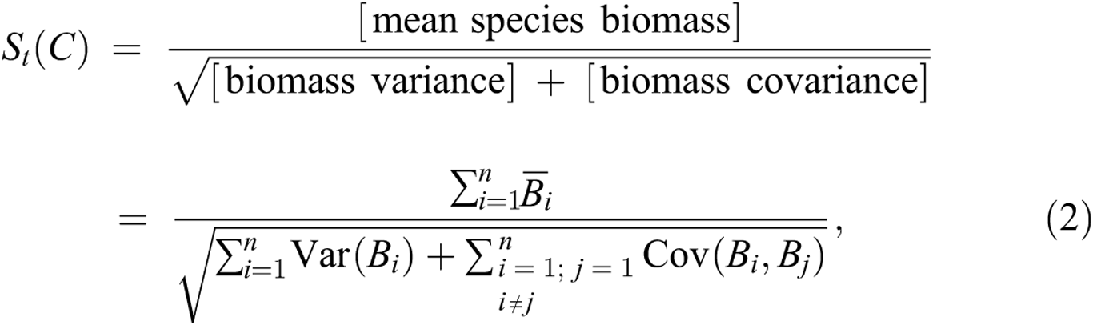
where Var and Cov designate variance and covariance, respectively. With this equation, St precisely characterizes ecological stability in terms of biomass constancy of the community’s species. Precision is too often lacking when putatively emergent phenomena are discussed, so St affords a rare opportunity.
With this account of stability in mind, Maclaurin and Sterelny (Reference Maclaurin and Sterelny2008, sec. 6.4) argue that it constitutes an emergent property, immune to the reductive craft of MI. Their contrast is labeled an “individualistic” view of communities in which abundances and distributions of organisms are largely controlled by abiotic factors, not interorganismal interactions. As embodied by seminal figures such as Henry Gleason and Robert Whittaker, this view reflects a long-standing theoretical orientation in ecology according to which ostensibly community-level properties simply derive from patterns of abiotic factors impacting different species; lower-level interactions are causally negligible or fail to produce anything novel at the community level. The marked difference between this austere conception of individualism and MI should be clear. While MI countenances interactions between individuals in accounts of higher-level phenomena, the conception Maclaurin and Sterelny describe corresponds most closely with methodological atomism (see sec. 3). Such a constraint would seem to preclude canonical cases of past reduction—thermodynamics to statistical mechanics, Newtonian mechanics to relativity theory, and so on—reductions that depend indispensably on lower-level entities interacting in specific ways. Championing ecological emergence based on the implausibility of ecological atomism would therefore be a victory too easily achieved. Marginal controversy exists, but as Maclaurin and Sterelny themselves document, few contemporary ecologists doubt that biological interactions such as competition, predation, obligate mutualism, and others shape the composition and structure of communities.Footnote 6
Nor is any conceptual difficulty posed for MI by the substantive propositions Maclaurin and Sterlney (Reference Maclaurin and Sterelny2008) associate with emergence, that communities are “real” or that there are causally efficacious properties usually described at the community level.Footnote 7 These are open questions that depend on empirical data, and both contentions are consistent with MI. Tilman’s own extensive grassland studies have attempted to demonstrate, for instance, that community stability is responsible for and/or produced by diversity, another community-level property (Tilman, Reich, and Knops Reference Tilman, Reich and Knops2006). And Sterelny (Reference Sterelny2001) himself convincingly argues for the reality of communities (at least in the past) based on extensive analysis of paleoecological data. These are reasonable contentions, but they do not establish anything meriting the label ‘emergence’, which Maclaurin and Sterelny characterize as the idea that community properties “are not just an extrapolation of” (Reference Maclaurin and Sterelny2008, 113) or are “not simple reflections of” (120) the properties of individuals. Emergence so conceived, they claim, challenges the reductive view that “all important system-level behavior can be explained, and can only be explained, by explaining the behavior of the parts” (Reference Maclaurin and Sterelny2008, 120).
Before turning to whether temporal stability is emergent in the intended sense, one might think that once causally efficacious properties are described at a higher level, emergence has been established. This criterion is much too weak. Car crashes offer a straightforward example. In analyzing a crash, a car’s total mass is (correctly) represented as causally efficacious. It accounts, for instance, for how far a car penetrated a storefront, propelled a pedestrian, and so on. But the total mass is simply the sum of, and therefore simply reflects, the masses of car components. Causal efficacy at a higher level therefore provides a poor guide to emergence. And note that beyond such straightforward cases, the same conclusion holds for more complex higher-level properties. The car’s propulsive causal capability, for example, reflects its parts and their interactions, and explanations of that capability would thereby derive from behaviors of its parts.
What is missing from Maclaurin and Sterelny’s analysis is an account of how temporal stability is any different. If emergence amounts to anything, it precludes reductive analyses of higher-level properties in terms of lower-level properties. The calculation is obviously more complicated than summing car part masses, but in an explicit formula equation (2) indicates exactly how a community-level property reflects population-level properties, namely, biomass means, variances, and covariances. Once population-level details are set, not only is this community-level property fixed, but its precise magnitude can be calculated, and the contributions different population biomasses make to it can be inspected. Population biomasses, in turn, exhibit a much simpler, aggregative relationship with the biomasses of individual organisms composing them.Footnote 8 It therefore seems that temporal stability is not emergent. It can be reductively accounted for by the properties and behavior of a community’s parts.
5. Reductive Unification in Ecology
In trade-offs between breadth and depth, MI is usually faulted for aligning too rigidly with depth. But scientific history shows that this charge is frequently unfair. Finding underlying connections or commonality is often the means to greater generality; reduction is sometimes the conduit of unification.
There are several unificatory targets in ecology. Perhaps the most prized is the elusive integration of classical population-community ecology (see sec. 2) and ecosystem ecology. Biological entities are the primary focus of the former, and its models address issues concerning species composition, intraspecific dynamics, and interspecific interactions between coexisting species. The abiotic environment has little, and rarely an explicit, role in these models. In contrast, energy and material flows through biotic interactions and abiotic mechanisms are the principal focus of ecosystem ecology. For instance, tracing cycles of nitrogen as it is processed by organisms and flows through physical channels is one of many such targets of analysis.
Given their contrasting perspectives, models developed in each subfield differ markedly. The causal relations represented are quite dissimilar, and even the variables considered are usually completely disparate. The prospects of synthesizing such divergent modeling approaches therefore seem dim, and, unsurprisingly, relatively few ecologists have attempted. Loreau’s (Reference Loreau2010) recent and cogent attempt, however, not only is one of the most promising but also showcases MI’s salience for ecological modeling.
Loreau tries to integrate several models in population-community and ecosystem ecology, which involves making connections between intratrophic-level species diversity and ecosystem functioning, interactions in food webs and ecosystem functioning, indirect mutualism and nutrient cycling, population stability and ecosystem stability, and many others. Surveying such extensive and mathematically sophisticated results is impossible here, but fortunately there is a manageable core. The edifice’s foundation is a theoretical insight about how population-community and ecosystem perspectives can be bridged that Loreau then applies, elaborates, and scales in different contexts to affect broader integration. And, crucially, the connection concerns the mass and energy budgets of individual organisms. Before giving the relevant equation, Loreau explains why such a bridge should exist:
Ecosystem ecology and eco-physiology share the concepts of mass and energy budgets as tools for understanding the acquisition, allocation, and disposal of materials and energy in the metabolism and life cycle of both organisms and ecosystems. On the other hand, growth and reproduction are the two processes at the individual level that are responsible for population growth, and these processes place high demands on energy and materials in the metabolism of individual organisms. Thus, the unification of population and ecosystem approaches should be rooted in the ecophysiology of organisms, in particular, in the constraints that govern the acquisition, allocation, and disposal of materials and energy. (2010, 9; emphasis added)
Loreau believes that the following equation captures the insight:

where P designates total organismal production (tissue growth and reproduction), C designates energy consumption, B designates organismal biomass, µ designates mass-specific basal metabolic rate, and ε designates production efficiency beyond basal metabolism, that is, the efficiency with which consumed energy is converted into tissue growth or reproductive output beyond what survival requires.
If P > 0, organisms consume enough energy to grow and/or reproduce. When aggregated across individuals, this determines whether populations grow or shrink. Equation (3) therefore links factors typically in ecosystem ecology’s purview (available energy in organisms’ environments and organismal physiology) with individual growth and, scaling up, population growth. Through this link, familiar models of population ecology, such as the logistic equation and equation (1) from above, can incorporate principles of and models developed within ecosystem ecology.
The two domains of models being reconciled both largely ignore individual variation. Loreau follows suit to affect their integration. He recognizes, however, that the mathematical “convenience” (2010, 13) of this unrealistic abstraction constitutes a nontrivial limitation, one ecologists working with IBMs are unwilling to accept. In fact, equation (3) and related equations are commonplace within IBMs, and spatially explicit representations of individual-level variability organismal production often yield significantly different results than when all individuals are idealized as equal (see Grimm and Railsback Reference Grimm and Railsback2005, sec. 7). Loreau does not pursue individual-based modeling, but the crucial insight undergirding his expansive integrative project nevertheless stems from the representational import of the individual level.
6. Conclusion
As a relatively new modeling strategy in ecology, individual-based modeling does not benefit from the mathematically sophisticated techniques developed to analyze classical ecological models over several decades. Instead, IBMs opt for enhanced specificity and the greater realism it furnishes by making individual organisms the explanatory and representational priority. In so doing, individual-based modeling draws from a general, individualistic approach to understanding the world with a long tradition in the social sciences known as ‘methodological individualism’. This paper has argued that it is as fruitful in ecology as it is there.


