Introduction
In politics and policy processes, interested individuals and organisations collaborate to achieve their policy objectives. As a result, collaboration is often studied from the position of policy actors or people internal and external to government who are vying for influence on policy decisions to fulfil their vision for a better society (Lasswell Reference Lasswell1971; Putnam Reference Putnam1976). Policy actors can include officials from any level of government or relevant government agency, representatives from business and industry, nonprofit managers and advocates, experts from academia, consulting firms and think tanks, bloggers and journalists from specialised to mainstream news media and individuals who are politically engaged but unaffiliated with any formal organisation.
These policy actors are subsumed in a policy subsystem, which is a subset of a political or governing system focussed on a topical issue and geographic locale (Sabatier Reference Sabatier1988). Collaboration among policy actors who share policy-related beliefs in a subsystem can provide the basis for the formation of interest groups and advocacy coalitions, which can wield substantial influence in shaping policy outcomes (Sabatier and Jenkins-Smith Reference Sabatier, Focht, Lubell, Trachtenberg, Vedlitz and Matlock1993; Bernauer and Caduff Reference Bernauer and Caduff2004). Yet, collaboration can also occur between policy actors with disparate beliefs in attempts to negotiate solutions to a particular policy problem. Such collaboration may be particularly beneficial for addressing intractable or “wicked” policy problems (Head and Alford Reference Head and Alford2015).
Although collaboration among policy actors can yield many benefits such as enhancing the ability to address shared problems, building trust, fostering policy learning, developing political capacity and achieving organisational objectives, collaboration is not a given (Gerlak et al. Reference Gerlak, Heikkila and Lubell2012). Many policy actors work to achieve their policy goals independently and engage with other policy actors more competitively or combatively. Given this, understanding why people choose to collaborate with each other has been an enduring question in political science and policy studies (Olson Reference Olson1965; Dawes Reference Dawes1973; Ostrom Reference Ostrom1998; Lubell Reference Lubell2007). Despite longstanding scholarly interest in understanding collaboration, there are several weaknesses in the literature that our study aims to address.
First, much of the literature has explored collaboration in policy subsystems characterised by low or intermediate levels of policy conflict intensity, and these subsystems are arguably more conducive to collaboration. Policy conflicts of low-to-intermediate intensities occur when a population of policy actors tend to diverge slightly in policy positions (often on the means not the ends), perceive minimal-to-moderate threats from opponents’ policy positions and are willing to compromise at least somewhat on policy positions (Weible and Heikkila Reference Weible and Heikkila2016). Studies on such policy conflicts have focussed on a variety of topical areas including environmental and natural resource partnerships (Heikkila and Gerlak Reference Heikkila and Gerlak2005; Sabatier et al. Reference Sabatier and Jenkins-Smith2005; Calanni et al. Reference Calanni, Siddiki, Weible and Leach2014), intergovernmental relations (Bel and Warner Reference Bel and Warner2015), social and welfare issues (Jacobs Reference Jacobs2010; Weare et al. Reference Weare, Lichterman and Esparza2014) and disasters and crises (Robinson and Gaddis Reference Robinson and Gaddis2012; Nohrstedt and Bodin Reference Nohrstedt and Bodin2014). Less attention has been paid to explaining collaboration in policy subsystems of high-intensity policy conflicts, which exist when a population of policy actors diverge strongly in their policy positions, perceive threats from opponents and are unwilling to compromise on policy positions (Weible and Heikkila Reference Weible and Heikkila2016). This article complements the literature by providing a rare analysis about the rationales for collaboration in policy subsystems with high-intensity policy conflicts. To do so, this article explores data from a survey of policy actors involved in the policy debate around oil and gas development that uses hydraulic fracturing in Colorado, Texas and New York, USA, which have been characterised as exhibiting high policy conflict intensity (Heikkila and Weible Reference Heikkila and Weible2016).
Second, a large proportion of the research on collaboration focusses solely on a single rationale for collaborating, such as beliefs (Jenkins-Smith and St. Clair Reference Jenkins-Smith, Nohrstedt, Weible and Sabatier1993; Zafonte and Sabatier Reference Zafonte and Sabatier2004) or resources (Provan et al. Reference Provan, Beyer and Kruytbosch1980; Park and Rethemeyer Reference Park and Rethemeyer2012). A few studies, however, explore competing explanations for collaboration in the same study, or consider whether differences in explanations are tied to characteristics of policy actors. This study compares three common theoretical rationales motivating people to collaborate: resource dependence (Henry Reference Henry2011; Park and Rethemeyer Reference Park and Rethemeyer2012), professional competence (Levi Reference Levi2000; Lubell Reference Lubell2007) and shared beliefs (Jenkins-Smith et al. Reference Jenkins-Smith and St. Clair2014).
The third limitation of the literature is its overemphasis on indirect measures rather than direct measures in identifying the rationales for collaboration. With the exception of Calanni et al. (Reference Calanni, Siddiki, Weible and Leach2014), the literature relies mainly on indirect approaches for measuring the rationales for collaboration by correlating characteristics of policy actors (e.g. policy beliefs) with measures of collaboration (e.g. network ties) (Matti and Sandström Reference Matti and Sandström2011; McNutt and Pal Reference McNutt and Pal2011). One benefit of indirect measures is mitigating response bias in the direct measures of rationales for collaboration, but they may inadvertently introduce other response biases in measures of the characteristics of policy actors.Footnote 1 This article contributes to the dialogue on collaboration through direct measures by asking policy actors to express their rationales for collaboration.
This article aims to extend the literature on collaboration by answering two research questions: (1) What are the rationales motivating policy actors to collaborate with each other in high-intensity policy conflicts? (2) What policy actor attributes are associated with these rationales? In the following section, we lay out theoretical arguments that motivate the different rationales among policy actors to collaborate and provide the background for the research context on hydraulic fracturing policy debates in three United States (US) states. We then present our methods and findings and conclude with a discussion of the insights our analyses offer the scholarship on collaboration in policy subsystems.
Theoretical overview
The first question that this article seeks to answer is what are the rationales motivating policy actors to collaborate with each other in high-intensity policy conflicts? This article analyses three categories of rationales motivating policy actors to collaborate with another policy actor.
One rationale motivating policy actors to collaborate with each other is the need to acquire or control resources for achieving organisational objectives and seeking political influence. One of the principal theories that supports this argument is resource-dependence theory (Pfeffer and Nowak Reference Pfeffer and Nowak1976; Park et al. Reference Park, Chen and Gallagher2002; Park and Rethemeyer Reference Park and Rethemeyer2012). From this perspective, the effectiveness of individuals and organisations for achieving their objectives is contingent upon their environment. No individual or organisation is completely self-contained, and therefore they seek to work with others who have the technical, financial, political or human resources needed to achieve their goals. In high-intensity policy conflicts, the success of policy actors depends foremost on influencing politics and government decisions. Thus, one of the most important resources is political influence, which can be defined as a degree of access and effect on policy actors with authority (Weible Reference Weible2005; Henry Reference Henry2011). Another important resource is financial, which includes individuals or organisations that can fund political activities (Park and Rethemeyer Reference Park and Rethemeyer2012).
A second rationale in choosing to collaborate with others is shared beliefs. This rationale is rooted in social psychology, which recognises that people feel mental discomfort when experiencing information discordant to their beliefs (Festinger Reference Festinger1962). Thus, people seek to collaborate with others who share their beliefs, and conversely are less likely to collaborate with those who have divergent beliefs. In the public policy literature, this rationale for collaboration is often labelled as the “belief homophily” hypothesis (Jenkins-Smith et al. Reference Jenkins-Smith and St. Clair2014). The concept of shared beliefs also provides the rationale for the existence of high-intensity policy conflicts – that is, disagreement among policy actors about how government should handle the issue under dispute leads to their mobilisation to protect or advance what they care about. In high-intensity policy conflicts, the beliefs that are often central to disagreements are related to policy positions about government action or inaction (Putnam Reference Putnam1976; Tilly and Tarrow Reference Tilly and Tarrow2007; Jenkins-Smith et al. Reference Jenkins-Smith and St. Clair2014). It is when policy actors share beliefs on these issues that leads them to collaborate or work together to achieve shared goals. Conversely, divergent beliefs among policy actors can be a disincentive for collaboration. Researchers also find that the tendency of policy actors to demonise policy actors with competing beliefs, or exaggerate their power and evilness (also known as the “devil shift”), will further erode the likelihood of collaboration (Fischer et al. Reference Fischer, Ingold, Sciarini and Varone2015).
A third rationale motivating policy actors to collaborate with others involves professional competence. The theoretical argument underlying professional competence is the literature on trust and transaction cost theory. From this perspective, perceptions of professional competence among collaborating individuals lowers negotiation, monitoring and enforcement costs of agreements and coordinated behaviours (Coleman Reference Coleman1990; Ostrom Reference Ostrom1998; Ferguson and Stoutland Reference Ferguson and Stoutland1999; Levi Reference Levi2000; Levi and Stoker Reference Levi and Stoker2000; Bacharach and Gambetta Reference Bacharach and Gambetta2001; Lubell Reference Lubell2007). For policy actors, collaborative networks are often informal, without contracts and legal agreements, which makes negotiation, monitoring and enforcement extremely difficult, especially in high-conflict situations (Feiock Reference Feiock2013; Weible and Heikkila Reference Weible and Heikkila2016). Therefore, the professional competence of others is posited as a critical rationale in choosing with whom to collaborate.
Although existing studies provide evidence that the three rationales mentioned above are viable explanations motivating policy actors to collaborate with each other, evidence also exists that the relative importance of these rationales may vary depending on the context. For example, Calanni et al. (Reference Calanni, Siddiki, Weible and Leach2014) found that the belief homophily hypothesis did not hold in lower-intensity policy conflicts in cooperative aquaculture partnerships; instead, trust and resource dependence were more important. As we borrow methodologically from Calanni et al. (Reference Calanni, Siddiki, Weible and Leach2014) in asking policy actors directly about these same rationales for collaborating, we are able to compare how the rationales expressed in high-intensity policy conflicts, in the case of hydraulic fracturing, relate to lower-intensity policy conflicts. Although other studies have also underscored the possible importance of the subsystem context in explaining rationales to collaborate, the different theoretical and methodological underpinnings of these studies make direct comparison more difficult. For example, in a low-intensity policy conflict, Berardo (Reference Berardo2010) showed that resource dependence was less important than other factors, such as the strength of an actor’s network ties in explaining collaboration. In a high-intensity policy conflict, Weible (Reference Weible2005) found that beliefs were more important than resource dependence in shaping coordination, ally, opponent and information networks.
Although empirical studies suggest that the level of policy conflict in the policy subsystem matters in shaping the motivations among policy actors to collaborate, limited theoretical attention has been paid to explaining how the context matters. Building on insights on the theory of advocacy coalitions within policy subsystems (see Jenkins-Smith et al. Reference Jenkins-Smith and St. Clair2014), one might expect that shared beliefs, relative to other rationale, would be particularly important for collaborating in high-conflict policy subsystems. The theory maintains that in the formation of advocacy coalitions, shared beliefs serve as the “glue” around which policy actors mobilise to achieve their policy goals. In other words, theoretically, beliefs in high-intensity policy conflicts should have more currency than resource dependence as a rationale to collaborate. At the same time, in high-intensity policy conflicts, it may be incumbent on individuals who do not share beliefs to work together. In such cases, other factors, such as trust, might emerge as key rationale for collaborating. What is clear from both the empirical and theoretical literature, however, is that the relative weight of different rationales is not well-understood across or within different policy subsystems, especially for different levels of policy conflict intensities.
In addition to differences in the relative importance of the rationales to collaborate across policy subsystem contexts, we would expect to see variation in rationales for collaborating across the individual members of a policy subsystem – that is, because policy actors differ in their motivations, experiences and interests, not all policy actors will have the same rationales for collaborating with others. Explanations for the variation in policy actors’ rationales for collaboration can be gleaned from the existing literature.
First, Dahl (Reference Dahl1963) argues that resources are unequally distributed in society because policy actors differ in their specialisation and attention, inherited inequalities and their innate skills and talents. Hence, policy actors will have different rationales to collaborate with another based on their different capacities or need to fulfil gaps in the capacities they lack (Park and Rethemeyer Reference Park and Rethemeyer2012). This highlights the need to recognise the diverse types of policy actor capacities that may motivate them to collaborate. Policy actor capacities can range from financial to support from the media as well as from allies and opponents (Elgin Reference Elgin2015). In other words, some individuals with more limited financial capacities might rely on resource-dependence rationales for collaborating, whereas those who lack certain types of political support might rely on shared beliefs as a rationale.
A second characteristic of policy actors that might explain individual-level variation in rationales to collaborate is their functional role in a policy subsystem. In any political system, different governing functions provide different opportunities for influence. Therefore, policy actors will undertake these different functions in various niches or sectors (Lasswell Reference Lasswell1956; Scott and Meyer Reference Scott and Meyer1991; Gray and Lowery Reference Gray and Lowery1996). Some may engage through advocacy-based affiliations whose primary mission is building coalitions, which may suggest that they engage in collaboration to acquire resources for such activities. Other types of organisations might focus more on generating and using information or formulating and adopting policies or organisations. As a result, these organisational-level affiliations are likely to be associated with policy actors’ rationales for collaborating.
Third, the degree to which actors take moderate versus extreme policy positions has been shown to affect patterns of collaboration. Weible (Reference Weible2005), for example, found that policy actors with extreme policy positions were more insular in their coordination patterns than policy actors with moderate beliefs. This suggests that these types of policy actors are also more constrained in their rationales for collaboration – that is, they may restrict their collaboration activities to their most trusted affiliates, in part because they are also more likely to feel threatened by others in a policy subsystem. By extension, they may also choose less-pragmatic rationales to collaborate, such as resource dependence.
Given the possible importance of policy actors’ organisational capacity, organisational affiliation and extreme policy positions, we use these three overarching categories of factors to explore answers to our second research question: What policy actor attributes are associated with these rationales? In answering this question, we do not make causal claims. The data provided in this article are unable to overcome threats from endogeneity in teasing apart causal relations from correlations in relating the variables. In addition, there is a paucity of theory underlying this question to guide formal hypothesising about these relationships. Nonetheless, we offer a set of logically derived expectations about the association between policy actors’ attributes and their rationales to collaborate in adversarial policy subsystems. These expectations include the following:
-
1 The importance of professional competence as a rationale to collaborate will be associated with policy actors’ organisational affiliation. Policy actors with certain types of organisational affiliations might be expected to value professional competence in their interactions more than others. For instance, among organised advocacy groups, where the transaction costs of collaboration can constrain available resources, policy actors may depend more on professional competence in establishing collaborative ties. In contrast, government officials sometimes have legal requirements to collaborate with their constituents, and thus professional competence may be less important for them.
-
2 The importance of resource dependence as a rationale to collaborate will be associated with policy actors’ organisational capacity and organisational affiliation. Policy actors are likely to have differing levels of capacity, and when lacking in one area of capacity they are likely to collaborate with other organisations that have that capacity. In other words, resource dependence as a rationale to collaborate is likely to be linked to organisational capacity. At the same time, different types of organisations may seek out collaboration with other organisations to help them achieve policy-related goals that they cannot achieve on their own. Thus, organisational affiliation can also be expected to be positively related to resource dependence as a rationale to collaborate.
-
3 The importance of shared beliefs as a rationale to collaborate will be associated with policy actors’ extreme policy positions and their organisational affiliation. As described above, people who have more extreme policy positions are more likely to report shared beliefs as an important rationale to collaborate (Weible Reference Weible2005). In addition, organisational affiliation is likely to be related to shared beliefs as a rationale to collaborate. This is particularly the case for individuals who belong to organised advocacy groups as they are more likely to be in need of building coalitions around common policy beliefs to influence government decisions. This expectation is relative to other types of organisational affiliations, such as government or academia, where policy actors might be expected to be less concerned about shared beliefs when choosing whom to collaborate with on policy issues.
In the analysis that follows, we examine these relationships with controls for location by state. Before presenting the analysis of these expected relationships, we first provide an overview of the research context, describe the methods of data collection and present the descriptive data on the rationales for collaborating.
Research context: hydraulic fracturing in New York, Colorado and Texas
The issue of oil and gas development that uses hydraulic fracturing is a timely topic for exploring questions related to collaboration in adversarial policy subsystems. Since 2008, intense political debates have emerged around the issue of hydraulic fracturing and the rapid development of unconventional oil and gas resources across many states in the US (Warner and Shapiro Reference Warner and Shapiro2013). The most extensive drilling activity in the US has occurred in several shale formations including the Marcellus, Bakken, Eagle Ford, Haynesville and Niobrara (US Energy Information Administration 2015). As a result, much of the political activity surrounding this issue has emerged in the states and localities that overlie these active shale formations (Richardson et al. Reference Richardson, Gottlieb, Krupnick and Wiseman2013). Less political activity has emerged at the federal level, as states retain most of the authority over regulating and permitting oil and gas drilling in the US, except on federal lands (Davis Reference Davis2012). In addition, political pressure on state and local governments has intensified as oil and gas drilling is increasingly visible to local communities (Boudet and Ortolano Reference Boudet and Ortolano2010). The debates that have emerged across states and localities have been characterised by broad mobilisation from diverse policy actors, including landowners and mineral rights owners, local governments, state governments, the oil and gas industry and environmental and citizen-based groups (Fisk Reference Fisk2013; Heikkila et al. Reference Heikkila, Weible and Pierce2014; Heikkila and Weible Reference Heikkila and Weible2016).
To explore questions related to policy actor collaboration, we selected three diverse states – New York, Colorado and Texas – which vary in their levels of unconventional oil and gas drilling and political activity on this issue. In New York, part of which overlies the Marcellus Shale, the production of shale gas through high-volume hydraulic fracturing remains at zero (US Energy Information Administration 2014a). The lack of Marcellus Shale development in New York was previously the result of the state’s decision to maintain a de facto moratorium on permitting high-volume hydraulic fracturing since 2008 (Heikkila et al. Reference Heikkila, Weible and Pierce2014), and in 2014 the state officially banned the practice (Weible and Heikkila Reference Weible and Heikkila2014). Before the 2014 ban, questions were raised not only about the potential environmental and health risks to the state from shale development, but also about whether the recoverable shale gas in New York was economically viable (Orcutt Reference Orcutt2011; Weible and Heikkila Reference Weible and Heikkila2014).
In Colorado, oil and gas development using hydraulic fracturing has expanded rapidly since 2007. For example, between 2007 and 2013, crude oil production in Colorado more than doubled and natural gas production rose by 38%. Because of this increase in production, Colorado is now the seventh largest producer of energy from oil and natural gas in the US (US Energy Information Administration 2014a). Much of the oil and gas development since 2007 has occurred in the Denver-Julesberg Basin in northeast Colorado (US Energy Information Administration 2014b), which is close to Colorado’s major metropolitan areas. The expansion of oil and gas development has resulted in a few attempts by local governments to ban hydraulic fracturing, particularly in urban communities near shale developments. The Colorado Oil and Gas Conservation Commission also made major changes to the state’s oil and gas regulations between 2008 and 2014. Further policy debates, especially related to the authority of local governments in governing oil and gas, have arisen in the state legislature, proposed ballot initiatives and court cases.
Texas is the most active among the three states in terms of oil and gas drilling as it is the top oil- and gas-producing state in the country. It produced 35% of the nation’s natural gas from shale deposits in 2012 (US Energy Information Administration 2014b) and accounted for 36% of all crude oil produced in the US, with most coming from shale deposits (US Energy Information Administration 2014c). Between 2008 and 2014, Texas passed state-level policies that affect hydraulic fracturing and drilling. In 2014, Denton, Texas voted to pass the first local government ban on hydraulic fracturing in the state, but the State then passed a bill outlawing such local bans, and Denton subsequently repealed its ban.
As found in previous publications (see Heikkila and Weible Reference Heikkila and Weible2016), all three states have two distinct and opposing coalitions: opponents and proponents of hydraulic fracturing, which have divergent policy positions. Proponents tend to support the expansion of hydraulic fracturing and include individuals who are affiliated with the oil and gas industry, industry associations and people from state and local governments. Opponents tend to support stopping or limiting the expansion of hydraulic fracturing and typically include individuals affiliated with environmental and community-based organisations, as well as respondents from differing levels of government. There are subtle differences across these policy subsystems, however. For instance, the Governor’s decision to institute a statewide ban on the permitting of hydraulic fracturing in New York is reflective of the strength of the opponent coalition, within a context that has little middle ground and minimal economic potential for unconventional natural gas development relative to the other two states. Despite high values of unconventional oil and gas resources in Colorado and Texas, and a shared history of drilling in these states, Colorado has exhibited more policy activity and more interactions across coalitions compared with Texas.
Methods
In exploring the rationales for collaboration within the hydraulic fracturing subsystems in New York, Colorado and Texas, we use data from surveys conducted between 2013 and 2014 of the policy actors who are actively involved in or knowledgeable about policy issues related to oil and gas development and hydraulic fracturing. In contrast to research involving the general public, policy actor research provides insights into individuals most proximate to policymaking and most likely to participate in policy processes for extended periods of time, making them ideal for understanding political activities and collaboration in policy subsystems (Sabatier Reference Sabatier1991). We also conducted preliminary interviews to inform the design of the surveys and provide background information on the research context.Footnote 2
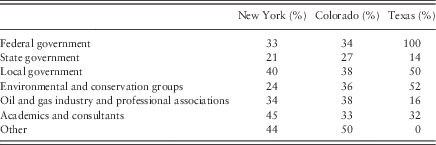
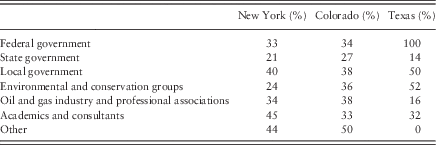
The surveys were administered online to the population of policy actors involved in the hydraulic fracturing subsystem in each state. This population of policy actors was generated through the interviews; lists of attendees at state and local public hearings; attendees and presenters at academic, government, environmental and industry-sponsored public meetings; organisers of public protests; participants in law-making and rule-making processes; and news media covering events related to hydraulic fracturing and oil and natural gas development in each state. The population of policy actors included individuals from a wide variety of organisational sectors (as presented in the Appendix). As policy actors can operate in a wide variety of positions both within and outside of government, they are not necessarily individuals from the same “position” in an organisation. The population can include managers, elected officials, directors, activists, researchers, members of the media or anyone who is identified as actively involved in influencing or attempting to influence the policy debate in the state. In addition, the unit of observation for our data collection is the policy actor, not the organisation. Therefore, survey questions were asked for individual-level perceptions. In total, the surveys were emailed to 379 individuals in New York with 129 completed (34%) in 2013; 398 individuals in Colorado with 137 completed (34%) in 2013; and 324 individuals in Texas with 78 completed (24%) in 2014, with a total of 344 respondents.
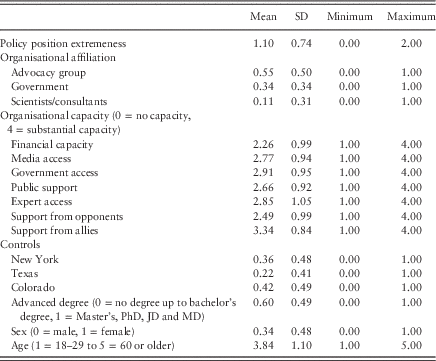
The surveys provide measures of the key concepts identified in our research questions. The survey questions were adapted from and modelled after other surveys that have used the Advocacy Coalition Framework to explore policy actors’ positions and interactions in subsystems. In particular, the questions we use to explore the first research question – rationales to collaborate – closely match with questions used in the study by Calanni et al. (Reference Calanni, Siddiki, Weible and Leach2014).Footnote 3 For the measures of rationales to collaborate, our survey question asked respondents to identify “what factors are important in choosing which organization(s) you collaborate with on issues related to unconventional shale development”. Response items from this question were used as our indicators of the three overarching rationales for collaboration that we presented in the literature review. The indicator from the survey for professional competence as a rationale to collaborate was the following: “They are professionally competent”. Two items were used to measure resource dependence: “They have political influence” and “They have access to financial resources”. The indicator of shared beliefs was the following item: “They share my position about major issues”. Respondents ranked the importance of each of these items on a scale of 1–5 (from 1=not important to 5=extremely important). As with all self-reported measures, the measure for rationales to collaborate must be interpreted with caution given social desirability bias and that the questions were not randomised to control for question order effects.
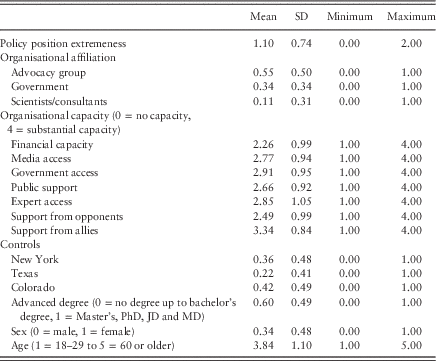
Our second research question explores what attributes of policy actors are associated with each rationale to collaborate. Policy actors’ attributes include the extremity of their policy positions on hydraulic fracturing, their organisational affiliation, their organisational capacity and their location. To measure respondents’ extreme policy positions about hydraulic fracturing, we use data from a survey question that asked respondents to identify their position on oil and gas development using hydraulic fracturing. The response categories for their policy position include the following: stop, limit, continue at current rate, expand moderately or expand extensively. We then use the data from this question to create a measure of “extreme policy positions”, which is calculated by taking the absolute value of the policy position question where, for example, the ends of the scale for “stop” equals −2 and for “expand extensively” equals +2. The extreme policy positions variable, thus, ranges from 0 for “continue at current rate”, to +1 for “limit or expand moderately”, and to +2 for both “stop” and “expand extensively”. Roughly, 32% of respondents (n=109) had extreme policy positions of “stop” or “expand extensively”.
The measure for organisational affiliation of the respondent is a dummy variable for the type of organisation where the respondent works. For simplification in the analysis, we include two possible affiliation categories: advocacy groups (which include either environmental/citizen organisations or industry-affiliated groups) and government at all levels (with government as the baseline variable) or academics/consultants. To measure the respondents’ organisational capacity, we use the data from a survey question that asked respondents on a scale of 1–4 (1=no capacity; 4=substantial capacity) to report the extent to which they have the capacity to use or mobilise various resources to achieve policy objectives in relation to hydraulic fracturing. They include financial capacity, access to media, access to government, public support, access to experts, support from opponents and support from allies.
Finally, the models include various control variables. These include dummy variables for the respondent’s location in either New York, Colorado or Texas, with Colorado as the baseline. The models also include a variable to identify whether the respondent has an advanced degree (i.e. Master’s, PhD, JD, MD), a variable for the respondent’s sex and the respondent’s age.Footnote 4
Findings
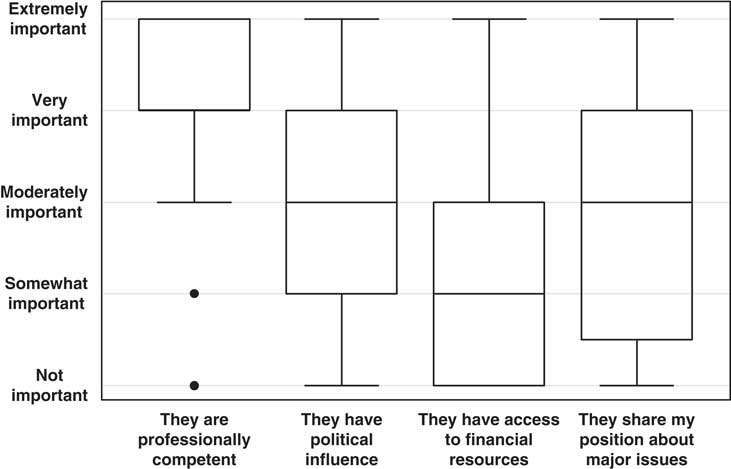
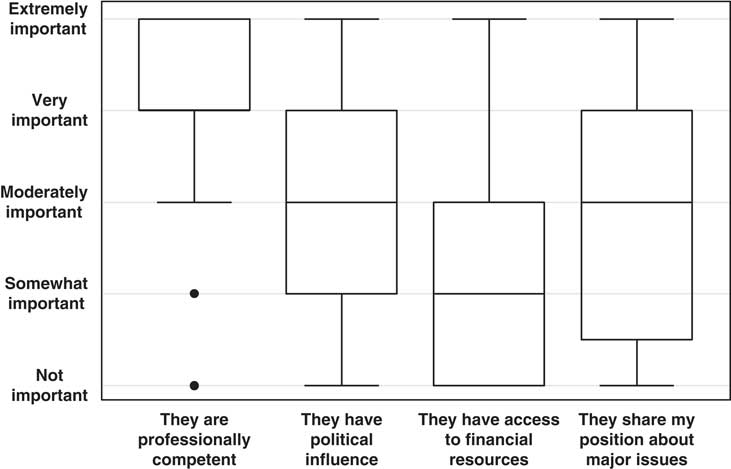
What are the rationales motivating policy actors to collaborate with each other in high-intensity policy conflicts? In examining this first research question, we find that professional competence is the most important rationale to collaborate. It ranks very important to extremely important on average, with the mean score for professional competence at 4.3 (SD 0.89) on a scale of 1–5 in the level of importance. For one of the resource-dependence variables, political influence is a somewhat-to-moderately important rationale for collaboration, with a mean score of 2.8. Access to financial resources is the least important rationale (mean score=2.2; SD=1.1). Shared beliefs (“they share my position”) is a moderately important rationale (mean score=3.0), but has the most variance in responses (SD=1.5).
Figure 1 presents the data in a box plot and denotes the median score (middle line in each box) and the four quartiles of responses. The response categories for shared position, political influence and financial resources all show wide variance in the range of responses within each quartile, with shared position showing the largest interquartile range. Figure 1 indicates that professional competence is important for most respondents and that financial resources is the least important. As is the case in most self-reported measures, these results must be interpreted with some caution. For instance, social desirability may lead a respondent to report that competence of others is a more important rationale to collaborate than political influence or financial resources.
Level of importance of four rationales to collaborate, reported by policy actors (n=295).
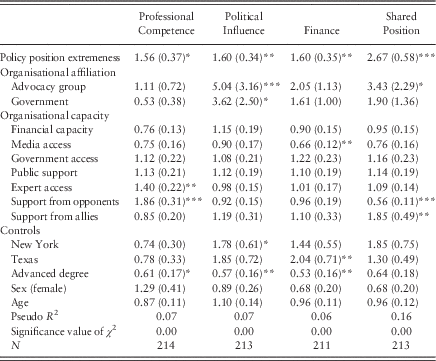
What policy actor attributes are associated with their rationales to collaborate? Table 1 presents the results of the ordered logit models that explore the association of beliefs, organisational affiliation and organisational capacity with policy actors’ stated rationales for collaborating.Footnote 5 The baseline for the organisational affiliation variable is academics/consultants, whereas Colorado is the baseline state for location. The odd ratios are reported.
Ordered logistic models exploring factors associated with rationales to collaborate
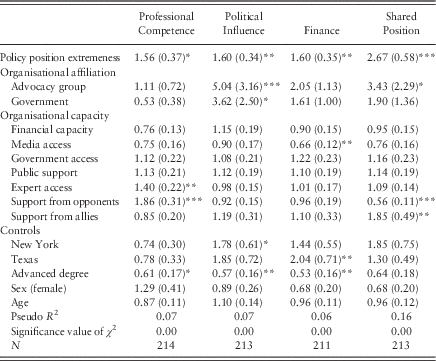
Note: *p<0.10, **p<0.05, ***p<0.01; odds ratios reported and robust standard errors in parentheses.
Our first expectation was that professional competence as a rationale to collaborate would be associated with organisational affiliation. This expectation is not supported by the results. Instead, the results suggest that support from opponents increases the odds of a high score on professional competence by 1.86. People who have expert access increase the odds of high professional competence as a rationale to collaborate by 1.4. There is also an unexpected positive relationship between a policy actor’s level of extreme policy positions and professional competence as a rationale to collaborate, where the odds for high scores for professional competence increases by 1.56 for those with extreme policy positions. Among the control variables, we find that having an advanced degree is significant and lowers the odds of seeing professional competence as an important rationale.
Our second expectation was that resource-dependence rationales for collaboration would show significant associations with organisational capacity and organisational affiliation. The advocacy group affiliation and government affiliation variables both raise the odds (5.04 and 3.62, respectively) related to the indicator for the political influence rationale, in accordance with our expectations, but not with the indicator for the financial resources rationale. The results further show that the measures of organisational capacity are rarely associated with resource-dependence rationales for collaboration. One capacity item, media access, lowers the odds of viewing access to financial resources as an important rationale. Unexpectedly, we find that having more extreme policy positions increases the odds (1.60) in identifying both the resource-dependence measures as important rationales for their collaboration choices. The control variables are also associated with resource-dependence rationales. First, policy actors from New York, relative to the baseline respondent from Colorado, are more likely to report political influence as important. In Texas, policy actors are more likely to identify financial resources as an important rationale. Finally, as with professional competence, when policy actors have advanced degrees, they are less likely to identify resource-dependence rationales in their decisions to collaborate.
The third expectation was that shared beliefs as a rationale to collaborate would be related to the degree to which a policy actor takes extreme policy positions, which our data support. In addition, a policy actor who has more extreme policy positions increases the odds of reporting shared positions as an important rationale to collaborate by 2.67, compared with a respondent with moderate beliefs. Similarly, a policy actor who is associated with advocacy groups increases the odds of reporting shared positions as an important rationale to collaborate by 3.43, compared with academics/consultants. Unexpected are the results for the organisational capacity indicators. We find support from allies increases the odds (1.85) for reporting shared beliefs as an important rationale to collaborate, and support from opponents decreases the odds (0.56) of shared beliefs as an important rationale to collaborate. None of the control variables are statistically significant in the model for shared beliefs.
Discussion of findings
For our first research question, the results build on a recent study by Calanni et al. (Reference Calanni, Siddiki, Weible and Leach2014), which asked policy actors to rate the importance of their rationales for collaborating but in a cooperative setting of aquaculture partnerships. Calanni et al. (Reference Calanni, Siddiki, Weible and Leach2014) found that trust (measured as both professional competence and promisekeeping) was the top rationale, followed by resource dependence and finally shared beliefs. Similar to Calanni et al. (Reference Calanni, Siddiki, Weible and Leach2014), this study finds that professional competence is a top rationale, but that shared beliefs are moderately important rationales, and that resource dependence is weakly important. This suggests that the belief homophily hypothesis is more applicable to high-intensity policy conflicts and less applicable to lower-intensity policy conflicts. One question that emerges from this study is the lack of support for the resource-dependence hypothesis. In a relatively lower-intensity conflict studied by Calanni et al. (Reference Calanni, Siddiki, Weible and Leach2014), resource dependence was shown to be moderately important (behind trust but more important than shared beliefs). This is in contrast with the literature that shows that resource dependence can be one of the most important factors in governance for public managers (Park and Rethemeyer Reference Park and Rethemeyer2012) and in politics for policy actors (Weible Reference Weible2005; Henry Reference Henry2011). This could be because of the intensity of the policy debate – that is, trust may actually be low in high-intensity conflicts. Therefore, before resource dependence becomes important, factors associated with trust, such as demonstrated professional competence, need to be developed. This further speaks to the potential for trust to be considered a “foundational” rationale that precedes resource dependence.
Of course interpretations other than the intensity of the policy conflict could explain why our findings differ from Calanni et al. (Reference Calanni, Siddiki, Weible and Leach2014). For example, the difference may have to do with particular characteristics of the policy issue. In the case of oil and gas development and hydraulic fracturing, the economic and political stakes of policy change are high, which could explain why professional competence would be more important than resources. Alternatively, in a policy subsystem where the economic stakes are high, actors may already have relatively high levels of existing resources – at least in terms of the political and financial resources that were captured in our resource-dependence questions. We also cannot discount the possibility that with these types of survey questions, respondents may have some social desirability biases towards ranking rationales such as professional competence as more important than say dependence on resources.
In answering our second research question, we explored some logically derived propositions, which, we argue, can help extend the literature on rationales to collaborate, given that a few studies have explored how policy actor characteristics are associated with rationales for collaboration. Our first expectation that professional competence as a rationale to collaborate is associated with organisational affiliation was not supported by the results. This is likely because professional competence ranks relatively high for all policy actors, which further reinforces the argument that professional competence may serve as a foundational rationale for making decisions about whom to collaborate with. We also find that extreme policy positions are associated with professional competence as a collaboration rationale. This unexpected finding is perhaps not surprising as those who have extreme policy positions are typically more incentivised to see their policy preferences reflected in policy outcomes. As a result, they may value professional competence when deciding whom to collaborate with because such competence can be critical in successful policy strategies.
We find mixed support for the second expectation that resource-dependence rationales for collaborating are associated with organisational affiliation and organisational capacity. Although policy actors with advocacy group and government affiliations are both more likely to report political influence as an important rationale, organisational affiliation is not associated with financial resources as an important rationale. With respect to organisational capacity, the findings suggest that only a lack of media support is associated with financial resources as being more important, whereas other capacity measures are not significantly associated with resource-dependence rationales.
One explanation for this is that the context within which policy actors are situated may override the importance of specific capacity measures. As our results show, location is associated with both political and financial resource-dependence measures. Policy actors in New York and Texas are more likely to value political influence and those in Texas also value financial influence as more important rationales to collaborate, relative to actors in Colorado. This may mean that there is weaker overall capacity in the political system in New York, and perhaps weaker financial capacity among policy actors involved in Texas, but these capacity issues perhaps do not play out at individual policy actor level, or there is limited variance in the capacity indicators within the policy subsystems. These results may also be reflective of the specific issue of interest in this particular policy subsystem, where actors across multiple sectors have been investing in capacity given the high stakes nature of this policy debate.
For the third expectation, our findings do confirm that shared beliefs as a rationale to collaborate is associated with extreme policy positions and organisational affiliation – at least with advocacy group affiliations. In addition, two of our capacity indicators showed unexpected relationships with shared beliefs as a rationale to collaborate: support from opponents, which decreases the odds for stating shared beliefs as an important rationale, and support from allies, which increases those same odds. Neither of these findings, however, runs counter to logic. People who already have support from opponents would not see shared beliefs as essential to collaboration, or perhaps because they do not value shared beliefs in collaboration they are more likely to build support from opponents. The reverse logic holds for the positive relationship between support from allies and shared beliefs. These results underscore the challenges of establishing causality with the data we use for this study and with the theoretical connections. As we noted in the introduction, the relationships explored in this study are admittedly endogenous. This is a facet of much of policy research, and we argue that understanding the relationships between policy actor characteristics and rationales for collaborating in high-intensity policy conflicts offers important insights for policy process theories.
Conclusions
This article contributes to the literature on collaboration in policy subsystems in three ways. First, it confirms some of the insights found in previous studies that consider why people collaborate, and it underscores how the rationales for collaborating may differ in higher- versus lower-intensity policy conflicts. In the case of hydraulic fracturing policy debates, the study demonstrates how professional competence is the most important rationale to collaborate. At the same time, our results provide weak support that access to financial resources, as an indicator of resource dependence, is an important rationale to collaborate. However, we do find that access to political influence, as another measure of resource dependence, is a moderately important rationale to collaborate. In addition, although many studies recognise the importance of shared beliefs as an important rationale for collaborating, this study finds that there is substantial variance in the extent to which respondents view this as an important rationale. An issue that emerges from these results that deserves more attention in future studies is the role of professional competence as a way to build trust in high-intensity policy conflicts, or a rationale that may interact with other functional rationales for collaborating, such as resource dependence. Teasing out such interactions may be a fruitful area of research.
The findings on the degree of variance in shared beliefs as a rationale to collaborate point to the second contribution of this study. That is, the rationales for collaborating are likely to differ on the basis of the characteristics of policy actors. This study explored the association of policy actors’ extreme policy positions, organisational affiliation and organisational capacity. The findings show that the degree to which policy actors hold extreme policy positions is associated with professional competence, both indicators of resource dependence, and shared beliefs as reasons to collaborate. It also shows that organisational affiliation is associated with only one of the resource-dependence indicators and also with shared beliefs as rationales to cooperate. Contrary to expectations, organisational capacity is not consistently associated with resource dependence as rationales to collaborate. Unexpected is the finding that among capacity measures, support from opponents increases the odds of reporting professional competence as an important rationale, and lowers the odds of viewing shared beliefs as an important rationale to collaborate. This suggests that some policy actors choose to work with their opponents and do so on the basis of professional competence and not shared beliefs.
By directly asking policy actors to rank the importance of various rationales for collaborating, this article offers a methodological contribution to the literature that has explored the motivations of policy actors to collaborate. Directly asking individuals to report their rationales to collaborate comes with certain limitations, such as social desirability biases, as we have recognised. However, it provides an alternative approach to more indirect methods that measure professional competence, beliefs or capacity among individuals, correlate those measures with measures of collaboration, and then draw inferences about rationales to collaborate. Although the indirect approach avoids the social desirability bias, it cannot determine whether correlation equates to intention or rationale among the policy actors. Both approaches, we argue, can complement each other and provide for more valid insights on collaboration if used in concert.
One element of our findings that needs further study is related to government officials. Government officials are often tasked with working with people on all sides of an issue, and thus are not statistically significant as a rationale for collaborating. However, there is likely an important distinction between government officials who are charged with administering public programmes and other types of policy actors who seek to influence government. Certainly, these categorisations of people overlap, but their motivations and purposes may differ as will their rationales for collaboration. Compared with other types of policy actors, government officials might be more motivated to overcome the complexity of joint action in implementing a policy or programme, which increases the importance of coordinating resources (Park and Rethemeyer Reference Park and Rethemeyer2012). In contrast, policy actors outside of government might be motivated to collaborate with others who share their beliefs in efforts to influence the design and adoption of public policies.
In addition, this study not only highlights the value of examining multiple theoretical insights for explaining collaboration but also points to the importance of studying the rationales for analysing collaboration from a comparative perspective – across topics, locale and types of policy actors. As our study demonstrates, the rationales for collaboration may differ in a subsystem characterised with high-intensity policy conflicts, relative to one with lower-intensity conflicts. By comparing our results to the results of Calanni et al. (Reference Calanni, Siddiki, Weible and Leach2014), who explored rationales to collaborate in a subsystem with lower-intensity conflict, we can make a strong case for professional competence as an important aspect, regardless of the level of conflict within the policy subsystem. However, our findings, compared with Calanni et al. (Reference Calanni, Siddiki, Weible and Leach2014), may suggest that shared beliefs are more important in subsystems with higher-intensity conflicts, whereas resource dependence is somewhat less important. In addition, our results are able to examine how different types of policy actors are likely to be associated with different rationales for collaboration. Although other scholars also have begun to explore collaboration among policy actors from a comparative approach (e.g. Berardo and Scholz Reference Berardo and Scholz2010; Weible et al. Reference Weible, Sabatier and Pattison2010; Matti and Sandström Reference Matti and Sandström2011; Ingold and Fischer Reference Ingold and Fischer2014), more research is needed to understand the relative importance of different rationales for collaboration and what is associated with these rationales across a diversity of policy subsystems.
Questions about what motivates people to collaborate in politics will, of course, continue. As a research community, we are gaining ground by expanding our theoretical focus by comparing the relative importance of different rationales, by varying our methods of data collection from indirect comparisons of individual attributes and networks to direct questions about the rationales to collaborate and by varying the context. Only through the accumulation of cases and explicit recognition of different individual and contextual factors can we begin to advance the theory or theories of why people collaborate in politics, management and governance.
Acknowledgements
The authors appreciate the generous support of the Alfred P. Sloan Foundation in funding this research, as well as the contributions of Samuel Gallaher, Benjamin Blair and Jennifer Kagan to the survey development and the larger research project that informed this study.
Appendix
Response rates for different organisational types per states
Summary statistics for the independent variables