Introduction
The dairy industry commands a significant market with a diverse range of products that attract consumers worldwide. These products are valued not only for taste but also for nutritional benefits and health advantages. Rising consumer demand for new dairy products has intensified competition and spurred innovation, enhancing sensory qualities and nutritional and functional value.
Petit Suisse cheese is a soft fresh cheese made by coagulating milk with rennet and starter cultures (Saito et al., Reference Saito, Martins-Madalão, Bernardes, Bosi, Della Lucia, Saraiva and Silva2019). This popularity includes its variety in terms of consistency and flavour due to the addition of sugar, fruit, fruit purees, spices, and condiments (Fox et al., Reference Fox, Guinee, Cogan and McSweeney2017). This way, Petit Suisse has been used as a matrix for incorporating functional ingredients and developing new products (Pereira et al., Reference Pereira, Cavalcanti, Esmerino, Silva, Guerreiro, Cunha, Bolini, Meireles, Faria and Cruz2016; Barcelos et al., Reference Barcelos, Egypt, Dos Santos, Moraes and Teixeira2020; Morais et al., Reference Morais, Soares, Morais, Oriente, Nascimento, Melo, Souza, Cavalcanti-Mata, Lisboa, Gusmão and Abrantes2023).
Pitanga (Eugenia uniflora L.) is a tree belonging to the Myrtaceae family, native to South America and commonly found in various countries across the region (Lazzarotto-Figueiró et al., Reference Lazzarotto-Figueiró, Capelezzo, Schindler, Fossá, Albeny-Simões, Zanatta, Oliveira and Dal Magro2021).
Pitanga fruits are berry-shaped, with 8–10 longitudinal furrows, and range from 1.5 to 3 cm in diameter (Ramalho et al., Reference Ramalho, Barbosa, Ferri and da Costa Santos2019). The fruit contains about 66–88% pulp and typically has one or two seeds that are greenish, globose, and flattened (Ramalho et al., Reference Ramalho, Barbosa, Ferri and da Costa Santos2019; Fidelis et al., Reference Fidelis, Savall, de Oliveira Pereira, Quines, Ávila and Pinton2022). Its flavor ranges from sweet to acidic, with slight astringency and a characteristic aroma (Ramalho et al., Reference Ramalho, Barbosa, Ferri and da Costa Santos2019; Castro et al., Reference Castro, Rozycki, Latorre, Alesso, Exner, Piagentini and Pirovani2020). Pitanga is low in calories, and rich in calcium, phosphorus, iron, and vitamins B1, B2, and C, as well as catechins, flavonols, proanthocyanidins, and carotenoids (Ramalho et al., Reference Ramalho, Barbosa, Ferri and da Costa Santos2019).
Due to their high perishability and short postharvest life, pitanga fruits are often commercialized as frozen pulp, jellies, ice creams, or juices (Borges et al., Reference Borges, Azevedo, Medeiros and Correia2016). This results in significant disposal of peels and seeds, referred to as bagasse or pomace (Denardin et al., Reference Denardin, Hirsch, da Rocha, Vizzotto, Henriques, Moreira, Guma and Emanuelli2015; Lazzarotto-Figueiró et al., Reference Lazzarotto-Figueiró, Capelezzo, Schindler, Fossá, Albeny-Simões, Zanatta, Oliveira and Dal Magro2021).
Bagasse contains carbohydrates, vitamins, minerals, phenolic acids, flavonoids, and pigments (Chaouch and Benvenuti, Reference Chaouch and Benvenuti2020). Pitanga peels are particularly rich in pigments – carotenoids in the red-orange genotype and anthocyanins in the purple genotype – along with flavonoids and hydrolysable tannins. These pigments are known for their antioxidant properties (Rodrigues et al., Reference Rodrigues, Zola, Ávila-Oliveira, Sacramento, da Silva, Bertoldi, Taylor and Pinto2016; Fidelis et al., Reference Fidelis, Savall, de Oliveira Pereira, Quines, Ávila and Pinton2022).
Pitanga leaves are more explored that bagasse for food and medicinal applications, as a production of active films with pronounced antioxidant and antimicrobial activities for food packaging (Ramalho et al., Reference Ramalho, Barbosa, Ferri and da Costa Santos2019); although, pitanga seeds are rich in phenolic compounds, insoluble fibre, unsaturated fatty acids and terpenes that, in terms of innovation in the food and pharmaceutical areas, exhibit antioxidant activity, antimicrobial activity against Staphylococcus aureus, Escherichia coli, Pseudomonas aeruginosa and Bacillus subtilis and arginase inhibition, as well as antihyperglycemic potential (Santos et al., Reference Santos, de Souza, de Oliveira, Silva and de Oliveira2015; Lazzarotto-Figueiró et al., Reference Lazzarotto-Figueiró, Capelezzo, Schindler, Fossá, Albeny-Simões, Zanatta, Oliveira and Dal Magro2021; Fidelis et al., Reference Fidelis, Savall, de Oliveira Pereira, Quines, Ávila and Pinton2022).
The bioactive compounds found in pitanga bagasse, when consumed as part of a usual diet, can potentially enhance human health by lowering the risk of degenerative diseases such as cardiovascular diseases, cancers, and metabolic disorders (Saraiva et al., Reference Saraiva, Vital, Anjo, Ribas and Matumoto-Pintro2019).
The reuse of pitanga bagasse (PB) as an ingredient in dairy products provides a new destination for this residue, improving its nutritional value and contributing to the greater competitiveness of the dairy industry. However, the interaction of milk components with functional compounds changes the technological properties of dairy products (Saraiva et al., Reference Saraiva, Vital, Anjo, Ribas and Matumoto-Pintro2019). In this way, the objective is to evaluate the techno-functional effects and the sensorial acceptance of the addition of pitanga bagasse (PB) to Petit Suisse during 21 days of storage.
Materials and methods
Materials
Ripe pitanga fruits (8.97 ± 0.12 ºBrix and titratable acidity 2.66 ± 0.11 g 100 mL−1 of citric acid) were harvested in Brazil (25°06ʹ18″S, 50°10ʹ03″W) from October to November 2021. After sanitization, the fruits were processed in a centrifugal juicer, and the resulting solid fraction was dried in an oven at 55 °C, milled, and sieved at 48 mesh.
To produce Petit Suisse, whole powdered milk, cream milk, and sugar were purchased from local shops in Brazil. The starter culture (Lactococcus lactis ssp. cremoris, Lactococcus lactis ssp. lactis, and Streptococcus salivarius ssp. thermophilus) was provided by the company Rica Nata (Piracema, Brazil).
Characterisation of pitanga bagasse
The chemical composition of PB was determined through analyses of moisture, ash, crude protein, and lipids according to the Association of Official Analytical Chemists (AOAC, 1995) and expressed based on dry matter. Carbohydrates are calculated by subtracting the sum of crude protein, lipids, and ash from the total weight. The dietary fibre analysis was carried out using a combination of enzymatic and gravimetric methods (AOAC, 1995). The pH was determined using a digital pH meter.
Total polyphenol compounds (TPC)
The PB extracts were prepared with 100% methyl alcohol in the proportions 1:100 (w/v) according to Saraiva et al. (Reference Saraiva, Vital, Anjo, Ribas and Matumoto-Pintro2019). The total polyphenol compounds (TPC) content was determined using the Folin-Ciocalteau method (Singleton and Rossi, Reference Singleton and Rossi1965). The results were expressed as mg gallic acid equivalent per 100 grams (mg GAE 100 g−1) (online supplementary material).
Antioxidant activity
Antioxidant activity analyses were performed by capturing the free radicals ABTS (2,2′-azino-bis-(3-ethylbenzothiazoline-6-sulfonic acid) assay (Re et al., Reference Re, Pellegrini, Proteggente, Pannala, Yang and Rice-Evans1999) and DPPH (2,2-diphenyl-1-picrylhydrazyl) assay (Li et al., Reference Li, Hydamaka, Lowry and Beta2009). The results were given as percentages (online supplementary material).
Colour and pigments
The color measurement of the PB powder was performed using CIELab coordinates, where L* (0–100) represents the lightness axis (from dark to light), +a* indicates a shift toward red and −a* toward green, and +b* indicates a shift toward yellow and −b* toward blue. A colorimeter (CR-400, Konica Minolta, Japan) was used for the analysis. The instrument was calibrated with a standard white reference, and measurements were taken at a 10° viewing angle. Each measurement represents the average of three readings, with one reading taken at each point of the sample. β-carotene was determined following the methodology of Nagata and Yamashita (Reference Nagata and Yamashita1992) and the results were given in mg mL−1 (online supplementary material).
Production and characterisation of petit suisse cheese
Petit Suisse cheeses were formulated without PB (control) and with the enrichment of 0.5%, 1.0%, and 1.5% PB, respectively. The base mass for Petit Suisse production was detailed in online Supplementary Table S1. The cheese was processed, and sugar (8%) and milk cream (10% with 17% fat) were added; after homogenization, the product obtained was fractionated (25 g) in 50 mL glass jars and stored under refrigeration at 4 ± 1 oC for up to 21 days.
Cheese manufacturing yield was determined by the amount of cheese produced divided by the initial volume of milk and expressed as a percentage. The pH, colour, antioxidant activity, texture, and syneresis analyses were performed on days 1, 7, 14, and 21 of storage. The manufactured cheeses were analysed after 24 hours for the approximate composition and sensory analyses. For rheology, the cheeses were analysed after three storage days.
Physical-chemical composition
Chemical composition was determined by AOAC methods (AOAC, 1995). The total caloric value (kcal 100 g−1) was calculated based on Atwater's conversion factors for proteins, carbohydrates, and lipids (4, 4, and 9 kcal, respectively) (Atwater, Reference Atwater1902).
Each sample of Petit Suisse was placed on a plate, and the colour was measured at three different points using a colorimeter, following the specifications described above. As previously described, the capture of free radicals ABTS and DPPH was evaluated from a methanolic cheese extract (1:5 w/v) of each treatment. The pH was measured using two cheeses from each treatment using an electronic pH meter.
Syneresis index and textural parameters
The syneresis index of the Petit Suisse cheeses was evaluated according to Aichinger et al. (Reference Aichinger, Michel, Servais, Dillmann, Rouvet, D'Amico, Zink, Klostermeyer and Horne2003). Brookfield texture analyser-CT III equipment was used in the following configurations: TPA; test speed: 5 mm/s; compression distance: 5 mm; TA4 cylindrical acrylic probe (3.5 cm high and 1.3 cm in diameter); and 15 g trigger. The parameters measured for TPA were hardness (g), elasticity (mm), and chewiness (mJ).
Microstructure
For the scanning Electron Microscopy, Petit Suisse cheese samples were inserted into a 3% glutaraldehyde solution added with 1 M cacodylate oats for 48 hours; Afterwards, the samples were washed three times with 1 M cacodylate and dehydrated in an ethanol solution. They were introduced with 2% osmium tetroxide and passed through a LEICA CPD-300 critical point for 12 cycles. Subsequently, at an aluminium stub with conductive carbon tape, they were metalised in a BAL-TEC SCD-050 metallisation to be visualised in SEM Quanta-250 brand FEI at 25 KV spot 4.5.
Rheological measurements
The measurements were carried out using a commercial rheometer model, HAAKE MARS II (Thermo Fisher Scientific, Karlsruhe, Germany), which contains a parallel steel cone-plate geometry of 35 mm (cone C35/2◦ Ti), with 0.105 mm of gap separation. In continuous mode, the upward and downward curves were acquired (shear rate from 0 to 300 s−1, progressive increase in time up to 150 s, and then decreasing for 150 s).
In the oscillatory rheometric study, the viscoelasticity of the systems was investigated. The data were obtained in the frequency sweep range from 0.1 to 10.0 Hz in the linear viscoelastic region (L.R.V). The RheoWin 4.10.0000 (Haake®) software provided the values of the parameters: elastic modulus (G’) and viscous modulus (G”). All analyses were performed with at least three replicates, and the samples were kept at 4 ± 1 °C throughout the procedure. Approximately 1 g de Petit Suisse was used for each analysis and repetition.
Viability of lactococcus and streptococcus in Petit Suisse
To estimate the population of Lactococcus and Streptococcus thermophilus levels on Petit Suisse, serial dilutions of the samples were made up to 10⁻10 in 9 ml of 0.1% peptone water, and 1 g of Petit Suisse was aseptically inoculated onto plates containing M17 agar (Corry et al., Reference Corry, Curtis and Baird1995). The plates were incubated anaerobically at 30°C. After 48 hours, colonies were counted on plates with visible growth. The average number of colonies was calculated and expressed as CFU ml−1. Control plates with only M17 agar were incubated to check for contamination of the culture medium.
Sensory analysis
Sensory acceptance tests were conducted exclusively on Petit Suisse cheeses enriched with PB aiming to avoid stimulation and contrast errors between the control samples and those with the addition of PB. The test was made using a 9-point hedonic scale ranging from 1 (“extremely disliked”) to 9 (“extremely liked”) to assess appearance, colour, taste, texture, and overall acceptability (Qureshi et al., Reference Qureshi, Saeed, Nadeem, Muhammad, Murtaza and Ibrahim2024). Sixty untrained tasters (65% women, 35% men, aged 18–67) participated. Most consumed dairy daily (56.67%), followed by up to three times per week (28.33%), fortnightly (8.33%), and occasionally (6.67%). Purchase intention was assessed using a scale ranging from “I would buy” to “I would not buy.” The sensory analysis was approved by the Research Ethics Committee of the State University of Maringá (CAAE: 69070123.1.0000.0104).
Statistical analysis
The results obtained were subjected to analysis of variance using SISVAR® software system version 5.6. Means and standard deviations were calculated for each variable. When differences were statistically significant, Tukey's test was used with a significance level of 5%. The experiment was repeated two times, and the analyses were duplicated.
Results and discussion
The chemical composition of pitanga bagasse (PB) is summarised in Table 1, with carbohydrates highlighted as the predominant nutrient. According to Chaouch and Benvenuti (Reference Chaouch and Benvenuti2020), carbohydrates (including pectin, cellulose, and hemicellulose), secondary metabolites (such as phenolics, glycosides, alkaloids, gums, mucilage, and volatile oils), lipids (notably polyunsaturated fatty acids or PUFA), and proteins are the mainly components of fruit by-products.
Results of physicochemical characterization of pitanga bagasse (Eugenia uniflora L.)

* Results are expressed on a dry basis and are presented as mean ± standard deviation. TPC, total polyphenol compounds; GAE, gallic acid equivalent.
PB contains 19.20% of dietary fibre its dry matter. Dietary fibre is a type of carbohydrate that cannot be digested or absorbed by the human body but still offers numerous health benefits (Tian et al., Reference Tian, Sheng, Wu and Wang2024). Cellulose, hemicellulose, and lignin are insoluble fibres and well-recognised for their roles in water absorption and promoting intestinal regulation. Furthermore, pectin and gums (soluble fibres) have demonstrated notable effects in lowering cholesterol levels and regulating blood glucose (Chaouch and Benvenuti, Reference Chaouch and Benvenuti2020). According to Bagetti et al. (Reference Bagetti, Facco, Rodrigues, Vizzotto and Emanuelli2009), the insoluble fibre found in pitanga seeds was approximately 23 g per 100 g of fresh weight.
The lipid content in PB was higher that found by Castro et al. (Reference Castro, Rozycki, Latorre, Alesso, Exner, Piagentini and Pirovani2020) in edible portion of the fruit. This is attributed to the greater proportion of fatty acids found in the seeds, which were the primary component of the bagasse. Pitanga seeds contain about 60-70% unsaturated fatty acids, of which 45–47% are polyunsaturated fatty acids (PUFA), considered a healthy fat source (Bagetti et al., Reference Bagetti, Facco, Rodrigues, Vizzotto and Emanuelli2009).
Regarding the phenolic compounds, the classification of native non-traditional fruits from Brazil proposed by Rufino et al. (Reference Rufino, Alves, de Brito, Pérez-Jiménez, Saura-Calixto and Mancini-Filho2010), PB could be considered a fruit with a medium content of phenolic compounds (between 1000–5000 mg GAE 100 g−1). The TPC value obtained in PB is lower than found in pitanga pulp (Denardin et al., Reference Denardin, Hirsch, da Rocha, Vizzotto, Henriques, Moreira, Guma and Emanuelli2015; Rodrigues et al., Reference Rodrigues, Zola, Ávila-Oliveira, Sacramento, da Silva, Bertoldi, Taylor and Pinto2016). The extraction method, fruit variety, part of the fruit analysed, stage of fruit development, climate, and soil are potential factors that may contribute to this difference (Denardin et al., Reference Denardin, Hirsch, da Rocha, Vizzotto, Henriques, Moreira, Guma and Emanuelli2015). For example, the concentration of phenolic compounds in pitanga seeds is five to ten times higher than in the edible part of the fruit (Ramalho et al., Reference Ramalho, Barbosa, Ferri and da Costa Santos2019).
The antioxidant activity of PB was evaluated using DPPH and ABTS radical scavenging assays. PB demonstrated greater efficiency in scavenging DPPH radicals compared to ABTS radicals (Table 1). The difference can be attributed to the distinct reaction mechanisms involved. While ABTS scavenging is based on electron transfer, DPPH scavenging primarily relies on hydrogen atom transfer (HAT) that occurs between antioxidants and peroxyl radicals (Santos et al., Reference Santos, de Souza, de Oliveira, Silva and de Oliveira2015). The presence of β-carotene, vitamins, minerals, and phenolic compounds in PB is responsible for its antioxidant capacity and health benefits.
PB typically exhibits a yellowish-orange colour due to the presence of β-carotene pigments in the pitanga peel and the colour of the residual pulp and seeds. This observation aligns with the yellowish tonality observed in dried PB by Borges et al. (Reference Borges, Azevedo, Medeiros and Correia2016).
Table 2 presents the composition of Petit Suisse cheeses. The PB increased the moisture content, reduced the carbohydrate levels and consequently reduced the caloric value, and increased fibre when compared to the cheese control (0% PB). Barcelos et al. (Reference Barcelos, Egypt, Dos Santos, Moraes and Teixeira2020) observed a similar centesimal composition in goat Petit Suisse cheeses supplemented with acerola pulp.
Proximate composition of Petit Suisse cheeses enriched with pitanga bagasse (Eugenia uniflora L.)

Results are expressed as a percentage on a dry basis. The caloric value is expressed in kcal per 100 g.
* Crude fibre is included in the total carbohydrates. Control: treatment without PB addition. 0.5, 1.0 and 1.5% were the concentrations of PB addition (w/w) in the Petit Suisse. Means with different capital letters in the same row have a significant difference (P < 0.05). Results are expressed as mean ± standard deviation.
The increased moisture content may be attributed to the higher levels of fibre in treatments with higher percentages of PB. Insoluble fibre has the capacity to absorb and retain water, contributing to this effect. These outcomes associated with the functional and sensory results are attractive to consumers.
Table 3 describes the colour, antioxidant activity and pH of cheeses. Appearance is an important attribute affecting consumer preference and influencing their flavour perception. The addition of PB turned the cheese reddish, like the colour of the bagasse. During storage, the parameters a* (+red; −green) and b* (+yellow; −blue) changed. The addition of PB turned the cheese reddish, although, during 21 days of storage, pigments in PB were oxidised and degraded (Saito et al., Reference Saito, Martins-Madalão, Bernardes, Bosi, Della Lucia, Saraiva and Silva2019).
Colour, antioxidant activity and ph of Petit Suisse cheeses enriched with pitanga bagasse (Eugenia uniflora L.) During 21 days at 4 ± 1°C

* (100—white; 0—black)
** (+, red; –, green)
*** (+, yellow; –, blue)
Results are expressed on a wet basis. Control: treatment without PB addition. 0.5, 1.0, and 1.5% were the concentrations of PB addition (w/w) in the Petit Suisse. Results are expressed as mean ± standard deviation. Means with different capital letters in the same column have a significant difference (P < 0.05). Means with different lowercase letters in the same row have a significant difference (P < 0.05).
On the first day of storage, the 1.5% PB-enriched cheeses had an antioxidant activity about three times higher than the control (0% PB) (Table 3).
Importantly, this high antioxidant capacity was maintained over the 21-day storage period, indicating the potential health benefits of PB-enriched Petit Suisse. The results differ from Saito et al. (Reference Saito, Martins-Madalão, Bernardes, Bosi, Della Lucia, Saraiva and Silva2019), where the antioxidant activity of Petit Suisse with jabuticaba peel extract decreases over storage time because of the degradation of anthocyanins, mainly pigment present in this wild fruit.
The analysis of total polyphenols and beta-carotene in the cheeses was not included, as the detected values were close to the spectrophotometer's minimum detection limit when using the same dilution factor as in the radical scavenging.
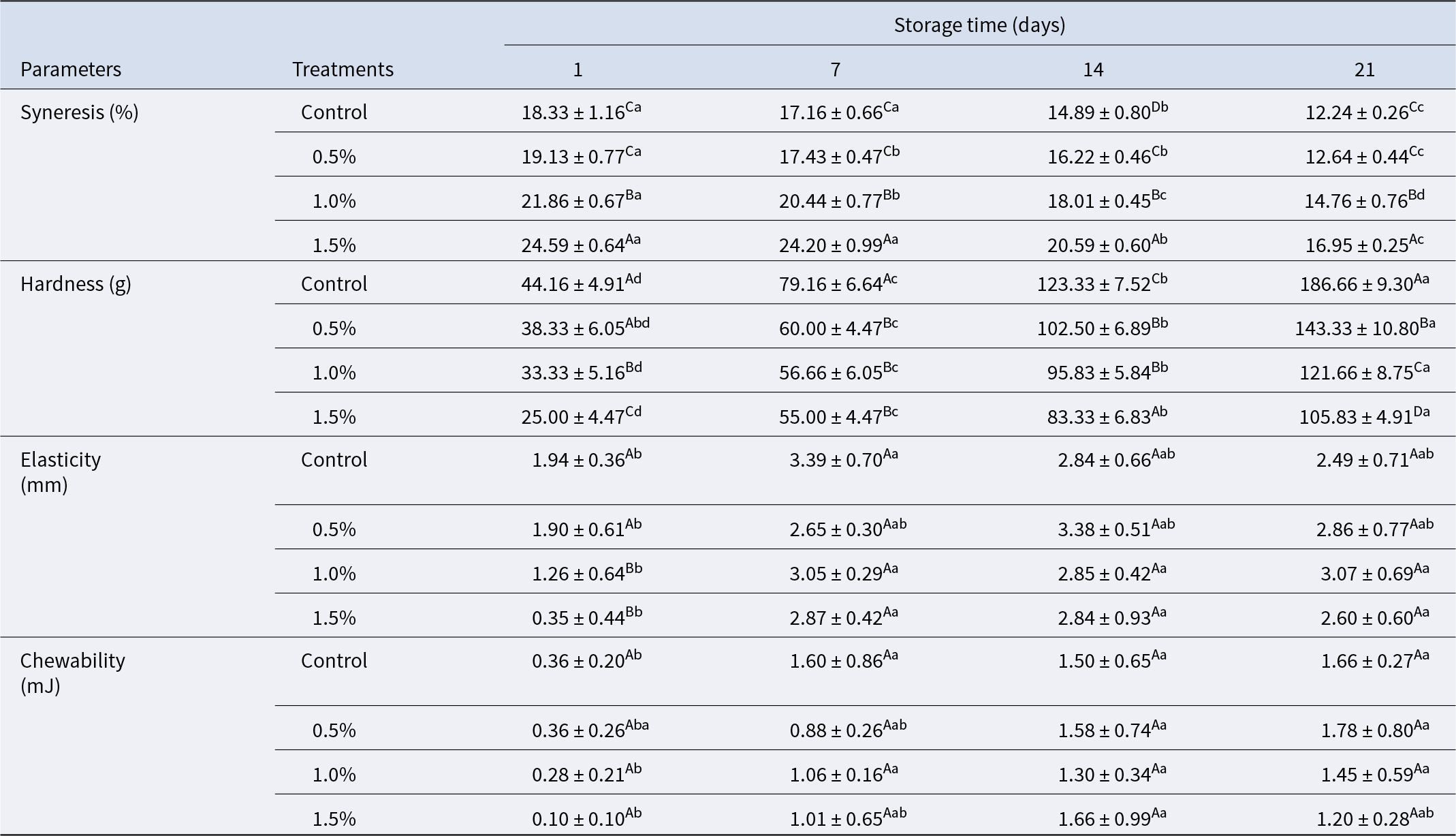
The pH values ranged from 4.63 on the first day of storage to 4.39 in 21 days (Table 3). This cheese was typically slightly acidic (e.g., pH 4.4–5.0) because coagulation occurs close to the isoelectric pH of casein in the production process (Fox et al., Reference Fox, Guinee, Cogan and McSweeney2017). It generates a slightly acidic flavour and aroma, characteristic of fermented foods such as fresh cheese and yoghurt (García-Burgos et al., Reference García-Burgos, Moreno-Fernández, Alférez, Díaz-Castro and López-Aliaga2020; Hurtado-Romero et al., Reference Hurtado-Romero, Zepeda-Hernández, Uribe-Velázquez, Rosales de la Cruz, Raygoza-Murguía, Garcia-Amezquita and García-Cayuela2023). It is important to correlate the lower pH at the end of storage time with the hardness of cheeses. According to Madureira et al. (Reference Madureira, Pintado, Gomes, Pintado and Malcata2011), pH affects the reactivity of the binding sites on casein molecules, thus influencing the matrix structure. Acidification during storage, through the generation of lactic acid, leads to firmer cheeses (Table 4).
Syneresis and texture parameters of Petit Suisse cheeses enriched with pitanga bagasse (Eugenia uniflora L.) During 21 days at 4 ± 1°C

Results are expressed on a wet basis. Control: treatment without PB. 0.5, 1.0, and 1.5% were the concentrations of PB addition (w/w) in the Petit Suisse. Results are expressed as mean ± standard deviation. Means with different capital letters in the same column have a significant difference (P < 0.05). Means with different lower letters in the same row have a significant difference (P < 0.05).
The syneresis index, evaluated by the amount of whey expelled in the cheese, can occur during the storage of dairy products. Table 4 showed the syneresis index and texture profile of Petit Suisse cheeses. There was no difference (P > 0.05) between the control and 0.5% PB during 21 days of storage, except on the 7th day. The lower syneresis index present in these treatments (0 and 0.5% PB) indicates the formation of a gel with a greater water-holding capacity when a force is applied. In contrast, Petit Suisse, with 1% and 1.5% PB, presented greater moisture that is, greater retention of the whey caused by the insoluble fibres of the PB, but with less stability which led to a greater expulsion of this whey under induced syneresis, which is harmful from an industrial point of view. According to Hurtado-Romero et al. (Reference Hurtado-Romero, Zepeda-Hernández, Uribe-Velázquez, Rosales de la Cruz, Raygoza-Murguía, Garcia-Amezquita and García-Cayuela2023), the amount of fruit powder in fermented dairy products is a critical factor in texture properties, formation and stability of gel matrix, syneresis, and viscosity.
Over the storage time, less whey expulsion was observed for all the treatments. For longer storage times, the gels formed will restructure the PB fibre-protein network, strengthening it and reducing the tendency for syneresis (Morais et al., Reference Morais, Soares, Morais, Oriente, Nascimento, Melo, Souza, Cavalcanti-Mata, Lisboa, Gusmão and Abrantes2023).
There was a significant effect (P < 0.05) of PB inclusion on hardness. Higher moisture content produces fewer firm cheeses (Madureira et al., Reference Madureira, Pintado, Gomes, Pintado and Malcata2011). A similar effect was observed in fresh cheese with Helianthus tuberosus Tubers (Elgarhy et al., Reference Elgarhy, Omar, Al-Otibi, EL-Abbassy, Khalifa, Abou Ayana and Saber2023). Insoluble fibre in treatments with 1 and 1.5% PB generated cheeses with higher initial moisture, making them less hard. No differences (P > 0.05) were detected in elasticity (except on the first day of storage) and chewiness. These results differ from Ribeiro et al. (Reference Ribeiro, Guimarães, Lago, Pereira, Abreu and Pinto2021), where including oat bran at different concentrations (3, 6, and 9 g 100 g−1) produces more hardness, chewiness, cohesiveness, and adhesiveness in Petit Suisse.
The hardness of dairy products is dependent on the composition of the gel protein matrix, which is influenced by the total solids content, system protein content, and protein composition (Prudencio et al., Reference Prudencio, Prudêncio, Gauche, Barreto and Bordignon-Luiz2008). So, the gel's structure significantly influences the final product's texture, sensory attributes (smoothness), and chemical stability during storage (Fox et al., Reference Fox, Guinee, Cogan and McSweeney2017). Chemical compounds in PB, especially insoluble fibre modified the extent of casein aggregation during gel formation, the structure of the casein network, and gel permeability (pore size) in the final product (Fig. 1), resulting in less physicochemical stability, more moisture and less hardness. During the storage period, all the cheeses presented less syneresis, more hardness, and chewability. The strengthening of the gel can explain this behaviour at the time (Morais et al., Reference Morais, Soares, Morais, Oriente, Nascimento, Melo, Souza, Cavalcanti-Mata, Lisboa, Gusmão and Abrantes2023).
Scanning electron microscopic images of petit suisse samples with 0% (control), 0.5%, 1%, and 1.5% of pitanga bagasse addition. White is the protein phase. Black is the whey phase. Arrow: calcium phosphate microgranules; F, fat globules; C, curd junction; fi, elongated protein fibres; P, pores.

Fig. 1 shows the scanning electron microscopic images of Petit Suisse cheeses. The presence of casein micelles, whey protein aggregates, and water cavities or pores represented by the dark areas was observed. These pores correspond to air pockets or the aqueous phase evaporating during the samples’ freeze-drying (Ong et al., Reference Ong, Dagastine, Kentish and Gras2012).
In Petit Suisse control, the gel-forming protein is distributed more uniformly, resulting in a thinner gel with smaller interstitial spaces or pores, which slows down the whey flow. Similar microstructure as observed during the cooling stage of the processed cheese, when the dispersed caseinate matrix forms “flocs” that promotes a gritty mouthfeel due to the compact aggregate of proteins (Mehta, Reference Mehta2018). The flocs then interact to form a uniform gel network.
The addition of PB resulted in larger cavities in the product structure (spaces that were previously filled with whey), less compact aggregates, and smaller aggregation structures, which was more evident in the treatments with 1 and 1.5%, indicating low interaction between casein and the compounds present in PB such as fibres, which can lead to a structure with less stability, more fragile and with a greater tendency to syneresis.
Figs. 2 and 3 show the results for the rheological parameters of Petit Suisse cheeses after three days of storage. The continuous flow curve (Fig. 2) showed that the shear stress-shear rate relationship was non-linear for all treatments, a characteristic of non-Newtonian fluids (Silva et al., Reference Silva, Neves, de Oliveira Meira, Alexandre, Oliveira and de Resende2021). The shear stress is reduced with increasing shear rate, classifying them as pseudoplastic, in which viscosity decreases as a function of increasing shear rate (Pereira et al., Reference Pereira, Cavalcanti, Esmerino, Silva, Guerreiro, Cunha, Bolini, Meireles, Faria and Cruz2016).
Continuous flow curve of petit suisse cheeses samples with 0% (control), 0.5%, 1% and 1.5% of pitanga bagasse.

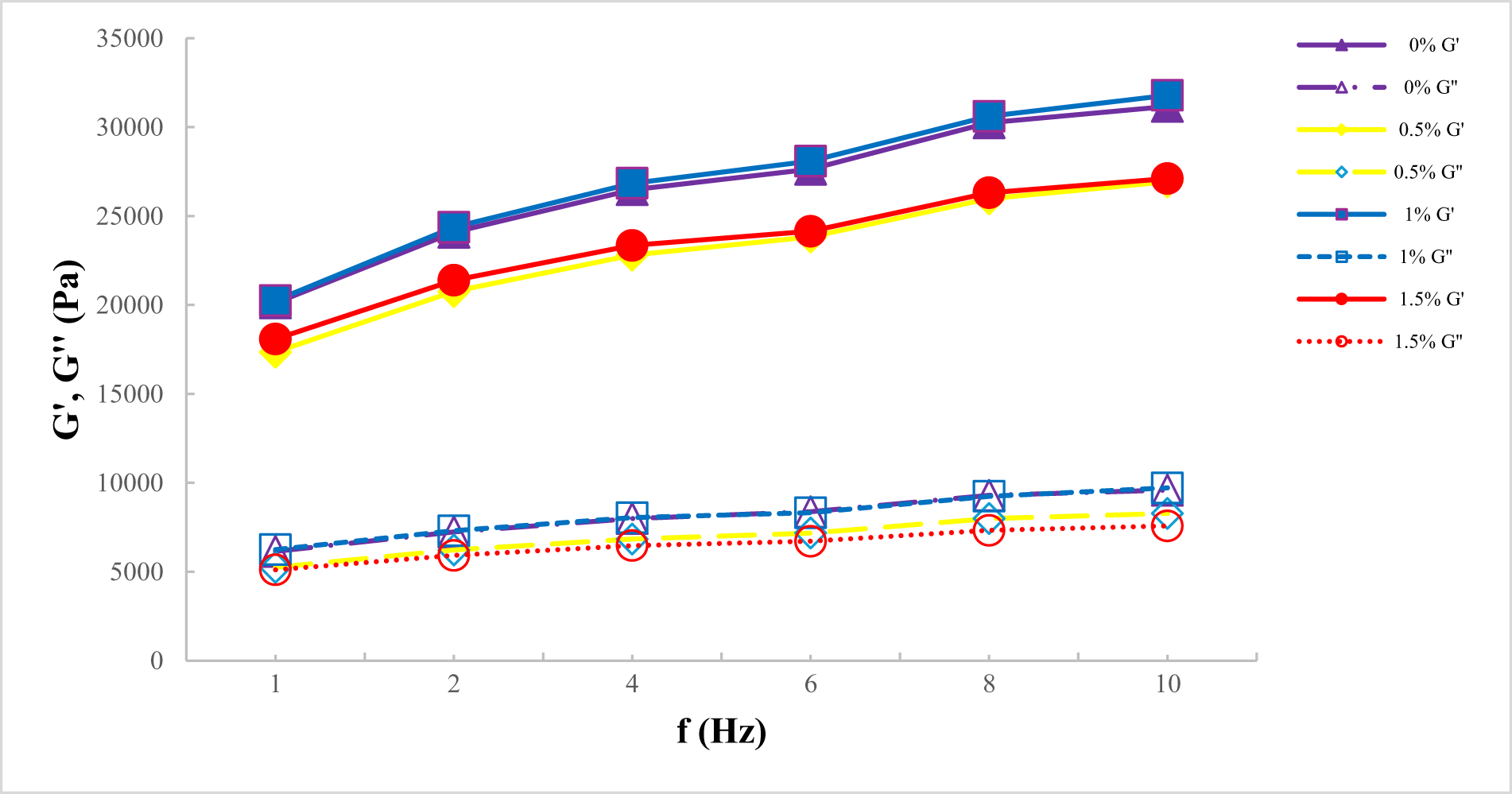
Oscillatory flow curve of petit suisse cheeses samples with 0% (control), 0.5%, 1% and 1.5% of pitanga bagasse.

The thixotropic behaviour can be measured through the area of a hysteresis loop, where the more significant the area, the greater the thixotropic effect (Prudencio et al., Reference Prudencio, Prudêncio, Gauche, Barreto and Bordignon-Luiz2008). With 1.5% PB, Petit Suisse presented the highest hysteresis area (P < 0.05) and the most thixotropic, which the samples’ lower hardness and greater syneresis can explain (Table 5). Such results differ from those of Pereira et al. (Reference Pereira, Cavalcanti, Esmerino, Silva, Guerreiro, Cunha, Bolini, Meireles, Faria and Cruz2016), where a higher concentration of antioxidants added to Petit Suisse exhibited a protective effect on the typical thixotropic behaviour of Quark cheese gel, and samples containing antioxidants generated a less viscous and consistent product.
Sensory acceptance, distribution of scores (%) according to the preference of consumers and purchase intention (n = 60) in the sensory analysis of Petit Suisse cheeses enriched with pitanga bagasse (Eugenia uniflora L.)

0.5, 1.0, and 1.5% of PB addition in the Petit Suisse. Results are expressed as mean ± standard deviation. Means with different capital letters in the same row have a significant difference (P < 0.05). 1: most preferred sample; 2: intermediate; 3: least preferred sample. Sum of orders of each sample = (1 x no. scores 1) + (2 x no. scores 2) + (3 x no. scores 3).
The viscoelastic properties of Petit Suisse's were determined by oscillatory flow analysis (Fig. 2). The G’ value represents the deformation energy stored in the sample during shearing, used as an index of stiffness or elasticity, and the G’’ value represents the measure of the deformation energy during shearing, demonstrating a viscous behavior (Cruz et al., Reference Cruz, Cavalcanti, Guerreiro, Sant'Ana, Nogueira, Oliveira, Deliza, Cunha, Faria and Bolini2013).
In this study, the G’ value was greater than that of G’’ for all treatments. This indicates that the cheeses behaved as predominantly elastic networks, like a gel; the deformations were fully recoverable. The Petit Suisse 0% PB presented higher G’ and G’’ values than the treatments with PB, suggesting that the gel network formed was more interconnected and stable. The cheeses behaved as predominantly elastic networks. Similar results were obtained by Cruz et al. (Reference Cruz, Cavalcanti, Guerreiro, Sant'Ana, Nogueira, Oliveira, Deliza, Cunha, Faria and Bolini2013) and Ramírez-Santiago et al. (Reference Ramírez-Santiago, Lobato-Calleros, Espinosa-Andrews and Vernon-Carter2012) for yoghurts supplemented with oligofructose and reduced-fat Petit Suisse, respectively.
Several factors interfere with cheeses’ rheological behaviour, such as their composition, microstructure, the physicochemical state of their components, and macrostructure, which reflects the presence of heterogeneities such as granule-curd junctions, fissures, and cracks (Fox et al., Reference Fox, Guinee, Cogan and McSweeney2017). In this case, the carbohydrates, especially fibres present in PB can modify the casein network, and the structure of the cheeses becomes less consistent.
Effects of PB addition in the Petit Suisse cheeses on the viability of Lactococcus and Streptococcus during 21 days of storage showed count above 1010 CFU mL−1 during all the storage time. The results reveal that the formulated Petit Suisse cheeses have a probiotic character, as they have more than 108 log CFU g−1, which guarantees the survival of microorganisms when they enter the intestinal tract and thus have their beneficial effects on human health (Shoaei, Reference Shoaei2022). Moreover, traditional dairy products lack dietary fibre, an issue that can be addressed by incorporating plant waste ingredients. This approach allows for the creation of fibre-enriched dairy alternatives that support and enhance gut probiotics (Elgarhy et al., Reference Elgarhy, Omar, Al-Otibi, EL-Abbassy, Khalifa, Abou Ayana and Saber2023).
Sensory analysis is a valuable tool for developing new products. Through it, tasters analyse a product's properties (texture, flavour, appearance, smell) and can direct the market according to their preferences. For all analysed variables, the Petit Suisse with PB reveal scores ranged from 6 (I like it slightly) to 7 (I like it moderately) (Table 5). In the acceptance test, Petit Suisse, with 1% PB, had the better result for all the parameters. These data correlate with the purchase intention (49%) and the order of preference (55%), where the inclusion of 1% PB was more preferred among tasters. The results are like Barcelos et al. (Reference Barcelos, Egypt, Dos Santos, Moraes and Teixeira2020), who evaluated Petit Suisse with acerola pulp, and Pereira et al. (Reference Pereira, Cavalcanti, Esmerino, Silva, Guerreiro, Cunha, Bolini, Meireles, Faria and Cruz2016), who analysed commercial samples from Petit Suisse, showing promising results of this inclusion.
The inclusion of pitanga bagasse (PB) in Petit Suisse cheese resulted in a product with higher fibre content, lower caloric value, higher yield and enhanced antioxidant activity. The addition of PB altered the textural, microstructural, and rheological properties of the cheese. Cheeses containing 1% and 1.5% PB demonstrated reduced hardness, with a gel network that was less interconnected, as well as diminished stability and elasticity.
All the cheeses demonstrated probiotic characteristics. Notably, the cheeses achieved high sensory acceptance, particularly those with 1% PB. Pitanga bagasse has the potential to serve as an antioxidant additive in Petit Suisse cheese, improving its nutritional and functional properties. As future perspectives, it is suggested to evaluate the bioaccessibility of antioxidant compounds in Petit Suisse subjected to digestion processes (oral, gastric, and enteric) and colonic fermentation.
Supplementary material
The supplementary material for this article can be found at https://doi.org/10.1017/S002202992510109X.
Acknowledgements
We thank the Coordenação de Aperfeiçoamento de Pessoal de Nível Superior (CAPES) and Conselho Nacional de Desenvolvimento Científico e Tecnológico (CNPq) for fundings, and COMCAP/UEM for the rheometer and Scanning Electron Microscopy use.