Introduction: The History of Prisoners as Living Donors
In a 1964 article on kidney transplantation in JAMA, Dr. Thomas Starzl, one of the pioneers of organ transplantation, described 12 kidney transplants that had been performed since November 1962 at the University of Colorado. Footnote 1 Two involved deceased donor kidneys, the other 10 involved living donor kidney grafts. The relationships between the living donors and recipients were one mother to child; five sibling pairs; two spouses; and two who were unrelated. One of the donors was a volunteer who had responded to an advertisement and the other was a prisoner (who 12 days postoperatively “disappeared from the ward and has not been seen since”). Footnote 2 Later that year, Starzl and colleagues described 40 kidney transplants performed at the University of Colorado. Nine of the donors were prisoners. Footnote 3
The first symposium on ethics and transplantation was held in England in 1966, funded by the Ciba Foundation. Footnote 4 At that meeting, several participants challenged Starzl’s practice of appealing for donors at state prisons. Starzl argued that fewer than 100 of the 4,000 inmates expressed any interest, supporting his position that they were free to refuse and were acting on their own volition. He also suggested that they were under less pressure than some people experience from their families. He emphasized that “the consent form contained two written stipulations: (1) no pay was involved and (2) no reduction in the period of servitude was offered.” Footnote 5 He also noted that that many of the prisoners were nearing the completion of their sentence, supporting his position that they understood that this action would not shorten their penal obligation. However, by late 1966, Starzl stopped accepting prisoners as donors after “private and informal conversations with Professor David Daube,” a British legal scholar who was an attendee at the Ciba-sponsored symposium. Starzl stated, “The latter discussant had convinced me that the use of penal volunteers, however equitably handled in a local situation would inevitably lead to abuse if accepted as a reasonable precedent and applied broadly.” Footnote 6 The interest in prisoners serving as living donors was also diminished as the medical community began to realize that conditions such as hepatitis (and later on HIV/AIDS) were overrepresented in the prisoner population. Footnote 7
In the intervening 50 years, prisoners have infrequently served as living donors, and in those cases, they have donated to family members. Footnote 8 But the participation of prisoners as living donors came to national attention in 2010 when Governor Haley Barbour of Mississippi offered indefinite suspensions of the life sentences of Jamie and Gladys Scott provided that Gladys donate a kidney to her sister Jaime who had end stage renal disease (ESRD) within one year of their release. Footnote 9
In this article, we examine the ethics of prisoners participating as living solid organ donors (liver or kidney). We compare the prisoner as living donor with the prisoner as participant in medical research, as both living donors and research participants agree to participate with the primary goal of benefiting third parties. We show how the concept of vulnerability used in research ethics can help us understand the challenges to voluntary consent faced by prisoners considering living donation. Finally, we argue that the offer of sentence reduction as an incentive to encourage living organ donation is unethical. We focus our discussion on the prisoner who seeks to donate directly to a family member, as current federal policy restricts living donation by prisoners to first degree relatives. Footnote 10 Whether the current policy could be interpreted to allow a prisoner who is ABO incompatible or crossmatch positive with a family member to participate in a paired exchange (which would mean that the prisoner donates to a stranger in exchange for another stranger donating to his or her intended recipient Footnote 11 ) has, to our knowledge, not yet been discussed in the literature or challenged in the courts. The question of whether prisoners should be allowed to donate beyond the family (e.g., to friends or strangers) and whether they should be allowed to participate in exchanges go beyond the scope of the article.
The Prisoner as Vulnerable Research Subject
In response to several notable egregious research studies, most notably the United States Public Health Service Syphilis Study at Tuskegee, Footnote 12 the National Commission for the Protection of Biomedical and Behavioral Research (hereinafter referred to as the National Commission) was established in July 1974 under the National Research Act (PL 93-348). Footnote 13 The National Commission was specifically charged with developing federal human research subject protections for biomedical and behavioral research, and prisoners were considered one vulnerable group that needed additional protections. Footnote 14 The resulting guidelines for the protection of human research subjects were codified in 45 C.F.R. 46. Subpart A, the Common Rule which applies to all research participants, and additional protections were codified in the various subsections; Subpart B, Pregnant Women, Human Fetuses, and Neonates; Subpart C, Prisoners; and Subpart D, Children. Footnote 15
In the decades prior to the establishment of the National Commission, prisoners participated in research in large numbers. During World War II, prisoners participated in research designed “to develop treatment for infectious diseases that afflicted our armed forces” and continued to participate after the war because of the rapid expansion of biomedical research and the governmental policies for drug testing. Footnote 16
The charge given to the National Commission was timely. Investigative reports from the 1960s and 1970s described widespread abuse in medical research conducted in prisons. Footnote 17 The National Commission’s Report, Research Involving Prisoners, published in 1976, questioned whether incarceration truly allowed for free choice in deciding whether to participate in research: “the availability of a population living in conditions of social and economic deprivation makes it possible for researchers to bring to these populations types of research which persons better situated would ordinarily refuse.” Footnote 18 The National Commission concluded that given the vulnerabilities of the prisoners, they should only participate in research that offered direct benefit to the prisoners as individuals or to prisoners as a group. The research should also focus on health problems that are serious for or within this population. The result was the closing down of much prison-based medical research.
During the decades prior to the National Commission’s reports and the Federal Regulations that were developed from them, research subjects were typically paid. This was also true of the prisoner research subjects. The National Commission noted that prisoners were willing to participate for very small financial incentives, because alternative opportunities to earn money in prison were few and meager. To avoid “coercion or undue influence,” Subpart C restricted the use of incentives in research involving prisoners:
§46.305 (a)(2) Any possible advantages accruing to the prisoner through his or her participation in the research, when compared to the general living conditions, medical care, quality of food, amenities and opportunity for earnings in the prison, are not of such a magnitude that his or her ability to weigh the risks of the research against the value of such advantages in the limited choice environment of the prison is impaired; and…
§46.305 (a)(6) Adequate assurance exists that parole boards will not take into account a prisoner’s participation in the research in making decisions regarding parole, and each prisoner is clearly informed in advance that participation in the research will have no effect on his or her parole. Footnote 19
That is, the Federal Regulations were designed to protect vulnerable prisoners from participating in research against their better judgment by removing two disparate sources of “undue influence” that could interfere with their ability to give an informed and voluntary consent: large financial incentives and sentence reduction.
Another means of protecting prisoners enumerated in the Federal Regulations was to require institutional review boards—committees that oversee human subject protections—to include a prisoner, or a prisoner representative with appropriate background and experience when reviewing a research project involving the recruitment and participation of prisoners. Footnote 20
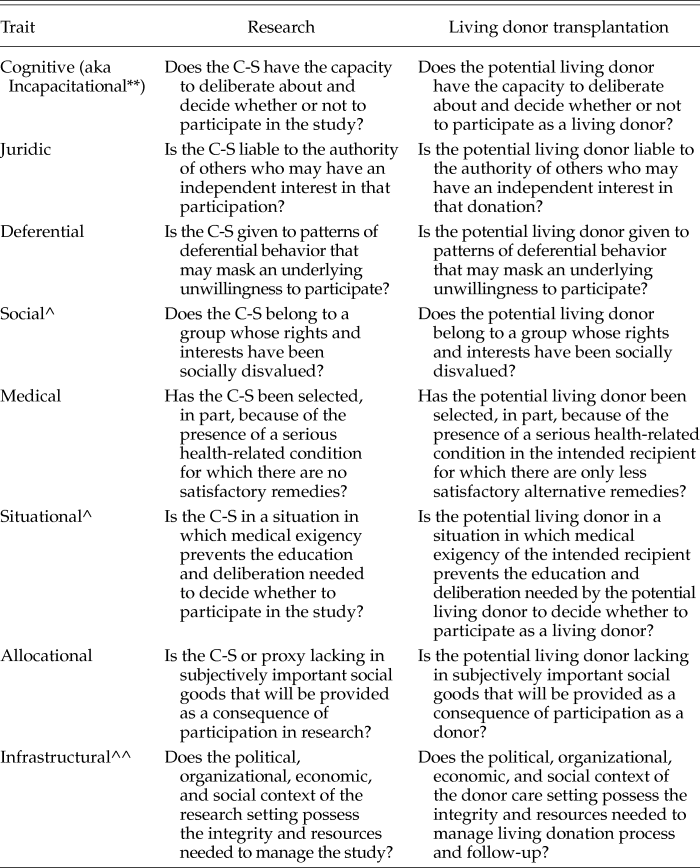
A quarter of a century later, Ken Kipnis argued that the National Commission’s classification of certain groups of people as vulnerable was inadequate: it was not comprehensive, and it ignored other groups as vulnerable as those enumerated by the National Commission “for example, drug abusers, the desperately ill, Ugandan women, illegal aliens, the impoverished homeless.” Footnote 21 Kipnis argued that it would be more effective to develop a taxonomy of the different types of vulnerabilities rather than to identify specific vulnerable subgroups. He proposed six discrete types of vulnerability: cognitive, juridic, deferential, medical, allocational, and infrastructural that “are intended to represent the ethically relevant features that bespeak vulnerability, not only in the designated subpopulations but in other groups as well.” Footnote 22 Although he claimed that the list was meant to be exhaustive, in an article 2 years later focused on children as research subjects, he proposed seven discrete types of vulnerability. Footnote 23 Five of the seven overlapped with his original list: incapacitational (in place of cognitive), juridic, deferential, medical, and allocational. Kipnis added two additional traits: social and situational vulnerabilities, and omitted infrastructural vulnerabilities. If one combines the two lists, there are eight discrete vulnerability traits (see Table 1, column 1) that define those circumstances that “call into question the efficacy of consent in effecting the permissibility of research.” Footnote 24 We believe that these traits can also be useful for evaluating the consent of the living donor. Using a modified version of Kipnis’ typology (see Table 1, column 2), we will examine the vulnerabilities that prisoners face that may interfere with their ability to consent freely to living organ donation.
Eight Vulnerabilities of Potential Living Donors adopted from Kipnis’s Research Candidate-Subject (C-S) Vulnerabilities*

*This table is developed from two articles by Ken Kipnis; see notes 21 and 23.
**In the article cited in note 23, Kipnis refers to this trait as “incapacitational” rather than “cognitive,” and focused on the situation in which the potential subject, a child, could not speak for him/herself. “Incapacitational” was used to mean: “Does the C-S lack the capacity to deliberate about and decide whether to participate in the study?” We have elected to use the more neutral phrasing: “Cognitive” to mean “Does the C-S have the capacity to deliberate about and decide whether or not to participate in the study?” which was the phrasing found in the article cited in note 21.
^This trait did not exist in the article cited in note 21, but was added in the article cited in note 23.
^^This trait existed in the article cited in note 21, but was omitted from the article cited in note 23. To be comprehensive, it is included here in modified form as a potential vulnerability for the living donor.
Incentivizing Prisoners to Serve as Living Donors
The prisoners whom Starzl recruited as living donors were unique both because they were incarcerated and because they were living donors with no genetic or emotional relationship to the recipient. At that time, most centers would not have accepted law-abiding citizens who volunteered to donate to strangers. Footnote 25 By the late 1980s and early 1990s, the willingness to accept non-biologically related donors was growing. Footnote 26 Donations between strangers (known as Nondirected donation or Good Samaritan donation) only became routinely accepted after the publication by Matas and colleagues in the New England Journal of Medicine in 2000. Footnote 27 Today, United States prisoners are not permitted to donate to strangers; however, they can and do donate to family members on a case-by-case basis. Footnote 28
More recently, however, there have been some proposals to incentivize prisoners to serve as nondirected donors by offering a reduction in their prison terms in exchange for organ or tissue donation. In 1998, Missouri State Representative Chuck Graham proposed a bill that offered “a life for a life”. Footnote 29 The bill targeted death row inmates and offered them a reprieve from execution to a sentence of life without parole if they donated a kidney. In 2007, South Carolina State Senator Ralph Anderson introduced Senate Bill 480 (SB 480) which offered to reduce a prisoner’s sentence by 180 days for a kidney. Footnote 30 Neither bill passed.
Even had the proposals passed in the United States, they would not have been implementable without modifications to the National Organ Transplantation Act (NOTA) of 1984, which specifically prohibits “any person to knowingly acquire, receive, or otherwise transfer any human organ for valuable consideration for use in human transplantation if the transfer affects interstate commerce.” Footnote 31 The phrase “valuable consideration” can be understood to prohibit payment as well as any other form of benefit such as reduction of a prison sentence. As one legal scholar, Emily Lee, explains, “Liberty, unlike monetary compensation, is not quantifiable, but it is still undeniably valuable.” Footnote 32
Therefore, it came as a surprise when in late 2010, Mississippi Governor Haley Barbour released Jamie and Gladys Scott who had served 16 years of their life sentences for armed robbery convictions on the condition of organ donation by Gladys to Jamie. Jamie Scott had ESRD and her release was what is known as a humanitarian or medical release. Her sister Gladys had offered to donate a kidney, which led to the governor offering her a conditional release. She was given 1 year to donate a kidney to her sister, or she could be sent back to prison.
After their release, it was determined that Jamie needed to lose weight to be eligible for an organ and Gladys needed to lose weight to be eligible to donate. As of July 2016, Jaime remains on dialysis. Footnote 33 Despite breaking this condition of parole, there has not been any attempts to reincarcerate the sisters.
Although the illegality of this conditional release seems obvious, Jefferson-Jones explains that this is not how the Mississippi governor understood the situation:
The Governor’s spokesperson denied that the exchange may have been illegal and instead pointed to Gladys’s petition to the parole board in which she indicated her willingness to donate. Gladys Scott even publicly claimed that it was her idea to donate her kidney to Jamie and that she would have done so willingly, even without the promise of freedom. This Article argues that one may therefore surmise that both Gladys and the Governor thought that the potential issue of valuable consideration (to the extent that they were aware of the issue) was meaningless because Gladys actually wanted to give a kidney to Jamie [footnotes omitted]. Footnote 34
Jefferson-Jones goes on to explain that they were wrong in their interpretation, and the deal was a violation of NOTA, whether or not Gladys volunteered. Footnote 35
Is it Ethical to Allow Prisoners to Serve as Living Donors? A Vulnerabilities Analysis
Although the courts have specifically stated that there is no legal right for a prisoner to be a living donor, Footnote 36 Goldberg and Frader have argued persuasively that prisoners, as members of humanity, should be allowed to donate to help a loved one if they can give a voluntary and informed consent. Footnote 37
The concern of whether a potential donor can give a voluntary and informed consent is a concern not unique to prisoners and is a concern recognized early on. At the Ciba Foundation symposium 50 years ago, some transplant professionals described incorporating a psychological evaluation into the living donor workup to ensure voluntariness and adequate information. Footnote 38 In 2000, the Live Organ Donor Consensus Report supported “an independent advocate for the donor…whose only focus is the best interests of the donor.” Footnote 39 The donor advocate was conceived as an individual who would help empower the potential donor to understand the risks, benefits, and alternatives and then to freely decide whether or not to donate. The Live Organ Donor Consensus Group believed that the donor advocate should have the authority to veto the donation if the consent was not informed and voluntary. Footnote 40 This was given further support in 2002 when the Department of Health and Human Services Advisory Committee on Organ Transplantation recommended an independent donor advocate to ensure that informed consent standards were met. Footnote 41 In 2007, the Centers for Medicare and Medicaid Services mandated a donor advocate for all living donor organ transplants. Footnote 42 These independent donor advocates are now referred to as living donor advocates (LDAs). Footnote 43 Some programs involve living donor advocate teams (LDATs), which are made up of two or more persons who evaluate, educate, and advocate for the living donor. Footnote 44 The LDAT approach acknowledges that all the skills needed to provide these services may not reside in one individual.
When the donor is a prisoner, there are additional vulnerabilities that may interfere with a free and voluntary consent process. Most LDAs or LDATs are unlikely to have the expertise to determine a potential donor’s ability to understand risks and benefits in the setting of incarceration, where the individual’s autonomy is compromised and daily life activities and well-being are controlled by others. The training and experience of LDAs enable them to detect and address the nuanced differences among potential living donors and their individual personal and social circumstances; however, is unlikely to give them adequate insight into the additional vulnerabilities that incarceration is likely to impose, and how these vulnerabilities affect decisionmaking for individual prisoners. We propose the mandatory inclusion of a social worker or psychologist who works or has worked with prisoners to be added to the LDAT on an ad hoc basis when a prisoner is being considered as a living donor. We will call this person a “prisoner liaison” (PL). The PL will have a better understanding of the constraints of prison life and its impact on decisionmaking, and can help determine whether the prisoner’s consent is informed and voluntary.
A vulnerabilities analysis can assist in the understanding of what additional challenges and concerns may be faced by the prisoner who is contemplating serving as a living donor. We use the modified vulnerabilities taxonomy enumerated in Table 1 and describe how these incarceration-related vulnerabilities can be addressed by including a PL as a member of an LDAT when the potential living donor is a prisoner.
Cognitive Vulnerability
Consider the first vulnerability trait: “Cognitive: Do prisoners as potential living donors have the capacity to deliberate about and decide whether or not to participate as a living donor?” Millis and Simmerling argue that most prisoners have the decisional capacity to serve as living donors because they otherwise would not have been allowed to stand trial. Footnote 45 They also note that prisoners can consent to being an organ recipient.
Millis and Simmerling may be a bit too quick in making their capacity assessment. First, capacity is not all-or-none, but rather decision specific. Footnote 46 This means that just because one can voluntarily consent to receiving a kidney does not mean that one can voluntarily consent to donating a kidney. There is a lower threshold for consenting to a lifesaving treatment than for consenting to a surgery that offers no clinical benefit to the patient but only to a third party. Footnote 47 Second, the data about prisoners are skewed to those with lower educational attainment. In 1997, approximately 41 percent of inmates in United States state and federal prisons and local jails and 31 percent of probationers had not completed high school or its equivalent. In comparison, 18 percent of the general population 18 years of age or older had not finished the 12th grade. Footnote 48 In 2002, Cunningham and Vigen reviewed 13 clinical studies of death row inmates conducted over the past 35 years, and found that they were frequently intellectually limited and academically deficient. Footnote 49 Although low educational attainment or low IQ is not an absolute contraindication to donation, it does raise red flags regarding the candidate donors’ ability to understand the risks of the procedure as well as their right to renege. Footnote 50
Mental illness may also impair an individual’s ability to make an informed decision, and mental illness is common among prisoners. In a 2002 analysis of 62 surveys of prisoners from 12 countries, Fazel and colleagues found that overall 5 percent (3–7 percent) of incarcerated men had psychotic illnesses, 10 percent (9–11 percent) had major depression, and 65 percent (61–68 percent) had a personality disorder, including 47 percent (46–48 percent) with antisocial personality disorder. A total of 4 percent of incarcerated women (3.2–5.1 percent) had psychotic illnesses, 12 percent (11–14 percent) had major depression, and 42 percent (38–45 percent) had a personality disorder, including 21 percent (19–23 percent) with antisocial personality disorder. Footnote 51 These statistics show that prisoners have a two- to four-fold excess risk of psychotic illness and major depression and about a ten-fold excess risk of antisocial personality disorder compared with the general population of similar age in the United States and the United Kingdom. Footnote 52
Drug and alcohol problems are also common. Fazel and colleagues analyzed 13 studies, and found that the “estimates of prevalence for alcohol abuse and dependence in male prisoners ranged from 18 to 30% and 10 to 24% in female prisoners. The prevalence estimates of drug abuse and dependence varied from 10 to 48% in male prisoners and 30 to 60% in female prisoners.” Footnote 53 Again, these are only risk factors; however, they suggest that a thorough capacity assessment is necessary. This is not to deny that many smart, sober, mentally healthy individuals also have difficulty understanding risks, especially in the high-stakes healthcare arena for procedures such as transplantation, but only to emphasize, when the potential living donor is a prisoner, the need for a robust LDAT that includes a PL who helps the potential donor think through the issues, including the risks, benefits, and alternatives.
Juridic Vulnerability
“Is the potential living donor liable to the authority of others who may have an independent interest in that donation?” One problem with prisoners serving as living donors is that they are liable to the authority of prison officials who have legal authority over them, even if the prison officials are not particularly invested in organ transplantation. No data exist; however, one could imagine that an advertising campaign to promote nondirected donation would be supported by some prison authorities who feel that prisoners “owe” it to the rest of society, or who even think that the prisoner is of little social value and, therefore, should be used to do some “good” for others. The task for the healthcare team is “to devise a consent procedure that will adequately insulate the prisoner from the hierarchical system to which he or she is subject,” Footnote 54 although some would question whether prisoners can ever give a truly voluntary consent given “the inherently coercive prison environment.” Footnote 55 Most LDAs and LDATs will not have a true grasp of the constraints of prison life and its impact on decisionmaking; however, this can be achieved with the addition of a PL to the LDAT. In addition, even though prisoners may be explicitly told that a reward is not permitted and that the information cannot be included in a parole hearing, there may be some implicit expectation of reward (e.g., earlier parole, better work assignment) for good behavior. An LDAT that includes a PL should only permit the donation to proceed if they are convinced that the prisoner is not motivated by an expectation of external reward.
Deferential Vulnerability
“Is the potential living donor given to patterns of deferential behavior that may mask an underlying unwillingness to participate?” Although juridic and deferential vulnerabilities certainly overlap and are often present together, juridic vulnerability entails a relationship in which one person has formal authority or power over the other whereas deferential vulnerability involves subjective responses (from respect to fear to insecurity) by the individual to certain others. Footnote 56 Although becoming a living donor is elective, the prisoner may feel social pressure to donate from his or her family, who exert some degree of informal control over the prisoner. Family ties are often of great importance for prisoners. Family members are the most likely individuals to visit a prisoner and are the most important source of support when the prisoner is released. Footnote 57 Therefore, one can conjecture that there is some degree of deferential vulnerability because prisoners may feel some degree of dependence on their families who are often their prime external contacts. Therefore, when a prisoner is informed that a family member needs an organ transplant, the prisoner may offer to be the donor either out of fear that not donating may lead to alienation or out of hope to do something positive as a way of “giving back.” Many prisoners provided financial support to their families before incarceration; they may have also offered physical and emotional support. Incarceration takes away these abilities to provide support and as such, the idea of donation may be a way of “giving back.” Footnote 58 In other scenarios, the prisoner may be asked to serve as the donor either because he or she is more “expendable” than other family members or because other family members cannot afford to take the time off for the workup and recuperation. The British Transplantation Society recently promulgated guidelines in which they asserted that the prisoner must be a “last resort”; Footnote 59 however, that is not a requirement in the United States guidelines, which only require that the donor be a first degree relative. Footnote 60 Again, the LDAT and PL should work with the prisoner to ensure that the donation is truly what he or she wants to do, to reassure the prisoner that third parties (both prison staff and family) need not be told the reasons for exclusion if he or she elects not to proceed, and to ensure that the prisoner understands what, if anything, is being offered in return (e.g., the potential for improved self-esteem and/or improvement in family relationships), but without guarantees, as well as what is not being offered (earlier parole or preferential treatment).
Social Vulnerability
“Does the potential living donor belong to a group whose rights and interests have been socially disvalued?” As Kipnis explains, “social vulnerability points to the ways in which entrenched prejudice and stereotypical thinking can compromise the care and consideration that would ordinarily be present.” Footnote 61 The history of research in prisons affirms that those in authority are willing to expose prisoners to significant risk even when no benefit is expected to accrue to the participants. Footnote 62 The PL’s role in the LDAT is to evaluate the threats that incarceration poses to donor voluntariness on account of their social devaluation.
Medical Vulnerability
“Has the potential living donor been selected, in part, because of the presence of a serious health-related condition in the intended recipient for which there are only less satisfactory alternative remedies?” For example, there may be external pressures if the intended recipient is doing poorly with dialysis, or even if the intended recipient is just unhappy with the burdensomeness of therapy. External pressures may be exacerbated if the intended recipient is sensitized to other family members who were tested for compatibility for living donation. It is critical that the LDAT and PL ensure that the prisoner understands that there may be other options for the candidate recipient. There are different modes of dialysis (e.g., peritoneal as well as hemodialysis). In addition, there is the possibility of desensitization protocols that would make it feasible for another family member to donate either directly or in a donor exchange program. However, even if the other alternatives are less effective, the prisoner must understand that he or she may still choose not to donate without repercussions from the penal system and without disclosure of the reason to the candidate recipient and family.
Situational Vulnerability
“Is the potential living donor in a situation in which medical exigency of the intended recipient prevents the education and deliberation needed to decide whether to participate as a living donor?” Consider, for example, a patient who presents in acute liver failure (ALF) and the physicians fear that a deceased donor will not become available in time. They ask about potential living donor volunteers. This scenario creates both a medical and a situational vulnerability for any potential living donor, whether a prisoner or a civilian. The medical vulnerability is that there is a very high likelihood that a deceased donor organ will not become available in time. To avoid the risk of recipient death, the physicians may encourage parallel workups of willing family members. ALF creates a situational vulnerability for all potential living donors because they have to undergo a complete medical and psychosocial workup in a very short period of time without much time for reflection about the risks and benefits.
We believe that a compressed workup is inadequate for evaluating a prisoner, given the numerous vulnerabilities he or she faces. It is also strategically problematic because of the complexities of getting the requisite resources (e.g., getting permission from appropriate prison authorities, hiring of guards, arranging transport) to undergo the workup in such a limited time frame. When time is so limited (situational vulnerability), it is difficult to ensure that even an unincarcerated competent adult has adequate time to make an informed decision, and transplant teams should restrict donation to those who are not at increased vulnerability.
Allocational Vulnerability
“Is the potential living donor lacking in subjectively important social goods that will be provided as a consequence of participation as a donor?” Incarceration threatens many social goods because prisoners lose most opportunities to control their own environment and must follow externally imposed constraints on activities and relationships. Prisoners may want to donate for personal, emotional, or spiritual redemption, or because they believe it will improve their self-esteem and self-respect or improve their relationships with the recipient and the wider family. Although there are data that show these benefits accrue to some donors, Footnote 63 there are no guarantees that any particular donor will gain these benefits. These intangible benefits may be harder to secure for a prisoner, given that postdonation, the prisoner will return to the isolation and hierarchy of the prison environment where redemption may seem illusory. It is critical that the LDAT and PL both help the prisoner understand what can and cannot be promised or guaranteed as a result of donation.
Infrastructural Vulnerability
“Does the political, organizational, economic, and social context of the setting possess the integrity and resources needed to manage living donation?” This vulnerability includes concerns about whether potential living donors who are incarcerated have adequate access to the resources necessary to get optimal medical and psychological evaluation at the transplant hospital, and concerns about whether potential prisoner donors can get adequate evaluation and counseling by an LDAT that includes a PL. It is equally important to ascertain whether there will be adequate access to resources necessary in the setting of incarceration for recovery from the donor procedure (access to adequate pain medication, skilled specialty nurses and physicians, and recovery-appropriate physical activities) and assured access for long-term transplant donor-specific follow-up care. Given the limitations of healthcare access in most prisons, Footnote 64 the answer may well be no. Although all prisoners ought to be guaranteed adequate access to healthcare, given the increasing awareness of the long-term health implications of living donation, especially kidney donation, Footnote 65 adequate care must be ensured before increasing the number of prisoners serving as living donors.
The practicalities of the infrastructural vulnerabilities may be too overwhelming for the prison system to permit the donation. First, there is the issue of who will pay for the additional resources needed; for example, guards for inpatient care pre- and postsurgery, and guards for transporting the prisoner to and from the transplant clinic and overseeing prisoners during appointments both before and after the donor surgery admission. The Department of Justice (DOJ) program statement on patient care explicitly states that it does not cover these expenses: “Hospitalizations or fees involved will not be at the Government’s expense including all costs associated with guarding the inmate at off-site facilities. This includes the US Marshals Service.“ Footnote 66 If the costs are not covered by the recipient’s insurance, they may have to be paid for privately, or the donation cannot proceed.
Second, transplant programs may be reticent to accept prisoners as living donors, even if the prisoner is a first degree family member, because incarceration increases the potential donor’s risk of being infected with HIV and/or hepatitis and transmitting it unintentionally with the donor organ. Footnote 67 The increased risk status must be disclosed to potential recipients even if the potential prisoner donor screens negative for these infections. Footnote 68 There is a period of time during which the newly infected may not test positive, or an individual can become infected between the time of testing and the time of donation. Footnote 69 Improvements in viral testing have reduced but not eliminated this window of risk. Although donors are told to refrain from high risk activities in the time between evaluation and donation, compliance cannot be assured, in part because some prisoners may engage in high risk activities involuntarily.
The PL can help strategize with the prisoner regarding risk reduction. Although the LDAT may be best situated to discuss the risks of infection transmission by organ transplantation and its frequency, the PL is best situated to evaluate and discuss these risks in the context of incarceration in general and in the context of the individual prisoner’s life within the prison. One proposed solution is to put prisoners in “medical isolation” between evaluation and donation, which may, unfortunately, translate into solitary confinement. Footnote 70 Solitary confinement may cause serious psychological harm and may not be in a prisoner’s best interests. The PL must evaluate the potential ill effects that solitary confinement might cause the prisoner, and such a strategy should not be imposed without the potential donor’s understanding and informed consent. Footnote 71 Even if the potential donor agrees to voluntary medical isolation, the PL must ensure that the prisoner understands that he or she has the right to withdraw from voluntary solitary confinement if the burdens become too great. The PL must also ensure that the prison staff understands the voluntary nature of this specific confinement.
How Do Incentives Impact the Vulnerabilities Analysis?
One difference between research participation and living donation is the permissibility of tangible incentives. In the research world, some incentives are permitted, provided they do not exert “undue influence” such that the potential participant feels as if he or she cannot refuse the offer. Footnote 72 There are even greater restrictions on what can be offered to prisoners because of the actual circumstances in which they live (infrastructural vulnerability). In contrast, incentives are prohibited in organ donation for both prisoners and the general population. Freedom is an important allocational good that prisoners lack, and the possibility of a reduction in sentence time is an offer that can be categorized as exerting “undue influence”: it is so tempting that donors may be unable or unwilling to truly consider the actual donation risks. As such, the offer interferes with the prisoner’s ability to give a truly informed consent and it is appropriately prohibited by the DOJ. Footnote 73
Concluding Remarks
In sum, Kipnis’s vulnerabilities approach for human research subject protections can be modified to address living donation. The vulnerabilities framework helps illuminate potential threats to the prisoner’s decisionmaking process. To overcome these threats, the prisoner requires access to an LDAT that includes a PL, as well as access to appropriate education and resources. It will be critical that the prisoner understand the risks, benefits, and alternatives to living kidney donation for him- or herself and for the potential recipient. An LDAT that includes a PL can attempt to provide the resources to overcome the vulnerabilities that may interfere with the prisoner’s comprehension. They can help the prisoner examine his or her own motivation and willingness, and examine the added psychological and physical burdens that incarceration may create for the potential donor. If either the PL or any other member of the LDAT does not feel that the donor is acting freely and knowledgeably, the donation should be prohibited.
We agree with Goldberg and Frader that prisoners should not be uniformly prohibited from serving as living donors out of respect for their humanity. Footnote 74 However, it must be recognized that incarceration imposes specific additional psychological and logistical vulnerabilities that may make organ donation an inappropriate course of action for many incarcerated individuals. In addition, modifying current federal regulations to permit sentence reduction or other tangible benefits related to incarceration status would exert “undue influence,” and, therefore, is ethically unacceptable.