Introduction
Since coconut oil is the main commercial product in many coconut-producing countries, the industry may put more effort into producing the best quality oil rather than increasing the quality of the copra meal by-products. Various reports have identified that copra meal is of typically poor nutritional and feeding value when it was used as a feed ingredient in poultry diets. The poor quality of copra meal is due to its low concentration of several limiting amino acids (Creswell and Brooks, Reference CRESWELL and BROOKS1971; NRC, Reference NRC1994; Sundu et al., Reference SUNDU, KUMAR and DINGLE2009), heat damage during drying and oil extraction process (Butterworth and Fox, Reference BUTTERWORTH and FOX1963) and high levels of dietary fibre (Knudsen, Reference KNUDSEN1997; Sundu and Dingle, Reference SUNDU and DINGLE2003; Sundu, Reference SUNDU2008).
Although efforts have been made to improve the feeding value of copra meal through physical and enzymatic treatments (Sundu et al., Reference SUNDU, KUMAR and DINGLE2005) and fermentation (Hatta and Sundu, Reference HATTA and SUNDU2009), limited success has been achieved in improving its nutritive value to allow acceptable levels of body weight gain in poultry. Many of the results were far from the body weights expected from standard breed tables. Instead of focusing on improving its nutritive value, extracting mannans from copra meal is the other area that can be potentially useful as a feed additive. Sundu and Damry (Reference SUNDU and DAMRY2008) pioneered research into using beta-mannans from copra meal as a prebiotic to replace antibiotic growth promoters and as a mycotoxin binder, since mannan-oligosaccharides from yeast have been successfully used to improve performance and health status of birds for decades. Since then, several authors have reported the success of using CM in the diets of broiler chickens (Yamin, Reference YAMIN2010; Fitryani, Reference FITRYANI2009). This paper reviews the potential use of CMs as either a prebiotic or a novel mycotoxin binder as compared to other similar products for broiler chickens.
Plant mannans
Southgate (Reference SOUTHGATE1991) classified mannans as; ‘reserve polysaccharides which are mainly the polymer of mannose, linked by either alpha or beta configuration’. Typically, mannans are encountered in different sub-families, depending upon the presence of other sugars in the polymer chain and these include pure mannan, galactomannan and glucomannan, and linkage configuration such as alpha and beta-mannan. Pure mannan is a polymer of mannose as it contains more than 95% mannose. The presence of galactose and glucose were reported in the side chain form in galactomannan and glucomannan respectively (Aspinal, Reference ASPINAL1970). Since the main component of these mannans is mannose, which forms the backbone of this carbohydrate, the term ‘mannan’ is widely used to refer to either galactomannan or glucomannan.
Mannans are found in legumes in the form of galactomannan. Mannan in legumes is made up of a chain of β (1-4) –D-manopyranose units to which the galactose residue attaches as a side chains of D-galactopyranose units (Kapoor et al., Reference KAPOOR, TARAVEL, JOSELEAU, MILAS, CHANZY and RINAUDO1998). A number of legume species have been reported to contain mannan, such as soybean (Jackson et al., Reference JACKSON, FODGE and HSIAO1999), guar gum (Daskiran and Teeter, Reference DASKIRAN and TEETER2001) and locus bean (Kapoor et al., Reference KAPOOR, TARAVEL, JOSELEAU, MILAS, CHANZY and RINAUDO1998). Mannan is found in yeast as a major constituent of its cell wall. Mannan in yeast, particularly Saccaharomyces cerevisiae, possess a backbone of α-(1-6)-linked D-mannose units which are substituted by side chains containing (1-2)-and (1-3)-linked D-mannose units (Cawley and Ballou, Reference CAWLEY and BALLOU1972) while mannan in Palmae spp., such as ivory nuts (Aspinal et al., Reference ASPINAL, HIRST, PERCIVAL and WILLIAMSON1953), date nuts (Ishrud et al., Reference ISHRUD, ZAHID, AHMAD and PAN2001), oil palm kernels (Daud and Jarvis, Reference DAUD and JARVIS1992) and coconut (Saittagaroon et al., Reference SAITTAGAROON, KAWAKISHI and NAMIKI1983), is composed of a chain of β (1-4) –D-mannopyranose units linked to a very small quantity of galactose units (Southgate, Reference SOUTHGATE1991; Kapoor et al., Reference KAPOOR, TARAVEL, JOSELEAU, MILAS, CHANZY and RINAUDO1998). The ratio of mannose to galactose units can affect the physico-chemical characteristics of these mannans when they are consumed by the chickens. The galactose units found in legumes can strongly bind water and make solutions (including intestinal contents) viscous, as found in guar gum and soybean meal with mannose to galactose ratios of 1.63 and 3.12 respectively (Kapoor et al., Reference KAPOOR, TARAVEL, JOSELEAU, MILAS, CHANZY and RINAUDO1998). Mannans in all forms, either homopolymer mannan, galactomannan or glucomannan, with either alpha or beta linkages, are considered indigestible as enzymes to break down these components are absent in the digestive tract of chickens, and mannans are insoluble in water (Aspinal, Reference ASPINAL1970; Southgate, Reference SOUTHGATE1991).
Over the last few decades there has been a rapidly expanding interest in polysaccharides both in the application of non-starch polysaccharides as a source of carbohydrates for energy and as a feed additive for poultry. Among non-starch polysaccharydes studied, mannan has been a main focus of interest in nutrition, due to its unique function. Beta-mannan, which is commonly found in legumes and other plants, has been reported to have antinutrient properties (Jackson et al., Reference JACKSON, FODGE and HSIAO1999) while alpha-mannan from Saccharomyces cerevisiae is believed to be a prebiotic (Newman, Reference NEWMAN1994) and mycotoxins binder (Devegowda et al., Reference DEVEGOWDA, ARAVIND and MORTON1997). Differences in chemical structure may be the cause of the difference in physiological properties when these materials are fed to broiler chickens. Studies on the effect of mannan and galactomannan have been carried out by a number of workers. The authors identified that mannans from guar gum and soybean meal can retard growth and decrease the efficiency of feed conversion in broilers (Ray et al., Reference RAY, PUBOLS and MCGINNIS1982, Verma and McNab, Reference VERMA and MCNAB1982), inhibit insulin secretion in human (Morgan et al., Reference MORGAN, TREDGER, MADDEN, KWASOWSKI and MARKS1985) and inhibit water and glucose absorption in swine (Sambrook and Rainbird, Reference SAMBROOK and RAINBIRD1985). However, yeast, particularly Saccharomyces cerevisiae that contains relatively high quantity of alpha-mannan (White et al., Reference WHITE, NEWMAN, CROMWELL and LINDEMAN2002), has a binding capacity against pathogenic bacteria and mycotoxins and thus can be used as a feed additive in poultry diets. Therefore, it may be beneficial to identify alternative mannans which facilitate better growth, production and health of poultry birds.
Copra-mannans
Coconut or copra non-starch polysaccharides (NSP) have been studied intensively by a number of workers. An early study by Balasubramaniam (Reference BALASUBRAMANIAM1976) indicated that NSPs in coconut are mostly in the form of mannan (26%), galactomannan (61%) and cellulose (13%). Previously, Rao and Bagchi (Reference RAO and BAGCHI1961) had identified these two carbohydrate fractions in copra meal. A more recent study by Saittagaroon et al. (Reference SAITTAGAROON, KAWAKISHI and NAMIKI1983) demonstrated that mannan is the major polysaccharide in copra meal, as it represents 61% of the total polysaccharides, and the residue of alkali extraction contained mannose (42%) and glucose (58%). The presence of mannose and glucose found by Saittagaroon et al. (Reference SAITTAGAROON, KAWAKISHI and NAMIKI1983) can be interpreted as glucomannan or a mixture of mannan and cellulose. From these two studies it may be hypothesised that these substances were from cellulose and mannan, as their availability had been identified in a previous study by Balasubramaniam (Reference BALASUBRAMANIAM1976), and neither Rao and Bagchi (Reference RAO and BAGCHI1961) nor Balasubramaniam (Reference BALASUBRAMANIAM1976) found the availability of glucomannan in the coconut meal. Supporting the finding of Saittagaroon et al. (Reference SAITTAGAROON, KAWAKISHI and NAMIKI1983), Dusterhoft et al. (Reference DUSTERHOFT, VORAGEN and ENGELS1991) stated that mannan was the predominant NSP in coconut meal as intracellular compounds.
A study of Knudsen (Reference KNUDSEN1997) was able to comprehensively break down NSPs in copra meal into monosaccharides. Of the 42% NSP in coconut meal, most NSPs were water insoluble non-cellulosic polysaccharides. The coconut monosaccharides included arabinose, xylose, mannose, galactose and glucose (Knudsen, Reference KNUDSEN1997) although they did not identify and quantify the kinds of possible NSPs. From the current understanding of monosaccharides residues in coconut meal, several NSPs can be predicted to be present, such as mannan, arabinogalactan and galactomannan. This prediction seems to be relevant to the finding of Saittagaroon et al. (Reference SAITTAGAROON, KAWAKISHI and NAMIKI1983) who reported the presence of mannan alongside small amounts of arabinogalactan, galactomannan, arabinomanogalactan and galactoglucomannan as previously mentioned by Knudsen (Reference KNUDSEN1997).
Kusakabe and Takashi (Reference KUSAKABE and TAKASHI1988) extracted mannans from copra meal by using 24% NaOH. The residue found after the extraction was identified as mannan, as the analysis followed a similar procedure was used by Balasubramaniam (Reference BALASUBRAMANIAM1976) who used 17% NaOH. Velasco and Meimban (Reference VELASCO and MEIMBAN1989) varied the concentration of NaOH to extract mannan from copra meal and found that among the extractants used, water was the poorest and the 18% solution of the NaOH extracted the highest total mannan, while the 4% solution ranked second. It seems that the higher concentration of NaOH in extracting CM was able to generate more mannan in the residue. Velasco and Meimban (Reference VELASCO and MEIMBAN1989) recommended to use 18% NaOH and even the use of a 24% solution, as used by Takashi and Kusakabe (1988), which may generate more mannans. Accordingly, Sundu and Damry (Reference SUNDU and DAMRY2008) extracted beta-mannan from copra meal by using the method of Kusakabe and Takashi (Reference KUSAKABE and TAKASHI1988). The authors found that the concentration of CM (the leftover residue) was in the range of 29 and 34%. According to Velasco and Meimban (Reference VELASCO and MEIMBAN1989), factors affecting mannan concentration in coconut included the maturity of the nuts, along with the solvent concentration to extract beta-mannan. The concentration of CM found by Sundu and Damry (Reference SUNDU and DAMRY2008) was relatively high as compared to others feedstuffs e.g. 1.49 to 2.12% in soybean meal (Hsiao et al., Reference HSIAO, ANDERSON and DALE2006) and 31% in yeast (White et al., Reference WHITE, NEWMAN, CROMWELL and LINDEMAN2002).
CM in poultry diets
Since Sundu and Dingle (Reference SUNDU and DINGLE2003) questioned whether CM has the same properties as was found in guar and soybean meal, studies involving the inclusion of copra meal in broiler diets and its impact on viscosity of the jejunal digesta have been intensively conducted both in the University of Queensland, Australia and The University of Tadulako, Indonesia. It is apparent that CM has different properties in the way it behaves when it binds water. Physically, CM is hard and crystalline, and chemically, the mannose to galactose ratio is very high, being 14:1 (Kusakabe and Takashi, Reference KUSAKABE and TAKASHI1988). This is far above the mannose to galactose ratio found in guar, soybean and fenugreek. As CM has relatively high water holding capacity (Sundu, Reference SUNDU2008), it may hold water more like sponge, and thus its viscosity is relatively low. Sundu et al. (Reference SUNDU, KUMAR and DINGLE2004) demonstrated that when copra meal was added in the diet, viscosity of jejunal digesta of broiler was not increased. There is no published data to justify CM being categorised as an antinutrient or a pronutrient. Hence, references that CM has an anti-nutritional properties is too simplistic and typically refers to mannan from guar, fenugreek and soybean.
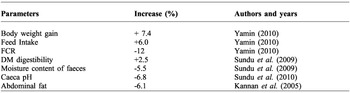
The question to be addressed is whether CM can be used as a feed additive to promote growth in poultry feed. Several studies have confirmed that CM has the potential to promote growth. Yamin (Reference YAMIN2010) indicated that, when 0.05% CM was included in the diet, both the growth and feed efficiency of broilers was improved by 7% and 12% respectively. Feed digestibility of CM-supplemented diets was improved by 2.5% (Sundu et al., Reference SUNDU, HATTA and DAMRY2010). More importantly, CM decreased the moisture content of faeces, as this continues to be a major commercial issue in poultry production. Problems associated with wet droppings are numerous, and include increased bacterial load in the litter, odour or ammonia in the house, insect problems, soiled feathers and footpad lesions (Butcher and Miles, Reference BUTCHER and MILES2011). Yamin (Reference YAMIN2010) pelleted diets containing CM to determine whether processing affects the efficacy of CM when included in the broiler feed. It was reported that pelleting did not impair the positive effect of CM in the diet since the body weight of birds was not negatively affected.
The mechanisms behind the improvement of body weight gain in birds fed CM-supplemented diets are not be clearly understood, and may be derived via several modes of actions. Firstly, addition of CM in the diet is associated with increased feed digestibility (Table 1). It is not difficult to elaborate the relationship between weight gain and feed digestibility as weight gain is a function of total digested feed and nutrient losses via faeces, urine and body heat. Secondly, CM may improve the health status of birds through the binding capacity of this carbohydrate against several pathogenic bacteria, such as E. coli (Fitryani, Reference FITRYANI2009). Thirdly, CM may bind mycotoxins (Sundu et al., Reference SUNDU, HATTA and DAMRY2010) which can damage enzymes, particularly lipase (Matur et al., Reference MATUR, ERGUL, AKYAZI, ERASLAN and CIRAKLI2010) and destroy the intestinal villi of birds (Applegate et al., Reference APPLEGATE, SCHATZMAYR, PRICKET, TROCHE and JI2009) and this contribute to decreased nutrient uptake.
Improvements in broiler performance due to CM supplementation used as a growth promoter.

CM as a replacement for antibiotic growth promoters
Mannose-based carbohydrates, either in the forms of mannosa (Oyofo et al., Reference OYOFO, DELOACH, CORRIER, NORMAN, ZIPRIN and MOLLENHAUER1989), mannan-oligosaccharides (Lyons, Reference LYONS2002) or mannan (Sundu and Damry, Reference SUNDU and DAMRY2008) have been presented as choices to replace antibiotics due to their capacity to bind and flush pathogenic bacteria out of the digestive tract of poultry. The commercial use of mannan-oligosaccharides extracted from Saccharomyces cerevisiae has existed more than three decades, and the product is widely available in the market today. In comparison, the use of CM in replacing antibiotic growth promoters has only recently attained research attention, with initial work being conducted by Sundu and Damry (Reference SUNDU and DAMRY2008), which has been followed up by Yamin (Reference YAMIN2010) and Fitryani (Reference FITRYANI2009).
A study carried out by Fitryani (Reference FITRYANI2009) showed that when the birds were challenged with E. coli in their drinking water for a week, broiler body weight gain was adversely affected and moisture content of the excreta increased by 13%, due to diarrhoea being observed in many of the E. coli - challenged birds. The supplementation of feed with 0.05% CM reversed the problems of decreased body weight gain, wet droppings and the incidence of diarrhoea for the challenged birds. However, the concentration of immunoglobulin A in the blood was not improved due to CM supplementation in the challenged groups (Fitryani, Reference FITRYANI2009). A few voluminous reports indicated that the addition of yeast mannan-oligosaccharides in diets improved the immune status of the birds (Newman, Reference NEWMAN1994; de Lange, Reference DE LANGE2007). Speculation behind the findings of Fitryani (Reference FITRYANI2009) has suggested that the shorter time of exposure to E. coli (7 days challenge) used in the trial may be the reason for unimproved immunoglobulin levels, either IgA or IgG.
A comparative study was conducted by Damry and Sundu (Reference DAMRY and SUNDU2009) to determine the efficacy of CM compared to commercial antibiotic growth promoters. The authors found that addition of CM in the diet improved growth rate to same level of body weight gain seen in birds fed diets supplemented either with commercial yeast mannan or avilamycin. It seems that these two mannan products posses similar efficacy of boosting the growth of broiler. Reasons of improved performance of birds due to the use of yeast mannan-oligosaccharides have been reviewed by other authors (Newman, Reference NEWMAN1994; De Lange, Reference DE LANGE2007). The reasons of improved bird performance due to CM supplementation are still unclear whether the improvement in body weight is due to CM in the diet per se or CM undergoes hydrolytic processes in the digestive tract of birds to form mannan-oligosaccharides or mannose through physical digestion in the gizzard or acid hydrolysis in the proventriculus. Since there is no specific enzyme to digest mannan in the digestive tract of birds, it can be speculated that formation of either mannan-oligosaccharides or mannose from CM may be low. This may explain why when Sundu and Damry (Reference SUNDU and DAMRY2008) used 0.02% CM, the improvement in body weight were statistically undetected and further increase in CM concentration in the diet to 0.05% produced significant improvement in body weight gain of broiler chickens.
Copra-mannan as a mycotoxin and cholesterol binder
Mycotoxins are produced by certain moulds and are defined as secondary metabolic products of e.g. Aspergillus, Penicillium, Fusarium and Claviceps. The numbers of mycotoxins that have been identified number about 300 different types to date, but it is predicted the total number is much more than this (Yiannikouris and Jouany, Reference YIANNIKOURIS and JOUANY2002). Of those mycotoxins, aflatoxins are more frequently found in the tropical regions, where the humidity and temperature suit the growth of mould, particularly Aspergillus spp. that produce aflatoxins. According to the FAO survey, 25% of the world's cereal grains are contaminated by mycotoxins (Devegowda and Murthy, Reference DEVEGOWDA and MURTHY2005). From 17 samples analysed from China and 824 samples from India, reportedly 90% and over were contaminated with mycotoxins (Swamy, Reference SWAMY2005). In Indonesia, 70% copra meal and 45% corn were contaminated by aflatoxins by more than 20 ppb (Sutikno, Reference SUTIKNO1990). So the problem of mycotoxins in the feed industry is real and widespread and this problem represents the second major problem in the poultry feed industry, after the increased price of conventional feedstuffs.
Although there is no agreement on the safe level of aflatoxins in feeds, this mycotoxin affects all poultry species. Kermanshahi et al. (Reference KERMANSHAHI, AKBARI, MALEKI and BEHGAR2007) and Devegowda and Murthy (Reference DEVEGOWDA and MURTHY2005) found decreased body weight gain when the birds were fed a diet containing 1.2 ppm and 2.5 ppm aflatoxin respectively. Since many factors can affect the negative effect of feeding Aflatoxin-contaminated feeds, including levels of aflatoxins, the presence of other mycotoxins and the duration of exposure, it is a general rule that growing poultry should not receive more than 20 ppb aflatoxin in the diet (Wyatt, Reference WYATT2005). Negative impacts of feeding mycotoxin-contaminated feed for poultry have been well reviewed by Devegowda and Murthy (Reference DEVEGOWDA and MURTHY2005). A number of organs in poultry are affected by mycotoxins, mainly the liver, kidney, mouth and digestive tract. Mycotoxins also impair feed quality and thus decrease feed intake, retarded growth and egg production, decrease activity of digestive enzymes (Matur et al., Reference MATUR, ERGUL, AKYAZI, ERASLAN and CIRAKLI2010), decrease feed digestibility (Damry and Sundu, Reference DAMRY and SUNDU2009), suppress the immune system and increase mortality (Elizabeth, Reference ELIZABETH2005; Swamy, Reference SWAMY2005).
In the sense of binding mycotoxins, yeast mannan has been reportedly to be a multi-mycotoxin binder, stable at high temperature over a wide range of pH and is considered environmentally friendly. Since the inclusion rate of this type of mycotoxin binder in the diet is relatively low, mixing it with the diet does not affect feed palatability and its does not bind other nutrients such as amino acids and vitamins (Hashmi et al., Reference HASHMI, PASHA, JABBAR, AKRAM and HASHMI2000; Devegowda and Murthy, Reference DEVEGOWDA and MURTHY2005). Although clays such as bentonite and aluminium silicate have been used for several decades to bind mycotoxins, this product has been reportedly effective for aflatoxins only, and it also binds other nutrients and needs to be included in relatively large quantity in the diet for efficacy (Chestnut et al., Reference CHESTNUT, ANDERSON, CHOCHRAN, FRIBOURG and and GWINN1992). The use of mannan, particularly yeast mannan, has been widely accepted in the feed industry.
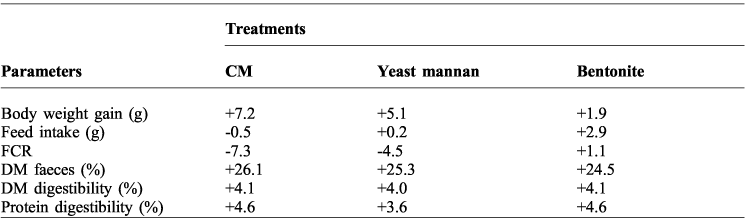
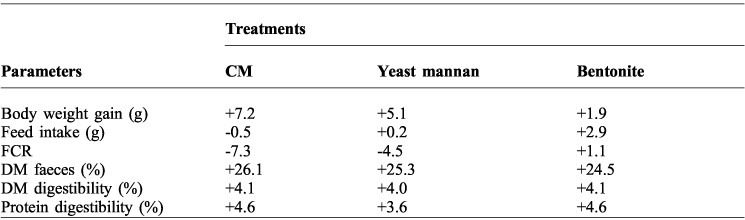
Since there was some evidence that CM had the capacity to bind certain pathogenic microbes to the same degree as yeast mannan (Sundu and Damry, Reference SUNDU and DAMRY2008), CM may also be able to bind mycotoxins. A study to examine this potential was conducted by Sundu et al. (Reference SUNDU, HATTA and DAMRY2010). The results showed that inclusion of CM at a level of 0.3 ppm in an aflatoxin-contaminated diet maintained the growth of birds to the same level of birds fed either the uncontaminated control diet or 0.3 ppm aflatoxins-contaminated diets supplemented with a commercial yeast mannan. When the authors compared the efficacy of CM as a mycotoxin binder with other commercial mycotoxin binders such as yeast mannan and bentonite, the results were promising, in which body weight gain of birds fed the aflatoxins contaminated diets with CM addition, was slightly higher than those birds fed on aflatoxins contaminated diets either with yeast commercial mannan or bentonite. The findings of Sundu and Damry (Reference SUNDU and DAMRY2008) have indicated that CM can be affectively used as mycotoxin binders (see Table 2).
Improvement of performance of bird fed 0.3 ppm aflatoxin B1 contaminated-diets (%) following the addition of different binders.
The use of mannan to decrease blood cholesterol level in poultry has been investigated by Vuksan and Vidgen (Reference VUKSAN and VIDGEN2001). Mannan has been reported to successfully lower total cholesterol level in the blood and, as a human food, may be related to lower incidence of heart attack. This fact motivated Kannan et al. (Reference KANNAN, KARUNAKARAN, BALAKRISHNAN and PRABHAKAR2005) to investigate whether CM could be used as a cholesterol binder in broiler feed. The use of 0.1% CM decreased total cholesterol and triglyceride levels from 197 mg/dl to 183 mg/dl and from 82.5 mg/dl to 59.3 mg/dl respectively, and reduced abdominal fat. Kannan et al. (Reference KANNAN, KARUNAKARAN, BALAKRISHNAN and PRABHAKAR2005) speculated that the decrease in either cholesterol or triglycerides was a result of increased populations of beneficial bacteria such as Lactobacillus or Bacillus Subtilis in the hind gut of poultry.
Since CM could reduce blood cholesterol of the birds, this mannan form may be used as an alternative to produce ‘healthier’ chicken meat. More studies are still needed to establish our understanding on CM by studying its mode of actions on how this product affects performance and health of birds. Work on quality control, extraction methods and consistency of this mannan is also needed to secure reliable performance responses in birds when used in the field or in large scale experiments.