Introduction
Ageism is reflected in negative or positive stereotypes, as well as in prejudice or discrimination against (or to the benefit of) older people because of their age (Iversen et al., Reference Iversen, Larsen and Solem2009). It is a pervasive phenomenon that is found in several domains (Palmore, Reference Palmore2001; North and Fiske, Reference North and Fiske2012), even in those settings which provide care for older people, such as long-term care (LTC) and healthcare (Kane and Kane, Reference Kane and Kane2005; Bowers et al., Reference Bowers2009). Ageism can have serious implications for well-being in that it negatively affects the quality of services (Nelson, Reference Nelson2005). There is also evidence that it produces a deterioration of sense of self-worth (McHugh, Reference McHugh2003), as well as a decline in memory and cognitive performance of the “victims” (Lamont et al., Reference Lamont, Swift and Abrams2015).
In Europe, perceived age-based discrimination is more prevalent than perceived sex and ethnicity-based discrimination (Ayalon, Reference Ayalon2014). Despite it being “the ultimate prejudice, the last discrimination, and the cruellest rejection” (Angus and Reeve, Reference Angus and Reeve2006: 139), ageism has been less researched than the other two “isms” (Nelson, Reference Nelson2005; North and Fiske, Reference North and Fiske2012). However, this is changing (Abrams et al., Reference Abrams, Swift, Lamont and Drury2015).
This paper reviews how research on ageism in LTC has been conducted, looking at analytical angles, theories, and concepts, as well as to research methods. Thus, we focus on the “how” rather than the “what,” i.e. the findings/results (please, see the following section for more details). Based on the results of this review, we present several recommendations for future research.
It is important to know how research on ageism in LTC has been conducted for two main reasons. First, a critical analysis of the advances and limitations of past research allows extending the research to domains not yet or under-explored, as well as developing research of higher quality. Second, enhancing the quality of empirical research is an essential condition for developing more effective intervention designs (Carolan et al., Reference Carolan, Smith and Forbat2015). A research report on health and social care institutions in England (Roberts et al., Reference Roberts, Robinson and Seymor2002) reveals that senior managers see age discrimination as endemic in the local services but, at the same time, they feel it is difficult to deal with it given that it is not easy to define, identify, and fight in practice. A critical overview of the way research on ageism in LTC has been conducted offers an opportunity to better conceptualize, detect, and measure the manifestations and the prevalence of the phenomenon and, consequently, to strengthen the capacity of conceiving effective interventions to prevent it.
We follow the Organisation for Economic Co-operation and Development (OECD) definition of LTC: “Long-term care is a range of services required by persons with a reduced degree of functional capacity, physical or cognitive, and who are consequently dependent for an extended period of time on help with basic activities of daily living (ADL), such as bathing, dressing, eating, getting in and out of bed or chair, moving around and using the bathroom. This is frequently provided in combination with basic medical services such as help with wound dressing, pain management, medication, health monitoring, prevention, rehabilitation or services of palliative care. LTC services also include lower-level care related to help with instrumental activities of daily living (IADL), such as help with housework, meals, shopping and transportation. LTC can be received in institutions or at home” (OECD, 2008: 33). This definition of LTC does not operationalize “extended period of time.” However, evidence from the USA tells us that the average length of stay in an LTC facility is 2.4 years (Martin and Ancoli-Israel, Reference Martin and Ancoli-Israel2008).
In another OECD publication (OECD, 2011a), it is stressed that LTC can be provided by “(. . .) family, friends and lower-skilled caregivers or nurses” (OECD, 2011a: 39). Finally, LTC can be provided by different agents, such as the state, the market, the voluntary/third sector, and the family.
This review will focus on care services, i.e. on care activities that imply helping with ADL or IADL or some basic medical needs.
We focus on ageism in LTC for several reasons. First, it is a significantly growing sector. In 2008, on average, 2.3% of the population in countries in the OECD was using formal LTC services (OECD, 2011a). An increase of this percentage is expected in the future due to population aging and the expansion of disability/disease trends, especially among those aged 80 years and older (Lafortune and Balestat, Reference Lafortune and Balestat2007; OECD/European Union, 2013). Second, the users of LTC services tend to be vulnerable, as the majority of them have difficulties in carrying out ADL (OECD, 2011b). The most vulnerable LTC users are at high risk of becoming victims of agist attitudes and practices (Band-Winterstein, Reference Band-Winterstein2013). Finally, LTC workers frequently have low qualifications, low wages (Bettio and Verashchagina, Reference Bettio and Verashchagina2010; OECD, 2011a), and low self-esteem (National Health Service, 2013). Low qualification is associated with higher levels of agist attitudes and stereotypes (Wells et al., Reference Wells, Foreman, Gething and Petralia2004; Reyna et al., Reference Reyna, Goodwin and Ferrari2007).
Review questions
Four specific review questions are considered: Which analytical angles have been explored? Which theories and concepts of ageism have been used? Which methods have been employed? Which variants of ageism have been covered? In what concerns the first question, we examine which of the following analytical angles are explored in each study: aetiology, prevalence, manifestations, consequences, and interventions. With respect to the second question, we identify the theories and conceptual definitions of ageism used by each study, analyzing in particular the number of components of each definition. The term “components” is based on the definition provided by Iversen et al. (Reference Iversen, Larsen and Solem2009) and it is clarified in the next section. In relation to the third question, we look at the following aspects: LTC settings/services, study participants, sampling, and data collection. With the last question, we examine which variants of ageism have been covered by the reviewed studies, paying particular attention to those not covered or under-covered. The term “variants” is also based on the definition provided by Iversen et al. (Reference Iversen, Larsen and Solem2009). A clarification of this term is offered in the next section.
Conceptual framework
Iversen et al. (Reference Iversen, Larsen and Solem2009) argue that there has been a lack of consensus on what constitutes ageism. To overcome this, they proposed the following definition of the phenomenon:
Ageism is defined as negative or positive stereotypes, prejudice and/or discrimination against (or to the advantage of) elderly people on the basis of their chronological age or on the basis of a perception of them as being ‘old’ or ‘elderly’. Ageism can be implicit or explicit and can be expressed on a micro-, meso- or macro-level (Iversen et al., Reference Iversen, Larsen and Solem2009: 12).
Iversen et al. (Reference Iversen, Larsen and Solem2009) established, on the basis of their definition, four dimensions and the components within each dimension: (i) the three classic components (cognitive-stereotypes, affective-prejudice, behavioral-discrimination); (ii) the positive/negative aspect (positive ageism, negative ageism); (iii) the conscious/unconscious aspect (explicit ageism, implicit ageism); and (iv) the typological division of levels (micro-level ageism, meso-level ageism, macro-level ageism). Subsequently, the authors combined the four dimensions and produced a conceptual framework with 20 variants of ageism.
The definition of ageism proposed by Iversen et al. (Reference Iversen, Larsen and Solem2009) is, to our best knowledge, the most comprehensive definition available, as it includes several dimensions and components. However, we agree with Snellman (Reference Snellman2016) when he argues that the definition proposed by Iversen and colleagues does not foresee the possibility of young people being a target of ageism, and does not solve the “us–them distinction,” i.e. the distinction between “us” and “older people.” The use of words such as “elderly,” “their,” and “them” in that definition is an indicator that this distinction was not overcome. In our viewpoint, the definition provided by Iversen and colleagues has another shortcoming: It omits “self-ageism,” as designated by Bodner et al. (Reference Bodner, Cohen-Fridel and Yaretzky2011). Self-ageism refers to stereotypes and attitudes toward people of one's own age or toward oneself, a phenomenon practiced by all human beings (Levy and Banaji, Reference Levy, Banaji and Nelson2002; Levy, Reference Levy2003). In order to overcome the aforementioned limitations, we propose the following adaptation of the definition of ageism authored by Iversen et al. (Reference Iversen, Larsen and Solem2009):
Ageism is defined as negative or positive stereotypes, prejudice and/or discrimination against (or to the advantage of) us on the basis of our chronological age or on the basis of a perception of us as being ‘old’, ‘too old’, ‘young’ or ‘too young’. Ageism can be self-directed or other-directed, implicit or explicit and can be expressed on a micro, meso or macro-level.
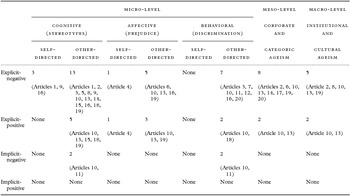
As a consequence of our proposal of introducing the new dimension “self-directed/other-directed” with its two components, namely “self-directed ageism” and “other-directed ageism” (including ageism from ego to other and vice versa), the conceptual framework with 20 variants of ageism proposed by Iversen et al. (Reference Iversen, Larsen and Solem2009) has now 32 variants (see Table 4).
In what concerns the micro-level, the cognitive component refers to what we think about different age groups, the affective component to what we feel about different age groups, and the behavioral component to how we behave toward different age groups (Iversen et al., Reference Iversen, Larsen and Solem2009; Abrams et al., Reference Abrams, Swift, Lamont and Drury2015). Each of these three components may be self-directed (directed toward people of one's own age or toward oneself) or other-directed (directed from a person to persons of other age groups or vice versa).
In relation to the meso-level, the framework proposed by Iversen et al. (Reference Iversen, Larsen and Solem2009) refers only to social networks. However, we opted to follow the broader theoretical proposal of Turner (Reference Turner, Calhoun, Rojek and Turner2005) of integrating micro- and macro-analysis in the domain of social sciences. At the meso-level of reality, Turner (Reference Turner, Calhoun, Rojek and Turner2005) identifies two structures, “corporate” units and “categoric” units. A corporate unit is “(. . .) a structure and its related culture organized to pursue goals or ends (for example, group, community, bureaucracy),” while a categoric unit is “(. . .) a social category which makes a difference in terms of how people act and are treated by others (for example, gender, ethnicity, age, social class)” (Turner, Reference Turner, Calhoun, Rojek and Turner2005: 412).
In what concerns the macro-level, ageism in institutional systems accounts for ageism in domains, such as public policy, education, and health, and their respective cultures. Iversen et al. (Reference Iversen, Larsen and Solem2009) implicitly recognize that the cognitive, affective, and behavioral components are also found at the meso- and macro-levels of reality, but they do not include them in their conceptual framework with 20 variants of ageism. We also do not introduce them in our adaptation in order to avoid an excessive fragmentation of the framework. However, in Tables S2 and S3 (supporting material), we clarify which of the three components (cognitive, affective, and behavioral) are present at the meso-level (corporate and categoric units) and macro-level (institutional systems).
Iversen et al. (Reference Iversen, Larsen and Solem2009) distinguish between explicit and implicit ageism and between negative and positive ageism. First, while the explicit component refers to agist beliefs, feelings, and behavior which are consciously initiated, the implicit component refers to the agist beliefs, feelings, and behavior which are automatically initiated without conscious awareness. Second, negative ageism refers to stereotypes, prejudices, and discrimination in disfavor of older people. On the contrary, positive ageism refers to stereotypes, prejudices, and discrimination in favor of older people.
This conceptual framework will be essential to analyze which variants have been covered by the reviewed studies.
Methods
This systematic review follows the guidelines by the Center for Reviews and Dissemination (CRD) at the University of York (CRD 2009) and the Preferred Reporting Items for Systematic Reviews and Meta-Analyses (PRISMA) (Moher et al., Reference Moher, Liberati, Tetzlaff and Altman2009).
Inclusion and exclusion criteria
We included studies reported in English, French, Spanish, and Portuguese, as these are the languages that the authors are able to read. Studies reported in other languages were excluded. Studies which did not focus on ageism, which did not focus on LTC, and those which focused on LTC in terms of cash benefits and other types of benefits beyond care services were excluded. This criterion is justified by the review questions and the concept of LTC adopted in this review. In addition, only studies based on empirical research were included. Theoretical studies, opinion papers, policy documents, and literature reviews were excluded (however, the reference lists from literature reviews were visually scanned with the aim of finding relevant studies). This criterion is also justified by the review questions. Finally, we only included papers published in peer-reviewed scientific journals, scientific books, and book chapters, as we only intend to review empirical research submitted to peer reviewing. Studies published before October, 2015, were reviewed.
Search strategy
Electronic databases: Web of Science, PubMed, and Social Care Online, were searched to identify relevant publications. Different combinations of keywords were used to search in these electronic databases:
-
- (‘ageism’ or ‘age discrimination’) AND (‘long-term care’ or ‘long term care’ or ‘social care’ or ‘home care’ or ‘day care center’ or ‘day care centre’ or ‘residential care’ or ‘nursing home’ or ‘care home’ or ‘assisted living’ or ‘community care’ or ‘social services’ or ‘respite care’ or ‘continuing care retirement communities’).
The specific keywords and other specifications used in each database are provided in Box S1 (supporting material).
Searches in electronic databases were combined with visually scanning reference lists from relevant publications and literature reviews, research reports, and other publications. A hand search of leading journals on Gerontology and Social Care, including, the European Journal of Ageing, the International Psychogeriatrics, the Health & Social Care in the Community, the Journal of Aging Studies, and The Gerontologist was also undertaken.
Selection of publications
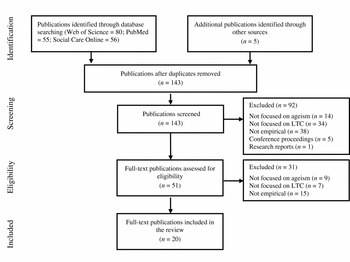
The selection of publications was undertaken using the PRISMA flow diagram (Moher et al., Reference Moher, Liberati, Tetzlaff and Altman2009). Figure 1 presents the stages of the selection process. All stages were conducted independently by the authors and disagreements were resolved through consensus.
Process of the selection of publications.

Based on the adopted definition of ageism, the processes of searching and selecting relevant studies were conducted without any restriction regarding the age of the users of LTC services. However, all the studies selected for review are focused on older adults.
Data extraction
Data were extracted using a data extraction form. A preliminary version of this form was pilot-tested in four randomly selected publications and the form was refined accordingly. The data extraction form includes the following items: author and date, research objectives, theoretical framework, study design (qualitative vs. quantitative), LTC services/settings, study participants (sampling methods; sample size), research methods (methods used to collect and analyze data), themes indicating ageism (qualitative studies), and operationalization of ageism (quantitative studies), and quality rating (quality appraisal of the publications).
The quality appraisal was also carried out using a form. A preliminary version of the form was pilot-tested in four randomly selected included publications, which revealed the need to refine it slightly. Box S2 (supporting material) provides the final version of the quality appraisal form used to evaluate the publications. It includes the following items: background/rationale of the study; objectives; study design; sampling; conceptual definition of ageism; themes indicating ageism/operationalization of ageism; data collection and data analysis; results/findings and discussion; quality of the results/findings and limitations. The quality was assessed chiefly in relation to reporting. The overall quality rating attributed to each paper indicates the extent to which the aforementioned items were covered in each publication (e.g. meets 14 items out of 16).
The process of data extraction (including the quality appraisal) was conducted by the authors of this review (working independently) and any disagreements were resolved through consensus.
Data synthesis
Data were synthesized by using the following approaches: “narrative synthesis” (Popay et al., Reference Popay2006) with respect to the first three review questions, and “narrative synthesis” and “thematic synthesis” (Thomas and Harden, Reference Thomas and Harden2008) with respect to the fourth review question.
Narrative synthesis “(. . .) refers to an approach to the systematic review and synthesis of findings from multiple studies that relies primarily on the use of words and text to summarize and explain the findings of the synthesis. While narrative synthesis can involve the manipulation of statistical data, the defining characteristic is that it adopts a textual approach to the process of synthesis to ‘tell the story’ of the findings from the included studies.” (Popay et al., Reference Popay2006: 5). In this paper, narrative synthesis was supported by organizing and presenting data in tabular form (Popay et al., Reference Popay2006).
“Thematic synthesis” is based on three stages. In the first stage, the aim is to code the data extracted. This initial coding produces “free codes.” In the second stage, these codes are grouped into “descriptive” themes. In the third stage, the aim is to aggregate “descriptive” themes into “analytical themes” (higher order themes created by the reviewers). This synthesis was carried out with the help of the software NVivo 9.
A brief overview of the included studies
As shown in Figure 1, we screened a total of 143 papers. Of these, 20 papers were selected for inclusion in this review.
In general, research on ageism in LTC services is relatively recent, as 14 of the reviewed studies were published between 2011 and 2015, with the remaining six published between 2000 and 2010. The research aims of the reviewed studies are highly diverse, ranging from examining the evidence of age discrimination in care practices to understanding the experiences of older women living in LTC with urinary incontinence (see Table S1, supporting material). In the great majority of the studies, ageism is a central topic, but there are some studies in which ageism is a secondary topic, given that it is conceived as a predictor of, or as a factor associated with other phenomenon, namely: elder neglect (Band-Winterstein, Reference Band-Winterstein2013), pain assessment (Natan et al., Reference Natan, Ataneli, Admenko and Noy2013), utilization of care services (Petersen and Warburton, Reference Petersen and Warburton2012), and older people's autonomy (Taverna et al., Reference Taverna, Nguyen, Wright, Tysinger and Sorenson2014). There are also two studies which do not focus primarily on ageism but where ageism emerged as a theme or subtheme during the process of qualitative data analysis (MacDonald and Butler, Reference MacDonald and Butler2007; Doyle, Reference Doyle2014). Most studies were conducted in North America (Canada and USA), and Australia. The remaining studies were conducted in the United Kingdom (England and Scotland), Israel, and Sweden. With regards to quality assessment, it is important to stress that all studies met 13 or more items out of 16, meaning that all studies have a high rating with respect to reporting. This precluded a comparison of the results according to the quality rating of the studies.
Results
Which analytical angles have been explored?
All studies explored the manifestation of ageism (see Table 1). The majority also explored other analytical angles. The etiology and the prevalence of ageism are the second most explored angles. Only two studies addressed the consequences of ageism and none addressed interventions concerning ageism in LTC.
Analytical angles

a From this point onwards, the reviewed studies are referred to by the respective number.
Which theories and concepts have been used?
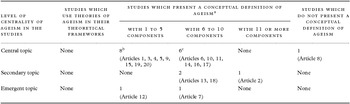
The reviewed studies used diverse theoretical frameworks. This might be a result of the diversity of research objectives pursued by the studies. Table 2 presents a synthesis regarding the number of studies that used theories and conceptual definitions of ageism. As it can be verified from this table, none of the studies includes theories that specifically focused on ageism in their theoretical frameworks. Theories used in some of the studies, include Goffman's perspectives on stigma and depersonalization in institutions, Age Stratification Theories, Foucault's perspectives on power, Normative Ethical Theories, and Communication Accommodation Theory. Two theories related to ageism, the Terror Management Theory and the Social Identity Theory, are mentioned briefly in the discussion sections of two studies. For a brief review of theories of ageism, please refer to North and Fiske (Reference North and Fiske2012; Reference North and Fiske2013).
Number of studies which use theories and conceptual definitions of ageism

a Some studies present two or more definitions of ageism. In these cases, we considered the definition with more components.
b Four studies define ageism only implicitly, without making reference to the supporting literature (Articles 1, 5, 19, and 20).
c One study defines ageism only implicitly, without making reference to the supporting literature (Article 14).
The concept of ageism is defined in all the studies reviewed, with the exception of one study. However, in five studies, ageism is defined only implicitly, although it is a central topic in these studies. Applying the framework of 32 variants of ageism described earlier, it is possible to verify that one study uses a conceptual definition of ageism with 11 or more components, namely the definition proposed by Iversen et al. (Reference Iversen, Larsen and Solem2009). Another set of nine studies use conceptual definitions of ageism with a moderate number of components, including the definitions proposed by Cuddy et al. (Reference Cuddy, Norton, Norton and Fiske2005), Greenberg et al. (Reference Greenberg, Schimel, Martens and Nelson2002), Hagestad and Uhlenberg (Reference Hagestad and Uhlenberg2005), Levy and Banaji (Reference Levy, Banaji and Nelson2002), and Palmore (Reference Palmore1999). Nearly half the studies use conceptual definitions of ageism with a low number of components. These definitions are clearly dominated by those proposed by Butler (Reference Butler1969; Reference Butler1975), especially by the 1975 definition that is the classic definition of ageism (Iversen et al., Reference Iversen, Larsen and Solem2009).
Which methods have been employed?
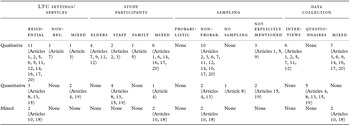
Table 3 provides a synthesis of the methodological strategies used in the reviewed studies. Most studies adopted a qualitative approach (13 studies) with predominance of ethnography and phenomenology. Among the remaining studies, five adopted a quantitative approach and two a mixed approach (combining quantitative and qualitative methods).
Number of studies by methodological strategies

The vast majority of qualitative studies selected exclusively residential services to collect data (i.e. services which include accommodation/housing for older people who cannot live on their own, such as independent living, assisted living, nursing home, sheltered housing, and so on). Only two studies selected non-residential services (i.e. services which do not include accommodation, such as home care) and the remaining one selected mixed settings (residential and non-residential). Three of the five quantitative studies selected exclusively residential services and two selected mixed settings. The mixed studies selected solely residential services. Therefore, the great majority of the studies focus on residential services (see Table 3).
Four qualitative studies relied exclusively on older persons, two included exclusively staff members and one older persons’ relatives. Most quantitative studies relied on staff members, with only one study including different types of participants. The two mixed studies collected data from a mixed group of participants (see Table 3).
Apart from one study which did not use sampling (strategies to systematically select research participants), as it selected the entire target population, and five studies which did not explicitly identify the sampling methods, the remaining studies used non-probability sampling. All samples, regardless of the study design, are heterogeneous. This heterogeneity relates to the basic sociodemographic variables (sex, age, level of schooling, etc.) and, in some cases, also relates to ethnicity, duration of residency, type of care facility, care profession, and duration of work with older people and in the facility.
The qualitative studies used a mixture of methods to collect data (seven studies; mainly interviews and participant observations) or exclusively interviews (six studies). In turn, the quantitative studies used exclusively questionnaires and the mixed studies used a mixture of methods. In this respect, it is possible to verify that most of the studies opted to use a single method to collect data (see Table 3).
All quantitative studies used validated scales of ageism to collect data, namely the Fraboni Scale of Ageism (Fraboni et al., Reference Fraboni, Saltstone and Hughes1990), the Thompson List of Ageist Assumptions (Thompson, Reference Thompson2006), the Attitudes Towards Older People Scale (Kogan, Reference Kogan1961), the Aging Semantic Differential Scale (Rosencranz and McNevin, Reference Rosencranz and McNevin1969), the Facts on Aging Quiz (Palmore, Reference Palmore1977; Reference Palmore1998), and the Reactions on Ageing Questionnaire (Gething, Reference Gething1994). Most of these scales are organized by dimensions/factors (Fraboni, Aging Semantic Diferential, and Reactions on Aging; the definitions of the scales’ dimensions/factors are presented in the footnotes to Table S3 (supporting material)) and are composed by a set of statements with a Likert scale to measure the level of agreement with each statement. The statements address older people in general and not older people who receive LTC services. Here are some examples of statements which convey negative stereotypes about older people: “Many old people just live in the past” (Fraboni Scale); “The majority of aged live alone” (Facts on Aging Quiz); “Most old people are irritable, grouchy, and unpleasant” (Attitudes Toward Older People Scale). Expressions such as “old people,” “elderly people,” and “the aged” appear in all the scales, with the exception of the Aging Semantic Differential Scale. These expressions display “older people” as a homogeneous group.
Finally, the qualitative studies used several methods of data analysis, with predominance for ethnography, phenomenology, and thematic analysis, whereas the quantitative studies used several methods of statistical analysis, such as descriptive statistics, statistical inference, factor analysis, and regression analysis. The mixed studies combined thematic analysis with descriptive statistics.
Which variants of ageism have been covered?
We identified a list of themes and subthemes of ageism, as reported by the qualitative studies (and the qualitative parts of the mixed studies), and pointed to the components of ageism covered by each theme (see Table S2, supporting material). Most themes (Providing care in a rigid and rushed manner; Requesting older adults to undertake childish activities; Not giving an older person enough privacy; Giving excessive medication and not reviewing it often enough; Respecting older people because of their age; Advertising older people as ageless for business purposes) are “descriptive themes.” The remaining themes are “analytical themes” (higher order themes) in that they were created by the authors to aggregate “descriptive themes.”
We also identified the operationalization of ageism in quantitative studies (and the quantitative parts in mixed-methods studies). As the operationalization of ageism is reflected in the instruments which were used to collect data, in Table S3 (supporting material), we describe the factors/dimensions of these instruments, the factors/dimensions which were included in each study and the components of ageism covered.
All scales measure explicit ageism, i.e. conscious ageism, rather than implicit ageism. According to Levy and Banaji (Reference Levy, Banaji and Nelson2002), the most commonly used instruments to measure implicit ageism are the “Implicit Association Test” and “Priming.” Second, all scales, with the exception of the Aging Semantic Differential Scale and the Reactions on Ageing Questionnaire, have at least one statement that measures attitudes toward discrimination at the meso- or macro-level of reality, such as discrimination in social networks, healthcare, leisure, political participation, and so on (e.g. “There should be special clubs set aside within sports facilities so that old people can compete at their own level” – Fraboni Scale of Ageism).
Table 4 offers a synthesis of the variants of ageism that have been covered in the reviewed studies. “Cognitive, other-directed, explicit, negative” statements represent the most common variant covered. The second most covered variant of ageism is “corporate and categoric, explicit, negative.” Next is the variant “behavioral, other-directed, explicit, negative.” Despite the significant coverage of some of the variants, it is noticeable that a large number of variants have not been covered by any study (17 variants) and that some of the variants are only covered by one or two studies. Both self-directed and implicit ageism were neglected by research.
Number of studies by variants of ageism

Discussion
The objective of this systematic review was to gather a comprehensive and accurate picture of past research on ageism in LTC. Four specific review questions were formulated: Which analytical angles have been explored? Which theories and concepts have been used? Which methods have been employed? Which variants of ageism have been covered?
Regarding the first question, we can say that we already have a reasonable body of evidence on the manifestation of ageism in LTC, as all studies explored this angle of analysis. This evidence is important not only for researchers but also for professionals and policy-makers. In what respects to professionals and policy-makers, the evidence on the manifestation of ageism puts them in a better position to fight ageism in practice. However, the remaining angles considered in this review received less attention, especially the consequences of ageism that received minimal attention, and interventions to reduce ageism that did not receive any attention. Hence, on the one hand, we have a reasonable knowledge about the manifestation of ageism in LTC but, on the other hand, we do not know which interventions are effective to prevent and fight the forms of ageism that we have identified.
As for the second review question, none of the reviewed studies included a theory that primarily focused on ageism. Although some of the mobilized theories have clear links to ageism, such as the Goffman's perspectives on stigma and depersonalization in institutions, the absence of theories specifically focused on ageism prevents the theoretical development of this particular field of inquiry. It is important to note that the majority of the studies adopted qualitative approaches, which tend not to explicitly adhere to a theoretical framework. However, a dialogue with theories of ageism, even in strongly inductive qualitative studies, would have enriched these studies (e.g. Alley et al., Reference Alley, Putney, Rice and Bengtson2010). Incorporating a theoretical framework in research is important because it helps to define research questions, to explain research findings/results and to inform interventions (Alley et al., Reference Alley, Putney, Rice and Bengtson2010). As Ferraro (Reference Ferraro2009: 75) argues, research without theory, and we would say, research on ageism without theories on ageism, may lead to “a science of the commonplace,” or at least, in our opinion, a science that does not reach its full potential. Nevertheless, Bengtson and colleagues (Reference Bengtson, Gans, Pulney and Silverstein2009) argue that research on aging, in which we would also include research on ageism, is “data-rich but theory-poor,” meaning that theories do not abound in this particular field of inquiry.
Despite the fact that none of the reviewed studies has used theories of ageism, almost all offered a definition of ageism, although in some cases only implicitly. Nevertheless, nearly half of the studies use narrow concepts of ageism (i.e. concepts with a low number of components of ageism) or do not use any concept of ageism, in addition to not mobilizing theories specifically related with ageism. This means that ageism was under-theorized and poorly conceptualized in these studies. In the other half of the studies, ageism is also under-theorized but better conceptualized, given that they use broader conceptual definitions of ageism. We acknowledge that concepts are normally chosen according to the aims of the studies, and that in some cases, such as when we have a concise research question and we want to test a restricted set of hypotheses, using narrow concepts rather than broad concepts can be appropriate. However, when we intend to undertake an exploratory study, as was the case of the reviewed qualitative studies, using a narrow definition of the phenomenon under study can compromise the ability to iteratively capture its multidimensionality and complexity. For example, the definition proposed by Butler (Reference Butler1975), which is the classic definition but still widely used (Iversen et al., Reference Iversen, Larsen and Solem2009) is, according to some authors (e.g. Iversen et al., Reference Iversen, Larsen and Solem2009; North and Fiske, Reference North and Fiske2013), no longer adequate for capturing the complexity of the phenomenon.
The majority of the studies were conducted in residential services (only one study was conducted in the elders’ homes). This means that we already have a significant body of evidence on ageism in residential services. However, considering the diversity of settings currently found in LTC services and the trend toward community care, especially home care, found in many parts of the world (Huber et al., Reference Huber, Rodrigues, Hoffmann, Gasior and Marin2009), special attention should be given to other LTC services in the future. In the current state of research, we are not able to clarify whether ageism in non-residential services has the same features (e.g. manifestation, prevalence, etc.) as ageism in residential services. In addition, the perspectives of those who are the target of ageism, namely, older adults, have been somewhat neglected. This may implicate an underestimation of the prevalence of ageism, given that the most subtle forms of prejudice are more readily detected by the target rather than by the holder of prejudice (Abrams et al., Reference Abrams, Swift, Lamont and Drury2015).
One of the mixed-methods studies used validated scales of ageism and the quantitative studies used only these scales to collect data. Considering the aims of these studies, the scales that were used are appropriate. However, as recognized in some of these studies, these scales have limitations. These scales are self-reporting techniques, and therefore prone to social desirability effects, which may involve an underestimation of the prevalence of ageism (Lagacé et al., Reference Lagacé, Tanguay, Lavallée, Laplante and Robichaud2012; Natan et al., Reference Natan, Ataneli, Admenko and Noy2013). In addition, almost all the scales include statements which consist of homogenizing expressions, such as “old people,” “elderly people,” and “the aged.” These kinds of expressions persist in the recent revision of the Fraboni Scale (Rupp et al., Reference Rupp, Vodanovich and Credé2005). This is problematic because, as North and Fiske (Reference North and Fiske2013: 38) argue, “Despite lay beliefs that older people are relatively uniform in appearance, attitudes, and health, the older population is actually one of the most diverse.” In the 1970s, Neugarten (Reference Neugarten1974) proposed a distinction between the “young-old” and the “old-old.” Later, Laslett (Reference Laslett1994) proposed a distinction between the “third age” and the “fourth age.” Furthermore, Gilleard and Higgs (Reference Gilleard and Higgs2011) suggested that the “destandardisation of later life” questions the importance of chronological age. Therefore, using homogenizing expressions creates a serious risk of multiple interpretations on the part of the respondents and is a potential source of bias. It is also important to note that the scales reviewed are not context-specific, i.e. they focus on older people in general and not on older people in specific contexts, such as LTC services. A scale devoted to ageism in LTC likely would have yielded different results.
Finally, we found that the studies have covered a small number of variants of ageism. This is not entirely surprising, given that studies focused on ageism in LTC do not abound. Some variants have been sufficiently covered, particularly the variant “Cognitive, other-directed, explicit, negative,” but there is still important “ground to explore.” It is important to underline that the variants which include implicit ageism and self-directed ageism have been neglected. The importance of the implicit component of ageism is well explained by Levy and Banaji (Reference Levy, Banaji and Nelson2002). These authors claim that all humans, regardless of their age, participate in the process of implicit ageism, and that “(. . .) one of the most insidious aspects of ageism is that it can operate without conscious awareness, control, or intention to harm” (Levy and Banaji, Reference Levy, Banaji and Nelson2002: 50). Implicit ageism is the root of agist practices (Levy and Banaji, Reference Levy, Banaji and Nelson2002), such as the agist language used by LTC workers (Lagacé et al., Reference Lagacé, Medouar, Loock and Davignon2011; Reference Lagacé, Tanguay, Lavallée, Laplante and Robichaud2012). Iversen et al. (Reference Iversen, Larsen and Solem2009: 16) argue that when a physician has a rigid schedule and scarce time, “implicit ageism may result in even less time for the elderly patients combined with a tendency to ascribe their complaints to old age.” We hypothesize that this can also happen in LTC settings. The self-direct component of ageism, i.e. self-ageism, is commonly implicit (unconscious) and therefore, can be particularly harmful (Levy and Banaji, Reference Levy, Banaji and Nelson2002). Several studies have demonstrated that implicit self-ageism may have a negative impact on the older persons’ cognition, behavior, and health (e.g. Palmore, Reference Palmore1999; Levy and Banaji, Reference Levy, Banaji and Nelson2002). Under-exploration of implicit ageism and self-directed ageism implies that we still have an incomplete picture of the prevalence and manifestations of ageism in LTC.
Recommendations for future research
Based on the review outlined above, we present recommendations for future research on ageism in LTC. Some of these recommendations can also be applied in healthcare settings in general.
Our first recommendation is to develop studies that explore the consequences of ageism and interventions to tackle ageism. Studies on interventions to tackle ageism are particularly needed, otherwise we will have little chance to effectively prevent or combat ageism in LTC.
We also recommend that future studies rely more heavily on theories of ageism or that, at least, establish a dialogue with these theories in order to develop them and/or create new ones. Furthermore, we believe that if we want to fight ageism in LTC in an effective manner, then we will need to identify and understand its multiple variants, especially the most subtle ones, such as those which include self-directed ageism and implicit ageism. This can be achieved, among other things, by using a comprehensive conceptual definition of ageism, such as the adapted definition that we proposed earlier in the conceptual framework. Even qualitative studies could use the aforementioned adapted definition of ageism, but in a sensitizing way (i.e. in a flexible way) in order to allow the emergence of new variants. If we identify which specific variants of ageism are most prevalent in a certain setting, we are in a better position to develop effective interventions and policies to fight it in practice.
Future studies should also pay more attention to non-residential facilities, especially home care that has grown in popularity in many countries, and to include the perspective of older persons. Potential research questions which deserve further attention, include the following: Does ageism in non-residential care (e.g. home care) have the same features (in terms of etiology, manifestations, prevalence, and consequences) as ageism in residential care? What is the level of ageism perceived by older people in LTC and how do they deal with its different manifestations?
Regarding methods of data collection, we agree with the suggestion made by Pedersen and Mehlsen (Reference Pedersen and Mehlsen2011) that future studies should combine self-reporting techniques with non-self-reporting techniques, such as, participant observation. Other methods such as diaries, a method which has proved effective in capturing the daily lives of older people (Bytheway and Johnson, Reference Bytheway and Johnson2001) or drawings could enrich current knowledge. Scales of ageism will benefit from removing homogenizing terms, such as “the aged” and “elderly people,” and taking into account “subtypes of ageism” (North and Fiske, Reference North and Fiske2013), i.e. ageism targeted at different subtypes of older people. The Aging Semantic Differential Scale is a good example in this respect, because it can be used with different age groups.
As argued above, fighting ageism in LTC in an effective way requires paying more attention to its most subtle variants, such as those which include self-directed ageism and implicit ageism. These are some examples of research questions regarding these two kinds of variants: How is implicit ageism manifested in daily practices of care staff? To what extent do older persons refuse to receive certain services, because they think they are too old? Future studies will need to develop new strategies and tools to measure and detect these subtle forms of ageism (Abrams et al., Reference Abrams, Swift, Lamont and Drury2015).
We take the opportunity to make a final recommendation. Following the arguments of Calasanti and Slevin (Reference Calasanti and Slevin2006), we recommend that future research explores the intersections between ageism and other forms of oppression, such as those based on gender or ethnicity/race. This will enrich theories and understanding concerning ageism.
Limitations
Despite its potential contribution, this systematic review has some limitations. First, it is always possible that we may have missed some relevant studies. Second, data extraction involved subjective judgments of the two authors. This was particularly evident in the detection of variants of ageism covered by the scales used in quantitative studies, as some of the statements inserted in the scales are in the border between two components of ageism. Despite our great care in this process, this can be a potential source of bias.
Concluding remarks
This review fills a gap by systematically reviewing approaches used for empirically studying ageism in LTC services, and by discussing avenues for future research in this area. We conclude that the research on ageism in LTC services is still scarce but important. Much has been done, contributing to a richer understanding of this phenomenon, its prevalence, and manifestations, but much remains to be done. It is our conviction that research focused on ageism in LTC services should continue in order to obtain a better understanding of the phenomenon. This will contribute to preventing and fighting ageism. We hope that the recommendations that we have made could be useful to produce further studies in order to capture the multidimensionality and complexity of ageism in LTC.
Considering the results of this review, it is our conviction that tackling ageism in practice requires interventions and regular monitoring at the macro-, meso-, and micro-level, in order to guarantee that LTC services are provided with respect for the dignity and needs of the care recipient. Future studies should aim to identify the specific types of intervention that can be most effective at different levels. It would also be valuable to identify good practices in specific countries/regions related with the mechanisms used to prevent/fight ageism.
Conflict of interest
None.
Description of authors’ roles
All the stages of the review process had the participation of both authors.
Acknowledgments
This paper is funded by National Funds provided by FCT- Foundation for Science and Technology and FEDER/COMPETE (Project UID/SOC/04020/2013; Grant PEst-C/EGE/UI4007/2013). This publication is also supported by COST (the acronym for European Cooperation in Science and Technology) IS1402 on ageism.
Supplementary Material
To view supplementary material for this article, please visit https://doi.org/10.1017/S1041610216001915.