African American English (AAE) continues to flourish as a native dialect for millions of speakers in the United States. Sociolinguists have long debated the origins of AAE, the extent of its uniformity across the United States, and its patterns of linguistic variation and change. Sociophoneticians in particular have used the acoustical analysis of vowels to provide pertinent sociolinguistic information about the status and evolution of AAE (e.g., Bailey & Thomas, Reference Bailey, Thomas, Mufwene, Rickford, Bailey and Baugh1998; Fridland, Reference Fridland2003; Thomas, Reference Thomas2001, Reference Wolfram2007).
This paper seeks to contribute to the body of literature on AAE by looking at the phonetic manifestation of /l/ among speakers from a small, longstanding, relatively isolated, majority (97%) African American community in Princeville, North Carolina. The word-initial /l/s of a multigenerational set of African American speakers—all residents of Princeville and direct descendants of the freed slaves who founded the town (the first in America to be incorporated by African Americans) in 1885 (Mobley, Reference Mobley and Nieman1994)—were analyzed acoustically for apparent-time change in the relative velarization of /l/ in that community. (Henceforth, velarization will be used to denote the measure of relative lightness or darkness of /l/ tokens. Acoustically, this measure is taken to be Z2−Z1.) The 36 Princeville speakers (16 males and 20 females) under study range in birth year from 1919 to 1988 and present a broad range of life experiences. The earliest-born speakers were sharecroppers or children of sharecroppers, employed by European American farmers in the heavily segregated rural communities surrounding Princeville. Most speakers born in the mid-20th century held unskilled jobs in local factories and institutions and were firsthand witnesses to the integrative consequences of the civil rights movement. Finally, the latest-born speakers boast broader educational and travel opportunities than their working-class parents and have lived and been schooled in a racially integrated American South.
In an effort to present additional contextual and comparative data, the word-initial /l/s of two other relevant groups were also analyzed. The first comparison group is composed of 10 ex-slaves (4 males and 6 females) born in the mid-19th century; the second is composed of 11 European Americans (6 males and 5 females) raised in counties adjacent to Princeville (birth years ranging from 1862 to 1942). With respect to the velarization of /l/, interspeaker and intercommunity correlations were performed, incorporating the additional phonetic factors of the duration of /l/ tokens as well as their following vowel contexts.
Results of multilevel mixed effects regression analyses reflect that there has been significant change in the relative velarization of /l/ in this community; namely, /l/s have become more velarized over the years. Compared to the ex-slave data, this finding is notable, given that the ex-slaves exhibited strikingly light /l/s, akin to those of the oldest Princeville speakers. Neighboring European American speakers, on the other hand, consistently show much darker /l/s than do their Princeville counterparts, though later-born Princeville speakers' /l/s align more closely with their European American neighbors than they do to their ex-slave predecessors. These results suggest that a phonetic shift in /l/ quality has taken place in recent decades in Princeville's speakers and likely within the greater AAE community as well, possibly due to convergence with European American dialects.
THE PHONETICS OF ENGLISH /l/
There is a dearth of literature on the acoustic characteristics of consonantal variables spoken in real-life settings (Docherty & Foulkes, Reference Docherty, Foulkes, Docherty and Foulkes1999). The reality that until recently there has not been adequate instrumentation to reliably measure consonants produced in noncontrolled settings means that many consonantal studies of conversational data have relied heavily on auditory perceptual impressions, but are lacking in sound empirical, acoustical analysis, and thus likely in reliability. (See discussions of this phenomenon in Thomas [Reference Thomas2002] with respect to consonant cluster simplification and in Yaeger-Dror, Kendall, Foulkes, Watt, Harrison, Kavanagh, & Oddie [Reference Yaeger-Dror, Kendall, Foulkes, Watt, Harrison, Kavanagh and Oddie2009] with respect to rhoticity.)
The “dark” and “light” variants of /l/
As a liquid, /l/ exhibits many of the same characteristics as do vowels, showing distinct formant patterns that are relatively easy to identify through spectrographic analysis (Espy-Wilson, Reference Espy-Wilson1992; Narayanan, Alwan & Haker, Reference Narayanan, Alwan and Haker1997). However, because liquids such as /l/ often occur adjacent to vowels and are highly susceptible to coarticulation effects, they can at times be difficult to measure acoustically. As with vowels, there is quite a bit of intra- and interspeaker variation in the /l/'s acoustic properties (Espy-Wilson, Reference Espy-Wilson1992). However, Espy-Wilson's work as well as other landmark studies such as Giles and Moll (Reference Giles and Moll1975) and Sproat and Fujimura (Reference Sproat and Fujimura1993) provided some guidelines for how /l/ can be measured, primarily in terms of F2 and F1, which are the most important formants for discerning the “darkness” or “lightness” of /l/.
Though originally considered to be discrete allophones of /l/ (Giles & Moll, Reference Giles and Moll1975), dark and light (also called clear) /l/s have more recently been shown to be two ends of a velarization continuum. Dark and light /l/s are distinguished by different articulatory processes. Light /l/s are alveolar, and most often occur in word-initial or syllable-onset positions. Dark /l/s, on the other hand, likely show both alveolar and velar constriction. Sproat and Fujimura (Reference Sproat and Fujimura1993) measured articulatory gestures for /l/ across a variety of syllable contexts (e.g., word-initial vs. word-final, syllable-onset vs. syllable-coda, before and after intonational boundaries) and found varying levels of velarization along a continuum (initial /l/s are always lighter than coda /l/s). Acoustic measurements corroborated the articulatory findings: /l/s in different syllabic contexts were shown to have different distances between F2 and F1. Lighter /l/s showed greater F2−F1s than did darker /l/s.
Recasens and Espinosa (Reference Recasens and Epinosa2005) have studied /l/'s gradient properties in several languages as well as dialects of English, including American English. They have found that different linguistic systems differ in the degree to which the light/dark /l/ phenomenon is scalar, as well as how these different types of /l/ are manifest in different word and syllable positions. American English, in their findings, characteristically exhibits a comparatively darker /l/ than do many other languages. In American English, the word- and syllable-initial /l/ variant is the lightest (highest F2−F1s) and the word-final variant is darkest (lowest F2−F1s). Carter (Reference Carter, Local, Ogden and Temple2003) substantiated this with four varieties of UK English.
Recasens (Reference Recasens2004) has also found that although there are many languages characterized as having light /l/s (e.g., Spanish and German), the relative velarization of those /l/s varies from one language to the next. Spanish, for example, has categorically lighter /l/s (in terms of higher mean F2s) than does German, despite their mutual light /l/ characterization. Additionally, although there are many languages that do indeed have the dark/light /l/ distinction (e.g., English, Catalan), Recasens has found these dark/light relationships to likewise be scalar. For example, light Catalan /l/s are lighter than the lightest of English /l/s, and dark Catalan /l/s are also much lighter than dark English /l/s. Thus, Recasens concluded that velarization of /l/ is indeed scalar and is unique to each language in absolute position and scope.
Not only has it been shown that /l/ resides on a different lightness/darkness spectrum for each language and dialect, but there have also been documented cases of languages where that spectrum has shifted because dark /l/s have changed diachronically. In modern Standard Polish, for example, dark /l/ or ł became so velarized with time that it phonemically shifted to a semivowel, and is now pronounced [w] (Ladefoged & Maddieson, Reference Ladefoged and Maddieson1996). Another example comes from transitional Middle/Early Modern English (van Gelderen, Reference van Gelderen2006) in which /l/s in coda position became so dark after mid and low back vowels that they eventually disappeared before velars and labial consonants in cases such as “folk,” “walk,” “half.” Thus, /l/ is not immune to phonetic and even phonemic shifts, related to the extent to which it is velarized.
Phonetic context has been found to affect velarization of /l/. Dalston (Reference Dalston1975) showed that /l/, especially light /l/, is quite susceptible to coarticulation with neighboring vowels. Recasens and Espinosa (Reference Recasens and Epinosa2005) also found that light /l/ is sensitive to coarticulation, but that dark /l/, by contrast, is strongly resistant to coarticulation, primarily due to the lowering of the tongue dorsum, causing “dark /l/ to exhibit a similar tongue configuration irrespective of whether it is placed next to front or back vowels” (7). Oxley, Buckingham, Roussel, and Daniloff (Reference Oxley, Buckingham, Roussel and Daniloff2006) took an acoustic look at vowel context for /l/. Indeed, they found that the /l/'s F2 is generally lower in back vowel contexts than it is in front vowel contexts. Thus, it seems as though lighter /l/s are strongly associated with fronter corresponding vowels.
Another phonetic factor found in some studies to relate to /l/ velarization is duration. Sproat and Fujimura (Reference Sproat and Fujimura1993) hypothesized that darker /l/s, because they are more vocalized, are therefore longer in duration than are lighter /l/s. Huffman (Reference Huffman1997) showed that this is not always the case. In addition to coarticulatory effects, there may be some dialect- and speaker-specific effects on the absolute degree of darkness of /l/ that cannot be explained by duration. Carter (Reference Carter, Local, Ogden and Temple2003) also found /l/ velarization to not be adequately predicted by its duration, finding that whereas the Sproat and Fujimura (Reference Sproat and Fujimura1993) prediction indeed held for nonrhotic speakers with lighter initial /l/s, it did not apply to nonrhotic speakers with darker initial laterals or rhotic speakers with either kind. Thus, it appears as though whereas an /l/'s duration may an important feature of its quality, there is no conclusive evidence to predict an /l/'s relative duration and velarization in any given dialect.
/l/ in African American English
The once widely prevailing notion of AAE being one, homogenized dialect across the great geographical, contextual, and socioeconomic ranges of its speakers has been disputed by linguists (Green, Reference Green2002; Rickford, Reference Rickford1999; Wolfram, Reference Wolfram2007). All the same, there seem to be many features that are widely shared among AAE speakers, and many linguists still treat it as one broad-ranging dialect. Therefore, although there is not necessarily a systematic connection between the speech of 1960s Detroit African Americans (e.g., Wolfram, Reference Wolfram1969), the speech of black teenagers from urban Palo Alto, California (e.g., Rickford, Reference Rickford1999), or the speech of the slave descendents in rural “Springville,” Texas (e.g., Cukor-Avila, Reference Cukor-Avila1995), linguists can still identify many morphosyntactical and phonological features that these speakers share, as well as trends for how these features have spread from one community to another.
In terms of the AAE /l/, little is known acoustically. Studies going back as far as Labov, Cohen, Robins, and Lewis (Reference Labov, Cohen, Robins and Lewis1968) and Fasold and Wolfram (Reference Fasold, Wolfram, Fasold and Shuy1970) described the tendency of the dialect to exhibit postvocalic /l/-lessness in syllable-coda and word-final positions. Vocalized /l/s are found on the darkest end of the light/dark /l/ continuum. If syllable- and word-final /l/ vocalization is comparatively prolific in AAE (e.g., Durian, Reference Durian2008), it could mean that AAE may utilize a darker /l/ continuum (cf. Recasens & Espinosa, Reference Recasens and Epinosa2005) than non-/l/-vocalizing dialects of English, such that even word-initial /l/s are comparatively darker than /l/s of other varieties. Gick (Reference Gick2002) examined the “intrusive” /l/ in several dialects of American English, explaining that the intrusive /l/ variant occurs only after a phonological process of widely generalized vocalization. The AAE speakers are among the most advanced in terms of this process. It has also been speculated (Durian, Reference Durian2008) that final /l/ vocalization is increasing in some AAE communities, and possibly in more broad-ranging AAE. An acoustic study of the /l/s of this dialect can shed light on this phenomenon, and the extent to which it may affect /l/s in other phonetic contexts. However, few researchers to date have examined /l/ vocalization using acoustic methods (except perhaps Dodsworth, Plichta, & Durian, Reference Dodsworth, Plichta and Durian2006), and none have focused on African American speakers.
Another aspect of AAE that leads to a hypothesis of /l/ change is documented change in rhoticity in the variety. In various British English dialects, Carter (Reference Carter, Local, Ogden and Temple2003) found a relationship between a speaker's rhoticity and patterns of velarization of /l/, such that rhotic varieties showed a more fixed acoustic pattern for lightness/darkness of both /l/ and /r/, more fixed than for nonrhotic varieties. Namely, he found that the position of /l/ in the syllable was more perceptually important for rhotic varieties; thus, a lighter initial /l/ coupled with a darker final /l/ pattern occurred more prominently in rhotic speakers. However, because nonrhotic varieties already have an initial/final perceptual distinction with regard to /r/, predictable acoustic patterns are therefore not as necessary for either /r/ or /l/ for nonrhotic speakers.
Nonrhoticity has historically been a point of similarity between AAE and the majority dialect spoken by European Americans of the American South, also called Southern White English (SWE). Although Thomas (Reference Thomas2007) pointed out that AAE shows greater rates of /r/-lessness than does SWE, both dialects are currently becoming increasingly /r/-ful, with AAE lagging behind SWE in this respect (Bailey & Thomas, Reference Bailey, Thomas, Mufwene, Rickford, Bailey and Baugh1998). Given Carter's UK findings (and those of Hawkins & Nguyen, Reference Hawkins and Nguyen2004), and what is known about changing rhoticity in both AAE and SWE, it is compelling to analyze relative velarization of initial /l/s in these dialects. For historically nonrhotic dialects such as AAE, which have also been noted to exhibit dark/highly vocalized final /l/s, there is still no necessary prediction for the quality of initial /l/s. Plus, if AAE is becoming more and more rhotic, all the while maintaining its dark final /l/s, the need for acoustic distinction between initial and final /l/s may predict that initial /l/s would be consistently quite light. An apparent time analysis of this feature in AAE could shed light on whether /l/ change and rhoticity are linked.
In sum, the phonetic and phonological literatures are not conclusive about the status of /l/ in the AAE dialect and are especially lacking in terms of acoustical analysis. Much has been observed impressionistically about AAE coda /l/s, but acoustic analysis is difficult to consistently and accurately perform for this feature. Because they are not likely to be vocalized, however, word-initial /l/s are easier to examine acoustically, and patterns of potential change in this variable could shed valuable light on the phoneme more generally.
METHODS AND COMMUNITY
This acoustic study of /l/s uses data from sociolinguistic interviews conducted on site in Princeville, North Carolina, through 2003 and 2004. These interviews were open-ended and semistructured, conducted by staff of the North Carolina Language and Life Project (NCLLP) and have since been catalogued, digitized, and uploaded to the Sociolinguistic Archive and Analysis Project (SLAAP). Original interview questions were aimed at eliciting not just sociolinguistic data for analysis but also ethnographic and anthropological data about this unique, resilient African American community (D'Andrea, Reference D'Andrea2005; Rowe, Reference Rowe2005). These features mark this study as different from previous acoustical studies of /l/s, which were performed under highly controlled laboratory settings that used prepared read speech samples or repetitive word strings to elicit the phone. Even though eliciting /l/s in spontaneous language settings is less controlled than in laboratory settings and introduces reliability issues related to instrumentation and the lack of contextual control for the /l/s produced, this naturalistic approach is helpful in that it can assume that the /l/s produced are more or less identical to those produced in authentic speech situations.
Princeville, North Carolina, is a suitable place for studying the evolution of an African American dialect, in that it is a long-standing community composed primarily of African Americans, many of whom can trace their families back to the original founders of the town, who themselves were recently freed slaves. Demographic data from the 2000 census shows that African Americans compose 97% of the population, followed by 2% European Americans, and 1% other. The social network structure in the community is considerably dense and multiplex (cf. Milroy, Reference Milroy1980), primarily due to its insular nature and the resilience of its inhabitants in the face of hardship. Citizens of Princeville have struggled through racial tensions with neighboring towns, economic hardships, and devastating floods (Rowe, Reference Rowe2005). Indeed, this same insularity and strong community cohesiveness make these speakers fascinating candidates for study of how AAE is developing. Given their direct connection to the ex-slaves who founded the town, the older speakers in this community can provide valuable insight into older varieties of AAE. The middle speakers, on the other hand, have lived through the turmoil of the civil rights movement of the 1960s and can shed light on how the dialect may have been affected in times of heightened tension. Finally, the youngest speakers, raised in a postintegration society and schooled in neighboring European-American-dominant Tarboro, North Carolina, may help to show how an integrated society can affect a minority dialect.
Not only have levels of racial integration changed in this area over time, but so have power differentials between the races. As Bailey (Reference Bailey and Lanehart2001) asserted, racial integration in the earlier agricultural South (post-Civil War) was actually quite advanced, as European Americans and African Americans often worked closely with each other on plantations. However, power differentials between the two racial groups were wide compared with those during the years following the Civil Rights movement. For example, Princeville sharecroppers largely worked as employees for European American plantation owners in neighboring towns. Later, many Princeville residents worked in the homes and businesses of wealthy European Americans. From the mid-20th century onward, however, the dependence of Princeville residents on wealthier neighboring European Americans diminished greatly as more Princevillians sought higher education, opened their own businesses, and became more engaged in civil pursuits.
Though an argument can be made for increased racial segregation as a result of these endeavors, especially given Princeville's continuing majority-African American racial composition, it must also be pointed out that later Princeville children attended fully racially integrated schools from the primary to the secondary levels. Thus, clearly, changing racial integration and power dynamics are at play in this community, potentially linking strongly to language change as well.
Speakers
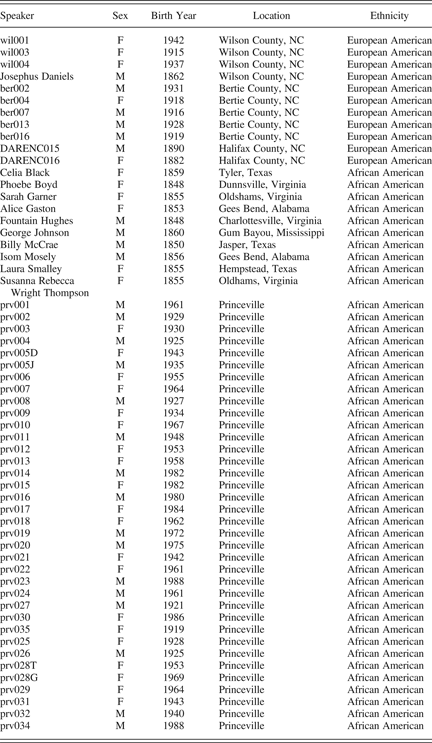
The primary speakers for this study were 36 African American Princeville residents (16 males and 20 females). Original field-workers in the Princeville community (see Rowe, Reference Rowe2005) selected participants through snowball sampling (original contact was initiated through administrators at a town hall meeting) and convenience sampling at community gathering places, and thus the participants were not controlled for sex and age, though they generally shared the same socioeconomic status. All individuals selected had spent the majority of their lives in the area. Birth years for these individuals ranged from 1919 to 1988, comprising a range of life experiences from sharecropping to industrial labor to gang membership. The Princeville sociolinguistic interviews were conducted in the years 2003–2005. Interviews were recorded on cassette tapes and were generally 45 minutes long. In most cases, only the interviewer and the subject were present, although sometimes another interviewer and/or the subject's relative(s) were also there. The primary interviewer was a white male, although two white females assisted with some of the interviews.
In addition to the Princevillians, 21 more speakers were selected to offer relevant comparisons. The first comparison groups of 10 speakers were former slaves (4 males and 6 females) with birth years ranging from 1848 to 1860. Interviews with these individuals have been compiled and catalogued by the Library of Congress's Archive of Folk Culture through the American Folklife Center.Footnote 1 Several interviews were conducted by the Library of Congress as part of the Archive of Folk Song; others were done as preliminary fieldwork in preparation for the Linguistic Atlas of the Middle and South Atlantic States; still others were oral history studies conducted by various folklorists and field-workers. Many of the interviews were conducted in the 1930s and '40s and were recorded on either 10-inch reel-to-reel tapes, direct-to-disc recorders, or 12-inch or 16-inch acetate disks, but one interview took place in 1974 on cassette tape. The methodological challenges of working with ex-slave data are well documented (see Bailey, Maynor, & Cukor-Avila, Reference Bailey, Maynor, Cukor-Avila, Bailey, Maynor and Cukor-Avila1991). Nevertheless several of these speakers have been used in other AAE phonological comparisons (Bailey & Thomas, Reference Bailey, Thomas, Mufwene, Rickford, Bailey and Baugh1998; Thomas & Carter, Reference Thomas and Carter2006) and have provided helpful insight despite their shortcomings.
The second comparison group of 11 speakers are European Americans who come from geographic locales near Princeville, namely from Wilson, Bertie, and Halifax counties. These speakers' birth years range from 1862 to 1942. Sociolinguistic interviews conducted with the Wilson and Bertie County residents were recorded on cassette tapes by staff of the NCLLP in the years 2002–2006. One Wilson County speaker's data originally comes from the Library of Congress collection American Leaders Speak: Recordings from World War I and the 1920 Election.Footnote 2 Halifax County speakers were recorded on reel-to-reel tapes as part of the Dictionary of American Regional English (DARE) project, which surveyed regional dialects across the United States in 1965–1970. Table 1 summarizes all of the speakers analyzed in this study.
Summary of speakers by sex, birth year, location, and ethnicity
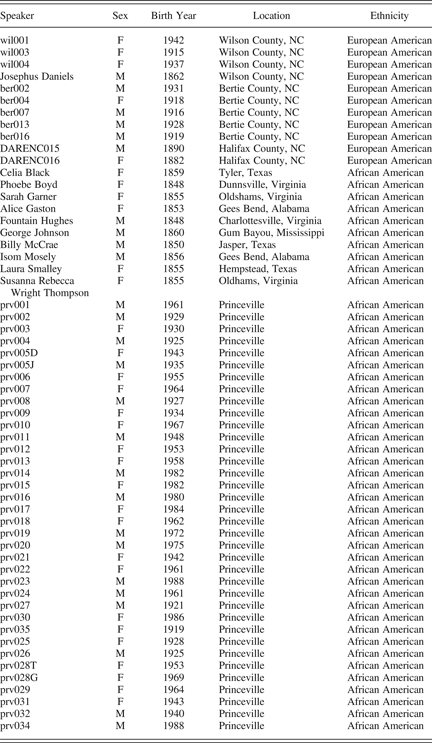
Speech data from the Princeville and European American speakers were digitized onto compact discs at a sampling rate of 44.1 kHz and a bit rate of 16. PRAAT software (Boersma & Weenink, Reference Boersma and Weenink2006) was used to convert the digital data to WAV format, which was then uploaded to the online SLAAP archive, from which it could easily be extracted and analyzed. Ex-slave recordings were extracted in WAV format from the Library of Congress's Voices from the Days of Slavery website.Footnote 3
Measuring /l/
Articulatory phonetic analysts have as yet come to no common consensus for best measuring velarization in /l/s. Phoneticians over the years have used cinefluorographic filming (Giles & Moll, Reference Giles and Moll1975), X-ray microbeam technology (Sproat & Fujimura, Reference Sproat and Fujimura1993), electropalatography (Narayanan, Alwan, & Haker, Reference Narayanan, Alwan and Haker1997; Recasens, Reference Recasens1996; Reference Recasens2004; Recasens, Fontdevila, & Dolors Pallarès, Reference Recasens, Fontdevila and Dolors Pallarès1995; Wrench & Scobbie, Reference Wrench, Scobbie, Palethorpe and Tabain2003), magnetic resonance imaging (MRI) (Narayanan et al., Reference Narayanan, Alwan and Haker1997), ultrasound (Wrench & Scobbie, Reference Wrench, Scobbie, Palethorpe and Tabain2003), and Carstens electromagnetic articulography (Wrench & Scobbie, Reference Wrench, Scobbie, Palethorpe and Tabain2003) to understand the articulatory characteristics of /l/ in its lighter and darker manifestations. Whereas these methods have shed light on the sequence and timing of the tongue gestures that produce /l/ in a variety of phonetic contexts, they are still bound by the constraints of artificial, laboratory speech production. Articulatory analyses such as these have helped to validate Sproat and Fujimura's (Reference Sproat and Fujimura1993) hypothesis of the gradience of /l/ velarization. But Sproat and Fujimura and others have also used acoustic analysis to come to the same conclusion. Despite its strengths, articulatory analysis is impossible to replicate in nonlaboratory settings, but acoustic analysis can be conducted on nonlaboratory speech. Therefore, because this study uses field recordings of conversational speech, acoustic analysis is the primary methodology used.
Acoustic phoneticians agree that spectral formant measurements are most appropriate for gauging velarization of /l/. Hawkins and Nguyen (Reference Hawkins and Nguyen2004) compared the ease and accuracy of formant measurements for /l/ against spectral center of gravity (COG) measurements. Center of gravity involves combining spectral prominences of the high frequency formants to create a preemphasized signal, which can be converted into an auditory excitation pattern that is scaled in decibels (Stevens, Reference Stevens1998). Measuring COG has an advantage over measuring formants because it can be fully automated (with minimal need for rechecking) and results in a single value (as opposed to multiple formant values). In their study, however, Hawkins and Nguyen found that COG was not a sensitive enough measurement tool to reflect nuances due to coarticulatory effects with neighboring vowels. Thus, they conclude that discrete formant measurements, rather than an overall COG score, are preferable for analyzing /l/ across phonetic contexts. Phoneticians focus primarily on F2 when measuring /l/ (see Carter, Reference Carter, Local, Ogden and Temple2003; Oxley et al., Reference Oxley, Buckingham, Roussel and Daniloff2006; Recasens, Reference Recasens2004), because generally, it is observed that F2 rises as /l/s get lighter. However, it has also been shown (Dalston, Reference Dalston1975; Espy-Wilson, Reference Espy-Wilson1992; Huffman, Reference Huffman1997; Sproat & Fujimura, Reference Sproat and Fujimura1993) that there is strong covariation between F2 and F1. Light /l/s are characterized not only by high F2s but also by low F1s. Dark /l/s, on the other hand, show a convergence of the two formants: lower F2s and higher F1s. Lower F2s and higher F1s in dark /l/s can be attributed to higher degrees of (velar) constriction in the back of the oral cavity (Stevens, Reference Stevens1998). In the latter conception, then, an /l/'s relative velarization can best be expressed as F2−F1. Lighter /l/s will have higher F2−F1s, and vice versa for darker /l/s.
Researchers have differed in terms of which points in the consonant they have determined to be most informative for taking formant measurements. Espy-Wilson (Reference Espy-Wilson1992), for example, extracted formant measurements at the /l/'s lowest F2 point (at the point of highest vocal tract constriction), but this was done in an effort to maximally distinguish /l/ from semivowels in her study. However, other studies that have focused exclusively on /l/, such as Sproat and Fujimura (Reference Sproat and Fujimura1993) and Huffman (Reference Huffman1997), take formant measurements of /l/ at the midpoint or steady state of each token, to minimize the effects of coarticulation with preceding or proceeding segments on formant values. When comparing formant values across several speakers, Espy-Wilson (Reference Espy-Wilson1992) and Carter (Reference Carter, Local, Ogden and Temple2003) normalized their /l/ tokens. Carter in particular used bark-scaling normalization. The Bark Difference Metric is an acoustic normalization technique that is used to control for the physiological differences among speakers, while keeping sociolinguistic dynamics reasonably intact. The Bark Difference Metric (developed by Syrdal & Gopal, Reference Syrdal and Gopal1986) uses the arithmetic difference between two dimensions of formant values that have been converted to Bark (Z).
This study seeks to compare formant measurements across speakers and to investigate duration and coarticulation effects on the lateral. Accordingly, F1 and F2 measurements were taken at the midpoint of each /l/ token. For normalization, all formant measurements were converted to Bark using Traunmüller's (Reference Traunmüller1990) formula and the difference between formants was computed. Bark-converted F2−F1, the measure of velarization, is referred to as Z2−Z1.
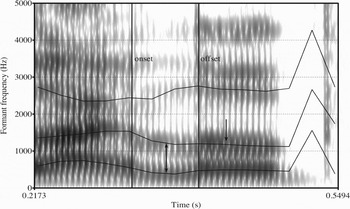
Phonetic effects of duration were gauged using time measurements at both the onset and the offset of each /l/ token. For coarticulation effects, an F2 measurement was taken 30 msec into the following vowel. Thirty milliseconds as an interval was chosen somewhat arbitrarily, but it did allow for sufficient F2 transition into the next segment. Potential interactions between the /l/'s duration and the F2 transition in the following segment were considered in statistical analysis. F2 values at 30 milliseconds into the following vowel were converted to Bark using Traunmüller's (Reference Traunmüller1990) formula, and measures of coarticulation were normalized as the arithmetic difference between Z2 (at /l/ midpoint) and Z2 (at 30 msec into the following vowel). Figure 1 illustrates measurement data using PRAAT software. Formant measures were extracted with PRAAT's defaults set to .025 seconds (window length), 30.0 dB (dynamic range), and 1.0 mm (dot size), with maximum formant set to 4000 Hz.
Spectrogram of light /l/ token little. Formant tracks for F1, F2, and F3 are superimposed on the spectrogram. Arrows denote measurement points at the midpoint and 30 msec into the following vowel. Vertical lines denote durational boundaries.

Token data and reliability
In American English, the “canonical” light /l/ (the lightest /l/ of all) occurs in word-initial environments (Hayes, Reference Hayes, Dekkers, van der Leeuw and van de Weijer2000; Sproat & Fujimura, Reference Sproat and Fujimura1993). However, word-initial /l/s are not categorically light across English dialects (Carter, Reference Carter, Local, Ogden and Temple2003), though they will always be lighter than their word-final counterparts. Additionally, because they do not generally show a tendency to vocalize, lighter /l/s are also less ambiguous to isolate acoustically than are darker /l/s. Therefore, due to their relative ease of measurement and their relevant cross-dialectal variation, this study has focused on word-initial /l/s, while remaining sensitive to the following vowel context (in terms of vowel frontness) of each /l/ token.
For each speaker, 30 tokens of word-initial /l/ were taken, with no more than 2 tokens of the same word used. Notes were made of each /l/'s context, and an effort was made to ensure a representative range of phonetic contexts, particularly with regard to potential coarticulation effects with following vowels. It was sometimes, though rarely, necessary to gather fewer than 30 tokens due to a paucity of sufficient appropriate tokens. Each /l/ token was measured according to the techniques described.
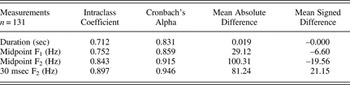
Altogether, 1566 tokens of /l/ were extracted from 57 speakers. Formant measurement reliability was assessed through interobserver comparisons whereby 10% of the tokens were randomly selected and measured blindly by a second trained sociophonetician. Intraclass correlations were run using SPSS 16.0 software comparing the two sets of measurements done for /l/ duration, midpoint F2, midpoint F1, and 30-msec F2. The intraclass coefficients ranged from 0.712 to 0.897 with Cronbach's Alpha scores ranging from 0.831 to 0.946. Both the intraclass coefficient and the Cronbach's Alpha score will approach 1.0 when there is less variance between the two groups of measurements; thus, these scores show a fairly high degree of interobserver reliability (these values as well as mean absolute and signed differences between the sets of measurements can be found in Table 2).
Interobserver reliability results

ANALYSIS
Statistical analyses were performed in an effort to address the following questions:
1. How might the word-initial /l/s of speakers from Princeville be characterized? Have they changed significantly in relative velarization (Z2−Z1) over 69 years of apparent time? If so, have they become darker or lighter over this period?
2. To what extent do phonetic factors such as /l/ duration and following vowel context affect an /l/'s velarization in this population?
3. How do the Princeville speakers' /l/s compare with those of other pertinent groups of speakers (i.e., ex-slaves and neighboring European Americans)?
Statistical analysis using the Princeville data set
Using STATA/IC 10.1 software, a multilevel mixed-effects linear regression model was used to address these questions. Multilevel mixed effects models are increasingly used in quantitative linguistic analysis (Baayen, Reference Baayen2008; Johnson, Reference Johnson2009) and are appropriate for statistical analysis with a data set such as this one, where many observations of /l/ (the units of analysis) (Sirkin, Reference Sirkin2006) were taken from each speaker. Thus, for example, whereas there are 1048 instances of /l/ used as data from the Princeville data set, they can be clustered into groups of about 30 for each speaker. A multilevel model controls for the potential effect of individual on the characteristics of the units of analysis, or /l/ tokens (Gelman, Reference Gelman2006).
A mixed regression model also allows for both fixed and random effects (Agresti, Reference Agresti2007). Fixed effects infer relationships within a finite group of subjects or measurements; random effects can infer correlative information about those subjects/measurements and the greater population from which they are drawn (Agresti, Reference Agresti2007). In this study, individual speaker was treated as a random effect. Another strength of the mixed effects model is that it can accommodate both between-subjects (such as birth year and sex) and within-subjects (such as /l/ duration and phonetic context) effects as covariates.
In the multilevel mixed regression used for this study, the following variables were included. /l/ velarization (operationalized as Z2−Z1), was the dependent variable. Independent variables included birth year, sex, context (denoting the phonetic effect of the following vowel), and /l/ duration. Context was operationally defined as the arithmetic difference between Z2 of the /l/ midpoint and Z2 of the point 30 msec into the following vowel. Log-transformed values for /l/ duration (originally measured in seconds) were used. All variables were continuous save for sex, which was binary.
Log-transformed values of the original linear duration values were used because they best described the data. Because of their small increments and lower limit of zero, linear durational values are often right-skewed. Log transformation is often done in phonetic studies of duration in order to centralize the distribution (Rosen, Reference Rosen2005). For these data, both Skewness-Kurtosis and Shapiro-Wilk tests confirmed that the log-transformed values of duration were less significantly skewed (p < .05) than were the linear duration values (p < .001). Accordingly, the log-transformed values for duration were used in the regression analysis (henceforth, the variable /l/ duration should be interpreted to be the log-transformed value of an /l/ token's duration).
In addition to exploring the additive effects of these variables, their potential multiplicative effects were also tested through the generation of several interaction terms. One potential interaction considered was that between /l/ duration and birth year. Older speakers (with earlier birth years) may speak more slowly than younger speakers, which could likely influence an /l/'s duration. There are likewise theoretical reasons for examining the interaction between birth year and context as well. If birth year is known to significantly interact with /l/ velarization, in that speakers with later birth years show darker /l/s, it is also probable that their /l/s will show fewer coarticulatory effects as well. Recasens and Espinosa (Reference Recasens and Epinosa2005) discussed how darker /l/s are more resistant to coarticulation. An interaction term would test this relationship. Finally, it is not uncommon (e.g., Holmes, Reference Holmes1995; Milroy, Reference Milroy1980) for birth year (often operationalized as age) and sex to have significant interactions in the use/non-use of a sociolinguistic variable. An interaction between sex and birth year was also created and tested.Footnote 4
In the course of statistical analysis, several relevant versions (with this or that variable removed or interacted) of the regression were conducted so as to ascertain the best model to fit the data. Measures of Deviance, Akaike Information Criterion (AIC), and Bayesian Information Criterion (BIC) were taken for each model. Additionally, each model's residual variance was calculated with respect to the random effect of speaker. The model that emerged with the lowest of these measures was determined to be the best model from which to report the results.
Statistical analysis including comparison data sets
Even though the 36 speakers of the Princeville data set were the primary speakers for this study, comparison speakers were also selected from two different, yet relevant, cohorts: ex-slaves, and European Americans living in counties neighboring Princeville. To analyze the relationship between these two additional data sets and the Princeville speakers, they were added into the multilevel mixed effects regression analysis; however, their limited sample size in terms of number of speakers (10 ex-slaves and 11 European Americans) should be noted. For this portion of the analysis, data set as a categorical variable was also added into the regression, so that the three different data sets could be compared with each other. The same interactions among the variables hypothesized earlier were also tested, and the same goodness-of-fit and variance measures were also used.
RESULTS
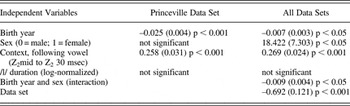
Table 3 depicts the results for the best-fit models of the two main regression analyses conducted for this study: (1) multilevel mixed effects regression conducted on the Princeville data set only; and (2) multilevel mixed effects regression conducted on all data sets for the sake of comparison (i.e., Princeville, the ex-slaves, and the European Americans).
Regression analysis of the effect of birth year, sex, context, and /l/ duration on /l/ velarization

Notes: The dependent variable is /l/ velarization (Z2−Z1).
Values indicated are regression coefficients with (standard error)
The first multilevel mixed effects regression model (Princeville data set only), testing the predictive effects of birth year, sex, context, and /l/ duration on /l/ velarization, resulted in two variables emerging as significant: birth year (p < .001) and context (p < .001). Regression coefficients indicate that for these Princeville African Americans, as birth year increases (that is, as speakers get younger) their word-initial /l/s get significantly darker. Additionally, there is a significant relationship between vowel frontness and /l/ lightness. That is, /l/s will tend to be lighter with fronter vowels and darker with backer vowels. Sex and /l/ duration were never significant in any of the models tested; however, when they were removed from analysis, residual variance increased substantially (the significance levels of birth year and context never changed with or without consideration of speaker sex and /l/ duration). Hence, they are retained in the final model (see Table 3). Finally, for the Princeville data set, none of the hypothesized interactions emerged as significant, and did not contribute to minimizing variance, so they were not incorporated into the final regression model.
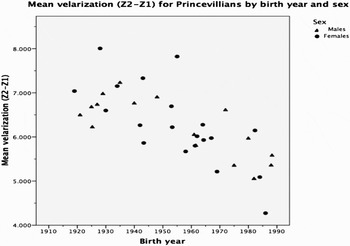
Perhaps the significant relationship between /l/ velarization (the dependent variable) and phonetic context is not surprising (due to coarticulation), but its significant correlation with birth year is. Birth year is independently significant as a predictor of /l/ quality in Princeville such that younger Princevillians utilize darker /l/s. Figure 2 shows the mean /l/ velarization values (Z2−Z1) for each speaker by birth year in the Princeville data set, with sex distinctions noted. (Sex is noted here purely for interest's sake, as sex never figured significantly in any of the statistical analysis for the Princeville data set.)
Mean velarization (Z2−Z1) for each Princeville speaker by birth year and sex. Note the coinciding distribution of both sexes.

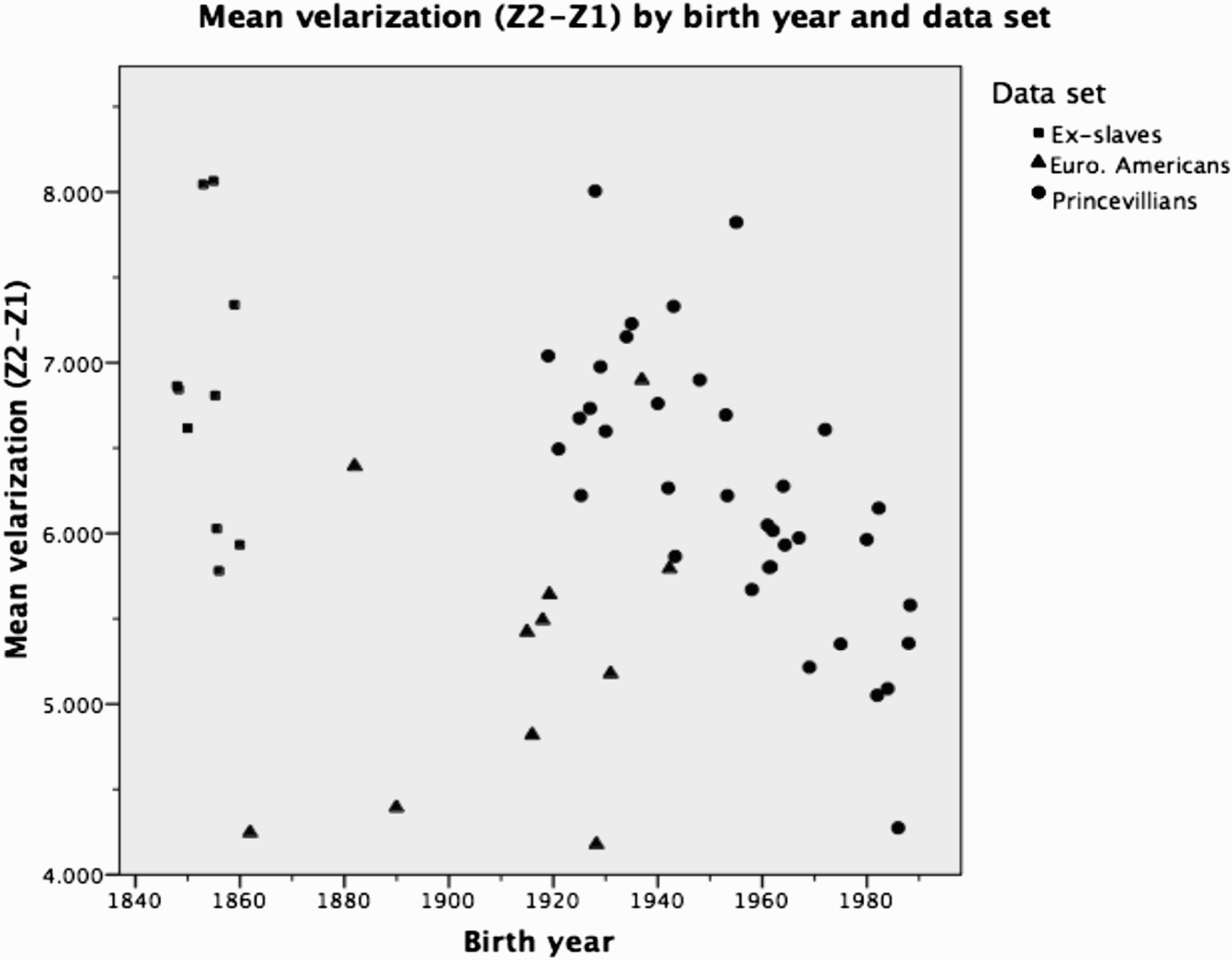
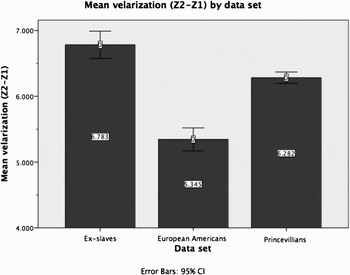
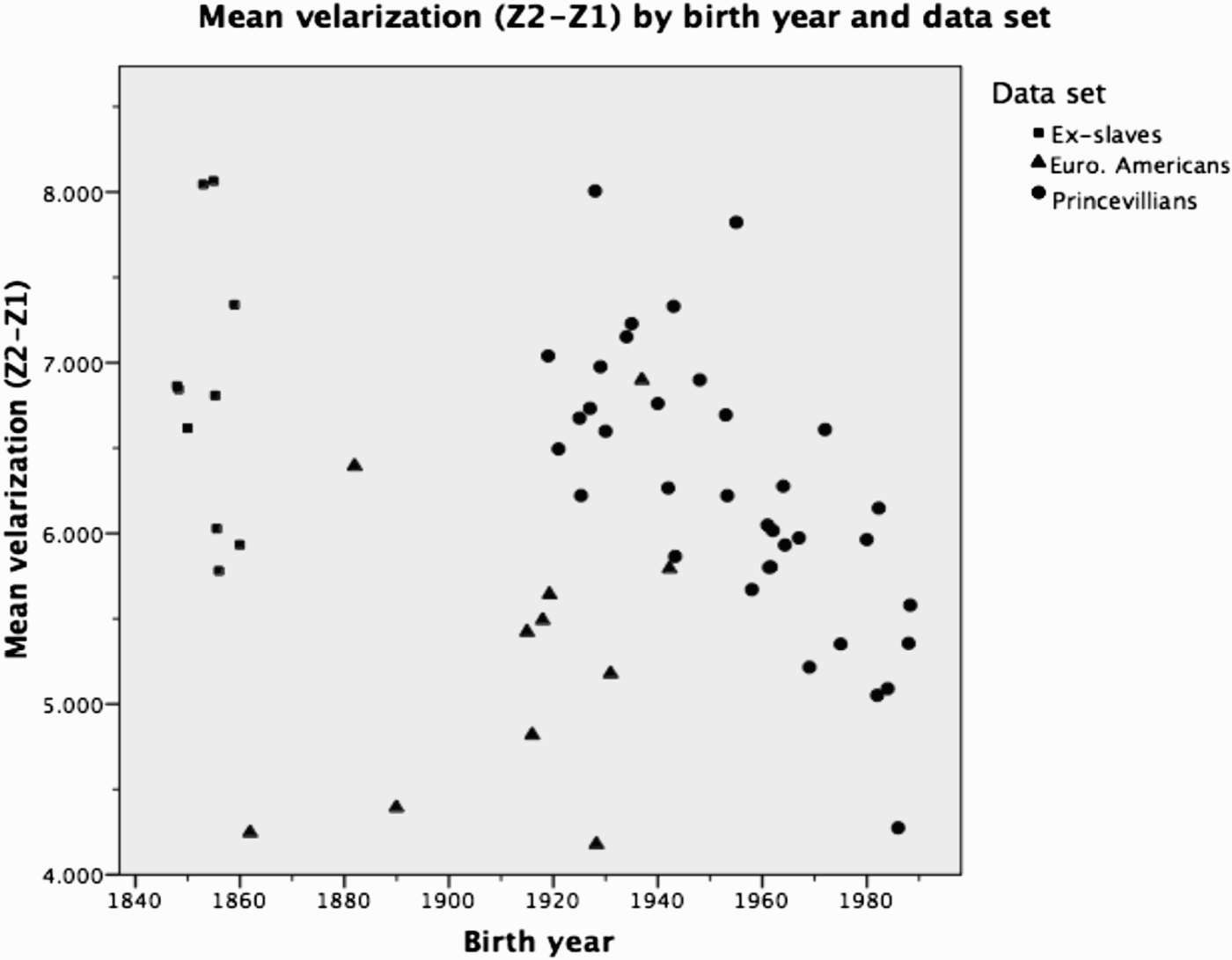
The best-fitting multilevel mixed effects regression model for the second portion of the analysis, which utilizes data from all data sets (Princevillians, ex-slaves, and European Americans), incorporates all of the same variables plus two more (see Table 3). Again, birth year (p < 0.05) and context (p < 0.001) were significant. Their coefficients indicate that later birth years predict darker /l/s, and fronter following vowels predict lighter /l/s. This is consistent with what was found with the regression of just the Princeville data set. However, unlike with the Princeville data set, sex is a significant predictor in this model (p < 0.05), in that males have significantly more velarized /l/s than do females. As well, one of the interactions emerged as significant in this model, that between birth year and sex (p < 0.05). In earlier birth years, the difference between sexes is quite pronounced; that is, females are much more likely to have light /l/s than are males. However, in later birth years, /l/ velarization for the sexes converges such that there is little if any difference between them. Data set is also a highly significant predictor of /l/ velarization (p < 0.001). Generally speaking, ex-slaves have lighter /l/s than do the Princevillians, who have lighter /l/s than the European Americans. Figure 3 shows mean values by speaker across birth year and data sets, and Figure 4 compares mean Z2−Z1 values across the data sets.
Mean velarization by birth year and data set.
Mean Z2−Z1 values across data sets.

Though the mean values of the three data sets differ significantly from each other, it is important to note the correspondences that individual Princeville speakers have with speakers of the other categories at various points in time. For example, the earliest Princeville speakers show mean Z2−Z1 scores that are right in line with the ex-slaves data—on the lighter end of this /l/ scale. Also, the latest Princeville speakers show mean Z2−Z1 scores that are in line with the European Americans in the sample, which places them on the darker end of the scale. Birth year is consistently a significant factor in /l/ velarization in the Princeville speakers, and the downward trajectory of these speakers in Z2−Z1 is clear in Figure 2. Thus, regression results point to a change in /l/ quality for this community over the last century that has brought their /l/s more in line with neighboring European Americans than with their ex-slave predecessors.
DISCUSSION
These results, then, can help to address the research questions outlined. Generally speaking, Princeville /l/s have changed over time, transitioning from the light end to the darker end of the continuum. Although phonetic conditioning also affects /l/ quality—following vowel context in particular, but not duration—this effect is independent of the effect of birth year on these speakers. In comparison with other speaker data sets, Princeville speakers have shifted in time away from the lighter /l/s of their ex-slave ancestors and toward the darker /l/s of their European American neighbors in North Carolina, indicating convergence of this feature.
It is not known at this point whether European Americans from this region experienced the same sort of /l/ darkening patterns in an earlier era. Among the 11 European American speakers analyzed in this study, the earliest-born speaker's /l/s exhibited the same mean Z2−Z1 scores as speakers born 25 and even 65 years later. This sample is too small to enable any pertinent conclusions in this respect.
Apparent time shift in velarization of /l/: social factors
This study has found that there is significant change among Princeville AAE speakers across 69 years of apparent time. This change has occurred in the relative velarization of /l/, in that /l/ has gotten darker (i.e., smaller Z2−Z1s) over the years. The oldest Princeville speakers exhibit mean Z2−Z1s in the 7.0 to 8.0 range, which parallels most of the ex-slave speakers. The youngest Princeville speakers show mean Z2−Z1s around 5.0, nearer the domain of the European American speakers' /l/s. Referring to Figure 2, the nearly completely coinciding distribution of the sexes is noteworthy; sex never figured as a significant factor for these Princeville data. Figures 3 and 4 exhibit the similarities between the ex-slave speakers and the earliest-born Princeville speakers, suggesting that lighter /l/s may have been a characteristic feature of earlier AAE varieties, possibly related to the light /l/s of the languages and creoles of the African diaspora (Childs & Wolfram, Reference Childs, Wolfram and Schneider2008; Elugbe, Reference Elugbe and Mesthrie2008; Ladefoged, Reference Ladefoged1968; Menang, Reference Menang and Mesthrie2008; van Rooy, Reference van Rooy and Mesthrie2008; Wheldon, Reference Wheldon and Schneider2008).
These findings indicate convergence between the African American population in Princeville and the European American communities nearby with regard to /l/. Also, it appears as though it is the African American population that is moving toward the European Americans in this respect—not vice versa. If this is the case, then this convergence is notable considering that, as Thomas (Reference Wolfram2007) noted, AAE vowels in the American South have not coincided with SWE norms (with respect to the Southern Vowel Shift) and have definitely not changed at such a rapid pace. Bailey (Reference Bailey and Lanehart2001) asserted that AAE and European American varieties in the South are more dissimilar today than they were during the days of slavery. But, with this feature, it appears as though assimilation between these two groups may be occurring. The timing of the convergence is also noteworthy. If these data accurately depict the /l/s of Princevillians at the turn of the 20th century, then it is likely that their /l/s were more like those of their slave predecessors than their European American neighbors, with whom the /l/s of younger Princevillians are much more in line.
One possible reason for this convergence may be related to the forced racial integration that took place between Princeville and neighboring communities as a result of the civil rights movement. Prior to this time, Princevillians were educated through elementary school in their own majority African American town. High school in neighboring Tarboro was a segregated affair, as African Americans and European Americans attended separate schools. Princevillians themselves recount that they had very little significant interaction with European Americans except in the workplace—in the fields or in the factories—but in those cases, Princevillians most often held positions of lower status than did European Americans.
Post-civil-rights Princevillians, in contrast, were bussed out to neighboring towns to study with European Americans in the same schools. Increased opportunity for African Americans at this time corresponded to better economic prosperity in Princeville, whose residents began taking advantage of opportunities for entrepreneurship, higher education, and travel never before afforded to them.
Another cross-generational study on the Princeville population (Rowe, Reference Rowe2005) also has found a dramatic linguistic shift in younger Princevillians, this time with a morphosyntactic variable: plural -s absence. After dividing speakers into three generational categories (Generation I born before 1945; Generation II born between 1948 and 1968; Generation III born 1970 to the present), Rowe found that Generation III had significantly fewer realizations of plural -s absence than did their predecessors. Princeville, Rowe explains, has historically had a higher frequency of plural -s absence than what is found in contemporary AAE. However, younger Princevillians are using the feature with supraregional frequency, mirroring other reports (e.g., Wolfram & Thomas, Reference Wolfram and Thomas2002) of rural AAE varieties accommodating to supraregional norms.
Given Rowe's study on plural -s absence in Princeville, the question arises whether /l/ quality in younger Princevillians mirrors supraregional /l/ norms in AAE. Aside from studies of /l/ vocalization in coda positions, there are no studies that characterize word- or syllable-initial /l/ velarization in broad-ranging AAE. It is possible that younger Princeville speakers have darkened their /l/s to align with what they see as African American norms (similarly to what they have done with plural -s absence), but this cannot be known for sure until the /l/s from larger populations of African Americans from urban settings have been analyzed.
If, as Recasens and Espinosa (Reference Recasens and Epinosa2005) maintained, General American English /l/s generally are on the darker side of the continuum in all positions, then it is also possible that not only integration with neighboring North Carolinian European American communities but also exposure to mainstream American media outlets has contributed to this change in /l/ quality over time. As mentioned, recent generations of Princevillians enjoy greater economic prosperity than did their forebears—corresponding to broader access to media outlets such as television and Internet. Darker /l/s for Princevillians, therefore, may be indicative of accommodation to greater General American English rather than specifically to the SWE of neighboring European Americans.
Apparent time shift in velarization of /l/: phonetic factors
In addition to looking at the between-subjects effects of sex, speaker, and birth year, this study also sought to control for within-subjects phonetic effects such as /l/ duration and following vowel context. Regression results indicated that duration does not play a significant role in the darkening of Princeville /l/s, but that phonetic context (i.e., the frontness/backness of the following vowel) does exert a significant influence. Generally, fronter vowels correspond to lighter /l/s and vice versa. This is consistent with plenty of evidence for a correlation between velarization of /l/ and F2 of neighboring vowels (Dalston, Reference Dalston1975; Espy-Wilson, Reference Espy-Wilson1992). The significant relationship between /l/ velarization and following vowel context seems to reflect expected coarticulatory processes.
However, the consistent significance of birth year in terms of predicting /l/ velarization suggests that for these data, birth year is also a strong, independent effect. What relationship might the passage of time have on the dramatic increase of word-initial /l/ velarization in this community?
Carter (Reference Carter, Local, Ogden and Temple2003) found rhotic dialects in the UK to predictably have perceptually distinct initial and final /l/s, initial /l/s being notably lighter than final /l/s. This prediction did not hold for nonrhotic UK dialects. AAE is known to be generally r-less, and D'Andrea (Reference D'Andrea2005) found r-lessness to persist in speakers from Princeville, North Carolina, through time. However, despite the persistence of nonrhoticity in this particular community, /l/ became significantly more velarized over time. These results support Carter's (Reference Carter, Local, Ogden and Temple2003) contention that nonrhoticity and /l/ velarization do not have a correlative relationship. So, increasing /l/ velarization cannot be said to be related to proposed changes in rhoticity. (Intensive acoustic study of /r/ in Princeville is necessary to substantiate this more concretely.)
A final possible reason for increased word-initial /l/ velarization in this community relates to speculation regarding the increase of word-final /l/ vocalization within the greater AAE-speaking community. In a comparison study of /l/ vocalization between European Americans and African Americans in Columbus, Ohio, Durian (Reference Durian2008) found /l/ vocalization in both communities, but that it is more pronounced and prolific in the AAE speakers, occurring with greater frequency and in more phonetic contexts. In fact, Durian's sample used near categorical (93%) /l/-vocalization in syllable-final conditions. Durian posits that increased /l/ vocalization is an ethnic marker for Columbus area African Americans, which is consistent with Fix's (Reference Fix2004) study of social networks in the same community. As such a salient phonetic and ethnic marker, it may be that an extremely dark or vocalized /l/ in syllable- and word-final positions is becoming phonologized for this speech community. As such, its movement along the light/dark /l/ continuum has become so polarized on the dark side that it may slide off the continuum altogether and become a separate, distinct phoneme (similar to what happened historically with dark /l/ in standard Polish) or push the entire continuum in the darker direction, meaning that word-initial /l/s become comparatively darker as well. Essentially, to avoid a phonemic split between lighter /l/s and darker /l/s in this variety, the entire spectrum may have moved into darker territory. To determine if this is the case, a much broader study, incorporating syllable- and word-final /l/s in the Princeville community, and beyond, would be necessary. For now, it is enough to observe that word-initial /l/s have indeed changed acoustically (becoming darker/more velarized) in this community over time.
Beyond Princeville
Princeville, North Carolina, is a unique location with unique population of African American speakers. Despite specific differences in geographical and historical context, much of the social history of the Princeville residents is shared by members of the greater African American community. If the historical AAE /l/ is lighter on the continuum than are general American /l/s, as this study implies, then—for phonetic and social reasons—it is likely that the convergence found in the Princeville /l/ would extend more broadly across the dialect.
CONCLUSIONS
Through in-depth acoustical analysis of speakers of AAE from Princeville, North Carolina, and comparison speakers (ex-slaves and neighboring European Americans), this study has sought to ascertain what, if any, variation or development is occurring with /l/ in terms of its relative velarization. Given much of what has been debated regarding the possible origins of AAE and its subsequent accommodation or divergence from other varieties of English, an acoustic study of /l/ can shed valuable light on how the dialect has developed phonologically through time. This study has concluded that the AAE /l/ has darkened greatly in recent years, as exemplified by speakers in Princeville, North Carolina. It has been shown to move from the lighter /l/s of earlier generations (possibly tracing back to the dialects of former slaves) to much darker /l/s in later speakers, remarkably similar in quality to prevailing regional European American dialects in the United States. This phenomenon indicates convergence between AAE and SWE of /l/ in this setting, and likely beyond.