INTRODUCTION
The risks associated with the introduction of marine species are now generally acknowledged (Carlton, Reference Carlton, Leppäkoski, Gollasch and Olenin2002). Several national marine introduced species lists have been published (e.g. Eno et al., Reference Eno, Clark and Sanderson1997). Kerckhof et al. (Reference Kerckhof, Haelters and Gollasch2007) provided a comprehensive list for Belgium that was actualized and extensively annotated by Vandepitte et al. (Reference Vandepitte, De Pooter, Lescrauwaet, Fockedey and Mees2012). Wolff (Reference Wolff2005) did the same for The Netherlands.
The occurrence of so-called mud worms, i.e. the genus Polydora and related genera, often raises concerns in oyster culture as several species in this group drill holes in calcareous substrata, such as mollusc shells (Hoeksema, Reference Hoeksema1983; Bailey-Brock, Reference Bailey-Brock2000; Ruellet, Reference Ruellet2004; Simon et al., Reference Simon, Worsfold, Lange and Sterley2010). They can also form dense tube mats covering large areas in polluted or deteriorated habitats, smothering other sessile invertebrates (e.g. Daro & Polk, Reference Daro and Polk1973; Jaubet et al., Reference Jaubet, de los Ángeles Sánchez, Rivero, Garaffo, Vallarino and Elías2011). This was the reason for extensive research in the past in Belgium and The Netherlands (Korringa, Reference Korringa1951; Daro, Reference Daro1969; Daro & Polk, Reference Daro and Polk1973). However, for about half a century little or no attention has been paid to infestations of non-indigenous species such as shell-boring polychaetes on commercially harvested molluscs in Belgium and The Netherlands. In view of the problems with taxonomy and identification in this group of polychaetes and the high incidence of introductions worldwide (Hatton & Pierce, Reference Hatton and Pearce2013), a new investigation of mud worms in this region seemed worthwhile. We decided to sample habitats that non-indigenous polydorins were likely to prefer. In The Netherlands a quick survey of mud under wild Pacific oysters Crassostrea gigas (Thunberg, 1793) outside of culture plots was performed. In Belgium muddy turf of polydorin tubes on groynes, mainly of the native mud worm Polydora ciliata (Johnston, Reference Johnston1838), was sampled. During the analysis of our material Hatton & Pierce (Reference Hatton and Pearce2013) had already proved that such a sampling strategy could yield important new results.
MATERIALS AND METHODS
Sampling
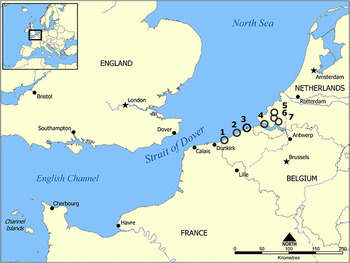
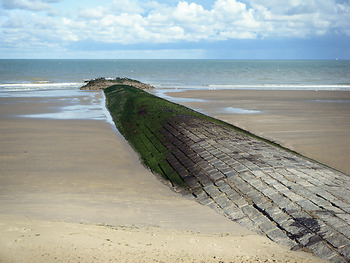
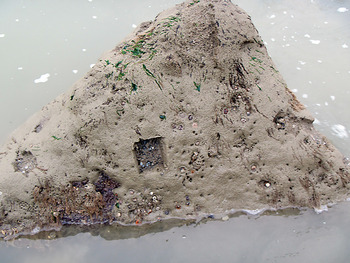
Samples were taken on the coast of Belgium and the south-west Netherlands in the Southern Bight of the North Sea (Figure 1). Along the Belgian coast sampling was conducted on groynes, man-made coastal defence structures of bluestone, built perpendicularly to the sandy coast (Figure 2). In January 2011 Polydora-turf (mainly Polydora ciliata) was collected from a large stone emerging at the seaward end of groyne no. 2 at Koksijde during spring tide low water (Figure 3). In August 2011 the intertidal marine growth on groyne no. 16 in Oostende (Raversijde) was sampled.
Sampling locations in the Southern Bight of the North Sea, mentioned in this paper: 1, Koksijde; 2, Oostende; 3, Zeebrugge; 4, Vlissingen and Borssele; 5, Zierikzee; 6, Goesse Sas; 7, Yerseke.

Groyne no. 16 at Oostende (Raversijde), 18 September 2011.

Large stone at the seaward end of groyne no. 6 at Koksijde: covered with polydorins in tubes and sampled on 23 July 2013.

In September 2011, a further 3 groynes along the Belgian coast were sampled quantitatively, including the 2 groynes where Boccardia proboscidea had been noted during the two previous searches: 1 groyne in Koksijde (no. 6); 1 in Oostende Raversijde (no. 16); and 1 in Oostende Halve Maan (no. 3). Numbering of the groynes was according to the maps used by the Flemish Coastal Administration (Anonymous, 2010). Scrape samples with a known surface between 100 and 300 cm² were taken distributed all over the length of the groyne.
The samples were randomly chosen in zones where B. proboscidea was expected. Bare areas, low tidal mussel beds and large sedentary animals such as Patella vulgata Linnaeus, 1758 were avoided. We only sampled the turf, consisting of young-of-the-year mussels, barnacles and sediment, with superficial green algae or Polydora colonies at the low water mark of spring tide. Material was scraped off with a putty knife and carefully collected for further processing in the laboratory.
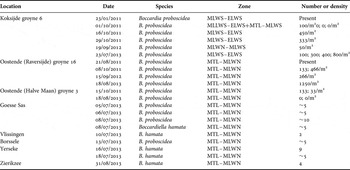
In The Netherlands, five locations in the south-western delta area were chosen to survey (Table 1; Figure 1). Yerseke (eastern Scheldt estuary) was chosen because it is the centre of shellfish handling and trade. Borssele (western Scheldt estuary) was chosen because it is situated along the busy international shipping route to the port of Antwerp and cooling water discharge from its power plant causes artificial warming of the seawater. Vlissingen is situated along the same shipping route, but does not experience artificial warming. Zierikzee and the Goesse Sas (eastern Scheldt estuary) have no shellfish trade, nor artificial warming, nor international shipping, but are situated near outlets of canals used by inland and/or recreational shipping. At each location, on each date, 10 Pacific oysters were dislodged from boulders, occurring less than 1 m above mean low water and polychaete worms were collected, occurring in mud crevices on the underside of and between oysters.
Samples taken to collect ‘mud worms’ and densities or numbers recorded; at locations in The Netherlands (Goesse Sas, Vlissingen, Borssele, Yerseke and Zierikzee) no densities were determined.

MLWS, mean low water spring; ELWS, extreme low water spring; MTL, mean tide level; MLWN, mean low water neap.
RESULTS
In our samples, we identified two new species for the North Sea region namely Boccardia proboscidea (Hartman, Reference Hartman1940) and Boccardiella hamata (Webster, 1879).
Along the Belgian coast, Boccardia proboscidea was present on all 3 locations, always in small numbers (Table 1). Densities varied between 100 ind./m² (Koksijde 2012) and 1250 ind./m² (Oostende 2013). In Koksijde B. proboscidea was only present in the lower intertidal, in the Polydora turf, and it was not found in samples higher on the groyne (Ulva zone). In Oostende (both sites) B. proboscidea was present along the whole algae zone covering the groynes, where it sometimes was the only spionid. In The Netherlands B. proboscidea was present near Borssele, close to the cooling water discharge of a power plant, and near the Goesse Sas, a site without artificial warming. Boccardiella hamata was present at all sites (Zierikzee, the Goesse Sas, Yerseke and Vlissingen) except the site with artificial warming (Borssele). Densities were not measured as the occurrence of the mud worms was highly patchy. 5–10 individuals of B. proboscidea were collected from mud under 10 oysters, and of B. hamata 2–5 individuals were collected from 10 oysters (Table 1).
Several specimens of B. proboscidea collected on 23 July 2013 are lodged in the Reference collection of the Operational Directorate Natural Environments (OD) of the Royal Belgian Institute of Natural Sciences at Oostende under registration number TRC 16. Three specimens of Boccardia proboscidea collected at the Goesse Sas on 8 July 2013 have been deposited in the collection of Naturalis Biodiversity Center, Leiden, with registration number RMNH.VER.19904; 3 specimens of Boccardiella hamata (Yerseke, 16 July 2013) have been deposited in the same collection with registration number RMNH.VER.19902. Three further specimens of B. hamata have been deposited in the reference collection of the OD under registration number TRC 60.
DISCUSSION
Species identification
Boccardia proboscidea (Hartman, Reference Hartman1940)
Synonym Polydora californica Treadwell, 1914
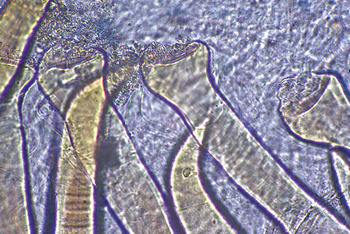
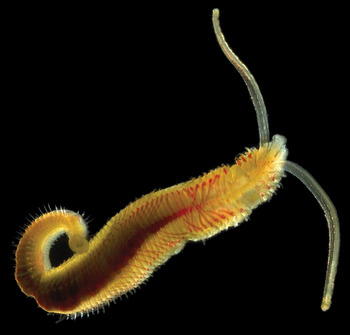
Identification of this species with a recent regional polychaete identification manual (Hartmann-Schröder, Reference Hartmann-Schröder1996) readily points to Boccardiella ligerica (Ferronière, Reference Ferronnière1898) due to the gills on chaetigers 2, 3 and 4. Identification with the older and more southerly-oriented manual of Fauvel (Reference Fauvel1927) points to Boccardia polybranchia (Haswell, Reference Haswell1885). Martínez et al. (Reference Martínez, Adarraga and López2006) provide a key to Boccardia species recorded from the Atlantic, including B. proboscidea, which highlights the short notopodial chaetae on the first chaetiger of B. proboscidea (Figure 4), that are lacking in B. polybranchia. Boccardia proboscidea further differs from other Boccardia species recorded from the Atlantic, in the bristle-tipped special chaetae of chaetiger 5 without subdistal bosses (Figure 5) and the undivided prostomium. In these characters B. proboscidea (Figure 6) also differs from Boccardiella ligerica (Hartman, Reference Hartman1940; Blake & Kudenov, Reference Blake and Kudenov1978; Martínez et al., Reference Martínez, Adarraga and López2006). The genera Boccardia Carazzi, 1893 and Boccardiella Blake & Kudenov, Reference Blake and Kudenov1978 differ in the presence of branchiae on the first setigers: in Boccardiella they are present on setigers 2, 3 and 4, in Boccardia branchiae are present only on setigers 2 and 3 (Blake & Kudenov, Reference Blake and Kudenov1978).
Boccardia proboscidea, Oostende (Raversijde), 21 August 2011: notopodial chaetae of first chaetiger (arrow).

Boccardia proboscidea, Goesse Sas, 8 July 2013: special chaetae of fifth chaetiger (bristle-tipped without bosses).

Boccardia proboscidea, Oostende (Raversijde), 24 September 2011, habitus: prostomium undivided, with black pigment laterally (photograph by Jan Haelters Royal Belgian Institute of Natural Sciences).

Boccardiella hamata (Webster, 1879)
Synonym Boccardia uncata Berkeley, 1927
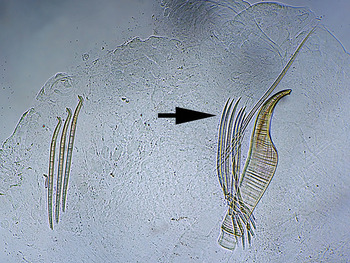
Using European polychaete identification manuals (Fauvel, Reference Fauvel1927; Hartmann-Schröder, Reference Hartmann-Schröder1996) this species will be identified as B. ligerica. However, the latter species is described as a strict brackish water species (e.g. Blake, Reference Blake1983), whereas B. hamata is common in fully marine as well as estuarine conditions (Blake, Reference Blake1966). There are at least two clear morphological differences (Blake, Reference Blake1966; Radashevsky, Reference Radashevsky1993). In the posterior region a series of segments with large re-curved notopodial hooks is present. In B. hamata these hooks are accompanied by a few thin capillary chaetae and a row of acicular spines (Figure 7).
Boccardiella hamata, Yerseke, 18 August 2013: neurochaeta (left) and notochaeta (right) of 27th chaetiger; arrow, row of acicular spines.

In B. ligerica these acicular spines are absent (Blake & Woodwick, Reference Blake and Woodwick1971; Hartmann-Schröder, Reference Hartmann-Schröder1996). Furthermore, the anal cirri of both species are clearly different. The pygidium of B. ligerica bears two more or less elongated processes, whereas the pygidium of B. hamata is provided with two short and flat flaps, each with a short and thin process, that is directed more or less laterally (Figure 8). A species with a similar pygidium is Boccardiella bihamata Blake & Kudenov, Reference Blake and Kudenov1978, described from Australia. Boccardiella bihamata differs from both species concerned in the possession of unidentate neuropodial hooks in the posterior region with re-curved notopodial hooks (Blake & Kudenov, Reference Blake and Kudenov1978).
Boccardiella hamata, Goesse Sas, 6 July 2013: pygidium with flat flaps; lateral processes of flaps (arrow) strongly contracted during fixation.

Historical background
After the research of Korringa (Reference Korringa1951) and Hoeksema (Reference Hoeksema1983) no investigations on mud worms in The Netherlands have been conducted. Daro (Reference Daro1969, Reference Daro1970) was the first and only to study mud worms in Belgium.
The main tube-building polychaete species forming dense tube-mats on artificial hard substrata in northern European intertidal habitats used to be Polydora ciliata (see Daro & Polk, Reference Daro and Polk1973). Our current knowledge about the occurrence of species of this group in the Southern Bight of the North Sea is certainly flawed. Intertidal man-made hard substrata, although increasing are little-studied habitats, which means that species present may remain unnoticed for a long time. Moreover, in the busily navigated and cultivated coastal areas of the southern North Sea, species from all over the world may show up, that are not mentioned in European identification manuals, which may lead to misidentifications (e.g. Kerckhof & Cattrijsse, Reference Kerckhof and Cattrijsse2001; Faasse & van Moorsel, Reference Faasse and van Moorsel2002).
In Belgium, Daro (Reference Daro1969) and Daro & Polk (Reference Daro and Polk1973) studied the spionid fauna (mainly Polydora ciliata) in some detail as this species was considered a pest for oyster culture and thus a reason for concern. Daro (Reference Daro1969, Reference Daro1970) was also the first to study the artificial habitats of the groynes along the Belgian coast. Some thirty years later, during the early 2000s, the groynes and certain harbour environments all along the Belgian coast were addressed in a more comprehensive study aimed to gain insight into the biological value of these man-made structures (Engledow et al., Reference Engledow, Spanoghe, Volckaert, Coppejans, Degraer, Vincx and Hoffman2001; Volckaert et al., Reference Volckaert, Engledow, Spanoghe, Degraer, Vincx, Coppejans and Hoffmann2003). In this study, sampling was done in autumn 2000 and during 2001, and included the groyne no. 6 at Koksijde but not the groynes around Oostende included in our study. Only Engledow et al. (Reference Engledow, Spanoghe, Volckaert, Coppejans, Degraer, Vincx and Hoffman2001) and Volckaert et al. (Reference Volckaert, Engledow, Spanoghe, Degraer, Vincx, Coppejans and Hoffmann2003) mention the presence of a second polydorin from the coast of Belgium, namely Boccardiella ligerica. It was first encountered at a site in the harbour of Zeebrugge, with 51 ind./m² (Engledow et al., Reference Engledow, Spanoghe, Volckaert, Coppejans, Degraer, Vincx and Hoffman2001). In the succeeding study (Volckaert et al., Reference Volckaert, Engledow, Spanoghe, Degraer, Vincx, Coppejans and Hoffmann2003) the presence of B. ligerica was also mentioned from groynes along the coast, in fully marine conditions, including groyne Koksijde no. 6 of our study and a sheltered site inside of the outer harbour of Zeebrugge.
We had reason to believe that Engledow et al. (Reference Engledow, Spanoghe, Volckaert, Coppejans, Degraer, Vincx and Hoffman2001) and Volckaert et al. (Reference Volckaert, Engledow, Spanoghe, Degraer, Vincx, Coppejans and Hoffmann2003) were probably not dealing with Boccardiella ligerica. Indeed, when we first encountered B. proboscidea and attempted to identify this species with the regional identification manual (Hartmann-Schröder, Reference Hartmann-Schröder1996) we ended up on B. ligerica (see Species identification). Part of the material of the study by Volckaert et al. (Reference Volckaert, Engledow, Spanoghe, Degraer, Vincx, Coppejans and Hoffmann2003) was still present in the collections of the Marine Biology Research Group at Ghent University and we were able to check the available samples identified as B. ligerica from Koksijde and Zeebrugge, all collected in November 2001. Indeed the specimens from Koksijde all proved to belong to B. proboscidea. However, the Zeebrugge sample, collected amongst Pacific oysters (Crassostrea gigas Thunberg, 1793) and thus a different habitat than the groynes, turned out to be B. hamata. Recently B. ligerica was also identified in macrobenthic samples taken in the vicinity of a wind turbine on the Thornton Bank (Belgium) (Degraer et al., Reference Degraer, Brabant and Rumes2013), but re-examination of the specimen revealed it belonged to the genus Dipolydora Verrill, 1881.
Distribution and dispersal
The genera Boccardia and Boccardiella have a predominantly Pacific distribution with few species in the north-east Atlantic. Fauvel (Reference Fauvel1927) mentions Boccardia polybranchia (Haswell, Reference Martínez, Adarraga and López1885) (as Polydora (Boccardia) polybranchia) and Boccardiella ligerica (as Polydora (Boccardia) ligerica). Recently Guérin (Reference Guérin1990) described a new species, Boccardia semibranchiata, from oyster parks in Normandy. Finally, Boccardia proboscidea was recorded from the Atlantic Iberian coast (Martínez et al., Reference Martínez, Adarraga and López2006) and recently from the north-west of Scotland (Hatton & Pierce, Reference Hatton and Pearce2013).
Boccardia proboscidea
Boccardia proboscidea was originally described from California (Hartman, Reference Hartman1940). The North Pacific coastlines of Japan and North America are considered to be the original distribution range of B. proboscidea (see Simon et al., Reference Simon, Worsfold, Lange and Sterley2010). The occurrence in Hawai'i (Bailey-Brock, Reference Bailey-Brock2000), Australia (Blake & Kudenov, Reference Blake and Kudenov1978), New Zealand (Read, Reference Read2004), South Africa (Simon et al., Reference Simon, Worsfold, Lange and Sterley2010), Argentina (Jaubet et al., Reference Jaubet, de los Ángeles Sánchez, Rivero, Garaffo, Vallarino and Elías2011), Maine (Bailey-Brock, Reference Bailey-Brock2000), Spain (Martínez et al., Reference Martínez, Adarraga and López2006) and Scotland (Hatton & Pierce, Reference Hatton and Pearce2013) is ascribed to human-mediated introductions, mainly related to transfers of cultured shellfish. Boccardia proboscidea was inadvertently transported to South Africa on Haliotis rufescens Swainson, 1822, which was imported from California in the late 1980s (Simon et al., Reference Simon, Worsfold, Lange and Sterley2010). Introduction to Hawai'i occurred with shipments of oysters Ostrea edulis Linnaeus, 1758 from Maine, on the Atlantic coast of North America (Bailey-Brock, Reference Bailey-Brock2000). Vectors of introduction to other regions have not been established with certainty.
The European records known to us are by Martínez et al. (Reference Martínez, Adarraga and López2006), who reported B. proboscidea from the Spanish coast of the Gulf of Biscay from 1996 onwards, and by Hatton & Pierce (Reference Hatton and Pearce2013) who reported the species from the Isle of Skye in Scotland in 2011 and 2013.
Boccardia proboscidea has now an almost cosmopolitan distribution in temperate waters. Only records from the south-east Pacific are lacking.
Boccardiella hamata (Webster, 1879)
Boccardiella hamata was described from the Atlantic coast of North America and was later reported from the Gulf coast (Dean & Blake, Reference Dean and Blake1966), the Pacific coast of North America (Blake, Reference Blake1966) and from the north-west Pacific (Japan) (Dean & Blake, Reference Dean and Blake1966; Radashevsky, Reference Radashevsky1993). We could not find any references to introduction of B. hamata with imported shellfish or other vectors. As far as we know, the species has not been reported from the north-east Atlantic before. Boccardiella hamata is now distributed in temperate waters all over the northern hemisphere. Blake (Reference Blake1966) synonymized Polydora uncatiformis Monro, 1938 from South America (Uruguay) with B. hamata. However, according to Blake & Kudenov (Reference Blake and Kudenov1978), this synonymization is erroneous and P. uncatiformis is a synonym of B. ligerica.
Possible vectors of transportation
There has been a significant increase in the incidence of marine biological invasions as human-mediated vectors, shipping and aquaculture in particular, continuously gain in importance (e.g. Carlton, Reference Carlton1985; Carlton & Geller, Reference Carlton and Geller1993). Along the coast of Belgium and The Netherlands both vectors are equally important, with two large ports, Antwerp and Rotterdam, and abundant shellfish culture and trade, resulting in numerous introductions by both vectors (Wolff, Reference Wolff2005; Kerckhof et al., Reference Kerckhof, Haelters and Gollasch2007). In the case of Boccardia proboscidea and Boccardiella hamata we cannot indicate the vector. Both species occur along shipping routes (Borssele and Vlissingen along the western Scheldt) and near shellfish culture areas (Zierikzee, Goesse Sas and Yerseke along the eastern Scheldt). Both species obviously may have been introduced with shellfish, possibly elsewhere in the region, but transport in hull fouling or as larvae in ballast water cannot be ruled out. After an initial introduction, secondary expansion may have taken place, enlarging the distribution range in the introduced region. The increased presence of man-made structures may have provided additional opportunities to settle and to establish permanent populations in the southern North Sea region.
Habitat and ecology
Polydorin species can either construct self-excavated burrows inside calcareous substrata, or live in mud-filled crevices or burrows or live in soft substrata. Behavioural differences in crawling, palp activity and tube construction between boring and non-boring polydorin species have been reported by Sato-Okoshi & Okoshi (Reference Sato-Okoshi and Okoshi1997). The non-boring Boccardia proboscidea is a rapid crawler with thick blood vessels in the branchiae that is able to quickly hide itself and construct a new tube when removed from its habitat (Sato-Okoshi, Reference Sato-Okoshi2000; authors, personal observations), while the borer in calcareous substrata B. berkeleyorum Blake & Woodwick, Reference Blake and Woodwick1971 is a slow crawler with thinner blood vessels in the branchiae, unable to form a new burrow or hide itself in mud deposits (Sato-Okoshi & Okoshi, Reference Sato-Okoshi and Okoshi1997). Sato-Okoshi & Okoshi (Reference Sato-Okoshi and Okoshi1997) suggest that the slower palp activity, the slower crawling and the inability to hide of mud-boring species are related to their stable habitat in calcareous substratum burrows.
Boccardia proboscidea exhibits a wide ecological amplitude. It creates burrows of varying shape and size that are made in muddy and sandy sediments or in existing mud-filled burrows and crevices in soft rock and mollusc shells. It can also be found among encrusting algae or amongst mussels (Hartman, Reference Hartman1940; Woodwick, Reference Woodwick1963; Gibson et al., Reference Gibson, Paterson, Taylor and Woolridge1999; Read, Reference Read2004; Ruellet, Reference Ruellet2004; Martínez et al., Reference Martínez, Adarraga and López2006; Simon et al., Reference Simon, Thornhill, Oyarzun and Halanych2009). Boccardia proboscidea is known as an indicator species for organic enrichment of sediments and is often numerically dominant (Johnson, Reference Johnson1970; Blake & Kudenov, Reference Blake and Kudenov1978; Jaubet et al., Reference Jaubet, de los Ángeles Sánchez, Rivero, Garaffo, Vallarino and Elías2011). In The Netherlands, it occurs at a location with artificially warmed seawater (Borssele), although it is not restricted to that location. The habitat where B. proboscidea was found in Belgium is on groynes, in Polydora ciliata patches in the lower intertidal zone and higher, amongst barnacles, green algae and small mussels and there it was often the only spionid attaining its largest densities. This habitat is ephemeral, i.e. during winter most of the biota on the groynes disappears, leaving a bare substratum until spring when recolonization starts. This leaves the question of the origin of the new settlers.
Boccardiella hamata occurs in a variety of muddy estuarine habitats, amongst tubes of fine sediment on rocks between bases of the barnacle Balanus improvisus on the west coast of North America (Dean & Blake, Reference Dean and Blake1966). These same authors report this species from galleries of shells on the east and Gulf coasts and from a muddy flat between crevices of rock in Japan. In Peter the Great Bay B. hamata occurs in estuaries in shallow water, reportedly boring into shells, mainly of the Pacific oyster and also inhabiting mud tubes on the exterior surface of the oysters (Radashevsky, Reference Radashevsky1993). Blake (Reference Blake1966) reports the species from British Columbia to Baja California from oyster beds, estuarine mud, Dodecaceria sp. Örsted, 1843 masses, and other littoral conditions. On the east and Gulf coasts it penetrates oyster and gastropod shells, according to Blake (Reference Blake1966). In central California it occurs in accumulated sand in algal holdfasts and in hermit crab shells, together with other polydorins (Blake, Reference Blake1966). According to Sato-Okoshi & Okoshi (Reference Sato-Okoshi and Okoshi1997) B. hamata does not bore. The latter authors refer to its occurrence in mud in the crevices of Pacific oysters in Japan or mud crevices in sandstone rocks in Canada. The habitat where B. hamata was found in Belgium, amongst Pacific oysters, is similar to the habit in The Netherlands.
Reasons for success
Larval development in mud worms is different between species. In Boccardia proboscidea development even differs within one population (Gibson et al., Reference Gibson, Paterson, Taylor and Woolridge1999). This species is able to produce non-viable eggs, which serve as food for developing larvae in the same egg capsule, resulting in rapid growth and offspring hatching as juveniles eleven days after oviposition. On the other hand, planktotrophic larvae may be produced, whose development to juveniles requires 19–36 days from oviposition (Gibson et al., Reference Gibson, Paterson, Taylor and Woolridge1999). The rapid growth of the first type of offspring enables quick growth of local populations. The pelagic planktonic development of the second type, the planktotrophic larvae, takes about a month and promotes dispersal over larger areas. This so-called poecilogonous development may enhance the success of the species in new areas. For Boccardiella hamata only planktotrophic development is known (Dean & Blake, Reference Dean and Blake1966), enabling expansion over larger areas, although build-up of local populations may take more time than in brooding species.
Possible effects and concerns
Several polydorins cause severe effects to their calcareous molluscan hosts. Many species are known to drill holes in bivalve shells, causing blisters, and consequently a substantial decrease in growth and survival (e.g. Sato-Okoshi & Okoshi, Reference Sato-Okoshi and Okoshi1997). Boccardia proboscidea has been described as a secondary borer (Simon et al., Reference Simon, Thornhill, Oyarzun and Halanych2009). However, some polydorins behave differently across various regions, boring in shells in one region and not boring, but tube-building, in another (Radashevsky & Pankova, Reference Radashevsky and Pankova2013). Shell-boring of Boccardiella hamata is known from the Atlantic coast of North America (Blake, Reference Blake1966). Therefore, the introduction of both species to the North Sea region is of concern for shellfish culture and wild populations of shelled molluscs. Furthermore, B. proboscidea may be a threat to local biodiversity as this species is able to form dense mats of aggregated tubes in situations of organic enrichment, smothering other invertebrates (Johnson, Reference Johnson1970; Blake & Kudenov, Reference Blake and Kudenov1978; Jaubet et al., Reference Jaubet, de los Ángeles Sánchez, Rivero, Garaffo, Vallarino and Elías2011). Therefore it is advisable to follow the development and dispersal of the introduced polydorins.
Conclusions and relevance of monitoring of hard substrata
Our present records of two non-indigenous mud worms detected in the southern North Sea within a few years do not necessarily imply the occurrence of recent invasions. In view of the low survey effort in artificial hard substrata habitats and the absence of dedicated mud worm research during more than half a century it is impossible to estimate the years of introduction, which may be any year between the 1950s and the present. Non-native species collected during surveys that are not focused on introductions are usually misidentified as morphologically similar native species when only local identification keys are used (e.g. Kerckhof & Cattrijsse, Reference Kerckhof and Cattrijsse2001; Faasse & van Moorsel, Reference Faasse and van Moorsel2002). In this context it is worth noting that in a limited period of time B. proboscidea was reported from such distant European regions as Northern Spain (1996–1997) (Martínez et al., Reference Martínez, Adarraga and López2006), north-west Scotland (2011) (Hatton & Pierce, Reference Hatton and Pearce2013) and the southern North Sea (2001 and 2011–2013) (this study). Although Ruellet (Reference Ruellet2004) did not report the species from the Normandy coast in his study performed in 2000–2003, the species may presently be widespread in several regions of the north-east Atlantic, but not recognized. This is illustrated here by the discovery of both species in previously collected samples from the Belgian coast, documenting an earlier presence in the North Sea. We emphasize the fact that deviations from morphological descriptions, especially when accompanied by divergences in habitat preferences, deserve further study using worldwide identification literature. We particularly emphasize the importance of keeping voucher material.
Currently no regular research programmes to monitor intertidal macrobenthic hard substratum communities are conducted in Belgium or The Netherlands. Published reports on surveys aiming at the possible presence of non-native species are incidental (e.g. Gittenberger et al., Reference Gittenberger, Rensing, Stegenga and Hoeksema2010). Although soft-bottoms constitute the original biotope in this region and these still cover the largest area, the increasing presence of man-made structures and altered environments creates opportunities for introduced species. Neglect of hard substrata poses risks to shellfish culture, fisheries and the hard-substratum communities themselves. Even quick surveys of hard substrata apparently yield economically and ecologically relevant results. In view of the European Union Marine Strategy Framework Directive a proper monitoring of hard substratum communities is indispensable, especially as the area of hard substrata grows quickly due to harbour development, coastal defence works, wind farms and other man-made constructions.
ACKNOWLEDGEMENTS
We thank Professor Dr Magda Vincx, head of the Marine Biology Research Group at Ghent University, for giving us access to the earlier samples and we acknowledge various colleagues and an anonymous referee for valuable comments on earlier versions of this paper.