Introduction: ‘CEWIGs’
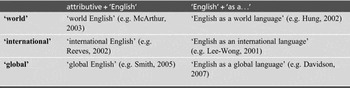
As regular readers of English Today would probably be aware, in the early years of the 21st Century, when applied linguists discuss the world-wide significance of the most widely learned and used language, it is not always enough to simply refer to it as ‘English’ or ‘the English language’. On the contrary, it has become almost de rigueur to collocate the word ‘English’ with ‘world’, ‘international’ or ‘global’. Thus, we have the six commonly used expressions set out in Table 1. At the risk of adding further to the crowded landscape of abbreviations in applied linguistics, I will refer to these as ‘CEWIGs’ (Collocations of ‘English’ with ‘world’, ‘international’ and ‘global’).
Matrix of six basic CEWIGs

Are these six expressions simply six ways of saying exactly the same thing? Or, are they used differently from one another? If so, how? These questions were explored by Tom McArthur in the pages of English Today a few years into the new millennium (McArthur, Reference McArthur2004). This paper revisits, some half a decade or so later, McArthur's discussion and findings from that 2004 article.
Revisiting McArthur (Reference McArthur2004)
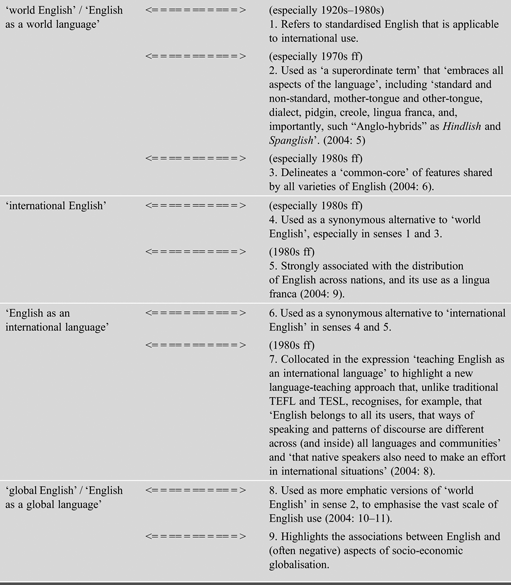
Overall, McArthur concluded that the semantic relations among the various CEWIGs ranged ‘from synonymy on occasion to a range of contrasts within a shared area’ (2004: 4). In other words, writers do use these expressions differently from one another. In coming to this conclusion, McArthur drew partly on lexicographic evidence. For example, he discussed entries in the Oxford Dictionary referring to 1927 and 1980 usages of ‘world English’ (2004: 4), and 1930 and 1958 usages of ‘international English’, along with more recent dictionary definitions of ‘world English’ (2004: 6) and ‘global English’ (2004: 10). Beyond these lexicographic points, he also reflected on his own use of the term ‘world English’ earlier in his academic career (2004: 4–5), and discussed instances of CEWIG use in a selection of books and journals published in the 1980s, 1990s and 2000s (2004: 6–11).
In this paper, I aim to go deeper into, and further beyond, McArthur's data sources, to build on his discussion and, albeit modestly (and belatedly), answer his call ‘to fill in any gaps in the story of [these] terms’ (2004: 3). To do this, I conducted an inductive literature search by entering each of the six CEWIGs into exact phrase searches of five academic databases.Footnote 1 The resulting compilations of citations were then browsed, along with a number of books with CEWIGs in their titles, to identify possible semantic associations for each CEWIG, much as McArthur did for his own data. My data is admittedly selective and the conclusions I draw are largely impressionistic, but it is hoped that this paper might contribute something to ongoing discussion of these terms.
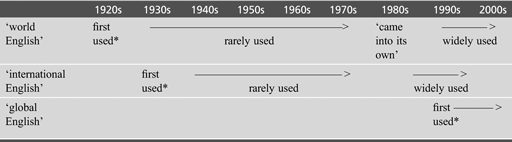
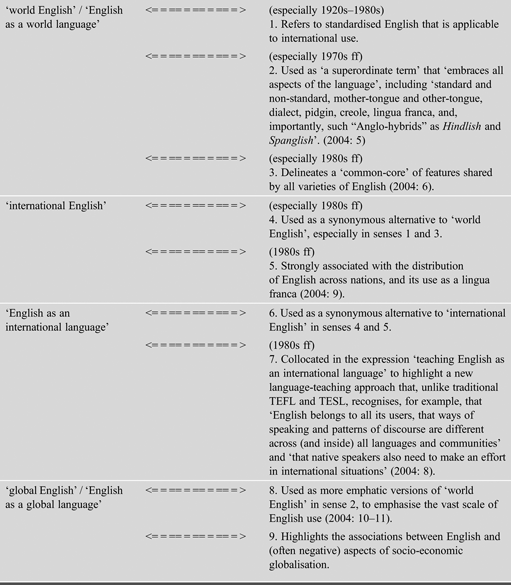
Overall, my informal inductive study of CEWIGs reaffirmed McArthur's major findings, but did add some possible nuances on certain points. First, let me summarise McArthur's main conclusions about the chronology and nature of CEWIG use (Tables 2 and 3).
Emerging use of various CEWIGs - a chronology (McArthur, Reference McArthur2004)
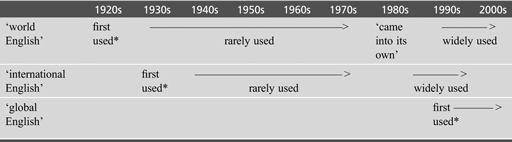
* In each case, according to McArthur (Reference McArthur2004: 10), usage of the phrases ‘English as a world / international / global language’ probably preceded and ‘apparently helped precipitate’, respectively, ‘world English’, ‘international English’ and ‘global English’.
A profile of semantic associations of various CEWIGs (McArthur, Reference McArthur2004)
The ‘when’ of CEWIG use: tinkering with McArthur's chronology
My perusal of CEWIG usage between 1888 and 2009 resonated with most aspects of McArthur's chronology (Table 2). However, the earliest recorded use of the term ‘world English’ that I found dates back, not to the 1920s, but to the late 19th century. An American intellectual, Alexander Melville Bell (Alexander Graham's father), coined the term to describe his proposed phonetic spelling system, which was ‘going the rounds of the press’ in the 1880s (Editors, 1888: 286). Admittedly, apart from a small subculture of spelling reform advocates (e.g. Wilcox, Reference Wilcox1914; Editors, 1930; Tovati & Jewett, Reference Tovati and Jewett1963; Bonnema, Reference Bonnema1976), this orthographic usage of ‘world English’ had pretty much disappeared by the 20th century. Thus, it might be considered a bit of a red herring in my current consideration of how CEWIGs have evolved down to the present day. The more familiar usage of ‘world English’, to describe the sociolinguistic reality of English around the world, also made rare appearances early on (e.g. Colburn, Reference Colburn1897), whereas its use increased from the 1920s. That decade also saw rising use of ‘English as an international language’ and ‘English as a world language’ (e.g. Collitz, Reference Collitz1926; Murray, Reference Murray1927; Kemp, Reference Kemp1928).
McArthur (Reference McArthur2004: 11) characterised the period from the 1920s to 1980 as ‘decades of relative obscurity’ when compared with the frequency of CEWIG use from 1980 onwards. My inductive search largely affirms this. While I uncovered some notable use in the earlier period, overall it was fairly infrequent. Apart from rare instances of ‘international English’ (e.g. Goad, Reference Goad1942), CEWIG usage seems to have been limited to intermittent use of three phrases: ‘world English’, ‘English as a world language’ and ‘English as an international language’. On the other hand, from around 1981, there was a major shift towards greater use of CEWIGs. In my inductive search, the number of CEWIG citations increased from a handful for each decade before 1980, to dozens for any given year since 1981. Finally, as noted by McArthur, it is only since the 1990s that ‘global English’ and ‘English as a global language’ have been widely used. I did, however, find one instance of ‘global English’ from the early 1960s, referring to ‘the growing divergence between British and American English’ (Editors, 1962: 275).
Overall, I found that, both before and since 1981, it has been expressions including the lexeme ‘world’ that have predominated in terms of raw frequency of CEWIG use. This concurs with McArthur's stance in his 2004 paper, when he notes ‘I felt the need to give world English four times the space needed for either of its rivals’ (i.e. international and global) (2004: 4). Lastly, my study was inconclusive on his premiss (2004: 10) that the ‘English as a(n) _ language’ forms predated and ‘precipitated’ the ‘attributive + English’ forms.
The ‘how’ of CEWIG use: adding to McArthur's semantic profile
While my inductive study tinkered at the edges of McArthur's chronology for CEWIG use, my perusal of the citations largely confirmed his findings on the semantic associations for each CEWIG (summarised in Table 3). In addition, however, I also found some possible patterns that were not mentioned by McArthur. I will now consider each CEWIG in turn, discussing their semantics both in terms of McArthur's findings and my own.
First, ‘world English’ …
Semantic Association 1 (Table 3) - Standardisation
As noted by McArthur (Reference McArthur2004: 4), ‘world English’, the first CEWIG to gain widespread currency, was initially associated with linguistic standardisation. Leaving aside Bell's (Reference Bell1888: 293, Reference Bell1889: 369, Reference Bell1890: 30) ‘world English’ spelling system, there were a number of proposals during the 1920s and 1930s for standardised transatlantic English usage, which were discussed under the rubric of ‘world English’ (Kemp, Reference Kemp1927: 322, Reference Kemp1928: 261–4; Clark, Reference Clark1931: 331–2, Aiken, Reference Aiken1933, Reference Aiken1934: 107; West, Reference West1934: 168). One of these, alluded to in McArthur's 1927 Oxford Dictionary citation, was that of de Witt (Reference De Witt1925), who argued that anglophone children should be taught ‘Good or World standard English’ that would ‘sound World-Well’ (de Witt, Reference De Witt1925: 174–6, 180; Barrows, Reference Barrows1926: 104), by avoiding regional pronunciation features. While this association between ‘world English’ and standardisation has been echoed more recently in Crystal's (Reference Crystal, Burns and Coffin2001: 57–68) idea of a ‘World Standard Spoken English’, it has been largely overshadowed by other usages of ‘world English’, to be discussed next.
Semantic Association 2 - All English
Like McArthur (Reference McArthur2004: 5), I found that perhaps the most common use of ‘world English’ has been as an all-inclusive term denoting English as used everywhere, by all its speakers, of whatever national and cultural background. In this ‘superordinate’ sense, ‘world English’ is sometimes used simply as a kind of grab bag term. For example, one book with ‘world English’ in the title is blithely described by Kaye (Reference Kaye2003: 655) as providing ‘a delightful discussion of English vocabulary around the world’. Some writers, meanwhile, go a step further to assert the equal validity of all the varieties that fall under the umbrella of ‘world English’. For example, Allen (Reference Allen2000) advocates a world English approach to lexicography that will give equal treatment to all varieties of English. Similarly, Weiner (Reference Weiner1987: 34) asserts that in international dictionaries ‘British English should be regarded as only one among a number of co-equal regional forms of (world) English’. Crystal (Reference Crystal1998: 17) likewise argues that the British and American standards so long upheld as pre-eminent models should each be seen as ‘only a dialect of World English’.
Semantic Association 3 - Common core
In addition to its primary, superordinate sense, my perusal of citations for ‘world English’ found the following two variations on the third semantic association, namely, the idea of a ‘common core’ of shared features.
Semantic association 3a–(Table 4) Subset of English use for international purposes
The first of these variations is the use of ‘world English’ to delineate the subset, or ‘offshoot’ (Bruton, Reference Bruton2005: 255), of English use that occurs for international purposes. For example, Rajagopalan (Reference Rajagopalan2004: 112) opines that ‘world English’ refers not to English as used for domestic communication within native speaking households and institutions, but rather to its use ‘routinely at check-in desks, and in the corridors and departure lounges of some of the world's busiest airports, typically during multinational business encounters, periodically during the Olympics, or World Cup Football seasons, international fairs, academic conferences, and so on’.
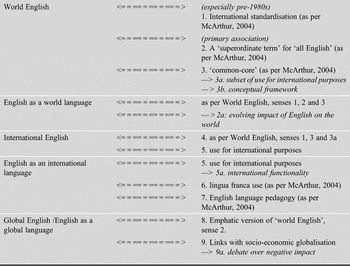
Semantic associations of CEWIGs (an updated profile)

Semantic association 3b – Conceptual framework highlighting key characteristics
On a more conceptual level, ‘world English’ is also used as a ‘a distinctive theoretical notion’ (Rajagopalan, Reference Rajagopalan2004: 332) or ‘center of gravity around which the international varieties revolve’ (Brutt-Giffler, Reference Brutt-Griffler2002: 177). In this sense, rather than describing a discrete, physical sub-set of English use, ‘world English’ is used to conceptualise key characteristics of worldwide English use, such as the central role played by non-native speakers in its development and the ongoing interpenetration between the English language and diverse cultures around the world. On the former, writers such as Brutt-Giffler (Reference Brutt-Griffler2002: 107) emphasise ‘the role of Africans, Asians, and other peoples of the world as active agents in the process of creation of world English’, whilst Kachru and Smith (Reference Kachru and Smith2009: 9), also under the rubric of ‘world English’, note the processes of reciprocal acculturation that are occurring between the English language and the cultures of communities in nations such as India (cf. Nadkarni, Reference Nadkarni1992: 333–5, 338).
… and, its near-equivalent, ‘English as a world language’
One area of McArthur's overview that might be further finessed is his tendency to treat as interchangeable the two terms, ‘world English’ and ‘English as a world language’, and to see the former as simply shorthand for the latter (2004: 10). On the one hand, it is true that the two phrases are sometimes used interchangeably, even within the same sentence, as in Nadkarni's (1992: 331) comment that
[w]hat has not been sufficiently recognized in my opinion, is that English as world language is not merely an international language, that world English even as an international language represents a totally new phenomenon in human history (italics added)
Likewise, in the title of their sweeping compendium of English varieties, Bailey and Görlach (Reference Bailey and Görlach1984) use ‘English as a world language’ in the superordinate sense of ‘world English’ (semantic association 2).
However, there seems to be at least one difference in emphasis between the two expressions. Whereas the term ‘world English’ generally focuses on description of the diversity within worldwide English, often at a given moment in history, the term ‘English as a world language’ is often used when explaining the evolving role of the English language through time. Thus, both before and since 1980, the term has often been incorporated into verbal constructions denoting ongoing change and increasing influence, such as Huebener's (1959: 200) ‘the rapid spread of English as a world language’; Nadkarni's (1992: 331) ‘English as a world language is gaining recognition as a special phenomenon’; Li's (Reference Li2003: 33) ‘English has emerged as a world language’; and Rajagopalan's (Reference Rajagopalan2004: 112) ‘the advance of English as a world language’. This leads me to suggest an additional semantic association that is particularly tied to ‘English as a world language’, namely the expanding impact English is having on the wider world (Semantic association 2a).
…and ‘international English’, used synonymously, to some extent
Turning to the synonymity between ‘world English’ and ‘international English’, my perusal of citations leads me to emphasise ‘to some extent’. While there has been some overlap between the usages of ‘international English’ and ‘world English’, for ‘international English’ the bias is clearly towards semantic associations 1, 3 and 3a, and away from the primary, ‘superordinate’ association (2) of ‘world English’. In other words, ‘international English’ seems more often used to delineate specific parts of worldwide English use, rather than to encompass the whole of this use, an idea more closely associated with ‘world English’, which ‘has tended to be the more all-embracing term’ (McArthur, Reference McArthur2004: 8).
In terms of semantic associations 3 and 3a, Ross (Reference Ross1997: 29), for example, argues that the term ‘international English’ is most appropriately used to denote either ‘a form of English, which […] provides the common core to all the world's varieties of English’, or, in particular, the English that is used as a lingua franca by non-native speakers ‘for communicating basic information in a simple manner, often in the business environment, but also in international airports, popular tourist resorts and so on’ (cf. Pakir, Reference Pakir1999: 110; Nelson, Reference Nelson, Kachru and Nelson2006: 740–1). Modiano (Reference Modiano1999: 25), meanwhile, places ‘international English’ at the centre of his diagram of the world system of English, and uses it as a ‘term which includes only the varieties which function well in cross-cultural communication’.
Other writers take a more monolithic view of ‘international English’, which brings us back to semantic association 1: standardisation. For example, Schneider (Reference Schneider2003: 236) and Wright (Reference Wright2004: 11–12) use the term ‘international English’ when discussing the prospect of a relatively homogeneous, ‘supranationally converging’ international version of English, such as may already be emerging in parts of Europe (cf. Johnson, Reference Johnson1990: 313; Ferguson, Reference Ferguson1994: 419; de Beaugrande, Reference De Beaugrande1999: 118; Kaye, Reference Kaye1999: 31; Jenkins, Reference Jenkins2006: 49). Other writers who associate ‘international English’ with standardisation include Trudgill and Hannah (Reference Trudgill and Hannah1994), who use it as shorthand for ‘varieties of standard English’, and Ahulu (Reference Ahulu1998: 34), who sees the term as denoting ‘a wider, international variety of educated usage’. In other words, ‘international English’ seems to have assumed the mantle of international standardisation that had been the primary motif of ‘world English’ in the late 19th and early 20th century.
‘English as an international language’: a focus on function, lingua franca use, and pedagogy
Whereas some writers (Johnson, Reference Johnson1990: 301, 312; Kaye, Reference Kaye1999: 31; Modiano, Reference Modiano1999) have used the phrases ‘international English’ and ‘English as an international language’ interchangeably, the latter expression seems to have assumed its own distinct constellation of semantic associations that set it somewhat apart from the ‘monocentric’ connotations of ‘international English’ (cf. Brutt-Giffler, Reference Brutt-Griffler2002: 15, n.5; Erling, Reference Erling2005: 40; Jenkins, Reference Jenkins2006: 43). My inductive search found that usage of the term ‘English as an international language’ largely entailed a threefold focus on: the functions that English serves in international contexts; its use by non-native speakers as a lingua franca (cf. semantic associations 5–6); and its evolving role in foreign language education (cf. semantic association 7). These findings largely overlapped with those of McArthur.
Semantic association 5a – International functionality
The term ‘English as an international language’ has been associated with international functionality since well before 1980. Just after World War II, Pulgram (Reference Pulgram1948: 60, 62) used the term in his discussion of how English functions as an ‘international linguistic hand-maiden’ for achieving practical goals, rather than a language to be adopted as part of one's cultural identity. In the early 1980s, Smith (Reference Smith and Smith1983a: 5) highlighted this aspect by referring to ‘English as an international auxiliary language’, and characterising it as a tool for specific needs, which people learn with the goal of better exchanging ideas among cultures, rather than learning about a ‘target’ English-speaking culture (cf. McKay, Reference McKay2003: 6–7). Davies (Reference Davies1989: 460, 465) similarly states that the scope of ‘English as an international language’ is determined by the instrumental purposes to which it is put, such as air traffic control. Widdowson (Reference Widdowson1997: 144) extends this functional argument further by closely linking the concept ‘English as an international language’ with ‘the development of autonomous registers which guarantee specialist communication within global expert communities’, rather than ‘to indulge in social chat’.
Semantic associations 5/6 – Lingua franca use
Ever since the 1980s, the concept of ‘English as an international language’ has also been tied to the centrality of non-native speakers of English, who now outnumber native speakers (Smith, Reference Smith and Smith1983a, Reference Smith and Smith1983b; Jenkins, Reference Jenkins2001; Modiano, Reference Modiano2001). This association does not exclude native speakers, who are ‘part of the rich tapestry that is English as an International Language’ (Promodrou, Reference Promodrou, Rubdy and Saraceni2006: 58), but they are no longer given the primary role in determining the future of the language. On the contrary, ‘[n]ative speakers need as much help as non-natives when using English to interact internationally’ (Smith, Reference Smith and Smith1983b: 11; Modiano, Reference Modiano1999: 25), and thus need to learn ‘English as an international language’ just as non-native speakers do (Llurda, Reference Llurda2004: 320).
Semantic association 7 – Pedagogy
This observation leads to the third key association of ‘English as an international language’, which McArthur (Reference McArthur2004: 8–9) pointed out very clearly. Like him, I found that, perhaps more than any other CEWIG, ‘English as an international language’ is evoked in discussions of English language teaching (e.g. Tan, Ooi & Chiang, Reference Tan, Ooi, Chiang, Rubdy and Saraceni2006: 126–7; Tomlinson, Reference Tomlinson, Rubdy and Saraceni2006: 140–2). McKay (Reference McKay2003: 2–4) puts the term at the centre of her discussion of the need to change overall pedagogy to respond to the fact that ‘many learners of English today will have specific purposes in learning English which in general are more limited than those of immigrants to English-speaking countries’ (cf. Smith, Reference Smith and Smith1983c: 19–20; Rubdy & Saraceni, Reference Rubdy, Saraceni, Rubdy and Saraceni2006: 14). Other writers have used the term to focus on discrete aspects of language pedagogy, such as Jenkins' (Reference Jenkins1998: 120) search for ‘clear specific pronunciation goals for teaching EIL’; Matsuda's (2003: 723) advocacy of incorporating input materials from all around the world, not just native English-speaking nations; and various writers' calls for language tests that are based on features of lingua franca interactions and do not penalise non-native speaker variants that are recurrent and systematic (Jenkins, Reference Jenkins2006: 48–9; Matsuda, Reference Matsuda2003: 724; Tomlinson, Reference Tomlinson, Rubdy and Saraceni2006: 145–7).
Lastly, collocations of ‘English’ with ‘global’
As noted by McArthur and confirmed in my inductive search, CEWIGs incorporating ‘global’ have been the most recent to gain widespread currency. Also largely echoing McArthur, I found that these CEWIGs display three main emphases, namely: the ubiquitous worldwide presence of English; its links with recent manifestations of international capitalism and technological development; and debates over the pros and cons of the spread of English.
Semantic association 8 – Emphasising the superordinate sense of ‘world English’
In some cases, ‘global’ seems to function simply as a more emphatic version of ‘world’, in its superordinate sense, highlighting the geographical spread of English throughout the world and its penetration of all fields of life (Brutt-Giffler, Reference Brutt-Griffler2002: 174; Davidson, Reference Davidson2007: 48). Halliday (Reference Halliday, Kachru and Nelson2006: 352), for example, argues that ‘[a] global language’ is one that ‘has moved beyond its nation’, and whose ‘range covers the whole world’, echoing Crystal's (2003: 3) stance that ‘a language achieves a genuinely global status when it develops a special role that is recognized in every country’. Moreover, compared to other CEWIGs, those containing ‘global’ seem to imply a stronger likelihood that the worldwide spread of English will keep steamrolling into the future (e.g. Graddol, Reference Graddol2006), with Crystal (Reference Crystal2003: 191) suggesting that English as a global language, ‘in one shape or form, will find itself in the service of the world community for ever’.
Semantic association 9 – Links with (often negative) aspects of socio-economic globalisation
Collocations of ‘English’ and ‘global’ are also invoked in discussions of the relationship between globalised capitalism and the development of English (Buttigieg, Reference Buttigieg1999; Nunan Reference Nunan2001: 605–6; Holland, Reference Holland2002: 6; Halliday, Reference Halliday, Kachru and Nelson2006: 362). For example, Buttigieg (Reference Buttigieg1999: 49–50) argues that economic globalisation is causing economic priorities to overshadow other considerations, including cultural and national identity, and in the process English is becoming ‘a commodity that is unmoored from any particular national culture’. Collocations of ‘English’ and ‘global’ are further linked with one particular facet of economic globalisation, namely advances in information technology. Having gained impetus from the worldwide marketing of anglophone popular culture via mass media such as MTV (Warschauer, Reference Warschauer2000: 512–13; Pennycook, Reference Pennycook2003: 513–14), ‘global English’ is seen by Halliday (Reference Halliday, Kachru and Nelson2006: 361–2) as joining with the rapidly advancing field of information technology ‘as the co-genitor of the new technological age, the age of information’.
Semantic association 9a – Debate over impact of English
The codicil ‘(often negative)’ seems to feature more prominently with ‘global’ than with either ‘world’ or ‘international’. Usage of collocations of ‘English’ and ‘global’ are often tinged by the ‘acrimony of debate’ (Holland, Reference Holland2002: 5) over the benefits and drawbacks of the worldwide spread of English, and whether, in Smith's (2005) words, global English is a ‘gift or curse’. Indeed, my inductive search found that negative aspects tend to feature prominently in this regard. For example, Gillman (Reference Gillman2005: 214) worries whether ‘global English’ will have a homogenising influence on other cultures; Griffin (Reference Griffin1997, Reference Griffin2001) quips that ‘global English’ has ‘invaded’ Poland and ‘infiltrated’ Bulgaria; and Imam (Reference Imam2005: 474) describes ‘English as a global language’ as ‘a Trojan horse: a displacer of national tradition, an instrument of imperialist intervention’.
A tentative conclusion
In short, my inductive survey of CEWIG use largely confirms, but also builds on, McArthur's findings from 2004. Table 4 includes a number of tentative generalisations that I have added to those of McArthur, carried over from Table 3.
To recap, ‘world English’, after its earlier associations with reformist movements for standardisation, has, since 1980, functioned mainly as a superordinate term to encompass all forms of English around the globe, and sometimes as a conceptual term emphasising key aspects of contemporary English use. ‘English as a world language’ has been used in similar ways to ‘world English’, both descriptively (Bailey & Görlach, Reference Bailey and Görlach1984) and conceptually (Reda, Reference Reda2003: 261, 267), but sometimes with a greater focus on the changing role of English in its wider context.
Next, collocations of ‘English’ and ‘international’, although sometimes used interchangeably with ‘world English’ and ‘English as a world language’, tend to refer to a subset of the wider phenomenon of ‘world English’, namely the varieties or features of English used for international communication, and to exclude, for example, the English used within native speaking communities. Meanwhile, if a distinction is to be made between the usage of ‘international English’ and ‘English as an international language’, it might be that the former has stronger associations with standardisation in the form of an emerging shared, international variety of English, whereas the latter primarily highlights three themes: international functionality, lingua franca use and teaching methodology.
Finally, the terms ‘global English’ and ‘English as a global language’ seem to have developed associations with economic globalisation, technological development, and debate over the pros and cons of the spread of English, as well as simply functioning as more emphatic versions of ‘world English’ in its superordinate sense, highlighting the ‘vast use’ of English around the world (McArthur, Reference McArthur2004: 3).
Does it matter?
This brings me to the additional question asked by McArthur in his review – how important are such discussions of CEWIG use? On the one hand, this kind of meta-meta linguistic discussion (talking about how we talk about language) might seem little more than an indulgent academic exercise, given that there are many more concrete and pressing issues in language use to be explored. On the other hand, there may be some worth in spending a bit of time reflecting on such terminology, if only to facilitate our ongoing discussions of such issues. On a related point, Judd (Reference Judd1981: 60) observes that ‘the plethora of terms’ such as TEFL and TESL can be ‘both a blessing and a curse’ and that
my students, colleagues and I have spent a lot of time ostensibly discussing the heart of the matter only to realize that we had been using either different terms to mean the same thing or the same term to mean different things.
Although it may be neither feasible nor even desirable to reduce each CEWIG to its own unchanging, rigidly separated definition, on the other hand, identifying ‘strong probabilistic relations’ (Stubbs, 2001: 58) between individual CEWIGs and certain semantic associations may help us avoid the kind of misunderstandings alluded to by Judd.
Hence, an occasional reflection on the usage of the various CEWIGs might be worthwhile – perhaps every half decade or so in the pages of English Today!
 MATTHEW WATTERSON has been teaching English for over 10 years in South Korea. He currently works at Hongik University, Seoul, teaching general academic English and IELTS preparation courses. He completed his Master's of Applied Linguistics (TESOL) in 2006 through Macquarie University, Sydney, Australia. His master's dissertation was based on a research study of the use of English as a lingua franca by a focus group of young adults studying at a Seoul university, with a focus on the communication strategies they used to ensure successful communication. He is particularly interested in the growing role of English as an academic lingua franca in South Korea. Email: mcw@hongik.ac.kr