INTRODUCTION
Many anomalies in fish have been described, including colour abnormalities (Dawson, Reference Dawson1964, Reference Dawson1966, Reference De Brito and Caramaschi1971; Dahlberg, Reference Dawson1970; Brown & Núñez, Reference Burton1998; Macieira et al., Reference Macieira, Joyeux and Chagas2006; Simon et al., Reference Simon, Joyeux and Macieira2009; Piorski & Nunes, Reference Piorski and Nunes2010). Hypermelanosis (e.g. Simon et al., Reference Simon, Joyeux and Macieira2009), hypomelanosis (e.g. Venizelos & Benetti, Reference Venizelos and Benetti1999; Burton, Reference Collette and Carpenter2010), ambicoloration (only flatfishes, see Macieira et al., Reference Macieira, Joyeux and Chagas2006) and albinism (e.g. Gudger, Reference Gudger1937; Venizelos & Benetti, Reference Venizelos and Benetti1999; Piorski & Nunes, Reference Piorski and Nunes2010) are some examples of colour abnormalities in marine fish. Albinism in fish refers to the absence of skin pigmentation, rather than it being associated solely with a hereditary characteristic. The diagnostic feature of oculocutaneous albinism is the lack of pigmentation on the skin and retina (Witkop, Reference Witkop1989). In fish, colour abnormality has important economic significance because it can deter the consumer from buying. When associated to skeletal malformations (which affect body development) (Burton, Reference Collette and Carpenter2010; see Shikano, Reference Shikano2005), alterations from typical behaviour may have important ecological implications (Sazima & Pombal, Reference Sazima and Pombal1986). Abnormalities are also linked to lower market values and higher production costs in aquaculture.
Although hypomelanosis has been reported to many marine fish species in the Atlantic Ocean (Lopes & Muratori, Reference Lopes and Muratori1991; Feitoza et al., Reference Feitoza, Rocha, Luiz-Júnior, Floeter and Gasparini2003; Sampaio et al., Reference Sampaio, Carvalho-Filho, Feitoza, Ferreira, Floeter, Gasparini, Rocha, Sazima, Alves and Castro2006), examples of chromatic anomalies, such as true albinism and intermediary stages, have seldom been described in marine fishes (Deynat, Reference Deynat2003). In Brazil, reported cases of albinisms are limited to a few freshwater teleosteans (Sazima & Pombal, Reference Sazima and Pombal1986; Brito & Caramaschi, Reference Brown, Núñez, Leatherland and Woo2005) and to one species of Chondrichthyes (Teixeira & Araújo, Reference Teixeira and Araújo2002). Among Western Atlantic Batrachoidiformes, oculocutaneous albinism has recently been reported to the pacuma toadfish Batrachoides surinamensis (Bloch & Schneider, 1801) in north-east Brazil (Piorski & Nunes, Reference Piorski and Nunes2010). The family Batrachoididae is represented in Brazil by six genera and 13 species, including Amphichthys cryptocentrus (Valenciennes, 1837). The bocon toadfish, A. cryptocentrus, is typically found in shallow waters of reef and estuarine environments and it has been recorded from Central America (Panama) to Bahia State (Brazil) (Collette, Reference Dahlberg2002; Menezes, Reference Menezes, Menezes, Buckup, Figueiredo and Moura2003). Here, we report the first record of oculocutaneous albinism and hypomelanosis for A. cryptocentrus and present information on the biology of the species.
MATERIALS AND METHODS
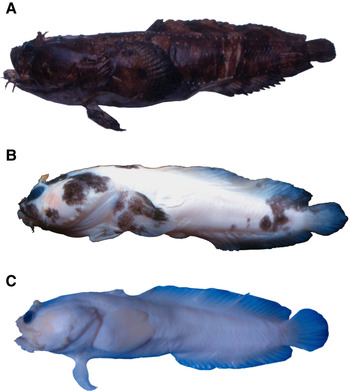
Two specimens of Amphichthys cryptocentrus with chromatic abnormalities were collected in June and July 2003 by professional collectors of marine ornamental fish in coral reefs and rocky shores inside Todos os Santos Bay, Salvador City, Bahia State, Brazil (see for details: Nunes et al., Reference Nunes, Sampaio and Barros2013; Reis-Filho & Santos, Reference Reis-Filho and Santos2014). One specimen had oculocutaneous albinism and the second specimen exhibited hypomelanosis. In order to assess morphological differences, another specimen with normal coloration was also captured for comparison (Figure 1A–C). Specimen identification followed (Menezes & Figueiredo, Reference Menezes and Figueiredo1998) and measurements were made with callipers. Morphometric data are expressed as a percentage of the standard length (SL).
Amphichthys cryptocentrus: (A) normal pigmentation, (B) hypomelanistic and (C) oculocutaneous albino.

Three specimens of both abnormal and normal chromatic fish were captured and placed in aquaria (40 cm width × 100 cm length × 60 cm height; 240 SL). Once the acclimatization period was completed (2 h), we recorded their behaviours over a 4 h period. The three specimens were photographed, examined and deposited at the fish collection of the Universidade Estadual de Feira de Santana (LIUEFS).
RESULTS
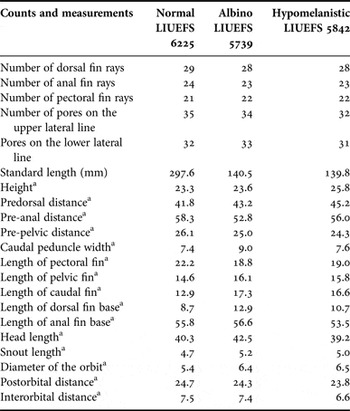
The oculocutaneous albine specimen (LIUEFS 5739, 140.5 mm SL), which exhibited a total lack of body pigmentation, had the characteristic pink-red translucid eyes and exposed the blood vessels. The hypomelanistic (LIUEFS 5842, 139.8 mm SL) specimen exhibited small dark spots over a uniformly white body and had normally pigmented eyes. Both specimens that exhibited chromatic abnormalities were juveniles, but their sex could not be determined. Analysis of the stomach contents of the hypomelanistic revealed the presence of the Xanthid crab Cronius ruber (Lamarck, 1818) and two unidentified Nematoda. The stomachs of the other two specimens were empty. The normally pigmented specimen (LIUEFS 6225, 297.6 mm SL) exhibited a uniformly dark body that is characteristic of the species as described in Figueiredo & Menezes (Reference Figueiredo and Menezes1978) and Collette (Reference Dahlberg2002). Table 1 provides a comparison of morphometric data in Amphichthys cryptocentrus, based on specimens captured in Todos os Santos Bay. In addition to the unmistakable distinction in pigmentation, there were few morphometric and meristic measures that were different between the examined fish. The individual with normal pigmentation showed lower values in the length of dorsal fin and diameter of the eye when compared to the other individuals that were clearly non-pigmented.
Meristics and morphometric of Amphichthys cryptocentrus from the Todos os Santos Bay, Bahia, north-east Brazil.

a Morphometric data expressed as percentage of standard length.
The behavioural notes taken whilst the fish were kept in aquaria showed that oculocutaneous albino and hypomelanistic individuals presented clear signs of stress (biting of a hand-net left in the tank, searching for darker areas of the tank and producing sound). The A. cryptocentrus with normal pigmentation, however, had a behaviour similar to that observed in the natural environment, sheltering near the rocks and sediment contained inside of the aquaria.
DISCUSSION
Sedentary fish species have a wide range of structural and colour adaptions that render them cryptic in their habitat (Brito & Caramaschi, Reference Brown, Núñez, Leatherland and Woo2005). Several species that live close to the substrate, like the Amphichthys cryptocentrus, are partly camouflaged by their similarity to their background. The chromatic abnormalities observed in A. cryptocentrus may be regarded as disruptive in its habitat. It has been hypothesized that albinism has little influence on nocturnal or cryptic fish species, which would not be noticed by their predators (Sazima & Pombal, Reference Sazima and Pombal1986). Albinism, therefore, would have little influence on the longevity of fishes such as batrachoidids (Piorski & Nunes, Reference Piorski and Nunes2010), which are solitary, have cryptic habits, may live partially buried or in crevices and exhibit nocturnal activity. However, chromatic abnormalities followed by unusual behaviour exhibited by A. cryptocentrus (as seen in this report inside the aquaria), could aid visually oriented predators, particularly when it occurs in the natural environment. Brito & Caramaschi (Reference Brown, Núñez, Leatherland and Woo2005) observed this increase in predation risk in non-pigmented loricarrids (albino specimens) found in a tropical South American river.
The international marine fish ornamental trade pays high amounts for rare species or specimens that exhibit chromatic abnormalities (Michael, Reference Michael2001; Wood, Reference Wood2001; Sampaio et al., Reference Sampaio, Carvalho-Filho, Feitoza, Ferreira, Floeter, Gasparini, Rocha, Sazima, Alves and Castro2006). This may explain the capture of the two specimens of A. cryptocentrus by professional collectors of ornamental fishes, where normally the pigmented individuals have market value in Bahia State and those with abnormal colours are only rarely traded for ornamental purposes (C.L.S. Sampaio, personal observation).
Records of albinism in Mustelus schmitti (Springer, 1939) from Rio Grande do Sul (southern Brazil) (Teixeira & Araújo, Reference Teixeira and Araújo2002); hypomelanosis in Genidens genidens (Cuvier, 1829) associated with underwater observations of other non-pigmented fish specimens at the Baía de Guanabara, Rio de Janeiro State (south-eastern Brazil) (Lopes & Muratori, Reference Lopes and Muratori1991); a recent record of Batrachoides surinamensis (Batrachoididae) at Ilha do Maranhão, Maranhão State (north-eastern Brazil) (Piorski & Nunes, Reference Piorski and Nunes2010); abnormal pigmentation patterns in Achiridae from the Piraquê-Açú Estuary, Espírito Santo (Venizelos & Benetti, Reference Venizelos and Benetti1999; Macieira et al., Reference Macieira, Joyeux and Chagas2006) and partial melanism in the coney Cephalopholis fulva (Epinephelidae) near Escalvada islands (Espírito Santo state) (Simon et al., Reference Simon, Joyeux and Macieira2009) suggest the hypothesis that colour abnormalities in fish are more common in nocturnal and/or cryptobenthic species than in diurnal or non-cryptic ones. The additional records of A. cryptocentrus, therefore, lend further support to this hypothesis.
ACKNOWLEDGEMENTS
Special thanks to Samuele Clerici and Bernardo Linhares for kindly donating the specimens of Amphichthys cryptocentrus; Ierece Rosa (Universidade Federal da Paraíba) and Lili Colman (University of Exeter) for paper review; Paulo Roberto Lopes for depositing specimens at LIUEFS fish collection and to CNPq and CAPES for providing research fellowships to the authors. Thanks also to Dive Bahia for their constant support during fieldwork.