


Introduction
The responsibility for meeting the needs of Aboriginal and Torres Strait Islander students (henceforth referred to as Aboriginal students) and promoting deeper understandings of Aboriginal histories and cultures for all students is one that has exponentially shifted into the domain of non-Aboriginal teachers. However, research into the experiences of Aboriginal students in schools and the introduction of the Aboriginal and Torres Strait Islander cross-curriculum priority has raised a series of questions pertaining to the efficacy of all teachers to (1) identify effective strategies for teaching Aboriginal students, (2) meaningfully incorporate Aboriginal perspectives into classroom learning and (3) respond to the needs of their local Aboriginal community (Perso, Reference Perso2012; Booth, Reference Booth2014; Buxton, Reference Buxton2015).
These challenges are intensified for non-Aboriginal educators involved in teaching Aboriginal Studies, a Stage 6 Higher School Certificate (HSC) NSW Secondary School subject. This subject uniquely provides Aboriginal students with explicit learning opportunities to explore, affirm and celebrate their social and cultural heritage as well as provide opportunities for all students to develop a greater appreciation of Aboriginal experiences and identities (New South Wales Board of Studies, 2010, p. 5). This includes the ongoing involvement of the local Aboriginal community in teaching the course, a requirement not present in other curriculum areas, therefore involving significant commitment beyond the classroom. Teaching both groups of students requires significant cognitive and emotional labour in creating culturally safe learning environments to support a diverse range of learner needs. Moreover, there is considerable responsibility and transformative potential in teaching Aboriginal Studies to non-Aboriginal students to dismantle intergenerational ignorance, apathy and racism through the presentation of decolonised perspectives of Australia's history and identity (Mooney et al., Reference Mooney, Halse and Craven2005; Wray, Reference Wray2006; Aboriginal Studies Association, 2014).
Appreciating the value and challenges of teaching Aboriginal Studies requires critical attention to ensure that non-Aboriginal teachers uphold its ethos as a counter-hegemonic project. Research in Australia demonstrates that students from a high socioeconomic status consistently achieve higher results (Teese and Polesel, Reference Teese and Polesel2003) as the values and skills of this group are reflected in school structures, policies, curriculum and pedagogy. This ongoing manipulation and maintenance of the status quo has resulted in generations of low expectations teaching to minority students such as low socioeconomic status, Aboriginal, those living with a disability or those with English as an additional dialect. This has been reproduced in classrooms as pedagogies of poverty (Haberman, Reference Haberman1991) and in staffrooms through deficit discourses about these students and their families (Comber and Kamler, Reference Comber and Kamler2004). Therefore, teacher understanding about how students' cultural practices, beliefs and values shape them as learners is critical to attaining high educational outcomes. Pertinent to a myriad of national and international charters, including the Council of Australian Governments' Closing the Gap commitment (2008) and the United Nations Declaration on the Rights of Indigenous Peoples (2007), as well as local Aboriginal community expectations of how their children are taught and how their histories and cultures are reflected in schools (NSW AECG & NSW DET, 2004), this paper identifies a clearer understanding of the ground-level challenges, roles and impacts of non-Aboriginal teachers of Aboriginal Studies. It further explores the importance of their work for addressing broader questions of decolonisation, political reformation and social justice. The research questions designed to explore these key ideas are as follows:
1. Is Aboriginality a requisite component for teaching Aboriginal Studies effectively?
2. How do non-Aboriginal teachers operate in Aboriginal contexts?
3. How does Aboriginal Studies address the goals of social justice?
Context
Historical context
The importance of Aboriginal Studies teaching lies embedded in the history of race relations between Aboriginal and non-Aboriginal peoples, particularly in the sphere of education (Bodkin-Andrews and Carlson, Reference Bodkin-Andrews and Carlson2014). The early participation of Aboriginal peoples in formal education was largely viewed in terms of their value to the domestic and vocational labour market (Fletcher, Reference Fletcher1989, p. 21; Native Institution, 1819), while the ‘Exclusion on Demand’ policy, coupled with Stanner's (Reference Stanner1968) notion of the ‘Great Australian Silence’, sent a clear message to Aboriginal communities that their beliefs, cultures and values had no place in the Australian mainstream (Aboriginal Studies Association, 2014, para. 4; Fletcher, Reference Fletcher1989, p. 8).
The alienation of Aboriginal students and cultures from formal education lies at the heart of contemporary struggles to achieve social justice, self-determination and conciliation, a term preferred by the participants (Beresford, Reference Beresford, Beresford, Partington and Gower2012, p. 119). The intergenerational transfer of educational disadvantage stemming from Australia's long history of injustice has left a crippling legacy on the socioeconomic outcomes, cultural vibrancy and political strength of Aboriginal communities (Beresford and Partington, Reference Beresford, Partington, Beresford, Partington and Gower2012). Moreover, the distinct lack of awareness, understanding and appreciation of Australia's Aboriginal heritage and shared history by non-Aboriginal peoples has further diminished Australia's collective sense of nationhood (Dodson, Reference Dodson2009).
Current discourses in Aboriginal education
Recent political and educational policy discourse has focused largely on the gap between Aboriginal and non-Aboriginal student educational outcomes (New South Wales Department of Education and Training, 2004; Perso, Reference Perso2012). Aboriginal students are often positioned as a ‘problem’ that needs ‘fixing’, with notions of deviancy, deficiency and disadvantage contributing to uncritical worldviews of Aboriginality and Aboriginal students (Beresford, Reference Beresford, Beresford and Partington2003). In schools, these deficit discourses culminated in self-perpetuating cycles of low expectations, misrepresentations of Aboriginality and low perceptions of Aboriginal student self-efficacy (Stronger Smarter Institute, 2014).
Aboriginal principal and researcher Dr Chris Sarra identified the need for teachers to engage in high expectation relationships with Aboriginal students and families that centre on ‘firm and fair’ approaches to discipline, ‘challenging conversations and dialogues’ and ‘critical self-reflection’ (Stronger Smarter Institute, 2014, p. 7). Similarly, Riley (Reference Riley2015) identified a comparable web of positive engagements with teachers, principals, Aboriginal staff, families, community members and support programmes to create the necessary conditions for Aboriginal student success.
The inclusion of Aboriginal and Torres Strait Islander histories and cultures in the Australian curriculum cross-curriculum priority aligns with the Melbourne Declaration on Educational Goals for Young Australians (2008) to ensure that Aboriginal students ‘see themselves, their identities and their cultures reflected in the curriculum’ and for all students to ‘engage in reconciliation, respect and recognition of the world's oldest continuous living cultures’ (ACARA, 2014, para. 3). However, research into the efficacy of this cross-curriculum priority has raised concerns about its value as a counter-hegemonic project. Booth (Reference Booth2014) highlights that the meaningful incorporation of Aboriginal perspectives in the classroom is often inhibited by time management, school culture, teacher interest and preconceived ideas. Furthermore, Lowe and Yunkaporta (Reference Lowe and Yunkaporta2013, pp. 11–12) contend that a confounding cycle of low learning expectations, inadequate attention to student cognitive engagement and the minimal inclusion of key social concepts and issues has culminated in a curriculum that is ‘weak, often tokenistic and overwhelmingly unresponsive to historical and contemporary realities’ (p. 12).
Aboriginal Studies has emerged from these discourses as a viable solution to support the revitalisation of Aboriginal education in Australia. As the only subject that is ‘wholly devoted to the exploration of Aboriginal Australia’, Aboriginal Studies encourages students to foster deep understandings of Aboriginal histories and cultures, provides cultural affirmation for Aboriginal students and sends a powerful message to schools, communities and to the Australian mainstream that Australia's Aboriginal history and heritage are important to our national character and story (Aboriginal Studies Association, 2014, para. 1).
Since Aboriginal Studies plays a crucial role in Australia's journey towards conciliation, the quality of teaching in Aboriginal Studies is vital. While teacher quality is universally recognised as a key factor influencing the outcomes of students across all curriculum areas (Hattie, Reference Hattie2009), the question of what constitutes quality teaching within Aboriginal Studies remains unclear, owing in part to a lack of research, but also to the historical context of Aboriginal education and differences between Indigenous and non-Indigenous epistemologies and ontologies that shape the ways in which students engage in classroom learning (Yunkaporta, Reference Yunkaporta2009).
As Aboriginal Studies becomes more broadly recognised as an integral component of the school curriculum and new generations of non-Aboriginal Aboriginal Studies teachers enter the workforce, the need to develop clearer understandings of the unique challenges, experiences and circumstances that enable and/or constrain non-Aboriginal educators in the teaching of Aboriginal Studies increases.
Theoretical framework
Non-Aboriginal research into Aboriginal communities has been responsible for the extraction, storage, control and imprisonment of Aboriginal knowledge (Rigney, Reference Rigney1999, p. 109). This has led to the construction of discourses about the lives and cultures of Aboriginal peoples that have had ‘no Aboriginal input, in a language that is non-Aboriginal, by and for a non-Indigenous audience’ (Foley, Reference Foley2003, p. 44). Accordingly, there exist deep sentiments of apprehension and caution among Aboriginal communities in relation to ‘Western’ research projects (Rigney, Reference Rigney1999). Here, it is necessary to examine our non-Aboriginal identity as researchers and to consider the limitations and implications that this standpoint holds for the research.
Locating and liberating a non-Aboriginal standpoint
Our ‘Western’ epistemological and ontological standpoint has been strongly influenced by experiences in formal education yet mediated by our deep engagement with Aboriginal peoples and knowledges as Aboriginal Studies teachers. Notably, Connell (Reference Connell2018) points towards the embeddedness of Aboriginal knowledge within a British–American–Australian epistemological axis to suggest that the ways in which we have learnt to consider, analyse and engage with Aboriginal worldviews have been inherently shaped by a legacy of intellectual colonialism. This notion rings true in Foley's (Reference Foley2003) Indigenous Standpoint theory, which contends that non-Aboriginal researchers cannot appreciate the complexities and realities of Aboriginal Australia with the same level of empathy and understanding as Aboriginal researchers. Moreover, it is critical to acknowledge that this project was completed within a Western research paradigm, determined to a large extent by the academic and logistical requirements of the university system exerting epistemological pressures on the ways in which Aboriginal perspectives have been collected, analysed, interpreted and reflected.
To obviate the inherent epistemological and ontological disconnect between our non-Aboriginal standpoint and the research topic, it was important to consider a range of theoretical positions that could provide a culturally-appropriate framework for analysing and interpreting Aboriginal worldviews and realities. While the allure of Aboriginal theoretical positions is difficult to ignore, Yunkaporta (Reference Yunkaporta2009, p. 55) contends that ‘Western’ and ‘non-Western’ theoretical dichotomies can often oversimply complex and contested knowledge spaces and reinforce notions of difference between the researcher and the researched. Instead, it is important as non-Aboriginal researchers to ‘think about ways of working within those [non-Aboriginal] limitations while still making a valid contribution to Indigenous pedagogy, and to students, Indigenous and non-Aboriginal who undertake Indigenous studies’ (McGloin, Reference McGloin2009, p. 37). Rather than avoid Western research frameworks altogether, this research accepted Martin's (Reference Martin2006) contention that the challenge for non-Aboriginal researchers is to ‘engage in research as an “interface” where conceptual, cultural and historical contexts converge based on different forms of relatedness to knowledge, to research and to self’ (p. 7).
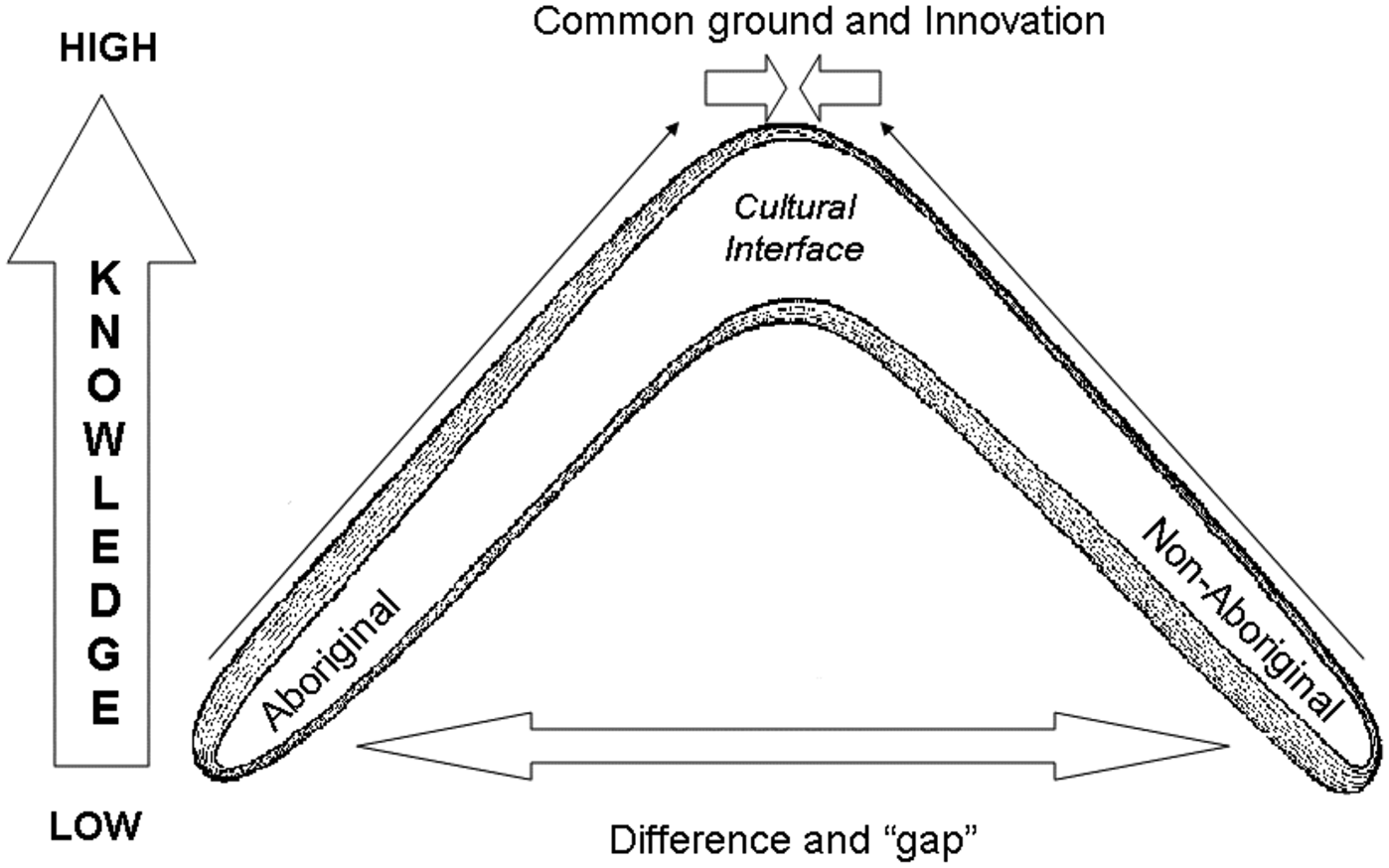
Accordingly, Nakata's (Reference Nakata2007) Cultural Interface theory emerged as a valid and appropriate framework for the interpretation and analysis of Aboriginal and non-Aboriginal worldviews. While the Cultural Interface was developed through an aspiration to understand how the everyday experiences of Aboriginal peoples are informed by the intersection of Aboriginal and Western knowledge systems, it can also be used to consider how non-Aboriginal people critically or uncritically shape their actions and interactions when presented with Aboriginal knowledge (Nakata, Reference Nakata2007, p. 11). Figure 1 below identifies the site of the Cultural Interface as a space of creation and ‘innovation’, where the ‘dynamic overlap between systems previously defined as dichotomous and incompatible’ conjoins to create new meanings and understandings of pedagogical knowledge and practice (Yunkaporta, Reference Yunkaporta2009, p. xv).
Boomerang matrix of cultural interface knowledge. Yunkaporta (Reference Yunkaporta2009, p. 4).

Herein lies the relevance of the Cultural Interface as a theoretical framework for this study. As a subject that rigorously engages with Aboriginal and non-Aboriginal epistemological and ontological standpoints, Aboriginal Studies inherently requires teachers to negotiate and harmonise contested worldviews in ways that maintain the elements of inclusivity, complexity and connectedness. Thus, observing the pedagogical and conceptual challenges and strategies that non-Aboriginal teachers encounter at the Cultural Interface will reveal the key tensions that enable and/or constraint quality teaching within Aboriginal Studies.
Methodology
A qualitative research design utilising in-depth semi-structured interviews was employed to explore key factors that enable and/or constrain non-Aboriginal teachers when teaching Aboriginal Studies. As this project sits within a Western research paradigm, we apply Bessarab and Ng'andu's (Reference Bessarab and Ng'andu2010) ‘Yarning’ research methodology to account for the myriad of complex historical and epistemological forces that govern non-Aboriginal research with Aboriginal communities and knowledges. As yarning constitutes an ‘informal and relaxed discussion through which the researcher and participant visit places and topics of interest relevant to the research study’ (Bessarab and Ng'andu, Reference Bessarab and Ng'andu2010, p. 38), this approach supports developing genuine relationships between the interviewer and interviewee, and for Aboriginal participants, as a way to locate the researcher within their meaning system (Martin, Reference Martin2008). It also reveals the complex cultural and contextual factors behind the challenges, experiences and perspectives of each participant (Yin, Reference Yin2009, p. 40). While the yarning approach has received criticism as a ‘vague’ and ‘self-limiting methodology’, its embeddedness in Aboriginal epistemology and ontology is vital for its capacity to uphold ethical protocols for engaging with Aboriginal knowledge and for its ability to unearth perspectives that a Western-oriented approach may not reveal (Bessarab and Ng'andu, Reference Bessarab and Ng'andu2010, p. 47; Goulding, Steels and McGarty, Reference Goulding, Steels and McGarty2015, p. 796).
Utilising Miles and Huberman's (Reference Miles and Huberman1994, p. 28) ‘stratified purposeful sampling method’, this study sought advice from the NSW Aboriginal Education Consultative Group to identify seven Aboriginal Studies teachers (five non-Aboriginal and two Aboriginal teachers) who presented a diverse range of perspectives and experience levels pertaining to Aboriginal Studies. As there are approximately 65 Aboriginal Studies teachers, of which approximately 50 are non-Aboriginal, this number provides a reasonable base for data collection given the rich nature of the data collected. Care was taken to ensure that Aboriginal Studies teachers from low, medium and high socioeconomic status schools were included, as well as schools that contained various Aboriginal student population sizes to allow the researchers to explore the complexity and variance of the research topic across different contexts. Further considerations were given to the participants' gender, age and relationship with their local Aboriginal community.
Data analysis involved identifying initial emerging themes through sentence-by-sentence coding and annotating individual transcripts (Creswell, Reference Creswell2012). Matrices were constructed as a way of organising and managing the depth and breadth of data. Transcripts were then re-read to examine and aggregate individual and collective responses in relation to the emerging themes and entered into the matrices to further develop the themes. Throughout this process, similarities and points of difference between the participants' responses were highlighted to obtain greater levels of abstraction, conceptual and contextual understanding. In the final stage of the data analysis process, six themes encapsulating the essence and complexity of the research topic were identified across the three research questions. A brief description of the participants is outlined below:
Daisy is an early career non-Aboriginal female teacher from a public school in Sydney's Inner West. The school had a high number of Aboriginal students and a close relationship with the local Aboriginal community.
Lauren is an early career female teacher from a high socioeconomic status Independent School in Sydney's Inner West. Although the participant is non-Aboriginal, members of her family identify as Aboriginal and she felt a greater sense of belonging to the local Aboriginal community than to the non-Aboriginal community.
Matthew is an experienced non-Aboriginal male teacher from a public school that has a relatively high socioeconomic status and an extremely low Aboriginal student population.
Andrew is an early career Aboriginal male teacher from a low socioeconomic status Western Sydney public school. The school has a high number of Aboriginal students and a close relationship with the local Aboriginal community.
Hannah is an early career, non-Aboriginal female teacher from a low socioeconomic status public school in regional New South Wales. The school has an extremely high number of Aboriginal students and a close relationship with the local Aboriginal community.
Kate is an experienced non-Aboriginal public school female teacher from Sydney's Eastern Suburbs. She grew up in the local vibrant Aboriginal community and has taught Aboriginal Studies for 25 years at the same high school that she attended as a student.
Anne is a mid-career Aboriginal female public school teacher from regional New South Wales. The school has a high number of Aboriginal students and a close relationship with the local Aboriginal community.
Findings and analysis
Research question 1
Theme 1: Aboriginality as a requisite for Aboriginal Studies teaching
Research question 1 sought to explore the inherent cultural challenges that underpin the work of non-Aboriginal Aboriginal Studies teachers and to consider the implications of these challenges on the effectiveness of their classroom practice. By applying Foley's (Reference Foley2003) Indigenous Standpoint premise that ‘the purity of research is enhanced if the Indigenous is researched by the Indigenous’ to the field of education, participants were asked if they believed that Aboriginal teachers were better suited to teach Aboriginal Studies than non-Aboriginal teachers (p. 46). While the participants generally agreed that Aboriginality was advantageous, they did not consider it to be an exclusive feature of quality Aboriginal Studies teaching. Daisy was adamant that ‘Aboriginal Studies teaching is open to and respectful of everybody’, while Matthew suggested that a critical ‘understanding of one's own identity, rather than Aboriginality as a feature of personal identity is more important for teaching Aboriginal Studies’. In a similar vein, both Aboriginal participants voiced their opinions that Aboriginality was not a crucial component of Aboriginal Studies teaching, with Andrew commenting that ‘we can't assume that all Aboriginal teachers are experts on Aboriginal Australia’ and Anne indicating that she has encountered ‘a lot of exceptional non-Aboriginal teachers of the subject’. For these participants, moving beyond ‘Western’ and ‘non-Western’ dichotomies of identity and engaging with Aboriginal Studies teaching as an interface of cultural tension allowed them to focus on the ways in which they could ‘make valid contributions to Indigenous and non-Aboriginal students who undertook Indigenous Studies’ (McGloin, Reference McGloin2009, p. 37; Nakata, Reference Nakata2007; Yunkaporta, Reference Yunkaporta2009).
Theme 2: Indigeneity as a challenge in the classroom
Although non-Indigeneity was not considered to be a differentiating factor in the context of quality Aboriginal Studies teaching, it was revealed to be a significant challenge for negotiating the cultural complexities of the course. When Matthew was asked the extent to which his non-Aboriginal identity and epistemological standpoint challenged him as an Aboriginal Studies teacher, he responded:
It's a challenge every day. My whole contemplation of Aboriginal Australia has been filtered through non-Aboriginal eyes. The heterogeneity of the course poses a real challenge because it is very difficult to legitimately present generalisations and any discipline needs to have a start point of a discourse before we get into any real complexity. I struggle so much with that because any attempt to generalise almost inevitably repeats the ignorance and failings of the past. I'm conscious about that every lesson.
Here, Matthew is highly cognisant of his non-Aboriginal standpoint and his need to actively engage in critical cultural reflection (Gay and Kirkland, Reference Gay and Kirkland2003) in order to deliver quality teaching in this subject.
Hannah and Kate were also conscious of the impact of ongoing colonisation of Aboriginal knowledge within institutional settings (Rigney, Reference Rigney1999; Nakata, Reference Nakata2007; Connell, Reference Connell2018). Hannah was cautious about presenting herself as a body of knowledge on Aboriginal Australia, while Kate was concerned about her ability to convey the diversity of Aboriginal histories, cultures and experiences without speaking on behalf of Aboriginal communities, revealing that she is conscious of ‘walking a fine line between teaching and facilitating the course content’. This ‘fear of offending’ (Sarra, Reference Sarra2011a) was established as a significant barrier to teaching Aboriginal perspectives (Booth, Reference Booth2014; Buxton, Reference Buxton2015) and was reflected as a powerful pedagogical challenge in Aboriginal Studies. As Matthew elaborated: ‘I struggle because my students just want me to give them a straight answer, but it's difficult’.
Here, Nakata's (Reference Nakata2007) conception of the Cultural Interface as a site that ‘informs as well as limits what can be said and what is left to be unsaid in the everyday’ illuminates the inherent cultural, epistemological and pedagogical challenges that underpin the work of non-Aboriginal Aboriginal Studies teachers (p. 12). While some participants maintained that ‘the questions are often more important than the answers in Aboriginal Studies’ (Anne), striking a balance when presenting the clarity and complexity of issues ingrained within Aboriginal Studies remained a largely unresolved tension among participants. There exists a critical need to further explore this issue.
Research question 2
Theme 1: centring Aboriginal voices
Research question 2 sought to examine how non-Aboriginal teachers negotiate the cultural complexity of the Aboriginal Studies course at a praxis level. All participants were conscious of the need to protect the ownership and integrity of Aboriginal knowledge, particularly in relation to the teaching of Aboriginal cultures (Rigney, Reference Rigney1999; Foley, Reference Foley2003). In this vein, Andrew asserted that ‘Being a non-Aboriginal teacher, you can advocate for the subject, you can teach the history of it, you can do it passionately and with great empathy, but you must remember that you are not Aboriginal’. To circumvent the epistemological, ontological and ethical challenges of teaching Aboriginal cultures, participants highlighted the importance of including Aboriginal people in classroom learning. Lauren sought out members of the local Aboriginal community to discuss topics that she lacked expertise in, while Hannah acknowledged the value of approaching Aboriginal organisations such as Clontarf and the AECG to assist with the teaching of cultural knowledge. For these participants, understanding the implications of their non-Aboriginal standpoint prompted them to engage Aboriginal people in classroom learning, representing a shift from knowing ‘about’ Aboriginal cultures (Nakata, Reference Nakata2007) to learning alongside Aboriginal peoples in a relevant and meaningful way (Yunkaporta, Reference Yunkaporta2009).
Theme 2: substantive relationships
Participants from schools with high Aboriginal student populations also placed a strong emphasis on the need to develop substantive, high-expectation relationships with their students. From the provision of the subject in schools to the everyday learning experiences in the classroom, these relationships emerged as a crucial feature of Aboriginal Studies teaching. Anne contended that ‘the connections I have with my students and the trust with their families has given me the spirit to keep teaching this subject’, while Daisy conversely indicated that ‘a lack of promotion [of the subject] and quality student-teacher relationships’ were key reasons why Aboriginal Studies had not previously run at her school. Reflecting on her first year as a non-Aboriginal Aboriginal Studies teacher, Hannah recalled the challenge of establishing constructive relationships with her Aboriginal students:
When I first arrived, I remember thinking ‘Oh my god I've got to teach a whole room of Aboriginal kids and I'm white and I don't know them’. It took me over a term to develop relationships with the Year 12s. I used to have whole lessons where they were silent the whole time.
She described how a process of ‘challenging conversations’ and ‘critical self-reflection’ (Stronger Smarter Institute, 2014, p. 7) had a transformative effect on her students' outcomes and approach to learning:
It was really good that I spent a whole term getting to know them. I told them who I am, where I'm from. I gave them a whole lesson to ask me about why I'm teaching Aboriginal Studies and how they feel about having a non-Aboriginal teacher. Kids who normally don't come to class are now sitting there for the whole lesson. One of my students who struggles in their other subjects got the top mark in our half-yearly exam.
Participants also advocated the need to develop ‘firm and fair relationships, premised on “strength-based” conversations about Aboriginality, with Aboriginal students’ (Stronger Smarter Institute, 2014). Daisy reflected on a particular ‘strength-based conversation’ with a student:
I once told off a student for being slow to unpack his things and he replied: ‘Miss you don't understand the “Black way”’. I found that unacceptable. I told him: ‘Don't you say that being lazy and being slow is being “Black”. You don't need to perpetuate stereotypes of Aboriginality more than the world already does. There are many reasons that you're lazy, but your Aboriginality isn't one of them’.
As Aboriginal students often ‘subscribe to the negative stereotypes that they are bombarded with’ (Sarra, Reference Sarra, Keeffe and Carrington2007, p. 33), challenging deficit student understandings of Aboriginality becomes a crucial component in the development of high expectation relationships and a vital part of Aboriginal Studies teaching (Sarra, Reference Sarra2011b). Yet while this concept was illuminated as a significant component of quality Aboriginal Studies teaching in schools with high Aboriginal student populations, Aboriginal Studies teachers from schools with low Aboriginal student populations placed little or no emphasis on this topic. This trend ties back to comments made by Matthew, who stated that, ‘having Aboriginal students in your classroom makes for a fundamentally different teaching and learning experience to a classroom of non-Aboriginal students. That difference cannot be underestimated. That, to me, is a significant aspect of Aboriginal Studies’. Herein lies a significant tension that shapes the nature and challenges of teaching Aboriginal Studies. For a ‘subject where the students in the room are representative of the subject itself’ (Matthew), the centrality of local and contextual factors makes it difficult to generalise about concrete realities within the sphere of Aboriginal Studies.
Research question 3
Theme 1: activism and Aboriginal Studies
Research question 3 sought to explore the value of Aboriginal Studies as a counter-hegemonic project and the capacity of non-Aboriginal teachers of Aboriginal Studies to contribute to change beyond the classroom. Participants were resolute in their assessment that Aboriginal Studies and Aboriginal Studies teaching cannot be divorced from broader issues of social justice, equity and conciliation. As Matthew proclaimed:
To teach Aboriginal Studies effectively, you have to teach it from the heart. I don't think it's possible to be a good Aboriginal Studies teacher without genuine passion for the bigger picture issues that the subject faces. You need to have that real heartfelt conviction.
Daisy also saw the value of Aboriginal Studies as a means of reconciling ‘deeper issues of national unity’ (Dodson, Reference Dodson2009, cited in Burridge, Reference Burridge2009, p. 117). She maintained that she chose to teach Aboriginal Studies because a ‘climate of social justice and human rights’ is embedded throughout the subject. Moreover, Daisy viewed the space of Aboriginal Studies as a relevant and pertinent site of activism, as she explains:
I'm not an activist in the sense that I go out and protest, but I'm an activist in the classroom. I'm an activist for my students, for my school, my community and for Aboriginal Studies. I'll always so proudly and fondly speak about my students and my subject.
Lauren and Kate located their motivations for teaching the subject in a more personal context; however, both participants linked their inspiration for teaching Aboriginal Studies back to a desire for social change. Lauren attributed her passion for Aboriginal Studies to her connection to the local Aboriginal community, having ‘seen the adverse effects’ of colonisation. Kate, meanwhile, acknowledged her sense of personal responsibility. Reflecting on her non-Indigenous positionality as a reason for investing her career in Aboriginal Studies, she noted that ‘My family has been here since 1788. I had an ancestor who came on the Sirius in the First Fleet. I think it's important for me and my family, to try and repair any past damages’.
For Andrew and Anne, Aboriginal Studies is an opportunity for students to learn about the importance of Aboriginal Australia, something that has been ‘denied to our people for generations’ (Anne). As Andrew commented:
I think that it's really significant that the subject is taken away from the Australian History context which for a lot of students is the only time when Aboriginal education is embedded in the syllabus, and even then it is up to the individual teacher to teach our stories appropriately. When I was at school, I don't remember the word ‘Aboriginal’ being muttered, and if it was, it wasn't mentioned in a way that was relevant to me at the time. Aboriginal Studies is beautiful on its own. Everyone else gets a subject so why shouldn't we?
From an Indigenous standpoint, Aboriginal Studies has a deeper personal significance that reaffirms Anne's and Andrew's lived experiences as valid and significant to the Australian narrative and provides opportunities for them to express this through their eyes.
Theme 2: the value of Aboriginal Studies
Another powerful theme that emerged from the data was that Aboriginal Studies also plays a significant role in engaging students with the issues of social justice and conciliation. Matthew highlighted the potential of Aboriginal Studies to promote deep levels of student awareness and understanding (Reconciliation Australia, 2016), relating that:
I genuinely think that the subject changes the way students see the world like no other subject. I think that it lifts the veil, it removes the earplugs and the blindfolds. What students choose to do when they see more clearly and think more deeply is up to them, but I don't know of any subject which has such a significant impact on the way that students see the world.
While Lauren suggested that ‘ultimately, I would like to see some Band 6 mark's’, she went on to state that:
at the end of the day if we actually learn to be a bit more respectful to Aboriginal people, learn a bit about Aboriginal culture and change attitudes so I'm happy with that. Aboriginal Studies is the place where students can learn how to deal with dinner table conversations. Of course, I care about the marks, but I think that this is more important.
Equipping students with the skills to contend with issues beyond the classroom was also an important factor for Daisy, who highlighted that, ‘the big goal is to get them to learn how to use what I know from Aboriginal Studies to challenge racism in everyday life’. Here, Nakata's (Reference Nakata2007) conception of the Cultural Interface as a site of changing agency for those engaged in with Aboriginal knowledge illuminates the potent role that non-Aboriginal teachers of Aboriginal Studies can play in promoting substantive change within and beyond the classroom.
Discussion
The key question not asked in any other subject—should non-Aboriginal teachers teach Aboriginal Studies—highlights the complexity, challenges and issues for teaching in this subject that is not evident in any other area of the curriculum. This complexity is compounded by the key syllabus requirement that a significant component of the learning centres on the local Aboriginal community and requires comparative analysis with an international local Indigenous community. Moreover, extensive skills in community consultation protocol, cross-cultural communication and ethical research methodologies in Aboriginal contexts are also critical and unique to this subject, skills that many teachers have not had the opportunity to develop prior to teaching this subject. It is worth noting here that a key difference between Aboriginal and non-Aboriginal teachers is that Aboriginal teachers believe that they are more likely to have experience and understanding in these key understandings and skills and therefore are more able to engage Aboriginal students in the subject. They do note, however, that this cannot be assumed.
Consequently, Nakata's (Reference Nakata2007) cultural interface and Indigenous Standpoint theories are extremely useful for understanding these complexities and making sense of non-Aboriginal teachers positioning in this context. Aboriginal and non-Aboriginal responses to research question 1 noted that while Aboriginality is not essential for teaching in this area, it helps engage Aboriginal students and bring authenticity to what is being taught. This reinforces the role of an Indigenous standpoint to foster these deep understandings. More importantly, the way Aboriginal peoples, cultures and histories are presented and discussed requires an acute understanding of the historical and current ways in which dominant discourses can inappropriately generalise, essentialise and objectify. In order to manage this tension, teachers in this study demonstrated an acute awareness of the colonising effects of non-Aboriginal ‘expertise’ and ‘western knowledge truths’ and actively worked to counteract this.
This is reinforced in responses to research question 2 where teachers demonstrated an acute awareness of the importance of centring Aboriginal voices as well as acknowledging Aboriginal ownership and copyright of Aboriginal knowledges. This decolonising approach was mobilised by some teachers through critical and strengths-based conversations with students that challenged Aboriginal stereotypes, low expectations and self-positioning. In applying Yunkaporta's (Reference Yunkaporta2009) boomerang matrix to this context, it becomes clear that when knowledge and understanding deepen and grow, common ground can be found, and innovation can emerge. This was evident in one teacher's observation that in this curriculum area, because the student body is so uniquely central to and representative of the subject matter, there is no singular or overarching pedagogical approach to teaching, noting the criticality of context for driving innovative teaching in this area.
Finally, responses to research question 3 provide more evidence of Aboriginal Studies teachers, through their passion, commitment and desire to make a difference, of the decolonising potential of this subject. Here, Aboriginal Studies cannot be separated from key society imperatives of social justice, equity and activism and as Nakata (Reference Nakata2007) notes opportunities for agency. The sense of repairing past damages as a result of experiencing new knowledges from Aboriginal people is captured by the teachers' articulations of conciliation rather than reconciliation to better describe and understand what they are trying to do. Moreover, the articulation of the importance of generating respect for Aboriginal peoples, cultures and histories over exam results is evidence of teacher enthusiasm and sense of obligation to creating a more just society.
Conclusion
This study aimed to generate new understandings around the theoretical, pedagogical and cultural challenges that enable or constrain non-Aboriginal teachers of Aboriginal Studies. As with all research methodologies, qualitative research is inherently limited in nature and scope. The greatest challenge to the credibility and trustworthiness of qualitative research is that it is channelled through the subjective lens and positionality of the researchers (Buxton, Reference Buxton2015, p. 17). In this project, the researchers' non-Indigenous standpoints are influenced by their epistemic and ontological experiences within a Eurocentric education system reflecting insider perspectives. To acknowledge and mediate this cross-cultural tension, researchers engage in ongoing reflexivity to critique and challenge this tension in order to sustain and enhance the integrity of the research project. Importantly, the mutual enthusiasm shared by the researchers and the research participants for Aboriginal Studies could implicitly or explicitly shape the nature of participant responses and consequently, the research outcomes. Moreover, the small sample size of this study also limits opportunities to establish broad-reaching understandings and implications and so future research is necessary to further investigate the research questions posed here.
Significantly, while non-Indigeneity was not considered to be a barrier to quality Aboriginal Studies teaching, non-Aboriginal teachers in this study were highly aware of their positionality. They reflected on the need to reconcile and negotiate complex issues of epistemology and ontology to teach Aboriginal Studies in an effective, nuanced and meaningful way. Moreover, they contended with these inherent cultural challenges in their pedagogy and practice, revealing that the privileging of Aboriginal perspectives and the development of substantive, high-expectation relationships were vital to their negotiations of contested and multi-layered knowledge spaces.
Aboriginal teachers, while acknowledging that Aboriginality is not a pre-requisite for quality Aboriginal Studies teaching, noted that their Indigenous standpoint, lived experiences and deep connection with Aboriginal families and the community meant that it was easier to develop meaningful student relationships to engage students in the course. They also noted that the deep personal significance of Aboriginal Studies as an HSC subject in reaffirming their own and student's Aboriginality is a positive step towards social justice and equity.
Finally, what is evident from both Aboriginal and non-Aboriginal teachers is the importance of the broader social significance of Aboriginal Studies and the role that students and teachers play in promoting notions of social justice, equity and conciliation. It is envisaged that this research project will become a useful resource for future Aboriginal Studies teachers to better understand the challenges and nature of their roles within and beyond the classroom.
Acknowledgements
We acknowledge the advice and support of the New South Wales Aboriginal Studies Association executive team.
Daniel Stern is a non-Indigenous, early career secondary school teacher from Sydney trained in Aboriginal Studies and History. He attended the University of Sydney from 2014 to 2018, where he completed a combined Bachelor of Secondary Education/Bachelor of Arts (Humanities and Social Sciences) with Honours. He is passionate about education and its power to promote social justice and shape the lives of young people. He is currently employed by the Department of Education in a secondary school in regional New South Wales.
Cathie Burgess is a non-Aboriginal teacher, researcher, community member and parent of Aboriginal children who has worked in Aboriginal education for over 35 years. She is currently lecturing and coordinating Aboriginal Studies, Aboriginal Community Engagement and Leadership in Aboriginal Education courses at the University of Sydney, Australia. Cathie's research involves community-led initiatives positioning Aboriginal community-based educators as experts through projects such as Learning from Country in the City, Aboriginal Voices: Insights into Aboriginal Education and Community-Led Research initiative.