Introduction
From the colonial period to present day, Latin America’s participation in global capitalism has been dominated by the large-scale export of raw materials and food, which has characterised the region’s position of dependence within world markets (Marini, Reference Marini2015; Osorio, Reference Osorio2016). In recent decades, the literature has referred to this phenomenon as ‘extractivism’, and studies have focused on socio-environmental inequalities and conflicts in places where extractive operations are located (Acosta, Reference Acosta2016; Burchardt & Dietz, Reference Burchardt and Dietz2014; Gudynas, Reference Gudynas2013; Machado, Reference Machado2015; Svampa, Reference Svampa2019). These operations are predominantly located in rural areas, places historically inhabited by peasant, indigenous, and Afro-descendant populations (Bengoa, Reference Bengoa2007; Veltmeyer, Reference Veltmeyer2019). The history of rural Latin America, therefore, is closely connected with an extractivist political economy (Kay & Vergara-Camus, Reference Kay and Vergara-Camus2018; McKay et al., Reference McKay, Alonso-Fradejas and Ezquerro-Cañete2021).
Of the diverse extractive activities that are practised in Latin America, mining developed early in the Andes (Assadourian et al., Reference Assadourian1980; Dollfus, Reference Dollfus1991; Hidalgo & Manríquez, Reference Hidalgo and Manríquez1992) and has shown an expansion that continues today (Bebbington & Bury, Reference Bebbington and Bury2013; Perreault, Reference Perreault, Cupples, Palomino-Schalscha and Prieto2018). In recent decades, studies on large-scale mining in the Andes have focused on how territories have suffered an intensification of socio-environmental inequalities, how conflicts have been exacerbated due to the dispossession and commodification of nature, and how forced transformations of customary ways of life have taken place (Babidge & Bolados, Reference Babidge and Bolados2018; Bebbington, Reference Bebbington2007, Reference Bebbington2012; Bebbington et al., Reference Bebbington2008; Bebbington & Bury, Reference Bebbington and Bury2013; Boudewijn, Reference Boudewijn2021; Bury & Kolff, Reference Bury and Kolff2002; Delgado, Reference Delgado2013; Jenkins, Reference Jenkins2017; Perreault, Reference Perreault2014; Prieto, Reference Prieto2022). This research has made significant contributions to highlighting the disruptive and destructive effects of mining extractivism in Andean rural areas and the socio-environmental conflicts that are linked to them.
However, when considering the evolution of mining in the long term, we can identify the contradictory ways in which it has been deployed in rural Andean territories and how it has connected with inhabitants (Assadourian et al., Reference Assadourian1980; Carrasco, Reference Carrasco2016; Contreras, Reference Contreras1988; Long & Roberts, Reference Long and Roberts1984; Lorca et al., Reference Lorca2022; Marston, Reference Marston2020; Nash, Reference Nash1979; Parodi & Benedetti, Reference Parodi and Benedetti2016). Together with its disruptive and destructive effects, mining has also established ambiguous relations with local populations, shaping different modes of integration and interdependence. The data we present show that, alongside dynamics of disruption, destruction, and conflict that have taken place at certain times and places, indigenous peoples have reshaped their ways of life by participating in cycles of large-scale mining, combining various economic activities, mobility practices, and employment relations.
In our theoretical approach, we integrate the debates on agrarian questions and the studies on Latin American extractivism. The former dealt with economic and social class transformations concerning capitalist expansion in rural areas, but they did not consider the role of non-agricultural primary capital (Akram-Lodhi & Kay, Reference Akram-Lodhi and Kay2010a, Reference Akram-Lodhi and Kay2010b; Levien et al., Reference Levien, Watts and Yan2018). On the other hand, the latter took into account the socio-environmental conflicts derived from the intensification of extractivism, but they barely touched on the economic changes to which local populations have been subjected (Chagnon et al., Reference Chagnon2022; Delgado, Reference Delgado2013; Ellner, Reference Ellner2021; McKay et al., Reference McKay, Alonso-Fradejas and Ezquerro-Cañete2021; Rodríguez & Baquero, Reference Rodríguez and Baquero2020; Veltmeyer, Reference Veltmeyer2019; Vindal & Rivera, Reference Vindal and Rivera2019). The objective of this article is to comprehend the historical configuration of Andean rural territories and the complex role of mining extractivism in its conformation, by historically reconstructing the changes and continuities of the productive practices of the Likan Antai indigenous people from the town of Caspana in the Atacama Desert of northern Chile. We accompany this with a study of the connections between these changes and continuities within the markets activated by extractivism. The case study is highly relevant for problematising the contradictory nature of the links between mining extractivism and Andean rural areas. There are records showing that Caspana has been inhabited since pre-Hispanic times by an Andean population dedicated principally to agriculture and grazing (Adán & Uribe, Reference Adán and Uribe2005; Castro & Uribe, Reference Castro and Uribe2004). However, Chuquicamata, one of the most important copper mines in the world, has been operating from 1915 to the present day, in the same basin of the Loa River in which Caspana lies (Millán, Reference Millán2006; Sutulov, Reference Sutulov1975). In view of this panorama, the period that we address in this article covers 1915 to 2019.
In this article, we formulate a historical reconstruction in order to answer two complementary questions: How has copper extractivism contributed to shaping the productive practices employed by the inhabitants of Caspana between 1915 and 2019? More specifically, how have the markets driven by copper extractivism transformed the productive practices of the inhabitants of Caspana during the period studied? For doing so, we combine diverse data sources and methodological approaches: oral histories obtained from ethnography, censuses, explorers’ records, and academic literature.
We first present the theoretical definitions guiding our article and then introduce the research methodology. We then describe the case study’s wider context and the expansion of large-scale mining. Next, we compose a historical reconstruction of the changes and continuities in the productive practices of the inhabitants of Caspana and their connections with the markets activated by mining extractivism. We close the article by presenting our conclusions.
The agrarian question and extractivism
Agrarian questions and Latin American extractivism both place capitalist accumulation at the centre of their analysis (Chagnon et al., Reference Chagnon2022). In this research, we understand capitalism as a mode of production. That is, as one of the main historical configurations in which the material reproduction of society has been organised (Marx, Reference Marx2008; Wolf, Reference Wolf2000). Although the core of the definition is the economy, every mode of production is a totality in which the material is dialectically co-produced with political, ideological, and ecological spheres (Smith, Reference Smith2008). Some general characteristics of this mode of production are the privatisation of nature and the means of production, the widespread presence of wage labour, and commodity production (Osorio, Reference Osorio2016; Smith, Reference Smith2008; Wolf, Reference Wolf2000).
The expansion of capitalism has resulted in the configuration of a world system divided into central and dependent economies that are intertwined through commodity chains, unequal exchange, and power relations (Osorio, Reference Osorio2016; Smith, Reference Smith2008; Wolf, Reference Wolf2000). Extractivism serves the reproduction of capitalism by the intensive exploitation of biological and/or inorganic natural resources and the exportation of unprocessed – or minimally processed – raw materials into the global market in large volumes (Acosta, Reference Acosta2016; Burchardt & Dietz, Reference Burchardt and Dietz2014; Machado, Reference Machado2015; Svampa, Reference Svampa2019).
Studies on Latin American extractivism are mostly focused on different socio-environmental conflicts. They pay attention to dispossession, commodification, and destruction of nature; distribution and appropriation of extractive rent; and identity politics – indigenous, environmental, and feminist (Chagnon et al., Reference Chagnon2022; Delgado, Reference Delgado2013; Ellner, Reference Ellner2021; McKay et al., Reference McKay, Alonso-Fradejas and Ezquerro-Cañete2021; Rodríguez & Baquero, Reference Rodríguez and Baquero2020; Veltmeyer, Reference Veltmeyer2019; Vindal & Rivera, Reference Vindal and Rivera2019). However, they do not analyze a central aspect of extractivism as an expression of the capitalist mode of production : the economic transformations experienced by local populations due to the expansions of capital.
Using the agrarian question approach, various authors have studied, among other topics: the economic transformations derived from the expansion of capitalism in rural areas, social class relations and conflicts, and the role of agriculture in capitalist reproduction (Akram-Lodhi & Kay, Reference Akram-Lodhi and Kay2010a, Reference Akram-Lodhi and Kay2010b; Levien et al., Reference Levien, Watts and Yan2018). However, these works focused on the role of agrarian capital, paying little attention to other raw materials. This dearth of research about mining capital motivates us to interrogate the mining industry from the perspective of the agrarian question. Likewise, the scarcity of research on local economic changes related to extractivism justifies focusing on this area.
To study the transformations driven by mining capital in the local economy, we use the concept of ‘productive practices’. Based on Pesenti (Reference Pesenti1979) and Narotzky (Reference Narotzky2004), we study these practices by identifying the subsistence activities – ownership over nature and the means of production; labour organisations; social groups that are constituted in production; the criteria of distribution of the social product; and its fundamental forms of circulation. In this article, we focus on the material sphere of productive practices, but we recognise them in the presence of political and ideological aspects that consecrate, legitimise, and contradict their organisation and functioning (Tsing, Reference Tsing2015).
The change in productive practices due to the penetration of capitalism corresponds to what Godelier (Reference Godelier, Cayuela Sánchez, Schriewer and Martínez2018) called a transition period. The connection of economic relations from different modes of production characterises this moment. However, other authors (Oliveira, Reference Oliveira and Ross2005; Tsing, Reference Tsing2015; Wolf, Reference Wolf2000) highlight that the combination of non-capitalist and capitalist practices is not unique of transition periods. They have found that, in specific spaces and moments, capitalism requires a combination of capitalist and non-capitalist relations for its functioning. These mixtures are not fluid and balanced connections but are characterised by ambiguous and contradictory links. We examine these links in this article concerning extractivism and Andean rural economies.
Methodology
In line with the methodologies used in research on the agrarian question and Latin American extractivism (e.g., Akram-Lodhi & Kay, Reference Akram-Lodhi and Kay2009; Ellner, Reference Ellner2021; McKay et al., Reference McKay, Alonso-Fradejas and Ezquerro-Cañete2021), we combine different sources of information and methodological procedures. For the historical reconstruction, we integrated oral testimonies recorded through ethnographic research, censuses, explorers’ records, and academic literature.
The oral testimonies were recorded during 2019 using an ethnographic methodology: open conversations, participant observation, and semi-structured interviews (fourteen in-depth interviews with seven men and seven women). We selected informants through qualitative sampling according to predefined criteria. Specifically, we gave priority to informants who were knowledgeable about the rural history of Caspana and who had engaged in diverse economic occupations throughout their lives. We also utilised snowball sampling. We systematised the data through a qualitative thematic analysis using deductive coding based on the theoretical category of ‘productive practices’ and its elements.
Furthermore, to account for demographic changes on a local level, we reviewed the historical censuses of the National Institute of Statistics of Chile. We recorded data on the population of Caspana between 1907 and 2017 and produced a time series. We interpret these data concerning the expansion of extractivism and changes in productive practices.
Along with the above, we reviewed explorers’ records and recent academic literature through the analysis of articles, books, and book chapters that we identified in academic databases (WoS, Scopus, and ScIELO) and specialised libraries. We organised these data according to the deductive codes elaborated from the concept of ‘productive practices’.
Finally, we interpreted, organised, and articulated the data set in order to elaborate the historical reconstruction that we present here.
The territory under study and the expansion of large-scale mining
Caspana is a pre-Hispanic town that is in the Atacama Desert, in the upper sector of the Loa River basin (Alto Loa), at 3,250 metres above sea level. The Atacama Desert is characterised by its extreme aridity below 2,500 m in altitude, with summer rains that concentrate between January and March, increasing in volume from west to east as they ascend the Andes Mountain range (Marquet et al., Reference Marquet1998). This makes the area’s ecosystems highly vulnerable to water availability changes. In this desert environment, the demand for water from extractive industries and urban populations has considerably affected ecosystems and has been the cause of numerous conflicts with local users (Romero et al., Reference Romero2013).
The Alto Loa is a territory of highland and desert areas in which people have lived since pre-Hispanic times. These Andean populations have integrated Quechua, Aymara, and Likan Antai cultural elements. This is, for example, observed in the toponymy (Aldunate et al. Reference Aldunate1986; Castro, Reference Castro2016). Likewise, diverse practices with precolonial roots (e.g., communal property, collective work, reciprocal relationships, complementarity of ecological floors, and the establishment of extensive exchange networks) are also evident (Dollfus, Reference Dollfus1991; Murra, Reference Murra1975). These practices have sustained the communities since pre-colonial times (Aldunate et al. Reference Aldunate1986; Martínez, Reference Martínez1998).
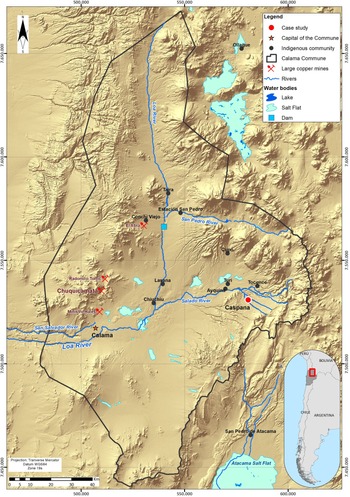
Since pre-colonial times, the Alto Loa has been occupied by different states. There are archaeological records of the Inka (or Tawantinsuyu) from before the Hispanic invasion in Caspana (Castro & Uribe, Reference Castro and Uribe2004; Adán & Uribe, Reference Adán and Uribe2005). Later, the Spanish crown (16th–18th century) occupied the so-called Atacama Corregimiento, dividing the area into Atacama La Alta and Atacama La Baja (Castro, Reference Castro2016). The latter corresponded to Alto Loa and included the towns of Calama, Chiu Chiu (Head), Ayquina, and Caspana. During the Republican era, since 1825, the Atacama Corregimiento was under Bolivian sovereignty, changing its name to Departamento del Litoral. This changed after the War of the Pacific (1879–1884) when the victorious Chile annexed the territory (Sanhueza and Gundermann, Reference Sanhueza and Gundermann2007)Footnote 1 . Currently, Alto Loa is part of the municipality of Calama in the Antofagasta Region of northern Chile (Figure 1).
Location of Caspana and other landmarks within the territory.

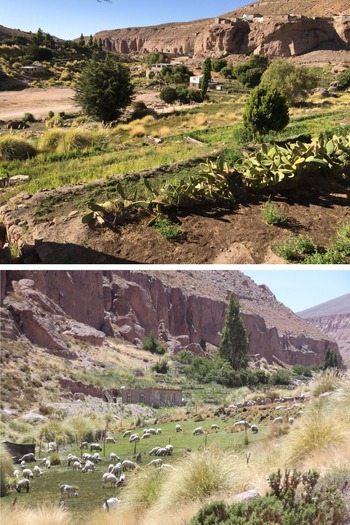
Specifically, Caspana is located in a gorge through which a tributary of the Salado River passes, itself one of the main tributaries of the Loa River. It is part of a group of Andean settlements located in the oases, gorges, and wetlands (vega or bofedal) of the Loa River basin, mainly in its mid and upper sectors. Their inhabitants have been dedicated to agriculture, grazing, and small-scale mining since the pre-colonial period (Adán & Uribe, Reference Adán and Uribe2005; Aldunate et al., Reference Aldunate1986; Castro, Reference Castro2016; Castro & Uribe, Reference Castro and Uribe2004). Although agricultural and livestock activities have undergone profound transformations (Calderón & Prieto, Reference Calderón and Prieto2020; Castro & Martínez, Reference Castro and Martínez1996; Gundermann, Reference Gundermann1998; Villagrán & Castro, Reference Villagrán and Castro1997), they continue to this day, albeit with different levels of intensity throughout the basin (Figure 2). The main trends of change involved: a general weakening of pastoralism and subsistence agriculture, the limited emergence of market agriculture, the deagrarianisation of rural income, rural–urban migration, and the targeted retention of the rural population. These dynamics are not homogeneous in time and space but vary according to the locality and time analysed.
Agriculture and livestock activities in Caspana, 2019.
Source: Authors’ own records.

In the late 19th and early 20th century, the indigenous people of Alto Loa complemented their agricultural and pastoral activities by working as day labourers and self-employed vendors of raw materials in the small mines of the mid Loa (Risopatrón, Reference Risopatrón1905; Sanhueza & Gundermann, Reference Sanhueza and Gundermann2007). They sold yareta (Azorella compacta)Footnote 2 firewood and were also employed at the Caracoles silver mine, small copper operations in the Chuquicamata area, and non-metallic mining operations (borax, sulphur, etc.) in various parts of the area.
The intensity and quality of their relationships with mining and the markets changed radically after 1915 when the US capital brought the large Chuquicamata mine into operationFootnote 3 . Since the mid-19th century, the industrialisation and urbanisation process of the central economies increased the demand for raw materials in general, and copper (Orellana, Reference Orellana2004; Sutulov, Reference Sutulov1975) in particular. In addition, the capitalist powers of the time – consolidated and emerging – intensified their control over global natural resources (Marini, Reference Marini2015). Chuquicamata was the largest copper mine in the world for much of the 20th Century (Millán, Reference Millán2006; Sutulov, Reference Sutulov1975). Its operation implied profound social and spatial transformations: the purchase of various mining rights; the opening of extraction zones; the construction of a thermoelectric plant and its transmission line; the construction of copper processing plants; the establishment of a large camp for 15,000 people; the provision of water rights; and the installation of pipes (Arriaza & Galaz-Mandakovic, Reference Arriaza and Galaz-Mandakovic2020; Millán, Reference Millán2006; Orellana, Reference Orellana2004).
Since the opening of the large Chuquicamata mine, copper extraction has been constantly increasing. During the 20th century and up to the present, copper has been the main Chilean export, and the country is number one producer around the world (Comisión Chilena de Cobre, 2020; Millán, Reference Millán2006; Sutulov, Reference Sutulov1975). In 2019, Chile accounted for 28% of world copper production. The mineral represented 48% of the country’s total exports, and the Antofagasta Region produced 54% of the national total (Comisión Chilena de Cobre, 2020).
In parallel to the growth of large-scale mining, the urban population of the Antofagasta Region (Arriaza & Galaz-Mandakovic, Reference Arriaza and Galaz-Mandakovic2020; Garcés et al. Reference Garcés, O’Brien and Cooper2010) and the Loa River basin (Bähr, Reference Bähr1985; Calderón-Seguel et al., Reference Calderón-Seguel2021) has increased to the present day. Urban growth in this basin is caused by the migration of workers from central and southern Chile, bordering countries, and rural towns in the area. However, rural demographic dynamics have not been homogeneous among the different localities over time. This dynamic has presented population growth trends according to market boom and bust cycles or when the extractive use of water has intensified, among other factors (Calderón & Prieto, Reference Calderón and Prieto2020; Consecol Ltda., Reference Ltda1988). Caspana has its unique dynamics, which we will review later.
The regional urban growth has caused the demand for water from the Loa River to increase considerably, both for large-scale mining and related industries, and the urban population (Arriaza & Galaz-Mandakovic, Reference Arriaza and Galaz-Mandakovic2020; Prieto et al., Reference Prieto2022; Yáñez & Molina, Reference Yáñez and Molina2011). The use of water for extractive purposes in the upper sector of the Alto Loa is one of the main reasons for the transformation and decline of agricultural and pastoral activities in the area (Carrasco, Reference Carrasco2016; Prieto et al., Reference Prieto, Salazar and Valenzuela2019; Villagrán & Castro, Reference Villagrán and Castro1997; Yáñez & Molina, Reference Yáñez and Molina2011). However, the root of the changes in Caspana does not lie solely in the extraction of water. The town is far from the main water sources used by mining, related industries, and cities (Prieto et al., Reference Prieto2022; Yáñez & Molina, Reference Yáñez and Molina2011) and has, therefore, not been directly affected by this problem. The extractive forces that have reshaped the community are related to other factors, mainly commercial dynamics propelled by mining activity and urban growth, which have produced contradictory connections between extractivism and the local population.
Productive practices in Caspana and extractive markets
Between 1915 and 2019, we have identified three main stages in the productive practices of the Caspaneños in relation to extractive markets. The first period covers 1915 to the 1970s, when subsistence agriculture and pastoral activities predominated, combined with the sale of labour for mining and the independent trade of yareta firewood.
The second period covers the 1970s and 1980s. This stage is characterised by a weakening of the extractive markets in which the inhabitants of Caspana participated in the previous stage. Given this situation, the population reshaped its productive practices, redirecting a substantial part of the farmland for commercial crops demanded by Calama. Although they retained their subsistence character, livestock activities lost relevance within the local economic base, and customary practices changed.
The third period runs from the 1990s to 2019. It is characterised by an ongoing decline in agriculture and livestock activities and of the extractive markets that had a direct influence on the town. In this context, some non-agricultural rural occupations developed among people habitually residing in Caspana. However, this stage is marked by a progressive migration to Calama as a place of primary residence.
From 1915 to the 1970s: extractive markets and subsistence agriculture and livestock production
Before Chuquicamata opened in 1915, the inhabitants of Caspana were involved in subsistence agriculture and pastoral activities and occasionally sold their labour for high-altitude mining (sulphur and other minerals) (Miranda, Reference Miranda2019; Risopatrón, Reference Risopatrón1905). They also individually extracted and marketed a limited amount of yareta. In terms of agriculture, Risopatrón (Reference Risopatrón1905) estimates that approximately ten hectares of land were cultivated.
The start of operations at Chuquicamata stimulated different markets in the Alto Loa (Calderón-Seguel et al., Reference Calderón-Seguel2021; Galaz-Mandakovic & Rivera, Reference Galaz-Mandakovic and Rivera2020; Richard, Reference Richard, Rivera, González and Lorca2021; Urdangarin, Reference Urdangarin2007). Chuquicamata operations required a workforce and raw materials (e.g., yareta firewood, sulphur, and other minerals). The need for raw materials intensified the demand for a workforce in these activities, as well as the participation of the indigenous population through forms of self-employment. The cities (Calama and the Chuquicamata camp) required food (vegetables, meat, etc.), fuel (yareta firewood), and a workforce for urban jobs and commercial agriculture in the Calama oasis.
For the following description of the 1915–1970 period, we have relied mainly on oral histories recorded during our ethnographic fieldwork and on studies conducted by Hanson (Reference Hanson1926), Walcott (Reference Walcott1925), and Miranda (Reference Miranda2019). Our data and these sources show that the demand for extractivism intensified commercial relations and the participation of the Caspaneños in these areas. Consequently, their productive practices balanced domestic and community relations in subsistence agriculture and grazing, mercantile relations in the independent extraction of yareta, and proletarianisation. Of all mercantile activities, the independent extraction and sale of yareta was the main source of income.
The combined development of these productive practices introduced a division of labour within households stratified by gender and age, with practices that varied throughout the year. Mercantile activities were mainly carried out by adult men, who travelled to extraction sites and trade centres. They participated in these tasks for most of the year, except in peak periods for subsistence agriculture. When more work was required for subsistence agriculture, it was common for adult men to return to Caspana to help. On the other hand, subsistence grazing was controlled by adult women, children, and teens, who moved throughout the year between the pastoral estancias Footnote 4 (livestock ranches) located in the puna (above 3,500 metres altitude). They also cared for agricultural crops.
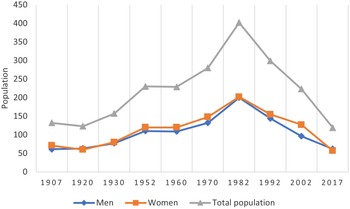
This combination of productive practices made it easier for the town to continue as a regular place of residence for the Caspaneños, without suffering a generalised emigration to cities during this phase. The urban centres had become poles of attraction for the population due to their labour markets; however, when analysing historical censuses, we see an increase in the census population in Caspana during much of the period (Figure 3).
Census population in Caspana, 1907–2017.
Source: Prepared by the authors using census data (Comisión Central del Censo, 1908; Dirección de Estadística y Censos, n.d.; Dirección General de Estadística, 1925, 1931; Instituto Nacional de Estadísticas, 1973, 1984, 1992, 2002, 2017; Servicio Nacional de Estadística y Censos, 1959).

The productive practices of the inhabitants of Caspana and their connections with extractive markets are characterised by certain details that deserve attention. These allow us to understand the functioning of the activities that comprised their economic strategies during the 1915–1970 phase, and its subsequent changes.
Agriculture was practised on the cultivation terraces present in the different gorges around the town. Land tenure was family-based, where the head of each household owned land and gave fractions of it to their children when they formed a family nucleus. These forms of tenure are maintained to the present day. The main crops were different types of corn and potatoes, wheat, barley, fava beans, and alfalfa. There were also prickly pears, and fruit trees were introduced during the period. The products were subsistence-based, although there was also reciprocal exchange between households in Caspana or other towns.
With regard to productive relationships, household labour predominated. However, at specific times of year, help from people outside the household was needed. This was a requirement in the few households that owned larger extensions of land, which correlated with greater livestock ownership. These occupied a more comfortable position in the local milieu. However, the informants we interviewed do not remember there having been land purchases to create this situation; rather, it was assumed to be a given condition. Therefore, in addition to household labour, there were other ways of accessing an agricultural workforce. We have identified: a) collective work as the result of a minga (the owner of the land provides food and drink in exchange for work); b) work from outside the family paid for in kind (very rarely in money); and c) reciprocal work between two households. Those who were in a comfortable economic position supplemented their own workforce with the first two forms, while those of a lesser economic position depended on the third. Since production was for subsistence, the money that was invested in agrarian activity in the first two modalities came mainly from the independent extraction and sale of yareta.
Livestock activities included the grazing of llamas, sheep, and goats in the puna through the alternating use of estancias. People also owned donkeys and mules that were used to transport goods. The puna was communal property, but each household occupied certain estancias during the year for grazing. They settled for a period of time in an estancia and, when the availability of forage decreased, they moved on to another. Similarly, the other towns in Alto Loa had their own long-established areas for grazing, which were recognised by other communities (Castro & Martínez, Reference Castro and Martínez1996; Gundermann, Reference Gundermann1998).
The towns of Alto Loa that were actively involved in the independent extraction and sale of yareta (Caspana, Toconce, Ayquina, Cupo, and others) distributed the extraction zones according to the spatial patterns used in grazing (Aldunate et al., Reference Aldunate1981; Club de Adultos Mayores de Ayquina-Turi, 2017; Miranda, Reference Miranda2019). Each community had its own territory where it carried out the activity, and within these, each household had priority areas. Labour relations were of a domestic nature, and, in the early years, yareta was transferred by llama to the places it was marketed (Chiu Chiu and Calama). Over the following years, until the 1950s, it was carried by donkey to Calama, where trade had become concentrated. During the 1950s, some wealthy households invested their savings in the purchase of trucks and became intermediaries who acquired yareta in the towns or nearby areas to take to Calama to sell. Those who did not possess this means of transport dedicated themselves exclusively to extraction. It is important to keep in mind that, from the 1950s, in several towns throughout the area, indigenous people also bought trucks and thus occupied a key role in the circulation of yareta and other raw materials (Richard, Reference Richard, Rivera, González and Lorca2021; Richard et al., Reference Richard, Moraga and Saavedra2016).
Those who sold yareta returned to Caspana with processed goods that were integrated into local consumption (oil, salt, sugar, canned food, clothing, tools, etc.). However, when trucks were incorporated, those who specialised as intermediaries controlled the flow of processed goods, as well as the transportation of yareta. This strengthened their position. Having established this last point, it is interesting to note that wealthy households did not invest their higher income in the acquisition of land or the activation of an agricultural labour market within the locality; rather, they used it to access an external workforce through customary mechanisms. In other words, additional income was used to reproduce the existing differentiation in subsistence agriculture, but not to deepen market relations in this activity.
Sporadic proletarianisation in high-altitude non-metallic mining (borax, sulphur, etc.) occurred through temporary migration, where work in sulphur and other mineral operations combined with residence in the town. The time spent at the mining sites versus the time spent in Caspana depended on individual motivations and household needs, either for money or agricultural labour requirements. Due to greater control over the means of production appropriate for the independent yareta market, we can infer that well-off groups obtained a large part of their monetary income from this market. On the other hand, those who held a lower economic position combined employment in yareta-based activities with the sale of their labour in high-altitude mining. There also existed long-term migration to Calama or Chuquicamata, where people went to work as wage earners in mining or urban jobs. However, these actors left the rural domestic economy and only reintegrated if they returned to the town or retired.
The yareta market in which the Caspaneños participated stopped operating at the end of the 1960s, when liquid gas became the main energy source in Calama (Richard, Reference Richard, Rivera, González and Lorca2021). Technical changes in the Chuquicamata operations in the mid-20th century (Rudolph, Reference Rudolph1951; Vergara, Reference Vergara2004) caused high-altitude mining, especially sulphur, to sharply reduce its activities starting in the 1960s (Richard, Reference Richard, Rivera, González and Lorca2021; Rivera, Reference Rivera2020). Faced with the loss of their main sources of monetary income, the Caspaneños promoted new productive practices and engaged with extractive markets in other ways from the 1970s.
Reconfigurations during the 1970s and 1980s: agrarian markets and new land use
Given the decline of activities that provided them with income in the previous period, the Caspaneños promoted in-depth transformations in agriculture, sending an important part of their production to the food markets of Calama. Livestock farming also underwent changes, although it remained a subsistence activity. In fact, during the 1980s, 80% of agricultural production was destined for sale and 82% of livestock production for subsistence (Consecol Ltda, Reference Ltda1988). Agriculture and livestock formed the subsistence activities basis of the Caspaneños, representing 66% of income by the late 1980s (Consecol Ltda, Reference Ltda1988). These activities were complemented by the occasional sale of labour in a declining high-altitude mining sector, in addition to state subsidies.
Mercantile agriculture was developed through a reorientation of land use, along with an expansion of cultivated land through the recovery of disused terraces. There was a reduction in the production of subsistence crops (corn, wheat, barley, and potatoes) due to their replacement with commercial crops: vegetables (garlic, parsley, cilantro, spring onions, and to a lesser extent, carrots, lettuce, and broad beans); cooking and medicinal herbs (oregano, rosemary, mint, lemon verbena, matico, and others); flowers (dahlias, gypsophila, gladioli, carnations, wallflowers, and others); and prickly pears. The product with the highest reported income to date is the prickly pear. On the other hand, subsistence crops remained, despite their decline. Some reduced in quantity and variety (corn and potatoes), while others practically disappeared (wheat and barley). Fruit trees were maintained mainly for subsistence production. Finally, the cultivation of alfalfa for livestock feed increased, and livestock, as seen below, stopped being taken regularly to the estancias.
The Caspaneños who we interviewed stressed that commercial crops demanded more water than those for subsistence, which implied a reorganisation of irrigation practices. In the previous phase, irrigation was coordinated among irrigators, who agreed on a shift system. Commercial agriculture required greater water consumption, mainly in the summer months. Thus, for a time, conflicts arose out of a failure to respect this system. Given this situation, the community reorganised its irrigation management by appointing an individual to oversee this (water judge or caretaker), a position that was rotated. This system currently operates between November and March, when there is greater demand for water. In the summer period, each irrigator pays a monetary amount for the right to water, which allows the community to remunerate the overseer for their full dedication. During the rest of the year, as there is less demand for water, there is a shift system in place directly between irrigators.
The commercial reorganisation of agriculture did not increase salaried relationships, nor did it generate major differences in land and animal ownership. Both wealthy households and those with reduced economic positions worked mainly with their domestic groups. Commercial crops reshaped productive relationships, making outside labour practically unnecessary. Reciprocity was used only for the preparation of terraces, and monetary payments were used to a lesser extent. Subsistence crops, such as wheat and barley, demanded a high amount of labour from outside of the family unit during harvest periods. As their presence reduced, the need for labour disappeared. Likewise, the minga ceased to be practised in agriculture and currently continues only in the cleaning of canals, repairs in community infrastructure, church repairs, or one-off events that require a collective effort. Commercial crops require greater care throughout the agricultural cycle; therefore, the stable presence of various household members in the town was necessary. For this reason, livestock grazing ceased to be practised in the estancias, and the animals began to be kept more regularly in the gorges near the town. With these developments, a great amount of land was allocated to planting alfalfa for livestock feed, and the total number of animals decreased.
The circulation of agricultural goods was initially analogous to the yareta trade. Wealthy households that owned trucks bought agricultural products from other Caspana inhabitants and took them to Calama, along with their own harvest. This allowed them to maintain their comfortable position and increase their level of income. Nevertheless, as in the previous stage, this was not expressed in a greater concentration of land or salaried agricultural relationships. However, they did maintain their interests in other sectors, for example, the trade of processed goods that they bought in Calama and sold in town. Some residents maintained a home in both Caspana and Calama, and a significant part of their income was used to support urban life. This dynamic implied mobility between the two places in the short term; therefore, it must be differentiated from longer-term emigration, where people left the rural economy.
Considering the key role played by the circulation of agricultural goods in providing income, various informants told us that, at different times in the 1970s and 1980s, those who were not part of the wealthy classes promoted cooperatives aimed at trading their members’ produce and buying from other producers. Some of these initiatives were carried out with state support, while others were self-managed. The results were variable; however, the informants recall that their presence was habitual during the period. In fact, Délano (Reference Délano1982) has confirmed the coexistence of different ways of circulating mercantile agricultural production: individual intermediaries; cooperatives of intermediaries; exchange of agricultural production for processed goods; and others.
Other sources of monetary income during this period were the occasional sale of labour in high-altitude mining and the contributions received from state subsidies. Proletarianisation mainly occurred in the sulphur mines and took the form of short-term migrations between Caspana and the mining operations, based on the need for money or agricultural labour. Those who participated in this labour market were adult men. State subsidies corresponded to pensions, retirement, and employment programmes implemented by the military dictatorship (1973–1989) in the face of the economic crisis that affected much of its administration. Beyond their monetary contribution, at certain times, the Caspaneños were able to use these employment programmes for maintaining agricultural and irrigation infrastructure.
The fact that the main source of monetary income was the agriculture practised in the town, together with proletarianisation in high-altitude mining close to the town, caused the census population in Caspana to increase from the 1970s to the 1980s (Figure 3). Related to this, housing in the town increased from 83 in 1970 to 117 in 1982 (Instituto Nacional de Estadísticas, 1973, 1984). However, in addition to economic processes, our informants explained that the population also increased after the Chilean State made the Caspana school responsible for teaching children and teens from the different villages of Alto Loa. In fact, according to the 1982 census, 52% of the total 402 people registered were under 14 years of age (Instituto Nacional de Estadísticas, 1984).
From the 1990s to 2019: decline of agriculture and livestock practices and new territorial configurations
The productive practices of the Caspaneños and their links with extractive markets have undergone different changes since the 1990s. A central factor is the lower number of inhabitants in the town. Our ethnographic records show that, for different reasons, Calama had become the primary residence for a significant number of households. As Figure 3 shows, the census population in Caspana decreased, falling from 402 people in 1982 to 119 in 2017. The reasons for this are varied. We highlight the growing penetration of cultural models associated with urban life, which generates an aspiration to live in the city for its services and goods, for the leisure activities that it offers, for the jobs that exist there, for the possibilities of obtaining a higher or safer monetary income, and other aspects.
In addition to the above, state decisions generated that Caspana reduced the years of schooling available there, which put pressure on those with school-age children to move to Calama.Footnote 5 Throughout this period, the roads that connect Caspana to Calama have also been improved (currently fully paved), and the means of transport have been optimised. Various households have their own vehicle (pick-up truck or car), and there is currently a bus service that operates with state subsidies four times a week, all of which have improved connectivity.
Related to the last point, the households that establish their primary residence in the city do not emigrate permanently. They set up a dynamic of double urban–rural residence. The data we recorded show that these domestic groups remain in the city from Monday to Friday and generally go back to the town on weekends, holidays, and for festivals or community events (Virgen de Caspana festival, canal cleaning, etc.). They also keep their homes and agricultural land, and some even own animals. Going back to the town also implies caring for their crops and livestock, although these can also be left under the supervision of relatives who live locally.
Ethnographically, the productive practices of the Caspaneños and their relationships with extractive markets during this period can be separated into two main groups. In the first group are households with primary residence in Calama, who generate their income in urban services as wage earners or are self-employed and sell their labour in industry or mining. These activities are complemented with income from agriculture or livestock activities carried out in Caspana through family work. Subsistence products are obtained (potatoes, corn, livestock production, fruit, etc.), and others are transported and marketed by them in Calama (prickly pears, flowers, vegetables, cooking and medicinal herbs, and others). They also operate as intermediaries, buying agricultural goods from Caspana residents. In the second group are the productive practises of the domestic groups that have their main residence in the locality.
The productive practices of the households whose primary residence is in Caspana are based on commercial and subsistence agriculture and livestock activities. In fact, according to the 2017 census, 60% of the economically active population was primarily engaged in these activities (Instituto Nacional de Estadísticas, 2017). However, their income is supplemented by non-agricultural rural occupations as day labourers or in self-employment (house building, road construction, municipal support services, specific tourism initiatives, and others), state subsidies (retirement, pensions, support for vulnerable families, agriculture and livestock development, and others), and occasional employment in Calama as wage earners or self-employed (construction, trade, and various other services). Related to this last point, a large number of rural households also own homes in Calama or have relatives who live in the city. It is, therefore, normal for them to spend variable periods of time in the city (for work, family reasons, paperwork, sale of agricultural products, and others) and then return to Caspana.
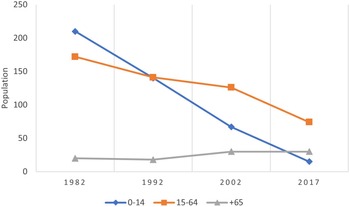
Agriculture and livestock activities maintain the characteristics of the previous period in relation to where they take place, land use, the orientation of production, and the predominance of domestic relations. However, the amount of land cultivated, the volume of production, the number of animals, and the people dedicated to these activities have decreased. In this regard, the agriculture and livestock system in this period is a weakened version of the one that existed in the previous stage. The main cause of this is the lack of a stable workforce in the town. Figure 4 shows that the population in the workforce age range (15 to 64 years) has decreased, while the number of elderly people has increased. Thus, although the work is carried out by households, wage labourers are occasionally hired due to the physical limitations of older peasants. This extraordinary salaried relationship has nothing to do with processes of peasant differentiation but is rather a response to the labour availability crisis. Another element that affects access to the workforce is that customary mechanisms no longer operate in an institutionalised manner.

Alongside the reduction of the workforce, the decline of commercial agriculture has been influenced by the progressive arrival in Calama of products from other parts of the country, which are more competitively priced than local ones. Therefore, Caspaneños with primary residence in Caspana assume that commercial agriculture must always be combined with other forms of employment.
The declining dynamism of mercantile agriculture dismantled the forms of commercialisation of the previous period, in which intermediaries with trucks, both individual and cooperative, predominated. There have been a few intermediaries during this phase, some living regularly in the town and others in Calama. They take their own produce to the city in their trucks, along with produce bought from other peasants. Peasants can often take their products to Calama themselves, using public transport or their own vehicles. Several peasants take their products directly to the El Loa Province Fair, an event organised annually in March by the municipality of Calama.
In the context of declining agriculture and livestock activities, the presence of households with different economic positions can no longer be identified based on clear distinctions in land or animal ownership. In general, lands have tended to be divided by succession and inheritance, which has diluted the differences described for previous stages. Economic differences in this period are not shaped and expressed by whoever controls the agricultural or livestock means of production. They are due to the successful development of urban markets and are expressed in the acquisition of somewhat expensive manufactured and luxury goods.
Before concluding, it is important to highlight that, despite agricultural and livestock decline, these activities and the memory of their practice have played an important political role during this period. The persistence of their presence and the oral history of their existence over a long period of time have allowed the Atacama Indigenous Community of Caspana to claim and recover an important part of its territory under the Indigenous Law of 1993 (No. 19.253). This law has given them formal room for manoeuvre to argue and defend a continuous and long-term occupation of the territory. Since the constitution of the Indigenous Community in 1994, there has been a formal organisational support that coordinates the urban and rural Caspaneños around the historic town. It should thus be considered that the formation of trans-local communities and rural–urban mobility are characteristics shared throughout contemporary Andean society in the Antofagasta Region (Imilan, Reference Imilan2007), northern Chile (Gundermann & Vergara, Reference Gundermann and Vergara2009), and in other Andean countries (Garcés & Bretón, Reference Garcés and Bretón2017).
Conclusions
The historical reconstruction of the productive practices of the Caspaneños and their changes in relation to extractive markets allows us to comprehend the growth of mining extractivism in Andean rural areas as a complex and contradictory process. In certain territories and at certain moments, these relationships have been expressed through socio-environmental conflicts and contradictions. However, in others, they manifest themselves through ambiguous links that, without denying their disruptive or destructive aspects, account for the participation of the indigenous population in extractive dynamics with different degrees of subordination, dependency, or autonomy. In the same way that the shaping of rural territories is explained by the specific forms that extractivism takes, its concrete expression is due to the relationships that the local population establish with it.
Throughout the period under study, the productive practices of the Caspaneños have been connected to various markets activated by mining extractivism: workforce, raw materials, urban markets, and others. Where there have been changes in these markets linked to the rearrangement of extractivism in the territory, the productive practices of the Caspaneños have also been transformed. However, this dynamic should not only be analysed as a local reaction to external forces but also one that expresses the great versatility of Andean society to redefine its productive practices in a highly changing and tense extractivist context (Contreras, Reference Contreras1988; Long & Roberts, Reference Long and Roberts1984; Marston, Reference Marston2020; Nash, Reference Nash1979).
The productive practices of the Caspaneños have been characterised by combinations of diverse economic activities, technologies, work relationships, and varied patterns of mobility between the highlands and lowlands. Some of these dynamics are typical of the customary practices of Andean society, while others are characteristic of capitalist relations. The main changes in social relations and technologies occur around activities with dynamic connections to extractive markets. Likewise, these changes (mainly technological) improve commercial performance among those who drive them properly. Although the typically capitalist components tend to predominate in the long term, they have not developed along a single linear path. Even today, these different types of relations coexist as reproduction mechanisms in Andean societies (Dollfus, Reference Dollfus1991; Lorca et al. Reference Lorca2022; Marston, Reference Marston2020; Prieto, Reference Prieto2022). The above cannot lead us to ignore that extractivism, as a form of dependent capitalism, absorbs and requires social practices that, in principle, are not typically capitalist. However, once these relations are integrated into cycles of capital reproduction, they do become typically capitalist, but with characteristics unique to their development in dependent territories (Oliveira, Reference Oliveira and Ross2005; Tsing, Reference Tsing2015; Wolf, Reference Wolf2000).
Currently, the concept of extractivism is used to analyse global processes (Chagnon et al., Reference Chagnon2022; Engels & Dietz, Reference Engels and Dietz2017). Some authors argue that it goes beyond the exploitation of natural resources and centre–periphery relations, including any dynamic of dispossession in which beneficiaries extract not only natural resources but also knowledge, cultural practices, finances, identity, among others, at any spatial scale (Chagnon et al., Reference Chagnon2022). Although this approach has value, there is a risk of turning the concept of extractivism into an empty signifier, diluting its political role. If all types of capitalist exploitation are considered extractivism, what purpose does this concept serve? How can we use it to identify and question particularities? As we have seen in this article, extractivism as a specific form of capitalist development, typical of regions dependent on global capitalism and characterised by the intensive production and export of raw materials and food, still requires detailed exploration for its description, understanding, and explanation.
Acknowledgements
We extend our gratitude to everyone who participated in the research for generously sharing their experiences and opinions. Funding for this research was provided by the Universidad de Tarapacá (grant number Proyecto UTA Mayor N° 6743-23). We also acknowledge the funding provided by the Agencia Nacional de Investigación y Desarrollo – ANID (grant numbers ANID—FONDECYT—11230028, ANID—FONDECYT—1201527, ANID—MILENIO—NCS2022_009, ANID—FONDAP—1522A0003). Special thanks to Gino Sandoval for providing the map. Lastly, we especially acknowledge the “Comunidad Indígena Atacameña de Caspana” for allowing us to conduct this research on their traditional lands.