Introduction
Rural communities have faced significant socio-economic challenges for the past several decades due to structural shifts and changing social expectations regarding the production, management, and markets for natural resources, including production agriculture. The prevailing industrial agricultural production model is facing emerging countervailing trends because of its negative effects on human health, rural economies and the environment (Hassan et al., Reference Hassan, Scholes and Ash2005; Foley et al., Reference Foley, Ramankutty, Brauman, Cassidy, Gerber, Johnston, Mueller, O'Connell, Ray, West, Balzer, Bennett, Carpenter, Hill, Monfreda, Polasky, Rockström, Sheehan, Siebert, Tilman and Zaks2011; Vermeulen et al., Reference Vermeulen, Campbell and Ingram2012; Institute of Medicine, 2015). For agriculture, these trends include expanding interest in multifunctional landscapes for environmental, economic and social benefits, such as providing ecosystem services in addition to supplying food and fiber (e.g., Hart et al., Reference Hart, McMichael, Milder and Scherr2016). In the marketplace, opposition to industrial production agriculture has been expressed as interest in local and regional food networks (RFNs) that support individual producers, many of whom operate on a small scale (<US$75,000 gross cash farm income (GCFI)).
While there is no consensus on the definition of ‘local,’ local food has become the fastest growing segment of the retail food market (Adams and Salois, Reference Adams and Salois2010). ‘Local’ has been described as within a political boundary (counties or states) or a defined distance (400 miles in federal statutes) (Clancy and Ruhf, Reference Clancy and Ruhf2010). It also connotes direct marketed fresh food moving to consumers from an identified place. But as ‘local’ has grown, the marketing options have expanded to other ‘short’ supply chain forms that implicitly avoid long industrial supply chains (Marsden et al., Reference Marsden, Banks and Bristow2000; Clancy and Ruhf, Reference Clancy and Ruhf2010). As place-based short supply chains have proliferated, RFNs have emerged as a theoretical tool and practical reality to describe the aggregation of short food supply chains within a geographical region. From a production perspective, regionalism allows us to consider a larger land base with a broad variety of natural resources and more diverse production capacity (Clancy and Ruhf, Reference Clancy and Ruhf2010). On the consumption side, RFNs encompass a larger market area where the number of potential consumers and demand depends on population density, other food options in the region, and household income levels. From an economic development perspective, economic returns from RFNs stay within the region by utilizing the new short supply chains (Marsden et al., Reference Marsden, Banks and Bristow2000; Clancy and Ruhf, Reference Clancy and Ruhf2010). Because of low population density in very rural areas, producers may engage in sales beyond the nearest neighbors or town, expanding their sales into regional markets through direct or intermediated sales, depending on the scope of their operation. At the same time, however, small-scale producers may have unique opportunities to sell in the local community to serve local needs.
Emerging interest in local agriculture provides opportunities for rural communities to diversify and expand local businesses around the use of natural resources, thereby helping to restore greater capacity for self-direction and adding to local community vitality. Natural resources, which include agriculture because it relies on soil and water, continue to be the dominant assets in many rural communities. The New Natural Resource Economy (NNRE) is an economic development approach comprising use of natural resources in ways that can build healthy environments and healthy, resilient local economies (Hibbard and Lurie, Reference Hibbard and Lurie2013). Emphasizing stewardship and restoration principles, it consists mostly of very small businesses—ten or fewer employees and sole proprietorships—which are the predominant business types nationwide and are particularly important in rural communities that are distanced from markets and infrastructure found in more populated areas (Muske et al., Reference Muske, Woods, Swinney and Khoo2007; Besser and Jarnagin, Reference Besser and Jarnagin2010; Brooks, Reference Brooks2013). These very small businesses use natural resources in innovative ways to create new products, such as biomass fuels and lumber from juniper, and tap into new markets, such as farm-to-table agriculture and agritourism as components of the NNRE. Viewing these types of natural resource-based enterprises in the aggregate, rather than by sector, provides a way for rural economic development specialists to recognize the collective importance of these very small businesses to rural economies in ways that are often not visible with traditional economic development approaches. It can help specialists identify and respond to those businesses’ particular needs in order to help them thrive. Because the NNRE is a local and regional rural economic development approach, we analyze the contribution of small-scale agriculture in rural Oregon to the framework.
Relying on survey responses of both producers and consumers who use RFNs in rural Oregon, we make the case that RFNs in rural Oregon counties display characteristics of an NNRE development strategy. Small-scale agricultural producers in rural communities can therefore benefit, and benefit from, an NNRE approach, helping sustain the local agricultural base and adding to local food security. While a range of local or regional small-scale producers does not represent a diversified, resilient economy in and of itself, it can play an important role in the NNRE aggregated approach by diversifying local economies in ways that are appropriate to a variety of local contexts to build better social, environmental and economic resilience.
Agriculture's connection to resource-dependent rural resilience
In general, the fortune of rural communities globally has been on the decline since approximately the 1950s (e.g., Hibbard and Lurie, Reference Hibbard and Lurie2013). Due to the heterogeneity of rural community attributes, in any given period some have been able to take advantage of, or at least adapt to, structural and other changes in demand for natural resources. While there have been challenges to the term resource dependence (Stedman et al., Reference Stedman, Patriquin and Parkins2012) based on the highly variable characteristics and interlinkages of resources, communities, and regions, resource-dependent rural communities rely on natural resources as a significant proportion of income or employment, which includes agriculture (Stedman et al., Reference Stedman, Parkins and Beckley2004). In addition, they are often located in areas that do not provide the same range of adaptive choices as communities closer to metropolitan areas with related infrastructure and labor force education and skills, including business, financial and technological support (Ring et al., Reference Ring, Peredo and Chrisman2010). Because NNRE includes agriculture, those communities with continued agricultural production as a major local economic driver are considered resource dependent. For many resource-dependent rural communities, there have been multiple cycles of booms followed by declines. This has led to a gradual erosion of economic and social dimensions of prosperity and well-being in part due to the industrial agriculture production model (Freudenburg, Reference Freudenburg1992; Krannich et al., Reference Krannich, Gentry, Luloff, Robertson, Bailey, Jensen and Ransom2014; Lobao, Reference Lobao, Bailey, Jensen and Ransom2014).
For over a century, farms have adopted new technologies, investing capital and replacing labor, in a trend toward specialization and commercialization (Welsh, Reference Welsh1997). Post-WWII industry provided synthetic fertilizers and pesticides that gave rise to monoculture commodity crops. The government also played a large role using system-wide tools such as price supports, crop insurance, food safety regulation, food aid programs and others with the goal of making food cheap and plentiful (Dahlberg, Reference Dahlberg, Lyson, Stevenson and Welsh2008). In the 1990s, global trade agreements contributed to the commodification of food, including harmonizing government and private production standards across geographic and political boundaries (Campbell, Reference Campbell2009). For farmers, specialization and commercialization led to production and marketing practices that were more commodity market-oriented, boosting production and increasing farm size while the number of farms and ranches declined. The number of farms in America peaked at 7 million in 1935, then fell by more than half by the 1970s (Hoppe, Reference Hoppe2014). Since then, the decline has continued for small commercial and midsized farms while large farms increased in number—up 107% from 1992 to 2012—and average farm size has steadily increased (Burns and Kuhns, Reference Burns and Kuhns2016).
Rural communities that are dependent on agriculture are subject to these changes in the structure of the agricultural sector along with others, including regulatory changes and modified social expectations regarding the balance between use and protection of natural resources (Krannich et al., Reference Krannich, Gentry, Luloff, Robertson, Bailey, Jensen and Ransom2014). Generally, those resource-dependent areas that do not or cannot adapt to structural changes in their primary industries tend to be highly vulnerable to diminished economic opportunities as well as population loss (McGranahan and Beale, Reference McGranahan and Beale2002; Eachus, Reference Eachus2014). The combination can result in an overall weakening of the economic and social fabric of the community. Through an NNRE approach, assessing the challenges and needs for very small businesses, including small-scale agricultural producers, and providing support for those enterprises as well as creating additional opportunities can help rural communities reverse the effects of this trend and begin to rebuild local prosperity.
The concept of resilience has gained popularity as a way to think about helping rural communities respond and adapt to changing conditions. Scholars writing about resilience from a socio-ecological perspective often cite the associated concept of diversity as a condition of resilience. A traditional prevailing economic development strategy to replace lost key employers is industrial recruitment—bringing in firms from outside the community that provide significant numbers of jobs in relatively rapid order—which may not make a community less vulnerable to economic downturns (Crowe, Reference Crowe2006; Eachus, Reference Eachus2014). This assumes the traditional strategy of replacing one dominant employer with another is the only choice. Another aspect of diversity is in the size of rural enterprises. The Goldschmidt hypothesis—that communities with a diversity of farm sizes, including small and mid-sized agriculture, have stronger and more diverse community institutions compared with communities dominated by large agribusiness—continues to be a focus for economic resilience, while environmental and social impacts are extensions today (Strange, Reference Strange1989; McMichael, Reference McMichael2000; Welsh and Lyson, Reference Welsh and Lyson2001; Lyson, Reference Lyson2004; Francis et al., Reference Francis, Lieblein, Steinsholt, Breland, Helenius, Sriskandarajah and Salomonsson2005).
Resiliency through economic diversity at the community level is also important within the different sectors that make up local enterprises. A diversity of marketing channels can increase the resilience of agricultural producers in the case of a drop in price or demand from one marketing channel. For the community, having multiple food supplies and distribution sources—from grocery stores to local agricultural producers—can insulate the community against shocks such as natural disasters that interrupt imports or local production (Smith et al., Reference Smith, Lawrence, MacMahon, Muller and Brady2016). This is particularly relevant in rural areas: 2.3 million US rural residents live in food deserts, where they do not have reasonable access to a grocery store and often face higher prices than urban areas (Oregon Food Bank, 2014).
The NNRE approach
Changes in natural resource planning and management over the past several decades have created challenges for resource-dependent communities. At the same time, however, they have created an array of new environmentally oriented activities and institutions to take advantage of emerging markets to complement traditional natural resource uses and which can provide economic opportunities for those communities. Rather than natural resources being viewed predominantly, or solely, as inputs for primary production, the NNRE is based on a multifunctional approach to the interlinkages of landscapes and communities. Some of the enterprises may be new; many are not. What is new about using an NNRE approach is looking at them in the aggregate rather than as discrete economic sectors (Hibbard and Lurie, Reference Hibbard and Lurie2013).
A partial list of NNRE activities includes watershed restoration projects, sustainable agriculture, value-chain differentiated products, payments for ecosystem services, and eco- and agritourism. The increasing interest in food production and distribution removed from industrial agriculture has given rise to a suite of approaches broadly termed alternative food networks, which involve direct contact between producers and consumers and typically comprise shorter production chains, smaller production scales, more environmentally sensitive production methods—though not always—and support for local producers (e.g., Cox et al., Reference Cox, Kneafsey, Venn, Holloway, Dowler, Tuomainen and Robinson2008; Hinrichs and Eshleman, Reference Hinrichs, Eshleman, Bailey, Jensen and Ransom2014). Understanding the needs and motivations of these enterprises, as the study revealed, and finding ways to help them prosper through an NNRE approach and development of RFNs sustains local agriculture and other NNRE businesses while helping support the rural communities where they are located.
Very small businesses
In rural resource-dependent communities, continued attention to natural resource oriented businesses, including agriculture, is appropriate because of the local history, expertise, land base and acceptance of agricultural land uses in the community, which are often codified in land use policy. Strategies for diversifying the local rural economy can be attentive to local context and to the dominant business model for rural communities—and, in fact, nationwide—which is very small firms of ten or fewer employees, and micro businesses, defined as enterprises with five or fewer employees, including the owner and requiring <US$35,000 in start-up capital (Edgcomb and Klein, Reference Edgcomb and Klein2005; FDIC, 2011; Carr and Anacker, Reference Carr and Anacker2013). This is an important distinction, and a significant aspect of an NNRE approach, which emphasizes developing supportive policies and tools that are appropriate to the local context. What constitutes a small business in many areas in terms of employees—defined by the Small Business Administration as between 100 and 1500 employees—would be considered a fairly good sized, or even large, business in many rural settings. For purposes of this paper, we use the term very small business to include both very small businesses and micro-businesses, as defined above, as well as sole proprietorships with no hired workers or only family labor. Very small businesses play an important role in rural areas in the USA for both individuals and communities (Muske et al., Reference Muske, Woods, Swinney and Khoo2007; Steiner and Cleary, Reference Steiner and Cleary2014; Steiner and Atterton, Reference Steiner and Atterton2015). In the first quarter of 2016, nearly 67% of private firms had nine or fewer employees in an eight-county rural region of Oregon, while 48% of all private firms in the area employed four or fewer employees (Wendel, Reference Wendel2017). While those very small businesses provided less than half of all jobs in the region, it is nonetheless an indicator of the proportion and importance of very small businesses in rural Oregon.
Very small business opportunities frequently provide individuals the means for staying in or moving to rural settings, which benefit both the proprietors and the community. Stephens and Partridge (Reference Stephens and Partridge2011) concluded that the distinction between necessity and opportunity entrepreneurialism is of little consequence; rather, having or creating a larger pool of businesses can be a key to boosting economic growth. Policies and programs to create and support a diversity of very small businesses in rural communities may indeed be a practical alternative, or adjunct strategy, to recruiting a single, large-scale employer.
There are other community benefits in addition to the financial development of local small-scale businesses. As Besser and Jarnagin (Reference Besser and Jarnagin2010, p. 5) note, ‘for many small business operators, the community is not just the place where business is conducted: it is home.’ Lyons (Reference Lyons2015) notes the difference between economic growth and community development: the former focuses on quantity while the latter is an emphasis on quality. Locally-owned sole proprietor and owner-manager enterprises, in contrast to satellite enterprises located in rural communities but associated with larger, non-local firms, tend to have a much greater social embeddedness. Owners of local enterprises generally exhibit a greater sense of responsibility to support the local community financially and through contributions of time and skills (Besser and Jarnagin, Reference Besser and Jarnagin2010; Steiner and Atterton, Reference Steiner and Atterton2015). Similarly, Liang and Dunn (Reference Liang and Dunn2014) studied farmers who use multiple forms of income-seeking strategies including agritourism, farm stands and farmers markets, value-added and off-farm work. Smaller operations were more motivated by consumer and community connections and enhancing sustainability than by farm income considerations.
In some instances, local business owners are also more attuned to area environmental protection (Steiner and Atterton, Reference Steiner and Atterton2015). This may often be the case with local, small-scale agricultural producers. First, consumer demand for healthful foods and support for local agriculture often includes the intent to support sustainable practices, thereby shaping the market response by producers. Studies indicate that at least some consumers who buy local agricultural products perceive that, in addition to providing healthful food, doing so directly benefits the local economy, community and environment (Adams and Salois, Reference Adams and Salois2010; Onozaka et al., Reference Onozaka, Nurse and Thilmany McFadden2010). The demand for healthful products and a local preference can create a virtuous agricultural and community economic cycle. Successful farmers markets can create added opportunities for small-scale producers that in turn benefit communities through increased dollars circulating in the community (Jablonski, Reference Jablonski, Pender, Weber, Johnson and Fannin2014), as can other direct market income opportunities such as farmgate sales, Community Supported Agriculture (CSA) deliveries, U-Pick arrangements, farm stands, or other informal sales or trading with neighbors and community members. These alternative marketing channels also provide a community gathering space to foster social ties and build what Lyson (Reference Lyson2004) terms ‘civic agriculture.’
Small-scale agricultural production
Attention to the potential of small-scale agricultural production to support rural economies is also important. While small commercial farms and mid-sized farms have been on the decline in the USA, very-low-sales farms (GCFI under US$10,000) have been on the rise from 1992 to 2012, up 61%, adding over 400,000 farms (Burns and Kuhns, Reference Burns and Kuhns2016). Some of this increase is likely due to USDA's enhanced ability to count very-low-sales farms and point farms (potential to sell at least US$1000 in agricultural products per year).
Farms in the ‘small’ categories (<US$350,000 GCFI per year) typically rely on some off-farm income for their livelihood, often investing their off-farm income into their farm operations. However, the farm is often an important source of supplemental income, particularly with the ability to capitalize on the trend in local demand to supplement modest income with very small-scale agricultural production and sales. The farm also has value beyond the economics—serving a desire for a lifestyle, family legacy, commitment to a rural community, open spaces and environmental values, or others that are unique to each farm owner. Furthermore, small farms may also be responding to demand from their communities for locally produced food. Between 2007 and 2012, the number of farms engaging in direct sales was up 6.5% in Oregon. While these factors may be at work across the state, distinguishing the motivations of rural resource-dependent producers is a key to understanding the broader effects of local food as an economic development strategy in their communities (USDA-NASS, 2012).
Farms that sell food into local and regional markets are overwhelmingly small—much smaller than the US$350,000 GCFI cutoff for small farms defined by the USDA. Small producers in the low-sales category with <US$75,000 GCFI comprise 85% of all US local food farms, though they accounted for only 13% of local food sales in 2012 (Low et al., Reference Low, Adalja, Beaulieu, Key, Martinez, Melton, Perez, Ralston, Stewart, Suttles, Vogel and Jablonski2015). Nonetheless, at over US$6 billion in local sales in 2012, sales by these small-scale producers represented US$780 million flowing directly to small-scale US farms (Low et al., Reference Low, Adalja, Beaulieu, Key, Martinez, Melton, Perez, Ralston, Stewart, Suttles, Vogel and Jablonski2015). In Oregon, over 5200 farms marketed over US$114 million in farm direct sales in 2015 (USDA-NASS, 2015). Moreover, direct marketing farms were more likely to stay in business from 2007 to 2012 than farms not using direct marketing and tended to increase their sales (Low et al., Reference Low, Adalja, Beaulieu, Key, Martinez, Melton, Perez, Ralston, Stewart, Suttles, Vogel and Jablonski2015).
Multifunctional landscapes, multifunctional agriculture
The NNRE incorporates the concept of multifunctional landscapes that are a mix of consumptive and non-consumptive uses, as well as preservation activities. Preservation of community and social heritage attributes related to the surrounding landscape (Buttel, Reference Buttel, Cloke, Marsden and Mooney2006; Liang and Dunn, Reference Liang and Dunn2014) is also an aspect of multifunctionality. Multifunctional agriculture in the NNRE context represents a non-productivist turn away from industrial agriculture. Its significance as a concept lies in its emphasis on enhancing ecosystem functions (Huang et al., Reference Huang, Tichit, Poulot, Darly, Li, Petit and Aubry2015) as well as tying together positive social, economic and environmental values (e.g. Buttel, Reference Buttel, Cloke, Marsden and Mooney2006; Holmes, Reference Holmes2006; Wilson, Reference Wilson2008), particularly in ways that enhance rural resilience (Magis, Reference Magis2010; Wilson, Reference Wilson2010).
Consistent with the RFN model as an alternative to industrial agriculture, the rising demand for local and sustainably produced foods creates opportunities for multiple, small-scale agricultural enterprises. Also consistent with the countermovement aspect of RFNs, many producers engage in more environmentally friendly production practices. For some producers, such practices are in response to market demand; for others, it is a philosophical and ethical perspective rewarded by market conditions. Those practices may consist of certified organic, biodynamic, organically raised but not certified, or some hybrid set of practices to respond to the increasing demand for nutritious products raised in ways that indicate commitments to a healthy environment. An example of the latter would be a producer committed to pasture or range raised beef who nonetheless uses antibiotics to treat a bacterial infection. Producers who are dedicated to stewarding their land may also provide wildlife habitat and put in stream buffers to protect and enhance water quality.
Some producers also incorporate recreational/tourism activities or educational opportunities into their operations (Liang and Dunn, Reference Liang and Dunn2014). Recreation may include seasonal activities such as corn mazes and hayrides. Education may comprise visits from school classes with discussions about the role of agriculture and how food is produced. In addition, some producers offer internships and may provide workshare arrangements so that CSA members can offset some of the cost of membership. All activities have the potential to help producers economically, make them more visible to the community, and strengthen the links between local producers and consumers. Doing so also adds to the benefits from multifunctional agricultural activities and outcomes to the community of local agricultural producers and to the larger community.
Methods
Two separate surveys were distributed in 2016 using mixed-mode convenience sampling (Bernard, Reference Bernard2011), one to Oregon producers and one to Oregon consumers. The producer survey was designed to gather responses from producers active in Oregon's RFN, distributed by paper copies and electronically. As there is no definitive list of RFN producers, we distributed the survey through partners that serve RFN producers—the Oregon State University Small Farms Conference, farmers markets, email and social media through several farm organizations and the Oregon Department of Agriculture. A total of 153 producer survey responses were recorded from Oregon. The consumer survey was intended to reach consumers from all parts of the state, distributed via email listservs and newsletters of several county economic development offices, and on social media through food and farm organizations. Paper copies were distributed in-person and through county economic development offices in Eastern Oregon to ensure coverage of rural areas. The consumer surveys yielded 489 Oregon responses. For each survey, not all respondents answered every question (i.e., income or other personal information is often skipped), in which case their data is dropped from the analysis where appropriate.
For the purposes of our NNRE analysis, we divided the survey respondents into two geographical regions: Willamette Valley counties and non-Willamette Valley counties (Fig. 1 shows the producer survey responses). Our goal is to test the characteristics of the RFN in the rural resource-dependent areas of the state, therefore, our analysis focuses on the non-Willamette Valley counties. Of the producer surveys, 73% were from the Willamette Valley counties and 27% from outside of the Willamette Valley. Of the consumer surveys, 80% were from the Willamette Valley counties and 20% from the non-Willamette Valley counties. The non-Willamette Valley areas were considered rural because they are generally not in close proximity to major urban areas or to interstates and other major transportation corridors. Their landscapes are dominated by forest or the more arid climate east of the Cascades mountain range. They are very different than the Willamette Valley, which includes the Portland metro area, has landscapes characterized by a warmer, wet climate and fertile soils in the agricultural zones. Furthermore, Fig. 2 illustrates that the non-Willamette Valley counties, with few exceptions, have lower overall per capita income than the counties in the Willamette Valley counties.
Oregon RFN Producer Survey Responses, Willamette Valley and Non-Willamette Valley.

Oregon Per Capita Income 2015, (Oregon Employment Department. 27 June 2017).

Results: Oregon 2016 RFN producer and consumer surveys
Because this was a convenience sample intended to capture information from Oregon's RFN producers and consumers, their demographic characteristics necessarily differ from the general population of farm operators and consumers. However, the results showed expected patterns of responses based on similar local food studies conducted in other parts of the country (Brekken et al., Reference Brekken, Parks and Lundgren2017). While we cannot draw generalized conclusions about all Oregon farms and ranches, we are instead seeking to understand how these RFN producers are connecting with consumers and the economic development of their communities. We view this convenience sample as a window into the RFN sector, reflecting only those producers and consumers that were motivated to participate in an RFN study. There is value in understanding the motivations of those consumers who are seeking out RFN foods to connect them to producers in Oregon's RFN.
The producer and consumer surveys provide information into the nature of the relationships among producers, consumers and market channels. By analyzing the responses of RFN producers and consumers in the rural counties of Oregon that lie outside of the Willamette Valley, we conclude that they are participating in an NNRE economic development approach typically made up of very small, multifunctional agricultural businesses. By understanding the motivations and barriers of producers and consumers in the non-Willamette Valley RFN today, policy makers and economic development specialists can view agriculture as another economic activity that can serve the NNRE goals of enhancing economic, social and environmental sustainability and resilience for isolated resource-dependent rural communities. Although the study is confined to Oregon, it is likely that it represents similar conditions found in other rural communities and regions.
Producer surveys
Farm marketing, acreage and income
Given that this was a convenience sample, we look at the marketing channel data to see that we captured data from a subset of producers who engage in RFN marketing channels. This is not representative data for the whole non-Willamette Valley region; therefore, we cannot say that all non-Willamette Valley producers are highly engaged in the RFN. Instead, we notice that all but one of our respondents are using RFN channels and then draw conclusions based on their reported farm acres, income, motivations, barriers, and other characteristics (Table 1).
Use of marketing channels

Of the 28 producers (out of 41) who indicated their marketing channels, 79% engaged in direct marketing, followed by 64% selling to local restaurants and retailers. Approximately 29% utilized local/regional distributors, who maintain the place of origin on the product through the supply chain. About 11% sold to local/regional institutions such as schools or hospitals while only one respondent sold to national/international distributors in commodity markets and did not participate in RFN marketing channels at all. Use of RFN marketing channels was quite robust: for every RFN marketing channel, there was at least one operation which obtained 90–100% of its gross farm income from the marketing channel, except agritourism.
Approximately 14% of non-Willamette Valley producers engaged in agritourism. Oregon only recently began to formally develop its agritourism industry through Travel Oregon and the Oregon Agritourism Network. One farm from our sample obtained 50% of its gross farm income from agritourism, which was the highest of all agritourism operators.
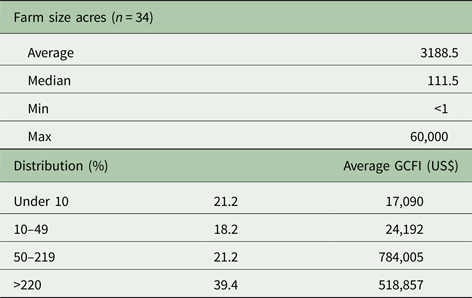
Farms ranged in acreage from under one acre to 60,000 acres, which includes acres both owned and leased; however, most farms in this sample fell into smaller acreage categories, with a median of 111.5 acres. Looking more carefully at the distribution, 21% are under 10 acres, 18% operate between 10 and 49 acres, 21% are between 50 and 219 acres, and the remaining 40% operate over 220 acres (Table 2).
Farm size acres

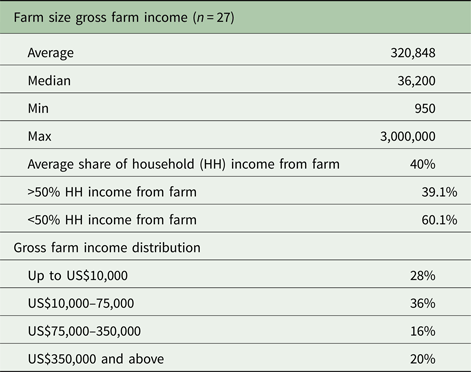
Twenty-five (out of 41) non-Willamette Valley producers reported annual gross income; seven are very-low-sales farms at <US$10,000 GCFI; nine have GCFI between US$10,000 and 75,000; four more are in USDA's ‘small’ farm category, making more than US$75,000 and <US$350,000; and five more reported GCFI over US$350,000 (Table 3). In sum, 64% of our sample falls into the low-sales category of <US$75,000 GCFI, while 80% are small farms by USDA standards. Non-Willamette Valley RFN producers in our sample obtained 40% of their household income from the farm, on average, indicating that the farm is an important source of income, although it is not the primary source. Approximately 60% get under half of their household income from the farm.
Farm size gross farm income

Farmer motivations and barriers for RFN marketing
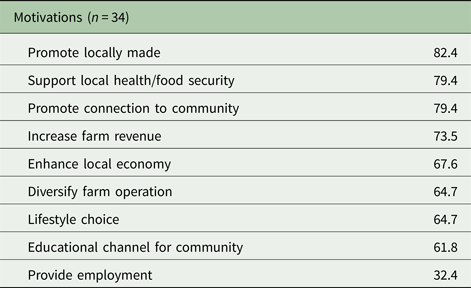
Farmer motivation and barriers for using different RFN marketing channels can give us some insight into their rationale for using specific markets. Consistent with Liang and Dunn's (Reference Liang and Dunn2014) prior research, community concerns came ahead of income concerns for our predominantly small-farm sample. ‘Promote locally made’ was the highest motivator for participation in RFN marketing, followed closely by ‘promote connection to community’ along with ‘support local health/food security’ (Table 4). Given the loss of rural grocery stores and lack of access to fresh foods in many parts of Oregon, these non-Willamette Valley producers seem to be responding to their local community's needs by ranking ‘support local health/food security’ as their second highest motivation (Oregon Food Bank, 2014).
Motivations for using RFN channels (rank order) (%)

All motivations, as shown in Table 4, were selected by over half of the respondents except for ‘provide employment’ at 32%. Respondents also reported the number of paid employees on their operations, which ranged from none to 64, but half had no paid employees. Of the other half, only two employed more than 10 workers and both of those utilized RFN channels for all of their GCFI. Therefore, all but two of the respondents in the survey are very small businesses as we have defined it.
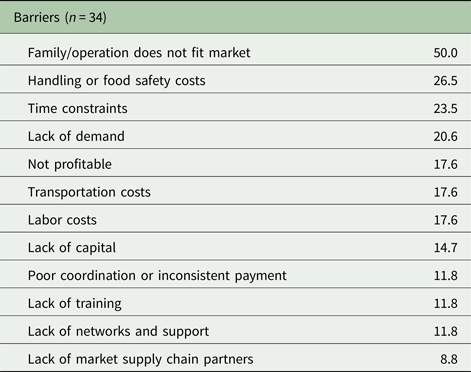
Non-Willamette Valley producers listed a variety of barriers to using various RFN marketing channels, although none seemed insurmountable, as no one barrier was selected by over 50% of the respondents (Table 5). Producers were able to indicate barriers for each separate channel, then we aggregated results for all channels (for more detail for all farms by GCFI, see Brekken et al., Reference Brekken, Parks and Lundgren2017).
Barriers to use of RFN channels (rank order) (%)

The top barrier for non-Willamette Valley producers was ‘doesn't fit my operation’ by a substantial margin. Interestingly, the only barrier in the single-digit range was for non-Willamette Valley producers, and that was ‘lack of market supply chain partners.’ Given that all but one of our respondents are already using RFN channels, they may be satisfied with their market supply partners or are using direct marketing which does not require an intermediary. The supply chain partners seem to be working well, looking at the rank order in the list. Issues with supply chain partners are ranked low, while whole farm-level concerns such as costs and time constraints are ranked higher.
Choosing to run a very small business can be related to the operator's desire for lifestyle and type of work, which can be expressed as entrepreneurial qualities. A high percentage of non-Willamette Valley farmers in the study (Table 6) showed entrepreneurial attitudes–being optimistic, realistic, creative, innovative, and open-minded. They also reflect realism and caution about taking chances in the face of potential economic downturns, such as willingness to take reasonable risks and considering both positive and negative outcomes.
Entrepreneurship qualities (rank order) (%)

Production practices
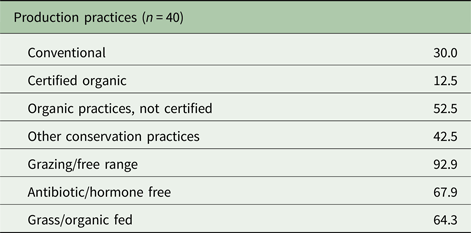
Table 7 indicates that roughly 53% of non-Willamette Valley respondents utilized organic practices but were not certified, while 13% were certified organic. Thirty percent reported using conventional methods, but many of those also chose other conservation practices as well, such as conservation tillage or no-till, cover crops, integrated pest management, or a nutrient management plan. Among non-Willamette Valley producers who raise animals, nearly 93% utilized grazing/free-range practices, 68% used antibiotic/hormone free feeding followed by 64% using grass/organic feeding methods.
Production practices (%)

When asked about motivations for using their chosen production methods (Table 8), nearly 78% indicated ‘alignment with my environmental values.’ That was followed by 35% each indicating profit incentives and having local or regional support and infrastructure for their production practices. Fewest indicated they were responding to established markets, at 28%.
Production practice motivations (%)

Given the high percentage of non-Willamette Valley producers indicating the importance of environmental stewardship, this suggests environmental stewardship is integral among non-Willamette Valley RFN survey respondents who sell into RFN marketing channels. However, it is unclear whether a more comprehensive sample would yield the same percentages.
Consumer surveys
Using convenience sampling, 489 responses were recorded from consumers living in 20 different counties in Oregon (out of 36 counties). Consumers from the rural resource-dependent counties outside of the Willamette Valley returned 96 surveys (20% of the total Oregon survey respondents). Demographically, about 14% were under the age of 30, 26% were aged 30–49 and 60% were over age 50. Respondents’ income ranged from 16% making <US$25,000 per year, 29% making US$25,000–50,000 per year, 40% making US$50,000–100,000 per year, and 14% making over US$100,000 per year. Non-Willamette Valley respondents most frequently purchased food from locally owned grocery stores, followed closely by supermarket chains (Table 9).
Food purchasing venues used (%)

Non-Willamette Valley consumers were very evenly split on the price premium they were willing to pay for local or regional food: equal to typical price, 10% above typical price and 25% above typical price each received about one-third of the responses.
Thus, overall about two-thirds of the respondents were willing to pay some price premium for local food, with a majority defining ‘local’ as ‘within my state’ (33%) or ‘within 100 miles’ (22%). When asked to select the reasons why they purchase local food, nearly 72% of non-Willamette Valley consumers said it was to ‘support local farmers,’ by far the highest response (Table 10). The next highest reason for purchasing local was to ‘promote local food’ at about 53% followed by over 36% choosing ‘tastes better.’ Environmental concerns, while not of primary importance, were ranked on par with preserving agricultural landscapes. ‘Safer to buy’ was the lowest motivation.
Consumer motivations for buying local/regional (rank order) (%)

Rural demands for local food appear to have less to do with environmental concerns than the desire to support local producers and the local economy. Nonetheless, producers using environmentally beneficial production methods because of personal reasons benefit from the willingness among consumers to pay a premium for local produce. Looking at the consumer preferences in the non-Willamette Valley region, producers may feel comfortable foregoing the costs of organic certification or other labeling even as they report using organic practices, knowing that the environmental certifications are not demanded in their region. They may also be using substantial direct marketing, where they are able to communicate their production practices to consumers with environmental concerns, foregoing certifications and labels. The ability to get a premium is, of course, somewhat dependent on the overall economic profile of any given rural community. High-amenity communities that tend to attract more affluent full and part-time residents are likely to have larger pools of consumers more willing and able to pay premium pricing on locally produced food.
Discussion
The NNRE for rural communities is based on a healthy environment-healthy economy principle, including three defining criteria: support for very small businesses, multifunctional landscapes and environmentally conscious use of natural resources to produce new products and/or reach new markets. For rural communities dependent on agriculture as a resource-based economic driver, small-scale, multifunctional, local agriculture as part of the NNRE can add to economic, social and environmental sustainability and increases diversity and resilience for communities that want to continue their historic economic and social culture of creating wealth from their natural resource assets.
Survey results from the non-Willamette Valley RFN producers show that a majority of respondents are very small businesses that employ fewer than 10 employees or are sole proprietorships with only family labor. They are also small-scale agriculture in terms of gross farm income: 64% are in the low sales category of <US$75,000 GCFI, while 80% are small farms by USDA standards. They are also multifunctional farms, engaging in agricultural activities for economic purposes while using environmentally sensitive production practices and are motivated by social and economic concerns related to their communities.
For the producer respondents, farm income is often supplemental income, with 60% of respondents getting less than half of their household income from the farm. Over three-quarters of respondents used some kind of direct sales strategy, followed by nearly two-thirds selling to local restaurants and retailers, and about a third selling to local and regional distributors and institutions. On average, respondents used two of the RFN marketing channels, while three of them used four different channels to sell their products. Significant use of direct marketing indicates community level sales; on average, those who used direct marketing obtained 74% of their farm income from direct marketing, the highest of any marketing channel. Local retail and restaurants were also used by a majority of respondents, but on average only 23% of farm income came from that channel. Given that most non-Willamette Valley producers buy their food from locally owned grocery stores, increasing the connections between RFN producers and groceries stores could be an area of growth for the RFN sector.
Producers were motivated to participate in the RFN by their personal value system and for the benefit of their community. Operators showed high entrepreneurial attitudes, drawing them to the challenge of running a small-scale agricultural operation and embarking on more recent trends in food marketing. Their top motivations for RFN marketing were community-focused, with ‘promote locally made,’ ‘support local health/food security,’ and ‘promote connection to community’ the top three with agreement by approximately 80% of respondents for each. The focus on local health and food security indicates that the non-Willamette Valley producers are attuned to particular ways that they can contribute to the economic and social sustainability of their communities. We see that producers are also aligned with consumer incentives for buying local food, as consumers are motivated foremost by supporting local farmers and promoting local food, as well as community economic and social concerns.
Nearly all of the producer respondents reported some use of sustainable agriculture practices, motivated by personal values. The non-Willamette Valley consumers showed little concern about the environmental consequences of their food choices but were motivated to pay a price premium for locally-produced foods, primarily to support local farmers. Thus, consumer interest in local foods can provide a price premium to the RFN producers engaging in sustainable practices, even if the environmental concerns of producers and consumers do not perfectly align. This indicates that producers could continue to reap the benefits of the local food trend in the non-Willamette Valley RFN without taking on the added cost of organic certifications or other environmental labels. The nexus of producers engaging in sustainable practices for personal reasons and consumers’ willingness to buy local products in order to support the local community and economy reflects NNRE's healthy environment-healthy economy principle.
The top three barriers to using RFN marketing channels were producers’ family or operations not fitting the market, handling or food safety costs, and lack of demand. ‘Doesn't fit the market’ is an expected response, given the range of RFN marketing channels—from agritourism to local/regional distributors. No one marketing channel will fit all types of farms. A thriving RFN will have different types of marketing channels that work for different types of farms to preserve diversity in production and marketing. Lack of demand may be perceived by producers, but our survey of non-Willamette Valley consumers indicated strong motivations for supporting local farmers through purchasing local foods, with two-thirds willing to pay a price premium of 10–25%. This is not a representative sample; however, it simply indicates that there is a segment of the non-Willamette Valley consumer population motivated to purchase local foods if they are accessible. While direct marketing is heavily used by our non-Willamette Valley RFN survey respondents, the other wholesale RFN channels are not as heavily utilized. They may need to use other marketing channels and work with intermediaries more closely to communicate the local origin of the products. However, handling or food safety costs are a barrier to wholesale channels, which was identified as a general barrier to RFN marketing by producer respondents. Given that non-Willamette Valley producers indicated high entrepreneurial tendencies, additional state and local assistance and support can help reduce barriers and stimulate the market demand, expanding local agricultural opportunities.
Conclusions
We began this paper by addressing the question of whether RFNs in rural Oregon counties display characteristics of an NNRE development strategy through the relationships between agricultural producers and consumers. Although both our producer and consumer surveys were gathered with convenience sampling, we were able to compare the motivations and barriers of some of the producer and consumer participants in Oregon's RFN, while noting that the conclusions do not illustrate the practices or attitudes of all rural Oregon producers or consumers.
The RFN in Oregon's rural counties does display characteristics of an NNRE development strategy, as reported by our survey respondents. The RFN participants in the rural resource-dependent areas of Oregon that responded to our survey are indeed very small businesses engaged in small-scale, multifunctional agriculture. They are motivated by economic, social, and environmental concerns as they contribute to the economic activity in their communities. Although the consumer respondents in the same counties are not primarily driven to buy local based on environmental considerations, they are nonetheless interested in supporting agriculture and local businesses and are willing to pay a price premium for local foods. Although we cannot make projections about total market supply or demand based on this convenience sample, this snapshot of Oregon's rural food consumers is useful information for farmers and policy makers as they look for new opportunities to market their products and enhance local economic development. Furthermore, exploring RFN opportunities on a wider statewide scale could reveal some market opportunities to connect with consumers in other parts of the state that are hungry for Oregon-grown products.
The demand for local products can create a virtuous cycle that contributes to the economic, social and environmental sustainability of rural communities, along with diversifying the type and scale of businesses to provide greater resilience within the NNRE healthy environment-healthy economy paradigm for rural economic development. Very small-scale agriculture shows itself to indeed be an important aspect of the NNRE. We are not arguing that small-scale production at the local level as part of an RFN better connects food with the community and assures the economic viability of small farms, nor are we suggesting that local food is a stand-alone economic development strategy. We instead expand the concept of NNRE. Sustainably managed production agriculture that is entwined in the economic and social fabric of rural communities is also a face of the NNRE that is familiar and authentic in places that are rooted in agriculture and self-reliance. For economic development goals, recognizing that agriculture can be a part of the NNRE can support the long-term resilience of rural economies.
Acknowledgements
This study was funded by the US Department of Agriculture under National Institute for Food and Agriculture grant 2014-68006-21854. Special thanks to Michael Hibbard, Professor Emeritus, University of Oregon, for providing comments on an earlier version of this manuscript.