Implications
This study reports on the variations in fatty acid (FA) profile in the subcutaneous adipose tissue between an obese (Iberian (IB)) and a conventional-type Landrace × Large White (LR × LW) pig subjected to identical nutritional management. Our observations confirm the known influence of genotype on body FA profile and pattern of FA unsaturation during growth. The high proportions of monounsaturated FA, particularly of C18:1 n-9, observed in the IB pig are positively associated with the high quality of its cured products. Consequently, a nutritional management based on balanced nutrient supply and designed to enhance the deposition of these FAs should be encouraged.
Introduction
The adipose tissue is the major (if not the only) site of fatty acid (FA) synthesis in mature pigs (O'Hea and Leveille, Reference O'Hea and Leveille1969), contrary to other animal species in which lipogenesis occurs also in the liver (e.g. birds, rodents and ruminants). The whole-body FA composition of pigs is specially influenced by nutrition, but it can also be strongly affected by other factors such as genotype, sex, age and environmental temperature (Wood et al., Reference Wood, Enser, Fisher, Nute, Sheard, Richardson, Hughes and Whittington2008). Body fat accumulation may be considered the net result of the balance among dietary absorbed fat, de novo fat synthesis (lipogenesis) and fat catabolism via β-oxidation (lipolysis; Kloareg et al., Reference Kloareg, Noblet and van Milgen2007). Selection for reduced back-fat thickness in pigs has resulted, at similar dietary FA supply, in lower total saturated (SFA) and monounsaturated (MUFA) and higher polyunsaturated (PUFA) FA content (Scott et al., Reference Scott, Cornelius and Mersmann1981; Wood et al., Reference Wood, Enser, Fisher, Nute, Sheard, Richardson, Hughes and Whittington2008). The Iberian (IB) pig is a slow-growing Mediterranean breed with higher whole-body fat content than conventional or lean-type pigs (Nieto et al., Reference Nieto, Miranda, García and Aguilera2002; Barea et al., Reference Barea, Nieto and Aguilera2007). The high quality and consumer acceptability of the IB pig products are related to their high intramuscular fat and oleic acid contents compared with conventional pigs (Serra et al., Reference Serra, Gil, Pérez-Enciso, Oliver, Vázquez, Gispert, Díaz, Moreno, Latorre and Noguera1998). In the IB pig industry, carcasses are graded according to major FA content in the subcutaneous fat following a standardized procedure (Boletín Oficial del Estado (BOE), 2004). Most of the studies reported involving carcass, meat and fat quality of IB as compared with conventional pigs have been carried out on finishing pigs (Serra et al., Reference Serra, Gil, Pérez-Enciso, Oliver, Vázquez, Gispert, Díaz, Moreno, Latorre and Noguera1998). However, to the best of our knowledge, there is no information in literature concerning the effects of pig genotype on the evolution of FA profile in the subcutaneous adipose tissue throughout the growing and finishing stages of growth. This information could be relevant to design nutritional strategies focusing on increasing the quality of fat in pig products.
It is well known that the efficiency of utilization of dietary protein for body protein deposition is strongly related to pig genotype (Campbell and Taverner, Reference Campbell and Taverner1988; Rivera-Ferre et al., Reference Rivera-Ferre, Aguilera and Nieto2006; Barea et al., Reference Barea, Nieto, Vitari, Domeneghini and Aguilera2011). It is accepted that a low dietary CP supply may limit muscle growth so that the dietary energy that would be used for an increased protein synthesis under unrestricted provision of amino acids may be used for fat accretion if the amino acid supply is insufficient. Teye et al. (Reference Teye, Sheard, Whittington, Nute, Stewart and Wood2006) found that a reduced CP supply increased marbling fat in longissimus muscle, and Doran et al. (Reference Doran, Moule, Teye, Whittington, Hallett and Wood2006) observed lower effect of dietary CP supply on subcutaneous adipose tissue as compared with the intramuscular fat content. Lizardo et al. (Reference Lizardo, Le Bellego, Noblet, van Milgen and Mourot2002a) found no effect of increasing dietary protein from a low level to requirements in FA composition of adipose tissue of growing pigs. In growing and fattening IB pigs, we have observed that increased supplies of CP over requirements resulted in decreased deposition of energy as body fat (Nieto et al., Reference Nieto, Miranda, García and Aguilera2002; Barea et al., Reference Barea, Nieto and Aguilera2007), concomitant with a decline in the overall efficiency of utilization of metabolizable energy for energy gain. These findings suggest that some energy from the diet was diverted to eliminate nitrogen excess when the protein supply exceeds requirements. Nevertheless, there is scarce information on the effect of dietary CP supply on FA composition of fat depots in different pig genotypes.
The aim of the current study was to investigate possible effects of pig genotype (i.e. IB and conventional type) on the FA profile and evolution of the inner and outer layers of subcutaneous back-fat during the growing and finishing stages of growth. As the dietary CP requirements of the IB and conventional pigs differ (Nieto et al., Reference Nieto, Miranda, García and Aguilera2002; Barea et al., Reference Barea, Nieto and Aguilera2007; Conde-Aguilera et al., Reference Conde-Aguilera, Aguinaga, Aguilera and Nieto2011), the comparison was made at two dietary CP levels, one of them close to the adequate supply of amino acids for each of the porcine genotypes under study. The study is part of a larger project aiming at identifying causes of variable nature, which can contribute to explain the poor overall efficiency of utilization of dietary nutrients and energy of the IB pig and the higher energy cost for protein and fat deposition found in the IB pig compared with conventional or lean-type pigs (Nieto et al., Reference Nieto, Miranda, García and Aguilera2002; Barea et al., Reference Barea, Nieto and Aguilera2007; Conde-Aguilera et al., Reference Conde-Aguilera, Aguinaga, Aguilera and Nieto2011).
Material and methods
Experimental design and diets
Experimental procedures and animal care were carried out according to current Spanish legislation. Certificates authorizing animal experimentation were provided by the Bioethical Committee of the Spanish National Research Council (CSIC) after approval of the experimental protocol.
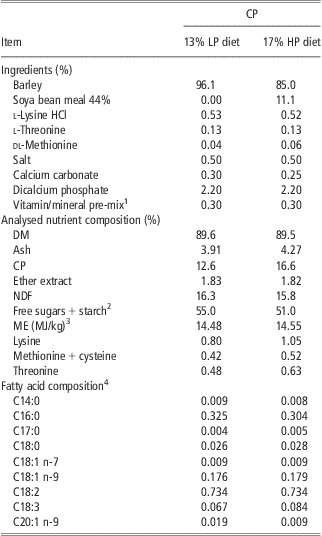
Part of the experimental design and the experimental diets have been described in detail by Barea et al. (Reference Barea, Nieto, Vitari, Domeneghini and Aguilera2011). Briefly, a total of 38 purebred IB and Landrace × Large White (LR × LW) barrows (n = 19 per genotype) were used. At ∼15 kg BW, three pigs per genotype were slaughtered just before the beginning of the trial. The remaining pigs were housed in individual pens (2 m2), located in an environmentally controlled room and offered one of two diets of similar (and adequate) amino acid profile, although with different CP content: 13% (low-protein (LP) diet) or 17% (high-protein (HP) diet) as fed (Table 1). Dietary CP content was fixed to meet or exceed the current recommendations for growing IB (13% CP, Nieto et al., Reference Nieto, Miranda, García and Aguilera2002) and intermediate-type pigs (17% CP, British Society of Animal Science (BSAS), 2003). These CP contents were maintained along the whole experiment. Dietary energy content and other nutrients than CP were supplied to be equivalent or to exceed the current requirements for growing intermediate-type pigs (BSAS, 2003). A pair-fed procedure (eight pigs per treatment and breed) was used and the feeding level was restricted at 0.8 × ad libitum intake of the IB breed. Daily feed allowance was adjusted on a weekly basis according to a BW function previously described for IB pigs (Nieto et al., Reference Nieto, Lara, García, Gómez, Zalvide, Cruz, Pariente, Moreno and Aguilera2001). Water was freely available during the experiment. Four pigs per treatment and genotype were slaughtered by exsanguination after electrical stunning at 50 kg BW, whereas the remaining pigs were kept on the trial until slaughter at 115 kg BW. The pigs slaughtered at different BWs (∼15, 50 and 115 kg) were used for determinations of organ weight and micro-anatomical studies of small intestine, as described previously (Barea et al., Reference Barea, Nieto, Vitari, Domeneghini and Aguilera2011). Repeated sampling of the back-fat subcutaneous tissue was used to investigate the effects of pig genotype and dietary protein content on the FA profile and evolution of the subcutaneous fat during the growing and finishing stages.
Ingredients and chemical composition of the diets on an as-fed basis

LP = low-protein diet; HP = high-protein diet; DM = dry matter; ME metabolizable energy; LR × LW = Landrace × Large White.
1Provided the following nutrients (per kg diet as-fed): vitamin A, 5000 IU; vitamin D3, 1000 IU; vitamin E, 15 mg; vitamin K3, 2 mg; thiamin, 1.3 mg; riboflavin, 3.5 mg; niacin, 15 mg; calcium pantothenate, 10 mg; pyridoxine, 1.5 mg; biotin, 0.1 mg; folic acid, 0.6 mg; vitamin B12, 0.025 mg; Fe, 80 mg; Cu, 6 mg; Zn, 60 mg; Mn, 30 mg; I, 0.75 mg; Se, 0.1 mg; Co, 0.75 mg; and ethoxiquin, 150 mg.
2Free sugars + starch: Calculated as DM − (CP + ether extract + NDF + ash).
3ME: metabolizable energy (average values of digestibility trials carried out in IB and LR × LW pigs; Barea et al., Reference Barea, Nieto, Vitari, Domeneghini and Aguilera2011).
4Assuming a fatty acid/ether extract ratio of 0.75 (Sauvant et al., Reference Sauvant, Perez and Tran2004).
Sampling procedure
Subcutaneous fat shot-biopsies were taken from both pig genotypes at ∼38, 50, 65, 90 and 115 kg BW (n = 16 pigs/genotype for samples taken at 38 kg BW, and n = 8 pigs/genotype for the rest of sampling points) for the determination of the FA profile evolution. Back-fat samples at 50 and 115 kg BW were obtained immediately after slaughter following the same procedure. Biopsy samples were taken at 4 to 6 cm from the spine midline at the dorso-lumbar region (2 cm depth) using a Czech gun (PPB-2 Biotech, Nitra, Slovakia) with an adapter cannula (0.25 cm of diameter) with a sharpened edge. In addition to skin, biopsies included the inner and outer layers of the subcutaneous back-fat. All necessary procedures were undertaken to minimize anxiety and discomfort in the pigs during and after all processes. This included intramuscular injection of 2 mg/kg BW of azaperon (Stresnil, Esteve, Barcelona, Spain) 1 h before taking the biopsy and local anaesthesia with ethyl chloride (Cloretilo Chemirosa; Lab. ERN, Barcelona, Spain). After biopsy, the zone was sprayed with oxytretracycline and lidocaine (Veterin Tenicol; Lab. Intervet S.A., Salamanca, Spain). Biopsy samples were placed in plastic bags, vacuum-packaged and frozen at −80°C until analyses. Immediately before analyses, the subcutaneous fat tissue from the biopsy samples was separated from the skin and washed with distilled water to remove any material (dirt, hair, blood, etc.) that could affect results.
Chemical analyses
Nutrient content of feed samples was determined as described by Barea et al. (Reference Barea, Nieto, Vitari, Domeneghini and Aguilera2011). The FAs of feeds were extracted and quantified by the procedure described by Sukhija and Palmquist (Reference Sukhija and Palmquist1988). Pentadecanoic acid (C15:0; Sigma-Aldrich, Madrid, Spain) was used as internal standard. Fatty acid methyl esters (FAME) were identified by gas chromatography as described by López-Bote et al. (Reference López-Bote, Rey, Ruiz, Isabel and Sanz Arias1997) using a Hewlett Packard HP-6890 (Avondale, PA, USA) gas chromatograph equipped with a flame ionization detector and a 30-m capillary column with an internal diameter of 0.32 mm and 0.25 μm polyethylene glycol-film thickness (HP-Innowax). A temperature program of 170°C to 245°C was used. The injector and detector were maintained at 250°C. The carrier gas (helium) flow rate was 2 ml/min.
Fat extracts from biopsy samples were obtained by the procedure proposed by Bligh and Dyer (Reference Bligh and Dyer1959) for total lipid extraction. FAs were methylated in the presence of sulphuric acid and analysed as described above. Results were expressed as grams per 100 g of detected FAME.
Statistical analyses
The results of FA contents of subcutaneous adipose samples either from biopsies (taken at 38, 65 and 90 kg BW) or from slaughtered pigs at 50 and 115 kg BW (n = 4 pigs; n = 8 at 38 kg BW) per dietary treatment at each sampling point within genotype were subjected to ANOVA using the GLM procedure (SAS Institute Inc., Cary, NC, USA) for a factorial arrangement of treatments, which included genotype, dietary CP content, subcutaneous back-fat layer and their interactions. Pig effect was also considered. Nevertheless, as back-fat layer had a significant effect upon some of the main analysed FA, results were reanalysed and presented separately for each back-fat layer. This analysis included genotype, dietary CP content and their interactions. In case of significant interaction between factors, data were then subjected to a one-way ANOVA. The LSMEANS option of SAS was used to evaluate statistical differences between variables according to a Student t-test. The effect of BW at which the biopsies were taken and its respective interaction with genotype (G × BW), dietary CP (CP × BW) and genotype × CP content (G × CP × BW) was evaluated by a repeated measures test using the proc MIXED procedure of SAS. The genotype, CP content and genotype × CP content levels were the between-subject effects and the BW of biopsying was the within-subject effect. The individual pig was used as the experimental unit and differences were considered significant at P < 0.05 for all data.
Results
No apparent signs of serious illness or discomfort were observed during the experiments and (or) biopsying procedures. Occasional cases of diarrhoea occurred during the first 2 weeks of the experiment and pigs were then treated with amoxicillin (Penimox L.A., Bayer Health Care S.A., Barcelona, Spain). The two diets were offered at the same restricted feeding level (0.8 × ad libitum of IB pigs), implying similar energy intake between genotypes at each stage of growth. Average daily feed intake was 2474 and 2600 g/day in LR × LW pigs and 2535 and 2515 g/day in IB pigs for LP and HP diets, respectively. However, as reported in our previous paper (Barea et al., Reference Barea, Nieto, Vitari, Domeneghini and Aguilera2011), daily gain was higher in LR × LW (835 and 847 g/day, respectively for LP and HP diets) than in IB pigs (648 and 573 g/day, respectively for LP and HP diets).
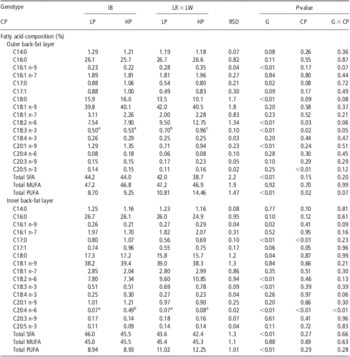
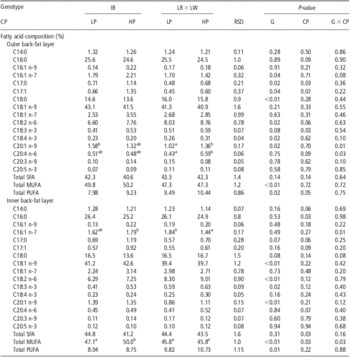
The results of the statistical analysis of FA contents of subcutaneous adipose samples from slaughtered pigs at 50 and 115 kg BW appear in Tables 2 and 3. Results from biopsies taken at 38, 65 and 92 kg BW are reported in Supplementary Tables 1 to 3, available online.
Effect of genotype and dietary CP content on the fatty acid profile (g per 100 g of FAME) of outer and inner subcutaneous back-fat layers of pigs slaughtered at 50 kg BW (least squares means)

FAME = fatty acid methyl esters; IB = Iberian pigs; LP = low-protein diet, 12.6% CP as fed; HP = high-protein diet, 16.6% CP as fed; LR × LW = crossbred Landrace × Large White pigs; RSD = residual standard deviation (n = 15 and 14 for outer and inner subcutaneous back-fat layers, respectively); G = genotype; SFA = saturated fatty acids; MUFA = monounsaturated fatty acids; PUFA = polyunsaturated fatty acids.
Within a row, values with different superscript alphabets differ significantly (P < 0.05).
Effect of genotype and dietary CP content on the fatty acid profile (g per 100 g of FAME) of outer and inner subcutaneous back-fat layers of pigs slaughtered at 115 kg BW (least squares means)

FAME = fatty acid methyl esters; IB = Iberian pigs; LP = low-protein diet, 12.6% CP as fed; HP = high-protein diet, 16.6% CP as fed; LR × LW = crossbred Landrace × Large White pigs; RSD = residual standard deviation (n = 15 and 14 for outer and inner subcutaneous back-fat layers, respectively); G = genotype; SFA = saturated fatty acids; MUFA = monounsaturated fatty acids; PUFA = polyunsaturated fatty acids.
Within a row, values with different superscript alphabets differ significantly (P < 0.05).
FA profile of subcutaneous back-fat tissue at 50 kg BW
The three-way factorial analysis revealed that the outer back-fat layer had higher relative proportions of C18:1 n-9 (40.6% v. 38.7%; P < 0.01) and total MUFA (47.0% v. 45.3%; P < 0.01) and lower proportions of C18:0 (13.9% v. 16.5%; P < 0.001) and total SFA (42.1% v. 44.4%; P < 0.01) than the inner back-fat layer of pigs at 50 kg BW. Consequently, the data were reanalysed separately for each back-fat layer, including the effects of genotype, dietary CP content and their interaction, as shown in Table 2.
Pig genotype affected widely the FA relative composition of both subcutaneous back-fat layers. Concerning the outer layer, higher contents of C18:0 (+34%; P < 0.01) and total SFA (+9%; P < 0.01) and lower contents of C16:1 n-9, C18:2 n-6, C18:3 n-3 and total PUFA (P < 0.01 in all cases) were detected in IB compared with LR × LW pigs. Pigs receiving the HP diet presented the highest C18:2 n-6, C18:3 n-3, C20:5 n-3 and PUFA contents. A significant genotype × CP content interaction was observed for C18:3 n-3 because of the increased concentration of this FA in LR × LW pigs when offered the HP diet (P < 0.05).
For the inner layer, total SFA was higher in IB than in LR × LW pigs (45.9% v. 43.1% on average, respectively; P < 0.01), which was related to higher relative contents of C17:0 and C18:0 in the IB breed (P ⩽ 0.02). Similar to the outer layer, LR × LW showed higher C18:2 n-6, C18:3 n-3 and PUFA contents than IB pigs (on average +34% for C18:2 n-6, +45% for C18:3 n-3 and +30% for total PUFA; P < 0.01). Pigs receiving the HP diet presented higher concentrations of some minor FA (C17:0 and C17:1; P < 0.05).
A significant genotype × CP content interaction was observed for C20:4 n-6 concentration (P < 0.01) because of the increased content of this FA in IB pigs offered the HP diet.
FA profile of subcutaneous back-fat tissue at 115 kg BW
At 115 kg BW, the main difference detected between back-fat layers was increased total MUFA content (48.6% v. 47.2%; P < 0.01) and decreased total SFA (42.1% v. 43.5%; P < 0.05) in the outer back-fat, similar to our observations at 50 kg BW.
The analysis of the effect on FA content of genotype and dietary CP supply for each back-fat layer at 115 kg BW is shown in Table 3. For the outer back-fat layer, the MUFA content was higher in IB than in LR × LW pigs (+5%; P < 0.01). Contrary to 50 kg BW pigs, C18:0 concentration was higher in LR × LW than in IB pigs (+13% as mean value; P < 0.01). Moreover, LR × LW pigs showed higher C18:2 n-6 (on average +17%) and C18:4 n-3 and total PUFA (+17%; P = 0.02 in all cases) than IB pigs. As for the dietary CP content effect, increased C17:0, C18:3 n-3 and total PUFA were found in pigs fed the HP diet (P < 0.05). Significant genotype × CP interactions were found only for minor FA (C20:1 n-9 and C20:4 n-6) because of increased concentrations in LR × LW pigs offered the 17% CP diet.
In the inner layer, C18:1 n-9 and C20:1 n-9 contents were higher in IB than in LR × LW pigs (P < 0.01). Similar to the outer layer, LR × LW pigs presented greater concentration of C18:2 n-6 (+28%), C18:3 n-3 (+30%) and total PUFA (+22%) than IB pigs (P ⩽ 0.02). Higher C16:0 and SFA contents (+5%; P = 0.03) were found in pigs offered the LP diet. There was a genotype × CP interaction for MUFA concentration because of the higher MUFA content observed in IB pigs offered the HP diet (P = 0.03).
Evolution of FA profile in subcutaneous back-fat tissue during growth
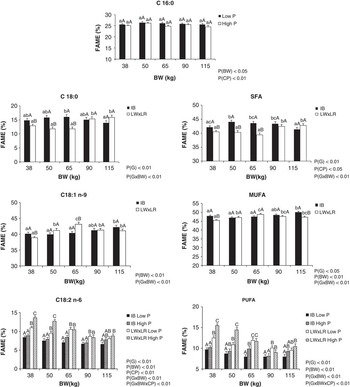
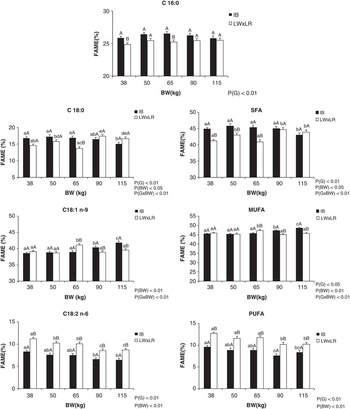
The FA composition of the subcutaneous back-fat at 38, 65 and 90 kg BW is given in Supplementary Tables 1 to 3. In general, for SFA and MUFA the highest changes in relative content with BW were between 2% and 3% units. Changes on the relative proportions of main FA over the growing and finishing phases in the outer back-fat layer of the IB and LR × LW pigs are shown in Figure 1. Except for C16:0, the variation in FA relative content as affected by BW was associated with genotype for all the FAs shown (e.g. as pointed up by the significant G × BW interaction). Only minor changes in the relative proportion of C16:0 were observed during growth (P < 0.05) with no differences between both types of pigs. In IB pigs, minor changes in both C18:0 and SFA contents were observed during growth, although they tend to decline at heavier BW. Differences in C18:0 content between 65 and 115 kg BW and in SFA between 50 and 115 kg BW were significant (P < 0.05). The relative contents of C18:1 n-9 and MUFA were constant up to 65 kg BW and increased from this BW onwards and attained a maximum value at the highest BW (P < 0.01). For LR × LW pigs, the relative content of C18:1 n-9 increased significantly up to 65 kg BW to decline afterwards, whereas MUFA increased up to 65 kg BW and plateaued thereafter (P < 0.01). Until ∼65 kg BW, the relative proportions of C18:0 and SFA were smaller in LR × LW than in IB pigs (P < 0.05), although they remained similar thereafter. Total MUFA proportions were higher in IB than in LR × LW pigs at 38 and 115 kg BW (P < 0.05). As a result, both the C18:1/C18:0 and MUFA/SFA ratios were higher (P < 0.01 to 0.05, data not shown) in LR × LW pigs at the earlier growth stages. Nevertheless, differences disappeared at 90 kg BW, and at 115 kg BW these ratios turned out to be higher for IB pigs (P < 0.01 to 0.05). The proportions of C18:2 n-6 and PUFA remained rather constant for IB pigs and tend to decline with age in LR × LW pigs. Changes in C18:2 n-6 and PUFA proportions were affected by dietary CP supply. These changes differed with genotype and BW (P(G × CP × BW) < 0.01). When consuming the highest CP diet, LR × LW pigs presented higher relative contents of these FAs at 38 and 50 kg BW than when offered the LP diet and also than pigs from the IB breed (P < 0.05).
Changes in the main fatty acids (% of fatty acid methyl esters (FAME)) of the outer subcutaneous back-fat layer of growing Iberian (IB) and Landrace × Large White (LR × LW) pigs. High-protein diets (High P) and low-protein diets (Low P) were considered when dietary protein content had significant effects. Within the same pig genotype (or category specified in the legend), different lower case letters indicate significant differences between sampling points. Within sampling points, differences between pig genotypes are expressed by different capital letters (P < 0.05), except for C16:0, which remains unaltered by genotype. G = genotype; SFA = saturated fatty acid; MUFA = monounsaturated fatty acid; PUFA = polyunsaturated fatty acid.

Figure 2 shows the relative proportions of the main FA in the inner back-fat layer throughout the growing and finishing periods. For C16:0, higher proportions were detected in IB than in LR × LW pigs at 38 and 65 kg BW. Except for minor changes, similar results as described for the outer back-fat layer were obtained regarding C18:0, total SFA, C18:1 n-9 and MUFA. In the IB pig, a constant concentration of C18:0 and SFA was observed throughout the earlier phase of the growing period to decline at the highest BW (P < 0.05). On the contrary, in LR × LW pigs the highest contents of these FAs were found at the latest stages of growth (P < 0.05). The concentration of C18:1 n-9 was significantly higher in IB than in LR × LW pigs at 90 and 115 kg BW (P < 0.05). The opposite was observed at 65 kg BW (P < 0.05), whereas at lower BWs no genotype differences in C18:1 n-9 were found. The C18:1/C18:0 and MUFA/SFA ratios followed a similar response as described for the outer back-fat layer. Contrary to the outer layer, no effects of dietary CP supply on C18:2 n-6 and PUFA proportions were obtained in the inner layer. Both C18:2 n-6 and PUFA contents decreased as pigs grew irrespective of the genotype (P < 0.01). However, the concentrations of these FAs in LR × LW pigs were greater than those obtained for IB pigs (P < 0.05).
Changes in the main fatty acids (% of fatty acid methyl esthers (FAME)) of the inner subcutaneous back-fat layer of growing Iberian (IB) and Landrace × Large White (LR × LW) pigs. Within the same pig genotype, different lower case letters indicate significant differences between sampling points. Within sampling points, differences between pig genotypes are expressed by different capital letters (P < 0.05). G = genotype; SFA = saturated fatty acid; MUFA = monounsaturated fatty acid; PUFA = polyunsaturated fatty acid.

Discussion
In the present study, a comparison is made on the pattern of changes of FAs in subcutaneous fat of two pig genotypes, which differ profoundly in growth rate and composition of growth: the IB pig, as a representative of an obese breed, with a low potential for growth and lean tissue deposition, and a LR × LW pig, as a conventional genotype. In addition, the effects of dietary CP level on the FA profile are also addressed.
Wood et al. (Reference Wood, Enser, Fisher, Nute, Sheard, Richardson, Hughes and Whittington2008) reported that the major factor affecting the FA composition of adipose tissue and muscle in pigs is the total body fat mass. Dietary FA composition and feed intake are also extremely important factors. We have shown (Nieto et al., Reference Nieto, Lara, García, Vílchez and Aguilera2003; Barea et al., Reference Barea, Nieto, Lara, García, Vílchez and Aguilera2006) that at 50 and 100 kg BW, the carcass of IB pigs fed at 0.80 × ad libitum intake diets with CP content ranging from sub-optimal to levels exceeding the requirements, contained 388 and 529 g/kg of fat, on average. Correspondingly, back-fat thickness measured at the last rib was 23.5 and 51 mm. These values are well above those found in the carcass of conventional pigs, as shown by Serra et al. (Reference Serra, Gil, Pérez-Enciso, Oliver, Vázquez, Gispert, Díaz, Moreno, Latorre and Noguera1998) and Morales et al. (Reference Morales, Pérez, Baucells, Mourot and Gasa2002) in their comparative study on IB and LR pigs. In the present experiment, back-fat thickness was not measured. However, as reported by Barea et al. (Reference Barea, Nieto, Vitari, Domeneghini and Aguilera2011), the IB pigs presented much greater mesenteric fat than LR × LW pigs, both at 50 (11.79 v. 6.43 g/kg empty-BW) and 115 kg BW (18.4 v. 13.3 g/kg empty-BW, respectively). This suggests increased fat deposition and, consequently, increased subcutaneous fat depot in the IB pig. Wood et al. (Reference Wood, Enser, Whittington, Moncrieff and Kempster1989) found that as back-fat depth increased the concentrations of SFA and C18:1 increased and those of C18:2 and C18:3 decreased. PUFA showed the highest changes. Although the effect of genotype is well known (Wood et al., Reference Wood, Enser, Fisher, Nute, Sheard, Richardson, Hughes and Whittington2008), available information on the FA profile of back-fat in IB pigs as compared with conventional or lean-type breeds is scarce in literature and mainly focuses on the finishing stage of growth. Serra et al. (Reference Serra, Gil, Pérez-Enciso, Oliver, Vázquez, Gispert, Díaz, Moreno, Latorre and Noguera1998) observed higher contents of SFA and MUFA (and lower PUFA) in back-fat tissue of IB pigs of 105 kg BW as compared with LR. Similarly, Morales et al. (Reference Morales, Baucells, Pérez, Mourot and Gasa2003) obtained higher MUFA and lower PUFA concentrations in subcutaneous fat of IB as compared with LR breed at 133 kg BW. In the present experiment, the IB pigs presented higher MUFA and lower PUFA contents at 115 kg BW, irrespective of the back-fat layer. In contrast, the SFA concentrations were higher in IB pigs in both outer and inner layers only at 50 kg BW. Our results compare well with those reported by Daza et al. (Reference Daza, Mateos, Rey, Ovejero and López-Bote2007) for the FA profile of the subcutaneous back-fat outer and inner layers of finishing IB pigs under different feeding systems.
The difference in C18:0 and SFA back-fat concentration between IB and LR × LW pigs observed in the present work may be a consequence of changes in the de novo lipid synthesis. This biochemical pathway first produces C16:0 from acetyl-CoA and malonyl-CoA by means of an acetyl-CoA carboxylase. From C16:0, C18:0 can be subsequently synthesized by elongation (Lizardo et al., Reference Lizardo, van Milgen, Mourot, Noblet and Bonneau2002b; Wood et al., Reference Wood, Enser, Fisher, Nute, Sheard, Richardson, Hughes and Whittington2008). It has been suggested that differences in the lipogenic enzyme activity are mainly influenced by genotype and to a lesser extent by feed intake and composition (Morales et al., Reference Morales, Pérez, Baucells, Mourot and Gasa2002). Mourot et al. (Reference Mourot, Kouba and Bonneau1996) measured the acetyl-CoA carboxylase activity in Meishan pigs (e.g. an obese-type breed) growing from 20 to 100 kg BW. Compared with data previously obtained in LW pigs, they observed that the activity of this enzyme was higher in Meishan pigs at 20 kg BW, whereas the reverse was observed in heavier pigs. Freire et al. (Reference Freire, Mourot, Cunha, Almeida and Aumaitre1998) studied the effects of genotype and source of dietary fat on the activities of enzymes involved in lipogenesis in LW and Alentejano (a line of the IB breed) weaned piglets offered isoenergetic diets containing 5% of either olive oil or tallow. In the Alentejano piglets, the acetyl-CoA carboxylase activity was three- and nine-fold higher in the dorsal subcutaneous and in the perirenal fat, respectively, than in the LW piglets. Other lipogenic enzymes were also substantially increased in the former breed. Although enzyme activities were not measured in the current experiment, the higher levels of C18:0 and SFA in IB pigs from 38 to 65 kg BW could be associated with a higher lipogenic activity in IB pigs at this period of growth.
The MUFA can be directly deposited from feed or synthesized by desaturation or elongation and desaturation of the de novo synthesized FA. The C18:1 n-9 content has been generally used as an indicator of meat quality in dry-cured products from IB pigs (Antequera, Reference Antequera1990). High levels of C18:1 n-9 in back-fat tissue is commonly used as an indicator of relevant quality traits in dry-cured products, highly valued by consumers, probably associated with the production in these products of oleic acid-derived volatiles (Martín et al., Reference Martín, Timón, Petrón, Ventanas and Antequera2000). In the present experiment, IB pigs showed higher proportions of MUFA (mainly C18:1 n-9) than LR × LW from 90 to 115 kg BW. To the best of our knowledge, there is no information available in the literature concerning comparable desaturase activities between IB and a conventional pig genotype. Our results indicate that the C18:1 n-9/C18:0 (and MUFA/SFA) ratio tends to increase in IB pigs as they approach the finishing period, whereas it is reduced in LR × LW pigs as they increase in BW. This would indicate genotype differences (i.e. inhibition or activation) in the desaturation of C18:0, suggesting possible differences in desaturase activity between obese and lean pig genotypes.
The C18:2 n-6, C18:3 n-3 and C20:4 n-6 are essential PUFA which must be directly obtained from feed. The lower essential PUFA (and higher SFA) contents in obese pigs have been related to their higher feed intake capacity, resulting in increased lipid deposition, as compared with lean-type pigs (Scott et al., Reference Scott, Cornelius and Mersmann1981; Morales et al., Reference Morales, Baucells, Pérez, Mourot and Gasa2003). However, in the current experiment, the differences in FA profile were similar to those reported in the literature even if both breeds were fed to attain 0.8 × ad libitum intake of the IB pigs. Under these experimental conditions, the IB pigs had increased mesenteric fat depots in comparison with the LR × LW pigs (Barea et al., Reference Barea, Nieto, Vitari, Domeneghini and Aguilera2011), an index of enhanced body fat deposition. The higher proportions in C18:2 n-6 and PUFA (exclusively from dietary origin) in back-fat from LR × LW pigs could be explained by a lower de novo lipid synthesis in this leaner crossbreed. Thus, both breeds consumed the same quantity of C18:2, but because of a greater de novo synthesis (of SFA and MUFA) the proportion of C18:2 is lower in IB (i.e. dilution effect). On the other hand, it is widely recognized that the outer back-fat layer is more unsaturated than the inner, in part by a likely preferential deposition of PUFA in the outer layer, but also as a result of the dilution effect caused by an increased deposition of de novo FA from a stimulated de novo lipogenesis in the inner layer (Bee et al., Reference Bee, Gebert and Messikommer2002).
In the present experiment, the pigs received the same amount of energy relative to their BW throughout the growing and finishing periods. Nevertheless, in spite of this equal energy supply, the LR × LW pigs had consistently a greater rate of growth than IB pigs, as a result of comparatively increased protein deposition and efficiency of the nitrogen absorbed. As genotype differences in energy requirements for maintenance may be substantial (van Milgen et al., Reference van Milgen, Bernier, Lecozler, Dubois and Noblet1998; Noblet et al., Reference Noblet, Karege, Dubois and van Milgen1999; Nieto et al., Reference Nieto, Miranda, García and Aguilera2002; Barea et al., Reference Barea, Nieto and Aguilera2007), dietary energy available for production is expected to be greater in the obese genotype. It is well known that a low dietary CP supply may limit protein deposition (Campbell and Taverner, Reference Campbell and Taverner1988; Rivera-Ferre et al., Reference Rivera-Ferre, Aguilera and Nieto2006). The energy that could have been used for muscle growth may be derived for lipid deposition. In contrast, an increased energy expenditure can be expected as a result of the greater urea production and excretion as dietary CP supply exceeds requirements. In the present experiment, the dietary CP supply was fixed to meet or exceed the current recommendations for growing IB (13% CP, Nieto et al., Reference Nieto, Miranda, García and Aguilera2002) and to approach recommendations for conventional-type pigs (17% CP, BSAS, 2003). Thus, the CP supply was tested in each genotype under its otherwise optimal CP level at the growing period (∼15 to 50 kg BW). In fact, the diet with 13% CP was initially deficient for LR × LW pigs (from 38 to 50 kg BW, approximately) and it supplied a sub-optimal CP level for this genotype thereafter (Barea et al., Reference Barea, Nieto, Vitari, Domeneghini and Aguilera2011). In the current work, LR × LW pigs receiving the diet containing 17% CP presented higher proportions of C18:2 n-6 and PUFA at 38 and 50 kg BW in the outer layer than when offered the LP diet and also than IB pigs, which can be explained (in relative terms) by the lower de novo synthesis of lipids of LR × LW pigs offered the HP diet. Protein synthesis is a highly energy-demanding process. An increased protein deposition, as observed in the LR × LW pigs offered the 17% CP diet, implies that a greater proportion of dietary energy is diverted to meet the increased energy cost of the protein retained, in comparison with those offered the 13% CP diet. Therefore, less energy is available for lipid synthesis in the HP-fed group. On the contrary, when insufficient protein is provided, dietary energy excess is diverted to fat deposition. Consequently, a deficient CP supply (as in the case of young LR × LW pigs offered the diet with 13% CP) will lead to increased lipid synthesis and, consequently, a relative decrease in the accumulation of dietary C18:2 n-6 and PUFA in subcutaneous back-fat.
The present results point out clear differences between the IB and LR × LW pigs in the degree of unsaturation of FAs in the subcutaneous fat as a function of BW. Increasing values for the ratio unsaturated FA to SFA are observed in the IB pig because of both a decline in SFA and an increase in MUFA contents, in contrast to the LR × LW crossbreed at the heaviest BW. It seems that the magnitude of total desaturation activity will be higher in the IB breed as it has much greater back-fat depots. A higher desaturase activity could be related to an increase in the energetic cost related to the desaturation process (Nelson and Cox, Reference Nelson and Cox2000). However, this cost would be minor compared with the total energy involved in the FA synthesis. Our results suggest that genetic variation in de novo lipid synthesis and pattern of FA unsaturation explain differences in back-fat FA profile of IB and LR × LW pigs under identical nutritional management. These metabolic events may help to explain a comparatively lower efficiency of nutrient and energy utilization in the IB pig.
In conclusion, this study points out significant differences in the FA profile and pattern of its evolution in back-fat tissue of two pig genotypes with different capacities for lean tissue deposition. Our results have been probably a consequence of genotype differences in: (i) partition of energy deposition, (ii) de novo lipid synthesis, (iii) desaturation capacity and (iv) further metabolic fates of the preformed FA in lipid depots. All of these processes might explain differences in efficiency of energy utilization linked to genotype. Nevertheless, additional research is required to better understand the lipogenic activity and the biochemical, molecular and genomic mechanisms responsible for variation on the overall efficiency of energy utilization in pigs from different metabolic profiles.
Acknowledgements
The authors wish to thank Ms Ana Navarro, Mr Francisco Funes and Mr Miguel Liñán for their skilful technical assistance, and Sánchez Romero Carvajal Jabugo S.A. (Seville, Spain), Jodral Gutiérrez S.A. (Cordoba, Spain) and Institut de Recerca i Tecnologia Agroalimentàries (IRTA, Tarragona, Spain) for helpful collaboration. This work was supported by the Spanish Ministry of Science and Innovation (MICINN), grants AGL2008-00255 and AGL2011-25360.