Nonventilator hospital-acquired pneumonia (NV-HAP), including postoperative pneumonia, and ventilator-associated pneumonia (VAP), are the most common nosocomial infections. Reference Magill, O’Leary and Janelle1 Postoperative pneumonia, a subset of NV-HAP and VAP, has been estimated to occur in ∼1% of surgical inpatients, Reference Walter, Haller and Quinten2,Reference Chughtai, Gwam and Khlopas3 similar to the rate among nonsurgical patients. The incidence of VAP is also substantial at ∼10% of patients receiving mechanical ventilation for >48 hours. Reference Metersky, Wang and Klompas4 The impacts of postoperative pneumonia and VAP are considerable. Although estimates vary, VAP may result in an attributable mortality of ∼10%. Reference Papazian, Klompas and Luyt5 It also results in substantially increased costs and hospital lengths of stay. Reference Kalil, Metersky and Klompas6 Similarly, postoperative HAP has been associated with increased risk of mortality, hospital length of stay, and cost. Reference Chughtai, Gwam and Khlopas3,Reference Kazaure, Martin and Yoon7
Substantial efforts nationally and at the individual hospital level have been made to decrease the rate of VAP. 8,Reference Klompas, Anderson and Trick9 Nonetheless, a prior report by our group suggested that VAP rates remained constant in the United States between 2005 and 2013. Reference Metersky, Wang and Klompas4 Although CDC data suggest a decrease in VAP rates during the same period, Reference Dudeck, Edwards and Allen-Bridson10 these data may have been biased by self-reporting and imprecise definitions. Reference Klompas11 Less attention has been given to non–ventilator-associated postoperative pneumonia, with just a few reports from single hospitals or hospital systems Reference Kazaure, Martin and Yoon7,Reference Cassidy, Rosenkranz and McCabe12–Reference Wren, Martin and Yoon14 and no national interventions such as payment policy or quality improvement initiatives.
Data regarding trends in postoperative pneumonia rates are limited; however, a study reported conflicting results in 2 national databases. Based on the National Inpatient Sample, the incidence of postoperative pneumonia decreased significantly between 2009 and 2013. In the National Surgical Quality Improvement Program database, however, no significant trends have been identified other than a statistically significant increase in postoperative pneumonia in cardiothoracic surgery patients. Reference Chughtai, Gwam and Khlopas3
The Medicare Patient Safety Monitoring System (MPSMS) is a nationwide chart-abstraction–based database of adverse events in hospitalized patients. The MPSMS has measured the rates of both VAP and postoperative pneumonia for many years using stable definitions for both entities. Here, we report trends in the rates of VAP and postoperative pneumonia from 2009 to 2019.
Methods
Study sample
Our study sample was drawn from MPSMS data, the nation’s largest randomly selected hospital medical record–abstracted adverse-event database. The sample included only medical records for the 4 conditions (ie, acute myocardial infarction, heart failure, pneumonia, and major surgical procedures) included in the CMS Hospital Inpatient Quality Reporting Program and in the CMS Surgical Care Improvement Project. The data include patient demographics, comorbidities, and 21 selected in-hospital adverse-event measures jointly developed by federal agencies and private healthcare organizations. Hospitals were randomly selected each year and contributed approximately equal numbers of randomly selected medical records to the MPSMS. Medical record abstraction was conducted at the CMS Clinical Data Abstraction Center. Based on 80 monthly reabstractions, the agreement between abstraction and reabstraction ranged from 94% to 99% for data elements used to identify adverse events. Detailed information on the MPSMS has been reported elsewhere. Reference Metersky, Wang and Klompas4,Reference Hunt, Abend, Lyder, Jaser, Safer, Davern and Henrikson15–Reference Wang, Eldridge and Metersky22 The Institutional Review Board at Yale University waived the requirement for informed consent based on the nature of the study.
We created 2 study cohorts from the MPSMS data: (1) the postoperative pneumonia cohort that included patients who underwent a major surgical procedure as defined by the Surgical Care Improvement Project (SCIP) Reference Wang, Eldridge and Metersky21 and (2) the VAP cohort that included patients who had acute myocardial infarction (AMI), heart failure (HF), pneumonia, or underwent a major surgical procedure, and were intubated for at least 48 hours. Postoperative pneumonia was defined when the following occurred after a patient underwent a major surgical procedure included in the national SCIP denominator: a new chest radiograph abnormality consistent with pneumonia, a documented physician diagnosis of pneumonia, and either a provider order for antibiotics to treat the pneumonia or death or discharge the day of pneumonia diagnosis. VAP was defined based on the same criteria, in patients who had required invasive mechanical ventilation for at least 48 hours, whether or not they had undergone surgery. Patients with a diagnosis of pneumonia prior to surgery or prior to mechanical ventilation were excluded from both denominators. Some patients were at risk for both outcomes (VAP and postoperative pneumonia) and were thus included in both cohorts. For both cohorts, we restricted the study to patients who were discharged from an acute-care hospital in the United States between January 1, 2009, and September 30, 2019, an 11-year period, although no data were captured from October 1 to December 31, 2009.
Patient, hospital characteristics, and outcomes
Patient characteristics for the MPSMS data were obtained from medical records, including demographics (age, sex, and race), comorbidities (heart failure, obesity, coronary artery disease, renal disease, cerebrovascular disease, chronic obstructive pulmonary disease, cancer, diabetes), and smoking status. Using the International Classification of Disease, Ninth Revision (ICD-9) and ICD-10 diagnosis codes, we also created an aggregated comorbidity variable that counts each of the 29 individual Elixhauser-specific comorbidities Reference Elixhauser and Palmer23,Reference Moore, White and Washington24 for each patient in the MPSMS sample. This variable ranged from 0 to 29; a patient with a value of 0 presented no major Elixhauser-specific comorbidities and a patient with a value of 29 presented the highest number of comorbidities. We used this ordinal variable in addition to the MPSMS-abstracted comorbidities for the risk-adjustment analysis.
To address changes in the types of surgical procedures over time and to overcome the large volume of individual ICD-9 and ICD-10 procedure codes, we used the Clinical Classifications Software (CCS), Reference Elixhauser and Palmer23 a diagnosis and procedure categorization algorithm developed by the Agency for Healthcare Research and Quality, to collapse >3,800 (ICD-9-CM) and 70,000 (ICD-10-PCS) individual procedure codes into 285 clinically homogeneous, meaningful, and mutually exclusive procedure categories (https://www.hcup-us.ahrq.gov/toolssoftware/ccs10/ccs10.jsp). Hospital characteristics were obtained from the 2010–2017 American Hospital Association’s Annual Survey Database, including teaching status (teaching vs nonteaching), geographic location (urban vs nonurban), ownership (private not-for-profit vs others), bed size (continuous), performances of coronary artery bypass graft surgery (yes or no), and percutaneous coronary intervention (yes or no).
Our primary outcomes were the occurrence rate of postoperative pneumonia and ventilator-associated pneumonia. We also report trends in hospital length of stay and in-hospital mortality for patients in the study cohorts.
Statistical analysis
We conducted descriptive analyses to illustrate patient characteristics over the study period for both cohorts. We fit a sequence of linear mixed-effect models with a logit link function to evaluate the trend in the occurrence rate of adverse events. Specifically, model A was fit without adjustment for any covariates; model B was adjusted for patient characteristics; model C was adjusted for patient and hospital characteristics; and model D was adjusted for patient characteristics, hospital characteristics and type of surgery. To account for changes in the frequency of types of surgical procedures performed over time, we conducted a principal component analysis to convert the CCS-specific procedures into 5 components in which each component represented a linear combination relationship of all the CCS-specific procedures in Model D. We also included the top 6 CCS-specific procedure categories, which represented 78.1% of the cases during the study period in model D in addition to the following patient and hospital characteristics: arthroplasty knee (CCS 152); hysterectomy, abdominal and vaginal (CCS 124); hip replacement, total and partial (CCS 153); colorectal resection (CCS 78); coronary artery bypass graft (CCS, 44); and lower GI therapeutic procedures (CCS 96). All models were fit with hospital-specific random intercepts to account for within-hospital and between-hospital variations and included an ordinal time variable, ranging from 0 to 10, corresponding to years 2009 (time, 0) to 2019 (time, 10) to represent the annual change in adverse event rates. The odds ratio of the time variable was used to represent the average annual change in the occurrence rate of adverse event rates. To facilitate data presentation and increase the sample size in the baseline period, patient characteristics and adverse event rates were reported in 3-year intervals. Analyses were conducted using SAS version 9.4 64-bit software (SAS Institute, Cary, NC). We followed the guidelines for cohort studies, described in the Strengthening the Reporting of Observational Studies in Epidemiology (STROBE) Statement (ie, guidelines for reporting observational studies). Reference von Elm, Altman and Egger25
Results
Postoperative pneumonia
Between 2009 and 2019, data were available for 58,618 patients at risk for postoperative pneumonia, an average of 5,329 patients per year (range, 1,847–9,721 per year) (Table 1). During this period, the median age increased, the percentage of female patients decreased, and changes were noted in the prevalences of several comorbidities (Table 1). We also identified some changes in the characteristics of the hospitals these patients were admitted to. Both the median hospital length of stay and the in-hospital mortality rate decreased significantly. Table 2 demonstrates the frequency of the 6 most common surgical procedure types, used in the multivariable models, as defined by Clinical Classification Software (CCS) codes. The 20 most frequent CCS codes are listed in Supplementary Table 1 (online). These 20 most frequent codes represented 96.8% of all included surgeries in during 2009–2011 and 95.8% of all included surgeries in 2017–2019. Notable changes occurred in the frequency of some of the types of surgery in our sample over time, most notably a marked decrease in the percentage of hysterectomies. Among these patients, 1,556 had a major surgical procedure and were at risk for VAP due to mechanical ventilation for at least 48 hours. Thus, they are also included in the VAP sample described in the next section. Table 3 lists data related to the trends in observed pneumonia rates. We detected a statistically significant yearly decrease in postoperative pneumonia rates over time. For the first 3 years of observation (2009–2011), the observed rate was 1.9%, (1.5% in 2009, 2.1% in 2010, and 1.8% in 2011), but this rate decreased to 1.3% during 2017–2019 (1.1% in 2017, 1.6% in 2018, and 1.3% in 2019).
Patient and Hospital Characteristics of Patients at Risk for Postoperative Pneumonia

Note. IQR, interquartile range; COPD, chronic obstructive pulmonary disease; JC accredited, Joint Commission accredited; PCI, percutaneous coronary intervention; CABG, coronary artery bypass graft surgery.
a Elixhauser-specific comorbidity information was composited from 29 Elixhauser-specific comorbidity variables, ranging from 0 to 29. A patient with a value of 0 presents no major Elixhauser-specific comorbidities and a patient with a value of 29 presents the highest number of comorbidities.
Six Most Frequent Clinical Classification Software (CCS) Codes

Note. CCS, clinical classifications software; OR, operating room; GI, gastrointestinal; CNS, central nervous system.
Observed Rates of Postoperative Pneumonia

Ventilator-associated pneumonia
In total, 4,007 patients were identified as being at risk for VAP during the study period (Table 4). No significant changes occurred in the median age of the sample (although there was an increase in the very elderly population) or other demographics over time. We detected changes in the frequency of several comorbidities over time. These changes included an increase in the prevalence of cancer, obesity, coronary artery disease, and renal disease. In addition, we identified an increase over time in hospital size and capacity to perform advanced procedures such as percutaneous coronary interventions and heart surgery. Median hospital LOS, while demonstrating a statistically significant trend, changed little in absolute terms. The mortality rate did not change. In contrast to postoperative pneumonia rates, there was no change in VAP rates, with rates each year clustering around 10% (Table 5).
Patient and Hospital Characteristics Among Patients at Risk for Ventilator-Associated Pneumonia a

Note. IQR, interquartile range; JC accredited, Joint Commission accredited; PCI, percutaneous coronary intervention; CABG, coronary artery bypass graft surgery.
a Includes nonsurgical patients and 1,556 surgical patients at risk for VAP.
b Elixhauser-specific comorbidity information was composited from 29 Elixhauser-specific comorbidity variables, ranging from 0 to 29. A patient with a value of 0 presents no major Elixhauser-specific comorbidities and a patient with a value of 29 presents the highest number of comorbidities.
Observed Rates of Ventilator-Associated Pneumonia

a Includes operative and nonoperative patients at risk for VAP.
Adjusted trends in postoperative pneumonia and VAP rates
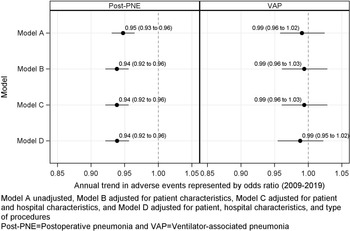
Figure 1 demonstrates the annual change in adjusted pneumonia rates after considering patient and hospital characteristics and type of surgery. After adjusting for all factors (model D), the odds ratio (OR) for postoperative pneumonia by year was 0.94, (95% CI, 0.92–0.96), signifying an average 6% decrease in the odds of pneumonia each year. In contrast, we did not detect a decrease in VAP rates over time (OR, 0.99; 95% CI, 0.95–1.02.)
Annual change in adjusted postoperative and ventilator-associated pneumonia and rates accounting for patient and hospital characteristics and type of surgery.

We also examined the trend in postoperative VAP among the 1,556 patients who had a major surgical procedure as well as mechanical ventilation for at least 48 hours. Consistent with the lack of improvement over time in VAP overall, there was no decrease in the observed or adjusted risk of VAP in these patients during the study period. The observed VAP rate varied from 10.1% in 2009–2011, 7.8% in 2012–2016, and 8.1% in 2017–2019 (P = .2674 for trend). The adjusted annual change in postoperative VAP was 0.95 (95% CI, 0.89–1.02).
Discussion
Using random sampling from a national cohort of patients, we documented a decrease in postoperative pneumonia rates between 2009 and 2019. The observed rate dropped from 1.9% during 2009–2011 to 1.3% during 2017–2019. This trend persisted after adjustment for patient and hospital-related factors and type of surgery; the annual adjusted decrease was 6%. In contrast, VAP rates remained largely unchanged between 2009 and 2019, a discouraging finding similar to that of our previous report for 2005–2013. Reference Metersky, Wang and Klompas4
In this observational study, we were unable to determine the reason for the significant decrease in postoperative pneumonia rates. Although efforts to prevent postoperative pneumonia have occurred, such efforts have only been reported from individual hospitals or hospital systems. Reference Kazaure, Martin and Yoon7,Reference Cassidy, Rosenkranz and McCabe12,Reference Caparelli, Shikhman and Jalal13 Although such efforts may have occurred at many other hospitals, we have insufficient data to attribute the improvements to these efforts. Improvements in surgical techniques, such as increasing use of minimally invasive and robotic surgery modalities have been associated with decreased postoperative pneumonia rates. Reference Kneuertz, Singer and D’Souza26–Reference Masoomi, Buchberg and Nguyen28 Other improvements might also be playing a role, including but not limited to advanced analgesia methods that improve postoperative pain control and likely improve the ability to cough, breathe deeply, and mobilize soon after surgery. Reference Matsutani, Dejima and Nakayama29,Reference Li, Li and Huang30 The increasing implementation of Enhanced Recovery After Surgery initiatives might also have contributed to decreases in postoperative pneumonia rates. Reference Wang, Lai and Li31 Furthermore, opioids may increase the risk for pneumonia Reference Rozario32,Reference Dublin, Walker and Jackson33 and recently efforts have been undertaken to reduce opioid use in hospitalized patients. Reference Rozario32
The decreasing rate of postoperative pneumonia is undoubtedly an encouraging finding, even if the exact mechanism of this decrease cannot be determined. Fewer cases of postoperative pneumonia result in lower rates of mortality, morbidity, hospital length of stay, and cost. Reference Chughtai, Gwam and Khlopas3,Reference Thompson, Cabrera and Strobel34
On the other hand, we have again demonstrated that VAP has been largely resistant to prevention efforts. This finding is not likely to be due to our definition of VAP not being responsive to change because the postoperative pneumonia definition is structurally similar, and we did detect a significant improvement over time. The VAP and postoperative pneumonia definitions differed only in the requirement for previous major surgery and lack of requirement for mechanical ventilation. Rather, as has been noted by previous researchers, few tools are clearly effective in preventing VAP. Reference Vazquez Guillamet and Kollef35 Many interventions have been reported to lower VAP rates, but their interpretation is complicated because of risk of bias due to the subjectivity of VAP criteria as well as circularity between some preventive measures (eg, oral care with chlorhexidine) and VAP diagnostic criteria (eg, positive respiratory-tract cultures). The evidence supporting most interventions commonly employed to prevent VAP is of low quality in most cases. Reference Campogiani, Tejada and Ferreira-Coimbra36–Reference Klompas38 Likewise, a meta-analysis of randomized trials in critical care reported that the only preventative strategies for critically ill patients associated with a mortality benefit were interventions designed to minimize iatrogenic ventilator injury (ie, noninvasive positive pressure ventilation in selected patients and low tidal volume ventilation, neuromuscular blockade, and prone positioning for patients with ARDS). Reference Santacruz, Pereira and Celis39
Few data to which ours can be compared are available, but the available data mirror our findings for VAP, whereas postoperative data are mixed. A point-prevalence study across the United States demonstrated no change in either VAP or non-VAP hospital-acquired pneumonia rates between 2011 and 2015. Reference Magill, O’Leary and Janelle1 Similarly, Chugtai et al Reference Chughtai, Gwam and Khlopas3 reported a national postoperative pneumonia rate of 0.97% per the National Inpatient Sample during 2009–2013 and a statistically significant decrease in this rate during that period. Reference Chughtai, Gwam and Khlopas3 In contrast, NSQIP data reported in the same manuscript demonstrated a 1.3% rate and no overall change over the same period, except for an increase among cardiothoracic surgery patients. Reference Chughtai, Gwam and Khlopas3
This study had several limitations. First, we were unable to report on nonpostoperative, non-VAP, hospital-acquired pneumonia because the MPSMS does not collect data on this adverse event. Second, this was a retrospective study, and as such was dependent on documentation; we may have missed episodes of pneumonia that were not diagnosed or documented. Finally, limited by sample size, we were not able to calculate rates of postoperative pneumonia after specific types of surgery; rather, we report on the universe of surgeries in the MPSMS sample. Due to the large number of types of surgeries included in our sample, we could not add each type to the risk-adjustment model. Rather, we adjusted for the 6 most common procedures; these 6 procedures comprised 78.1% of all cases. Changes in the frequency of the remaining surgery types were minor in absolute terms (Supplementary Table 1 online). Furthermore, temporal trends unrelated to safety and quality could have introduced bias into the results. For example, our sample includes inpatients only. The increasing tendency for many surgeries to be performed on an outpatient basis likely selects for more complex patients with more comorbidities included in an inpatient sample, but this trend would have resulted in a bias against a decrease in pneumonia rates. Thus, among patients undergoing major surgical procedures, whether subsequently admitted to the hospital as inpatients, the decrease in postoperative pneumonia rates might have been more than we measured in this inpatient population. Finally, although we present data on postoperative VAP, the numbers of at-risk patients in this subgroup were relatively low, and the lack of a statistically significant decrease might be a type 2 statistical error because the adjusted yearly decrease of 5% was not much less than the 6% adjusted yearly decrease for all postoperative pneumonia.
In summary, we report a clinically and statistically significant decrease in observed and adjusted postoperative pneumonia rates in a nationally representative sample between 2009 and 2019. VAP rates, in contrast, remained static at ∼10% of patients at risk. These results suggest an improvement in patient safety among surgical patients, although the exact mechanism of this improvement cannot be determined. The lack of decrease in VAP rates points to the need for innovative interventions or more aggressive use of protocols to avoid invasive mechanical ventilation, lighten sedation, and speed extubation. Reference Santacruz, Pereira and Celis39
Supplementary material
For supplementary material accompanying this paper visit https://doi.org/10.1017/ice.2022.264
Acknowledgments
Financial support
This work was supported by the Agency for Healthcare Research and Quality, US Department of Health and Human Services (contract no. HHSA290201800005C). The authors are solely responsible for this document’s contents, findings, and conclusions, which do not necessarily represent the views of AHRQ. Readers should not interpret any statement in this paper as an official position of AHRQ or of the US Department of Health and Human Services.
Conflicts of interest
In the past 3 years, Harlan Krumholz has received expenses and/or personal fees from UnitedHealth, IBM Watson Health, Element Science, Aetna, Facebook, Massachusetts Medical Society, the Siegfried and Jensen Law Firm, Arnold and Porter Law Firm, Martin/Baughman Law Firm, F-Prime, and the National Center for Cardiovascular Diseases in Beijing. He is a cofounder of Refactor Health and HugoHealth, and he has received grants from Medtronic, the US Food and Drug Administration, Johnson & Johnson, the Foundation for a Smoke-Free World, the State of Connecticut Department of Public Health, the Agency for Healthcare Research and Quality, the National Institutes of Health, the American Heart Association, and the Shenzhen Center for Health Information. Dr Krumholz, Ms Mathew, and Ms Eckenrode work under contract through Yale New Haven Hospital with the Centers for Medicare & Medicaid Services to support quality measurement programs. Dr Metersky has worked on various quality improvement and patient safety projects with the Centers for Medicare & Medicaid Services and the Agency for Healthcare Research and Quality. His employer has received remuneration for this work. The other authors report no conflicts of interest.