

1 Introduction
Small businesses are acknowledged to play an important role in sustaining economic growth and employment (OECD, 2016). On this basis, they are often supported by governments, through regulations and taxes. Studying the effects of government policy instruments on self-employment is thus of considerable importance.
In Italy, the self-employment rate has historically been high, mainly due to the country's high percentage of craftsmen and shopkeepers (OECD, 2016)Footnote 1. These two groups of self-employed workers, which form the subject of our analysis, have benefited from public financial support though various channels, including the public pension system. The amount of contributions that must be paid to the public pension system and the expected pension benefit at retirement are two key ingredients, which influence the Social Security Wealth (SSW), or pension wealth, of the workerFootnote 2. SSW is an important, although illiquid, component of individual wealth. From a theoretical point of view, the effect of changes to SSW on the decision to be or to become self-employed is ambiguous. Changes to pension wealth affect the total amount of resources available to workers over their life cycle. This effect would typically imply that an increase in the amount of SSW in the case of self-employment as opposed to employment would increase the probability of choosing self-employment, all other things being equal. However, as Li et al. (Reference Li, Mastrogiacomo, Hochguertel and Bloemenx2016) point out, other factors may play a role. First, risk aversion may reverse the previous result: if the increase in resources also implies an increase in risk, a risk-averse individual may favour the path with fewer resources and less risk. An additional channel concerns the substitutability between public pension wealth and private wealth. If the two are substitutes, as has largely been found in the literature, a change in differential SSW may imply a change in the saving rate, and hence in the private financial wealth held by individuals. This, in turn, may affect the probability of becoming self-employed.
In this work, we empirically explore the role of SSW as a factor affecting the decision to become self-employed rather than employed. We use the exogenous variability in differential SSW induced by a series of reforms that took place in Italy in the nineties. In 1990, SSW became particularly generous for craftsmen and shopkeepers, a large group of self-employed workers, as opposed to employees. Later on, however, problems concerning the financial sustainability of the public pension system prompted a series of reforms, particularly in 1992 and 1995, which greatly reduced the generosity of the benefits for both categories of self-employed workers and employees. These reforms were (and are still being) implemented gradually, and affected workers belonging to different categories, to different generations, and with different past careers in very different ways. Overall, the effect of the reforms on expected SSW has been significant and uneven across generations and categories of workers. We use the exogenous variation in the individual difference in SSW between a career in self-employment and one in employment induced by those reforms, to identify its causal effect on the probability of being self-employed. To this end, we compute individual-specific SSW differentials by comparing each worker's expected pension wealth in self-employment and in employment.
There is a wealth of literature on the determinants of self-employment. Our study relates, in particular, to works that investigate how institutional factors affect self-employment. Quinn (Reference Quinn1980) studies the retirement and labour supply patterns of the self-employed and employees in response to retirement policies, while Long (Reference Long1982), Blau (Reference Blau1987) and Schuetze (Reference Zissimopoulos and Karoly2000) consider the role of taxes. Blanchflower (Reference Blanchflower2000) studies the determinants of self-employment trends in OECD countries. Using the differential tax treatment between the self-employed and employees, and also relying on panel data, Bruce (Reference Bruce2000) and Hansson (Reference Hansson2012) study how the individual decision to transition from employment to self-employment depends on differentials in average and marginal tax rates. A smaller number of studies consider the effect of SSW on self-employment. Zissimopoulos and Karoly (Reference Zissimopoulos and Karoly2007) find that, conditional upon other characteristics, SSW at age 62 is not significantly related to transitions to self-employment, neither for men nor for women. Closely related to our work, Li et al. (Reference Li, Mastrogiacomo, Hochguertel and Bloemenx2016) isolate the causal effect of wealth on the transition from employment to self-employment and find that an exogenous reduction in pension wealth significantly decreases the probability of transitioning from wage-employment to self-employment.
For our analysis, we must obtain a good estimate, at each point in time, of the difference in SSW in the event that a worker chooses self-employment and in the event that he chooses employment, a task which is inherently difficult as it requires a huge amount of information on workers’ histories. To this end, we use a large sample of administrative data, which enables us to compute public pension wealth extremely specifically, as the data contain the complete work history of a sample of private sector workers covered by the public pension system. Our dataset is based on a large panel of administrative data drawn from the archive of Italy's main social security scheme (National Institute of Social Security, Istituto Nazionale di Previdenza Sociale (INPS)). INPS manages the Social Security accounts for various categories of private workers, including employees, craftsmen, shopkeepers, farmers and other smaller categories. Other categories of workers, most notably public sector employees, are not managed by INPS and, as a consequence, are not included in the sample. This means we are compelled to restrict our attention to craftsmen and shopkeepers, who we label as the self-employed, and to private sector employees, who we label as employees.
An analysis of the self-employment rate is able to estimate the probability of an individual being self-employed rather than an employee in any given period, which is the combined probability that a worker switched to self-employment at some time and remained in self-employment until that time period. While this analysis is mainly descriptive, it provides a useful illustration of the data and allows for a comparison to be made with previous studies analysing the self-employment rate. As we have a large sample size – over 9 million person/year observations – we are also able to estimate the transition probabilities, i.e., the probability of a wage worker switching to self-employment, and a self-employed worker switching to wage employment, although persistency in the same pension scheme is extremely high. In particular, in our sample, the yearly transition probability between employment and self-employment amounts, on average, to 1.3%, while the yearly transition probability between self-employment and employment is about 2.7%. Given the large sample size, we observe more than 100,000 transitions from employment to self-employment and about 65,000 from self-employment to employment. Moreover, the panel nature of the data allows us to control for unobserved determinants of an individual's self-employment status and its dynamics, such as risk aversion. Controlling for time-invariant unobserved heterogeneity is crucial to our analysis, as, while the administrative data are extremely rich in some respects, most notably on income histories, it lacks other important demographic information.
We concentrate our analysis on the two main categories of self-employed workers covered by INPS – craftsmen and shopkeepers – also because they share the same Social Security rules and can be treated as a single category. Thus, we study how the probability of being (or becoming) self-employed or employed depends, amongst other things, on the difference in expected SSW that can be accrued in the two alternative employment scenarios, i.e., the difference between the expected SSW from self-employment and the expected SSW from wage employment. In other words, we test if Social Security rules favourable to the self-employed as opposed to employees encourage self-employment. Participation in the public pension system is compulsory and the difference in expected SSW reflects the respective advantage of participating in either scheme.
As SSW depends on the lifetime income stream of each worker and this, in turn, depends on past, current, and a projection of future income (which is based on current income), our measure of differential SSW suffers from a potential endogeneity problem, as long as current income is affected by current Social Security rules. We construct an exogenous measure of the difference in SSW using income streams constructed on past income only, i.e., projecting future income on the basis of past income, and use it to construct an exogenous differential SSW to be used as an instrumental variable.
Our key finding is that the difference in expected SSW does indeed affect both the probability of being in self-employment and the probability of switching in or out of self-employment. In particular, a higher difference in expected SSW from self-employment as opposed to employment has a positive effect on the probability of being in self-employment and on the probability of switching to self-employment, while it has a negative effect on the probability of switching from self-employment to employment. We also study how these effects vary with age and we find that transitions from employment to self-employment are more sensitive to differential SSW at older ages, while the reverse is true for transitions from self-employment to employment.
The rest of the paper is organised as follows: in Section 2, we review the related literature, in Section 3, we outline the evolution of Italian pension legislation and in Section 4 we describe our empirical strategy. In Section 5, we describe how we estimate SSW, and in Section 6, we illustrate our dataset and present some descriptive analysis. In Section 7, we present the results of our econometric analysis based on the pooled sample, while in Sections 8 and 9, we study transitions from employment to self-employment and vice versa. Section 10 concludes the paper.
2 Related literature
The literature on self-employment analyses both the factors explaining self-employment rates and the determinants of the decision to become self-employed. Studies focusing on self-employment rates include both time-series analysis (Blau, Reference Blau1987) and cross-sectional studies (Schuetze, Reference Schuetze2000). This literature typically concentrates on factors affecting the evolution of self-employment rates. These include shifts in the composition of industries’ employment shares towards industries where self-employment is more prevalent, as in the case of service production (Blau, Reference Blau1987), shifts in the demographic composition of the workforce (Crompton, Reference Crompton1993) as well as institutional factors, most notably income tax policy (Schuetze, Reference Schuetze2000), minimum wage legislation (Blau, Reference Blau1987) and also retirement policies (Quinn, Reference Quinn1980). Self-employment rates have also been found to rise with increases in local or national unemployment rates (Blanchflower and Oswald, Reference Blanchflower, Oswald, Jowell, Witherspoon and Brook1990; Blanchflower, Reference Blanchflower2000; Schuetze, Reference Schuetze2000). More recently, Torrini (Reference Torrini2005) studies the role of institutional variables in determining self-employment rates across OECD countries. In particular, he studies the role of taxation, tax evasion opportunities, product market regulation and employment protection legislation.
The individual decision to become self-employed has also been studied, highlighting various factors that may influence such a decision, which may be driven by the positive benefits of being self-employed, but also by the poor job prospects of wage-employed or unemployed workers (Blanchflower and Oswald, Reference Blanchflower and Oswald1998). Evans and Leighton (Reference Evans and Leighton1989) find that workers with previous unemployment spells, lower wage workers and workers with a history of job instability are more likely to become self-employed, a result consistent with the notion that unsuccessful workers are pushed into self-employment (the so-called ‘push’ hypothesis). Self-employed workers are also found to face liquidity constraints. Using US micro data, Evans and Leighton (Reference Evans and Leighton1989) and Evans and Jovanovic (Reference Evans and Jovanovic1989) find that people with more family assets are likelier to switch from wage-employment to self-employment. Blanchflower and Oswald (Reference Blanchflower and Oswald1998) find that the probability of self-employment depends positively upon whether the individual has ever received an inheritance or gift. Using a quantitative life cycle model with altruism across generations and entrepreneurial choice, Cagetti and De Nardi (Reference Cagetti and De Nardi2006) analyse the role of borrowing constraints as determinants of entrepreneurial decisions. Their results indicate that voluntary bequests are an important channel allowing some high-ability workers to establish or enlarge an entrepreneurial activity.
Bruce (Reference Bruce2000) and Hansson (Reference Hansson2012) study how the individual decision to transition from wage-employment to self-employment depends on average and marginal tax rates, while Bruce (Reference Bruce2002) analyses transitions from self-employment to wage work. Bruce (Reference Bruce2000) uses US data to find that reducing an individual's marginal tax rate on self-employment income reduces the probability of entry, while reducing his average tax rate increases the probability of switching to self-employment. However, this finding is not universal, as, for example, Hansson (Reference Hansson2012) performs a similar analysis using Swedish panel data, and finds that both higher average and marginal taxes have a negative impact on the decision to become self-employed. Stabile (Reference Stabile2004) examines the effects of introducing a payroll tax (the Employer Health Tax) into the labour market, which taxes employers, but which exempts the self-employed. Using a time series of cross-sections of Canadian data, he finds that payroll taxes influence the decision to become self-employed, with the probability of self-employment increasing as taxes on employees increase and vice versa.
Zissimopoulos and Karoly (Reference Zissimopoulos and Karoly2007) use panel data drawn from the US Health and Retirement Study to study the determinants of labour force transitions to self-employment at older ages. Their analysis controls for a number of factors, including demographic characteristics, health status, financial and pension wealth. Conditional upon other characteristics, they find that SSW at age 62 is not significantly related to transitions to self-employment, neither for men nor women. Mastrogiacomo and Belloni (Reference Mastrogiacomo, Belloni, Börsch-Supan, Litwin, Myck, Kneip and Weber2015) also look at entrepreneurship choices among older workers and conclude that those who shift to self-employment are more motivated employees seeking higher job satisfaction.
The work by Li et al. (Reference Li, Mastrogiacomo, Hochguertel and Bloemenx2016) is closely related to our study as the authors aim to isolate the causal effect of pension wealth on the transition from wage-employment to self-employment and, to this end, they use a pension system reform in the Netherlands in 2006 as an exogenous variation in pension wealth. After the reform, employees born on or after 1 January 1950 faced a substantial reduction in their pension wealth, while self-employed workers were unaffected by the reform. The authors use the employees’ expected pension wealth before and after the reform as an explanatory variable in an equation of self-employment transitions. Their main empirical results indicate that this exogenous wealth reduction has a significant negative effect on the decision to switch to self-employment: the authors highlight that a possible explanation for this result is that when pension wealth drops, the wage-employed tend to reserve a higher amount of liquid private wealth for retirement and precautionary saving, so less liquid financial wealth will be used to start a new business and bear the risk of self-employment, resulting in a reduction of transitions to self-employment.
Our work also relates to a broader strand of the literature, namely to studies using exogenous changes in SSW to evaluate its effect on economic outcomes, such as the decision to retire (Brugiavini and Peracchi, Reference Brugiavini, Peracchi, Gruber and Wise2004; Belloni and Alessie, Reference Belloni and Alessie2009) or to accumulate private wealth through personal savings (Attanasio and Brugiavini, Reference Attanasio and Brugiavini2003; Attanasio and Rohwedder, Reference Attanasio and Rohwedder2003). Attanasio and Brugiavini (Reference Attanasio and Brugiavini2003), in particular, provide evidence that saving rates increase as a result of the reduction in pension wealth induced by the Italian pension reforms. They also allow for the possibility that substitutability changes with age, and find that substitutability is particularly high (and precisely estimated) for younger workers.
3 Evolution of the rules in the Italian pension system
Pension legislation in Italy is still extremely fragmented, even after the reform process aimed at harmonising the rules that began back in the 1990s, a process that is still very much ongoing. The main Social Security institution, INPS , covers most of the workers in the private sector: the employees, craftsmen, shopkeepers and farmers. Among the self-employed, many professionals (e.g., lawyers and doctors) are not included because they have independent pension funds, some of which have only very recently been incorporated by INPS as part of the harmonization process. We focus on the evolution of the pension rules pertaining to craftsmen and shopkeepers, who we label self-employed and who basically share the same rules, and privately employed workers.
For brevity, in this section we only sketch the main evolution of the pension rules, and leave details to the Appendix. In summary, the Italian public pension system is a pay-as-you-go system, with different rules, payroll taxes and benefits applying to the self-employed and to employees. While, until 1990, the self-employed were entitled to a contribution-based benefit, after that year a reform introduced a defined benefit (DB) system, similar to the one already in place for employees but with lower payroll taxes. As we show in Section 6, the 1990 reform greatly increased the SSW of the self-employed while leaving it unaffected for employees.
Financial sustainability problems, however, prompted a reform in 1992, which whilst preserving the DB system, modified the pension benefit formula for both employees and self-employed workers. For younger workers, pensionable earnings (or income) were planned to be based on the worker's entire earnings history and re-valued at the nominal gross domestic product (GDP) growth rate. For older workers, a transition phase gradually increasing the period over which pensionable earnings were to be computed was started. Most importantly, the pension indexation mechanism was downgraded from wages to prices for all categories of workers, with immediate effect, causing a sudden reduction in SSW for all workers (as well as pensioners). Such an indexation mechanism has since been maintained by all subsequent reforms. In addition, eligibility requirements for employees were gradually tightened.
In 1995, another major reform triggered a transition to a Notional Defined Contribution (NDC) scheme for all workers, while maintaining differences in payroll taxes. The lengthy transition period planned by the reform, which will last until 2030, also implies that its effects are heterogeneous across generations and categories of workers. When the new system will be phased in, benefits will be commensurate to the amount of payroll taxes paid, capitalised at an interest rate equal to the growth rate of the GDP and annuitised according to life expectancy at retirement. The 1995 reform, however, also introduced an important differential treatment between self-employed and employees, due to the more favourable computation of notional contributions granted to the former.
The intended effect of these and other minor reforms that have occurred since 1992 was to reduce the generosity of the public pension system for all workers: their effect on expected SSW has, however, been uneven for different generations and categories of workers. While we leave a detailed description of the evolution of the rules to the Appendix, in Section 6 we show the results of our estimation of expected SSW for different generations of self-employed and employed workers, highlighting how the reforms had heterogeneous effects across different categories of workers.
4 Empirical strategy
The aim of the empirical analysis is to test the hypothesis that SSW affects the probability of being self-employed rather than employed, as well as the probability of switching from self- to wage-employment and vice versa. As we have the benefit of a long panel dataset, we are able to analyse both the self-employment rate and the transitions from and to self-employment. An analysis of the self-employment rate is able to estimate the probability of an individual being self-employed rather than an employee in any given period, which is the combined probability that a worker switched to self-employment at some time and survived until that time period. This analysis is mainly descriptive, as it does not differentiate the determinants of switching and survival into self-employment (Evans and Leighton, Reference Evans and Leighton1989), but in addition to providing a useful illustration of the data, it allows for a comparison to be made with previous studies of the self-employment rate. Having the benefit of a long panel dataset, we are also able to estimate the transition probabilities, the probability of a wage worker switching to self-employment and of a self-employed worker switching to wage-employment.
In both analyses, of statuses and transitions, we define a dichotomous variable selfit+1 equal to 1 if a worker is self-employed in period t + 1, and equal to zero if he is an employee. With our data, we are able to identify two types of self-employed workers, shopkeepers and craftsmen: the Social Security rules are virtually the same across the two groups and we treat them as one single group. In addition, we have information on employees. For all workers, we observe all the information needed to compute their expected public pension as well as the contributions they are expected to payFootnote 3. The administrative data, however, lack important information on marital status, family, education and so on. For this reason, our estimates are based on a linear probability model, which allows us to control for unobserved time-invariant factors, including preferences towards risk. Our estimated equation closely follows the work of Bruce (Reference Bruce2000, Reference Bruce2002) and Hansson (Reference Hansson2012), who study how variations in differential tax rates affect the probability of becoming self-employedFootnote 4.
The estimated equation is of the type:
 $${\rm Self}_{it + 1} = \alpha \left( {{\rm SSW}_{it + 1}^{{\rm SE}} (y_{it + 1}^{{\rm SE}} ) - {\rm SSW}_{it + 1}^{{\rm WE}} (y_{it + 1}^{{\rm WE}} )} \right) + \beta X_{it} + \varepsilon _{it + 1} + \nu _{t + 1} + \mu _i. $$
When we study the self-employment rate, i.e., the probability of being self-employed rather than employed, the equation is estimated on the pooled sample, while, when we focus on the transitions from wage-employment to self-employment and vice versa, we select employees (or, alternatively, the self-employed) and follow them until they switch.
In equation (1) we include the difference between the expected SSW in the event a worker decides to be self-employed from time t + 1 onwards  $({\rm SSW}_{it + 1}^{{\rm SE}} (y_{it + 1}^{{\rm SE}} ))$ and the expected SSW in the event he decides to be (wage) employed from time t + 1
 $({\rm SSW}_{it + 1}^{{\rm WE}} (y_{it + 1}^{{\rm WE}} ))$. The expected SSW is equal to the present value of benefits expected by the worker minus the payroll tax, which has to be paid from time t + 1 onwards. In both cases, the expected SSW depends on the entire income stream of the worker, from the beginning of his career up to retirement, measured at time t + 1. Until time t + 1 the income stream is known and taken as given, and it may include both periods in wage-employment and periods in self-employment. We construct expected income from time t + 2 onwards in the case of self-employment and in the case of wage employment: we do this by assuming time t + 1 income grows at the average rate of growth in the case of self-employment or in the case of wage employment, as estimated from our dataFootnote 5.
However,  ${\rm SSW}_{it + 1}^{{\rm SE}} (y_{it + 1}^{{\rm SE}} )$ and
 ${\rm SSW}_{it + 1}^{{\rm WE}} (y_{it + 1}^{{\rm WE}} )\; $ depend on income earned at time t + 1 (as well as on its projection into the future), which is endogenous to the decision to be (or to become) self-employed at time t + 1. In addition, our estimated SSW is likely to be affected by some measurement errors; however, precise the procedure to estimate it. To construct an exogenous instrumental variable, we also compute the expected SSW at time t + 1, using the (exogenous) pension rules in force in period t + 1 as in the previous case, and an income stream constructed on the knowledge of income only up to time t (which we call
 $(y_{it}^{{\rm SE}} )$ and
 $(y_{it}^{{\rm WE}} )$). In other words, we project real income from time t + 1 onwards as equal to income at time t inflated by the real growth in income for self-employed or employees estimated from our sample. In this way, the two income streams are not influenced by the decisions taken by the worker at time t + 1, which are likely to be influenced by the Social Security rules in place at time t + 1. We compute the expected SSW in the two scenarios, of self-employment and wage work, and use the difference in these two variables as an instrument in equation (1). Alternatively, we also estimate the reduced form of (1), plugging in
 ${\rm (SSW}_{it + 1}^{{\rm SE}} (y_{it}^{{\rm SE}} ) - {\rm SSW}_{it + 1}^{{\rm WE}} (y_{it}^{{\rm WE}} ))$ as a regressor in place of the original SSW variables. Our instrument is valid only under the hypothesis that workers at time t do not anticipate what rules will be in place at time t + 1. Indeed, as stressed for example by Attanasio and Brugiavini (Reference Attanasio and Brugiavini2003), the reforms of the nineties were accompanied by a wide public discussion. However, the type of reform that would be implemented was not known in advance, and it was far from obvious what workers would be affected more by the reform and by how much.
The X variables include age dummies and other variables which may explain the probability of being (or becoming, depending on the specification) self-employed. In particular, we include the present value of real income, which represents the present value, valued at time t, of income from work earned throughout the entire working life. This value is meant to capture the overall performance in the labour market, reflecting the opportunity cost to become self-employed or poor employment opportunities. Alternatively, however, it may be the case that high-income workers have more opportunities to be successful when they are self-employed, resulting in a positive coefficientFootnote 6.
Additionally, we include other variables capturing the labour market performance up to period t. Total experience is defined as the number of periods a worker has spent in the labour market since entering the labour force. These include working spells as well as periods of sick or subsidised unemployment, both as an employee or as a self-employed worker. In addition, we include the fraction of time since entering the labour force for the first time spent outside the INPS archive, i.e., not working as a covered INPS worker, and not having sick or subsidised unemployment spells. Finally, we also include the fraction of time, since entering the labour force for the first time, spent on sick or subsidised unemployment leave. All these variables are expected to identify whether or not individuals with poor careers are pushed into self-employment.
In equation (1), we also include a common time effect (ν t+1), modelled as a set of year dummies, an individual-specific time-invariant effect (μ i) and an idiosyncratic shock (ε it+1). We control for individual-specific effects by demeaning.
As is typical in these kinds of studies, we are unable to disentangle age, time and cohort effects. While we estimate a flexible specification including both year and age dummies, we do not attempt to interpret them by attributing trends to either component.
As our final sample numbers approximately 9.4 million observations, we are also able to estimate the age-specific response of the probability of self-employment to public pension wealth by interacting expected SSW with age dummies.
5 Estimating SSW
For each selected individual and in each period, we compute his expected SSW in the two alternative hypotheses of a continuous career, from that point onwards, as an employee or as a self-employed worker, assuming the worker would retire at the legal retirement age applied in each regime. SSW is defined as the present value of benefits expected by the worker minus payroll tax, which has to be paid from time t + 1 onwards. We obtain for each time t + 1 the relevant quantities in the two alternative scenarios of working as an employee from time t + 1 to retirement age and of working as a self-employed worker from time t + 1 to (self-employed) retirement age, taking the past career as given and fixed. In both scenarios, workers (potentially) have mixed careers, as in the past (up to time t) they may have had spells of employment as well as self-employment.
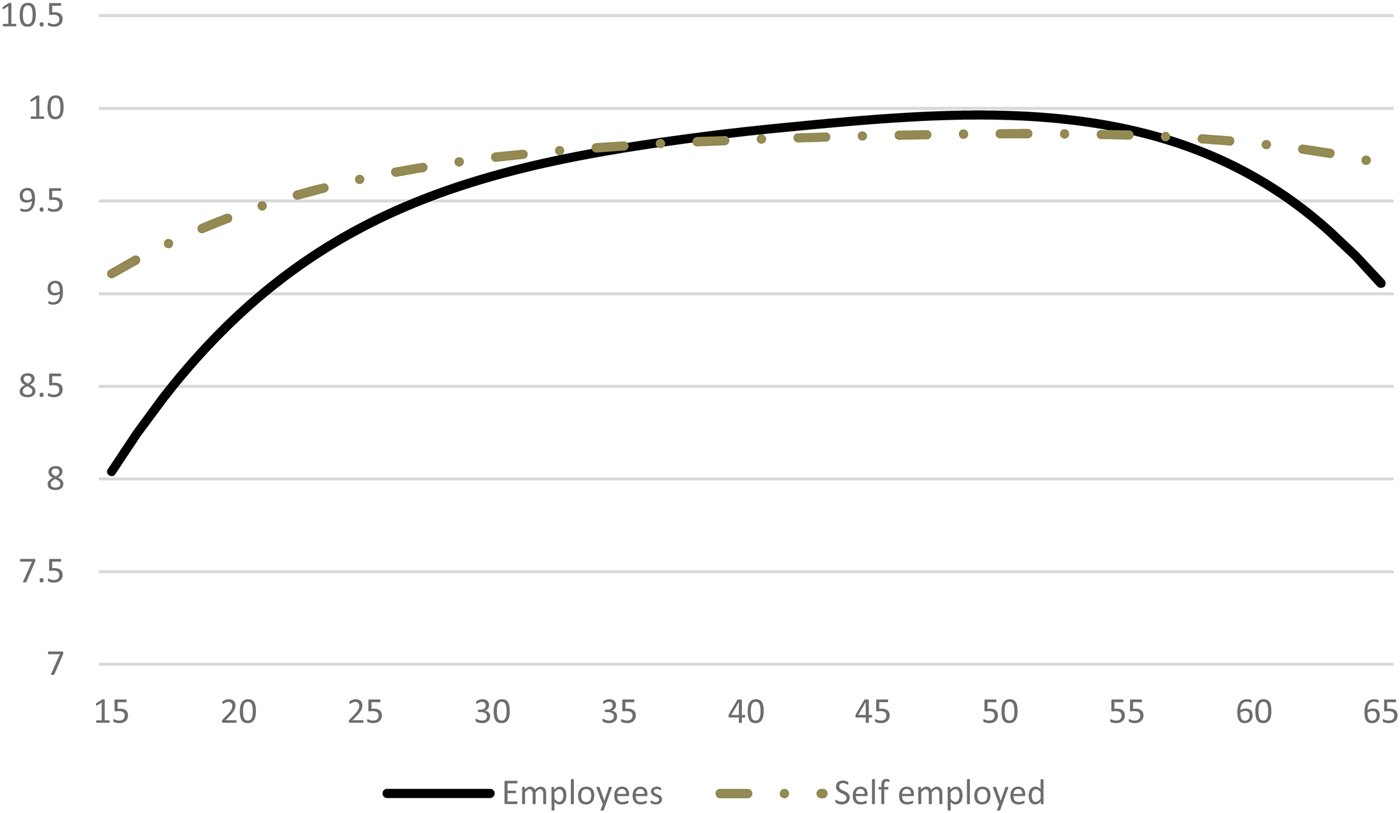
To obtain the desired quantities, we proceed as follows. We assume the income stream is given by its actual realisation until time t + 1, and it is projected to grow in real terms from that point onwards, until the worker retires at the legal age required by the legislation in force at time t + 1. The real income rate of growth is estimated from the data separately for employees and self-employed workers. Specifically, we estimate typical earnings profiles running ordinary least squares (OLS) regressions on the logarithm of total earnings on a fourth-order polynomial in age and on cohort dummies, separately for employees and self-employedFootnote 7. We use these estimated profiles to compute the rate of growth of earnings over the life cycle. With this procedure, we are able to take into account the fact that, on average, the employees earnings profile is more hump-shaped relative to the one for self-employed workers, as shown in Figure B2 in the Appendix.
Computing the pension benefit and SSW in the case of mixed careers is a complex exercise and we simplify the calculation using a two-step procedure. Using the income stream for each scenario, we compute the expected pension benefits and contributions paid over the rest of the working life assuming, alternatively, that the individual has been an employee or a self-employed person for all his working life, using the current (at time t + 1) pension legislation. We then approximate the pension benefits in the case of mixed careers according to the actual rules applying in each case. For the scenario of a career as an employee from time t + 1 onwards, we take a weighted average of the pension benefits in the self-employment and the employment continuous scenarios, using the number of years in each occupation as weights. For the alternative scenario of a career in self-employment from time t + 1 onwards, the pension benefit is the same as a continuous career in self-employment.
More in detail, for each individual and at each point in time, we compute two estimates of the old-age pension benefits earned at the end of the career, one assuming a full wage employee (WE) career, and the other assuming a full self-employed (SE) career. We compute the Present Value (PV) at time t + 1 of the discounted sum of the pension benefits received since retirement age until death, and call it  ${\rm PV}_{t + 1} (P^{{\rm WE\_c}} )$ and
 ${\rm PV}_{t + 1} (P^{{\rm SE\_c}} ),$ respectivelyFootnote 8. Similarly, we compute the PV of the contributions to be paid from time t + 1 until retirement in each employment scenario, PVt+1 (C WE) and PVt+1 (C SE)Footnote 9. What we need for our estimates are the expected SSWs computed on the basis of the actual career until time t + 1, and of a projected career of (continuous) wage or self-employment from time t + 1 onwards.
According to Italian legislation, a worker could switch from employment to self-employment at no cost, as the amount of contributions paid was higher in the former case. Hence, the expected SSW when continuously being self-employed or when switching to self-employment is the same:
 $${\rm SSW}_{t + 1}^{{\rm SE}} = {\rm SSW}_{t + 1}^{{\rm SE\_c}} = {\rm PV}_{t + 1} (P^{{\rm SE\_c}} ) - {\rm PV}_{t + 1} (C^{{\rm SE}} ),$$
where  ${\rm SSW}_{t + 1}^{{\rm SE}} $ is SSW computed at time t + 1 in the case of a mixed career, while
 ${\rm SSW}_{t + 1}^{{\rm SE\_c}} $ is SSW in the case of a full SE career.
When computing the opposite case, that of a worker in wage-employment from time t + 1 onwards, we need to consider that for workers switching from self-employment to employment the transition was (and still is) costly. We approximate the expected SSW in this case as the weighted average of the PV of the pension benefits based on the continuous careers, using as weights the number of periods spent in each occupation, minus the PV of the contributions still to be paid:
 $${\rm SSW}_{t + 1}^{{\rm WE}} = \displaystyle{{N_{{\rm WE}}} \over {N_{{\rm TOT}\;{\rm WE}}}} {\rm PV}_{t + 1} (P^{{\rm WE\_c}} ) + \displaystyle{{N_{{\rm SE}}} \over {N_{{\rm TOT}\;{\rm WE}}}} {\rm PV}_{t + 1} (P^{{\rm SE\_c}} ) - \; {\rm PV}_{t + 1} (C^{{\rm WE}} ),$$
where N WE is the number of years a worker spent contributing to the employee scheme throughout his working life, N SE is the number of years spent contributing to the self-employed scheme, and N TOT WE is the total number of years spent in the labour market when retiring as a wage employee. The career length is individual-specific as we observe the entrance into the labour market for each individual. Formula (3) applies with the condition of accruing at least 15 years of contributions in each scheme. If a worker accrues <15 years in a scheme, which was the minimum seniority required to claim a retirement benefit in the years considered in our study, he is not entitled to obtain a benefit in that scheme and his pension will only be constituted by the benefit accrued in the other schemeFootnote 10.
All the above formulae apply both when we compute SSW based on an income stream extrapolated using information up to time t + 1  $(y_{it + 1}^{{\rm SE}} \;{\rm or}\;y_{it + 1}^{{\rm WE}} )$ and when we compute SSW based on an exogenous income stream extrapolated using information only up to time t
 $(y_{it}^{{\rm SE}} \;{\rm or}\;y_{it}^{{\rm WE}} )$, which is used to construct our instrument.
6 Data
We use a sample of administrative data drawn from the archive of Italy's main Social Security scheme (National Institute of Social Security, INPS)Footnote 11.
The INPS archive officially records the complete earnings and contribution histories of all participants, i.e., employees in the private sector and some categories of the self-employed (craftsmen, tradesmen and farmers). Other categories of self-employed workers, and, in particular, professional workers, have their own independent pension funds and are not covered by INPS; hence, we have no information on those professional workers. The available sample is formed by all individuals born on the first and the ninth of each month of any year – so that the theoretical sample frequency is 24 : 365 – and reports employment spells until 2012. The archive contains very rich information about the earnings histories of the workers, recording spells of unemployment and sickness, as well as labour income earned each year.
As is typical with administrative data, the demographic information is, on the other hand, less rich: The sample records the gender, date and region of birth and region of residence in 2012 for each worker. No information about the family status or education level of the worker is available.
We clean our sample in the following way. We start by restricting our attention to the period 1985–2005, as we are interested in studying the effect of reforms to the pension system that occurred during the ninetiesFootnote 12. We also select male individuals born between 1940 and 1980, as well as workers aged between 25 and 59Footnote 13. We also disregard individuals whose information on region of birth is missing, about 0.7% of the sample, as well as individuals born in a foreign region, as for this last group different pension rules applyFootnote 14.
We transform the data into yearly spells by adding up, for each year, the number of weeks worked and the income earned. If an individual contributed to both wage- and self-employment schemes in the same year, we define the main scheme as the one in which the majority of time was spent (measured in weeks of work). We keep year observations in which the worker is active for at least 12 weeks. Other cut-points produce more or less similar results.
After these selections and transformations we are left with a sample of 10.4 million person-year observations, pertaining to workers contributing to five main schemes: employees, the self-employed, agricultural workers, flexible workers and a remaining group, which includes minor schemes such as clergymen or rail workers (which we label ‘other’).
We then restrict our analysis to employees and self-employed workers, who are the focus of this paper, and together account for more than 90% of the workers covered by INPS. We group observations of the resulting sample according to year of birth, and form four 10-year year-of-birth groups, born between 1940 and 1980. The time evolution of the self-employment rate for the resulting four generations (or cohorts) is shown in Figure 1, where, in the x-axis, we report the calendar year to highlight the time effects. For example, in 1985 the self-employment rate of all workers born between 1940 and 1949 (named cohort 1945 in the graph) amounted to 29%. In the same year, the self-employment rate for individuals born between 1950 and 1959 (hence aged between 26 and 35 in 1985) amounted to 23%. Each line in the graph then shows the self-employment rate of each generation as it ages. The younger generation (born between 1970 and 1980) enters the graph in 1995 as we disregarded individuals younger than 25 from our sample.
Self-employment rate, by cohort. Source: Authors’ calculations based on INPS dataset.

Figure 1 shows that the self-employment rate increases over time for all cohorts, although with different patterns. For the eldest cohort, born in 1945, the increase is particularly accentuated in the second half of the 1990s: this may also reflect the fact that some employees, before the year 2000, were allowed to retire after reaching age 55 while, typically, self-employed workers retired at older ages. As we shall see in the next Figure 6, the various pension reforms undertaken during the nineties increased the pension wealth of the self-employed relative to that of the employees in the years 1990–1996, while after that period the relative advantage of the self-employed slowly starts declining. Our research question is whether this change in the relative SSW influenced the choice to be or to become self-employed.
As we follow the same individuals over time, we are also able to study transitions between employment and self-employment. As the total number of observations is about 9.4 million, despite the transition from employee to self-employed only occurring with probability of 1.3%, we are able to observe it more than 100,000 times. Self-employed workers, on the other hand, display a higher probability of switching to the employee scheme, of approximately 2.7% (about 65,000 transitions).
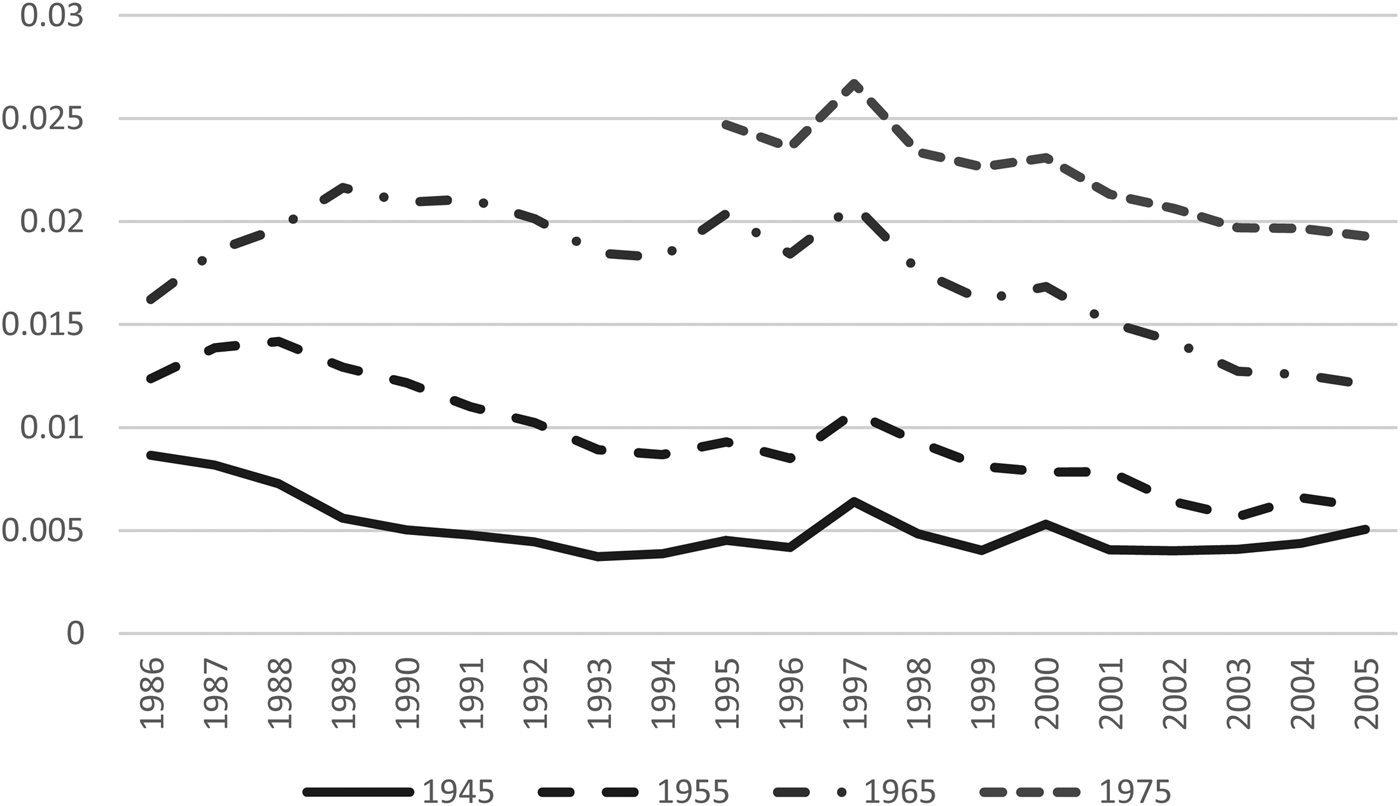
In Figures 2 and 3 below, we show the transitions over time and by cohort. For transitions from employment to self-employment, shown in Figure 2, we select individuals who start their career as employees and follow them until they switch to self-employment (or until the end of the sample if they do not switch). Figure 2 highlights that there are strong age effects in the transition rate from employment to self-employment, with younger individuals being more likely to switch. Common macro shocks are also evident in the figure, such as the relatively flat profile for all cohorts in the nineties, which may be induced by the pension reforms, or the spike in the year 1997, a year in which an important reform introducing more flexibility in the labour market was implemented.
Transition rate from employment to self-employment, by cohort. Source: Authors’ calculations based on INPS dataset.

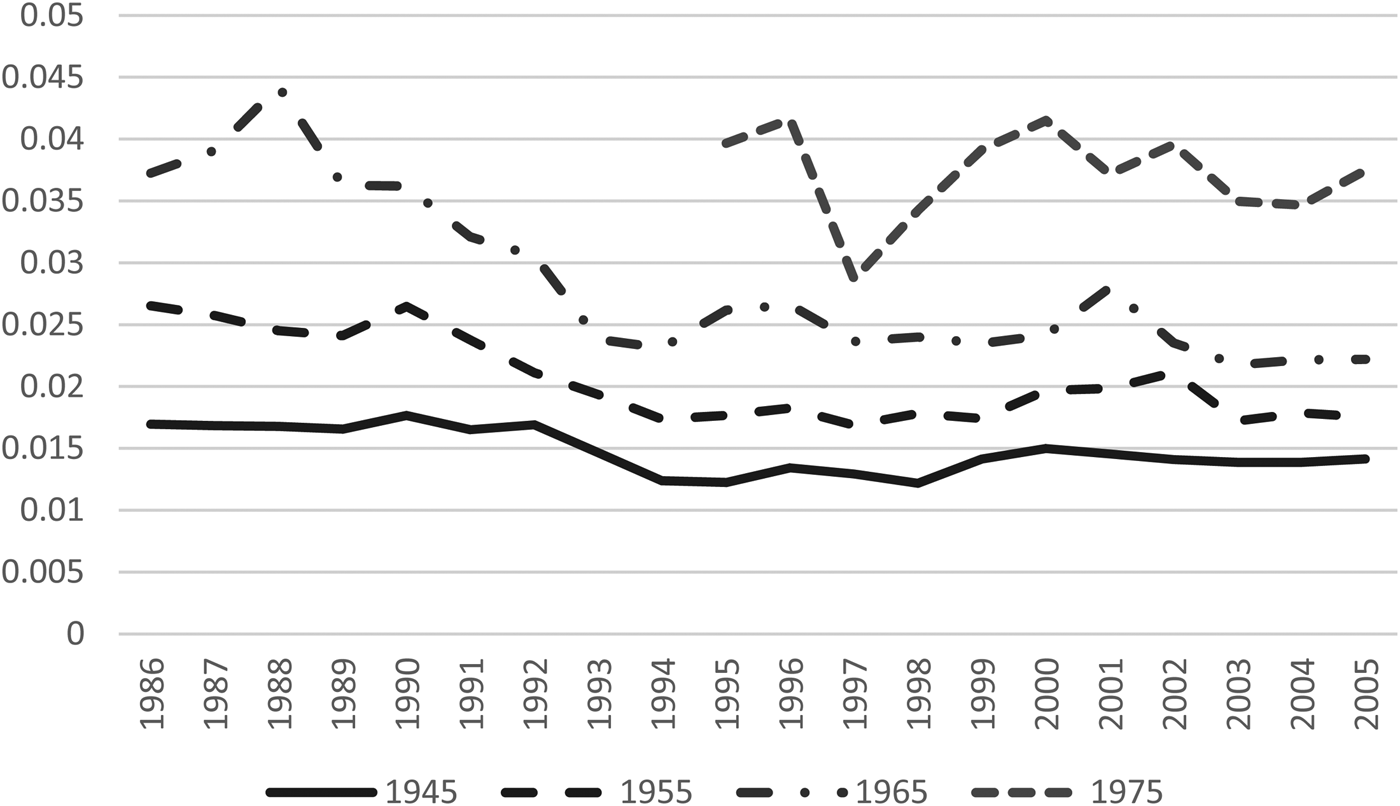
Transition rate from self-employment to employment, by cohort. Source: Authors’ calculations based on INPS dataset.

Similarly, we study transitions from self-employment to employment, selecting individuals who start their career as self-employed and following them until they switch to employment (or until the end of the sample if they do not switch). These transitions are more likely than the previous ones, as already noted. Common time trends are particularly evident in Figure 3: in particular, while between 1990 and 1996 the trend is in general decreasing, after that period it turns quite flat for all the cohorts considered.
As we want to relate the self-employment and transition rates to the SSW that could be accrued by each worker in either scheme, we now present our estimates of pension wealth for the employed and the self-employed.
In Figures 4 and 5, we show the average SSW in the continuous scenarios  $\lpar{\rm SSW}_{it + 1}^{{\rm WE\_c}} \; $ and
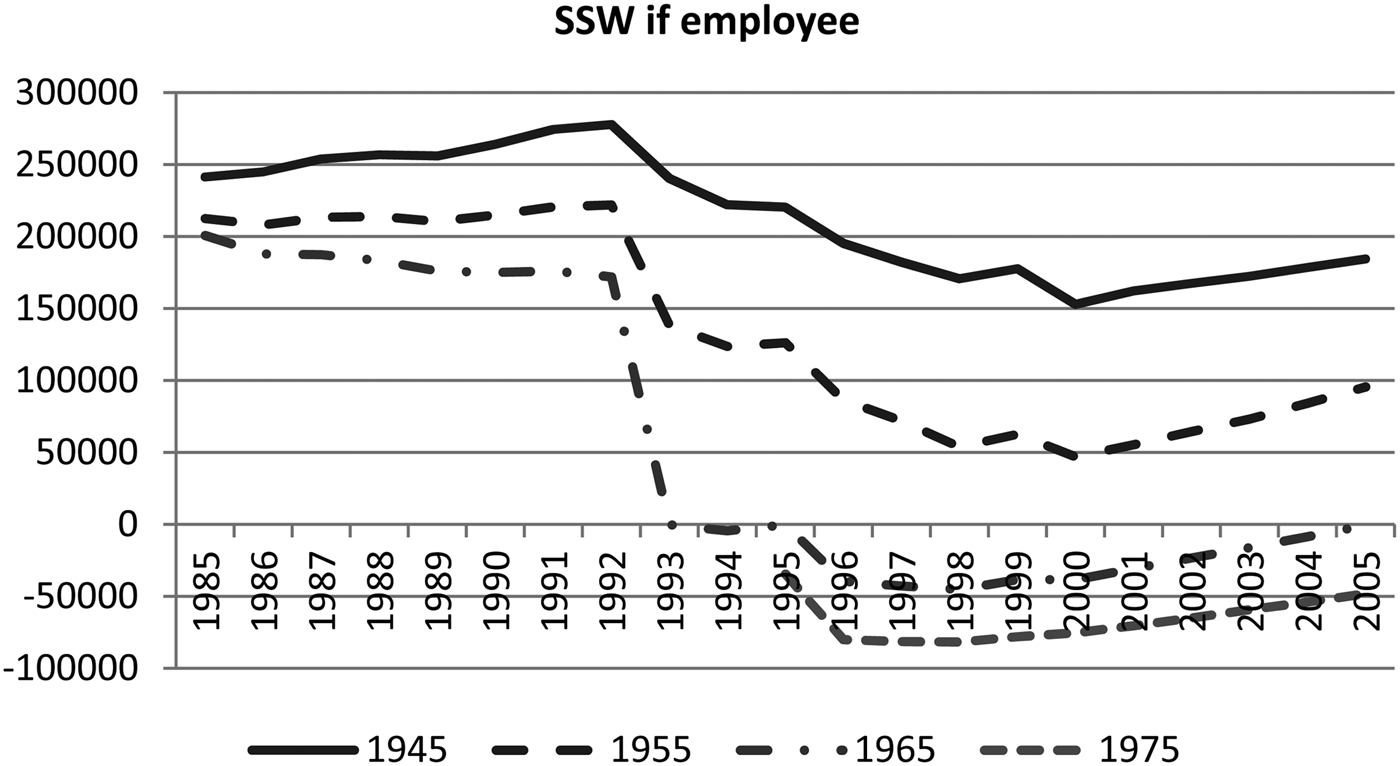
 ${\rm SSW}_{it + 1}^{{\rm SE\_c}} $), i.e., assuming continuous careers either as employed or as self-employed, by 10-year-of-birth generations (from 1940 to 1980). As occurred previously, the variable of interest is plotted with the calendar year on the x-axis, in order to highlight the macro shocks induced by the reforms. When all other aspects are equal, SSW is lower for younger individuals whose distance from retirement age is greater (as contributions have to be paid for a longer period; in addition, there is a discounting effect). Starting with SSW where an individual remains an employee for his whole life, shown in Figure 4, the effects of the 1992 and 1995 reforms can clearly be seen for each cohort: younger cohorts start with a lower SSW both because in any year they are younger and because the payroll tax rate increased quite steadily over time, well before the nineties. Our results on the effect of the reforms are in line with those found, for example, by Borella and Coda Moscarola (Reference Borella and Coda Moscarola2006, Reference Borella and Coda Moscarola2011).
Average SSW in the case of a career in wage-employment. Note: values expressed in 2013 Euro. Source: Authors’ calculations.

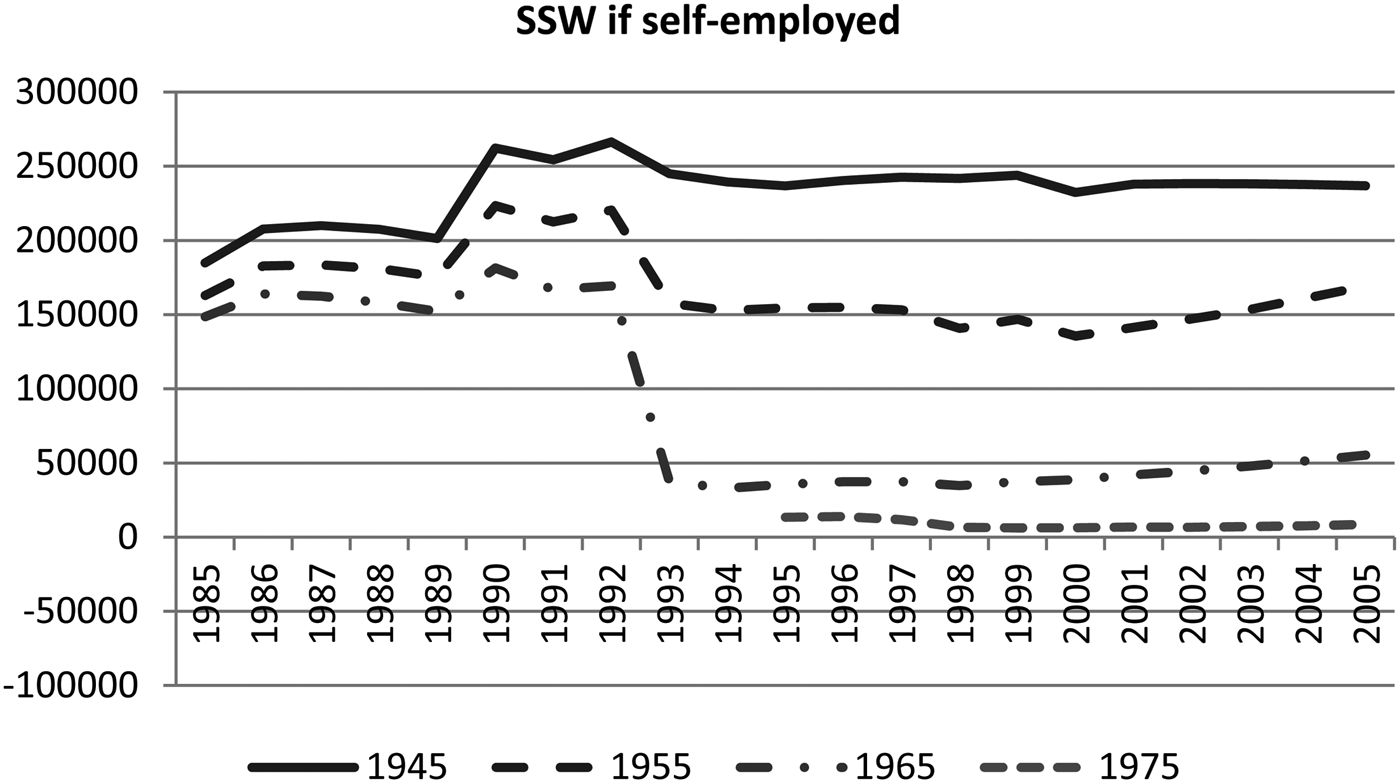
Average SSW in the case of a career in self-employment. Note: values expressed in 2013 Euro. Source: Authors’ calculations.

The SSW where an individual is always self-employed is shown in Figure 5. Self-employed workers before 1990 paid lower (although increasing over time) payroll tax rates and received, on average, lower benefits, computed with a DC mechanism. Their expected SSW is consequently lower than that of employees until the reform of 1990. That reform, increasing both the contributions and benefits for the self-employed, resulted in an increase in their SSW starting from the years 1990–91. Subsequently, the self-employed were also hit by the reforms in 1992 and 1995, which had the effect of reducing their expected SSW, although to a lesser extent than employees.
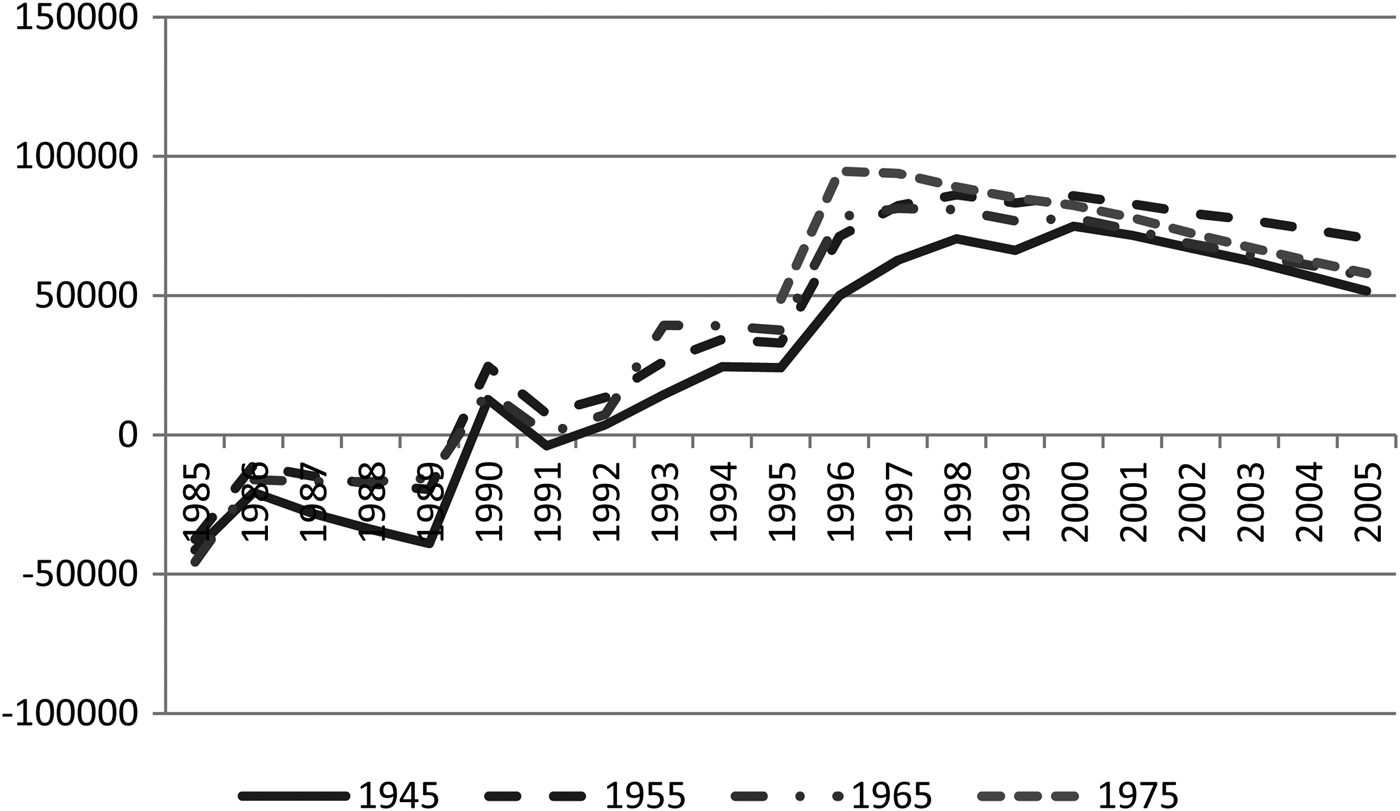
Our main variable of interest is not SSW itself but, rather, the difference in SSW deriving from opting to be in self-employment or employment from time t + 1 onwards, given the career undertaken until that time:  ${\rm SSW}_{it + 1}^{{\rm SE}} (y_{it + 1} ) - {\rm SSW}_{it + 1}^{{\rm WE}} (y_{it + 1} )$ in terms of equation (1). The evolution of this variable by cohort and over time is shown in Figure 6. The figure shows that this difference varies greatly across generations and over time. For example, for workers born in 1945 the average difference moves from around −50,000 Euro in 1985 to almost 80,000 Euro in the year 2000. The difference, on average, was negative until 1989, i.e., until the 1990 reform that increased the SSW for the self-employed, and positive thereafter, indicating that after the reforms of the 1990s the self-employed have, on average, a higher expected SSW than employees. In addition, after the year 2000, the difference diminishes for all cohorts and the variation across cohorts also vanishes, a result of the (slow) harmonisation process introduced by the reforms.
Average difference in individual SSW in the case of self-employment or employment, by cohort. Note: values expressed in 2013 Euro. Source: Authors’ calculations.

7 Results: self-employment status
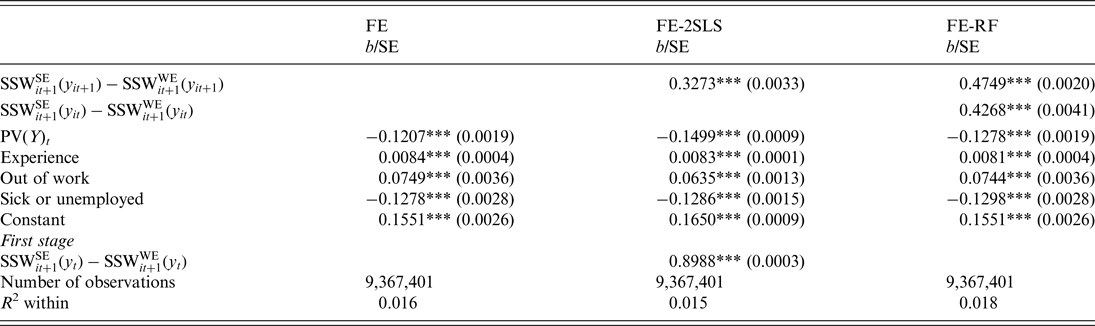
We estimate the effect of differential SSW on the probability of an individual being self-employed rather than wage-employed for individuals who were either self-employed or wage employed between 1985 and 2005. In all our specifications, we include the difference between the expected SSW in the case where the worker decides to be self-employed for the rest of his working life and the expected SSW in the case where he chooses to be an employee from the current period onwards until retirement. As discussed earlier, we estimate expected SSW using the rules in force at t + 1 and an income projection based on income for the same period, as well as expected SSW using t + 1 rules and an income projection based on income in period t. We use this second couple of variables (in the case of self-employment and wage-employment) to form an instrument to be used in our main specification and we also estimate the reduced form using the instrument directly as a regressor. The three specifications are shown in Table 1, columns 1–3.
The effect of the difference in SSW on the self-employment rate

Notes: The dependent variable is equal to 0 in the case of employment and to 1 in the case of self-employment. FE, fixed-effects estimate; FE-2SLS, fixed-effects two-stage least-squares estimate; FE-RF, fixed effects reduced form estimate; Individual-level clustered standard errors in parentheses. All specifications include time and age dummies. The SSW variables and the PV of income are all expressed in millions at 2013 prices. Significance levels: *p < 0.1, **p < 0.05, ***p < 0.01.
In the first column, we find that the overall coefficient for the difference in SSWit+1 (y it+1) where an individual chooses self-employment versus wage-employment amounts to 0.33, with a standard error of 0.003, hence statistically different from zero at any standard significance level. As our sample consists of about 9.4 million person-year observations, estimating very low standard errors – or, in other words, estimating coefficients with small confidence intervals – is unsurprising. What is important in this context is the size of the effect, as we are, in principle, able to estimate precisely effects that are close to zero. As our SSW variables are expressed in millions, our finding implies that, other things being equal, a 10,000 Euro increase of the difference in SSW increases the probability of being in self-employment by about 0.33 percentage points. The average increase in the difference in SSW between 1989 and 1990 was about 32,000 Euro, while between 1992 and 1993 it was approximately 25,000 Euro. Assuming that these differences are due entirely to the change in Social Security rules, our estimate implies that the effect of these two reforms on the probability of being in self-employment was of about 1 and 0.8 percentage points, respectively. The 1995 reform had, on average, a greater effect on the difference in expected SSW, of about 38,000 Euros, implying an increase in the probability of being in self-employment of about 1.3 percentage points.
As a measure of the overall performance in the labour market, we also include the present value of income. We find a small, negative effect of this variable: a 10,000 Euro increase of the PV of income reduces the probability of being self-employed by 0.12 percentage points. In addition, we find that labour market experience, measured in years, increases the probability of being self-employed by about 0.8 percentage points for every additional year. Individuals who have been in the labour market for longer are more likely to have switched to self-employment, as already found, for example, by Evans and Leighton (Reference Evans and Leighton1989).
We also find that the fraction of time spent out of the INPS archive increases the probability of being self-employed, indicating that individuals which are likely to have poor career prospects may be pushed into self-employment. Conversely, the fraction of time spent in sick or subsidised unemployment leave – two benefits typically (but not solely) received by wage-employed workers – reduces the probability of being self-employed, indicating that workers who are protected are less likely to be self-employed.
In column 2, we estimate the same specification with an FE-2SLS estimator, using as instrument the difference in expected SSW in the case of self-employment and wage-employment computed on an expected income stream based on past income up to time t. The coefficient estimated from the first stage is reported in the bottom part of the table and amounts to 0.89, indicating that our instrument indeed helps to explain the difference in SSW. This estimate confirms the results shown in column 1, with the absolute values of the coefficients on the difference in expected SSW higher than the one found in the first column, as a 10,000 Euro increase of the difference raises the probability of being self-employed by about 0.47 percentage points.
Finally, in the third column we report the reduced form estimates, with the expected SSW in the case of self-employment and wage-employment computed on an expected income stream based upon past income up to time t included as regressors. The results indicate that with a 10,000 Euro increase of the difference, this raises the probability of being self-employed by 0.43 percentage points.
In Appendix C, we also show some sensitivity analysis to our estimates, in particular we check whether results are driven by our assumptions on the income stream, by assuming the future income stream is constant in real terms (Table C1), or by the choice of a linear probability model, by estimating a probit model (Table C2). We also limit our sample to the year 1998 (Table C3).
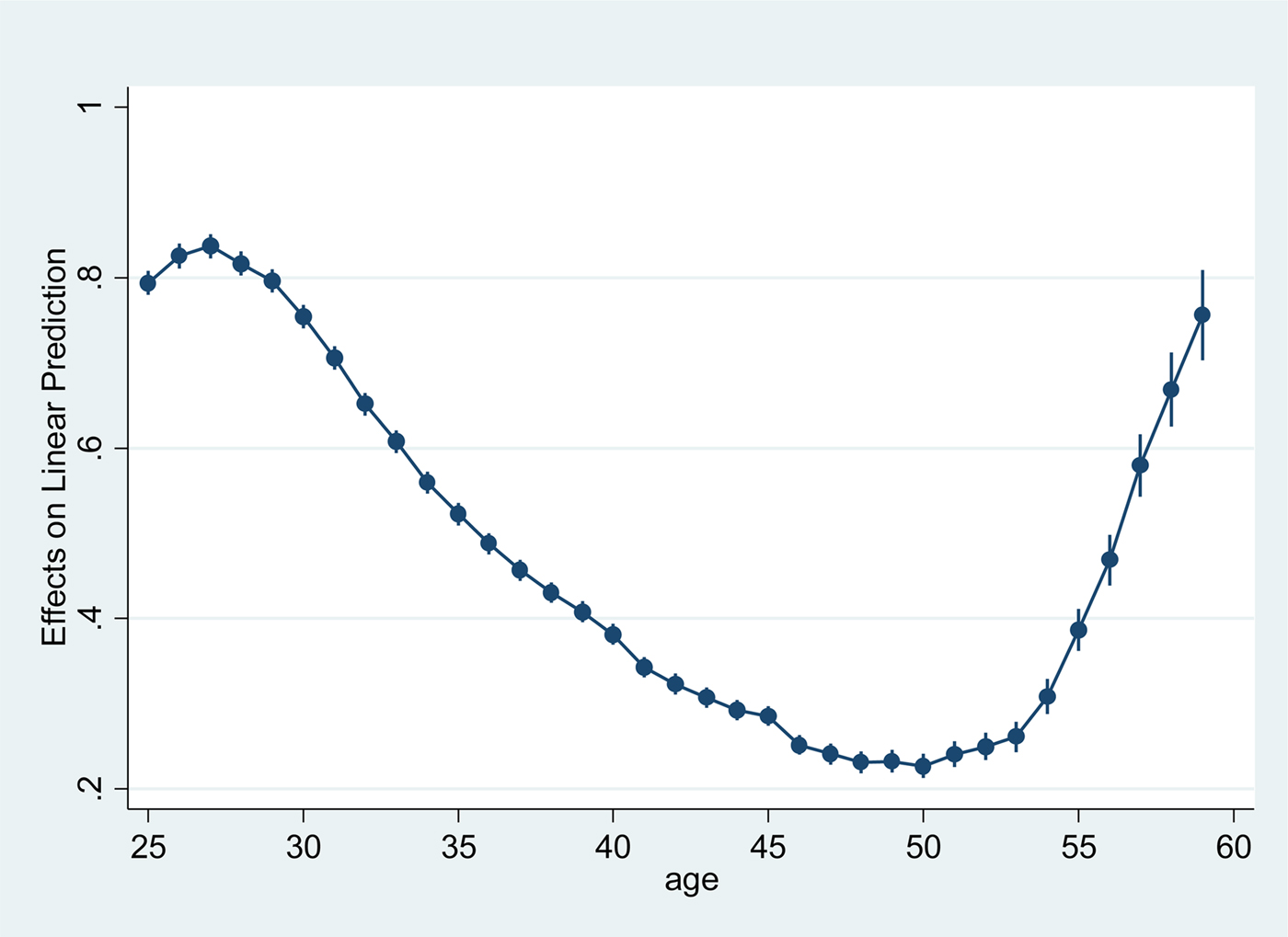
Finally, we relax the assumption that the effect of the difference in SSW is constant over age and estimate a fully flexible model where the difference in SSW is interacted with age dummies. Thanks to the very large sample size at our disposal, the parameters are very precisely estimated (the results are available upon request). Figure 7 reports the resulting average marginal effects (including 95% confidence intervals (CI)) by age for the difference in SSWit+1 (y it), estimated using the reduced form specification to avoid endogeneity issuesFootnote 15.
(Colour online) Average marginal effect of the difference in SSW, by age, on the self-employment rate. Source: Authors’ calculations. Note: bars refer to 95% CI.

The effect of the difference in SSW on the probability of being self-employed decreases with age until age 45, and increases again at older ages. As the difference in SSW is measured in millions, the findings shown in Figure 7 indicate, for instance, that a 10,000 Euro increase of the difference in SSW determines an increase in the probability of being self-employed of 0.8 percentage points at age 25 and of about 0.4 percentage points at age 40.
8 Results: transitions to self-employment
In Table 2, we show the estimates of the probability of switching to self-employment. To obtain these estimates, we select wage-employed individuals and include them in the sample until they switch to self-employment. If they do switch, subsequent observations are disregarded from the sample.
The effect of the difference in SSW on the transition rate from WE to SE

Notes: The dependent variable is equal to 0 in the case of employment and to 1 in the case of self-employment. FE, fixed-effects estimate. FE-2SLS, fixed-effects two-stage least-squares estimate. FE-RF, fixed effects reduced form estimate. Individual-level clustered standard errors in parentheses. All specifications include time and age dummies. The SSW variables and the PV of income are all expressed in millions at 2013 prices. Significance levels: *p < 0.1, **p < 0.05, ***p < 0.01.
In this case also, we estimate three specifications: our basic fixed-effect specification, an FE-2SLS specification to account for endogeneity in expected SSW, and the reduced form.
The results, consistent with our previous estimates of the self-employment rate, indicate that an increase in the difference in expected SSW increases the probability of switching to self-employment from wage-employment. The estimate of this effect is equal to about 0.14 percentage points every 10,000 additional Euros in the difference in SSW for specification 1, again to about 0.08 percentage points in the FE-2SLS estimates, and finally to 0.06 percentage points in the reduced form reported in column 3. As the probability of switching is very low (as shown in Section 5) and equal to 1.3% on average, the effect of the difference in expected SSW is sizeable even in the latter estimate. Our 2SLS-FE estimate implies that the effect of the 1995 reform on the probability of switching to self-employment was of 0.5 percentage points after the 1995 reform and of almost 0.4 percentage points after the 1992 reform.
The present value of the income stream has a negative effect on the probability of switching; indicating a 100,000 Euro increase of this variable reduces the probability of entering self-employment by about 1 percentage point – a result that provides some evidence in favour of the ‘push’ hypothesis.
Experience in this case measures the number of years spent in the labour market as wage-employed and it has a negative effect on the probability of switching: ten additional years spent in the labour market as an employee reduce the probability of switching by 0.7%. The fraction of time spent out of the INPS archive has a positive impact on the probability of switching, while the fraction of time spent in sick or subsidised unemployment has a negative effect, consistently with what we found for the self-employment rate in the previous section.
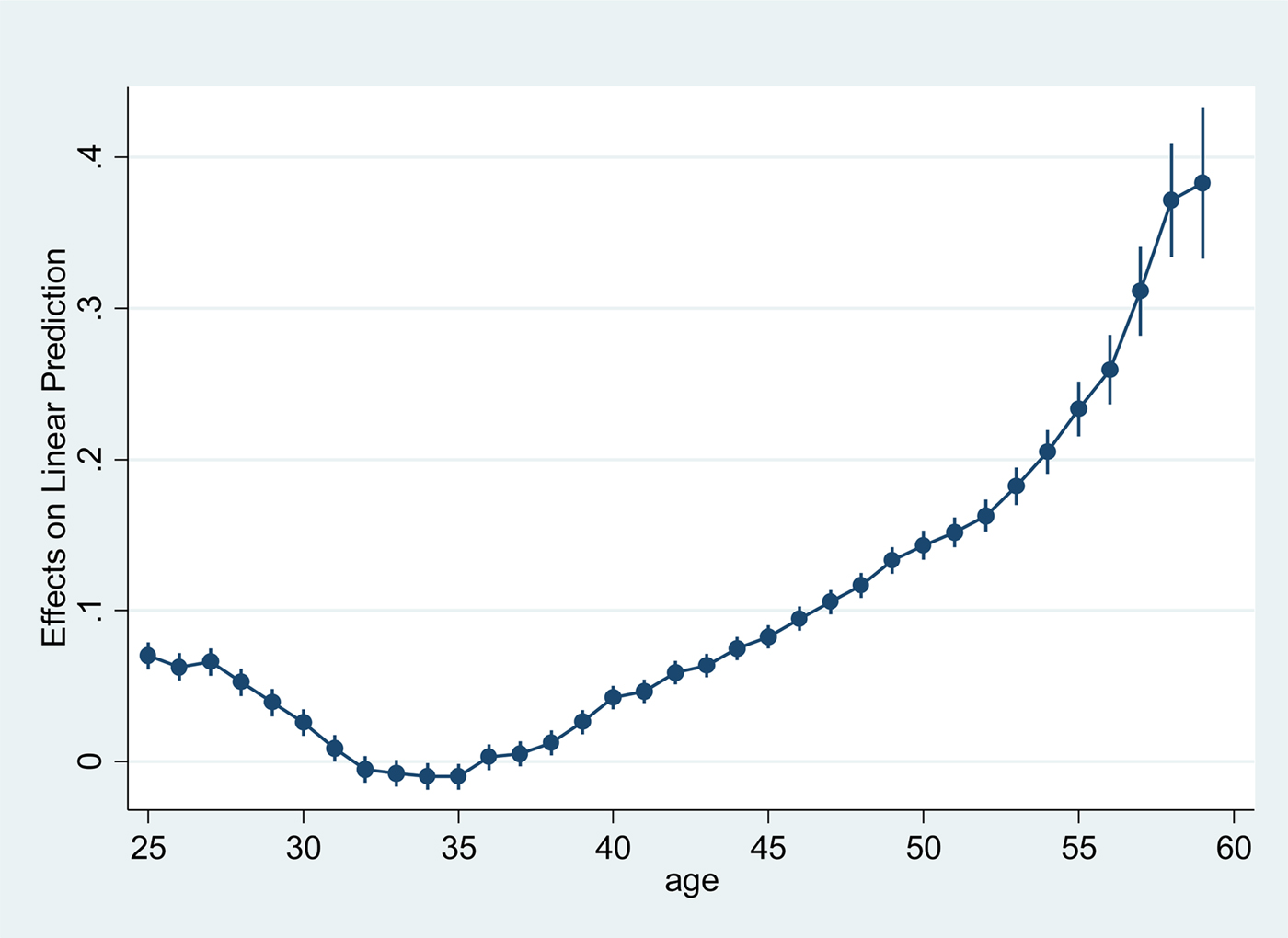
In Figure 8, we show how the effect of the difference in SSW varies with age. The effect is not constant over the age range, but it is positive but decreasing at younger ages, reaching zero between 30 and 35, and then increasing again thereafter. After that age, the difference in expected SSW is found to play an increasingly important role.
(Colour online) Average marginal effect of the difference in SSW, by age, on transitions from employment to self-employment. Source: Authors’ calculations. Note: bars refer to 95% CI.

9 Results: transitions to employment
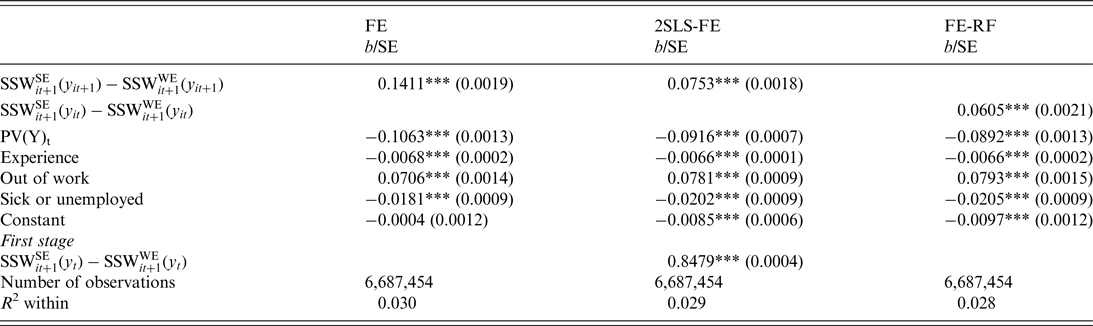
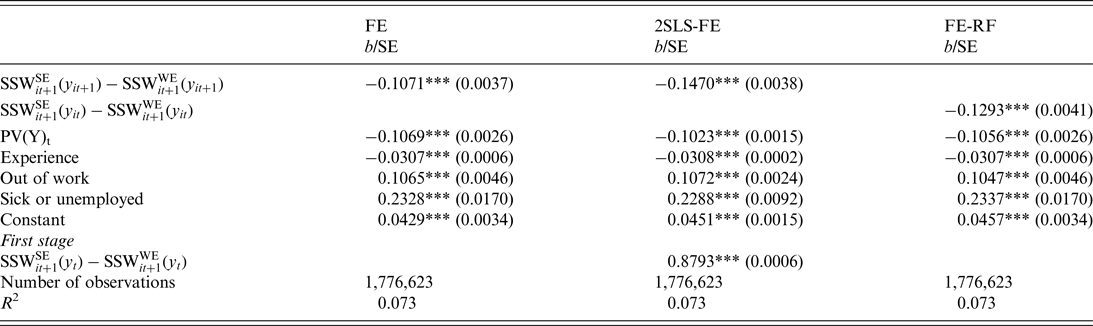
As we have a large sample, we are also able to provide evidence on the probability of self-employment workers switching to wage-employment. To this end, we use the same variables and specifications used in the previous sections but this time we define the dependent variable to be equal to 0 when a worker is self-employed, and equal to 1 when he switches to wage-employment. Paralleling the analysis of the previous section, we disregard all observations following the (possible) switch. The results reported in Table 3 show that the effect of the difference in SSW on the probability of switching is quite sizeable: the results from the 2SLS-FE specification reported in the second column imply that a 10,000 Euro increase of the difference in SSW reduces the probability of switching to wage-employment by 0.15 percentage points, while the results from the reduced form in column 3 imply a reduction in the same probability by 0.13 percentage points. The effect of the reforms, implied by our 2SLS-FE estimates and computed as in the previous sections, leads to a reduction in the transition rate of about 0.6 percentage points after the 1995 reform, and of about 0.4 percentage points after the 1992 reform (where the overall transition rate is 2.8%).
The effect of the difference in SSW on the transition rate from SE to WE

Notes: The dependent variable is equal to 1 in the case of employment and to 0 in the case of self-employment. FE, fixed-effects estimate; FE-2SLS, fixed-effects two-stage least-squares estimate; FE-RF, fixed effects reduced form estimate. Individual-level clustered standard errors in parentheses. All specifications include time and age dummies. The SSW variables and the PV of income are all expressed in millions at 2013 prices. Significance levels: *p < 0.1, **p < 0.05, ***p < 0.01.
Also in this case, the present value of income has a negative coefficient, indicating that, conditional upon being a self-employed worker, having a higher income reduces the probability of switching. In other words, successful workers tend not to change job. Experience, measured as years spent as a self-employed worker, also has a negative effect, while experiencing a high fraction of time out of work increases the probability of switching. Self-employed workers who paid contributions, while off sick are much more likely to switch to employment.
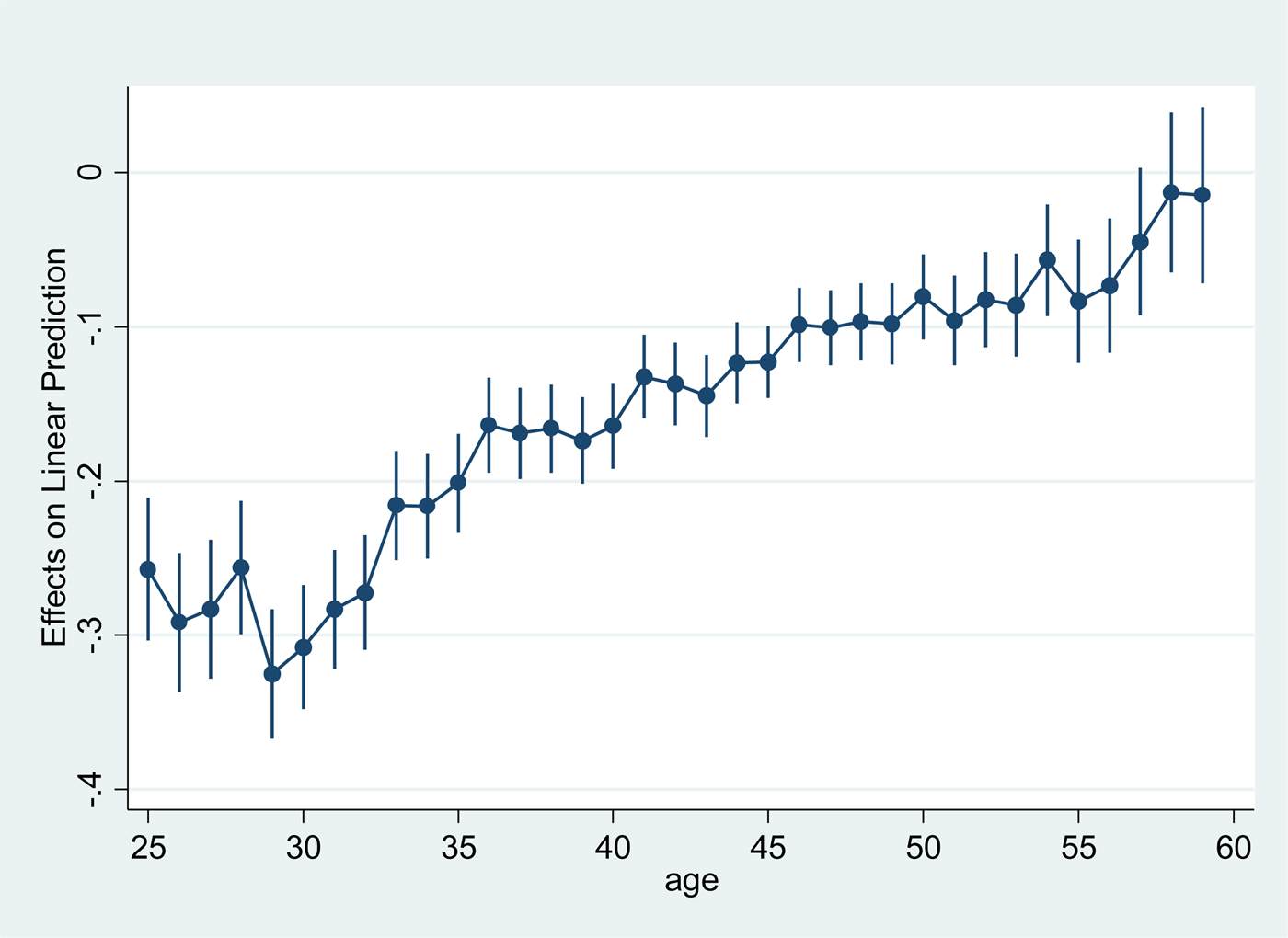
Looking at the effect over age ranges, we find a different dynamic, with workers switching from self-employment to employment mostly responsive to the difference in expected SSW at younger ages (Figure 9). While the effect diminishes after age 30, it is still quantitatively very important until age 50. For example, at age 30 a 10,000 Euro increase of the difference in SSW reduces the probability of switching by about 0.3 percentage points, while the same amount at age 46 reduces the probability by 0.1 percentage points.
(Colour online) Average marginal effect of the difference in SSW, by age, on transitions from self-employment to employment. Source: Authors’ calculations. Note: bars refer to 95% CI.

10 Conclusions
In this work, we study the effect of differential SSW in explaining the individual probability of being in self-employment rather than in employment as well as the probability of switching from self-employment to employment and vice versa. We base our analysis on a large panel of administrative data drawn from the archive of Italy's main Social Security scheme (National Institute of Social Security, INPS). We use the large exogenous variation in the individual differential in SSW occurring as a result of the reform process undertaken in Italy during the 1990s to identify its effect on the probability of being self-employed. We concentrate our analysis on the two main categories of self-employed workers – craftsmen and shopkeepers – which share the same Social Security rules and can be treated as one single category.
We compute the expected SSW for each individual and at each point in time in the two alternative scenarios of self- and wage-employment, and show that the difference in expected SSW between being self-employed and an employee was greatly affected by the reforms of the nineties. In 1990, the public pension system became particularly generous for craftsmen and shopkeepers, as opposed to employees. Later on, however, problems concerning the financial sustainability of the public pension system prompted a series of reforms, particularly in 1992 and 1995, which greatly – but unevenly – reduced the generosity of the benefits for both categories of self-employed workers and employees.
We use the exogenous variation in the individual differential SSW to estimate its causal effect on the self-employment rate and on the probabilities of switching to and from self-employment.
As SSW depends on the lifetime income stream of each worker and this, in turn, depends on past, current, and a projection of future income (which is based on current income), our measure of differential SSW suffers from a potential endogeneity problem, as long as current income is affected by current Social Security rules. We construct an exogenous measure of the difference in SSW using income streams constructed on past income only, i.e., projecting future income on the basis of past income, and use it to construct an exogenous differential SSW to be used as an instrumental variable.
We estimate a linear probability model controlling for other observable determinants, in addition to the difference in SSW, and unobserved heterogeneity. Overall, we find that the difference in expected SSW in the two scenarios plays an important role in explaining the observed patterns.
In particular, when looking at the self-employment rate, we find that, all other things being equal, a 10,000 Euro increase of the difference in expected SSW in the two scenarios increases the probability of being in self-employment by between 0.3 and 0.5 percentage points, depending on the specification. The average increase in the difference in SSW after the 1990, 1992 and 1995 reforms was about 32,000, 25,000 and 38,000 Euro. The effect of the difference in SSW on the probability of being a self-employed worker is not independent of age: our estimates show that its effect is highest for young individuals, decreasing for middle-aged workers, and increasing again after reaching a minimum at age 50. This pattern, as observed by the transition analyses, is due to the fact that, in response to an increase in differential SSW, among self-employed workers, the young are less likely to switch to employment, while among employees those aged 50+ tend to switch more to self-employment.
We also estimate the probability of switching to self-employment from employment and vice versa. The results indicate that an increase in the difference in expected SSW in the scenarios of self-employment and employment increases the probability of switching to self-employment from employment, while it reduces the probability of switching to employment from self-employment.
With regard to transitions from employment to self-employment, we find that the effect of the difference in expected SSW is quite sizeable, given that the average probability of switching is very low, amounting to 1.3%. We find that, all other things being equal, a 10,000 Euro increase of the difference in SSW increases the transition probability between 0.14 and 0.06 percentage points, depending on the specification. When estimating how this effect varies with age, we find that young individuals respond very little to the difference in SSW, while the effect is higher for individuals in their fifties.
Transitions from self-employment to employment are more likely to occur, with an average transition rate of 2.8%. Our analysis shows that a 10,000 Euro increase of the difference in SSW reduces the probability of switching from self-employment to employment by 0.1–0.15 percentage points. We also find that younger individuals are more sensitive to differential SSW, while the effect tends to reduce to zero for individuals close to retirement age. This pattern reflects the fact that switching to employment is disproportionately costly for self-employed workers close to retirement.
We conduct our analysis using Italian data both because it is a country in which many Social Security reforms took place, ensuring exogenous variation to individual SSW, and also because the self-employment rate is particularly high. This is due to a high percentage of craftsmen and shopkeepers, which constitute the subject of our analysis. We find a positive effect of the differential SSW between self-employment and employment on the probability of switching from employment to self-employment, a result that is at odds with the findings of Li et al. (Reference Li, Mastrogiacomo, Hochguertel and Bloemenx2016) for the Netherlands. The difference between our results and what was found for the Netherlands may result from different factors. First, we focus on a particular group of self-employed workers – craftsmen and shopkeepers – which represent a larger group in Italy compared with other countries. In addition, and perhaps most importantly, the institutional structures are quite different in the two countries: while in the Netherlands the pension wealth of the self-employed is mainly private, in Italy, on the other hand, pension wealth is (almost) entirely public and switching from employment to self-employment on average implies an increase in public pension wealth. As a result, while in the Netherlands it appears that employees react to an increase in differential SSW – caused by a reduction in their pension wealth – by increasing their private savings for retirement and they do not use their additional wealth to start up new businesses, the results for Italy indicate that employees take advantage of an increase in differential public pension by increasing the probability of switching to self-employment.
Appendices
Appendix A – The Italian pension system
A1 – The evolution of the Italian pension system
While the Pension Fund for Private Employees (PFLD) dates back to the beginning of the 19th century, it was respectively in 1959 and in 1966 that craftsmen and shopkeepers began to be covered by Social Security: self-employed workers then became eligible to receive retirement benefits. As a transitory measure, workers were able to apply for pensions with only 1 year of contributions. The payroll contributions for the self-employed were especially low, set at 12% of a minimum figurative income until 1973, when they were slightly raised. In 1982, an additional 4% computed on actual taxable income was added. The accrued pension benefit, computed with a defined contribution approach, was consequently very low and in most cases it was subsidised to reach the guaranteed minimum pension. In the same years, private employees contributed with a total payroll tax rate of about 20–25%, which then increased over time as imbalances of the public pension system became apparentFootnote 16. Their pension benefit was computed with a DB formula and they could, in general, retire earlier than self-employed workers.
An important reform in 1990 profoundly modified the rules, only for self-employed workers, increasing the contributions paid into the system and transforming benefits, introducing a DB pension formula similar to that applied to employees.
Hence, immediately after the 1990 reform, the pension system was characterised, for all workers, by a DB pension formula, based upon the last few years of earnings or income, without any actuarial correction for age at retirement.
In the main scheme, the FPLD, the pension was based upon pensionable earnings – computed as the average of the last 5 years’ earnings – multiplied by the number of working years and by the annual accrual rate:
 $$P_{{\rm DB}} = N \times \gamma \sum\limits_{i = 1}^5 {w_{\bar a - i + 1} /5}, $$
where  $\bar a$ is the individual's age in his final working year, w is his gross annual earnings indexed for inflation, γ is the annual accrual rate (approximately equal to 2%), and N is the number of years the individual has been active in the labour market. For self-employed workers a similar formula applied, with the average income computed over the last 10 years of activity.
An important difference between the self-employed and employees was constituted in the old-age requirement, being 65 for the former and 60 for the latter group.
The reform that took place in 1992, whilst preserving the DB system, modified the pension benefit formula for both employees and self-employed workers. For younger workers, pensionable earnings (or income) were planned to be based on the worker's entire earnings history and re-valued at the nominal GDP growth rate. For older workers, a transition phase gradually increasing the period over which pensionable earnings were to be computed was started. Most importantly, the pension indexation mechanism was downgraded from wages to prices for all categories of workers, with immediate effect, causing a sudden reduction in SSW for all workers (as well as pensioners). Such an indexation mechanism has since been maintained by all subsequent reforms. In addition, eligibility requirements for employees were gradually tightened.
Another reform, approved in 1995, rescheduled a new (and lengthy) transition towards an NDC formula. When the new system is phased in, benefits will be commensurate to the amount of payroll taxes paid, capitalised at an interest rate equal to the growth rate of the GDP and annuitised according to life expectancy at retirement.
The reforms of 1992 and 1995 thus opened a lengthy transition period which will end in 2030. Until then, in fact, the rules for accessing retirement and for calculating the pension benefit will evolve differently for different generations of workers. In particular, three groups can be distinguished:
1 Workers who accumulated at least 18 years of service at the end of 1995: the pension for these workers is calculated with the DB rules as modified by the 1992 reform. The age requirements for retirement have also been raised. Hence, a Modified Defined Benefit (MDB) applies to these workersFootnote 17;
2 Workers who started contributing to the pension system before 1995, but accumulated <18 years of contributions at the end of 1995: for these workers the pension is calculated with a pro rata (PR) system. The first part of the pension covers the seniority accrued up to the end of 1995 and is calculated with the DB formula. The second part of the pension instead refers to seniority accrued after 1995 and is calculated with the NDC formula;
3 Workers who entered the labour market since January 1, 1996: the NDC system fully applies to these workers.
The above classification applies to both the self-employed and employees, although there are still differences in the computation of pensionable earnings, in the payroll tax rates and in legal retirement ages.
It is useful to describe the above mentioned pension formulae for the computation of the benefits, as the results of our analysis are largely based upon them. In the MDB system, the benefit depends upon pensionable income, i.e., average income earned at the end of the career. As a consequence of the 1992 reform, the benefit consists of two parts, in which pensionable income is computed taking the average over a longer period for seniority accrued after 1992. Apart from this complication, the MDB check is a traditional DB pension computed as:
 $$P_{{\rm MDB}} = \alpha {\rm \;} (c_1 W_1 + {\rm \;} c_2 W_2 ),$$
where W 1 and W 2 is pensionable income, i.e., average income over the last five (W 1) or ten (W 2) years of the working career (10–15 for the self-employed), re-valued in line with inflation (W 1) or nominal GDP growth (W 2), and c 1 and c 2 are the years of contribution accrued before and after 1992, respectively. The annual accrual rate α is equal to 2% up to a certain threshold, gradually reduced for higher pensionable incomes.
The NDC pension, for all categories of workers, is computed as
 $$P_{{\rm NDC}} = \left( {\sum\limits_{i = \underline a} ^{\bar a} {C_i (1 + g)^{\bar a - i}}} \right)\delta _{\bar a + 1}, $$
where C i is the contribution paid by the worker at age i, g is the 5 years moving average of the nominal GDP growth rate, δ is an age-specific annuity rate,  $\underline a $ is the age at which the worker entered the labour market and
 $\bar a$ is the individual's age in his final working year. In other words, the pension benefit in the NDC system is equal to the notional capital, i.e., the sum of all contributions paid, re-valued to a rate equal to the 5 years moving average of the nominal GDP growth rate, multiplied by an age-specific coefficient δ. The annuity rates δ are set by law as the inverse of the present value at retirement of a one unit annuity benefit and they are updated according to life expectancy. The NDC pension formula fully applies to NDC workers, who entered the labour force after 1/1/1996. During the transition, i.e., for workers already active in the labour force in 1995, the pension benefit will be computed with a pro rata mechanism, as a weighted average of the MDB and NDC check, with the weights given by years of seniority accrued before and after 1/1/1996.
Due to the length of the transition, numerous legislative measures have gradually raised the requirements for access to retirement, but without changing the method of calculating the pension. In particular, in December 1997 age requirements to claim a seniority benefit have been raised for all categories of workers, and payroll tax rates have been raised for self-employed workers.
As a result of the reform process, payroll tax rates have reached 32.7% for employees and 17.2% for the self-employed in the year 2005, the last year considered in our analysis.
A2 – Hypotheses in the computation of the Present Values and expected SSW
To compute future pension entitlements and expected SSW we use the official ISTAT mortality tables from 1985 to 2005. As for the macroeconomic variables, we set the interest rate, inflation rate and GDP real growth rate at their historical levels up to the year 2013. For the future they are set at 2%, 1.6% and 1.5%, respectively. The real discount rate is also set at 1.5%.
Nominal SSW ( $\widetilde{{SSW}}$) for an individual aged a at time t + 1 is defined as:
 $$\widetilde{{SSW}}_{a,\; t + 1} = \mathop \sum \limits_{k = \bar a + 1}^A P_k \; \eta _k \; (1 + i_{t + 1 + k - a} )^{ - (k - a)} - \mathop \sum \limits_{\,j = a}^{\bar a} C_j (1 + i_{t + 1 + j - a} )^{ - (\,j - a)}, $$
where  $\bar a$ is the individual's age in his final working year, A is the maximum age, P k is the (nominal) pension a worker aged a at time t + 1 expects to receive at age k, η k is the probability of being alive at age k, conditional on being alive at retirement, i is the nominal interest rate, and C j is the contribution paid by the worker at age i, in nominal terms. We obtain real SSW by deflating it using the Consumer Price Index (CPI) for the relevant year.
Appendix B – Data appendix
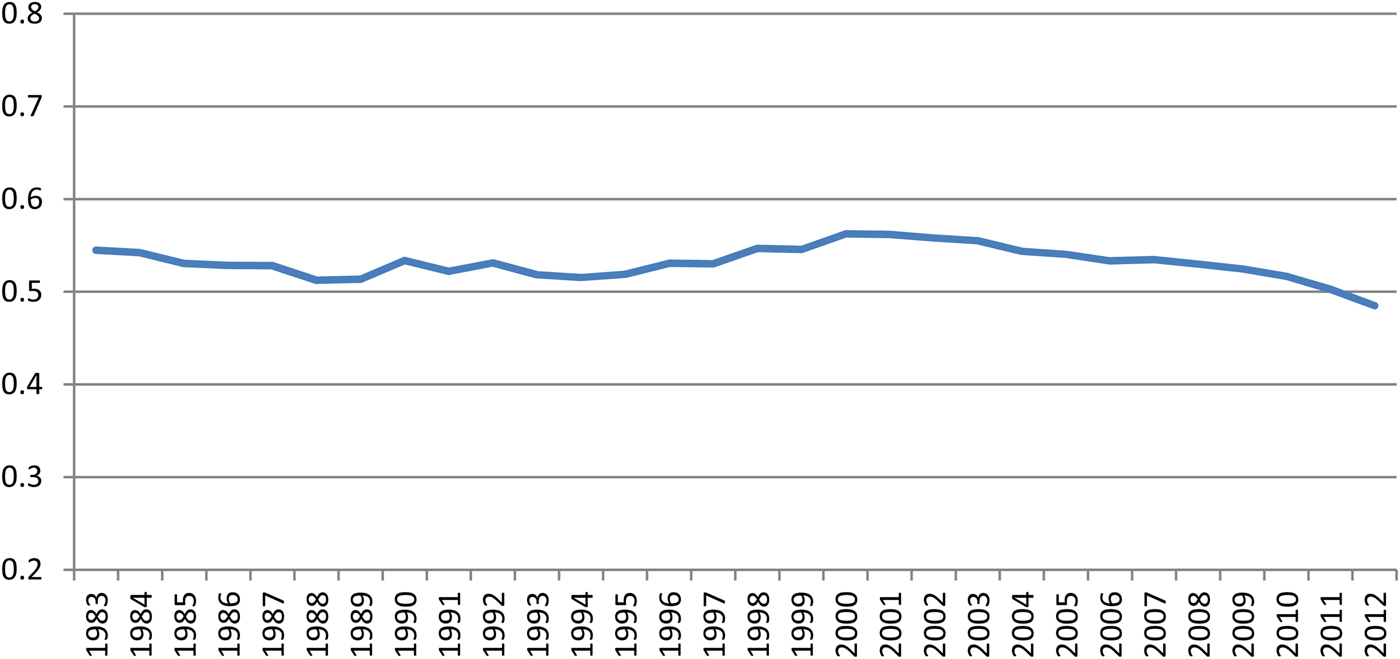
As we perform our analysis using administrative data from the INPS archive, we are interested to know if the fraction of Italian workers covered by INPS is stable over time. In the graph below, we show the percentage of workers covered by the INPS archive over the total number of workers (source: Eurostat) from 1983 to 2012. This demonstrates that the proportion of workers who we follow over time is roughly constant, at around 55% of the total workers.
(Colour online) Fraction of workers covered by INPS. Note: In this graph we show the ratio (expressed as a percentage) of workers covered by the INPS archive and the total number of workers (aged 15 +) as recorded by Eurostat.

B2 – Summary statistics for regression variables
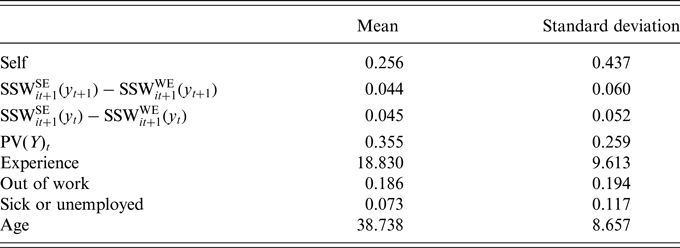
Summary statistics for variables included in the regressions, pooled data

B3 – Earnings profiles for self-employed and employees
We estimate average earnings profiles running OLS regressions on the logarithm of total earnings on a fourth-order polynomial in age and on cohort dummies, separately for employees and self-employed. We use these estimated profiles to compute the rate of growth of earnings over the life cycle.
Log Earnings Age Profiles, cohort born in 1940. Note: Earnings are expressed at constant 2013 prices.

Appendix C – Sensitivity analysis
C1 – Results based on flat real earnings profiles
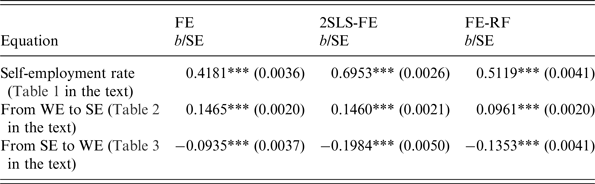
In Table C1, we report the results of the specifications shown in the main text (Tables 1–3) based on a different measure of SSW computed using flat real earnings profiles, both for self-employed and for employees. In this case, the SSW is computed assuming the income stream is the actual one up to time t + 1 (or time t, depending on the specification) and constant in real terms thereafter, irrespective of the decision to be self-employed or employee. For brevity, only the coefficients on the differential in SSW between self-employment and employment are reported.
Coefficients on the difference in SSW

C2 – Probit results
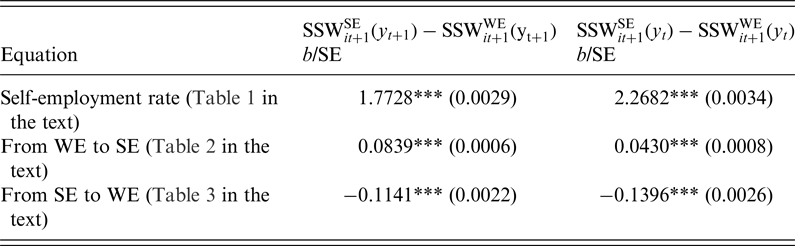
In Table C2, we report the estimated marginal effects of the variable of interest of the specifications shown in the main text (Tables 1–3) estimated using a probit model. In the column labelled  ${\rm SSW}_{it + 1}^{{\rm SE}} (y_{t + 1} ) - {\rm SSW}_{it + 1}^{{\rm WE}} (y_{t + 1} )$, the differential SSW is computed on an income stream projected using information up to time t + 1, while in the column labelled
 ${\rm SSW}_{it + 1}^{{\rm SE}} (y_{t + 1} ) - {\rm SSW}_{it + 1}^{{\rm WE}} (y_{t + 1} )$, the differential SSW is computed using an income stream projected using information only up to time t.
Probit estimates, marginal effects

C3 – Sample period: 1985–1998
As the last major reform affecting payroll tax rates and age requirements was implemented in 1998, and only small changes have been implemented after that year (e.g. to minimum contributions), in Table C3 we report the results of the specifications shown in the main text (Tables 3–5) based on a different sample, up to 1998. For brevity, only the coefficients on the differential in SSW between self-employment and employment are reported.
Coefficients on the difference in SSW, sample period: 1985–1998