INTRODUCTION
South Georgia is situated on the northern extension of the Scotia Arc, and biogeographically forms a district of the West Antarctic sub-region (cf. De Broyer & Rauscher, Reference De Broyer and Rauscher1999; Linse, Reference Linse2002). It is considered to constitute a marine biodiversity ‘hotspot’ in the Southern Ocean (Hogg et al., Reference Hogg, Barnes and Griffiths2011), where its geological age (approximately 30 Ma, cf. Dalziel & Elliot, Reference Dalziel and Elliot1971) and separation of its continental shelf by very deep water from other shallow areas (Clarke & Johnston, Reference Clarke and Johnston2003), have been suggested as partly being the drivers of its high biodiversity and high degrees of endemism (Hogg et al., Reference Hogg, Barnes and Griffiths2011; Goodwin et al., Reference Goodwin, Brewin and Brickle2012).
Intertidal zones of South Georgia experience highly variable environmental stresses, such as temperatures ranging from 24oC to −15oC, high inputs of fresh water and siltation from glaciers, mechanical stresses from ice scour, wave exposure, and high organic inputs from high densities of birds and mammals (Davenport, Reference Davenport1997; Peck et al., Reference Peck, Convey and Barnes2006; Smale et al., Reference Smale, Barnes and Fraser2007; Waller, Reference Waller2008). Furthermore, South Georgia lies just south of the Polar Front, and because of this proximity, the island's biodiversity may be particularly vulnerable to impacts of predicted rapid ocean warming (Hogg et al., Reference Hogg, Barnes and Griffiths2011). Better understanding of South Georgia's intertidal communities may, therefore, lead to better monitoring of climate related changes. However, the intertidal species assemblages of South Georgia have received little attention, with the exception of sporadic, unstructured collections during historic expeditions in the early part of the 20th Century. More recently, studies of responses to disturbance (e.g. Pugh & Davenport, Reference Pugh and Davenport1997), and of environmental tolerances (e.g. Pugh & Bartsch, Reference Pugh and Bartsch1993; Moore et al., Reference Moore, MacAlister and Taylor1995; Davenport & Macalister, Reference Davenport and Macalister1996; Davenport, Reference Davenport, Barnett and McAllen1997; Davenport et al., Reference Davenport1997) have been carried out on specific macrofaunal groups.
Because of their size and habitat preferences, marine planarians (Tricladida Maricola) are among the turbellarians more likely to be detected in ecological studies carried out in the intertidal zone. However, little is still known about their diversity and distribution in the Scotia Arc. A search of OBIS (Intergovernmental Oceanographic Commission of UNESCO, 2013), and SCAR-MarBin (De Broyer & Danis, Reference De Broyer and Danis2013; De Broyer et al., Reference De Broyer and Danis2013) returns for the area only about 100 records of ‘Turbellaria’ and four records corresponding to the taxa ‘Seriata’, ‘Rhabdocoela’, Thysanozoon nigropapillosum (Polycladida) and Synsiphonium liouvilli (Tricladida).
Most of the marine triclads or Maricola known from South Georgia were found during the Swedish Antarctic Expedition, which took place between 1901 and 1903 (Hallez, Reference Hallez1906, Reference Hallez1911; Westblad, Reference Westblad and Odhner1952; Sluys, Reference Sluys1989). The marine planarians reported for this island so far are: Centrovarioplana tenuis Westblad, Reference Westblad and Odhner1952, Stummeria marginata (Hallez, Reference Hallez1906), Meixnerides armatus Westblad, Reference Westblad and Odhner1952Obrimoposthia wandeli (Hallez, Reference Hallez1906), Synsiphonium anderssoni (Westblad, Reference Westblad and Odhner1952) and Synsiphonium liouvilli Hallez, Reference Hallez1911. It is interesting to note that these six species are representative of five families, viz. Centrovarioplanidae, Cercyridae, Meixneridae (Cercyroidea), Uteriporidae and Bdellouridae (Bdellouroidea), respectively. Therefore, a high morphological variability underlies this low number of species.
During a survey carried out to describe the intertidal and subtidal species and habitat distribution along the north coast of South Georgia, several Tricladida Maricola were found. One of the specimens turned out to be a new species of Allogenus Sluys, Reference Sluys1989 (Uteriporidae).
MATERIALS AND METHODS
Specimens were collected by P. Brewin and A. Massey on 6 December 2010 from Corral Bay, Cumberland East Bay, South Georgia (54o17.92′S 36o22.63′W), at approximately 4 m up the shore from low tide (Figure 1). The survey was part of a larger programme aimed at quantitatively describing the intertidal and subtidal species and habitat distribution along the north coast of South Georgia (Shallow Marine Surveys Group, unpublished data). Specimens were preserved in 96% ethanol for fixation, and later transferred to 70% ethanol for long term storage.
Collection site: (A) map of South Georgia showing Corral Bay. Inset: Scotia Arc; (B) quadrant (0.25 m2) where the specimen was found.

For the histological study, a sexually mature specimen was dehydrated via an ascending series of ethanol, cleared in xylene and embedded in paraffin. Serial sections were cut at intervals of 5 μm, stained with Heidenhain's iron haematoxylin (Langeron, Reference Langeron1949) and mounted in Canada balsam.
Drawings and measurements were made with the aid of a drawing tube, and photomicrographs were taken with a Nikon DS-Fi1 camera. The format of the descriptions and terminology follows Sluys (Reference Sluys1989).
Abbreviations used in the figures
- bu
bursa
- cm
circular muscle fibres
- co
common oviduct
- ed
ejaculatory duct
- ey
eye
- go
gonopore
- in
intestine
- le
lens
- lm
longitudinal muscle fibres
- ma
male atrium
- mo
mouth
- od
oviduct
- ov
ovary
- pc
pigment cup
- ph
pharynx
- po
pharyngeal pouch
- pp
penis papilla
- rc
retinal cell
- sd
spermiducal vesicles
- sg
shell glands
- sp
sperm cells
- sv
seminal vesicle
- te
testis
- vd
vas deferens
- vi
vitelline gland
SYSTEMATICS
Superfamily BDELLOUROIDEA Sluys, Reference Sluys1989
Family UTERIPORIDAE Böhmig, 1906
Subfamily UTERIPORINAE Böhmig, 1906
Genus Allogenus Sluys, Reference Sluys1989
Allogenus sluysi sp. nov.
(Figures 2–6)
ETYMOLOGY
The species is named after Dr Ronald Sluys, for his great contribution to the knowledge of marine planarians.
TYPE MATERIAL
Six slides with sagittal sections of a single specimen from Corral Bay, Cumberland East Bay, South Georgia (54°18′S 36°22′W), collected on 6 December 2010, deposited in the Natural History Museum (NHM), London (Accession number: NHMUK 2013.9.30.1).
ECOLOGY AND DISTRIBUTION
Corral Bay is approximately west facing, with steep bedrock promontories, flat rocky platforms with numerous rock pools, and medium sloping cobble/boulder beaches. The upper shore is bordered by low-lying terrain of dense tussock grass (Parodiochloa flabellata). The macrofaunal assemblage is somewhat depauperate, with dense and highly patchy distributions of mites (Halacaridae), bivalves (Gaimardia trapesina), gastropods (Laevilitorina caliginosa) and Oligochaeta. The seaweed Enteromorpha sp. is also found with similarly highly patchy distribution.
DIAGNOSIS
Allogenus sluysi sp. nov. has the characteristics of the genus and can be distinguished from the type species, Allogenus kerguelensis, by its smaller size, blackish-brown pigmentation, presence of three retinal cells in each eye cup, position of its testes half-way between the ventral and dorsal body surfaces or in a slightly more ventral position, and by having an ejaculatory duct that opens centrally at the tip of the penis papilla.
DESCRIPTION
Habitus
Length of preserved specimen 3.8 mm; maximum width 1.4 mm. Body tapering gradually towards the rounded front end (Figure 2A, B); hind end slightly expanded, somewhat obtusely pointed (Figure 2B). No indication of auricles.
General features of Allogenus sluysi sp. nov.: (A) fixed specimen in dorsal view; (B) fixed specimen in ventral view; (C) reconstruction of the internal anatomy based on the serial sagittal sections; (D) sagittal section of an eye.
The dorsal surface is uniformly blackish-brown. Small marginal and larger, paramedial white spots are present (Figure 2A); however, because of their unequal size and their asymmetrical distribution on the dorsal surface, these spots do not seem to be part of the pigmentation pattern. Two faint, pale spots run along the anterolateral margin on either side of the head, extending to the level of the eyes. The ventral surface is whitish to grey, with a brownish tint in the anterior region (Figure 2B).
Two small, anterior eyes surrounded by a small whitish halo (Figure 2A, C). Each eye has three retinal cells enclosed by the pigment cup, and one large lens (Figure 2D).
Alimentary system
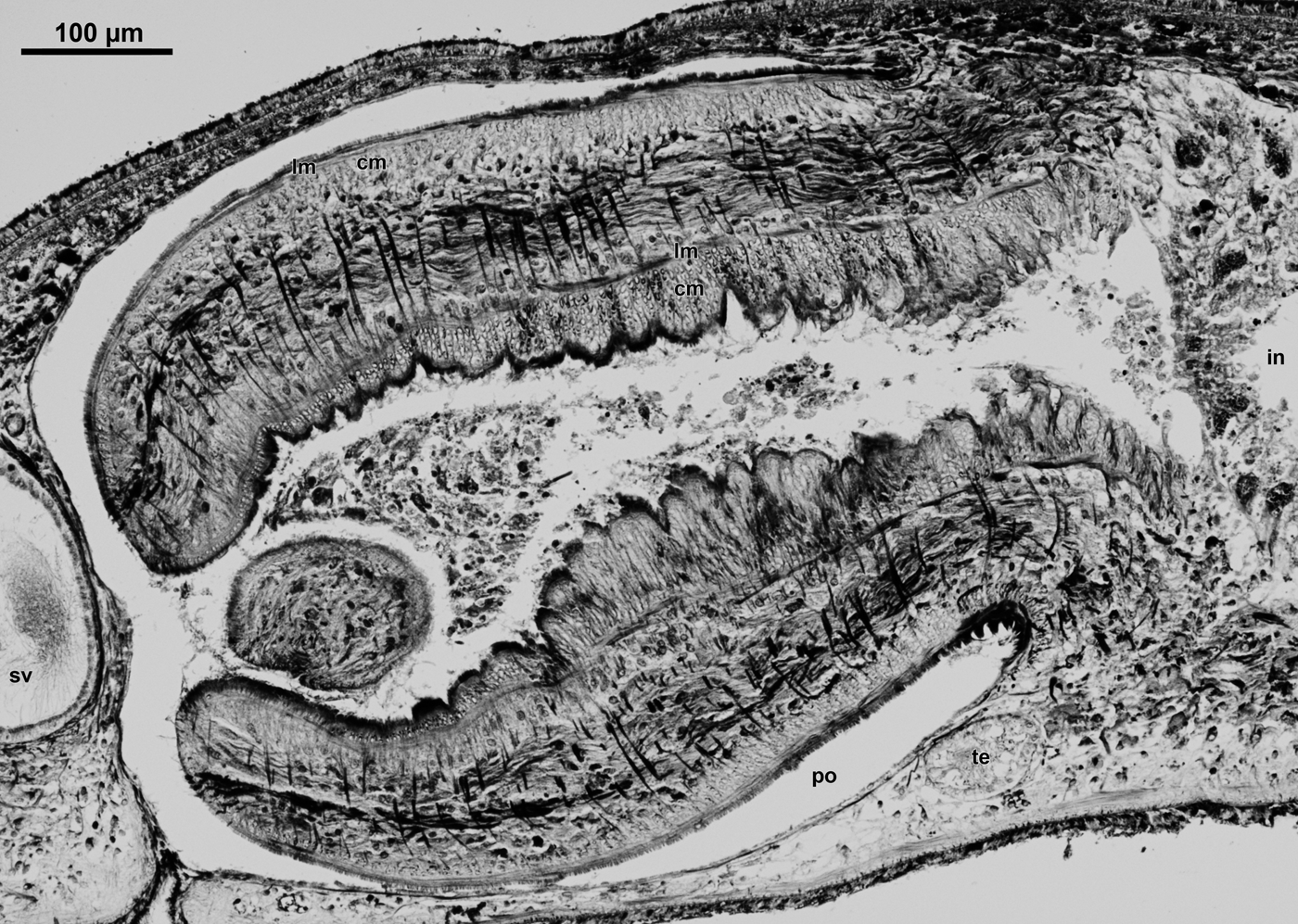
Pharynx about one-sixth of the body length, located in the posterior half of the body (Figure 2C). The outer and inner longitudinal muscles are arranged in thin layers. The anterior half of the inner layer of circular muscles is thicker than the outer circular muscle layer (Figure 3). The mouth opening is at the hind end of the pharyngeal cavity, at about 150 µm from the gonopore.
Sagittal section of the pharynx of Allogenus sluysi sp. nov.
At the level of the eyes, the anterior intestinal ramus gives rise to a short anterior branch that ends at a distance of 340 µm from the front end. There are ~10 mostly forked postocellar diverticula on each side. Each of the posterior rami gives rise to ~10 lateral, unbranched diverticula and a few medial, short branches. Both rami meet close to the posterior end, and a short common branch arises from their point of confluence (Figure 2C). The latter ends at a distance of 115 µm from the hind end.
Male reproductive system
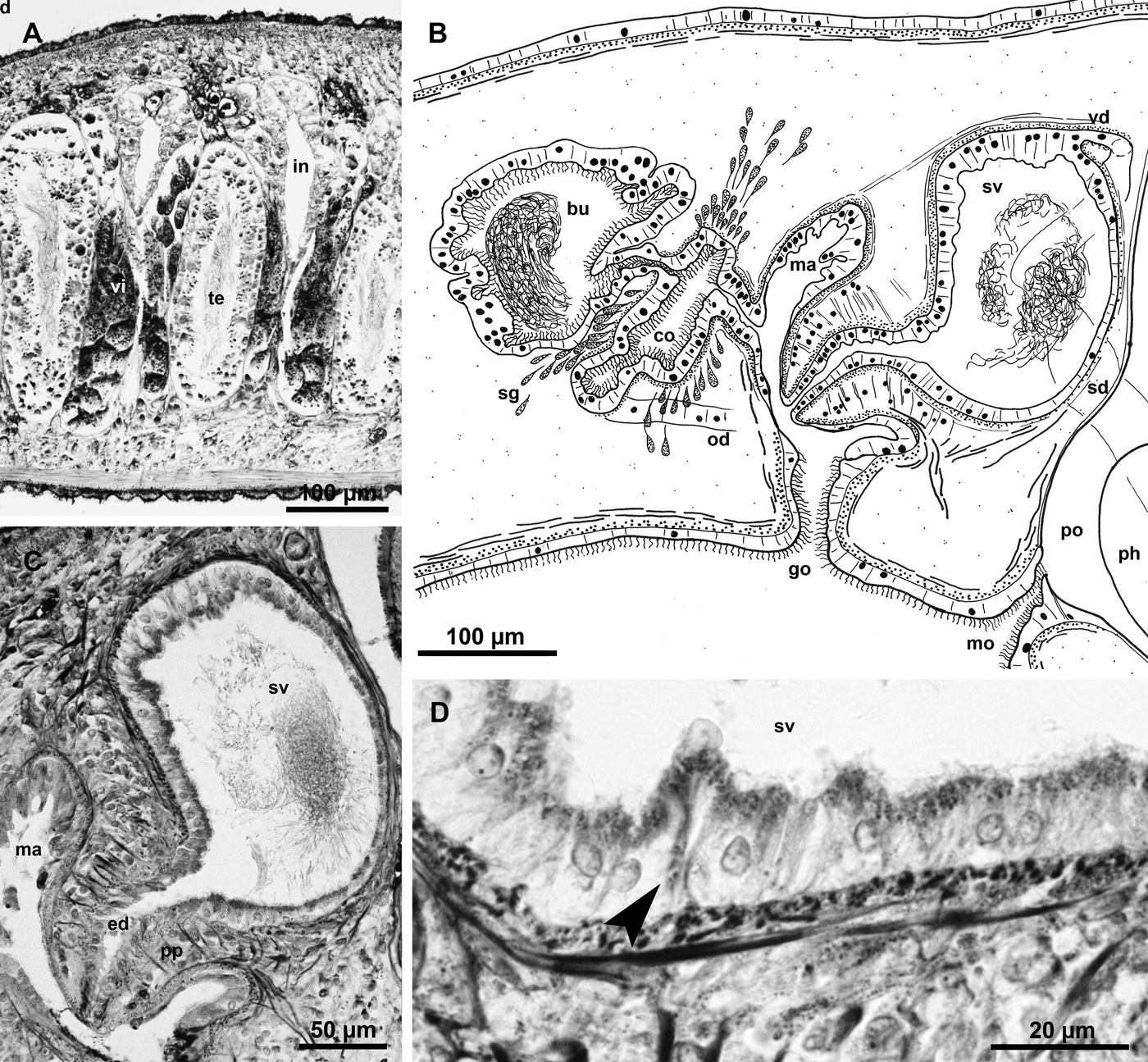
The large testes extend from directly behind the ovaries to the level of the root of the pharynx (Figures 2C, 3). There are about 16 follicles on either side of the body, situated half-way between ventral and dorsal surfaces, or in a slightly more ventral position (Figure 4A).
Reproductive system of Allogenus sluysi sp. nov.: (A) sagittal section showing testes; (B) reconstruction of copulatory apparatus in sagittal view; (C) sagittal section of penis; (D) epithelium of the seminal vesicle, showing cyanophil secretions.
The vasa deferentia run posteriorly and expand at the level of the base of the pharynx to form spermiducal vesicles, lined with a flat epithelium. These spermiducal vesicles run posteriorly for a short distance and narrow gradually while ascending towards the seminal vesicle. The ducts unite just before entering the penis bulb, giving rise to a short, narrow vas deferens (Figure 4B). The common vas deferens is lined by a cuboidal, nucleated epithelium, surrounded by circular muscle fibres; it opens into the antero-dorsal portion of a large seminal vesicle (Figure 4B). The latter is lined with a cuboidal, nucleated epithelium that is taller dorsally (Figure 4C); it is surrounded by circular and obliquely running muscles. The seminal vesicle tapers rather abruptly into an ejaculatory duct, whose distal portion opens centrally at the tip of the penis papilla (Figure 4B, C). The ejaculatory duct has a cuboidal, nucleated, non-ciliated epithelium and is surrounded by circular and longitudinal muscles.
The penis is small and has an oblique, ventro-caudal orientation. It consists of a weakly muscularized bulb, and a conical, symmetrical penis papilla (Figure 4B, C). The bulb occupies about two-thirds of the total length of the penis, and is almost entirely filled by the seminal vesicle (Figure 4B, C). The penis papilla is lined with a flat, nucleated epithelium, and provided with circular and longitudinal muscle layers; there are also abundant radial muscle fibres as well as nuclei. Penis glands could not be discerned; fine, cyanophil granules were seen in the epithelium of the seminal vesicle (Figure 4D), as well as externally to the surrounding muscle layer.
Female reproductive system
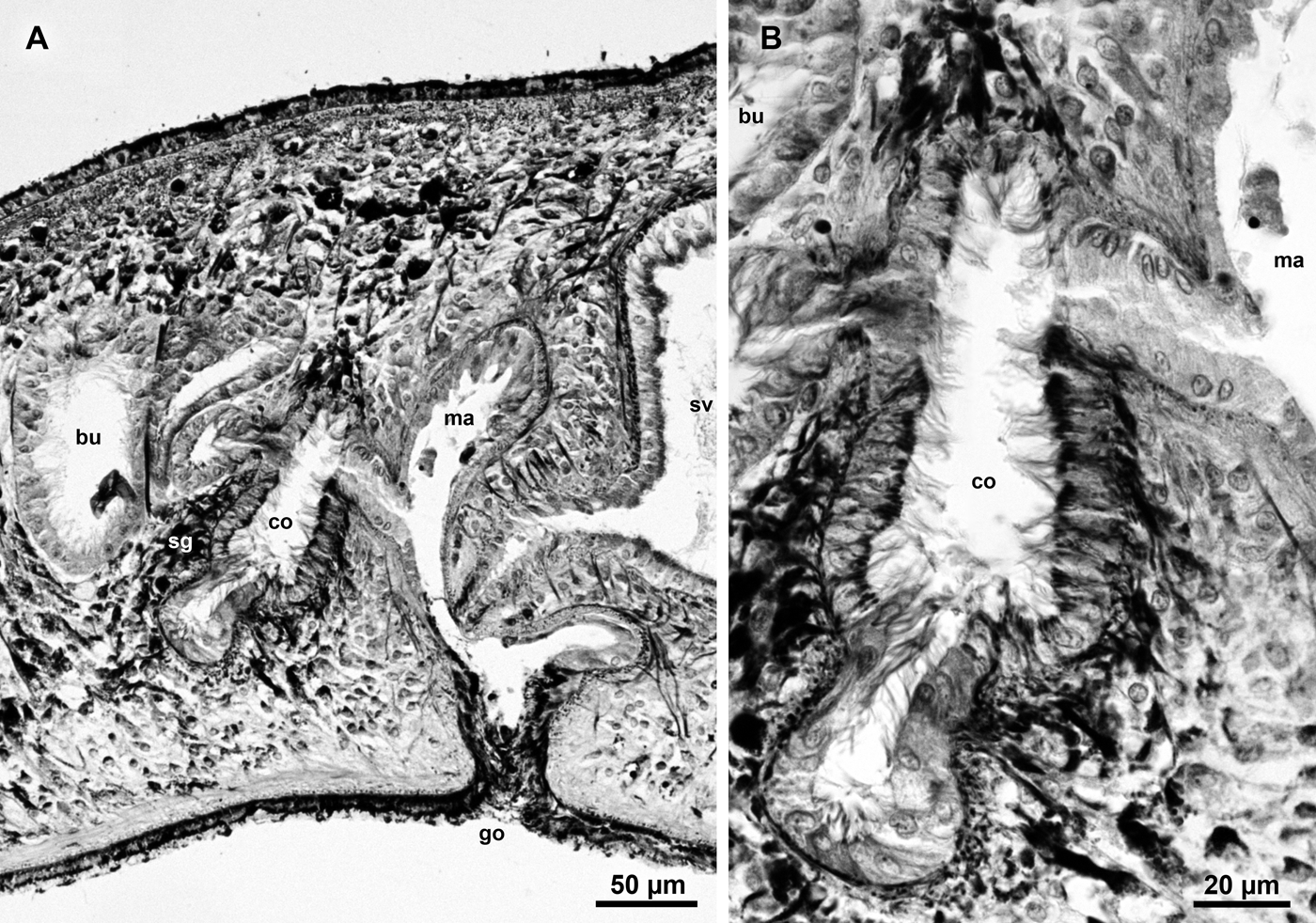
The two ovaries lie medio-dorsally to the nerve cords, at about one-third of the distance between the brain and the root of the pharynx. The oviducts arise from the ventrolateral surface of the ovaries and run posteriorly, laterally to the lateral nerve cords, receiving along their course the secretion of the vitelline glands. Behind the gonopore the oviducts turn medially and unite to form a common oviduct, which is lined with a cuboidal, nucleated and ciliated epithelium that is surrounded by a thin layer of circular muscle fibres (Figure 5). The proximal portion of the common duct is narrow, while its distal section is more expanded, the latter receiving the secretion of shell glands. The common oviduct gives rise to a non-ciliated, narrow duct that opens into the atrium; this duct is histologically similar to the wall of the atrium (Figure 5).
Reproductive system of Allogenus sluysi sp. nov.: (A) sagittal section through the copulatory apparatus showing the bursa, common oviduct and shell glands; (B) detail of the common oviduct and associated ducts in sagittal view.
The vitelline glands are located mostly half-way between the ventral and dorsal surfaces, or in a slightly more ventral position (Figure 4A). They extend from anteriorly to the ovaries into the hind end of the body (Figure 2C).
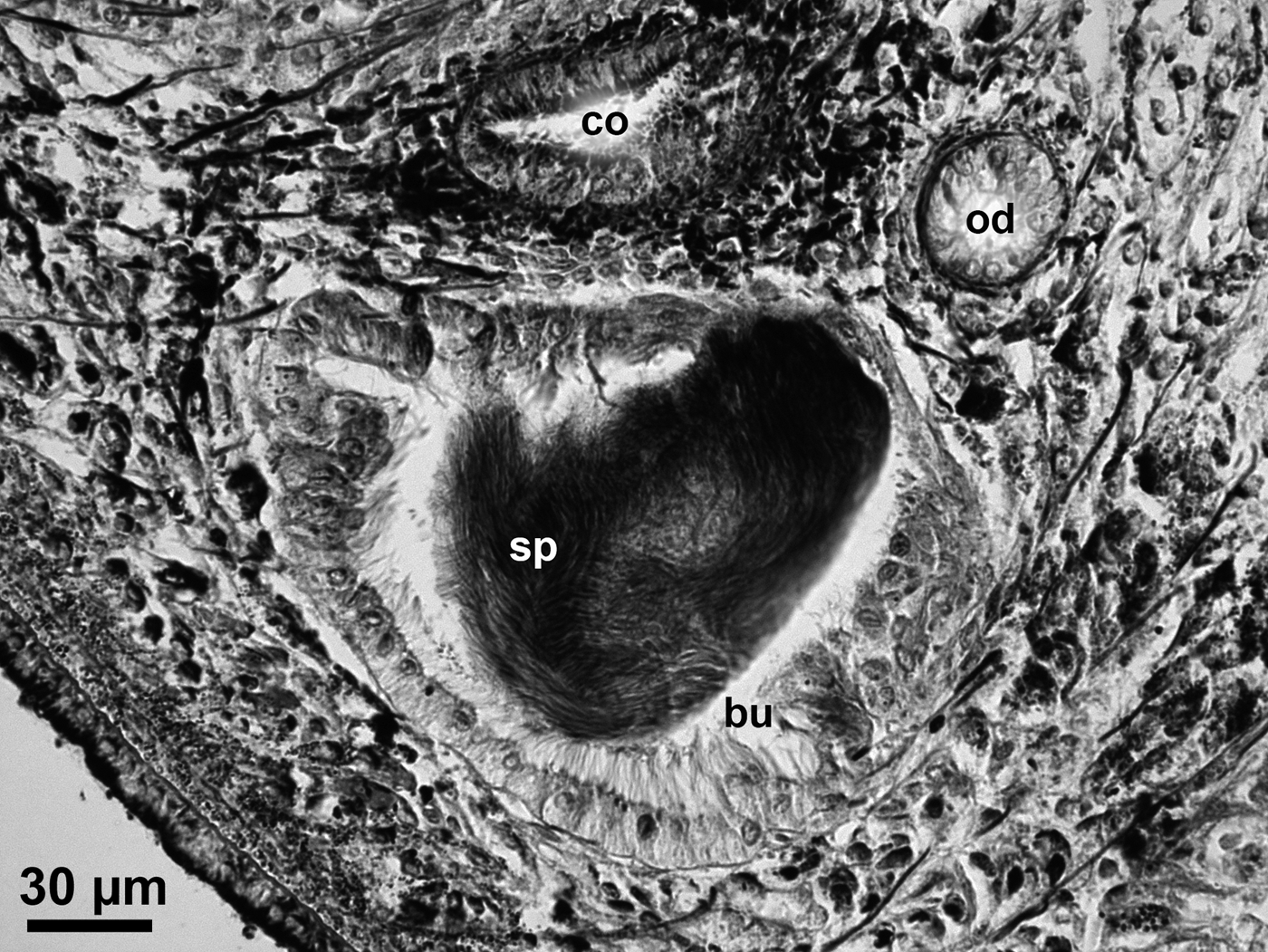
The irregularly-shaped copulatory bursa is located posteriorly to the gonopore, in a dorsal position (Figure 4B); it is lined with a ciliated, nucleated epithelium of irregular height, and has no associated musculature. Densely packed sperm cells were observed inside the bursa (Figure 6), while a vacuolated mass was not apparent. The bursa is connected to the common oviduct through a short, narrow duct lined with a flat, ciliated and nucleated epithelium that is surrounded by a few circular muscle fibres.
Sagittal section through the copulatory bursa of Allogenus sluysi sp. nov., showing densely packed sperm in its lumen.
DISCUSSION
Taxonomy
Allogenus sluysi sp. nov. has all the characteristics of the genus Allogenus Sluys, Reference Sluys1989, i.e. a copulatory bursa that communicates with the female genital duct or common oviduct through a very short connecting duct, and ovaries that are located at one-third of the distance between the brain and the root of the pharynx (Sluys, Reference Sluys1989). Furthermore, the new species shares many features with the type and only known species, Allogenus kerguelensis (Hyman, Reference Hyman1958). It has the same general shape of the body, apparent lack of auricles, position of the eyes, organization of the alimentary system, distribution of gonads and glands, and general organization and histology of the reproductive system.
Despite these similarities, A. sluysi sp. nov. can be clearly differentiated from A. kerguelensis. The specimen of A. sluysi sp. nov. has large testes with abundant sperm, while sperm is packed inside the seminal vesicle. Furthermore, it has well-developed yolk and shell glands. All of these traits indicate that it is fully mature. Therefore, it can be concluded that A. sluysi sp. nov. is much smaller than A. kerguelensis, whose mature specimens have a size of about 7 mm (Hyman, Reference Hyman1958; Sluys, Reference Sluys1989). In addition, in A. kerguelensis the dorsal and ventral surfaces are devoid of pigment, the eyes have two retinal cells and one lens in the pigment cup, testes are ventral, and the ejaculatory duct opens acentrally at the tip of the penis papilla (Hyman, Reference Hyman1958; Sluys, Reference Sluys1986, Reference Sluys1989). In contrast, A. sluysi sp. nov. has blackish-brown pigmentation on the dorsal surface and, to a smaller extent, on the anterior ventral surface, eyes with three retinal cells and one lens, testes half-way between the ventral and dorsal surfaces or at most in a slightly more ventral position, and an ejaculatory duct that opens centrally at the tip of the penis papilla.
Allogenus kerguelensis was originally described by Hyman (Reference Hyman1958) from two specimens from Kerguelen as Procerodes kerguelensis Hyman, Reference Hyman1958. Years later, a specimen belonging to this species was found on Macquarie Island (Sluys, Reference Sluys1989). Specimens from both localities were found to be very similar in all respects, except for the shape of their seminal vesicles (small in specimens from Kerguelen, large and rounded in the specimen from Macquarie) and the contents of the copulatory bursae (sperm and an unidentifiable vacuolated mass were noted in the specimen from Macquarie) (Sluys, Reference Sluys1989). Allogenus sluysi sp. nov. has a large seminal vesicle, as in the specimen of A. kerguelensis from Macquarie Island; however, in the former the entrance of the common vas deferens is more anterior.
The unidentifiable vacuolated mass observed by Sluys (Reference Sluys1989) in the specimen of A. kerguelensis from Macquarie Island was not observed in the specimen of A. sluysi sp. nov. The copulatory bursa of the latter only contained densely packed sperm, so that we are unable to elucidate the nature of this vacuolated mass.
Biogeography
Up until now, the genus Allogenus had only been found on two isolated, sub-Antarctic islands, about 5700 km apart. In a biogeographical analysis of marine planarian distribution, Sluys (Reference Sluys1989) noted that because of this distribution, Allogenus contributes to a generalized track across the Southern Ocean. The finding of A. sluysi sp. nov. on the sub-Antarctic island of South Georgia considerably extends the known range of Allogenus, and gives further support to Sluys' observation.
As a further result of his historical biogeographical study, Sluys (Reference Sluys1989) proposed vicariant geological events as the main factor to explain the current distribution of Southern Ocean marine planarians. According to this author, the observed distribution is likely to be the result of the division of a formerly continuous Gondwanian distribution area. He was reluctant to postulate long-distance dispersal as the major factor behind the current distribution pattern, in view of the low dispersal capacity of marine triclads, the lack of a dispersive stage in their life cycle, the lack of circumstantial evidence for passive dispersal, and the low probability of a single individual being the founder of a new population.
With the inclusion of A. sluysi sp. nov., currently seven species belonging to six genera of Maricola are known from South Georgia. Three of these are representatives of three families within the Cercyroidea, which is considered to be the most primitive group among the marine planarians (Sluys, Reference Sluys1989), while the remaining four belong to two families within the Bdellouroidea. Their distributions can be summarized as follows: Centrovarioplana tenuis and Meixnerides armatus, the two species with the smallest range of distribution, have also been found at the West Falkland Islands (Westblad, Reference Westblad and Odhner1952; Sluys, Reference Sluys1989); Stummeria marginata at Maritime Antarctica (Hallez, Reference Hallez1906, Reference Hallez1907; Sluys, Reference Sluys1989); Synsiphonium anderssoni at South America and Maritime Antarctica (Westblad, Reference Westblad and Odhner1952; Sluys, Reference Sluys1989), and Synsiphonium liouvilli and Obrimoposthia wandeli at South America, Maritime Antarctica, Antarctica and islands of the Kerguelen-Heard Plateau (Hallez, Reference Hallez1906, Reference Hallez1907, Reference Hallez1911, Reference Hallez1913; Böhmig, Reference Böhmig1908, Reference Böhmig and Drygalski1914; Westblad, Reference Westblad and Odhner1952; Hyman, Reference Hyman1955, Reference Hyman1958; Nurse, Reference Nurse1963; Sluys & de Vries, Reference Sluys and de Vries1988; Sluys & Ball, Reference Sluys and Ball1989; Sluys, Reference Sluys1989). At present, A. sluysi sp. nov. seems to be the only endemic maricolan on South Georgia. However, the possibility cannot be ruled out that with more sampling efforts, it may be found also elsewhere.
From the above it follows that the remaining five species have been found on either the Falkland Islands or South America, excepting Stummeria marginata and A. sluysi sp. nov. Given the continental origin of South Georgia, this can be interpreted as the result of vicariant events, in agreement with Sluys' (1989) vicariance hypothesis. In fact, vicariance would also explain the heterogeneous species composition observed on the island, as was also proposed by Sluys (Reference Sluys1989) for the isolated Southern Ocean islands. However, considering the relatively close proximity of South Georgia to the Falkland Islands and South America, together with the direction of the West Wind Drift, it could also be argued that passive dispersal from these areas is a distinct possibility. Therefore, the heterogeneous species composition on South Georgia and the distribution of these species in the region are in agreement with a vicariance-based scenario, but, at this local scale, dispersal cannot be ruled out. Continued sampling effort in South Georgia, the sub-Antarctic, and Antarctic regions, combined with molecular examination, will further elucidate such historical and contemporary processes.
ACKNOWLEDGEMENTS
Special thanks to Ali Massey and the staff at King Edward Point Research Station, South Georgia. We are grateful to D. Barnes for facilitating this collaboration. An anonymous referee is thanked for his/her valuable comments on the manuscript.
FINANCIAL SUPPORT
We wish to thank The Government of South Georgia and South Sandwich Islands, The South Georgia Heritage Trust, and the Falkland Islands Government Fisheries Department for logistic and financial support. O.V. gratefully acknowledges a SCAR Fellowship facilitating collaborative research with the Shallow Marine Surveys Group through the British Antarctic Survey. P.B. was supported by the Joint Nature Conservation Committee (UK), a Darwin Initiative Grant, and the British Antarctic Survey.