1. Introduction and selection criteria
With the development of digital technology tools, L2 writing has witnessed innovation in teaching and research. New technologies have revolutionized the ways we communicate and construct knowledge, and have also reshaped the traditional notions of writing and literacy (Li & Storch, Reference Li and Storch2017). As Hyland (Reference Hyland2016) reminds us, the new technologies have impacted ‘the ways we write, the genres we create, the authorial identities we assume, the forms of our finished products, and the ways we engage with readers’ (p. 40). In response to the new directions in writing, an increasing amount of dissertation research has been identified in relation to L2 writing and technology. As the role of technology in L2 writing will continue to be a heated topic for future research (Godwin-Jones, Reference Godwin-Jones2018), the authors reviewed 20 doctoral dissertations on L2 writing and technology completed in the USA during the past decade, in the hope to provide timely research synthesis and shed light on research directions, particularly for doctoral research.
The authors identified dissertations via the database ProQuest Dissertations & Theses Global. Under the advanced search option, ‘L2 or ELL’ (English Language Learner) and ‘writing or literacy’ and ‘technology or computer’ were input for abstract, and the manuscript type ‘Doctoral dissertations’ was selected. Meanwhile, ‘English’ was chosen for language and ‘Last 10 years’ (2010–2019) was chosen for publication date. As this study focuses on dissertations within the USA, all the dissertations conducted outside the US were removed. We also excluded work which did not explicitly report the trustworthiness of the study or validation strategies. Taking the breadth of research approaches and language learning contexts into consideration, we finally selected a total of 20 Ph.D. dissertations for close review. Afterwards, the corresponding author examined the abstracts of the twenty dissertations and derived five thematic categories, which were then verified by the co-author. The thematic categories include (1) computer-mediated teacher/peer feedback; (2) automated writing evaluation; (3) computer-based collaborative writing; (4) technology-based writing instruction/assessment; and (5) digital composing/literacy. Table 1 displays an overview of the dissertations reviewed in this study.
Overview of dissertations

The research approaches of the chosen dissertations range from qualitative studies to quantitative and mixed-methods studies. The participants were students in various learning settings. Of the total dissertations, five were conducted by students from Iowa State University and three from the University of South Florida, as the two institutions offer a doctoral degree program with a focus on Computer-Assisted Language Learning (CALL). The majority of dissertations on automated writing evaluation were written by graduates of Iowa State University.
In the following sections, the authors discuss the twenty Ph.D. studies in relation to five thematic categories, focusing on the research designs, findings, and contributions. Illustrative tables (Tables 2–6) are presented, including information on context and participants, technology, theoretical/pedagogical frameworks, writing tasks, research focus, and research data.
Computer-mediated teacher/peer feedback

Automated writing evaluation

Computer-based collaborative writing

Technology-based writing instruction/assessment

Digital composing/literacy

2. Computer-mediated teacher/peer feedback
Teacher feedback and peer feedback in the Computer-Mediated Communication (CMC) context is a growing research area in applied linguistics. Teachers, beyond grading obligations, provide constructive feedback to help students in achieving their writing goals. Meanwhile, peer feedback has been widely implemented to allow peer scaffolding to occur during co-learning of writing (de Guerrero & Villamil, Reference de Guerrero and Villamil1994). With the development of technology tools, electronic feedback via MS Word or Google Docs and screencast feedback have captured increasing attention in the field of L2 writing (Tuzi, Reference Tuzi2004; Elola & Oskoz, Reference Elola and Oskoz2016). The following three dissertations address the theme of computer-mediated teacher/peer feedback, ranging from typed text and coded written feedback through digital mediums to feedback using screencast technology and video chat. Cunningham (Reference Cunningham2018) examined the use of screencast as a medium to provide feedback on ESL students’ writing, while Han (Reference Han2019) addressed different types of computer-mediated teacher feedback in a Chinese as an FL class. Vorobel (Reference Vorobel2013) researched ESL students’ peer feedback in the K-12 setting. Regarding the three dissertations, research and instructional methods are examined, and teacher and student reception to this relatively new and changing way of pedagogical interaction is explored (summary displayed in Table 2). Effective feedback using different modes and technologies in an online learning environment is suggested, as well.
In line with previous research (e.g., Elola & Oskoz, Reference Elola and Oskoz2016) drawing our attention to multimodal feedback, Cunningham (Reference Cunningham2018) examined the role of feedback modalities by comparing screencast video feedback using Snagit and text feedback using MS Word Comment across four ESL writing assignments. Results showed that students preferred video feedback for its efficiency, clarity, and ease of use. Cunningham (Reference Cunningham2018) also explored the differences in video and text feedback in terms of the use of interpersonal language, drawing on the Systemic Functional Linguistics-informed Appraisal Framework (Martin & White, Reference Martin and White2005). Appraisal is useful in capturing interpersonal considerations of linguistic choices through the three systems of attitude, engagement, and graduation (White, Reference White, Tracy, Ilie and Sandel2015). Results revealed that textual feedback was more likely to point out deficiencies and weakness in students’ writing, while video feedback provided a more balanced evaluation, with a larger number of responses, both positive and negative. Video feedback was also found to have encouraged student agency: Students were able to play, pause, revise, and then re-watch the video until they felt they had addressed each teacher comment. This dissertation initially explored the differences between multimodal feedback and text feedback, with a fresh new focus on the use of language for interpersonal considerations. The Appraisal Framework has proven to be an effective construct for L2 research into student identity, perception, and ownership, and can be adjusted for multiple feedback contexts in future studies.
Informed by Ferris's (Reference Ferris2010) finding that direct and indirect teacher feedback may deliver different but complementary results on student writing, Han (Reference Han2019) applied a multiple-case study design to investigate the effects and students’ perceptions of both direct and coded Written Corrective Feedback (WCF) in an online, multiple-draft Chinese as an FL writing environment. Six intermediate-level Chinese as an FL learners completed four writing drafts, four revisions, four surveys, and four interviews. Student responses to computer-mediated feedback were evidenced through acquisition and writing accuracy reflected in error changes over the semester. Students’ attitudes to computer-mediated WCF were also examined. Based on an analysis of the participants’ responses, the researcher identified cross-case patterns on how the students viewed indirect and coded WCF and the computer-mediated WCF in the course management system. The results of the survey indicated that student attitudes played an important role in writing, and that a clearer understanding of WCF and its purpose was significant in the reduction of error rates. Focused, coded error feedback in particular was found to be useful and effective. However, it took time for students to become familiar with feedback codes and task specifics. Immediate pedagogical implications of this study are students’ enhanced ability to transfer feedback knowledge to new writing assignments, and that students may be better served if they have the opportunity to discuss errors with teachers, further increasing student motivation. This dissertation study is one of the first studies that examined the effect of computer-mediated WCF on Chinese L2 writing, which shed light on future research and pedagogy regarding computer-based teacher feedback in an FL context.
In addition to computer-mediated teacher feedback, online peer response has been increasingly implemented in L2 contexts due to its advantages of facilitating interactive textual exchange and enhancing student participation (Guardado & Shi, Reference Guardado and Shi2007). Vorobel (Reference Vorobel2013) examined the peer response practices of four ELLs in relation to two essays in the K-12 setting, using both face-to-face and online formats. Triangulated data sources included researcher and student e-journals, and written artifacts, including peer comments and students’ writing revisions. The four participants perceived peer scaffolding beneficial to their writing performance and incorporated most of the peer feedback during the revision process. Moreover, students found peer reviewing in the online context easier than in face-to-face sessions due to the convenience of the technology and the technology affordance of working at one's own pace, in contrast to the time constraints and pressure during face-to-face peer review. This dissertation explored the positive role of Web 2.0 tools in L2 literacy practices of adolescent ELLs, and discussed how computer-mediated peer review can be beneficial in the online context from an ecological perspective (van Lier, Reference van Lier2004): how the learner makes meaning out of and employed affordances in their writing and makes revisions accordingly as an active agent.
3. Automated writing evaluation
The research on automated writing evaluation (AWE) has been developed with the fact that automated essay scoring (AES) systems have grown in sophistication and effectiveness since first being introduced in 1966, and later developed at Massachusetts Institute of Technology and Harvard University (Keith, Reference Keith, Shermis and Burstein2003; Wang & Brown, Reference Wang and Brown2007). With this initial exploration into the feasibility of such a system, and the ubiquitous presence of computers and online ecosystems in the current learning environment, AES systems such as IntelliMetric, the Educational Testing Service's Criterion system, and other specialty systems developed across universities and businesses have been increasingly used in the US. From high stakes testing such as Graduate Records Examinations to the quotidian tasks of grading daily essays of L2 students, AES systems such as IntelliMetric and Criterion have the potential to assess student writing fairly and accurately, while at the same time relieving educators of some of the more time-consuming and subjective tasks of L2 teaching and evaluation (Shermis & Burstein, Reference Shermis and Burstein2003).
The four dissertations (see Table 3) provided valuable insight into teacher and student perceptions of AES systems, the impact of AES on student writing, as well as novel systems developed using free online software, which can be customized for specific student populations and learning goals. Alsallami (Reference Alsallami2017) examined students’ perceptions of automated writing evaluation compared with traditional feedback. Choi (Reference Choi2010) investigated actual improvements in student writing following the use of automatic writing evaluation. Cotos (Reference Cotos2010) examined the nature of Intelligent Academic Discourse Evaluator (IADE), which produces immediate automated feedback on writing samples, while Link (Reference Link2015) developed and evaluated another new AES engine, CAFFite.
Alsallami (Reference Alsallami2017) examined 30 college ESL students’ experiences of automated corrective feedback (CF) via a lab experiment, supplemented with a survey. Descriptive statistics of the surveys and exploratory factor analysis were used to identify relationships between writers’ attitudes toward automated written CF and their preferred frequency of feedback. The results indicated students’ strong preference for direct correction, with metalinguistic CF, identification of errors, and graduated CF (from implicit to explicit) following respectively. A close association between perceived clarity and usefulness of comprehensive CF and direct correction was identified. Also, CF preferences are primarily shaped by the time required to use CF successfully; students overall preferred more frequent and comprehensive CF, and the amount of time dedicated to a learning task influenced their preferences the most. This study suggested that when developing AES, developers should consider learner concerns and partiality, as well as their language proficiency and purpose of the specific writing task, rather than using the one-size-fits-all strategy of design. This dissertation was particularly strong because of the author's development of an automated graduated CF, wTutor, which was not offered by any commercial or free AWE at the time of writing.
Choi (Reference Choi2010) explored the impact of AES on ESL students’ writing quality across different levels of integration of Criterion (i.e., No-AES, Optional-AES, and Integrated-AES with the mandatory use of Criterion) via a quantitative study. Data were collected through student essays, student surveys, instructor interviews, and course artifacts. Students were randomly assigned, and pre- and post-tests were given involving a writing task on a given topic for 40 minutes. Students’ writing performance was assessed by measuring writing quality across three dimensions: holistic view of quality, accuracy, and fluency. Two types of statistical analysis (i.e., ANOVA and ANCOVA) were used to determine if different levels of AES integration impact students’ performance over time. Results showed better performance from the Integrated-AES group in the writing quality of their essays than other two groups. Results indicated that the high performance of the Integrated-AES group was directly attributed to features of Criterion, e.g., timely feedback, recursive and multiple drafting processes, and comprehensive feedback. This dissertation highlighted the positive effect of AES on students’ writing performance and provided valuable pedagogical insights on integrating AES as an instructional process.
Relating to genre knowledge, Cotos (Reference Cotos2010) investigated the effectiveness of another AWE technology, IADE, which is a web-based program that analyzes research article introductions. IADE provides immediate, individualized feedback in relation to writing tasks specific for graduate students in multiple disciplines. A mixed-methods approach was used, and multiple data sources were analyzed, including surveys, automated and human scores for drafts, pre-/post-test scores, students’ writing drafts, think-aloud protocols, screen recordings, observations, and interviews. The study found IADE to be an effective formative assessment for targeted instructional contexts and also to scaffold learning and writing through learner noticing/focusing on discourse form, understanding, and output modification. The results showed that learners repeatedly modified their output through engagement with the program's Help options, producing higher-quality research article introductions, with better and more appropriate rhetorical moves. While previous studies have investigated AWE, such as Choi's use of Criterion, Cotos's line of research added important insights to the field, as it shed light on genre-specific AWE in L2 classrooms. Furthermore, IADE's colorcoded and numerical feedback was shown to be a successful method for enhancing students’ awareness of academic writing discourse.
In the fourth dissertation, Link (Reference Link2015) developed and validated an AES engine named CAFFite, utilizing measures of complexity, accuracy, fluency, and functionality (CAFF). CAFFite was built into computer algorithms using natural language processing (NLP), Standford CoreNLP, which uses an annotation-based processing pipeline that can be integrated with student writing to give linguistic annotations (Manning et al., Reference Manning, Surdeanu, Bauer, Finkel, Bethard and McClosky2014). This dissertation used a mixed-methods triangulation design addressing different parameters within the AES engine and used qualitative and quantitative data in a complementary manner to produce a comprehensive analysis of the validity of CAFFite. Essay responses were collected and input into the engine for multiple phases of analysis to detect the accuracy of CAFFite compared with human raters, and consistency of the relationship between human raters and the CAFFite scoring engine across different writing prompts. Results of the study showed a mixed set of validity evidence, mitigating both for and against the use of CAFFite measures for assessment. This dissertation research, informed by the knowledge in computational linguistics (i.e., NLP), innovatively offered detailed methods and procedures for evaluators and developers of ASE, and created a novel hybrid approach with first statistical parsing of students’ text and then developing rule-based algorithms from the parsed text.
4. Computer-based collaborative writing
As technology has continued to evolve, the use of web-based applications has offered increased opportunities for students and teachers to take advantage of collaborative writing activities across variable locations and time (Bikowski & Vithanage, Reference Bikowski and Vithanage2016; Li, Reference Li2018). Different tools afford different options for collaboration, and students develop their own processes to perform their collaborative tasks. Although the importance of teachers in the collaborative process cannot be overlooked, computer-based collaboration allows for more student agency and increased autonomy as students take control of the collaborative process of content creation and revision.
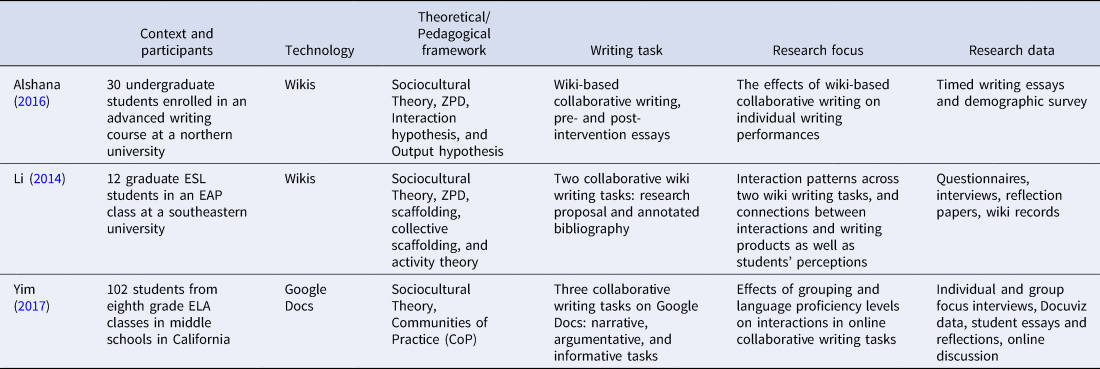
The three dissertations (i.e., Li, Reference Li2014; Alshalan, Reference Alshalan2016; Yim, Reference Yim2017) examine computer-based collaborative writing from different learning settings, using different research approaches (summaries displayed in Table 4). Alshalan (Reference Alshalan2016) investigated the effect of collaborative writing on individual writing performance, while Li (Reference Li2014) and Yim (Reference Yim2017) examined the nature of collaborative writing in the asynchronous CMC and synchronous CMC (S-CMC) context, respectively.
Alshalan (Reference Alshalan2016) utilized a quasi-experimental study (with a pre-test and post-test comparison) to examine the effects of wiki collaboration on the development of writing skills, as well as the undergraduate ESL students’ perceptions of using Wiki for collaborative writing. Eighteen students in the experimental group received the wiki-based intervention, in which they collaboratively wrote three essays in pairs on wikis, while the twelve students in the control group received the individual writing strategy, in which they completed the three essays individually. After examining the timed essays graded on a rubric via the Wilcoxon Signed-Rank Test, the researcher found that wiki-based collaborative writing significantly improved individual student performance across five measured areas: content, organization, vocabulary, grammar, and mechanics. While many studies have highlighted the role of wikis in the collaborative writing processes and students’ perceptions, this dissertation implemented an intervention for a close examination of ESL writing improvement and language development, and also provided important implication on technology use. As the researcher noted, the absence of synchronous communication and only single access at a time involving wikis may prove a hindrance for student communication, and Google Docs can be an alternative tool for CMC collaborative writing, which allows for synchronous multiple edits by multiple students.
Differently, Li (Reference Li2014) and Yim (Reference Yim2017) explored peer interactions as students worked on joint online writing tasks in small groups. In Li's (Reference Li2014) multiple-case study conducted in a graduate EAP class at a public southeastern university, small groups of ESL students worked on two collaborative writing tasks using the wiki: a research proposal and an annotated bibliography. Li (Reference Li2014) examined the patterns of interaction across two wiki tasks, the joint wiki writing products, and factors mediating the peer interaction. Informed by Storch's (2002) model that analyzed indexes of ‘equality’ and ‘mutuality’ to derive patterns of face-to-face interaction, Li (Reference Li2014) developed an analytical framework to examine wiki-based interaction drawing on wiki records, including three focused aspects: (1) language functions (initiating vs. responding), (2) writing change functions (self vs. other), and (3) scaffolding strategies. The results revealed distinct dynamic patterns of interaction in relation to four focal groups: Collective-Active/withdrawn; Expert/novice, Dominant/defensive-Collaborative, and Cooperating in parallel. After examining the wiki papers, graded according to the rubric, the researcher found that the group demonstrating a collective interaction pattern produced a wiki paper of the best overall quality while the group exhibiting a cooperating-in-parallel pattern produced a paper of the lowest quality. Moreover, content analyses of interviews and reflection papers revealed that peer interactions were mediated by factors such as goals, agency, and emotion. Li (Reference Li2014) contributed methodologically to the field of collaborative writing in that the study developed a systematic way to evaluate equality and mutuality in CMC contexts, with respects to language functions, writing change functions, and scaffolding strategies. This dissertation also initially examined the links between online interaction patterns and qualities of wiki writing products (i.e., rhetorical structure, coherence, and accuracy), which extended research (e.g., Storch, 2002) exploring connections between interaction patterns and student learning gains in the face-to-face collaborative writing environment. Moreover, drawing on the activity theory, this study innovatively interpreted group dynamics in the online collaborative writing task environment.
In the K-12 setting, Yim (Reference Yim2017), via a mixed-methods study, examined bilingual adolescents’ collaborative writing experiences and how students’ English proficiency and grouping status may influence their interaction and learning experience, as they worked on three collaborative writing tasks (i.e., narrative, argumentative, and informative essay) using Google Docs. Specifically, Yim divided the students into different groups: the same ability Proficient groups, and mixed ability groups consisting of Proficient + Advanced and Proficient + Basic groups. Based on the interview data, the researcher found that collaborative writing practices were seen as relevant to cultural practices by the students, in that digital literacies practiced in the collaborative writing activities have significant overlap with out-of-school literacy practices. In particular, Yim innovatively implemented computational analysis through text mining via Docuviz to determine the group dynamics (regarding students' writing/revision history across various scales of participation and collaboration). Along with the grading rubric, the Coh-Metrix text analysis tool was used to analyze writing quality in terms of lexical diversity, grammatical complexity, and textual cohesion. Results indicated that group dynamics of norms and agreed-upon rules of interaction, shared responsibility, and conflict resolution were important in developing consensus among peers. Echoing the finding of Watanabe (Reference Watanabe2008) examining the role of proficiency grouping in face-to-face collaborative writing, the researcher found that proficiency gaps present in some groups was less important than group dynamics when assessing the benefits of collaborative writing using Google Docs. For instance, mixed ability groups in this study were detected to provide more opportunities for students to edit, and what matters most is the ability of the group to negotiate and maintain cohesion. This longitudinal study highlighted the value of synchronous collaborative writing as a new literacies practice for secondary school students. In particular, it makes an important methodological contribution to L2 writing in that it shows how a text mining approach can be integrated to enhance research capacity, suggesting patterns and trends of students’ interaction via statistics.
5. Technology-based writing instruction/assessment
Technology-assisted writing instruction/assessment has become increasingly important in writing pedagogy, including the wide use of online corpora to assist in the writing process. Early corpus research was frequently limited to the creation of classroom materials and perhaps grammar references, but recently researchers and instructors are beginning to fully use corpora in the context of writing instruction (Yoon, Reference Yoon2008). Researchers (e.g., Yoon & Hirvela, Reference Yoon and Hirvela2004; Lee & Swales, Reference Lee and Swales2006) have examined ESL students’ use of corpora and found that online corpora aid students in common usage of words, as well as in investigating lexicon-grammar patterns and genre analysis. While corpora are widely regarded as a valuable tool for writers when they navigate genres and registers, how corpus linguistics can be best implemented to writing pedagogy is still an emerging area of inquiry. Moreover, the effect of technology-based writing assessment is still under-examined.
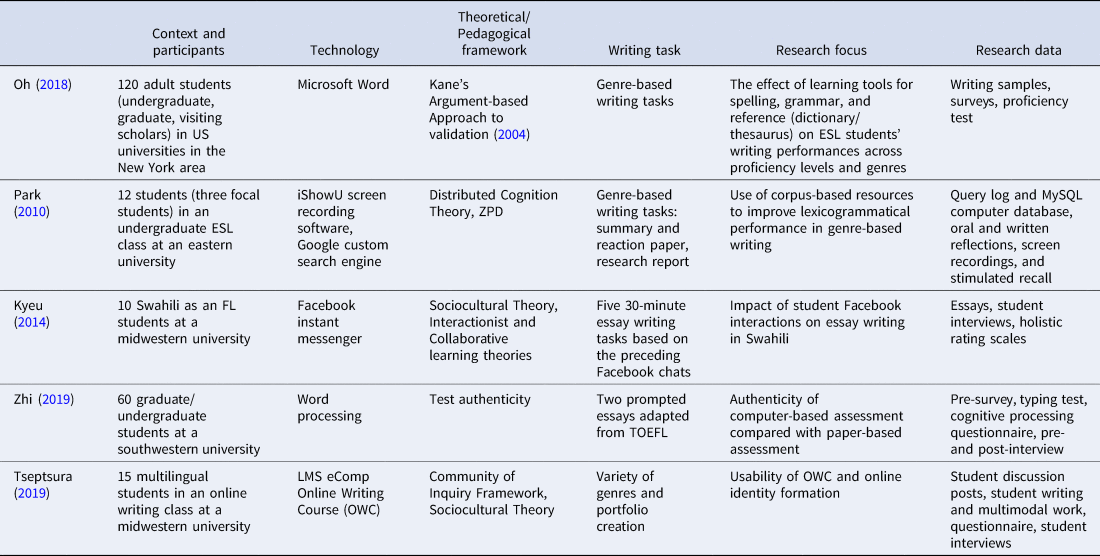
The following dissertations investigated the use of technology for L2 writing tasks in diverse learning contexts (summaries displayed in Table 5). Oh (Reference Oh2018) and Park (Reference Park2010) examined ways of using technology and corpora (e.g., Corpus of Contemporary American English (COCA)) in and out of class to assist ESL students’ academic writing. Kyeu (Reference Kyeu2014) examined how synchronous computer-mediated communication (S-CMC) and face-to-face communication impacted individual essay writing in Swahili as an FL. Tseptsura (Reference Tseptsura2019) explored multilingual writers’ experience with technology, identity construction, and the online learning community in a fully online college composition class. Different from the other four studies, which addressed writing instruction, Zhi (Reference Zhi2019) thoroughly examined computer-mediated writing assessment.
Oh (Reference Oh2018) used a mixed-methods design to examine how adult students (e.g., undergraduate students, graduate students, visiting scholars) use linguistic tools, namely spelling, grammar, and reference resources, in the process of L2 composition. These tools were frequently used for confirmation of spelling or linguistic choices, often through the use of online spell checks, thesauruses, or dictionaries, with free and accessible online word processing, as well. Via the writing assessment based on a coding scheme, Oh (Reference Oh2018) aimed to examine how access to different linguistic tools impacts ESL learners’ writing performance on three tasks (i.e., email, online review, and discussion post) across three language proficiency levels (Basic, Advanced, Proficient). The tasks were chosen specifically to assess grammar form and meaning, lexical form, topical meaning, intended meaning, and implied meaning under different assessment conditions and linguistic tools. The results indicated that the spelling tool and reference tool (dictionary/thesaurus) were shown to have great potential in facilitating L2 students’ writing, with distinctions in test-taker performance less pronounced across proficiency levels for those who used linguistic tools. This study provides empirical evidence that can be of value to test developers, and also has important implications for educators, causing teachers to recalibrate the common perception that linguistic tools can be a form of distraction, while in fact they may be beneficial in developing students’ overall writing ability.
Park (Reference Park2010) examined corpus-based learning, with a focus on improving the lexicogrammatical aspect of writing from L2 academic writers. Rather than using concordance programs such as COCA, Park (Reference Park2010) innovatively employed a customized search engine, the Google CS, and developed discipline-specific corpora, used for both instruction and research in academic writing. The academic corpus for this study was a virtually compiled corpus of hyperlinks to academic journals. Specifically, the study examined undergraduate ESL students’ lexicogrammatical performance, their evaluations of the system, and the effect of the system on writing performance. Data were collected from screen video clips, oral and written reflections, and the query log. The results revealed that the writer interaction with the corpus was highly structured and interactive, and the custom corpus played a facilitative role in improving students’ lexicogrammatical performance, thus providing teachers with a potentially effective means to help students engage in independent academic writing tasks. Park's (Reference Park2010) study made an important contribution to the field, highlighting and confirming the role that corpora can play in the improvement of students’ lexicogrammatical performance. This dissertation sought to bypass the ‘long enculturation processes’ (p. 195) of genre writing by directly using genre-specific corpus databases to reflect on the target genre, thus leading to students’ enhanced awareness of genre knowledge.
Theoretically grounded in interactionist and collaborative learning theories, Kyeu (Reference Kyeu2014) examined how S-CMC and face-to-face communication impacted individual essay writing in Swahili as an FL at the tertiary level. While S-CMC chat research is not new, what makes this study unique is that it investigates how participants transfer written aspects of their chat into essays written in Swahili (Sotillo, Reference Sotillo2016). The students took part in five 50-minute computer-mediated pair interactive sessions as well as five face-to-face pair interactive sessions, followed by 30-minute timed essays on topics previously discussed. Interviews and perception questionnaire were used to derive student perceptions. Results indicated that students using S-CMC transferred aspects of their communication more frequently than when they participated in face-to-face communication. Participants noted that the S-CMC enabled more time to think about the interactions, while face-to-face allowed little reflection. Moreover, students did not transfer as many of the ideas and syntactic structures from their face-to-face communication into their essays as they did with chat. This study pointed to the value of collaborative practice in writing with students with limited linguistic resources and informed us that speaking-to-write activities stimulate social learning and the opportunity to think deeply about a topic. Integrating two digital media environments into learning tasks, this dissertation addressed pedagogical innovation on teaching Swahili as an FL.
Tseptsura (Reference Tseptsura2019) employed a mixed-methods case study design to explore the experiences of linguistically diverse students in an online writing class, with participants recruited from an online composition program. Through student interviews and written work, as well as instructor interviews, the researcher examined L2 writers’ experience with technology, identity construction, and the online learning community built for multilingual writers. The usability and engagement aspects of the Learning Management System (LMS) were viewed through the lens of the Community of Inquiry Framework, a social constructivist model of learning in online and blended environments, built on cognitive, teaching, and social presence (Garrison, Cleveland-Innes, & Fung, Reference Garrison, Cleveland-Innes and Fung2010). Results revealed important aspects of students’ peer interactions and identity construction, particularly how students’ unwillingness to disclose their language background may impact instructor decisions, as well as student-student interactions and creation of social presence. The findings are particularly useful for online composition instructors when developing instructional materials, specifically the call for the use of multimodal video or audio instructions, additional guidance on the LMS, and frequent usability tests to help students master English writing skills.
Zhi (Reference Zhi2019) re-examined the delivery mode of writing assessment, which was reported to have an important influence on student assessment performance in previous research (e.g., Lee, Reference Lee2004). Zhi's study compared the authenticity of computer-based and paper-based academic writing, expanding validity to include test takers’ perceptions of the assessment, which may influence measurement. Specifically, each participant completed two writing tasks with separate prompts (adapted from TOEFL) in computer-based and paper-based modes. Immediately after the writing tasks, a cognitive writing process questionnaire was adapted to capture participants’ writing processes while writing. Trained raters assessed the essays according to rubrics, with high inter-rater reliability determined. Overall findings point to the advantage of the computer-based tests in the assessment of advanced ESL students’ writing proficiency for a higher degree of authenticity, while simultaneously exposing potential issues of validity and fairness. Test takers perceived themselves performing better and had more confidence in test validity with the test mode they were most familiar with. If students were not accustomed to computer-based writing tasks, it was perceived as less valid because they felt disadvantaged due to lower computer literacy skills. Contrary to previous research by Li (Reference Li2006), which showed that paper-based writing led to higher-level revisions of ideas and structures, this study showed more high-level revisions in the computer-based writing. Moreover, a correlation was identified between scores and computer literacy. Computer familiarity and computer availability at school produced the highest correlation with computer-based essay scores. The results informed us that equal access and use of computers in school for academic work are an important factor in learning outcomes, and students from settings with limited computer availability are at a disadvantage that needs to be addressed by teachers and administrators in order to close the digital divide. This dissertation is expected to capture researchers’ wider attention to validity and reliability of computer-based writing assessments, which plays an increasingly important role in the digital era.
6. Digital composing/literacy
Given the development of digital technologies and radical changes in the communication environment, digital practice captures increasing attention in L2 writing contexts. The digital age provides rich opportunities for writers to deploy multiple resources to make meaning, construct knowledge, and express self-identity (Li & Storch, Reference Li and Storch2017). The following five dissertations examined students’ digital composing practice from different perspectives (summaries displayed in Table 6). Dzekoe (Reference Dzekoe2013) examined college students’ computer-based multimodal composing activities and their effect on revisions and writing development. Moore (Reference Moore2017) examined the ways in which college ESL students’ interaction with technology influences their understanding and implementation of multimodal writing practices. Bauler (Reference Bauler2012) examined online forums specifically, and the role they play in the development of academic literacy and language learning in college ESL writing classes. Jiang (Reference Jiang2013) examined high school ESL students’ school-sponsored and self-sponsored digital writing practices with new media/social networking. Chen (Reference Chen2012) researched digital literacy practices of college ESL students and explored the relationship between SLA and social networking.
First, Dzekoe (Reference Dzekoe2013) conducted a case study on six ESL students' using computer-based multimodal composing activities integrating multiple language skills to facilitate writing revisions in a college ESL composition classroom. Specifically, ‘multimodality’ refers to transforming written text to poster form, and ‘Text-to-Speech’ (TTS) refers to hearing the written texts to help identify errors, using the TTS software (NaturalReader). Data were collected from students’ written drafts and final copies of four expository essays (via Google Docs), posters (using Glogster), screen records of their editing activities in the revision process, as well as reflections, survey responses, and stimulated recall interviews. The research findings indicated that computer-based multimodal composing helped students independently evaluate linguistic and rhetorical elements, organizational structure, and specific information that they used in the revision process. Students reported a greater sense of agency and voice, while also performing more content-level revisions than surface-level ones, which contrasts with previous studies by Chambers (Reference Chambers2011) and Suzuki (Reference Suzuki2008). Dzekoe showed that the use of computer-based multimodal composing activities, particularly listening-writing connections, could help students self-revise academic writing, while simultaneously developing their own writing voice. Another valuable takeaway from this research was the need for teachers and researchers to focus more on revision history and strategies than the changes of writing products.
Via an ethnographic multiple-case study, Jiang (Reference Jiang2013) conducted a year-long research project with four high school ELLs in an urban community in the western US. Jiang sought to understand the relationships, links, and gaps between the school-sponsored writing practices and self-sponsored writing practices through the use of different media. Jiang collected data from multiple sources, including in-class writing, formal and informal interviews, field notes, writing samples, and recorded classroom interactions. Inductive analysis drew out important themes related to negotiation and construction of identity, socialization, and language use across different platforms. To compare school-sponsored writing and self-sponsored writing, Jiang (Reference Jiang2013) analyzed writing activities (including writing topics, genres, and audience) and student engagement, respectively. The study uncovered that no clear boundary was identified between the two types of writing practices, with overlapping between various environments and communities, but each maintaining a distinct circle of friends. With reading and writing in online digital environments being the norm now, as evidenced with participants in this study, teachers should encourage digital multimodal writing both in and outside classrooms. This dissertation highlighted the connections of the digital literacies practices in in-school and out-of-school contexts and motivated researchers to conduct further inquiry on this topic in broader language learning contexts (e.g., Vandommele, van den Branden, van Gorp, & de Maeyer, Reference Vandommele, van den Branden, van Gorp and de Maeyer2017).
Bauler (Reference Bauler2012) examined the role of digital media, particularly online discussion forums, in college ESL students’ literacy practices. Bauler (Reference Bauler2012) explored different discourse practices and collected data from online discussions and argumentative essays produced in writing classes. Results revealed that online forums offer a space with greater variety combined with increased student engagement. Online discussions contribute to L2 learning via meaningful language use and language negotiation with peers. Moreover, the study revealed that the online discussion forum can be a valuable place, if connected to curriculum design, to create a participatory multimodal environment for student engagement and idea generation, which provides a low-stakes setting for social and cultural mediation with peers. The ideas generated in online discussions contributed to construction of follow-up persuasive essays. Building on work by Snyder and Bulfin (Reference Snyder and Bulfin2008), who uncovered gaps in school preparedness to integrate technology in learning environments, and Warschauer and Grimes (Reference Warschauer and Grimes2007), whose research further highlighted the importance of collaboration through sharing of content, Bauler (Reference Bauler2012) adds to the field of online collaborative learning by providing a detailed analysis of the digital literacy practices of college-level ESL students’ collaborative discursive interactions while negotiating meaning in online forums.
Chen (Reference Chen2012) explored the use of multimodality through digital media and the relationship between social networking and L2 learning in and out of school among graduate L2 students. The research consisted of three components: (1) a survey-based study of social networking sites (SNSs) and literacy practices in SLA (data from questionnaire and interview); (2) a case study addressing two L2 users’ SNS-mediated identity and community relationships (data including a background survey, Facebook and SNS usage analysis, and semistructured interviews and field notes); and (3) genre awareness through SNS-enhanced instruction (data from reflective journals and student-teacher conferences). Results revealed that SNSs served an important role in connecting with home country discussions as well as new discourses. The study provided illustrative examples concerning two focal students who negotiated multiple identities and affiliations across varied networks. Moreover, Facebook and SNSs were found to become a hybrid third space where multiple languages, identities, and literacies are navigated, and which raises a sense of engagement and awareness of rhetorical features, audience, contexts, and genre. This dissertation highlighted the value of learning L2 writing in informal ways, which is increasingly discussed in the current body of literature (e.g., Lehtonen, Reference Lehtonen2017; Zheng, Yim, & Warschauer, Reference Zheng, Yim, Warschauer and Liontas2018).
The last dissertation discussed in this section, Moore (Reference Moore2017), aimed to fully understand how ESL undergraduate students interacted with digital resources in the writing process through a grounded theory approach. Moore examined the technologies that students used and their attitudes toward various media. This dissertation involved a survey phase, in which an online questionnaire was used to explore students’ composing process and engagement with social media, and two interview phases, in which ten students discussed the kinds of compositions they were comfortable sharing, who they were as digital composers, and the role of technology in the writing classroom. Results of the study indicated that participants were highly digitally literate, yet still were apprehensive of the situation of adopting digital literacy in place of traditional practices. As ELLs attempt to negotiate their way and become members of a community, their language use/fluency either makes them a member of the institutional community, or can cause them to feel excluded. This dissertation attempts to add to a small but growing body of research exploring the attitudes of ESL students toward digital writing practices. This study enhanced our understanding of how students approach a video composition compared with text-dominant composition, and how the teachers navigate the pros and cons while integrating these different modes into the classroom.
7. Conclusion and future directions
This article has reviewed 20 Ph.D. dissertations on L2 writing and technology completed during the last decade (2010–2019) in the USA. It has addressed five relevant thematic categories: computer-mediated teacher/peer feedback, AWE, computer-based collaborative writing, technology-based writing instruction/assessment, and digital composing/literacy. We specifically analyzed and discussed the research design, research results, and contribution for each dissertation study. Overall, these dissertations conducted rigorous inquiries of significant research topics, using different methodological approaches. They have collectively made an important contribution to the scholarship in the fields of L2 writing and CALL.
Based on the close review, we highlight future directions for Ph.D. research on L2 writing and technology, within the US and beyond. Regarding study contexts and participants, the majority of participants in the dissertations (17 out of 20) were at the tertiary level. Only three dissertation studies were conducted in the K-12 setting, but with no elementary school students. Regarding the language context, dissertation research was mainly conducted in the English as an L2 setting (18 out of 20). Only two addressed a foreign language, namely Chinese and Swahili, respectively. Research in the contexts of teaching and learning modern languages other than English are still largely under-represented. Dissertations addressing more diverse language learning contexts would definitely be welcome in the future.
The 20 dissertations employed qualitative, quantitative, and mixed-methods design. Studies of some thematic categories tended to rely on a certain research design more than others. For instance, most of the data analysis in relation to computer-based collaborative writing and digital composing/literacy tended to be more qualitative, drawing on data such as writing archives, observation, questionnaire, and interviews. Thus, mixed-methods design is to be encouraged, since this offers strengths that will offset the weaknesses of either quantitative or qualitative research and at the same time provides a comprehensive picture of the role of technology in L2 writing. In addition, it should be noted that the majority of the qualitative dissertation studies used the case study approach, while just one utilized discourse analysis and one grounded theory. Other qualitative approaches such as narrative inquiry and phenomenological research are largely missing. Therefore, narrative inquiry telling stories of students’ digital literacy practice and phenomenological research exploring students’ lived experiences of learning writing through corpora, for example, can be potential directions for future dissertation research, due to the increasing role of narrative and digital rhetorics in composition classrooms (Sundvall, Reference Sundvall2019).
Moreover, the dissertation research reviewed in this paper has been informed by various theoretical/pedagogical frameworks, such as Sociocultural Theory, the Interactionist approach, Systemic Functional Linguistics, Complexity Theory, and the study of new literacies. With the increasing attention to interdisciplinary research, future dissertation studies are expected to draw on diverse theoretical constructs for the inquiry of research issues from multiple lenses. With the reiteration of technology development, more thematic strands are likely to occur in the following decade, such as exploring the effectiveness of computer-assisted writing instruction. In particular, given the pandemic, more future studies will respond to the need for research in online pedagogy addressing synchronous teaching environments, such as the virtual classrooms facilitated by Zoom or Google Classroom, which have taken on increased importance due to social distancing guidelines and imposed school shutdowns (Gunawan, Suranti, & Fathoroni, Reference Gunawan, Suranti and Fathoroni2020). The continuously changing situations for learning will call for future doctoral research studies that will continue to shed new light on research and pedagogy worldwide in the field of L2 writing and technology.
Mimi Li, Ph.D., is an Assistant Professor of Applied Linguistics/TESOL in the Department of Literature and Languages at Texas A&M University-Commerce. Her main research areas are second language writing and CALL. She has conducted research projects on online collaborative writing, computer-based peer review, gamification and vocabulary learning, and multimodal pedagogy in teacher education. Her work has appeared in Journal of Second Language Writing, Computer Assisted Language Learning, Language Learning & Technology, System, Computers & Education, Computers and Composition, among others. She serves on the editorial boards of Journal of Second Language Writing and Language Learning & Technology.
John Gibbons, M.S., is a Ph.D. student in the Department of Literature and Languages at Texas A&M University-Commerce. He teaches English Composition and Rhetoric, and his main research interests include second language writing, mobile-assisted language learning, and composition and rhetoric. He was an assistant editor for Best of the Journals in Rhetoric and Composition 2019. He has taught English as a Foreign Language in Jordan, China, and Taiwan, as well as ESL in the US.