Introduction
The aim of this article is to provide a syntactic analysis of the early development of left dislocation (1) and right dislocation (2) in French L1 acquisition.
(1) Ma mère i elle i arrive pas à me parler en allemand.
My mother she is.able NEG to me speak in German
‘My mother can't speak to me in German’
(Pekarek Doehler, De Stefani & Horlacher, Reference Pekarek Doehler, De Stefani and Horlacher2015, p. 22)
(2) Elle i est germanophone votre mère i ?
She is German-speaking your mother
‘Is your mother German-speaking?’
(Pekarek Doehler et al., Reference Pekarek Doehler, De Stefani and Horlacher2015, p. 22)
For this purpose, we extracted a total of 704 dislocations produced by three children from the Lyon corpus (Demuth & Tremblay, Reference Demuth and Tremblay2008). The goal of this article is threefold: (i) starting from the cumulative frequencies of left (LD) and right dislocations (RD), we will show that in early L1 acquisition, RD is more frequent than LD, contrary to adult French, in which LD is more frequent (Horváth, Reference Horváth2018); (ii) on the basis of a multinomial regression model of RD and LD, we will show that early utterances with LD are significantly more “syntactically complete” than utterances with RD, and that French children tend to drop finite verbs and the resumptive clitic more frequently in RD than LD; (iii) in order to explain the counter-examples to the previous generalization, we will provide a qualitative analysis of those cases of LD in which the resumptive clitics and finite verbs are dropped.
We will use these analyses as a test case for the hypothesis developed by Freudenthal, Pine, Aguado-Orea, and Gobet (Reference Freudenthal, Pine, Aguado-Orea and Gobet2007) according to which some patterns of child language development can be explained if children acquire constructions incrementally from the right edge. Hence, in order to learn a word or phrase from a sentence in the input, the child must have already acquired all the other words or phrases on its right. We will show that this hypothesis indeed accounts for part of our data, but that additional learning mechanisms must be at work to explain cases in which LD are produced without resumptive clitics or without verbs. We identify several exceptions to the learning from the right edge hypothesis, including contrastive topics, which seem salient enough to generate acquisition from the left edge.
Background
Dislocation in adult French
Dislocation in adult French is a construction in which a referential constituent is produced outside the clause (Lambrecht, Reference Lambrecht and Haspelmath2001), in the left (1) or right (2) periphery, or, less frequently, in both peripheries at the same time (3) (Pekarek Doehler & Horlacher, Reference Pekarek Doehler and Horlacher2013).
(3) Ça c’est affreux ça.
That it-is awful that
‘It's awful’
(Pekarek Doehler & Horlacher, Reference Pekarek Doehler and Horlacher2013, p. 97)
The linguistic literature sometimes distinguishes between dislocated phrases which are coreferential with a resumptive clitic within the clause (4a) and those without a resumptive clitic (4b). Dislocations without resumptive expressions can be of two types: hanging topics and topicalizations (Horváth, Reference Horváth2018; Pekarek Doehler et al., Reference Pekarek Doehler, De Stefani and Horlacher2015).
-
(4)
a. Les femmes, je leur fais pas confiance.
the women I them do NEG trust
‘I don't trust women’
(Blasco-Dulbecco, Reference Blasco-Dulbecco1999, p. 139)
b. Le turc euh je comprends mais je parle pas?
DET Turkish I understand but I speak NEG
‘I understand Turkish but I don't speak it’
(Pekarek Doehler et al., Reference Pekarek Doehler, De Stefani and Horlacher2015, p. 52)
Since dislocation constructions without a resumptive expression may have specific syntactic and pragmatic properties (Barnes, Reference Barnes1985; Horváth, Reference Horváth2018; Pekarek Doehler et al., Reference Pekarek Doehler, De Stefani and Horlacher2015), this article will focus only on dislocations with a resumptive clitic, or those dislocations in child language which should include a resumptive clitic to be adult-like. We will not make any distinction based on the case-marking of the dislocated phrase (see example 5 below), because, in French, it is impossible to determine whether a dislocated phrase bears a nominative case-marking or no case-marking (Blasco-Dulbecco, Reference Blasco-Dulbecco1999). The distinction is therefore impossible to make for dislocated subjects, which constitute the overwhelming majority of dislocated phrases in French (Ashby, Reference Ashby1988; Horváth, Reference Horváth2018).
-
(5)
a. Mon père, je lui parle.
My father I him talk
‘My father, I talk to him’
(Barnes, Reference Barnes1985, p. 27)
b. à mon père, je lui parle.
to my father I him talk
‘To my father, I talk to him’
(Barnes, Reference Barnes1985, p. 27)
In adult French, LD is more frequent than RD, as around 80% of the dislocated phrases in the corpora of both Ashby (Reference Ashby1988) and Horváth (Reference Horváth2018) are dislocated in the left periphery. Pronouns and lexical NPs are the most frequent types of dislocated constituents. Some authors argue that lexical NPs are more frequent in dislocation (De Cat, Reference De Cat2002; Horváth, Reference Horváth2018) while other studies show a higher frequency of pronouns (Ashby, Reference Ashby1988; Barnes, Reference Barnes1985). All studies agree however on the fact that the overwhelming majority of dislocated constituents correspond to the subject of the sentence (Ashby, Reference Ashby1988; De Cat, Reference De Cat2002; Horváth, Reference Horváth2018).
Dislocated subjects are so frequent in spoken French that it is often claimed that most of them are not true instances of dislocation, but should rather be described as subject doubling, in which the resumptive clitic is a morphological (inflectional) marker rather than an argument of the verb (Auger, Reference Auger, Ashby, Mithun, Perissinotto and Rapossa1994; Legendre, Culbertson, Barrière, Nazzi & Goyet, Reference Legendre, Culbertson, Barrière, Nazzi, Goyet, Torrens, Escobar, Gavarro and Mangado2010; Zribi-Hertz, Reference Zribi-Hertz, Cinque, Koster, Rizzi, Luigi and Zanuttini1994). Several types of evidence are used to support this claim, including the lack of prosodic markedness of left-dislocated lexical subjects (Avanzi, Gendrot & Lacheret-Dujour, Reference Avanzi, Gendrot and Lacheret-Dujour2010), the drop of the preverbal negative particle ne which allows the clitic pronoun to directly precede the verb, and experimental results on Information Structure (see Culbertson, Reference Culbertson2010 for an overview of the evidence supporting an inflectional interpretation of clitic pronouns in colloquial French).Footnote 1
In the present work, we do not enter the debate on whether subjects resumed by a clitic pronoun are cases of subject doubling or of dislocation. Instead, the aim of this paper is to understand, in contexts where children can produce the subject either pre-verbally or postverbally, why they choose to produce them more frequently in a postverbal position. The precise syntactic nature of the clitic pronoun is therefore irrelevant for our analysis. For simplicity, we will keep the term dislocation in the present article.
Dislocation in child French
The literature on the acquisition of dislocation in French L1 is rather scarce. De Cat (Reference De Cat2000, Reference De Cat2002, Reference De Cat, Prévost and Paradis2004, Reference De Cat2007b) shows that this construction appears before age 2, and that, in a large proportion of early dislocations, the resumptive clitic, and even the verb, may be dropped (6). Parisse (Reference Parisse, Guijarro Fuentes, Pilar Larrañaga and Clibbens2008) shows that dislocated subjects are even more frequent in child than in adult French.
-
(6)
a. est là, les dames.
is there the ladies
‘The ladies are there’
(De Cat, Reference De Cat2002, p. 228)
b. Minon Yolande, ça.
Cat Yolande that
‘That's Yolande's cat.’
(De Cat, Reference De Cat2002, p. 261)
Interestingly, studies on the beginning of the acquisition of dislocation in child French show that children produce dislocated phrases mostly in the right periphery (De Cat, Reference De Cat2002, Reference De Cat2007b; Legendre et al., Reference Legendre, Culbertson, Barrière, Nazzi, Goyet, Torrens, Escobar, Gavarro and Mangado2010), whereas in adult French LD is more frequent than RD (Ashby, Reference Ashby1988; Blasco-Dulbecco, Reference Blasco-Dulbecco1999; Horváth, Reference Horváth2018). This difference remains unexplained in the literature on child French, and even the interpretation of the clitic pronoun as a bound morpheme attached to the verb does not explain this tendency in child French to produce subjects in the right edge of the sentence. In the present study, we will show that, in our data too, RD (78% of all dislocations) is more frequent than LD, and tend to be produced slightly earlier than LD.
In the next section, we will present the hypothesis of Freudenthal, Pine, and Gobet (Reference Freudenthal, Pine, Aguado-Orea and Gobet2007), which – as we will show below – can explain at least partly this early preference for RD over LD.
Construction development from the right edge
Several studies on different constructions and different languages show that the sentence-final position is particularly salient for children and that they tend to produce words or phrases which, in the input, occur frequently at the end of sentences when their Mean Length of Utterance (MLU) is below 3. For instance, with respect to lexical development before age 2,5, not only the frequency of a verb, but also its frequency in sentence-final position can predict how early it will be acquired (Naigles & Hoff-Ginsberg, Reference Naigles and Hoff-Ginsberg1998). Freudenthal, Pine, Jones, and Gobet (Reference Freudenthal, Pine, Jones and Gobet2016) also hypothesize that the salience of the right edge can explain the preference for nouns in early vocabulary acquisition. As for sentence production, Bloom (Reference Bloom1990, Reference Bloom1993) and Hyams and Wexler (Reference Hyams and Wexler1993) show that young children acquiring English tend to drop the subject, which is situated towards the beginning of the utterance, whereas they do not usually drop the direct object. Bloom (Reference Bloom1990, Reference Bloom1993) suggests that the most informative part of the utterance is usually towards the right edge, and that, as a result, it is less frequently omitted by children.
Veneziano and Clark (Reference Veneziano and Clark2016) investigate the development of the verbal nucleus in child French, and argue that it develops from the rightmost to the leftmost element. Hence, French children start by producing verbs in a simple form, like saute ‘jump’, or only the participle, such as tombé ‘fallen’. In a second stage, they acquire the element directly preceding it: auxiliaries for participles, like ai tombé ‘have fallen’, and subjects for simple verb forms Je saute ‘I jump’. In the next stage only, children are able to add the subject in front of auxiliaries.
Freudenthal, Pine, and Gobet (Reference Freudenthal, Pine, Gobet, Sun and Miyake2006) too advance that children may initially start developing constructions from the right edge. Their hypothesis is supported by the computational model they developed, called MOSAIC, which simulates language learning by children. The model has no built-in knowledge of syntax, such as syntactic categories or functions, has no access to semantic information and is completely insensitive to intonation or phonology. The model receives child-directed speech as input, and is programmed to learn to produce increasingly long utterances, which are developed incrementally from the right edge. In other words, when the model receives an utterance as input, it will acquire the last word only. If the last word is already known by the model, the model acquires the word directly preceding it. When the model encounters two words that it has already acquired, the two words are stored together as a phrase. The authors illustrate the functioning of the model by the acquisition of the sentence He goes home. The first time the model encounters this sentence, only the word home is stored. The second time, the word goes is stored. At the third encounter, the model stores the phrase goes home. At the fourth encounter, the model will acquire the word he, and finally, at the fifth encounter, the model will store the complete sentence he goes home. As a result, the more input the model receives, the longer the output it can produce.
The model was used by the authors to test whether development from the right edge can explain cross-linguistic differences in the production of sentences with non-adult-like non-finite verbs in English, Dutch, French, German and Spanish, such as (7) in Dutch. The authors show that the model is able to provide an account of the frequency at which children produce non-finite verbs for each language in declarative and interrogative sentences. For Dutch, the output of the model at a low mean length utterance (MLU) has the highest percentage of non-adult-like infinitive verbs, which corresponds to actual child data (7) (Freudenthal et al., Reference Freudenthal, Pine, Aguado-Orea and Gobet2007b, Reference Freudenthal, Pine and Gobet2010). This can be related to the input, since, in Dutch, many constructions require a non-finite verb in the sentence final position (8) (see also Wijnen, Kempen & Gillis, Reference Wijnen, Kempen and Gillis2002 for similar findings on child Dutch).
(7) Mama ijs eten.
Mom ice-cream eat-INF
‘Mom is eating ice-cream’
(Freudenthal et al., Reference Freudenthal, Pine, Jones and Gobet2015: 62)
(8) Hij kan naar het park gaan.
He can-3S to the park go-INF
‘He can go to the park’
(Freudenthal et al., Reference Freudenthal, Pine, Aguado-Orea and Gobet2007a: 317)
According to Freudenthal, Pine, and Gobet (Reference Freudenthal, Pine, Aguado-Orea and Gobet2007b), the MOSAIC model can also explain the subject omission documented by Bloom (Reference Bloom1990, Reference Bloom1993). The model produces sentences without subjects when the VP is longer (with a direct or indirect object), and with a subject if the VP is shorter (for example, without an object), like the children studied by Bloom (Reference Bloom1990, Reference Bloom1993).
Goal of our study
The goal of this article is to test whether the hypothesis of Freudenthal et al. (Reference Freudenthal, Pine and Gobet2007b, Reference Freudenthal, Pine and Gobet2010) on construction development from the right edge can explain the early clitic left and right dislocations in French child language. Their hypothesis predicts RD to be more frequent than LD, and it also predicts children's LD to be more adult-like than RD: if language development occurs from the right to the left edge, once the left edge is acquired, all the following elements should be acquired too. We will therefore analyse and compare children's LD and RD, to test whether LDs produced by children are more syntactically complete than RDs.
Methodology
Participants
We carried out a corpus analysis on three monolingual French-speaking children between age 1 and age 2;7: Anaïs (until age 2;5), Marie (until age 2;2) and Nathan (until age 2;7) from the Lyon corpus (Demuth & Tremblay, Reference Demuth and Tremblay2008). We selected these children because of the presence of sound files synchronized with the transcripts, since our extraction criteria (see below) include intonation. We did not extend our analysis to more children for practical reasons: the recordings are one-hour long, and were taken on average every other week, which results in large corpora for each child: 27 hours for Anaïs, 23 for Marie and 36 for Nathan. The corpus consists of unscripted, unplanned, spontaneous conversations between each child and one of its parents. The researcher collecting the data makes almost no intervention during the interactions.
Data extraction
We based our data extraction protocol on that described by De Cat (Reference De Cat2000, Reference De Cat2002, Reference De Cat2007b) taking into account five criteria: (i) the presence of a resumptive clitic, (ii) the left- or right peripheral subject constituent is a strong non-nominative pronoun, (iii) word order, (iv) the presence of an adjunct between the verb and its argument and (v) prosody.
First of all, in our corpus, we identified as a case of dislocation all instances in which an element at the right or left edge of an utterance is resumed by a resumptive clitic within the utterance (211 cases out of a total of 704 dislocations). Hence, even if the realization of this resumptive clitic is embryonic, the utterance is considered to be a case of dislocation (De Cat, Reference De Cat2007b, p. 173):
(9) Où l’est poisson? (Marie, 1;11.11, corpus Lyon)
where it-is fish
‘Where is the fish?’
The second extraction criterion is the production of a preverbal subject with a strong non-nominative pronoun. As De Cat (Reference De Cat2002, p. 246) shows, early utterances with strong pronouns (10) are not cases of children assigning the wrong case to the subject pronoun but rather early attempts of LD without resumptive clitic. Hence, if a constituent is unambiguously the subject and is realized by a strong pronoun, we interpreted it as a dislocated constituent (49 cases in our corpus).
(10) Moi veux pas ranger. (De Cat, Reference De Cat2002, p. 246)
Me want NEG clean-up
‘I don't want to clean up’
The third extraction criterion that we used is the production of non-adult-like sentence-final subjects (205 cases), such as (11), which may either be a lexical NP or a strong pronoun.Footnote 2
(11) Est parti poisson. (Marie, 1;10.23)
Is left fish
‘The fish left’
Déprez and Pierce (Reference Déprez and Pierce1993) claim that such sentence-final subjects in child French (and which are absent in child English) result from the movement of the verb to Infl, with the subject staying in a VP-internal position. This is however contradicted by the research of Labelle and Valois (Reference Labelle and Valois1996) and Ferdinand (Reference Ferdinand1993, Reference Ferdinand1996). Indeed, Ferdinand (Reference Ferdinand1993) shows that sentence-final subjects in early child French are restricted in the same way as right-dislocated subjects in adult French, in that indefinite referential and quantified NPs do not occur in these positions, while children do produce them in preverbal positions at the same age. Moreover, in terms of information structure, all early cases of sentence-final subjects in Ferdinand's (Reference Ferdinand1993) corpus correspond to the topic of the sentence and do not convey new information. As for Labelle and Valois (Reference Labelle and Valois1996), they show that the prosody of early sentence-final subjects is similar to the prosody of right-dislocated subjects. Finally, in adult French, true postverbal non-dislocated subjects are limited to specific discourse contexts, and tend to belong to formal registers (Lahousse, Reference Lahousse2003, Reference Lahousse2011). They are therefore unlikely to be present in children's input, whereas Labelle and Valois (Reference Labelle and Valois1996) find in their corpus that RD is frequent in child-directed speech.
The fourth criterion only concerns objects: following De Cat (Reference De Cat2002, Reference De Cat, Prévost and Paradis2004, Reference De Cat2007b), if an adjunct occurs between the verb and the sentence-final object, such as là ‘there’ in (12), we interpret the object as being a right-dislocated object (14 cases in total).
(12) Met là bébé. (Anaïs, 2 ;4.20)
Put there baby
‘The red riding hood is there’
For 233 cases in our corpus, there is no adjunct between the predicate (whether it is nominal or verbal) and the sentence-final argument, and the syntactic function of the argument is unclear, such as (13). In such cases, syntactic criteria alone do not allow to determine whether this post-predicate argument is a dislocated subject or a non-dislocated object. For example, ça ‘that’ in (13) could be the dislocated subject of the truncated predicate (est un) bébé ‘is a baby’, or a non-dislocated object in a sentence like bébé (fait) ça ‘the baby does that’.
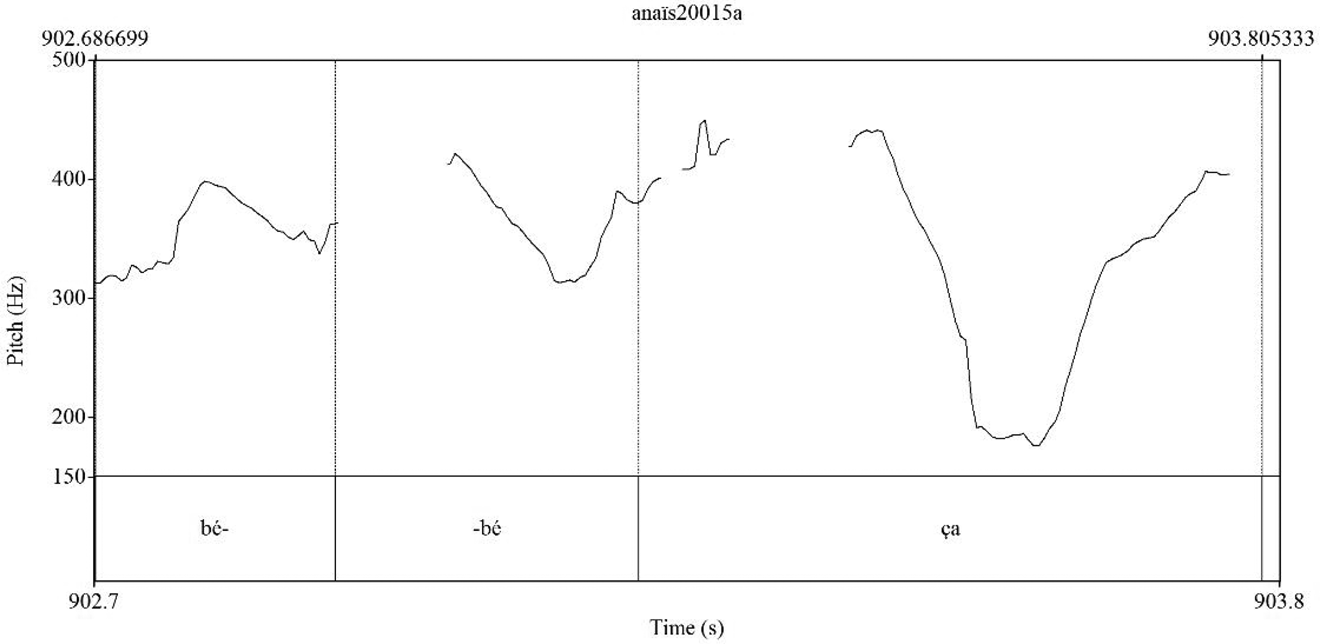
(13) Bébé ça (Anaïs, 2;00.15)
Baby that
‘That's a baby’
In order to determine the status (dislocated or not) of such constituents, we used prosody. Even though prosody is not fully adult-like in child speech, De Cat (Reference De Cat2002, Reference De Cat2007b) shows that the prosody of RD in child French exhibits adult-like properties that allows to differentiate them from other (non-dislocated) postverbal arguments. Using PRAAT, we first analysed the prosodic profile of clear instances of right-dislocated subjects (14) and of non-dislocated objects (15) in the utterances of the children from our corpora.
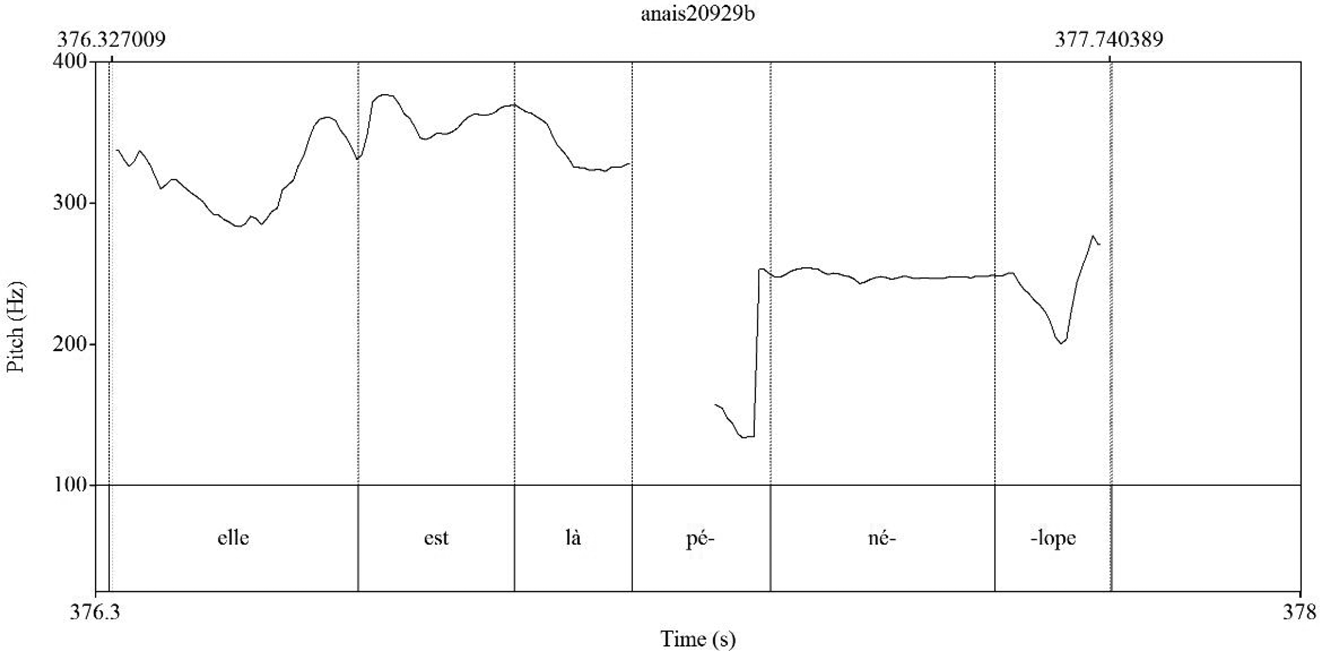
(14) Elle est là Pénélope. (Anaïs, 2;09.29)
She is there Pénélope.
‘Pénélope is there.’
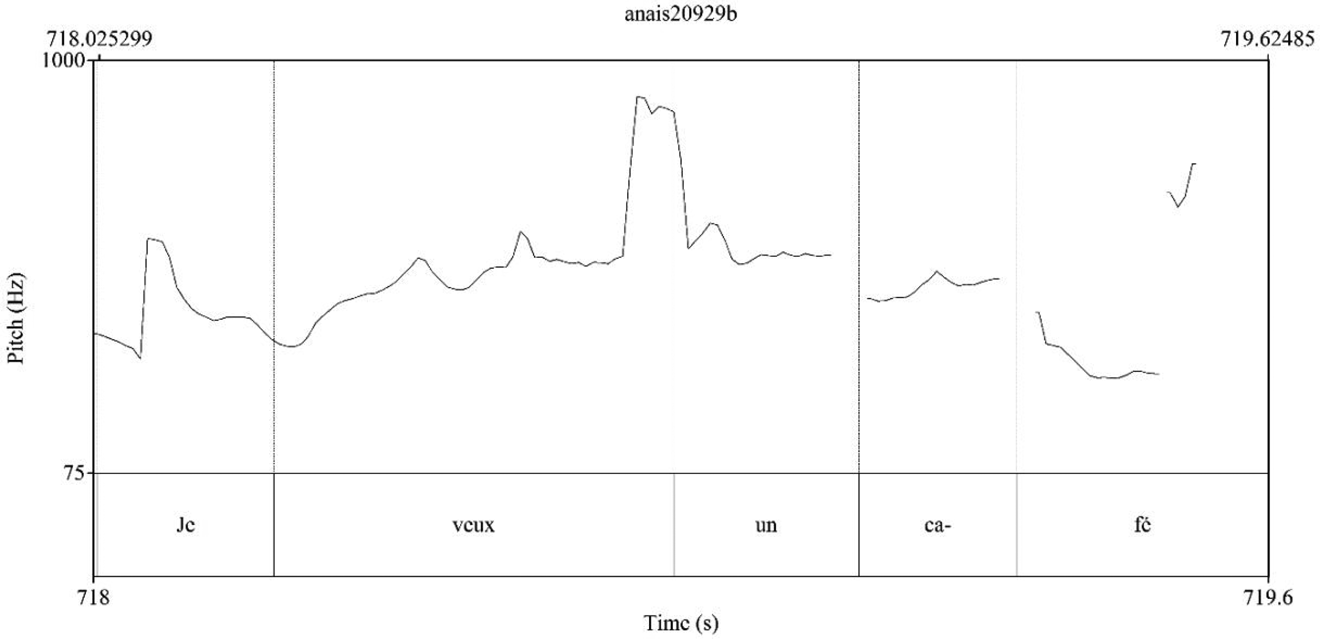
(15) Je veux un café. (Anaïs, 2;09.29)
I want a coffee
‘I want coffee.’
Results are shown in figure 1 for right-dislocated elements, and in figure 2 for non-dislocated objects.
Typical intonation contour of a right-dislocated subject in child French

Typical intonation contour of a non-dislocated object

In figure 1, the main intonation accent of the full sentence Elle est là Pénélope ‘She is there Pénélope’ falls on the constituent là ‘there’. The pitch falls and rises slightly again in the same syllable. As for the dislocated constituent, Pénélope, it also receives a fall-rise intonation contour on its last syllable, therefore copying the intonation contour of the rest of the utterance. The main accent of the sentence is higher than the accent of the dislocated constituent in figure 1, which illustrates that the main accent is produced with a higher pitch than the accent of the dislocated constituent. The copy of the main intonation contour on right-dislocated elements with a lower pitch is also common in adult language (Rossi, Reference Rossi1999). This copy, especially if used with a fall-rise contour, is the most frequent intonation contour for the dislocations in our child speech corpus. This type of intonation contour is very different from that of typical non-dislocated objects, as exemplified in figure 2.
In figure 2, the nucleus of the utterance is un café ‘a coffee’, which corresponds to the focus of the utterance, and receives a fall, which is the intonation nucleus of the sentence.Footnote 3
For the ambiguous examples in our corpus, i.e., those which could be a right-dislocated subject or a direct object, we analysed whether their intonation contour is closer to what we found for typical dislocated subjects, like in figure 1, or to the intonation contour of non-dislocated objects like in figure 2. An example of the contour of such ambiguous cases is shown in figure 3.
Intonation contour of a non-adult-like dislocation

The intonation contour of the element in figure 3, ça ‘that’, corresponds to what we found for children's right-dislocated elements (figure 1). The main accent of the sentence falls on the second syllable of the word bébé, and has a fall-rise contour. Ça also has a fall-rise intonation contour, as a copy of the main accent of the sentence. What is more, the dislocated constituent is produced with a lower pitch than the rest of the utterance. This is typical of dislocated phrases produced by the children from our corpus.Footnote 4
Prosody was not used to distinguish lexical non-dislocated subjects from lexical dislocated subjects without a resumptive clitic (16), as it is not a reliable criterion in adult French (Avanzi et al., Reference Avanzi, Gendrot and Lacheret-Dujour2010). The children from our corpus produced only 29 preverbal lexical subjects (8 by Anaïs, 19 by Marie, and 2 by Nathan), out of which 22 have an adult-like syntax (i.e., no missing verb or compulsory morpheme). We still extracted these cases and we will discuss them in the results below.
(16) Marie veut de l'eau. (Marie, 2;0.28)
Marie wants of the-water
‘Marie wants water.’
On the basis of these five criteria, we extracted 704 instances of dislocation from the corpus: 119 instances of Left Dislocation (LD), 551 instances of Right Dislocation (RD) and 34 cases of Double Dislocation (DD). DD are instances of the same referent being produced in both the left and right periphery (17).
(17) Cacao où il est cacao? (Marie, 1;10)
Cacao where it is cacao
‘Where is the cacao ?’
Data analysis
We hypothesized that LD should be more syntactically complete than RD in child language (see above). We established the predictor “degree of syntactic completeness”, based on the presence or omission of three elements which are frequently omitted by French children: the main verb, the auxiliary, and the resumptive clitic (Jourdain & Canut, Reference Jourdain and Canut2018; De Cat Reference De Cat2002, Reference De Cat2007b). We chose these categories because they are compulsory elements in adult sentences, and because they correspond to independent words. Indeed, if we want to compare our data with the results of Freudenthal et al. (Reference Freudenthal, Pine and Gobet2010) on the basis of the MOSAIC model, we need to consider independent words or free morphemes, and not bound morphemes. Inflectional morphemes, even those realized phonologically, have also been excluded for this reason.Footnote 5
The predictor “degree of syntactic completeness” may therefore take the following values: (i) full clauses (18), i.e., a clause with a resumptive clitic, and a finite verb; (ii) clauses with an overt finite verb but without a resumptive clitic (19), (iii) clauses with an overt participle but without an auxiliary and without a resumptive clitic (20), (iv) clauses without an overt verb and without a resumptive clitic (21).
(18) Où il est, le papillon? (Marie, age 2,1.13)
Where it is the butterfly
‘Where is the butterfly ?’
(19) Est là, le vélo (Anaïs, 2;0.15)
Is there the bicycle
‘The bicycle is there’
(20) Cassé, Chloé (Anaïs, 2;5.23)
Broken chloé
‘Chloé has broken (it)’
(21) À Marie, ça (Marie, 1;10.11)
To Marie, that
‘That (belongs) to Marie’
21 dislocations of our corpus could not be coded for the degree of syntactic completeness due to the quality of the recordings which prevented us from identifying with certainty the elements produced before the right-dislocated phrase. They have therefore been excluded from the rest of the analysis.
We also included the Mean Length of Utterance (MLU) in our analysis, as we expected it to correlate with syntactic completeness. We obtained the MLU of each recording of our corpus automatically, using the MLU function in the CLAN software.
We built a multinomial regression model to test whether the position of the dislocated element (LD, DD or RD) is determined by the degree of syntactic completeness of the utterance (i.e., whether it is more or less adult-like). We made the multinomial regression model with the function multinom from R, and computed the significance values with the stargazer function (Hlavac, Reference Hlavac2018).
Results
Results: cumulative frequencies of LD, RD and DD
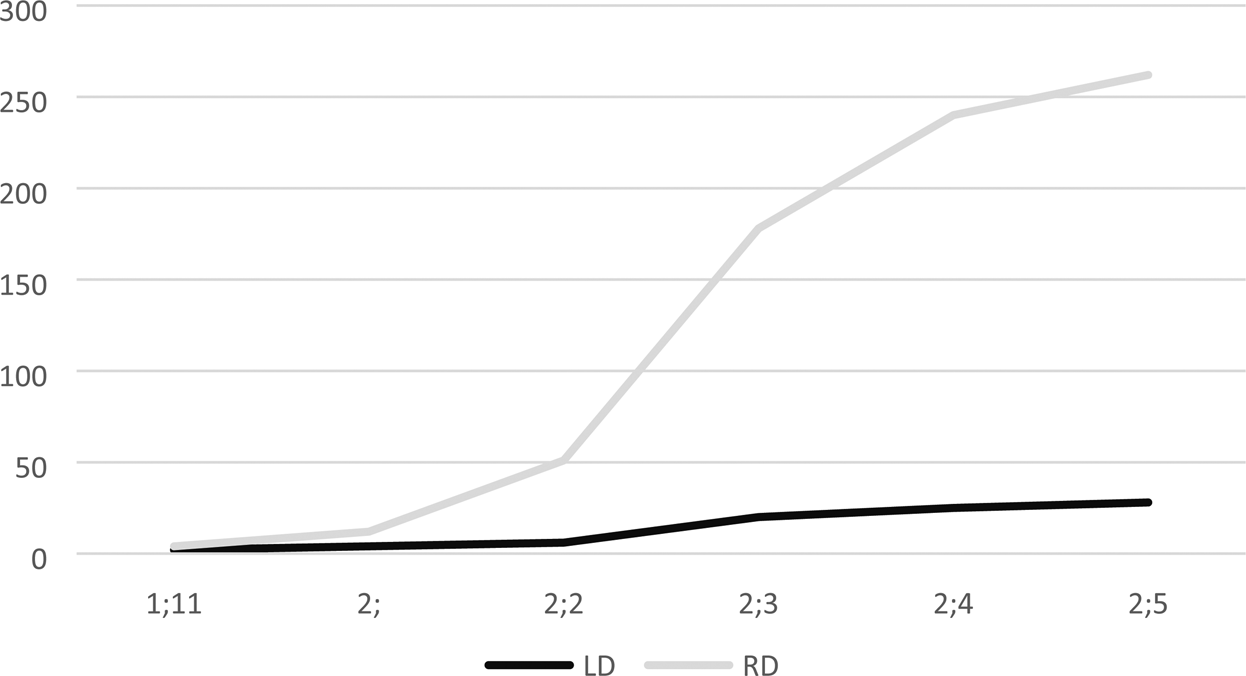
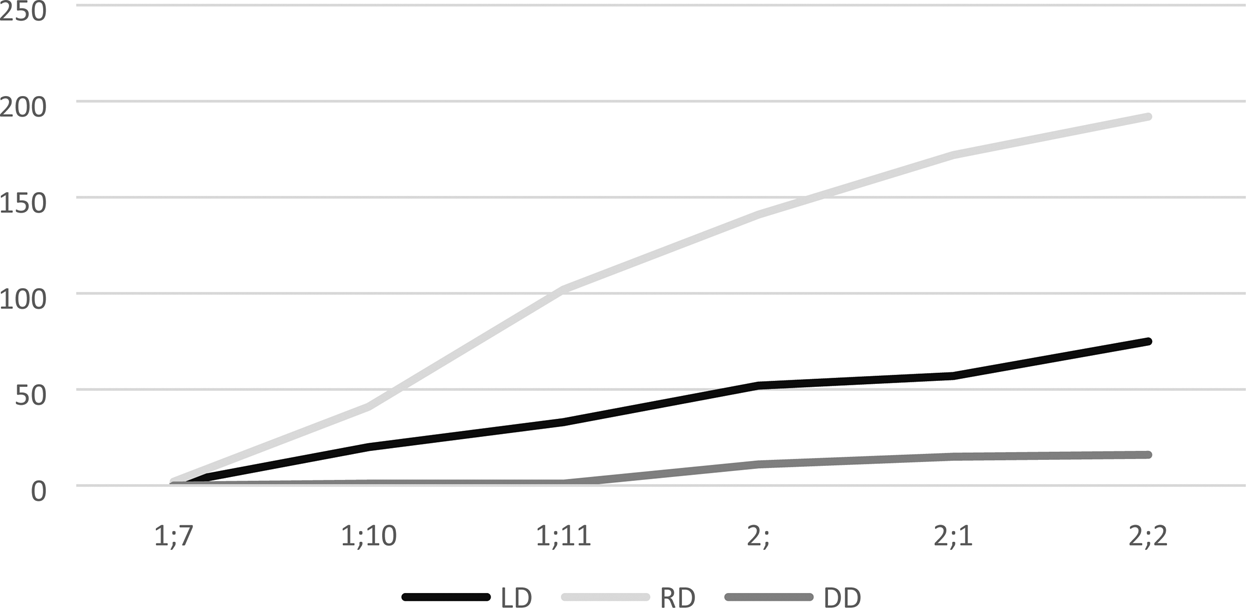
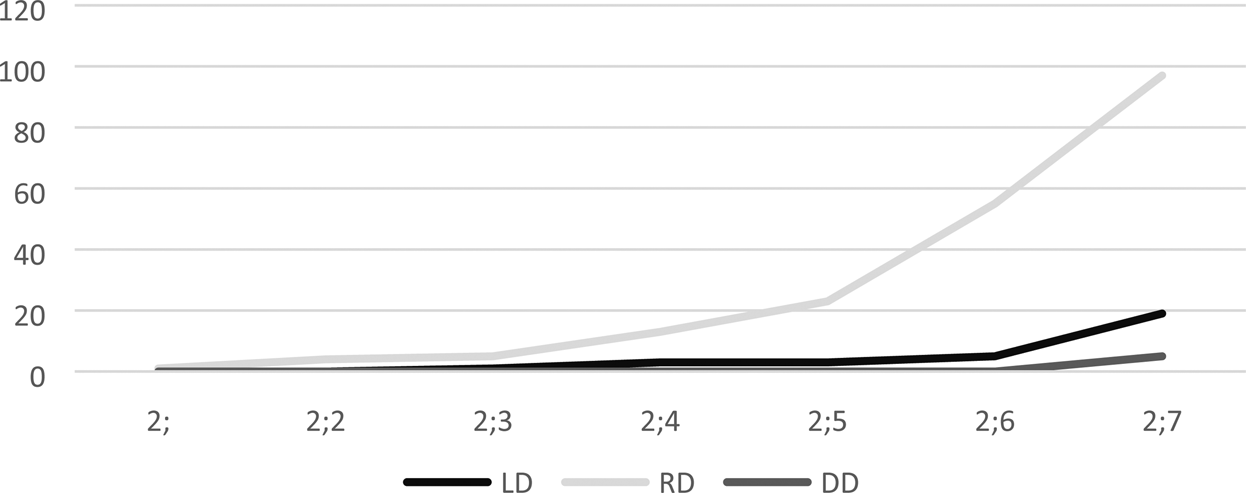
We present the cumulative sums of dislocations for each child in figures 4–6.
Cumulative sums of RD, LD and DD by age (Anaïs)

Cumulative sums of RD, LD and DD by age (Marie)

Cumulative sums of RD, LD and DD by age (Nathan)

The first striking result in these figures is that (i) for all children, RD is more frequent than LD and that (ii) for Anaïs and Nathan, RD also appears before LD. For both Anaïs and Nathan, the rise of the number of RD is sharper than for LD.
As for DD, they seem to appear when children start producing LD more frequently. For example, Marie starts producing DD at age 2, which is the age when there is a sharper increase in the frequency of LD in her recordings. As for Nathan, this rise in the frequency of both LD and DD occurs at age 2;7. Interestingly, after the first rise in the frequency of LD in Marie's data, Marie produces almost no DD. This correlation between the beginning of the rise in the frequency of LD and the production of DD could potentially be caused by a confusion between RD and LD. RD may be so frequent compared to LD that it might interfere when children are trying to produce a LD. As soon as LD is more established and frequent, the child might mix the constructions less frequently.Footnote 6 We will leave the investigation of this hypothesis for future research.
It is important to note that, even though RD is overwhelmingly more frequent than LD in our data, Marie and Anaïs produce both RD and LD in the first recordings in which they produce dislocations. Nathan's first LD appears two months after its first RD in the corpus. In other words, even though RD is more frequent in the production of these young children, LD and RD seem to appear around the same age. In the next two sections, we will compare the degree of completeness of RD and LD, i.e., the presence or omission of the verb and the resumptive clitic.
Results: Degree of completeness of LD, DD and RD
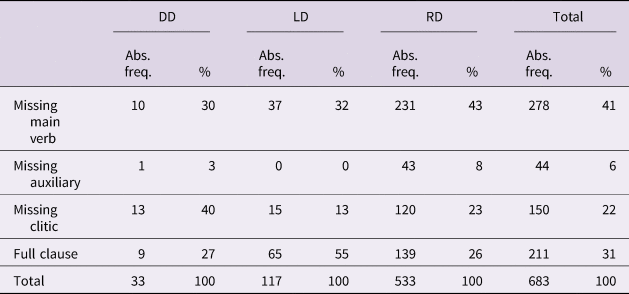
The results of our analysis of the degree of completeness (see above) of all types of dislocations are presented in table 1. It appears that most elements dislocated in the left periphery occur with a full clause (65 occurrences, corresponding to 55% of all LD) whereas RD is often produced without a main verb (41% of RD). 74% of the RD are incomplete, in contrast with 45% of LD.
Degrees of syntactic completeness of children's dislocation

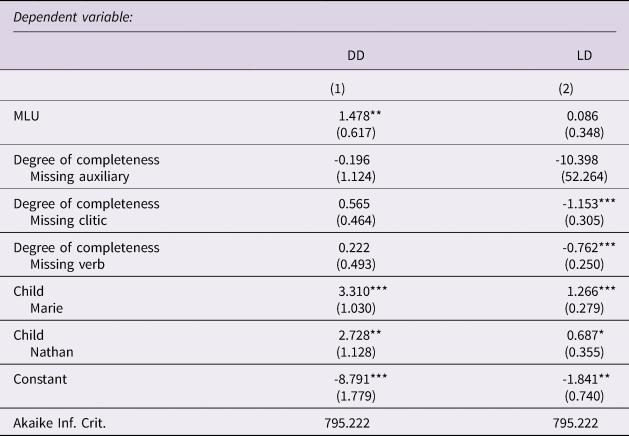
Coefficients in multinomial regression analysis of RD, LD and DD

Note: *p < 0.1; **p < 0.05; ***p < 0.01
This higher proportion of LD used with a full clause (55% of all the cases of LD) compared to RD suggests that there might be a correlation between the degree of completeness of the sentence and the position of the dislocated constituent in French child language. Even if we had included the sentences with a preverbal lexical subject in our data, the number of LDs with a missing clitic would be of 37 and the number of LDs with a missing main verb would be of 44. Hence, the proportion of LDs produced as full clauses would be of 44%, which is still higher than the 26% for RDs. We built our multinomial regression model based on these data to determine whether this difference in the frequency of the different degrees of completeness across the different types of dislocations is significant.
To build our model, we had to select which predictors to use and to keep. Following our original hypothesis, we had to test whether the sentence is complete (i.e., adult-like) or whether some elements (the verb or the resumptive clitic) are missing. To account for possible individual differences, we included the individual children as a predictor. It is indeed possible that some children prefer one periphery over the other. Finally, we coded the MLU, to assess whether general syntactic development has an impact on the position of the dislocated constituent.
We first ran a model with only one predictor, and then added one predictor after the other, running the model with each added predictor. Each time we ran the model, to determine whether we should keep the newly-added predictor, we looked at the AIC value of the model and at the p value of the predictor. The AIC value indicates how much of the variation in the data can be explained by the model; the lower the AIC value, the better the model is at explaining variation in the data. The first predictor we used in our model was the MLU. The MLU had a significant p value for both DD and LD and has therefore been kept in for the next model. In the second model, we added the degree of syntactic completeness as a predictor. The AIC value lowered from 890 to 833, and the predictor had a significant p-value. However, the significance of the MLU in that model dropped, and the p-value for LD was only of p < 0.1. Finally, we added the individual children as the final predictor. The AIC lowered again, and the predictor was significant, but the significance of the MLU lowered again, and remained only significant for the production of DD, not of LD. We ran a final model, including the individual children and the degree of completeness as predictors while excluding the MLU. The AIC value was slightly higher: 796,875, against 795,222 for the model with the MLU. Considering that the model with the MLU has a lower AIC, and that it had a significant p-value for the production of DD, we kept that predictor. Yet, since the difference in the AIC value is much smaller than when we added the other predictors, we must keep in mind that the effect of MLU on the position of the dislocated element is likely to be rather small. Hence, the list of predictors we kept comprises the MLU, the degree of completeness, and the individual children.
In a multinomial regression model, one value of each categorical variable must be chosen as the reference value, and is therefore absent from the summary table with the coefficients. In our case, we selected RD as our reference for the dependent variable. For the independent variables, the value “Full clause” was taken as the reference for the variable of the degree of completeness, and Anaïs was taken as the reference for the children.
The results are as follows:
(i) There is a significant correlation between the degree of completeness of the sentence and the production of LD. The coefficients for missing resumptive clitic and missing verb are negative, which means that, if a sentence lacks a verb or a resumptive clitic, the dislocated constituent is less likely to be produced in the left periphery, as a LD, and, consequently, more likely to be produced as a RD. The value “missing auxiliary” is not significantly correlated to the position of the dislocated constituent because no LD without auxiliary was attested in our data. The degree of syntactic completeness does not seem to be correlated to the production of DD.
(ii) The model also shows that there is a correlation between the individual children and the production of LD, DD and RD. The coefficients for Marie and Nathan are positive for both LD and DD, which means that Marie and, to a lesser extent, Nathan are more likely to produce DD and LD than Anaïs. This result suggests that there are individual variations in the preference for the production of DD, LD and RD.
(iii) Interestingly, the MLU does not have a significant effect on the production of LD. This might be due to a dependency between that variable and the degree of completeness. As children become able to produce longer utterances (and hence have a higher MLU), they are less likely to omit parts of the sentence like the verb.
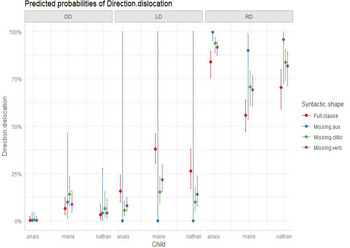
The predicted probabilities of production of DD, LD and RD, depending on the child and the degree of completeness of the sentence, are shown in Figure 7. We selected these two predictors and excluded the MLU, as it does not have a significant correlation with LD (see above), and to make the visualization clear. For LD, for each child, we can see that the probability of having a full clause is higher than the probabilities for the other values of the degree of syntactic completeness; whereas for RD, for all children, the probability of having a full clause is lower than the probabilities of having a clause with a lesser degree of completeness.
Predicted probabilities of the position of the dislocated element

Note that the probability of a RD with a full clause is still higher than the probability of a full clause in LD, because RD is considerably more frequent (78% of all dislocations) than LD (19%). Hence, even though 55% of LD and only 26% of RD are full clauses, only 30% of dislocations with a full clause are LD (63 cases), and 66% of dislocations with a full clause are RD (139 cases).
The general tendencies operating in the acquisition of LD and RD in French shown by our multinomial model thus seem to confirm – at least to some extent – the hypothesis of Freudenthal et al. (Reference Freudenthal, Pine, Aguado-Orea and Gobet2007a), according to which some non-adult-like patterns in child language can be explained by the fact that children develop constructions incrementally from the right edge. In our data, LD seems indeed to be more syntactically complete than RD. However, this hypothesis does not explain the 52 cases or 45% of LD from our corpus which lacks a verb or resumptive clitic. In the next section, we will try to explain some of these exceptions to the hypothesis of Freudenthal et al. (Reference Freudenthal, Pine, Gobet, Sun and Miyake2006, Reference Freudenthal, Pine, Aguado-Orea and Gobet2007b, Reference Freudenthal, Pine and Gobet2010).
Results: qualitative analysis of LD without verbs or resumptive clitics
Our corpus contains a total of 52 LD with omitted elements, resumptive clitics or the verb. These examples seem to be counter-examples to Freudenthal's hypothesis that constructions develop from the right edge, since they violate the prediction that LD should occur only with complete syntax, as the dislocated phrase in LD is the leftmost constituent of the sentence.
A qualitative analysis reveals that around 73% of these incomplete LDs occur in one of the following three main contexts, which we will explain in more detail below: (i) the dislocated constituent is contrastive; (ii) the LD is a repetition of a previous utterance made by the adult interlocutor; (iii) the verb of the sentence is vouloir ‘to want’, used with the 1st person singular je ‘I’.
25% of LD without resumptive clitics or verbs (13 cases) are explicitly contrastiveFootnote 7, which means that there is an explicit alternative mentioned in the discourse, as in example (22). Graf, Theakston, Lieven, and Tomasello (Reference Graf, Theakston, Lieven and Tomasello2015) show that, independently from their position in the utterance, contrastive entities are not omitted by children. A contrastive dislocated topic, even in the leftmost position, would therefore not be dropped. In French, contrastive topics are typically produced in the left periphery in adult French (Ashby, Reference Ashby1988; De Cat, Reference De Cat2002, Reference De Cat2007b). Contrastive topics could therefore be one of the exceptions to the acquisition from the right edge.
(22) M. Celui-là, il est à Marie.
this one, it is at Marie
C. Et ça, à maman ! (Marie, 1 ;10.11)
and that at mommy
‘M. This one belongs to Marie
C. And that to Mommy!’
We also found an additional 13% of syntactically incomplete LDs (7 occurrences), which express implicit contrast. In implicit contrast, the alternative of the contrastive entity is not necessarily mentioned in the discourse with a similar predicate, but can be simply salient in the context (Mayol, Reference Mayol2010). For example, in (23), the constituent ça ‘that’ refers to a card, that the child gives to the dame ‘lady’, who is the researcher recording the interaction between the mother and the child. The child does not mention explicitly that another card is for another person, such as the mother or the child.Footnote 8
(23) M. Tu distributes les cartes? T'en donnes à Marie
You hand the cards You-some give to Marie
et puis tu en donnes à Maman. Merci
and then you some give to Mummy thank-you
C. ça à dame.
that to lady
An additional 12% of LDs without a verb or without a resumptive clitic from the Lyon corpus (6 cases) appear in a context where the child attempts to repeat an utterance produced by the adult, but fails to repeat the verb or the clitic, like in example (24).Footnote 9 It is possible that, in the interaction, the intonation of the dislocated phrase in the adult's utterance is more salient than the resumptive clitic and the verb, resulting in the child repeating the dislocated phrase but omitting the verb and clitic.
(24) M. ça, c'est un tigre.
C. ça, tigre (Marie, 1;11.11)
‘M. that it's a tiger
C. that, tiger’
In 22% other occurrences of incomplete LD (12 cases), the verb is vouloir ‘to want’ at the first person singular (25). The French clitic pronoun je is phonetically elided in front of consonants by some speakers, being reduced to /ʒ/ (Temple & Schladebeck, Reference Temple and Schladebeck2016, p. 398).Footnote 10 Since this consonant, as well as the /v/ in veux, are fricative consonants, we hypothesize that the difference between these two sounds lacks sufficient salience for children to identify the presence of the clitic je in the input before the verb veux ‘want’.Footnote 11 Children therefore do not store this pronoun while storing exemplar sentences from their input. The resumptive clitic in such contexts might not be salient enough to generate acquisition.
(25) Moi veux faire. (Marie, 2;2.17)
Me want do
‘I want to do it’
Our corpus still contains 31% of syntactically incomplete LDs (16 cases) that we could not explain from the specificities mentioned above in this section, such as the examples in (26). We could not find any pattern among these remaining LD that could explain the production of syntactically incomplete LD under the hypothesis of Freudenthal et al. (Reference Freudenthal, Pine and Gobet2010).
-
(26)
a. Non. Est à moi. À moi. Moi arrive pas là. (Anaïs, 2;5.23)
no is to me to me me manage NEG there
‘No, it's mine. Mine. Me, I can't do it’
b. M. C'est pour Na… Magalie?
it-is for Na… Magalie
‘Is it for Na… Magalie?’
C. Oui. ça,'pour Magalie. (Marie, age 2;0.8)
Yes. That for Magalie
‘Yes. It's for Magalie’
Out of these 16 cases, two are difficult to analyse, as they occur at the very beginning of the recording, making it difficult to take the context into consideration. It is important to report that 12 of these 16 cases of incomplete LD are produced by Marie. Our multinomial regression model shows that this child significantly produces more LD than the other children.
These results show that even though the multinomial regression model suggests that children develop dislocation from the right edge, other learning mechanisms must be at work to explain the 52 cases of LD without a verb or a resumptive clitic in our data. Whereas half of the LD with syntactically incomplete sentences can be explained by some specific contexts, it is not the case for the remaining half. In the next section, we will discuss these results and try to explain what they entail for the hypothesis of the acquisition of constructions from the right edge.
Discussion
Implications for the theory of the development from the right edge
The proportion of RD and LD, and the results of our multinomial regression model, seem to support the hypothesis of Freudenthal et al. (Reference Freudenthal, Pine, Gobet, Sun and Miyake2006, Reference Freudenthal, Pine and Gobet2007b, Reference Freudenthal, Pine and Gobet2010): that some patterns of child language development can be explained by an acquisition from the right edge of sentences from the input. Our original predictions, that RD would be more frequent than LD in early child language and that LD would be significantly more syntactically complete than RD, due to dislocated phrases being in the leftmost part of the sentence, are borne out by our data. Our model suggests that the tendency of LD to have a higher degree of completeness happens for the three children of our analysis.
Yet, the production of LD in syntactically incomplete sentences cannot be accounted for by the hypothesis of language development from the right edge. We have quite a large number of syntactically incomplete LD, 45% of the LD produced by the children from our corpus. The hypothesis of the development from the right edge could be more precise and account for our data if it included the following: (i) omission of elements which lack salience and (ii) inclusion of salient elements in the left edge (see below).
In some circumstances, the learning mechanism from the right edge is too robust, as it does not take into account some specific features that might also have an influence on language acquisition. For example, in our data, the resumptive clitic je is omitted in front of the verb vouloir. As we explained in the result section, this resumptive clitic is not salient in such contexts, as it is unstressed, like all clitic pronouns, and is reduced to a simple consonant. If the MOSAIC model could include phonetic properties, one possible way to make its language learning more child-like would be to increase the number of encounters required for a morpheme lacking salience to be stored in the model and to allow the program to jump to the next element.
Freudenthal et al. (Reference Freudenthal, Pine and Gobet2010, Reference Freudenthal, Pine, Jones and Gobet2015) too argue that the acquisition from the right edge alone cannot account for all their data. They hypothesize that learning from the left edge might occur because, in addition to the recency effect exhibited by right edge learning, humans show what they call a “primacy effect”. This means that when subjects are asked to remember a list of items, they tend to remember the first elements in addition to the last items (Gupta, Reference Gupta2005; Gupta, Lipinski, Abbs & Lin, Reference Gupta, Lipinski, Abbs and Lin2005). Hence, the MOSAIC model was expanded to include two learning mechanisms at once: one from the right edge, and one from the left edge. The authors hypothesize that the right edge is still more salient than the left, and programmed MOSAIC accordingly: learning from the left edge is programmed to be twice as slow as the learning mechanism from the right edge. To learn a phrase of the same length in the left edge requires the double amount of exposure as for the right edge. If language learning occurs from both the left and right edges, it can explain the occurrence of LD in sentences without a verb or a resumptive clitic.
Freudenthal et al. (Reference Freudenthal, Pine and Gobet2010, Reference Freudenthal, Pine, Jones and Gobet2015, Reference Freudenthal, Pine, Jones and Gobet2016) do not explain or hypothesize in which contexts acquisition from the left edge is more likely to occur. The literature on child directed speech shows that sentence position is just one of the factors influencing ease of acquisition (Naigles & Hoff-Ginsberg, Reference Naigles and Hoff-Ginsberg1998; Shady & Gerken, Reference Shady and Gerken1999; Wijnen et al., Reference Wijnen, Kempen and Gillis2002). MOSAIC does not include prosody, semantics or information structure, which are additional factors that can facilitate acquisition. Contrastive topics are typical of LD, and not of RD in French (De Cat, Reference De Cat2007b; Lambrecht, Reference Lambrecht, Perret and Verschueren1981), and they can carry a different intonation fromm non-contrastive dislocation in adult-directed spoken French (Horváth, Reference Horváth2018). Such instances of LD might have an impact on acquisition from the left edge.Footnote 12 What's more, our data suggest that there might be individual variation in the preference for one periphery. Marie produces significantly more LD than Anaïs, and Marie also produces the majority of syntactically incomplete LD that we could not explain. Further research on the possible factors of salience, including the acquisition from the edges, but also intonation and semantics, and on individual variation, might allow us to get a better understanding of the reasons underlying the developmental paths of children's constructions. In the next parts of the discussion section, we will try to understand whether different theories about word order in child language can provide a better explanation for our results than the hypothesis of development from the edges.
Competing interpretations
The syntactic derivation hypothesis
Some authors document similar word order patterns as we did in early child language, such as an early preference for sentence-final subjects in the speech of children who are acquiring SVO languages. Friedmann and Costa (Reference Friedmann and Costa2011), for instance, show that, at least until age 2, children acquiring Palestinian Arabic and Spanish as their native language can repeat VS sentences with more accuracy than SV sentences. They also tend to reverse SV sentences into a VS order, even though the SV order is more frequent in adult language (Dahlgren, Reference Dahlgren, Lutz and de Jong2010; Gutiérrez-Bravo, Reference Gutiérrez-Bravo2005). Children become able to repeat SV sentences with the same accuracy as with VS sentences at around age 3. As for Greek, which has a flexible word order but more frequent SVO sentences, most children below age 2 from the longitudinal study by Kapetangianni (Reference Kapetangianni, Anderssen, Bentzen and Westergaard2010) produce more than 80% of their overt subjects post-verbally, and the proportion of preverbal subjects rises as the subjects age, until around age 3, when preverbal and postverbal subjects are equally frequent. An older study by Bates (Reference Bates1976) provides similar results for Italian children, who initially produce a majority of postverbal subjects in spontaneous data, before switching to a preference for preverbal subjects.
Friedmann and Costa (Reference Friedmann and Costa2011) argue that the different preferred word order by children acquiring these different languages is caused by the different syntactic derivations produced by the children from these languages. They argue that Spanish and Palestinian children raise the verbs to the I’ position, resulting in a frequent VS order. The hypothesis proposed by Friedman and Costa to explain this difference is that Spanish and Arabic children already have the spell-out domain at the IP level. They argue that this is linked to the presence of clitic doubling in Spanish and Arabic grammar. As stated by Torrego (Reference Torrego1998), in languages with clitic doubling, the clitic must undergo movement at the IP-level, to be assigned a theta role.
If one assumes that subjects resumed by a clitic in French are true cases of dislocations, the explanation above cannot be carried over to French dislocation, since, in the generative approach, left and right-dislocated constituents have been shown by De Cat (Reference De Cat2002, Reference De Cat2007a, Reference De Cat2007b) and Rizzi (Reference Rizzi and Haegeman1997) to be base-generated, and, hence, they do not involve syntactic movement. From this perspective, the left and the right periphery should be of equal difficulty for French children.
However, under a subject doubling interpretation (Culbertson, Reference Culbertson2010), dislocated constituents are not base-generated. Rather, these subjects are raised from a lower position to specTP if produced in the sentence-initial position, just as non-dislocated subjects. Under that assumption, if children produce non-adult-like syntactic movements, they could also produce a higher proportion of RD than adults. Nevertheless, it remains unclear how erroneous syntactic movements could be correlated to the production or omission of compulsory sentence elements such as verbs. This hypothesis, at least by itself, cannot account for our results on the syntactic completeness of LDs and RDs.
Other models on reduced syntactic structures in child speech
The hypothesis of Freudenthal et al. (Reference Freudenthal, Pine, Gobet, Sun and Miyake2006, Reference Freudenthal, Pine and Gobet2007b, Reference Freudenthal, Pine and Gobet2010, Reference Freudenthal, Pine, Jones and Gobet2016) implies that children's processing limitations occur at the learning level: they only attend and store elements from the right edge. However, other authors argue that the processing limitations resulting in children dropping some elements of their sentences does not affect learning, but rather sentence production. Children may have acquired all the linguistic means to produce a complete sentence, but, when the sentence is too long, they drop some constituents. This truncation approach was developed by Rizzi (Reference Rizzi1994). Following the Full Competence Hypothesis, he argues that children's early grammar is not characterized by a truncated mental representation of sentence structure. However, in the early speech production, some projections can be omitted. If a projection is omitted, all the projections dominating this projection are also omitted. Similarly to the model developed by Freudenthal et al. (Reference Freudenthal, Pine, Aguado-Orea and Gobet2007b, Reference Freudenthal, Pine and Gobet2010), the truncation approach can explain the production of non-finite verbs in French child language (Rizzi, Reference Rizzi, Hoekstra and Schwartz1993, Reference Rizzi1994) and in Dutch child language (Haegeman, Reference Haegeman1995).
This approach could also explain our data. Indeed, if children do truncate the sentence at the TP level, they only omit the higher, and not the lower projections; and hence they omit preverbal subjects, but not sentence-final elements in French. This would lead to a higher proportion of RD than of LD, which is borne out by our data. What's more, the truncation approach also explains why LD is more likely to be adult-like than RD, since preverbal subjects are situated in a higher projection than verbs and resumptive clitics.Footnote 13 Yet, the truncation approach cannot explain why, in some cases, LD is produced without a verb or resumptive clitic. Nor can this approach be combined either with a different learning mechanism that would explain the sentence-medial truncation of LD with a low degree of syntactic completeness, as the truncation implies completely dropping all elements in higher projections.
Radford (Reference Radford1990) provides a different account for the omission of compulsory syntactic elements such as clitic pronouns, or even verbs. According to this author, children's early multiword utterances are purely lexical projections, lacking functional categories such as Inflection, Determiner or Complementizer. At that stage, children would typically produce two-word utterances such as open box, baby cup, etc. Such utterances are indeed similar to the earliest cases of dislocation that we extracted from our corpus, and could potentially explain why most early dislocations lack compulsory elements such as auxiliaries or the clitic pronoun. Nevertheless, this account cannot explain why RDs are more frequent than LDs in early child French, and why RDs are statistically more likely to be incomplete than LDs. It remains unclear why functional categories would be produced in some contexts but not others.
The competition based model developed by Yang (Reference Yang2002) could account for the presence of different grammars in child speech. According to this author, children have different competing grammars, that they test, and eventually discard the grammars that do not match their input through statistical frequencies. It could potentially explain why the children of our corpora seem to sometimes produce or omit syntactic elements such as the clitic pronoun at the same age (some children from our corpus produce dislocations as syntactically complete or with a missing verb in the same recording), and even why RD would initially be more frequent than LD. However, in our data, the production of each grammar seems to be dependent on the position of the dislocated constituent in our data: the grammar including clitic pronouns is statistically more frequent in LD than in RD. It is not clear how the model of Yang (Reference Yang2002) could explain why children would have different grammars based on the position of dislocated constituents. Therefore, this model does not seem the most suitable to account for our results.
To conclude this section, we could not identify a model of child language acquisition that could account for all our data. The hypothesis of the development of constructions from the right edge requires additional learning mechanisms. Nevertheless, traditional models of the acquisition of syntax do not seem to accommodate the fact that RDs are more frequent than LDs in child French, in contrast with adult speech, and that LDs are statistically more frequently complete in terms of syntax. One underlying issue could be that the traditional model of the acquisition of syntax does not consider children's cognitive limitations, such as working memory, while the model of Freudenthal et al. (Reference Freudenthal, Pine, Gobet, Sun and Miyake2006, Reference Freudenthal, Pine, Aguado-Orea and Gobet2007b, Reference Freudenthal, Pine and Gobet2010) does not include any form of syntactic abstraction and considers only the gradual storage of exemplars from the input. A model considering both children's syntactic knowledge and their cognitive limitations could probably provide a better fit for our results.
Conclusion
This article provides an analysis of the syntactic completeness and the position in the left or right periphery of 704 occurrences of dislocations produced by three French children in the Lyon corpus (Demuth & Tremblay, Reference Demuth and Tremblay2008). We show that RD is more frequent for the three children, and, on the basis of a multinomial regression model, that RD is significantly less syntactically complete than LD. This result is compatible with the hypothesis of the development from the right edge put forward by Freudenthal et al. (Reference Freudenthal, Pine, Gobet, Sun and Miyake2006, Reference Freudenthal, Pine, Aguado-Orea and Gobet2007b, Reference Freudenthal, Pine and Gobet2010): if constructions tend to develop incrementally from the right edge, it is predicted that, once the left edge is acquired, all the elements following it should also be acquired.
Our data however also show that syntactic development from the right edge cannot be the only mechanism explaining the acquisition of dislocation in child French, since 45% of the LD from our data are not syntactically complete. The acquisition of sentence-internal elements might be delayed when they lack salience, and the acquisition of some elements at the left edge might be facilitated if they are more salient. However, due to the high number of LDs with lower degrees of syntactic completeness, the circumstances under which acquisition from the left edge occurs remain unclear. Since a large number of the syntactically incomplete LDs are produced by one child out of the three from the corpus, a study on a larger number of children might reveal whether development from the edges is a learning process generalizable across children or whether it is subject to high individual variation.
Further perspectives
The next step to support our results and interpretations with computational data would be, with a model similar to MOSAIC, to simulate the acquisition of dislocation with a learning process from the right edge, and from the left edge in some specific contexts (like contrastive topics), with the inclusion of prosody. If the model produces dislocations similar to those from our data, it would support the hypothesis that dislocation is acquired from the edges. This computational model could also be used to generalize theories about the position of subjects in child language. It could simulate the position of the subject in French and other languages that show an early preference for postverbal subjects, to determine whether this early preference in some languages can also be explained by development from the edges.
Acknowledgements
This research was funded by the KU Leuven project grant BOF C14/15/021.