Introduction
When policymakers set the policy agenda, i.e. prioritise which items will receive government attention (Zahariadis Reference Zahariadis2016), the process includes two phases: the visible decision-making process and the latent predecisional process. In the former, policymakers openly decide what issues will be placed on the formal agenda; the list of issues set for consideration by a particular institutional decision-making body (Cobb and Elder Reference Cobb and Elder1983). In the latter, powerful actors systematically prevent some issues from arising on the agenda to maintain the status quo (Cobb and Elder Reference Cobb and Elder1983), by using the second face of power (Bachrach and Baratz Reference Bachrach and Baratz1962). Specifically, they might use latent threats that will force other actors to refrain from suggesting certain issues because of the anticipated negative consequences they might bring. Alternatively, powerful actors can gain control over information and disseminate it in a way that will make certain issues seem inappropriate, and thus actors will not even consider raising them. The issues that are systematically blocked from the formal agenda owing to latent power mechanisms are termed “nondecisions” (Bachrach and Baratz Reference Bachrach and Baratz1962, Reference Bachrach and Baratz1963; Pierson Reference Pierson2015; Wolfinger Reference Wolfinger1971).
The predecisional process is important for understanding policy outcomes because it determines the terms of the debate, such that, in some cases, the visible decisions are a mere formalisation of the winnowing process of the predecisional process (Cobb and Elder Reference Cobb and Elder1983). Despite this importance, and despite advancements in agenda-setting research (see, for instance, Green-Pedersen and Walgrave Reference Green-Pedersen and Walgrave2014), scholars often side-step the predecisional process and focus mostly on visible decisionmaking. There are two main reasons for this. First, with the expansion of governments in many countries to new domains, few issues remain that are not on the formal agenda; and second, it is difficult to study nondecisions because they are invisible (Jones Reference Jones2015, Reference Jones2016). Nonetheless, this article argues that the predecisional process remains relevant and can be studied at least partly empirically.
Specifically, the predecisional process takes place in the domain of problem definitions – the specific aspect of a problem being dealt with (Dery Reference Dery1984). This is because, although today’s governments address many issues, they do not necessarily address all the aspects of each issue. In fact, in some cases, governments intentionally ignore certain aspects to contain the scope of the conflict (Dery Reference Dery2000). For instance, when fighting obesity, governments can deliberately ignore the regulatory aspects that can hurt powerful food corporations and focus entirely on educating the public.
To partly overcome the empirical difficulty of studying nondecisions, this article suggests examining problem definitions that were once on the formal agenda and then disappeared from it. Such problem definitions can be identified because they leave their fingerprints on the formal agenda. When problem definitions disappear despite continuing to be relevant, and when the disappearance is a result of powerful actors’ use of latent power mechanisms, they can be termed nondecisions.
These arguments are tested using theory testing process tracing (Beach and Pedersen Reference Beach and Pedersen2013) in two American policy case studies: prescription drug prices and child care. The two cases were chosen because in both there are problem definitions that disappeared from the agenda despite continuing to be relevant, and powerful actors with an interest in this disappearance. As such, they are appropriate for a process tracing analysis.
The rest of the article continues as follows. First, I explain the importance of the predecisional process. I then examine the two factors most responsible for the neglect of the predecisional process in the current research and explain how studying problem definitions that disappeared from the agenda can address both the relevance of the predecisional process and the empirical challenge. This is followed by a description of the two power mechanisms that can be present when problem definitions disappear from the agenda. In the next part, I describe the methodology and the data, followed by a detailed analysis of the two case studies. Last, I discuss the main conclusions.
Agenda-setting and the predecisional process
The systematic policy agenda (also termed the public agenda) refers to the “general set of political controversies that will be viewed by the public as falling within the range of legitimate concern meriting the attention of the polity” (Cobb and Elder Reference Cobb and Elder1971, 905). Within this list of items, some are scheduled for consideration by a particular institutional decision-making body (e.g. legislature, executive). This is termed the formal or the institutional policy agenda (Cobb and Elder Reference Cobb and Elder1983).
As the attention span of individuals and governments is limited (Jones and Baumgartner Reference Jones and Baumgartner2005), governments have to set priorities when deciding which items will move from the systematic to the formal agenda. This prioritisation is termed “agenda-setting.” The agenda-setting process has two facets. First, the decision stage is an open contestation between groups within the formal branches of government over which issues will be placed on the formal agenda. Second, the predecisional stage is when, without crossing the domain of active controversy, powerful actors systematically block issues that can be deemed appropriate for government consideration from arising on the formal agenda, using latent power mechanisms. Such issues are termed “nondecisions” (Bachrach and Baratz Reference Bachrach and Baratz1963). The predecisional process defines the scope of the conflict in the decision-making process – i.e. which issues are discussed and which groups are involved (Cobb and Elder Reference Cobb and Elder1983). Consequently, the formal agenda reflects not only the preferences of the policymakers regarding the problems that should be addressed, but also their preferences regarding what problems they wish to keep away from consideration (Zahariadis Reference Zahariadis2016). Hence, to understand the policy agenda in a given polity, one should not only examine the issues actually placed on the agenda, but also those that were denied access to it.
Although scholars agree on the existence of the predecisional process and nondecisions, the development of theories and measures for the systematic study of the visible agenda (Baumgartner and Jones Reference Baumgartner and Jones2009) has allowed them to side-step the idea of the predecisional process and focus more on the visible agenda: the decisions being made, the policy instruments selected and so on. (Jones Reference Jones2016). Many works examine the effect the public and the media agendas have on the formal agenda. However, in most cases, they look at those items that have breached the formal agenda, not those that failed to do so (see, for instance, Jones and Baumgartner Reference Jones and Baumgartner2005; Baumgartner et al. Reference Baumgartner, Jones and Wilkerson2011; Green-Pedersen and Walgrave Reference Green-Pedersen and Walgrave2014; Zahariadis Reference Zahariadis2016). Moreover, most research focuses on issue attention, and not on the struggle of powerful actors to contain certain demands (Jones Reference Jones2016).
The relevance of the predecisional process today
One explanation for the neglect of the predecisional process in current research is changes in reality. From the late 1950s, governments across the Western world became bigger. Many issues that had not been addressed by governments before entered the formal agenda. Consequently, today fewer issues are denied agenda access, and ideas that groups raise almost always fit into some preordained conflict structure (Jones Reference Jones2015).
This does not, however, make the predecisional process irrelevant. The conflict over the agenda is not just over issues, it is also over problem definitions (Cobb and Ross Reference Cobb and Ross1997). While today’s governments might be more vulnerable to pressure from interest groups to address issues, they still have the power to manipulate problem definitions (Dery Reference Dery2000).
Every policy issue has several problem definitions (also termed policy image, frame or issue definitions), which refer to the way the policy is understood and discussed (Baumgartner and Jones Reference Baumgartner and Jones2009). A problem definition addresses a specific aspect of the problem being dealt with (e.g. information, regulation, etc.), as well as the nature of the problem in terms of its severity, generality and causes. When defining a problem, some aspects of the situation are highlighted, at the expense of others (Dery Reference Dery1984; Rochefort and Cobb Reference Rochefort and Cobb1994).
Problem definition is consequential for the policy outcome because each definition affects the solutions that are perceived to be available and plausible, the interests that play a role during policy deliberation, what type of coalitions are likely to emerge and who makes up the policy’s constituencies. In other words, the definition of the problem shapes the structure and nature of the conflict.
Problem definitions and redefinitions are political acts that are used strategically to expand and restrict the scope of the conflict and to gain an advantage in the policy-making process (Stone Reference Stone1989; Weiss Reference Weiss1989; Rochefort and Cobb Reference Rochefort and Cobb1994; Dery Reference Dery2000; Daviter Reference Daviter2007; Baumgartner et al. Reference Baumgartner, Berry, Hojnacki, Kimball and Leech2009). Powerful problem definitions benefiting from a high degree of consensus help preserve the status quo. When an alternative problem definition is proposed, actors wishing to maintain their power will try to make it seem irrelevant or illegitimate (Baumgartner and Jones Reference Baumgartner and Jones2009). For instance, Dery (Reference Dery2000) has demonstrated how, during the tent protest in Israel, the government was able to prevent a significant shift from the status quo and to contain the scope of the conflict by defining the housing problem in a narrow way (as concerning only the neediest population), thus undermining a broader problem definition.
The empirical challenge
The second explanation for neglecting the predecisional process is that it is difficult (if not impossible) to study empirically events that did not happen, or things one cannot see. Bachrach and Baratz (Reference Bachrach and Baratz1963) and Gaventa (Reference Gaventa1982) claim that, while nondecisions are invisible, the nondecision-making process is observable. In other words, the identification of nondecisions can take place by revealing the power relations and the mobilization of bias (Schattschneider Reference Schattschneider1960) responsible for those nondecisions. Hence, one can study the predecisional process by uncovering the mechanisms through which the power dimensions should operate, and what the observable implications of the exercise of power might be. This can be done by going outside the decision-making arena into the community and observing the myths, rituals, institutional practices, relations between groups, decisions made and unaddressed grievances (Bachrach and Baratz Reference Bachrach and Baratz1970, Reference Bachrach and Baratz1975; Lukes Reference Lukes1974).
This approach, however, is useful only when the researcher has prior assumptions or knowledge regarding issues that might be nondecisions in a given community or polity that will guide the search process. In fact, in most works studying nondecisions, researchers already know or suspect which nonevents will be relevant, and the aim of the research is to reveal the power mechanisms and confirm that the inaction can be termed a nondecision (see, for instance, the works of Bachrach and Baratz Reference Bachrach and Baratz1970; Gaventa Reference Gaventa1982; Croucher Reference Croucher1997).
Otherwise, it is extremely time-consuming, and even perhaps beyond the researcher’s capacity, to examine all (or at least many) nonevents in order to identify those that are the result of latent power relations and can be termed nondecisions. This is because the number of nonevents that can potentially be nondecisions is enormous as nondecisions can result from both conscious and subconscious mechanisms (Wolfinger Reference Wolfinger1971; Polsby Reference Polsby1979).
One way to overcome the problem of narrowing the scope of relevant nonevents is by using a comparative perspective. One can choose similar issues in different places that are affected by the same “natural conditions” (suffering from the same problem) and examine why a certain issue arises in one community/country/area and not in another (Wolfinger Reference Wolfinger1971; Polsby Reference Polsby1979). For instance, Crenson (Reference Crenson1971) wished to explain nondecisions in the field of air pollution by comparing cities with the same level of air pollution, where in some cities action had been taken to reduce pollution but in others it had not. (For a more comprehensive analysis of Crenson’s method, see Lukes Reference Lukes1974.) The main shortcoming of this solution is that it can be biased, based on the assumption that a real grievance in one place is necessarily so in another (Wolfinger Reference Wolfinger1971; Polsby Reference Polsby1979).
Partly overcoming the empirical challenge
One way to partly overcome this challenge is to examine problem definitions that were once on the formal agenda but that disappeared from it.Footnote 1 Such problem definitions leave empirical traces in the formal agenda. Correspondingly, one can identify them by tracing the formal agenda, looking for those problem definitions that are no longer there.Footnote 2 Examining such problem definitions enables the researcher to avoid biased identification because identification is not based on the researcher’s belief regarding what should be considered an appropriate problem definition; rather, it is based on the actors’ past beliefs and preferences that made them place the problem definition on the agenda in the first place.
Problem definitions that disappear from the agenda are not necessarily nondecisions. To be termed a nondecision, a problem definition that has disappeared should meet all the following conditions. First, the disappearance from the agenda should be systematic, continuing over a certain period of time, which means it is not a result of issue juggling (when policymakers shift their attention from one problem to another; Jones and Baumgartner Reference Jones and Baumgartner2005). Second, the disappearing problem definition should remain relevant during the period it is absent from the agenda. In other words, the problem is not resolved, and there are no alternative definitions that make it redundant or useless. Third, powerful actors exist who have an interest (ideological and/or material) in removing the problem definition from the agenda. Fourth, at least one latent power mechanism, such as anticipated reactions or information control (Bachrach and Baratz Reference Bachrach and Baratz1962; Pierson Reference Pierson2015), is responsible for the problem definition’s disappearance from the formal agenda.
Anticipated reactions
When powerful actors fail to prevent a problem definition from appearing on the formal agenda, they move to block its progress through the policy process, usually by using various strategies in open contestation (such as attacking its legitimacy or the legitimacy of the actors addressing it; Cobb and Ross Reference Cobb and Ross1997). When they succeed in achieving their goal, often after a highly salient conflict, this can send a powerful signal to those supporting the problem definition about the relative capabilities of their contestants. The more power the actors gain, the more consequential their reaction is seen to be. Over time, the supporters of the problem definition might strategically accommodate their behaviour, retreat or reorient their positions, or refrain from placing the unfavourable problem definition on the formal agenda. This is because they believe there is a high potential for future defeat and/or increased risks of countermobilisation – all without any explicit threat being made (Pierson Reference Pierson2015). For instance, in the United States (US) the victories of the business community in Congress in fields such as consumer protection and industrial relations sent a powerful signal to policymakers in both parties, forcing them to reorient their positions and become more responsive to the demands of the business community (Hacker and Pierson Reference Hacker and Pierson2010).
Information control
A policy problem is defined, among other things, based on information (Baumgartner and Jones Reference Baumgartner and Jones2009). Policymakers address a specific aspect of the problem when they receive information on it. The more diverse the information they receive, the more problem definitions will be placed on the formal agenda. Consequently, one way to limit the number of problem definitions and/or remove an existing problem definition from the formal agenda is by censoring information, i.e. by decreasing its diversity (Baumgartner and Jones Reference Baumgartner and Jones2015). This can be done when the information on a given issue is not evenly distributed among actors so that those who have less information become dependent on those who have more. This dependence is not only based on information provision, but also the need to have that information analysed and organised for them (Baumgartner and Jones Reference Baumgartner and Jones2015).
Powerful actors who control information can manipulate it to provide information on certain problem definitions that are favourable to their interests, and to omit information addressing others in order to contain the scope of the conflict (Baumgartner and Jones Reference Baumgartner and Jones2015; Curry Reference Curry2015). For instance, congressional leadership uses its informational advantage to shape the way rank and file members view the various legislative proposals and the preferences they develop to avoid opposition and ensure that rank and file members follow party lines (Curry Reference Curry2015).
However, information in a policy community is often shared across actors, both those who support and those who oppose change, so that aspects that actors deliberately ignore can be brought to the attention of others (Baumgartner et al. Reference Baumgartner, Berry, Hojnacki, Kimball and Leech2009). Therefore, a problem definition can disappear from the agenda when no information is provided by its supporters or its opponents. Powerful actors can affect the information provided by their opponents when they have control over venues that disseminate information, such as the media (either de jure or de facto), or by being able to communicate their ideas better than their opponent (Carstensen and Schmidt Reference Carstensen and Schmidt2016). In such cases, they can distribute information in a way that will make a certain problem definition seem illegitimate or inappropriate. Over time, as this perception spreads and becomes dominant, the problem definition is considered to be less appropriate, making its advocates believe it has no support. As a result, they stop addressing it and they stop providing information. Powerful actors are thus able to create a false consensus that can become real as specific views become rare (Pierson Reference Pierson2015). For instance, the growing power of the new right has made some problem definitions, such as the lack of public provision of certain services, seem inappropriate; as a result, even left-oriented parties rarely address them (Blyth Reference Blyth2013).
Data and method
The following analysis aims to examine whether problem definitions that disappear from the formal agenda can be termed nondecisions, based on two cases from American policy: prescription drug prices and child care. These cases were chosen because in both the cause and the outcome are present. Therefore, in principle the mechanism can also be present. This makes these cases appropriate for a theory testing process tracing analysis (Goertz and Mahoney Reference Goertz and Mahoney2012; Beach and Pedersen Reference Beach and Pedersen2013, Reference Beach and Pedersen2016). Specifically, both cases exemplify a problem definition that disappeared from the formal agenda for a certain period of time, despite continuing to be relevant, and both involve powerful actors who had an interest in the disappearance of the problem definition. In addition, the cases were chosen because each demonstrates a different latent power mechanism: anticipated reactions in the case of prescription drugs prices and information control in the case of child care. The analysis is composed of two steps: first, identification of the disappearing problem definitions and, second, testing whether the identified problems can be termed nondecisions.
Identification of the disappearing problem definition
To identify which problem definitions are no longer on the agenda, I use data from the Congressional Bills Project (Adler and Wilkerson Reference Adler and Wilkerson2012), which includes all the bills introduced in the US Congress from 1946 until the present, coded based on their content using the Comparative Agendas Project (CAP) coding scheme.Footnote 3 Using the bills’ agenda is appropriate because it includes a broad range of problem definitions on the formal agenda as bills represent policy ideas that are believed by policymakers to be appropriate regardless of their feasibility (Wilkerson et al. Reference Wilkerson, Smith and Stramp2015). In addition, because the Congressional Bills Project codes all the bills on a given subject, this provides the best estimate of the formal agenda in this venue.
I identified 117 bills coded under the CAP subtopic of “drug coverage and cost”, addressing the issue of prices from 1973 (when the first bill on the subject was introduced) until 2015, and 501 bills addressing child care coded under the CAP subtopic “child care and maternity leave”, from 1950 (when the first bill on the subject was introduced) to 2016. For each bill, I coded the problem definition based on the item’s description in the data. Next, I conducted a time series of the problem definitions to reveal which problem definitions no longer appear on the agenda.
Identifying the presence of latent power mechanisms
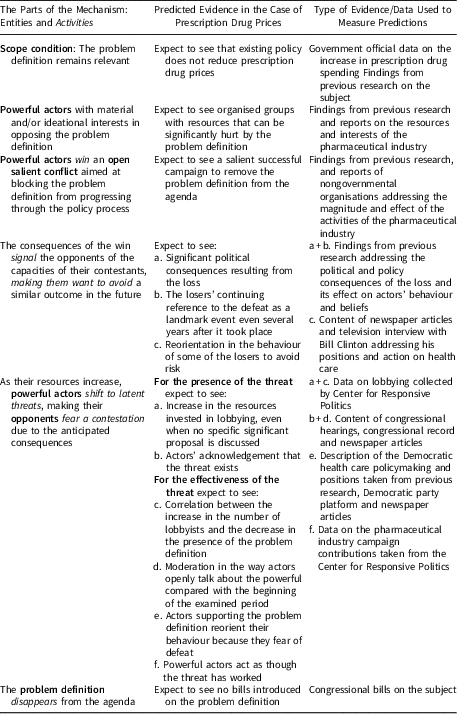
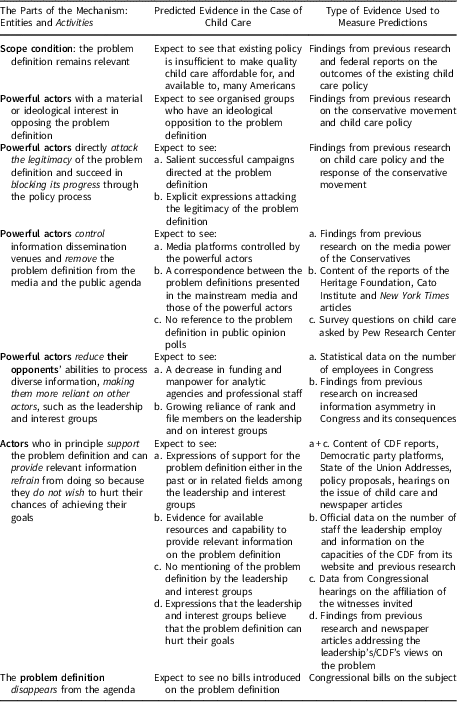
To identify the presence of latent power mechanisms, I did theory testing process tracing (Beach and Pedersen Reference Beach and Pedersen2013). The process tracing is built on three main stages, as identified by Beach and Pedersen (Reference Beach and Pedersen2017). The first stage is theorising the entities (the factors in the mechanisms) and activities (the procedures the factors engage in to promote change through the mechanism) of each part of the mechanism. This stage was conducted based on the existing theory and especially based on the study by Pierson (Reference Pierson2015). The second step was operationalising the observable manifestations of each part of the process based on the question as to what empirical fingerprints, if present, the entities and the activities might leave for each part of the mechanism in each specific case. This was done through an examination of a broad empirical and theoretical dataset in each case as elaborated below. The third step is justifying why the empirical data collected can act as evidence for the presence of the mechanistic part. In this step, I examined what the presence/absence of a specific piece of evidence can tell us based on the theoretical and contextual knowledge of each case, and also whether its presence can be justified by alternative explanation – specifically, that the disappearance from the agenda results from a change in the actors’ preferences and beliefs. Evidence for confirming/disconfirming the alternative explanation was also collected. Tables 1 and 2 detail the process tracing procedure and the data used for collecting the evidence in each case (based on Beach and Pedersen Reference Beach and Pedersen2013, 169).Footnote 4
Operationalisation of the anticipated reactions’ causal mechanism

Operationalisation of the information control causal mechanism
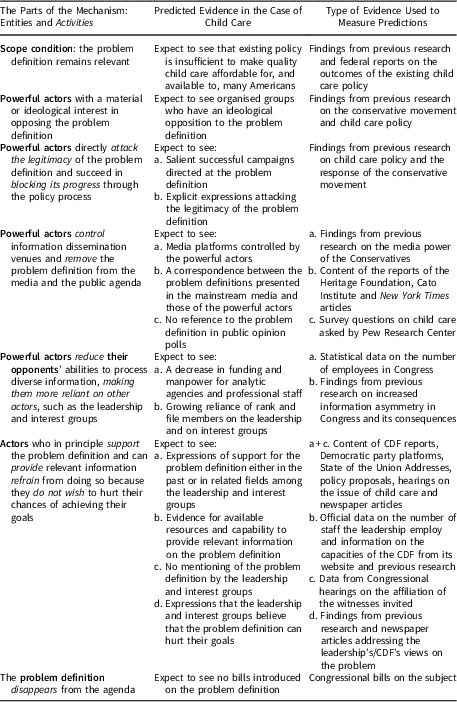
Note: CDF=Children’s Defense Fund.
Prescription drug prices
Problem definition that disappeared from the agenda
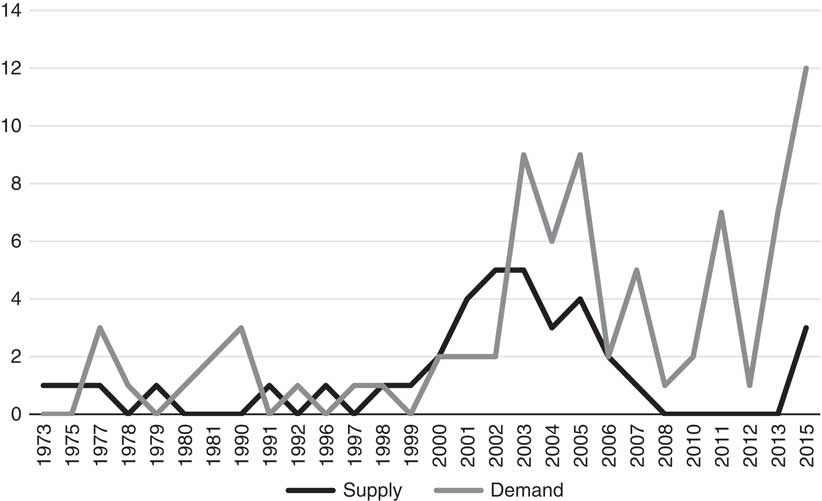
Prescription drug spending in the US is the highest among Western countries (Kesselheim et al. Reference Kesselheim, Avorn and Sarpatwari2016). The issue of prescription drug prices first appeared on the bills’ agenda in 1973, but it remained relatively low until 1999 (Oliver et al. Reference Oliver, Lee and Lipton2004). From 1973 to 2015, there were 117 bills introduced: 22 by Republicans, 93 by Democrats and two by independents. The bills contain two broad problem definitions: supply-side problems focussing on the market exclusivity of the pharmaceutical companies (N=37), such as regulations that restrict the availability of generic drugs, the patent regulation that enables the pharmaceutical industry to maintain high prices or the ban to import prescription drugs; and demand-side problems focusing on weaknesses of the consumers (N=80), such as insufficient information, and the ban on the Secretary of Health or states to negotiate lower prices for Medicare or Medicaid beneficiaries. Figure 1 demonstrates the formal agenda of problem definitions. It shows that, although between 1999 and 2002 the supply problem definition was dominant, its dominance gradually decreased, until it disappeared from the formal agenda in 2008. Despite its reappearance in 2015, it remained marginal (only 20% of the bills introduced in 2015 addressed the supply-side problem).
Bills on prescription drug prices, by problem definition.
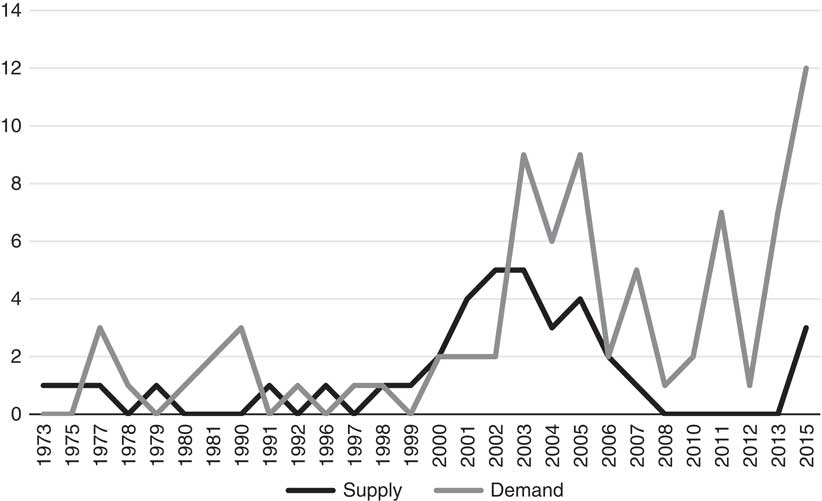
This disappearance was not because the demand-side problem became irrelevant. From 2008, expenditure on prescription drugs continued to rise, especially after 2013, owing to the approval of several new brand-name drugs (CMS 2016; Schumock et al. Reference Schumock2017). The main factor for the high prices of prescription drugs in the US is the market exclusivity enjoyed by pharmaceutical companies, which is protected by monopoly rights awarded by Food and Drug Administration approval, patents and various regulations limiting the availability of generic drugs (Angell Reference Angell2005; Kesselheim et al. Reference Kesselheim, Avorn and Sarpatwari2016). The disappearance was also not because the demand-side problem became more pressing. On the contrary, most of the issues addressed under the demand-side problem were already solved in the 2003 legislation (Morgan and Campbell Reference Morgan and Campbell2011).
Powerful actors signal their capabilities
The most powerful group in the field of prescription drug prices, and the one with the highest stake in the issue, is the pharmaceutical industry (herein after the industry). This industry is one of the most profitable industries in the US (Angell Reference Angell2005). For several decades, it has blocked any attempt to limit its monopolistic power (Oliver et al. Reference Oliver, Lee and Lipton2004). Although both demand- and supply-side problems affect its activities, the supply-side problem is more consequential, as it not only reduces drug prices but also limits its monopoly.
From the beginning of the 1990s, the industry significantly increased its spending on lobbying. Moreover, it became one of the interest groups with the biggest share of revolving door lobbyists (lobbyists who held previous positions in government). The share of revolvers is among the few variables that was found to systematically predict a group’s success in achieving their goals (Baumgartner et al. Reference Baumgartner, Berry, Hojnacki, Kimball and Leech2009). This is because revolvers not only have ties to policymakers but also have knowledge of the policy-making process behind the scenes, which provides them with leverage when trying to monitor and prevent risky initiatives from arising on the agenda (LaPira and Thomas Reference LaPira and Thomas2014). In addition, the industry significantly increased its campaign contributions to members of Congress and its funding to campaigns addressing specific legislative proposals (The Center for Public Integrity 1994).
In 1993, the industry (along with other organisations) invested an unprecedented amount of resources in lobbying, contributions and campaigns to block Bill Clinton’s health care reform, which included a provision for setting a committee to examine prescription drug prices and promoted the use of generic drugs (The Center for Public Integrity 1994; Angell Reference Angell2005). The extensive lobbying and contributions put significant pressure on members of Congress. In addition, the public campaign was believed to reduce public support for the reform, and as a consequence for the Democratic Party. The outcome was especially consequential. The reform was killed before even making it to the floor. Following the failure, the Democrats lost their majority in the 1994 elections, a loss that continued until 2006 (Hacker and Skocpol Reference Hacker and Skocpol1997; Hacker Reference Hacker2010).
The 1993 failure led the Democrats to consider any support for future health care initiatives carefully. It became a “blueprint of what not to do in health reform” (Oberlander Reference Oberlander2010, 113), and it was a reference point for calculating risks and designing the political strategy even in 2009 (Skocpol Reference Skocpol1997; Hacker Reference Hacker2010; Kingdon Reference Kingdon2011). As a consequence, despite fiercely attacking the industry in 1992 (The Center for Public Integrity 1994), and without changing his preferences on health care (Gupta Reference Gupta2009), Bill Clinton reoriented his behaviour. In 1999, he did not include price control in his initiative to add prescription drug coverage to Medicare (Oliver et al. Reference Oliver, Lee and Lipton2004), and in 2000 he killed a Democratic bill to allow drug importation (Pear Reference Pear2000).
Shifting to latent threats
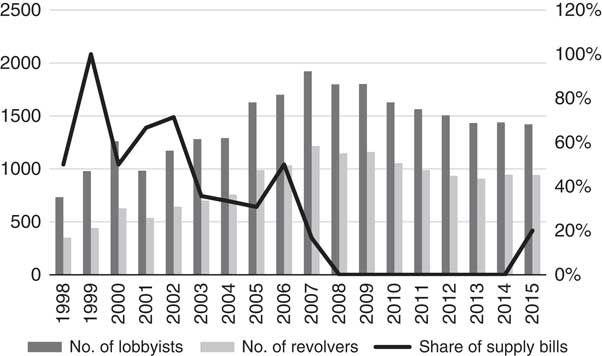
In 2003, the industry decided to shift its efforts from visible campaigns to lobbying aimed mostly at preventing drug importation or price regulation (Pear Reference Pear2003; United States Congress 2003). It increased its lobbying resources from $158 million in 2002 to $240 million in 2015, and the number of lobbyists grew from 1,172 in 2002 to 1,421 in 2015. There was also an increase in the number and share of revolving door lobbyists, from 643 in 2002 (55% of the industry’s lobbyists) to 943 in 2015 (66% of the industry’s lobbyists) (www.opensecrets.org).
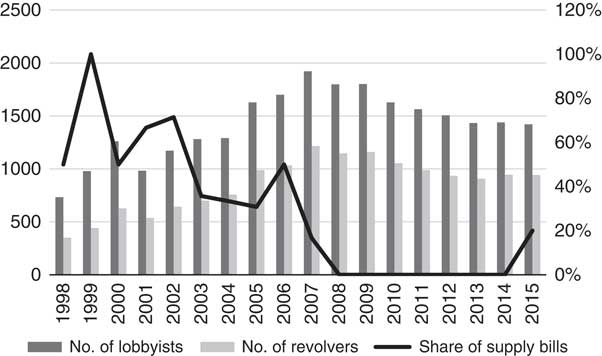
The increase in the resources invested in lobbying took place during 2003–2008, when no specific proposal was on the table. The most significant increase was in 2007, right before the supply-side problem definition disappeared from the agenda. Figure 2 demonstrates that as the number of lobbyists and revolvers increased, the share of supply-side bills decreased. This can be explained by the fact that interest groups invest in lobbying even when there is no specific policy on the agenda, in order to protect themselves from potential damage (in this case, a decrease in monopolistic power). In such a case, the role of lobbyists is constantly to monitor policymakers and to persuade them not to promote any initiative that will hurt their clients. The more lobbyists there are, the better they can monitor policymaking and identify and prevent potential risks even before they arise on the formal agenda (Baumgartner et al. Reference Baumgartner, Berry, Hojnacki, Kimball and Leech2009).
Number of pharmaceutical industry revolvers and lobbyists and the share of supply-side problem bills. Source: www.opensecrets.org
Members of Congress from both parties saw the increase in the number of lobbyists as threatening (United States Congress 2003). For instance, Senator Richard Durbin (D-IL) explicitly stated that the lobby of the industry has a death grip on Congress (Pear Reference Pear2003). Of another representative, who was engaged in the issue of drug prices, it was stated that “He has had to withstand the sling and arrows of outrageous fortune by fighting the pharmaceutical companies and their lobbyists here in Washington” (Dan Bruton, R-ID; Subcommittee on Human Rights and Wellness 2003).
The threat was most likely effective. Democratic members of Congress, especially those in leadership positions, have, over time, changed the way they talk about the industry. Before 2007, members of Congress explicitly referred to the powerful lobbying and the industry’s efforts to limit any attempt to control the drug prices (Committee on Health, Education, Labor and Pensions 2004, 2005). In addition, when addressing the issue of drug prices, they directly blamed the industry and often used negative expressions, such as accusing the industry of “raping” American citizens (United States Congress 2003). From 2007, however, members of Congress stopped mentioning the industry’s lobbying. This is despite the fact that the number of lobbyists continued to increase. In addition, the direct accusations made against the industry were replaced with vague statements suggesting a need to examine the causes of the high prices (Joint Economic Committee 2008). In some cases, these vague statements were made by the same members who had directly attacked the industry a few years earlier – see, for instance, the statements made by Chuck Schumer (D-NY) in 2002 (Committee on Commerce, Science and Transportation 2002) and in 2008 (Joint Economic Committee 2008). Last, the negative tone was replaced with a more balanced discourse, such as praising the industry for its contribution to improving the health of American citizens before mentioning that there are problems (Committee on Energy and Commerce 2009).
This change in tone and discourse was not because members of Congress had changed their views. Drug importation and lowering drug prices appeared on the Democratic Party platform in 2008. In addition, in all Congressional hearings the speakers specifically mentioned that they did not see eye to eye with the industry. Thus, it is more likely that the change in tone and discourse was due to members’ desire to avoid direct confrontation with the industry.
Another indicator for the effectiveness of the threat can be seen in the Democrats’ behaviour when they wished to promote a health policy initiative. In 2009 the Democrats had majorities in both houses. However, to pass health care legislation they needed the votes of all their members. Democrats believed that the industry’s support would enable vulnerable lawmakers to vote for the reform, and that avoiding a conflict with the industry was the right thing to do in order to learn from the mistakes made by Clinton in 1993 (Hacker Reference Hacker2010; Oberlander Reference Oberlander2010). Consequently, in 2009 the Democrats reached an agreement with the industry according to which the industry would support the Obama health care reform and, in return, the reform would not include price control measures or drug importation (Hamburger Reference Hamburger2009; Norman and Karlin-Smith Reference Norman and Karlin-Smith2016).
The agreement was signed despite the fact that drug importation was part of the Democratic Party platform in 2008. Moreover, Obama, as a candidate, explicitly attacked the industry for their influence in Washington, and as a Senator voted in favour of initiatives addressing the supply-side problem (Blumenthal Reference Blumenthal2010). Hence, it is more likely that the agreement was not a result of a Democratic change in positions, and rather was more a strategic act aimed at passing the health care reform.
Last, it seems that the industry also believed that its threat was effective, as can be seen by its campaign contributions. The link between campaign contributions and influence on the policy outcome is not direct. Campaign contributions are not used to ensure a specific outcome; rather, they are used as insurance to maintain the status quo and to keep friendly faces in the legislature. Therefore, interest groups contribute to those who already share their goals, or to those who the contributors believe are not going to hurt their interests (Baumgartner et al. Reference Baumgartner, Berry, Hojnacki, Kimball and Leech2014). The contributions thus do not buy influence, they buy stability.
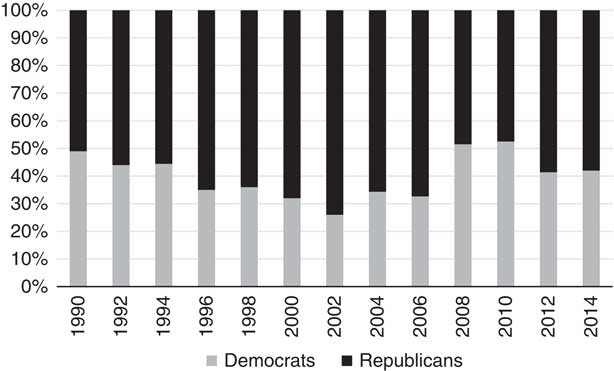
From 1990, the campaign contributions of the industry increased from more than $7 million in 1990 to more than $62 million in 2016. In 1990, the industry contributed equally to Democrats and Republicans. After 1996, as the industry became part of the Republican coalition (Morgan and Campbell Reference Morgan and Campbell2011), this changed, and it contributed to average 60% to Republicans and only 40% to Democrats. This distribution peaked in 2002, when the Democrats received only 26% of contributions. In 2008 and 2010, the situation flipped: the Democrats received 51% of contributions. In later election campaigns, their share dropped, but still remained high compared with the 1990s, receiving about 42% of the contributions (see Figure 3).
Pharmaceutical industry – share of campaign contributions (by party). Source: www.opensecrets.org
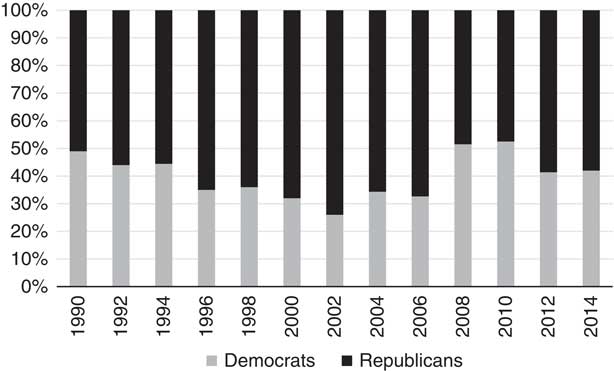
The increase in campaign contributions given to Democratic candidates took place right before the supply-side problem definition disappeared from the agenda. Thus, it is likely that the industry contributed to the Democrats when it already believed they would not hurt its interests, and the aim of continuing contributions was to keep things that way. As the Democrats did not share the industry’s goals, the industry’s belief was most likely based on the effective latent threat.
Child care
Problem definitions that have disappeared from the agenda
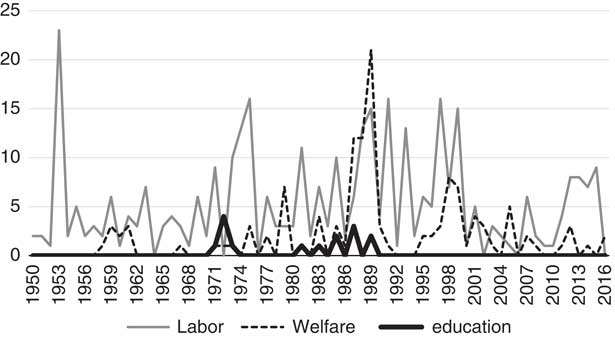
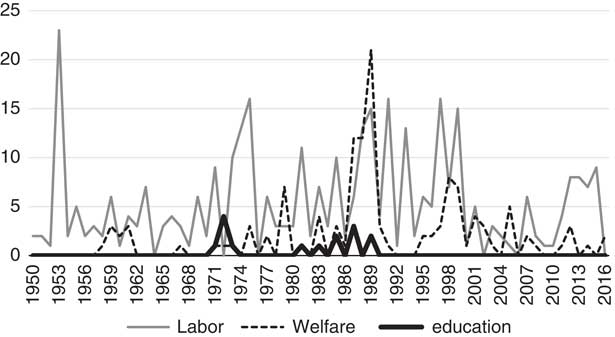
Child care refers to care for children under the age of five by someone other than their parents (Michel Reference Michel2000). From 1950, 501 bills on the issue of child care were introduced: 189 by Republicans and 312 by Democrats. All the bills aimed at addressing the broad goal of making quality child care more available and affordable. The problem definitions referred to the way policymakers understand child care – first, as education (N=15): child care is an extension of elementary education, part of child development and as such should be seen as an entitlement. The proposed solution is some form of a comprehensive federally funded child care system targeted at all children under the age of five. Second, as welfare (N=129): child care is part of broader welfare policy as the provision of child care is essential to enable low-income families or welfare recipients to become self-reliant. The policy proposed is some type of subsidy for child care given to welfare dependents and/or low-income families. Third, as labour (N=357): child care is a necessary expense for work. The policy proposed is tax exemptions for either parents or employers to compensate for the high cost of child care.
Figure 4 demonstrates the formal agenda of child care problem definitions. It shows that the education problem definition disappeared from the agenda in 1990. Note that, although a small number of bills on the education problem definition was introduced during the examined period, this was the dominant problem definition in 1971–1972. Moreover, this problem definition almost prevailed, when in 1971 bipartisan legislation on a comprehensive federally funded child care system passed both houses of Congress. However, the bill was vetoed by President Nixon (Solomon-Cohen Reference Solomon-Cohen2001).
Bills on child care, by problem definition.
The education problem definition is no longer on the agenda, despite the fact that policies addressing the welfare problem definition (the Child Care and Development Block Grants program, which provides child care subsidies to states) and the labour problem definition (tax exemptions) are insufficient to address the need for high-quality, affordable child care. Only 17% of children from low-income families who are eligible for some kind of child care subsidy actually receive it. The tax exemptions assist mostly high-income families, and in most states child care costs more than 10% of the median income, making it unaffordable for many. Last, much child care is unregulated (Levy and Michel Reference Levy and Michel2002; Laughlin Reference Laughlin2013; Congressional Research Service 2015; Office of the Assistant Secretary for Planning and Evaluation 2015). All this led to growing public discontent with the situation, which encouraged presidents and presidential candidates to place child care on their agenda (Clinton Reference Clinton1999; Obama Reference Obama2015; Clinton Reference Clinton2016; Trump Reference Trump2016).
Powerful actors directly attack the legitimacy of the problem definition
The objection to defining child care as an educational issue was mostly ideological and came from the conservative movement. Conservatives objected to government expansion and what they saw as an intervention in families’ lives. In 1971, they were not powerful enough to prevent the bill on universal, comprehensive child care system from passing Congress, but they did succeed in convincing President Nixon to veto it (Morgan Reference Morgan2001; Solomon-Cohen Reference Solomon-Cohen2001). The Conservative Pat Buchanan, who then worked as an advisor to President Nixon, admitted that the aim of the presidential veto was not to kill a specific piece of legislation, but rather to bury the idea of federally funded child care forever, by making it seem radical and politically risky (Badger Reference Badger2014).
After 1971, conservatives continued objecting to the education problem definition by launching campaigns that attacked any bill that saw child care as an educational issue, emphasising the negative implications of government intervention in the choices and well-being of families. The campaigns were successful. They not only stopped the bills from progressing through the legislative process but also made child care as an educational issue seem like a radical social policy. This significantly reduced the number of members of Congress who were willing to advocate for suggestions to establish a universal child care system (Morgan Reference Morgan2001; Solomon-Cohen Reference Solomon-Cohen2001).
Powerful actors take over information dissemination venues
The power of the conservative movement increased after 1980, and by the mid-1990s it was a powerful group within the Republican party, shifting the party more to the right (Zelizer Reference Zelizer2007). One venue that enabled conservatives to spread their ideas and gain power was the media. Conservatives gradually succeeded in building a type of media empire that is strongly ideological, composed of local and national newspapers, TV stations such as Fox News and radio shows. This has enabled them to control the information many Americans are receiving (Hacker and Pierson Reference Hacker and Pierson2008; Gonzales and Delgado Reference Gonzales and Delgado2015). Moreover, the alternatives and problem definitions conservatives air in their media are often adopted by national mainstream outlets, which increases the number of Americans who are exposed to their messages (Brock Reference Brock2005). This is thanks, among other things, to conservative columnists and pundits who are prominent in nonconservative media as well (Gonzales and Delgado Reference Gonzales and Delgado2015). In general, conservatives have been better than liberals at marketing their ideas, controlling the media agenda and appealing to the public. By the mid-1980s, it seemed as if the definition of a legitimate problem definition or solution (in almost any social issue) was determined by them, regardless of whether the public believed in their ideas or not (Reich Reference Reich1990; Ricci Reference Ricci1993; Zelizer Reference Zelizer2007; Hacker and Pierson Reference Hacker and Pierson2008).
This control of framing is also evident in the case of child care. Since the late 1980s, conservatives have set the terms of the public debate on child care, such that every time the issue arises on the agenda the problem definitions discussed in the nonconservative media are similar to those addressed by conservative think tanks – specifically, employment and welfare and the need to find the right balance between subsidies to the poor and tax exemptions (Rector Reference Rector1989; Olsen Reference Olsen1998; Riedl Reference Riedl2002). Out of 28 articles and columns published in the New York Times at the end of the 1980s, when the issue of child care was high on the agenda, only one of the earliest articles addressed the education problem definition (Brozan Reference Brozan1987). The rest echoed the debate between subsidies and tax exemptions (Passell Reference Passell1988; Salmans Reference Salmans1989). At the end of the 1990s, when Bill Clinton introduced his child care initiative, there was not even one article on the education problem definition, and this was also the case during the 2016 election campaign. Correspondingly, when public opinion polls took place on child care, the education problem definition was not addressed. For instance, Pew Research Center has asked 75 questions on child care from 1988 until the present, none of which address the education problem definition, although some address specific policy questions, such as an increase in subsidies for low-income families or expansion of tax exemptions (www.pewresearch.org).
Powerful actors reduce policymakers’ analytic capacities
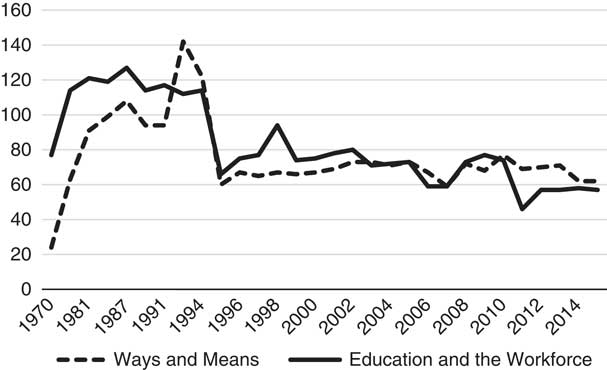
In 1994 the Republicans won the majority in both houses. Following their win, they cut funding for congressional analytical bodies (such as the Congressional Research Service and the Government Accountability Office), as well as for the congressional committees (Baumgartner and Jones Reference Baumgartner and Jones2015). The number of employees in the analytic bodies decreased from 6,499 in 1977 to 3,833 in 2015, with the most significant decrease taking place in the Government Accountability Office, the agency in charge among other things of making policy analysis. The number of committee staff decreased from 3,437 in 1979 to 2,115 in 2015 (Brookings 2018). This decrease is also evident in the congressional committees in charge of child care, especially in the House, as seen in Figure 5.
Number of staff members in House committees handling child care issues. Source: Brookings (2018).
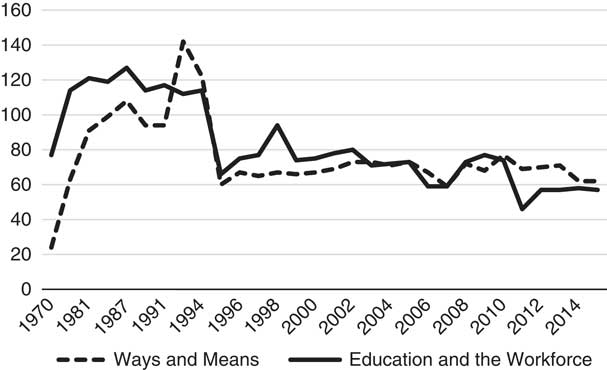
All of this decreased Congress’s analytic capacity and created an increased asymmetry in the ability to collect, sort and analyse information, making the rank and file members more reliant on information from the leadership, committee chairs, interest groups and think tanks. These actors are often interested in omitting problem definitions that do not serve, or that risk, their goals (Ricci Reference Ricci1993; Baumgartner and Jones Reference Baumgartner and Jones2015; Curry Reference Curry2015).
Leadership and interest groups refrain from addressing the problem definition
The Democratic leadership, including presidents, presidential candidates and the committee chairs, have seen child care as an important issue on their agenda (Clinton Reference Clinton1999; Obama Reference Obama2015; Clinton Reference Clinton2016). They also have resources to provide relevant information, because while the number of committee staff has decreased the number of leadership staff increased from 253 in 1979 to 374 in 2015 (Brookings 2018).
Nonetheless, they have wished to address the education problem definition as little as possible, because they believe that it is seen by the public as radical or unrealistic, and therefore raising it can hurt their chances of passing a meaningful piece of legislation (Lewis Reference Lewis1990; Solomon-Cohen Reference Solomon-Cohen2001). Correspondingly, the education problem definition has not appeared on the Democratic Party platform since the 1980s, and none of the presidents or the presidential candidates have mentioned it when addressing the need for improving child care policy (The White House 1998; Obama Reference Obama2015; Clinton Reference Clinton2016). Moreover, committee chairs have also refrained from providing information on this problem definition, as can be seen in the hearings, which are an important source of information for members of Congress. By inviting certain players to testify at hearings and not others, committee chairs select what information to present and what not to (Workman and Shafran Reference Workman and Shafran2015). From 1990, none of the 20 hearings on the issue of child care has addressed the education problem definition. In addition, not a single expert on education and child development has been invited to any of the hearings.
This omission is not because the leadership believed the problem definition to be irrelevant or illegitimate. From 1971 to 1989, committee chairs held 13 hearings on the education problem definition, inviting child development and education experts. In 1990, Hilary Clinton, then a board member of the Children’s Defense Fund (CDF), wrote a letter to the where she expressed her support for universal federally funded child care (Clinton Reference Clinton1990). In addition, while ignoring the education problem definition when discussing child care for children aged 0–3, this problem definition appeared when addressing universal preschool for four-year-old children, as seen in Clinton (Reference Clinton2016), Obama (Reference Obama2015), and the 2016 Democratic Party platform.
A similar omission is evident in the information provided by the most prominent interest group in the field of child care since the mid-1970s, the CDF. The CDF drafts legislation, issues reports to inform policymakers and often is invited to testify in Congress. The CDF was the leading organisation when the issue of child care arose on the agenda during the 1980s (Solomon-Cohen Reference Solomon-Cohen2001). At that time, it decided to refrain from addressing the education problem definition because it believed it would be impossible to do so, and that it could hurt the chances of passing meaningful legislation (Brozan Reference Brozan1987; Solomon-Cohen Reference Solomon-Cohen2001). Even then, every time it argued for more government involvement in the field, it was accused of being radical (Lewis Reference Lewis1990). Correspondingly, from the 1990s, no CDF testimony or report has advocated universal child care. This is despite the fact that the CDF continues to advocate for universal preschool and to state that every child should receive affordable high-quality child care (www.childrensdefense.org). Without public pressure or information coming from the media, the leadership and interest groups, and with little analytic capacities, it has become very unlikely for rank and file members to address the education problem definition.
Conclusion
Schattschneider (Reference Schattschneider1960) famously claimed that the struggle over what to fight about is the most fundamental political struggle. This article has argued that, today, this struggle takes place at the realm of problem definitions, where powerful actors try to prevent certain aspects or demands from arising on the formal agenda. In order to overcome the difficulty of studying nondecisions without relying on previous knowledge or subjective judgement, this article has suggested studying problem definitions that were once on the formal agenda and then disappeared from it.
Problem definitions that have disappeared from the agenda can be termed nondecisions when they disappeared despite addressing a relevant problem; when there are powerful actors with an interest in their disappearance; and when that disappearance was the result of latent power mechanisms, such as those responsible for problem definitions that never made it to the formal agenda.
For the examination of this argument, the article presented two case studies – prescription drug prices and child care – each representing a different power mechanism. In the case of prescription drug prices, the industry used its power to prevent Democratic members of Congress from addressing the supply-side problem definition. It did so first by signalling to policymakers, through open contestation, how consequential any attempt to try and break their monopolistic power could be. Once they gained more power they moved to a latent threat, making sure that the industry’s watchful eyes would continue to remind members of Congress of the possible negative consequences of any attempt to act against the industry’s interests.
In the case of child care, conservatives used their control over information dissemination venues to affect the problem definitions that appeared in the media and the public agenda. In addition, they decreased Congress’s analytic capacities to process diverse information. Following this, Democratic rank and file members became more dependent on the leadership and on interest groups. The latter, in turn, refrained from providing information on the education problem definition, believing that this would be risky. In the absence of information, rank and file members did not introduce any bills on the subject, and the problem definition disappeared from the agenda.
Although the actors discussed in the two cases have already been identified by previous research as powerful, this article focussed on the importance of the second face of power. Specifically, the two cases reveal the actors’ ability not only to block or promote change but also to set the terms of the debate, so that unfavourable issues will not be discussed.
Focussing on problem definitions that have disappeared from the agenda helps us uncover the predecisional process and understand policy outcomes – specifically, how, despite its relevance, a problem definition is not addressed. This article has also contributed to a better understanding of the politics of problem definition and issue framing. It has demonstrated that actors struggle not only over what definition will become dominant but also over removing unfavourable definitions from the agenda. For the long term, the latter might be no less consequential.
Although the article has demonstrated the power mechanism in a US setting, the findings are also applicable to parliamentary democracies as well. Recent research on lobbying and interest groups comparing Europe and the US found many points of convergence between the tactics and effects on both sides of the Atlantic (Mahoney Reference Mahoney2008). As for the information control mechanism, various works on European policy, especially (but not exclusively) economic policy, demonstrate how powerful actors prevent new alternatives from arising on the agenda. They do so by controlling the information provided to the public and thepolicymakers, either by virtue of their expertise or because of their control over the media (Blyth Reference Blyth2013; Schmidt and Thatcher Reference Schmidt and Thatcher2013; Carstensen and Schmidt Reference Carstensen and Schmidt2016; Seabrooke and Wigan Reference Seabrooke and Wigan2016).
This article focussed on two salient issues on the agenda and on nondecisions taking place in the legislature. Yet nondecisions also exist, and perhaps exist even more, in relation to issues that are less salient, where the policy-making process takes place away from the public eye, as well as in other venues, such as the courts or the bureaucracy. Further research should examine to what extent the two power mechanisms identified are present in less salient issues and in other venues. Last, given the dynamics of the policy agenda, future studies should also examine what distorts power mechanisms, allowing issues to arise once again on the agenda. Answering these questions will provide a more comprehensive understanding of the predecisional process, and, more generally, agenda-setting.
Acknowledgement
The author would like to thank Maraam Dwidar, the editor and the two anonymous reviewers for their useful comments and suggestions.