The present study investigates cross-situational word learning in school-age foreign language (FL) learners. Further, it takes an individual difference framework, exploring learner variables that may affect cross-situational learning in school-age FL learners. FL learners constantly encounter ambiguous situations (Ely, Reference Ely1989). Ambiguity can occur in many aspects of a linguistic message, including sound pattern, word boundary, and/or word meaning. Current pedagogical trends emphasize contextualized vocabulary learning in nonostensive contexts where words are mentioned but not directly taught. Not all input needs to be comprehensible (White, Reference White1987). There are occasions when novel words are mentioned but not explicitly taught, rendering ambiguity in form to meaning mappings, such as listening to stories, shared book reading, watching videos, or following directions in the classroom. In those ambiguous occasions, even when a word form is appropriately chunked from the continuous speech stream and encoded, a FL learner may still encounter multiple possible referents for that word. For example, during shared storybook reading, young FL leaners may hear a novel word in a picture that depicts several objects that they cannot name yet. While FL learners nowadays have a greater chance to learn words in a variety of nonostensive contexts, not much is known about how FL learners resolve referential ambiguity and what learner variables are associated with their ability to disambiguate a word's meaning.
Children's ability to make informed guesses about a word's meaning in referentially ambiguous situations has been widely discussed and investigated in studies of first language (L1) acquisition. When the situation is highly constrained, for example, when there is only one name-unknown object, children seem to circumvent the problem of referential indeterminacy with some built-in biases. They are more likely to map a novel name onto an object for which they do not have a label than an object for which they already have a name (e.g., Au & Glusman, Reference Au and Glusman1990; Golinkoff, Hirsh-Pasek, Bailey, & Wenger, Reference Golinkoff, Hirsh-Pasek, Bailey and Wenger1992; Golinkoff, Mervis, & Hirsh-Pasek, Reference Golinkoff, Mervis and Hirsh-Pasek1994; Markman & Wachtel, Reference Markman and Wachtel1988; Merriman & Bowman, Reference Merriman and Bowman1989). Such lexical biases have been consistently demonstrated in L1 children and are considered robust and fundamental in learning early L1 words (de Marchena, Eigsti, Worek, Ono, & Snedeker, Reference de Marchena, Eigsti, Worek, Ono and Snedeker2011; Golinkoff et al., Reference Golinkoff, Hirsh-Pasek, Bailey and Wenger1992). This pattern of responses has been replicated in children learning a nonnative language (e.g., Davidson & Tell, Reference Davidson and Tell2005; Hu, Reference Hu2012; Kan & Kohnert, Reference Kan and Kohnert2008; Wilkinson & Mazzitelli, Reference Wilkinson and Mazzitelli2003). For example, Hu (Reference Hu2012) found that when hearing a novel FL word in the presence of three objects, two name-known and one name-unknown, fourth-grade FL learners selected the name-unknown object as a referent for the novel word over 97% of the time. Nevertheless, the above learning condition is highly constraining, with one novel word in the presence of one name-unknown referent. Like L1 learners, FL learners also encounter situations where they hear multiple novel words in the presence of multiple name-unknown referents. Do school-age FL learners make connections between FL-sounding words and referents in those situations?
WORD MAPPING ACROSS AMBIGUOUS SITUATIONS
In recent years, researchers are interested in children's ability to sort out potential word to referent associations across multiple ambiguous situations, known as cross-situational word learning. Instead of one to one fast mapping through the application of some built-in lexical biases, the cross-situational word learning paradigm requires learners to track word-referent co-occurrence information across learning trials and evaluate co-occurrence probabilities across trials to determine the best-of-fit mappings (e.g., Scott & Fisher, Reference Scott and Fisher2012; Smith & Yu, Reference Smith and Yu2008; Vlach & Johnson, Reference Vlach and Johnson2013; Yu & Smith, Reference Yu and Smith2007). Consider a situation in which a child hears a word clamp in the presence of multiple name-unknown objects. The child cannot determine the referent of the word by applying the strategy of lexical biases. However, the child can determine the referent of the word after hearing the word clamp in multiple situations where clamp consistently co-occurs with a particular type of object. Studies on L1 learners have demonstrated that adults, children, and infants are able to determine the intended referent of a word across situations despite referential uncertainty in each situation (e.g., Smith, Smith, & Blythe, Reference Smith, Smith and Blythe2011; Suanda, Mugwanya, & Namy, Reference Suanda, Mugwanya and Namy2014; Vlach & Johnson, Reference Vlach and Johnson2013; Yu & Smith, Reference Yu and Smith2007, Reference Yu and Smith2011). There is evidence that the processes involved in cross-situational learning undergo developmental changes (Fitneva & Christiansen, Reference Fitneva and Christiansen2015; Vlach & Johnson, Reference Vlach and Johnson2013). For example, young children benefit from initial correct mappings whereas adults benefit from erroneous associations in initial trials (Fitneva & Christiansen, Reference Fitneva and Christiansen2015).
The cross-situational learning paradigm has rarely been investigated in school-age FL learners probably due to the assumption that in FL classrooms, the referent of a word is explicitly and directly pointed out by teachers. This assumption does not hold because many FL classrooms in today's world involve activities that do not strictly control language. Can school-age FL learners discover a word's referent by tracking FL-sounding words and ambiguous referents across situations? Cross-situational FL word learning can be seen as consisting of two steps. First, FL learners encode heard FL words in the presence of multiple potential referents. The encoding process can be highly demanding even for a single novel word because a FL-sounding word can be obscure in all aspects of phonological features, including overall word and syllabic shapes, segmental details, and articulatory gestures. Efficient encoding may depend, to a substantial extent, on the learners’ sensitivity to the sound structure of the language (Hu & Schuele, Reference Hu and Schuele2005). Second, FL learners have to carry the word forms, partially or completely encoded, from one situation to the next situation so that they can accumulate and compare information across situations and discover the correct referents of the heard words. Thus, the encoded forms have to be durable and recognizable as the same forms when they are heard again across situations. The two steps may occur simultaneously or sequentially and may interfere with each other. For example, tracking information encoded in a previous learning event may be disrupted when one attempts to encode a newer word in the current situation. Thus, the task of tracking multiple ambiguous mappings across situations, plus the difficulties in encoding FL forms on the fly, may tax young FL learners’ memory resources to such an extent that they may not actively and effectively resolve ambiguity in word-referent mappings and may even ignore the FL forms that are referentially ambiguous.
Studies on cross-situational word learning have proposed several mechanisms to account for how L1 learners discover referents for words across multiple ambiguous situations. While these mechanisms revealed the nature of cross-situational word learning in L1 learners, they generally do not consider the additional difficulties FL learners may face in encoding novel FL-sounding forms. According to the associative learning account (Smith & Yu, Reference Smith and Yu2008; Vouloumanos, Reference Vouloumanos2008; Yu & Smith, Reference Yu and Smith2007), when encountering multiple novel words with referential indeterminacy, learners track and maintain multiple hypotheses about the meanings of the words until sufficient information from subsequent encounters confirms or disconfirms the hypotheses. According to the hypothesis testing account (Medina, Snedeker, Trueswell, & Gleitman, Reference Medina, Snedeker, Trueswell and Gleitman2011; Trueswell, Medina, Hafri, & Gleitman, Reference Trueswell, Medina, Hafri and Gleitman2013), learners attend to one form at a time and do not attempt a second hypothesis until the first hypothesis is verified (Medina et al., Reference Medina, Snedeker, Trueswell and Gleitman2011). The debate is similar to the debate about delayed and immediate decisions made in syntactic parsing (Carroll, Reference Carroll2008). Whether by entertaining one or multiple associations at a time, mapping new words onto referents across time is a difficult task due to the uncertainty in every learning trial. In addition to the uncertainty in word-referent mappings, FL leaners face another challenge, namely, efficiently encoding FL forms into durable and recognizable representations that allow comparison across time. Given the double difficulties, FL learners may experience total failure in cross-situational word learning. In that case, cross-situational word learning is not a realistic mechanism in FL acquisition. Thus, the first goal of the study is to examine FL learners’ capacity of resolving referential ambiguity cross-situationally.
LEARNER VARIABLES
Another goal of the study is to identify individual learner variables that may affect FL cross-situational word learning. It follows from the above discussion that some aspects of individual differences, such as phonological awareness and memory span, may be associated with school-age FL learners’ capacity for cross-situational learning. Phonological awareness refers to the awareness of the phonological composition of a spoken word. It is a universal predictor of reading abilities across alphabetic orthographies (Ziegler et al., Reference Ziegler, Bertrand, Tóth, Csépe, Reis, Faísca and Blomert2010) and may also play a nontrivial role in learning to read a nonalphabetic orthography (Hu, Reference Hu2013; Newman, Tardif, Huang, & Shu, Reference Newman, Tardif, Huang and Shu2011). In addition to reading, children with weakness in phonological awareness exhibit difficulties encoding phonological details for novel words in another language, whether in ostensive or nonostensive contexts (de Jong, Seveke, & van Veen, Reference de Jong, Seveke and van Veen2000; Hu, Reference Hu2012; Hu & Schuele, Reference Hu and Schuele2005; McBride-Chang, Cheung, Chow, Chow, & Choi, Reference McBride-Chang, Cheung, Chow, Chow and Choi2006; Palladino & Ferrari, Reference Palladino and Ferrari2008). With reduced sensitivity to the phonological structure of a language, they demonstrate reduced capacity to extract recurring phonological patterns from input to support word learning (Hu, Reference Hu2014). Sensitivity to the phonological composition of a word may also affect cross-situational learning. Escudero, Mulak, and Vlach (Reference Escudero, Mulak and Vlach2015) found that adult learners had greater difficulty learning vowel minimal pairs (e.g., deet–det) than nonminimal pairs (e.g., deet–bon) or consonant minimal pairs (e.g., bon–ton).
Another relevant learner variable is memory span. Memory capacity has been shown to be associated with FL learning difficulties (Palladino & Ferrari, Reference Palladino and Ferrari2008). It plays a constraining role when learning involves aggregating and comparing information over learning events and has been discussed in many published studies of cross-situational learning (e.g., Kachergis, Yu, & Shiffrin, Reference Kachergis, Yu and Shiffrin2013; Medina et al., Reference Medina, Snedeker, Trueswell and Gleitman2011; Smith et al., Reference Smith, Smith and Blythe2011; Trueswell et al., Reference Trueswell, Medina, Hafri and Gleitman2013; Vlach & Johnson, Reference Vlach and Johnson2013; Yurovsky, Yu, & Smith, Reference Yurovsky, Yu and Smith2013). Children with better memory capacity are expected to find word mapping across multiple ambiguous situations easier whether they hypothesize about a word's meaning at one time (Medina et al., Reference Medina, Snedeker, Trueswell and Gleitman2011) or track and store all the possible referents until they discover the correct mapping (Yu & Smith, Reference Yu and Smith2007).
THE CURRENT STUDY
With two experiments, the study explored situational disambiguation skills in school-age FL learners and the learner variables that might contribute to individual differences in such learning. In both experiments, learners’ differences in memory span and phonological awareness were measured. Experiment 1 investigated whether school-age FL learners were capable of mapping heard words onto their referents across ambiguous trials as opposed to nonambiguous trials. After establishing that school-age FL learners were capable of word mapping across multiple ambiguous situations but the overall learning was low, Experiment 2 replicated the first experiment and further investigated whether structuring the input into temporally contiguous trials facilitated mapping performance. Previous studies have shown that L1 learners demonstrate better mapping performance when some of the word-referent pairs appear in successive trials (Kachergis, Yu, & Shiffrin, Reference Kachergis, Yu and Shiffrin2013; Vlach & Johnson, Reference Vlach and Johnson2013). It is thus interesting to see whether FL learners would benefit from experiencing consecutive encounters with FL words in cross-situational learning. In typical FL settings, children are more likely to hear a novel word a number of times before hearing other novel words. For example, listening to the story Seven Blind Mice, FL learners will hear the novel animal name “mouse” on successive pages, each in conjunction with another novel animal name.
It is worth noting that in order to evaluate word mapping in a more realistic setting, the target words were not presented in isolation as in the traditional cross-situational paradigm. Instead, the target words appeared in multiword, comprehensible utterances, which helped narrow down the potential referents of a novel word. In FL classrooms, learners are unlikely to encounter multiple novel words with multiple ambiguous referents without any contextual support or without any direct and explicit instruction.
EXPERIMENT 1
Third-grade FL learners were randomly assigned to two word-mapping conditions: contrastive and noncontrastive. The two conditions were equivalent in terms of the total occurrences of each target word but differed in within-trial ambiguity. In the contrastive condition, children could determine word referents within a trial by resorting to lexical biases of mutual exclusivity or mapping a novel word to a nameless category. In the noncontrastive condition, children could not determine word referents unless they aggregated information across trials. Across trials, each novel word co-occurred consistently with only one referent. It was not clear whether FL learners would demonstrate any learning in the noncontrastive condition. It was also unclear which condition would result in better word mapping performance. FL learners should intuitively demonstrate inferior mapping performance in the more ambiguous, noncontrastive condition when compared with the contrastive condition. However, it was also possible that the ambiguity in the noncontrastive condition might result in better retention as it required sustained attention to form-referent pairings over the learning trials, leading to elaborate and durable memory encoding (Vlach & Sandhofer, Reference Vlach, Sandhofer, Ohlsson and Catrambone2010, Reference Vlach and Sandhofer2014).
Method
Participants
The participants were 120 third-grade Mandarin-speaking students recruited from six classes of an elementary school. The mean age of the children was 8 years 10 months. These students had received formal instruction of English as FL since Grade 1, with two 40-min classes per week. Third grade was considered as the earliest point of development at which the FL learners were able to understand the carrier sentences in the present study. The students were not reported to have any evidence of neurological damage, emotional problems, sensory deficits, or history of articulation/language impairments. All the participants had permission for participation from parents. The participants were randomly assigned to two learning conditions (N = 60 for each condition). The two groups of participants did not differ in general receptive vocabulary of English measured by a standardized vocabulary test, the Peabody Picture Vocabulary Test, t (118) = 0.45, p > .05.
Learner variables
PHONOLOGICAL AWARENESS
Phonological awareness was measured in children's FL (English) and L1 (Mandarin Chinese). FL phonological awareness was composed of two subtests: oddity and deletion. The two subtests probed into the two essential aspects of phonological awareness, sound categorization (sound oddity) and phoneme segmentation (deletion), and have been successfully used in Mandarin-speaking children (e.g., Chen et al., Reference Chen, Anderson, Li, Hao, Wu and Shu2004; Hu, Reference Hu2013; Newman et al., Reference Newman, Tardif, Huang and Shu2011; Wang, Perfetti, & Liu, Reference Wang, Perfetti and Liu2005). Sound oddity required the child to choose from three monosyllabic consonant–vowel–consonant words the one that sounded different than the others. Half of the 16 test trials required the child to contrast the words according to the initial consonants (e.g., pin, pig, top) and the other half according to the rimes (e.g., peg, cot, leg). Deletion required the child to say English words (e.g., book) without saying the initial consonants (e.g., –ook). There were 10 trials. For each individual, a composite score of FL phonological awareness was obtained by averaging the proportional scores from English sound oddity and deletion. L1 phonological awareness was also composed of the two subtests, except that the stimuli were Chinese words. For example, the stimuli for oddity were mao2 (hair), mei2 (plum), and niou2 (cow). In deletion, the child heard a Chinese word (e.g., fang2zi5 “house”) and said what was left after removing the first sound (e.g., –ang2zi5 ). The proportional scores from Chinese sound oddity and deletion were averaged to create a composite score of L1 phonological awareness for each individual.
DIGIT SPAN
Participants’ memory capacity was measured by an auditory digit span test. The test giver read aloud lists of digits in children's L1 at a rate of one digit per second, starting with two digits and continuing by increasing one digit at a time until the participant failed in two consecutive trials in the same span length. Given that children were already highly familiar with digit names, the digit span test reflected the storage and maintenance components of children's memory capacity, independently of stimuli familiarity and phonological awareness. There were two practice trials. Span was the longest list length correctly recalled.
Word mapping
STIMULI AND DESIGN
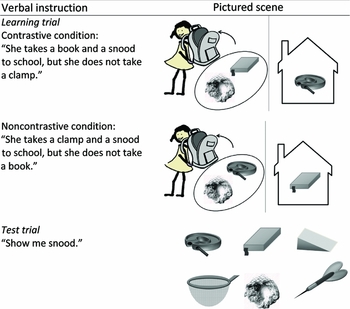
Stimuli included four words: clamp, wedge, snood, and dart. These words were chosen because they were novel to the participants, they represented concrete objects, and they were not phonologically similar to one another. There were four blocks of six learning trials each. Each learning trial consisted of two pairs of target word-referent associations. Each target word-referent association appeared three times in each block. Participants heard a story about some kids taking two items to school and leaving one at home. In the contrastive condition, the two word-referent pairs in each trial were contrasted: one was described as an item taken to school and the other as the item left at home. In the noncontrastive condition, the two word-referent pairs referred to the two items taken to school.
For each trial, the target words were embedded in a carrier sentence. The carrier sentence was “He/she takes an X and a Y to school, but he/she does not take a Z.” The three slots X, Y, and Z were filled in with two target words and one familiar word (e.g., book, pen, or dog). A pictured scene was simultaneously presented with the carrier sentence. As shown in Figure 1, the items taken to school were displayed on one side and the item left at home on the other. The referent locations for X and Y (left or right) and the order of the labels (first or second) were counterbalanced across the learning trials in both conditions.
Sample stimuli for the two conditions in Experiment 1. The object pictures were redrawn for illustration. The layout and the arrangement of the objects are identical to the stimuli used in the study.

In the contrastive condition, the target words were mentioned in slots X (or Y) and Z. Given that only one target word referred to one nameless object in the schoolbag, the referent of the target word was determinable, in a single learning trial, by mutual exclusivity and by the contrast between what was taken to school and what was left at home. In the noncontrastive condition, the target words were mentioned in slots X and Y, with no information about which target word referred to which object in the pictured scene in a single learning trial. Thus, the two conditions varied in within-trial ambiguity with respect to form-referent mappings.
Each block was immediately followed by a referent selection test to assess children's word mapping performance. In each test, there were six test items: four target words, one familiar word, and one novel word not heard in the learning trials nor carried over into the next referent selection test (i.e., sieve, chime, whisk, knob, or tong). The novel name-unknown object in the referent selection test allowed for an examination of whether the participants had acquired some knowledge of the target words even though they failed in exact one to one mappings.
Procedure
The participants were randomly assigned to a condition (N = 60 for each condition) and were tested individually in a quiet room in the school. They were informed that they would hear a story about some students who took some items to school and left some at home each day. To familiarize the participant with the task, the test giver showed a pictured scene where a boy was on his way to school, with a book and a toy dog on one side of the scene and a pen on the other. The test giver made the comment, “He takes a book and a dog to school, but he does not take a pen.” The participant was then shown a second picture of six familiar objects, a book, a dog, a pen, a ball, a pig, and a cup, and asked to identify the three items mentioned in the sentence just heard. Following the familiarization task was the four blocks of learning, each followed by a referent selection test. In each learning trial, the participant experienced two target word-referent pairings together with one familiar word-referent pairing. The test giver presented a pictured scene and orally described the scene with a carrier sentence, where two target words, along with a familiar word, were embedded according to the designated slots of each condition. The test giver did not point to the corresponding referent.
For each block, immediately after experiencing six learning trials, the participant took a referent selection test. The participant was shown six pictures, four target objects, one familiar nameable object (e.g., book), and one novel name-unknown object not shown in the learning trials (e.g., sieve). The test giver named the objects randomly, and the participant was instructed to point to the picture just named. Children received no feedback during the test. In total, each participant took the referent selection test five times: once immediately after each of the four blocks of learning and once in a delayed test taken 15 min after the last block of learning.
Results and discussion
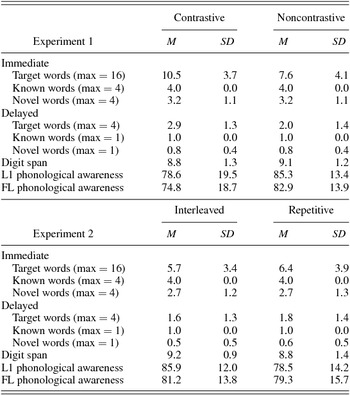
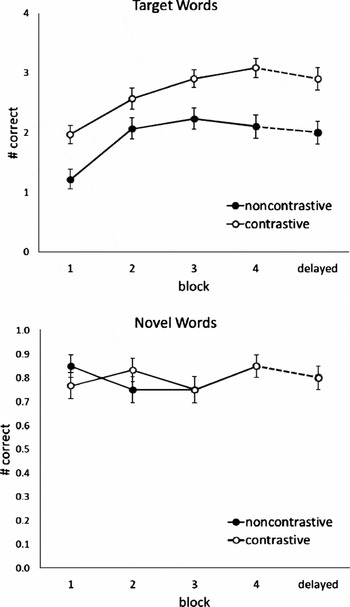
Table 1 presents the descriptive statistics of the principal variables in the study. Figure 2 displays mean accuracy scores in referent selection for each block in the noncontrastive and contrastive conditions. The results for the target words are shown in the top panel of the figure (max = 4 for each block); those for the novel words first heard in the referent selection tests are shown in the bottom panel (max = 1). Children scored perfectly for the familiar words. The two conditions were identical, except that the referents of the target words were inferable by mutual exclusivity within a trial in the contrastive condition but had to be inferred by tracking co-occurrence information across trials in the noncontrastive condition. To examine whether children demonstrated word learning in the noncontrastive condition, single-sample t tests were performed to test whether children's word mapping performance for the target words tests was above the level that would be expected from chance. The chance level was estimated to be 0.8 for the four target words. Although for each target word, there was an array of six referents (four target objects, a familiar object, and a still novel, nameless object), only five were competitors because the participants were all accurate in the selection of the familiar object. Thus, the chance level was estimated to be 0.2 (1 out 5) for each target word. The chance level for the summed score of the four target words was thus 0.8 (0.2 × 4). The results of the t tests revealed that participants performed significantly above chance in all the immediate and delayed tests of referent selection for the target words (ps < .01). These results indicate that even after one block of exposure, the FL learners were able to acquire some word-referent association from a small number of learning trials involving ambiguous referents.
Descriptive statistics of the principle variables for the two experiments

Note: L1, First language; FL, foreign language.
Mean accuracy for the noncontrastive and the contrastive conditions for the (top) target words and (bottom) novel words. Error bars show standard errors.

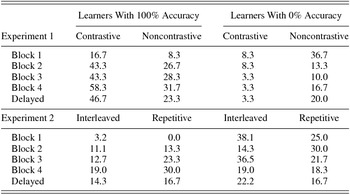
Nonetheless, resolving referential ambiguity cross-situationally appeared difficult to many school-age FL learners. As shown in Table 2, after experiencing six trials of learning in Block 1, 36.7% of the participants in the noncontrastive condition scored zero in selecting target referents, in contrast to 8.3% in the contrastive condition. In the final immediate test, there were still 16.7% of the participants in the noncontrastive condition who scored zero in selecting referents for the target words.
Percentages of learners that had 100% or 0% accuracy for all the immediate tests and the delayed test

To examine whether word mapping differed across the two conditions, scores for target referent selection were subject to a 2 × 4 analysis of variance (ANOVA) with learning condition (contrastive vs. noncontrastive) as a between-participants factor and block (1, 2, 3, 4) as a within-participants factor. The results revealed significant effects of learning condition, F (1, 118) = 16.55, p < .001, partial η2 = 0.12, and block, F (3, 354) = 25.79, p < .001, partial η2 = 0.18. There was no interaction effect, F (3, 354) = 1.20, p > .05.
To examine whether children's target word-referent mappings dropped differentially in the delayed test, children's performance for target words in the last referent selection test and the delayed test was subject to a 2 × 2 ANOVA with learning condition (contrastive vs. noncontrastive) as a between-participants factor and time (last immediate vs. delayed) as a within-participants factor. The results revealed an effect of learning condition, F (1, 118) = 15.17, p < .001, partial η2 = 0.11, but no effects of time or interaction between learning condition and time (ps > 0).
With respect to the novel words the participants had not heard in the learning trials but heard the first time in the referent selection test, the two groups of participants demonstrated a high rate of mapping accuracy (around 80%) for these words in both the immediate and the delayed tests, as shown in Figure 2. The results of a 2 × 5 ANOVA with learning condition (contrastive vs. noncontrastive) as a between-participants factor and test time (blocks 1, 2, 3, 4, and delayed) as a within-participants factor revealed that none of the effects were significant (all ps > .05).
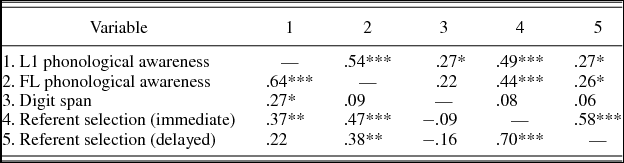
Table 3 displays the correlations between learner variables and word mapping performance in the two conditions. The referent selection scores for the immediate tests in the two tables were the scores for target words summed over the four blocks. The correlations above the diagonal are the correlations for the contrastive condition, and those below the diagonal are for the noncontrastive condition. As shown in Table 3, referent selection in the noncontrastive condition was associated with the two phonological awareness variables in the immediate tests (r = .37 and .47) and with FL phonological awareness in the delayed test (r = .38). Neither the immediate nor the delayed referent selection was correlated with digit span. A similar pattern of the correlations was found for the contrastive condition. Children's mapping performance was associated with the two phonological awareness variables both in the immediate tests (r = .49 and .44) and in the delayed test (r = .27 and .26), but not with digit span.
Intercorrelations of the principal variables for the contrastive and non-contrastive conditions for Experiment 1

Note: Correlations above the diagonal are for the contrastive condition, and correlations below the diagonal are for noncontrastive condition. L1, First language; FL, foreign language.
*p < .05. **p < .01. ***p < .001.
Overall, the results of the current experiment indicated that school-age children, as a group, were capable of resolving referential ambiguity across trials, each involving multiple ambiguous FL-sounding words. Nonetheless, introducing ambiguity within a trial posed substantial challenges to some young FL learners. A substantial portion of the participants in the noncontrastive condition (37%) scored zero in word mapping for the target words after one block of learning. Moreover, participants in the noncontrastive condition consistently performed more poorly than participants in the contrastive condition across the four blocks of learning and the delayed test. It should be noted, however, that the difficulty in word mapping did not result in more fragile representations for retention. The word mapping performance for the target words in the noncontrastive condition did not decay faster than that in the contrastive condition. In addition, the word mapping performance for the still novel word in the referent selection test was not worse in the noncontrastive condition than in the contrastive condition, indicating that children in the noncontrastive condition, though performing inferiorly in the one to one mapping, were not less able to distinguish the set of target words from the still novel word.
The most interesting finding was perhaps that the word mapping performance in the two conditions was associated with children's phonological awareness of L1 and FL, but not with the commonly proposed variable: memory span. Phonological awareness, whether measured in L1 or FL, was particularly associated with target word mapping performance not only in the immediate tests but also in the delayed tests, probably reflecting the specific demand of encoding FL sound sequences. The lack of a correlation between digit span and word mapping performance in cross-situational learning warrants explanations. Memory capacity, as measured by digit span, should have affected how much information could have been carried and aggregated from one learning trial to another. One possibility was that the current task was too demanding of memory resources of school-age FL learners.
EXPERIMENT 2
Experiment 2 served three purposes: to replicate the results regarding cross-situational word learning in Experiment 1; to examine whether structuring word-referent pairs according to temporal contiguity facilitated learning; and to see whether children's memory capacity emerged as a contributor to accounting for word mapping performance in a less demanding condition. Although young FL learners were able to learn words across situations, they showed significantly lower accuracy in mapping when the within-trial ambiguity was high. In Experiment 1, the sequence of the word-referent pairs in the noncontrastive condition was randomly determined. However, in naturalistic settings, naming events for a particular object or a particular construction are not randomly and evenly distributed but follow a Zipfian distribution (e.g., Ellis & Ferreira, Reference Ellis and Ferreira2009; Goldberg, Casenhiser, & Sethuraman, Reference Goldberg, Casenhiser and Sethuraman2004). Some words are just heard more often than others within a specific time window (Frank, Tenenbaum, & Fernald, Reference Frank, Tenenbaum and Fernald2013), due to the topic of a discourse or the focus of a story. In addition, given the time constraints in a FL class, FL teachers usually structure and manipulate FL input to maximize students’ learning. Structuring input affects different aspects of FL acquisition, for example, novel phonological contrast (Perrachione, Lee, Ha, & Wong, Reference Perrachione, Lee, Ha and Wong2011) and sentence construction (McDonough & Nekrasova-Becker, Reference McDonough and Nekrasova-Becker2012).
Experiment 2 compared the effectiveness of word mapping in two cross-situational learning conditions: repetitive and interleaved. In both conditions, participants had to infer the correct word-referent mapping by tracking co-occurrence information across trials. In the repetitive condition, initial ambiguity was reduced by presenting certain word-referent pairs in successive trials. Kachergis et al. (Reference Kachergis, Yu, Shiffrin, Taatgen, Van Rijn, Nerbonne and Schomaker2009) found that adult learners demonstrated better word mapping performance when some word-referent pairs were repeated in successive trials than when none of the pairs were repeated. Vlach and Johnson (Reference Vlach and Johnson2013) found that 16- month-old infants were capable of solving referential ambiguity for words presented in successive trials but not for words evenly distributed in time. The authors attributed infants’ failure in the evenly distributed condition to memory constraints of the infants. Given that repetition of word-referent pairs seems to reduce memory load in resolving ambiguity across multiple trials, it is interesting to see whether school-age FL learners benefit from such structuring and whether, in this less demanding cross-situational word learning task, FL learners’ memory capacity emerges as a contributor to accounting for their word mapping performance.
Method
Participants
The participants were 126 third-grade Mandarin-speaking students recruited from six classes of the same elementary school 2 years after Experiment 1. Three were absent for testing, and thus the number of students in the two conditions was not equal (N = 63 for the interleaved condition, N = 60 for the repetitive condition). All the participants had permission for participation from parents. The mean age of the children was 8 years, 10 months. The two groups of participants did not differ in general receptive vocabulary of English measured by the Peabody Picture Vocabulary Test, t (121) = 0.21, p > .05.
Learner variables
The measures of learner variables, including phonological awareness of L1 and FL and digit span, were identical to those used in Experiment 1.
Word mapping
STIMULI AND DESIGN
The target words, the manner of presentation, and the test procedure were identical to the noncontrastive condition of Experiment 1. The difference was in the manipulation of the sequence of the word-referent pairs. In the repetitive condition, two target words (e.g., A and D) appeared in three successive, adjacent trials (AB–AC–AD–BD–CD–CB) at some points during exposure. In the interleaved condition, no target words appeared in more than two successive trials (AB–CD–BD–AC–AD–CB). The first trial and the last trial of the two conditions were made equal to control the potential primacy and recency effects in word mapping performance. In both conditions, the order of the labels and the positions of the referents within a trial were randomized so that the mapping between a word and its referent was uncertain in a single trial.
Procedure
Like Experiment 1, participants were tested individually and were randomly assigned to condition. The procedure of the learning blocks and the referent selection test after each learning block were identical to those of Experiment 1. For each condition, there were four blocks of six learning trials. Each block was immediately followed by a referent selection test. After a 15-min delay, the participants took the referent selection test again. For each referent selection test, there were six test items, four target words, one familiar word, and one novel word just heard in the referent selection test.
Results and discussion
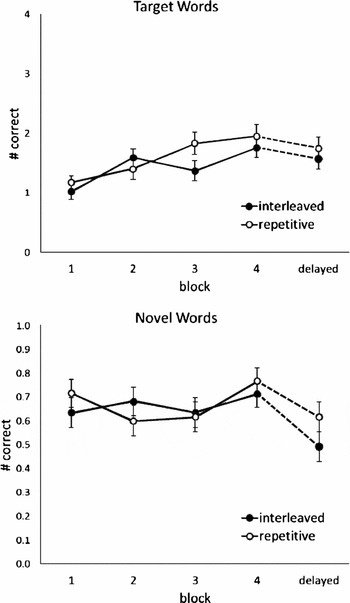
The descriptive statistics are shown in Table 1. Figure 3 displays mean accuracy scores in referent selection for each block in the interleaved and the repetitive conditions. The results for the target words are shown in the top panel (max = 4); those for the novel words first heard in the referent selection tests in the bottom panel (max = 1). Children scored perfectly for the familiar words. With the exception of the first block in the interleaved condition, t (62) = 1.67, p > .05, target referent selection for both conditions was significantly above chance in all the immediate and the delayed tests (ps < .01). Nevertheless, as in Experiment 1, there was a substantial portion of participants scoring zero after the first block of exposure to the target words in the interleaved condition (38.1%) and in the repetitive condition (25.0%). See Table 2 for the percentages of learners that had 100% or 0% accuracy for the immediate and delayed tests.
Mean accuracy by the interleaved and the repetitive conditions for the (top) target words and (bottom) novel words. Error bars show standard errors.

Children's scores in target referent selection were subject to a 2 × 4 ANOVA with learning condition (interleaved vs. repetitive) as a between-participants factor and block (1, 2, 3, 4) as a within-participants factor. The results revealed a significant effect of block, F (3, 363) = 12.09, p < .001, partial η2 = 0.09. There were no effects of learning condition, F (1, 121) = 0.90, p > .05, or interaction, F (3, 354) = 1.20, p > .05. To examine whether children's form-referent mapping dropped differentially in the delayed test, children's performance in the last immediate test and the delayed test was subject to a 2 × 2 ANOVA with learning condition (interleaved vs. repetitive) as a between-participants factor and test (last immediate, delayed) as a within-participants factor. None of the effects were significant (all ps > .05).
To further understand whether consecutive presentation affected item-based mapping performance, scores obtained from each of the two words presented in three successive trials in the repetitive condition were analyzed by a 2 × 4 ANOVA with learning condition (interleaved vs. repetitive) as a between-participants factor and block (1, 2, 3, 4) as a within-participants factor. The results revealed a significant effect of block, F (3, 363) = 5.50, p = .001, partial η2 = 0.04 for the first repeated word; F (3, 363) = 2.59, p = .05, partial η2 = 0.02 for the second repeated word. None of the effects involving learning condition were significant (ps > .05).
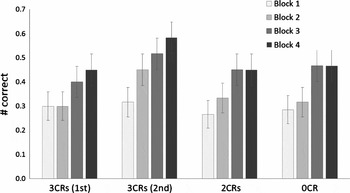
Another way to delve into the potential effect of temporal contiguity was to examine whether words with varying degrees of successive repetitions were learned at different rates. Two words in the repetition condition were presented with three consecutive repetitions in each block, one with two repetitions and one with no consecutive repetitions. Scores for the four target words in the repetitive condition were subject to a 4 × 4 ANOVA with number of repetition (first three consecutive repetitions, second three consecutive repetitions, two consecutive repetitions, and no repetitions) and block (1, 2, 3, 4) as within-participant factors. The results revealed a significant effect of block, F (3, 177) = 7.84, p < .001, partial η2 = 0.12. The effect concerning the number of repetition was only marginally significant, F (3, 177) = 2.47, p = .064. There was no interaction effect, F (9, 531) = 0.33, p > .05. Figure 4 displays the mean accuracy performance for words with varying degrees of consecutive repetitions in the repetitive condition. There is no indication that words with varying degrees of successive repetitions in the repetition condition were learned at different rates.
Mean accuracy for words with varying degrees of consecutive repetitions in the repetitive condition. Error bars show standard errors.

With respect to the novel words the participants just heard in the referent selection test, the two groups of participants demonstrated a fairly high rate of mapping accuracy (60%–70%) in the immediate tests, considering the presence of five unfamiliar and one familiar referents. The mapping accuracy for the novel word dropped slightly 15 min later in the delayed test, as shown in Figure 3. The results of a 2 × 5 ANOVA on the mapping performance of the novel words with learning condition (interleaved vs. repetitive) as a between-participants factor and test time (Blocks 1, 2, 3, 4 and delayed) as a within-participants factor revealed a significant effect of test time, F (4, 484) = 3.4, p < .01, partial η2 = 0.03. Neither of the effects involving learning condition was significant (ps > .05).
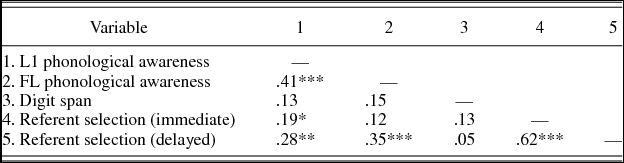
Table 4 displays intercorrelations of the principal variables for the two learning conditions. Because none of the effects involving learning condition were significant in the above analyses, scores obtained from the two learning conditions were collapsed and correlated with each other. As in Experiment 1, the scores for immediate referent selection were the scores summed over the four blocks of referent selection tests for the target words. Overall, the correlation pattern was similar to that in Experiment 1. Children's referent selection was associated with L1 phonological awareness in the immediate tests (r = .19) and with both L1 and FL phonological awareness in the delayed test (r = .28 and .35). Neither the immediate nor the delayed mapping performance was correlated with digit span.
Intercorrelations of the principal variables for the repetitive and interleaved conditions collapsed together for Experiment 2

Note: L1, First language; FL, foreign language.
*p < .05. **p < .01. ***p < .001.
The results of Experiment 2 replicated the findings of Experiment 1, showing that despite difficulties encoding FL sound sequences, school-age FL learners acquired some word-referent association when the only clues to the association were the co-occurrence information across ambiguous situations. Presenting some word-referent pairs consecutively did not seem to facilitate word mapping to any degree in school-age FL learners. None of the effects involving learning condition were significant whether the analyses were based on the target words as a whole, the individual target words repeated successively, or the still novel words in the referent selection tests.
GENERAL DISCUSSION
The present study extends earlier research on cross-situational word learning to school-age FL learners. Overall, the results of the two experiments reveal that like L1 adults and children, school-age FL learners are able to acquire word-referent mappings despite decoding difficulties and despite trial-by-trial ambiguity in the three cross-situational word learning conditions (one in Experiment 1 and two in Experiment 2). In both experiments, all the target words were referring FL words presented in FL utterances containing multiple nouns to better mimic the common practice FL learners were likely to encounter in nonostensive word learning situations. The school-age FL learners were able to map words at above-chance levels after experiencing a word three times, although from any one trial the referent was not inferable.
Such learning appeared robust against decay in time, at least for short times. First, children's mapping performance on the target words was still above the chance level in the delayed test taken 15 min after the last trial of learning in both experiments. Particularly in Experiment 1, the mapping performance in the cross-situational, noncontrastive condition did not decay to a larger extent than that in the more favorable, contrastive condition, where the participants could ascertain the referent of a target word in a single trial by resorting to lexical biases of mutual exclusivity (Markman & Wachtel, Reference Markman and Wachtel1988) or novel name to nameless category (Golinkoff et al., Reference Golinkoff, Hirsh-Pasek, Bailey and Wenger1992). Second, with respect to the novel words just heard in the referent selection test, the participants could map them onto their referents at a fairly high rate of accuracy not only after the very first block of learning but also in the delayed test. To map a just-heard novel word to its referent in the presence of four other referents for the target words, the participants had to know that the word was not one of the target words and eliminate the target referents as a possible referent for the novel word (Horst, Scott, & Pollard, Reference Horst, Scott and Pollard2010). These results suggest that the participants had acquired some knowledge of the target words and their referents even though they failed in some one to one mappings and that the knowledge was durable 15 min after learning.
Though school-age FL learners demonstrated robust learning despite trial-by-trial referential uncertainty, there was evidence that this uncertainty led to less reliable and slower learning when compared with a condition where the referent was deterministic in one trial. In Experiment 1, the major difference between the noncontrastive and the contrastive conditions was in whether referential ambiguity could be resolved in one single trial. FL learners performed consistently more inferiorly in the noncontrastive condition from the first learning block till the delayed test than in the contrastive condition. In addition to the group-level results, the advantage of decreasing within-trial referential uncertainty was also evident when we looked at individual children's performance. In the contrastive condition, only 8% of the participants failed to acquire any word-referent mapping after six trials of learning. However, 37% of the participants scored zero when the referent of a target word was not inferable in a single trial. Similarly in Experiment 2, there was a substantial portion of FL learners scoring zero after experiencing a block of cross-situational word learning (25%–38%).
Although reducing referential ambiguity within a trial facilitated word-referent mapping in school-age FL learners, reducing trial-by-trial ambiguity did not facilitate such learning. In Experiment 2, some word-referent pairs were repeated in successive trials. Theoretically, repetitive presentation of some word-referent pairs should have reduced trial-by-trial ambiguity and thus facilitated resolving mapping ambiguity across time because it allowed participants to quickly strengthen the association that had just been correctly built or verify the hypothesis just made before anything already stored faded away. However, unlike the findings from adult L1 learners (e.g., Kachergis et al., Reference Kachergis, Yu, Shiffrin, Taatgen, Van Rijn, Nerbonne and Schomaker2009), there was no evidence in the immediate or the delayed tests that such manipulation benefited FL learners in word mapping for the whole set of words or for the individual words presented in successive trials. To some extent, the null facilitative effect of repetitive presentation, coupled with the lack of correlation between mapping performance and digit span (to be discussed below), suggests that word mapping with trial-by-trial ambiguity is not a simple matter of rote memory process to young FL learners. The participants in the two conditions might have applied different approaches to resolving mapping to meaning ambiguity (Smith et al., Reference Smith, Smith and Blythe2011) even though the overall rate of success in the repetitive and the nonrepetitive (interleaved) conditions was similar. Future studies are needed to see whether successive repetition of some word-referent pairs enhances word mappings in more naturalistic contexts, for example, in the contexts where the words are the focus of a conversation or a story plot.
The present study also contributed to our understanding of individual learner variables associated with FL cross-situational word learning. Unlike L1 learners, FL learners experience another source of difficulty in mapping referentially ambiguous words, namely, in encoding and retaining FL words. A FL-sounding sequence is obscure along both the phonemic and the subphonemic dimensions at both segmental and suprasegmental levels. Consistent with the findings from previous research on the role of phonological awareness in FL word learning under ostensive instruction or in single ambiguous trials (de Jong et al., Reference de Jong, Seveke and van Veen2000; Hu, Reference Hu2012; Hu & Schuele, Reference Hu and Schuele2005; McBride-Chang et al., Reference McBride-Chang, Cheung, Chow, Chow and Choi2006; Palladino & Ferrari, Reference Palladino and Ferrari2008), the results of the present study indicate that resolving FL mapping ambiguity across situations may rely on one's sensitivity to the phonological composition of a spoken word. In the present study, FL learners with weaker phonological awareness demonstrated weaker mapping performance in the three cross-situational learning conditions as well as in the contrastive condition, not only in the immediate tests but also in the delayed tests. FL learners with weak phonological awareness relative to their peers might have built some representations with underspecified segmental details or they might have encoded spoken words solely on the basis of perceptual information without any segmental details. These impoverished representations were susceptible to disruption or degrading each time when their meanings were not yet resolved and when newer forms were added to the system. It is worth noting that in the present study, phonological awareness (whether measured in L1 or FL) is associated with target word mapping performance in both the immediate and the delayed tests. Thus, it seems that FL learners’ general sensitivity to the phonological structure of a language, as opposed to sensitivity to a specific language, contributes to encoding, representation, retention, and retrieval of FL sound sequences over the course of resolving referential ambiguity. It is worth noting that the syllable structure of the children's mother tongue, Mandarin Chinese, is relatively simple, containing only two coda consonants and no consonant clusters. Mandarin-speaking children may have particular difficulties encoding English word forms due to their limited insight into the phonological composition of words with complex syllable structure (Cheung, Chen, Lai, Wong, & Hills, Reference Cheung, Chen, Lai, Wong and Hills2001). Thus, future research may probe further into whether the pattern of the results in the present study is generalizable to other FL learners whose L1 has relatively complex syllable structure.
In contrast to phonological awareness, individual differences in memory span were not associated with word mapping performance in school-age FL learners. Caution should be taken to interpret the lack of correlations as the absence of memory processes in cross-situational word learning. The lack of correlations only suggests that FL learners with a longer memory span do not have an advantage in resolving referential ambiguity across trials. One reason for the lack of correlations may be the relatively small range of scores in the digit span. Digit span was used in the present study because unlike other memory tasks such as nonword repetition, which implicates phonological awareness and articulatory output skills (Metsala, Reference Metsala1999; Snowling, Chiat, & Hulme, Reference Snowling, Chiat and Hulme1991), digit span is a relatively simple and pure measure of memory storage capacity. Another reason for the lack of correlations may be that the cross-situational learning in the present study was too demanding of attentional resources for school-age FL learners, leaving them with too few resources available to efficiently control for the multiple possible mappings in memory. As shown in Figure 2 and Figure 3, despite the small number of words to learn (four target word-referent pairs), children in the three cross-situational conditions learned no more than two target words in each block after experiencing six learning trials. In the present study, the referents of two newly heard forms were uncertain until children heard the words in a different trial, adjacent or not. When children could not determine the referents of the two forms in the first encounter, they had to store and recall them in memory as meaningless sound-string representations and compare them with another new sound string whose reference was not yet determined either. Mapping words to meaningless pictures can be difficult, even for adult learners (Cunillera, Laine, Càmara, & Rodríguez-Fornells, Reference Cunillera, Laine, Càmara and Rodríguez-Fornells2010). It follows that retrieving, identifying, and distinguishing sound-string representations void of meaning might tax memory resources of young FL learners, rendering a lesser role of memory span in accounting for performance differences in word-referent mapping across trials.
Alternatively, young FL learners might attend to one form at a time until its reference was determined or disconfirmed (Medina et al., Reference Medina, Snedeker, Trueswell and Gleitman2011; Trueswell et al., Reference Trueswell, Medina, Hafri and Gleitman2013). They might not attend to multiple forms at a time because attending to multiple meaningless FL forms might be beyond their limits of processing. Young FL learners’ low capacity in retaining newly learned mappings was reflected by their performance in the contrastive condition. Children in the contrastive learning condition, on average, learned only two mappings after experiencing each word-referent pairing three times under a relatively low degree of referential uncertainty. If one form was attended at a time, success in such learning might rest on specification of that form rather than the amount of information stored at a time. Obviously, the above interpretations on the role of memory span are only suggestive. Further research is needed to reveal the exact contribution of memory span to individual differences in cross-situational FL word learning.
Limitations
It is important to note that the results of the present study only reveal the extent to which FL learners resolve referential ambiguity in the moment of intensive exposure to multiple novel word-referent pairings. Longitudinal research will need to investigate whether the results hold for long-term learning. On the one hand, studies on adult L1 learners have shown that learning that is initially challenging (e.g., in a situation with a higher degree of referential ambiguity) may lead to better long-term retention (Fitneva & Christiansen, Reference Fitneva and Christiansen2015; Vlach & Sandhofer, Reference Vlach and Sandhofer2014). On the other hand, referential ambiguity may interact in a complex way with other cognitive and affect factors in FL acquisition such as ambiguity tolerance, anxiety, motivation, and learning styles as well as the long interval between exposures in FL acquisition settings.
Conclusion
The evidence from the current study suggests that although school-age FL learners are able to solve ambiguity across situations like L1 learners, their vocabulary learning may need to be guided in situations where referential uncertainty is high, particularly for learners with weak phonological awareness relative to their peers. When the short-term learning effect is considered, word mapping and word retention performance can be enhanced by reducing ambiguity within a single learning trial. Reducing the ambiguity of the system without reducing the ambiguity within a single trial is not as effective in facilitating word mapping and word retention in school-age FL learners.
ACKNOWLEDGMENTS
This study was supported by grants from the National Science Council (NSC101-2410-H-845-009-MY2) and the Ministry of Science and Technology of Taiwan, Republic of China (MOST103-2410-H-845-004-MY2).